Over the weekend, crosswalk pedestrian signals in the backyard of Mark Zuckerberg and Elon Musk were hacked to play voices imitating their likeness. But they were not exactly kind to the billionaires, instead offering a commentary on the heightened polarization and distrust of the two leaders who have become more influential than ever in today’s society and Washington in particular.
In one video posted to TikTok, after the crosswalk button is pressed, it begins to say, “It’s normal to feel uncomfortable or even violated as we forcefully insert AI into every facet of your conscious experience.” It continues, “I just want to assure you, you don’t need to worry because there’s absolutely nothing you can do to stop it.”
Meta has been pushing AI heavily, inserting “Meta AI” buttons into search boxes across its apps and promoting the idea of interacting with AI characters tailored to a user’s interests in lieu of real humans. Recent surveying by YouGov found 44% of Americans are skeptical of AI over concerns ranging from invasion of personal privacy to the spread of misleading videos or deepfakes. But companies like Meta are betting that AI will enable more people to create content online and communicate with friends. (snip-MORE)
April, 16, 1971 The Internal Revenue Service (IRS) estimated over 2,000 people openly refused to pay part or all of their income tax. “If a thousand [people] were not to pay their tax bills this year, that would not be a violent and bloody measure, as it would be to pay them and enable the state to commit violence and shed innocent blood.” Henry David Thoreau on the Mexican War
April 16, 2000 Between 10,000 and 20,000 activists blockaded meetings of the World Bank and International Monetary Fund in Washington, D.C. Sitting down at intersections and locking arms to form human chains, the protesters were opposed to Bank and IMF policies that increased third-world indebtedness and did little to directly benefit the poor in those countries. “The World Bank is subjugating our economic and social independence,” Vineeta Gupta, a doctor from the Punjab in India, said in a letter he delivered to World Bank President James Wolfensohn at his home. “It is time that we shut the bank down, and this boycott is a great start.”
Let’s make one thing clear. The immigrants the Trump regime seized off the street and sent to a Salvadoran prison were NOT deported. To be deported, you have to go through due process. Immigrants who are deported usually have to face a judge. The people sent to the prison in El Salvador never faced a judge before being shipped off or received due process. They were not deported. They were kidnapped.
And this prison in El Salvador, where the president referred to himself as the “coolest” dictator, isn’t so much a prison as it is a concentration camp or a gulag.
Mona Charen wrote, “We are outsourcing torture and murder. What kind of president, what kind of political party, can look at that with satisfaction?” And what American can not at least wonder about their own security?”
Speaking to the “cool” dictator while he was visiting the White House yesterday (and you thought it got weird when Zelensky visited), Donald Trump told President Nayib Bukele (He deserves a “sic” too. Sic) that “home growns” should be next. He said, “The home growns. You gotta build about five more places. It’s not big enough.” By the way, the cool dictator didn’t wear a suit and tie either. See what you started, Elon?
But what does Trump mean by “home growns?” He’s referencing American citizens, even those born in the United States, that he deems to be criminals, and they should be sent to rot in a Salvadoran super-max prison where human rights are not a thing.
Then Trump told reporters, “I just asked the president — it’s this massive complex that he built, jail complex — I said, ‘Can you build some more of them please?’ As many as we can get out of our country.”
He added, “If they’re criminals, and if they hit people with baseball bats over the head that happen to be 90 years old, if they rape 87-year-old women in Coney Island, Brooklyn, yeah, yeah that includes them.” Or, if they testify against you, or do their jobs in the Justice Department in prosecuting people who start insurrections and steal classified documents, or they draw mean cartoons about you, yeah, yeah, that includes them.
The prison Trump is referring to and that he wants duplicated several times over is a so-called “terrorism confinement center” (CECOT). Prisoners are kept in their cells for at least 23-and-a-half hours a day. They are starved and beaten. There’s no fresh water. People are tortured. There have been 368 deaths in the prison, and it’s only been around since 2022.
Trump said, “They’re great facilities. Very strong facilities. They don’t play games.” You know, games like due process, civil rights, and human rights…”games” like that.
Trump claims all the bad people he sent there without due process are gang members. Still, there’s a new report that claims 90 percent are not gang members, including Abrego Garcia, 29, a Maryland father who was sent to El Salvador on March 15, despite a 2019 court order prohibiting the return to his home country for fear of persecution by a gang there.
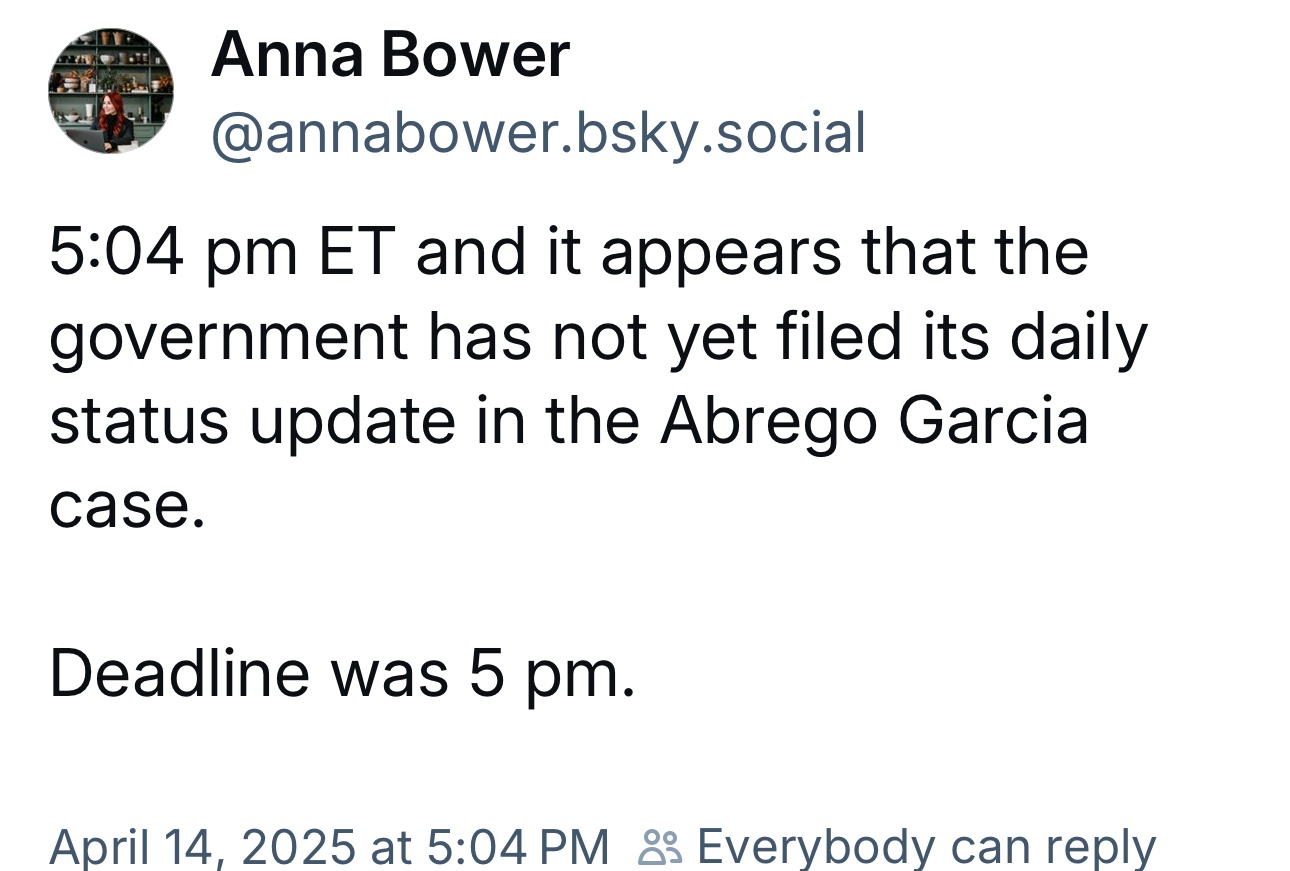
The Supreme Court has ordered the Trump regime to bring Garcia back home. The regime has admitted Garcia was mistakenly sent to this gulag, but the regime doesn’t want to bring him back. The dictator, El Salvador’s dictator, not ours, refuses to send Garcia back to the US. The decision by SCOTUS was unanimous. In case you’re a Republican, “unanimous” means all of them. Do you know how rare it is for all nine members of the Supreme Court to agree on anything? They can’t agree on lunch. There was a near revolt the time it was Clarence’s turn to choose, and he picked Blimpies.
So, if the regime can snatch legal residents off the street, then why can’t they do the same to US citizens? You may believe the Constitution protects you, and yeah…it’s supposed to. But the Constitution didn’t protect Abrego Garcia, Rumeysa Ozturk, Mahmoud Khalil, or Mohsen Mahdawi, who was arrested yesterday during an interview as part of his application for US citizenship. Ozturk, Khalil, and Mahdawi were arrested and then detained in Louisiana for protesting Israel’s bombardment of Gaza.
If you do get snatched up and sent away, you won’t be able to argue for your constitutional rights from a concentration camp in Central America that doesn’t even have toilets. The people who would argue for your rights may not even know you’re missing until you’re swatting at flying buzzy stingy things in a gulag in a Salvadoran mangrove swamp. They have jungles, snakes, giant spiders, crocodiles, gang bangers, and Blimpies down there. You won’t like it. I have two friends from El Salvador, and neither wants to go back…ever. And they weren’t in a concentration camp.
You know how people look at Indiana and say, “I don’t wanna be stuck there.” It’s kinda the same with Latin America and El Salvador. It’s the Indiana of the Americas.
Douglas Dunn, a friend of mine, posted on this cartoon at Facebook, “You are only as legal — you are only as much a U.S. citizen — as the nearest ICE agent (or his boss) says you are, if they can take you WITHOUT DUE PROCESS so you never get the chance to prove you are a citizen.” Doug is a great writer. He writes gooder than I do.
Trump has made it clear that he won’t bring you back, even if a federal court orders it, even if that court is the Supreme Court voting 9-0. Even Clarence and Sammy ordered Trump to bring Garcia back…with some Blimpies.
They can’t really start deporting American citizens, can they?
Last Friday, Nicole Micheroni, an American immigration lawyer born in Massachusetts, received a letter from the Department of Homeland Security (dog-killer Kristi Noem’s agency), saying her parole status has been revoked and she must self-deport within seven days. The letter (which was snail-mailed with a legal stamp and everything, so you know they’re serious) also said if she doesn’t self deport, then the government will take action. The letter ended with, “Again, DHS is terminating your parole. Do not attempt to remain in the United States – the federal government will find you. Please depart the United States immediately.”
Micheroni made calls and found out the letter was legitimate but intended for someone else. Maybe DHS is practicing for when they do start kicking Americans out of America. But still, if I was Ms. Micheroni, I’d sleep with one eye open for the next seven days, or four years, give or take.
Creative note: I’m never comfortable drawing myself, so consider this kinda-sorta me. When I put myself in a cartoon, I’m afraid I’ll come off as having delusions of grandeur, as though I think I’m important enough that the regime is paying attention to me. I also don’t want to be too kind to myself or even make myself too ugly. I’m still not happy with the self-caricature GoComics is using now (and I never sent this to them. I sent it to Cartooning for Peace. But maybe I should leave it alone in case the regime uses it like a mugshot when they come looking to snatch me off the street and send me to El Salvador.
Music note: I listened to The Beatles and The Rolling Stones. Are you a Beatles or Stones person? Tell me in the comments. I’m more Beatles than Stones.
Drawn in 30 seconds (Sorry for the earworm): (snip-Go see)
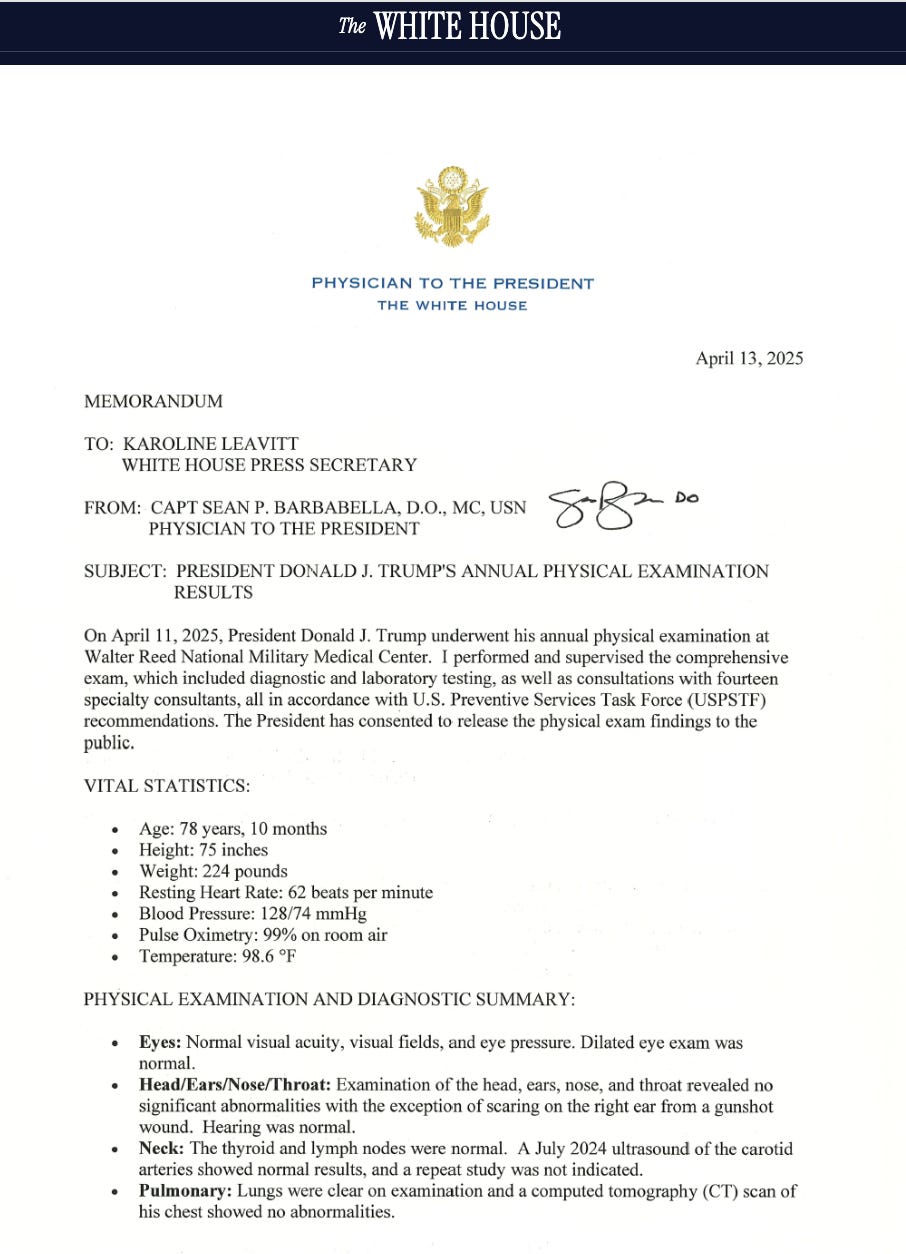
Rep. Jack Kimble tweeted that “President Trump is now 6’3” 224 pounds with 4.8% body fat. We might lose him to the NFL draft.”
Captain Barbarella, the physician to the president (sic), failed to hide in his memorandum about Donald Trump’s physical that he’s a Trump sycophant. Or at least he failed to hide that he was controlled by a member of the cult.
His doctor’s name is actually Captain Sean Barbabella and NOT Barbarella, the title of the 1968 Jane Fonda space sex movie (I’ve never seen it). If congressman Kimble can accidentally refer to the El Salvadore President Nayib Bukele as President Bukake, I can use Barbarella. Also, I don’t know what “bukake” means because I’m a good boy.
While the report of the exam looks like it was written by a real doctor in most of the details, there are still little bits included to make it political and cultist.
For example, when the memorandum mentions his hearing, it mentions “scarring on the right ear from a gunshot wound,” reminding us that Trump was shot is a superhero to survive it (unlike that sucker standing behind him). The doc also wrote that Trump’s “active lifestyle continues to contribute significantly to his well-being,” with one of those activities being his “frequent victories in golf events,” which makes him “fully fit” to be president (sic).
So it’s not the golfing that makes him physically fit to be president, but the golf victories. See what he did there? It’s like the champion is a Greek Adonis, but all the losers are donut-eating hose beasts. Have you seen John Daly? He also claims he’s 215 pounds.
Just how physically active is golfing when you don’t walk the course? Trump doesn’t even like stairs. Yes, there are elevators in the White House, and fortunately for Trump, one of them is a freight elevator. That brings us to Trump’s weight.
Captain Barbarella reports that Captain Big Mac only weighs 224 pounds. He also reports that Trump is 75 inches tall, which is six feet and three inches. I call bullshit.
Here’s what the White House released:
Unless you care about the president’s (sic) health (and I do not), it doesn’t matter to you or me what he weighs or how tall he is. What is important is that they’re dishonest. What’s important is the depth into which this regime sinks the cult into the government.
Trump, who is 78, needs to appear as a Superman to his cult. I’m shocked the memo mentions he takes aspirin for cardiac prevention. As we’ve learned, they lie about everything.
Right now, the regime is lying to the Supreme Court by claiming they can’t have a man they illegally snatched off the street and sent to a prison in El Salvador brought back to this country.
When Trump was running for president in 2016, Dr. Harold Bornstein stated that Trump would be the “healthiest individual ever elected to the presidency.” A couple of years later, we learned that Trump had dictated that letter, which didn’t surprise anyone. A doctor should lose his medical license over that. And it wouldn’t surprise us to learn he dictated “224” and “75 inches” to Captain Barbarella and wouldn’t allow him to mention that Trump’s cholesterol is just Big Mac Secret Sauce. His first White House physician was a lying alcoholic lunatic, Dr. Ronny Jackson, who doesn’t practice medicine anymore and is now in a place where he can’t hurt anybody, Congress.
Ronny Jackson claimed that Trump could live to be 200, and judging from the way our luck works, that might be true.
The memo does show that despite spreading debunked lies about vaccines, like his Health Secretary does, Trump is up to date on vaccines.
The part we should care about, and is more absurd than claiming he weighs 224 pounds, is the claim he scored 30 out of 30 on a cognitive test. I checked to be sure the memo didn’t state that he also has hands that are not tiny.
Anyone who believes Trump, the shark boat battery guy, scored 30 out of 30 on a cognitive test needs to take a cognitive test. I don’t believe this doctor would let us know if Trump scored less than 30.
Trump’s last presidential physical had him at 244 pounds. His 2023 arrest in Georgia listed him at 215 (they don’t weigh the prisoners but take their word for how much they weigh), and this exam says he’s 224.
If Trump does weigh 224 pounds, then that’s 224 pounds of walking/talking bullshit.
The one number that’s accurate about Trump is 34, as in 34 felony convictions.
Creative note: I still have a few other ideas I wrote last week that I want to get to, but I knew last night that I needed to cover this today. This idea hit me shortly after I woke up.
Music Note: I listened to The Beatles.
Drawn in 30 Seconds (with music): Sorry for the earworm. (Snip-go see/listen!)
So what is the goal here, to save money, or ultimately to kill unhealthy Americans that Republicans think are a drag on their wallets? Inside U.S. health agencies, workers confront chaos and questions as operations come ungluedflip.it/3rz_Ee
April 15, 1947 Jackie Roosevelt Robinson became the first African American to play in a major league baseball game in the 20th century. His stepping onto Ebbets Field in a Brooklyn Dodgers uniform broke the “color line,” the segregation of professional teams. The International League in 1887 began a wave of League-wide black exclusion, and it had been complete since 1899, when Bill Galloway became the last African-American player in white organized ball (Woodstock, Ontario). Though hitless in three at-bats, Robinson started at first base, and the Dodgers beat the Boston Braves that day, 5-3. “Jackie, we’ve got no army. There’s virtually nobody on our side. No owners, no umpires, very few newspapermen. And I’m afraid that many fans will be hostile. We’ll be in a tough position. We can win only if we can convince the world that I’m doing this because you’re a great ballplayer, a fine gentleman.”
April 15, 1967 King and Dr. Benjamin Spock lead an anti-war march to the United Nations, 15 April 1967 Amidst growing opposition to the war in Vietnam, large-scale anti-war protests were held in New York, San Francisco and other cities. In New York, the protest began in Central Park, where over 150 draft cards were burned, and concluded at the United Nations with speeches by Rev. Martin Luther King, Jr. and others. King’s opposition to the war, excerpts of his speeches and reaction throughout the country
Karla Jay remembers joining the second night of street protests during the 1969 Stonewall uprising in New York City. For her, and for so many other LGBTQ+ people, something had shifted: People were angry. They didn’t want things to go back to normal — because normal meant police raids. Normal meant living underground. It meant hiding who they were at their jobs and from their families. They wanted a radical change.
Radical change meant organizing. Jay joined a meeting with the Gay Liberation Front, which would become the incubator for the modern LGBTQ+ political movement and proliferate in chapters across the country. At those meetings, she remembers discussing what freedom could look like. Holding hands with a lover while walking down the street, without fear of getting beaten up, one person said. Another said they’d like to get married. At the time, those dreams seemed impossible.
Jay, now 78, is worried that history will repeat itself. She’s worried that LGBTQ+ people will be put in the dark again by the draconian policies of a second Trump administration.
“Are things worse than they were before Stonewall? Not yet,” she said. “It’s certainly possible that people will have to go back to underground lives, that trans people will have to flee to Canada, but it’s not worse yet.”
The 19th spoke with severalLGBTQ+ elders, including Jay, about what survival looks like under a hostile political regime and what advice they would give to young LGBTQ+ people right now.
“We have forgotten that the laws are written to protect property and not to protect people. They’re written to protect White men and their property, and historically, women and children were their property,” she said. “To expect justice from people who write laws to protect themselves has been a fundamental error of the lesbian, gay, bisexual, trans community.”
To fight back, LGBTQ+ Americans need to organize, Jay said. That starts with thinking locally — supporting local artists, independent stores and small presses, as well as LGBTQ+ organizations taking demonstrable political action and protecting queer culture.
“See what you can do without going crazy. If you can focus on one thing and you can spend one hour a week, or you can spend one day a week, that’s much better than being depressed and doing nothing,” she said. “Because the person you’re going to help is yourself. This is the time for all of us to step up.”
Renee Imperato (far right) poses with other demonstrators during a protest outside the Stonewall Inn, after the word transgender was erased from the National Park Service’s webpage, in New York, on February 14, 2025. (Courtesy of Renee Imperato)
Renata Ramos feels obligated to share her experiences with young people.As a 63-year-old trans Latina,she wants young people to know that so many of their elders have already been through hard times — which means that they can make it, too, including during this moment.
“I’m not scared in the least. Because we have fought so many battles — the elders. We have fought so many battles, with medicine, with HIV, with marching on Washington, with watching our friends die,” she said. “It’s been one war after another in our community that we have always won. We have always been resilient. We have always stood strong. We have always fought for our truth, and we’re still here. They haven’t been able to erase us.”
As Ramos watches the Trump administration use the power of the federal government to target transgender Americans and erase LGBTQ+ history, she’s not afraid for herself. She’s afraid for young LGBTQ+ people, especially young trans people who now find themselves at the center of a growing political and cultural war. If someone transitioned six months ago, she said, they now have a target on their back — and little to no experience with what that feels like.
“They don’t know what it is like to be a soldier going into war, as far as social issues. So I fear for them,” she said. “Who wouldn’t be scared?”
Criss Christoff Smith has seen firsthand what that fear can look like. On January 28, at 3 a.m., he received a phone call from an LGBTQ+ person who was considering taking their own life. This was a stranger —someone who admired from afar Smith’s advocacy as a Black trans man and Jamaican immigrant. This was someone who had been considering a gender transition for years, Smith said, who was now feeling broken. He spoke with them for two hours.
“It’s been quite dark,” Smith said. The onslaught of policies targeting marginalized people and the turbocharged news cycle are working to keep Black and trans people in a constant state of fear and uncertainty, he said.
“I tell everyone in my community, you have to stop responding to those alerts and just try to go inward,” he said. “Find a space of peace and spirituality.”
To Smith, who is 64, looking inward can mean reflecting on what’s still here. Although the Trump administration is going to make daily life harder for LGBTQ+ people, he said, laws can’t be undone with the stroke of a pen on an executive order. LGBTQ+ Americans need to find whatever source of strength and peace they can find right now — and try to remove themselves from the daily fray as much as possible — while still finding ways to take action.
“This is the time when we really have to find community, where we really have to hone in on our spiritual feelings and try to talk to someone. Don’t keep it to yourself,” he said. Joining protests or lobbying days at state capitols are great ways to find community in-person, Smith said — to be around like-minded people and to not feel so alone.
“That’s the best space to be in, not home alone and in your feelings and in your mind, because we can get lost there thinking negatively. So we have to stay positive and stay with like-minded people, and have those people constantly around you to reassure you and just hold you tight in that space,” he said.
Protests against the administration’s hostile LGBTQ+ policies have been ongoing — including outside the Stonewall National Monument. In at least one way, history is already repeating itself.
The National Park Service deleted all references to transgender and queer people from its web page honoring the 1969 Stonewall uprising — the most well-known moment from LGBTQ+ history in the country — leaving references to only lesbian, gay and bisexual people. Hundreds gathered in New York City to protest. Among them was Renee Imperato, a 76-year-old trans woman and New York native.
“Protests like this are our survival,” she told The 19th over email. “The rhetoric of this administration is driving a violent onslaught against our community. The Stonewall Rebellion is not over. We are at war, and we are still fighting back. What other choice do we have?”
Jay, herself an old hand at joining protests and demonstrations, said that she’s been afraid before every one of them. She’s lost sleep the night before and feared for her safety — but she did it anyway.
“I’m afraid I’ll be beaten. I’m afraid I’ll be arrested. But if you don’t do something even though you’re afraid, they win,” she said.
Jonathan says that when he asked a border agent to repeat a question, the reply was, “Are you deaf or just retarded?” He adds that he was then told, “Trump is back in town, we’re doing things the way we should have always been doing them.” Hit the link for much more. No paywall.
Alex Shultz Published April 13, 2025 | Comments (4)
Diablo Canyon, California’s sole remaining nuclear power plant, has been left for dead on more than a few occasions over the last decade or so, and is currently slated to begin a lengthy decommissioning process in 2029. Despite its tenuous existence, the San Luis Obispo power plant received some serious computing hardware at the end of last year: eight NVIDIA H100s, which are among the world’s mightiest graphical processors. Their purpose is to power a brand-new artificial intelligence tool designed for the nuclear energy industry.
Pacific Gas and Electric, which runs Diablo Canyon, announced a deal with artificial intelligence startup Atomic Canyon—a company also based in San Luis Obispo—around the same time, heralding it in a press release as “the first on-site generative AI deployment at a U.S. nuclear power plant.”
For now, the artificial intelligence tool named Neutron Enterprise is just meant to help workers at the plant navigate extensive technical reports and regulations — millions of pages of intricate documents from the Nuclear Regulatory Commission that go back decades — while they operate and maintain the facility. But Neutron Enterprise’s very existence opens the door to further use of AI at Diablo Canyon or other facilities — a possibility that has some lawmakers and AI experts calling for more guardrails.
PG&E is deploying the document retrieval service in stages. The installation of the NVIDIA chips was one of the first phases of the partnership between PG&E and Atomic Canyon; PG&E is forecasting a “full deployment” at Diablo Canyon by the third quarter of this year, said Maureen Zawalick, the company’s vice president of business and technical services. At that point, Neutron Enterprise—which Zawalick likens to a data-mining “copilot,” though explicitly not a “decision-maker”—will be expanded to search for and summarize Diablo Canyon-specific instructions and reports too.
“We probably spend about 15,000 hours a year searching through our multiple databases and records and procedures,” Zawalick said. “And that’s going to shrink that time way down.”(Emphasis mine- A. I worked at the nuke plant in my state in my 20s. I did Records Management. I’m not going to explain it all from back then the way I trained people, but it involves reading and interpreting what one has read in application to the function, part, area, etc. a document records, which is learned by reading the document, then coding it so it is efficiently retrieved later. So far, I don’t know that AI does that. Others who are more knowledgeable about records management and retrieval in this era and context may see better things than I see. The best worst I see is really angry and impatient engineers and inspectors in all the disciplines still at the plant. That’s no fun, anyway.)
Trey Lauderdale, the chief executive and co-founder of Atomic Canyon, told CalMatters his aim for Neutron Enterprise is simple and low-stakes: he wants Diablo Canyon employees to be able to look up pertinent information more efficiently. “You can put this on the record: the AI guy in nuclear says there is no way in hell I want AI running my nuclear power plant right now,” Lauderdale said.
That “right now” qualifier is key, though. PG&E and Atomic Canyon are on the same page about sticking to limited AI uses for the foreseeable future, but they aren’t foreclosing the possibility of eventually increasing AI’s presence at the plant in yet-to-be-determined ways. According to Lauderdale, his company is also in talks with other nuclear facilities, as well as groups who are interested in building out small modular reactor facilities, about how to integrate his startup’s technology. And he’s not the only entrepreneur eyeing ways to introduce artificial intelligence into the nuclear energy field.
In the meantime, questions remain about whether sufficient safeguards exist to regulate the combination of two technologies that each have potential for harm. The Nuclear Regulatory Commission was exploring the issue of AI in nuclear plants for a few years, but it’s unclear if that will remain a priority under the Trump administration. Days into his current term, Trump revoked a Biden administration executive order that set out AI regulatory goals, writing that they acted “as barriers to American AI innovation.” For now, Atomic Canyon is voluntarily keeping the Nuclear Regulatory Commission abreast of its plans.
Tamara Kneese, the director of tech policy nonprofit Data & Society’s Climate, Technology, and Justice program, conceded that for a narrowly designed document retrieval service, “AI can be helpful in terms of efficiency.” But she cautioned, “The idea that you could just use generative AI for one specific kind of task at the nuclear power plant and then call it a day, I don’t really trust that it would stop there. And trusting PG&E to safely use generative AI in a nuclear setting is something that is deserving of more scrutiny.”
For those reasons, Democratic Assemblymember Dawn Addis—who represents San Luis Obispo—isn’t enthused about the latest developments at Diablo Canyon. “I have many unanswered questions of the safety, oversight, and job implications for using AI at Diablo,” Addis said. “Previously, I have supported measures to regulate AI and prevent the replacement and automation of jobs. We need those guardrails in place, especially if we are to use them at highly sensitive sites like Diablo Canyon.” (snip-MORE; not tl;dr, though.)
Also, a belated Chag Sameach to everyone who celebrated Passover yesterday.
I know it’s been a super tough week—it’s all the more reason that a pause for good news is important. So here’s everything I could find that went right in the last seven days. As always, there was a lot more of it than you might have thought.
Enjoy reading this list. And please share. Lots of folks need a morale boost—I’m sure you know a few of them.
And if you notice that I forgot something please drop it in the comments! Like everything in this newsletter, they’re open to everyone.
OK, my friends. Have a great rest of your day. Tomorrow we get back to the fight.
Read This 📖
Rebecca’ Solnit’spost about the Hands Off protests, which includes the speech she made at the one she attended, is an absolute must-read.
Celebrate This! 🎉
In an unexpected win for antitrust, one of the Republican commissioners remaining on the Federal Trade Commission will save the agency’s investigation into pharmacy benefit managers by unrecusing himself from the case.
Sen. Richard Blumenthal announced that he plans to place a hold on ALL Trump nominees going forward.
Sen. Brian Schatz is placing holds on over 50 Trump nominees. He has also placed holds on all nominations at the State Department, bringing his total to over 300 positions. Bravo!
The American Library Association, the largest library association in the world, and the American Federation of State, County and Municipal Employees, the largest union representing museum and library workers, are suing the Trump administration over its gutting of the Institute of Museum and Library Services.
A federal judge in Texas (appointed by Trump) has issued a ruling blocking the removal of individuals under the Alien Enemies Act, citing concerns raised in the Supreme Court’s recent decision and the controversial Abrego Garcia case.
A Delaware judge ruled that Newsmax’s coverage of Dominion Voting Systems was false and defamatory.
Senator Adam Schiff called on Congress to investigate whether President Donald Trump engaged in insider trading or market manipulation when he abruptly paused a sweeping set of tariffs, a move that sent stock prices skyrocketing.
Indiana lawmakers in the state’s Republican-led senate are looking to take on pharma’s price-gouging middlemen known as pharmacy benefit managers by creating a public system.
The Government Accountability Office (GAO) is auditing DOGE.
A federal court ordered multiple government agencies to provide additional details about their use of Signal for official government business.
A coalition of more than 240 pastors, Christian faith leaders, and faith-based nonprofit organizations across Tennessee have come together to oppose a bill that could allow public schools there to deny enrollment for migrant children without legal status.
American Oversight secured a significant legal victory after a Georgia court denied State Election Board member Janice Johnston’s motion to dismiss in its ongoing transparency lawsuit against the Georgia State Election Board.
Maine officials sued the Trump administration to try to stop the government from freezing federal money in the wake of a dispute over transgender athletes in sports.
The Supreme Court told the Trump administration to seek the return of a migrant mistakenly sent to a Salvadoran prison, rebuffing government claims that it need do nothing to remedy its error.
In Wisconsin, former state Supreme Court Justice Michael Gableman agreed to surrender his law license following a disciplinary complaint related to his conduct during his investigation of the 2020 presidential election.
Two groups representing Harvard professors sued the Trump administration, saying that its threat to cut billions in federal funding for the university violates free speech and other First Amendment rights
After local residents organized a 1000-person march past Tom Homan’s house in rural upstate NY, the Sackets Harbor Superintendent announced that an ICE-abducted family—including 3 small children—would be returning home. Amazing!
Solar energy in New York got a big boost with the announcement of a $950 million contract to construct the state’s largest solar farm, and the program has now broken ground.
A first-of-its-kind pilot to electrify homes on Cape Cod and Martha’s Vineyard is set to finish construction in the coming weeks — and it could offer a blueprint for decarbonizing low- and moderate-income households in Massachusetts and beyond.
Initial analysis of the Wisconsin elections on April 5 shows that relative to 2024’s presidential race, every single county in Wisconsin moved left. Wow!
A federal judge rejected Johnson & Johnson’s third attempt to use a controversial legal maneuver to settle tens of thousands of lawsuits claiming its baby powder and other products were tainted with toxic asbestos and caused cancer.
A Mississippi judge on April 4 dismissed former governor Phil Bryant’s (R) defamation suit against a nonprofit newsroom for exposing potential corruption in his administration.
Some House Freedom Caucus members are apparently warming to the idea of a new 40% tax bracket for those earning $1 million or more to offset some new tax cuts. YEs, you read that right.
Alabama legislators unanimously passed a bill that would expedite access to Medicaid for pregnant women.
Former New Hampshire Gov. Chris Sununu (R) told the Pulse of New Hampshire that he will not run for the U.S. Senate, a setback for Republicans’ hopes to flip the open seat.
The Senate parliamentarian ruled that Republicans in Congress cannot use an obscure legislative maneuver to stop California’s ban on the sale of new gasoline-powered cars by 2035.
The Wisconsin Supreme Court dismissed a challenge last week that sought to limit municipalities’ authority to set early voting locations and prevent the future use of a mobile voting van.
Maryland lawmakers passed a package of energy bills that includes provisions for fast-tracking some community solar project approvals and prohibiting counties from banning solar development in hopes of curbing power rates.
Republican senators, led by Sens. Bill Cassidy of Louisiana and Lindsey Graham of South Carolina, unveiled a bill Tuesday that would slap penalties on countries that generate high levels of manufacturing pollution. Yes, really.
The world used clean power sources to meet more than 40% of its electricity demand last year for the first time since the 1940s, figures show.
Jeff Bezos is funding a secretive EV startup based in Michigan called Slate Auto that could start production as soon as next year. Slate Auto is tackling a big goal: an affordable two-seat electric pickup truck for around $25,000.
36K people attended Bernie Sanders’ and AOC’s “Fighting Oligarchy” event in Los Angeles.
Federal agents attempted to enter two Los Angeles Unified elementary schools this week. The principals of each school denied the agents entry and contacted legal support; the agents left. Let’s give a round of applause to the LAUSD community members and activists—some of whom I know—who “went deep on proper warrants for entry,” as soon as Trump was elected. Because of them, these schools were prepared and disaster was averted!
In Coeur d’Alene, Idaho, police have recommended criminal charges—including battery and false imprisonment—against the security team who brutally dragged Dr. Teresa Borrenpohl out of a town hall in February.
A federal judge in New York also blocked the Trump administration from continuing to deport people under the Alien Enemies Act.
A federal judge has rejected President Trump ‘s effort to dismiss a defamation lawsuit against him filed by the men formerly known as the Central Park Five
It’s official: The Tesla Cybertruck is a flop. (snip-a bit more)
Would Some Climate Nice Time Recharge Your Batteries? Here You Go! by Rebecca Schoenkopf
40 percent of the world’s electricity now comes from clean power. That’s big! Read on Substack
See that slightly darker middle balcony? Those are solar panels. Way to go, Germany! Video screenshot, EuroNews on YouTube.
With all the terribleness going on, we need to make those in power know that their attempts to bring fascism to America will not stand, man. But we also need to remind ourselves that a better country is worth fighting for, and that despite all the free range evil in our politics, humans really can do some amazing things, too. And so, let’s do another Climate Nice Time, not because we’re whistling past the graveyard and refusing to acknowledge the abyss, but because staring into that sucker all the time is exhausting.
Clean Energy Doing 40 Percent Of World’s Electricity, And Keeps Growing
While solar has been the fastest-growing source of clean energy for 20 years running, all solar (both grid-scale power plants and rooftop home installations) still provides only seven percent of world electricity, with wind accounting for another eight percent. Thing is, those percentages keep growing, while the two top sources of carbon-free electricity, hydroelectric (14 percent) and nuclear (nine percent) have remained fairly static. Other renewable sources like geothermal, biomass, and tidal energy account for another three percent; the growth of enhanced geothermal in the next decade is almost certain to take it out of the “other” category as surely as the Professor and Mary Ann broke out of “And the rest” in the second season of “Gilligan’s Island.”
Ember had previously predicted that the world’s emissions from electricity would peak in 2023 and begin declining after that, but a series of deadly heatwaves around the world that year boosted air conditioning use and therefore electricity demand past the growth of clean energy, also increasing fossil fuel generation by about 1.4 percent. Hello again, first chapter of The Ministry for the Future. Even if we don’t see a similar outbreak of heatwaves, increasing demand from data centers and for charging EVs means it remains critical to install as much new renewable energy as possible to keep up. Happily, the rest of the world doesn’t have That Man running it. [Guardian / Ember]
Germany: Balcony Solar Panels Help Renters Go Greener
Here’s just one of the energy success stories that contributed to the growth in clean energy: Germany has in the last few years seen a small revolution in solar panels that can be mounted right on apartment balconies. Unlike rooftop systems that are meant for homeowners, balcony solar is meant to be easily installed by renters, and the basic equipment can be bought online or even in supermarkets. Hell yeah, energy solutions for renters!
They start at around 500 Euros (around $570) for a simple system. In Germany, that socialist hellhole, government incentives also help with the purchase price. The systems include a “microinverter” that converts the panels’ DC output to AC home current, and plugs right into the wall. Regulations limit balcony systems’ output to 800 watts, because grid strain problems could result from lots of folks plugging more powerful systems into apartment walls. Still, it’s enough to
power a small fridge or charge a laptop, [and] the cumulative effect is nudging the country toward its clean energy goals while giving apartment dwellers, who make up more than half of the population, an easy way to save money and address the climate crisis.
Then there’s the sense of shared community involvement in doing one’s part: Neighbors see those panels and want to know more, and as renter Matthias Weyland said of his balcony solar setup,
“I love the feeling of charging the bike when the sun is shining, or having the washing machine run when the sun is shining, and to know that it comes directly from the sun. […] It’s a small step you can take as a tenant.”
Neato! I’m always excited to hear about options for renters to become part of the energy transition, and when you elect me, I’ll make damn sure the next climate bill includes subsidies for ebikes, balcony solar, and incentives for EV charging for apartments and condos too! [Grist]
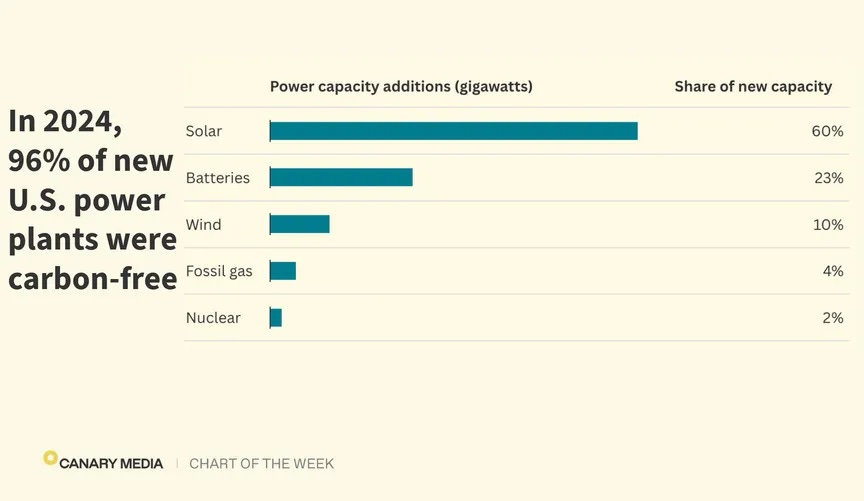
USA: Still Too Much Fossil Overall, But 96 Percent Of New Power Last Year Was Carbon-Free!
Chart by Canary Media, based on an analysis by Cleanview of data from the US Energy Information Administration
Solar installations dominated power plant additions — 34 gigawatts of utility-scale solar were constructed across the U.S., a 74 percent jump from 2023’s record-high year. Texas and California drove most of this surge.
Grid batteries were the next-biggest new source of power capacity — and saw the fastest growth. The U.S. built 13 GW of energy storage last year, almost double 2023’s record-shattering 6.6 GW. Texas and California led the way here as well.
The amount of new wind resources coming online dropped for the fourth straight year, however. The pandemic’s supply chain disruptions, followed by high inflation and the Fed’s high interest rates meant to combat inflation, really did a number on wind, far more than on solar and storage. Wind has also been hit hard by the slow process of connecting new generation capacity to the grid, a huge problem for all new energy. Donald Trump’s bizarre hatred of wind is likely to seriously slow wind growth in the US in the next few years, as will astroturfed rightwing opposition in red states. Stupid, stupid Right creatures!
Just a few random nice climate moments, Tabs-style:
Two years ago, Helsinki, Finland, decided to ditch coal power, which at the time made up 64 percent of the city’s electric power. The effort to reach the decision took a decade, but once made, it’s gone into effect quickly. Thanks to being ideally situated for wind power (resulting in absurdly low electric rates that approached zero Euros per kilowatt hour) and having a huge distributed heating system that warms homes and businesses with hot water pipes, Helsinki has largely shut down the coal plants that it used to run on. [Fast Company (paywalled); archive link]
For Earth Day (April 26) this month, 54 streets in New York City will be closed to cars so people can stroll and bike and generally see what living without cars could look like. It’s a one-day cleaner, quieter, Euro-style socialist hellhole celebration that the city has been doing since 2016! [Time Out New York]
Thanks to aggressive socialist hellhole government regulations and oppression, plastic pollution along Australia’s coastlines has dropped nearly 40 percent since 2013, and the sea turtles and people walking and doing recreation On the Beach are pretty damn glad to see it. The number of surveyed sites that had no plastic debris at all increased by an impressive 16 percent in the same period. [The Independent]
Lego this week opened a $1 billion factory in Vietnam that will by 2026 be making the popular building bricks using entirely clean energy, primarily solar panels and battery storage. The playsets produced there will be almost entirely for the booming Asian market, although Crom only knows how stupid US tariffs on Vietnam and the rest of the world may affect that rollout. Possibly some! And yes, Lego bricks are made with oil-based plastic; the company is spending big on researching more sustainable materials, but so far with only mixed success. [AP]
Go have you a great weekend, keep your activist batteries charged, and remember that the bastards only win if we let them! (snip)