The Republican President has been in office one month today, and we’ve seen some of today’s history repeat itself already. Republicans are working very rapidly.
February 20, 1942 The vast majority of teachers in German-occupied Norway refused to comply with the forced Nazification of the school system. The government had ordered display of the portrait of German-installed Minister President Vidkun Quisling (formerly head of Nasjonal Samling, the Norwegian fascist party) in all classrooms, revision of the curriculum and textbooks to reflect Nazi ideology, and teaching of German to replace English as their second language.The teachers organized and 12,000 of 14,000 nationwide wrote the same letter on this day to the education department refusing membership in the newly formed Nazi teachers’ association. Two days later clergy throughout the country read a manifesto against Nazi control of the schools. Vidkun Quisling (on right), Germany’s puppet leader in Norway, allowed Germany to invade his country and declared himself Prime Minister. In Norway his name has become synonymous with traitor. How the teachers pushed back Norwegian teachers prevent the Nazification of education
February 20, 1956 The U.S. rejected a Soviet proposal to ban nuclear weapons tests and deployment. The U.S. continued atmospheric nuclear testing in the South Pacific and Nevada until 1963.
February 20, 2011 Nearly 40,000 pro-Democracy Moroccans demonstrated peacefully in 57 towns and cities across the country. Though there was sporadic violence later that night, Interior minister Taeib Cherqaoui called the earlier efforts “the healthy practice of the freedom of expression.”
As well, Feb. 19th is the annual Day of Remembrance of Pres. Roosevelt’s E.O. 9066, interning Japanese-Americans.
February 19, 1919 A Pan-African Congress was organized by W.E.B. DuBois in Paris, France, to coincide with the Versailles Peace Conference after World War I. DuBois, sociologist, historian, novelist, playwright, and cultural critic, served as special representative of the NAACP (National Association for the Advancement of Colored People), and was assisted by Blaise Diagne, a member of the French Parliament from the West African colony of Senegal. W.E.B. DuBois, founder of the NAACP and convener for the Pan-African Congress in Paris. The Congress’s aim was to call the issue of “international protection of the natives of Africa” to the attention of the United States and the European colonial powers who were making momentous decisions on the nature of the post-war world. DuBois was a moving spirit behind the growing struggle for self-determination among Africans, both on the continent and in the diaspora, and the Pan-African Congresses helped to bring the issues of this struggle to world attention. The Pan-African Congress was re-convened in 1921, 1923, 1927, and 1945. Attendees at the Pan-African Congress. More about W.E.B. DuBois More depth on the Pan-African Congresses
February 19, 1942 President Franklin D. Roosevelt, ten weeks after the Japanese attack on Pearl Harbor, issued a directive ordering all Japanese Americans (Nisei) evacuated from the West Coast of the U.S., and forcing them to live in concentration camps. Executive Order 9066 authorized the Secretary of War and military commanders “to prescribe military areas . . . from which any or all persons may be excluded.” San Francisco Chronicle February 27, 1942 Photo by Dorothea Lange Japanese American residents board the bus for Camp Harmony, 1942. There was strong support from California Attorney General Earl Warren (later U.S. Supreme Court Chief Justice), liberal journalist Walter Lippmann and Time magazine—which referred to California as “Japan’s Sudetenland” Japanese-American child on bus to concentration camp. photo: Dorothea Lange 112,000 citizens of Japanese ancestry were relocated, losing their businesses, homes, and belongings to the white residents of their former neighborhoods.This day is referred to as the “Day of Remembrance.” It has been commemorated every year for 67 years to remind Americans of that miscarriage of justice, and to ensure such things do not happen again. Children of the camps Note: In the entire course of the war, 10 people were convicted of spying for Japan, all of whom were Caucasian Day of Remembrance “Not Enough People Know About Day of Remembrance”
February 19, 1972 Paul McCartney’s song, “Give Ireland Back to the Irish,” was immediately banned from airplay by the BBC. Opening of the song: Give Ireland back to the Irish Don’t make them have to take it away Give Ireland back to the irish Make Ireland Irish today Great Britain you are tremendous And nobody knows like me But really what are you doin’ In the land across the sea Tell me how would you like it If on your way to work You were stopped by Irish soldiers Would you lie down do nothing Would you give in, or go berserk? Paul McCartney and “Wings” rehearse the song
(I have AdBlock on my puter. If there’s an orange box on this post for you, just tell the box you’ll fix it next time. It’s the first option. This is a wonderful thing to read on its own, but it seems a good recommendation, as well. Enjoy! -A.)
This guest review is from Crystal Anne! Crystal Anne with An E comes to us from a sunny clime, but prefers to remain a pale indoor cat. She enjoys reading, cross-stitching something nerdy, going to see live music, and playing video games.
She works as an autism consultant by day, got a degree in information science for fun, and currently serves on her local library advisory board.
CW/TW
“I believe the children are our future….” Sometimes this is not just a line in a song.
My daughter learned much of her geekery from me. Fortunately for us both, that means we have noticeably similar taste in things we enjoy. I got her into Buffy the Vampire Slayer and Hamilton. I procured her every single Percy Jackson book available when she decided she wanted to read them. She recently returned the favor, by introducing me to Epic: The Musical.
I am rather confident that I would not have discovered it without her. I am terminally online the way a 46 year old person is. She is terminally online the way that an 18 year old is, and these ways are pretty different. She also is deeply interested in art and animation in a way that I am not (I enjoy these things, but she’s interested in making a career of it), and much of her discovery of this musical came about as she watched animatics of it. I am a deeply lucky parent in that when my daughter loves something, she wants me to love it, too, so she insisted that I was going to listen to the entirety of Epic with her. Yes, all 2 and a half hours of it. (snip-MORE. Go read it! It’s delightful! -A.)
Ocean acidification now looms as a direct challenge to oysters. Experts warn that more acidic conditions can alter the sex balance in these shellfish. Some oysters start life as male, then switch to female later. Shifts in pH threaten to speed that switch.
These shifts could upend aquaculture and coastal ecosystems everywhere.
Researchers note that an oyster population with too many females might see future reproduction problems, since a balanced sex ratio helps keep populations stable.
Photo: Pexels
Oysters rely on environmental cues to decide their sex. (snip-MORE)
Proposal calls on company to prepare reports on ‘macroeconomic costs’ of health insurer’s practices
UnitedHealth Group is attempting to swat down a non-binding shareholder proposal that asked the company to prepare reports on the costs of delayed and denied healthcare.
The proposal, filed by members of the Interfaith Center on Corporate Responsibility (ICCR), represents a new frontier in seeking to hold insurance companies accountable for the “macroeconomic costs” of denied care – arguing they eventually hurt the bottom line of large investors.
The proposal asks UnitedHealth Group to prepare reports on the “public health-related costs and macroeconomic risks created by the company’s practices that limit or delay access to healthcare”.
“The investors we work with are interested in long-term value creation,” said Meg Jones-Monteiro, senior director of health equity at ICCR. The coalition represents primarily institutional investors, such as pensions and foundations.
“When you think about the investment portfolios our members have, they are very diverse,” Jones-Monteiro. “What happens in one sector impacts another.”
The proposal is non-binding, but UnitedHealth Group is nevertheless fighting to stop it. In a filing with the Securities and Exchange Commission in January, UnitedHealth Group attempted to exclude the proposal from proxy statements on technical grounds, arguing in part that the terms “public-health related costs” and “macroeconomic risks” are vague and subject to interpretation. (snip-MORE)
Last month I asked to hear from trans-friendly employers who sponsor visas, and provided a simple form for interested employers to reach out. In the process, I heard from many individuals: people who were hoping to find new employment in another country, and people who worked for companies that were aligned, who were encouraging their bosses to fill in the form.
A quick reminder before we dive in: I’m not providing formal legal or financial advice. I’m just trying to point people in the right direction and provide some ideas for relocation for people who want it.
The bad news
Here’s the bad news: today, that form sits empty. While the post was shared far and wide, not a single person has filled it in.
I think there are a few reasons for this. First and foremost, in the current environment, being listed in such a database presents a significant risk, particularly if you’re doing business with US entities. In an environment where the administration is firing employees and cutting contracts for even the barest mention of support for trans people, there’s every reason to believe that the current administration will penalize people and organizations who work with trans people.
So, that’s not great. I’m very sorry to everyone who got their hopes up that I would be able to make direct connections.
The good news
The good news: some countries actively sponsor visas, welcome trans people, and are hiring.
In my personal conversations with people, what jumped out again and again was that emigrating to the Netherlands was a viable route for many people — and particularly those with tech skills (engineering, IT, product management, design, research, and so on).
Reasons include:
Dutch tech companies tend to sponsor visas. (Look for job vacancies written in English and/or on boards like Tech Me Abroad and Relocate.me.)
You can relocate with a self-employment visa if you have a skilled background, can demonstrate at least one Dutch-based contract or that you’ll start a tech-based business, and can show that you’ll independently make €1,613 (~$1,700) per month.
The DAFT visa lowers the barrier to entry for US entrepreneurs who can commit to invest €4,500 (~$4,700).
The Netherlands is also kind of just a neat country: excellent social safety net, great support for culture and the arts, good connectivity to other European countries, and a strong grant support network for mission-driven tech. Amsterdam is a first-class cosmopolitan city, but other centers in the Netherlands are not to be sniffed at, and the country is so small that you can easily take public transit from one to another in less time than it might take you to commute to work by car in the US.
It is not, however, perfect. Much like the US, the Netherlands has had its own racial reckoning; unlike the US, the discourse has often centered on the idea that racism doesn’t happen there. That’s a rich claim from a society where racist tropes like Zwarte Piet are still commonplace, and where women of color are often marginalized. There’s work to be done — although it’s worth asking if this is truly any worse than the US.
Not everybody can relocate, and not everybody has these skills. I’m aware that this is a privileged route that not everybody can take advantage of. It would be better if there was a defined route for everybody who needed to find a safer place to live; it would be better still if a safe place to live was the place they already call home. This situation is sick and sad, and I truly wish that everything was different.
It also comes with an attendant cost. It’s estimated that moving to the Netherlands will set you back between $6-10K. That’s a lot less than one might expect, but it’s obviously a significant barrier for many people. Unfortunately, very little financial support exists for these moves. If you know of grants, mutual aid funds, or community resources that help trans people relocate, please share them. Funding and guidance from those who’ve navigated the process could make all the difference.
Please reach out
In the meantime, I’ll keep looking. If you are a company in a country that is safe for trans people, and you’re looking to hire people from the US who need visa sponsorship, please fill out this form or reach out to me via email. I’m not giving up.
==========
I once had a wonderful experience with tens of thousands of pansies. by Worriedman
Plant the green side up and give it a good drink of water a couple of times a week…
Pansies are Viola hybrids, Viola x wittrockiana. (“wittrockiana” sounds like a mountainous region in the south of the Duchy of Grand Fenwick) The common names, pansy, viola and violet are used interchangeably. “Pansies” are usually larger and taller than true violas, with large showy blooms. Violas are usually smaller plants, with smaller blooms, more plentiful than find on pansies. If you want to be a real nerd you can look at the petals. Both kinds of blooms have five petals . On the pansy, four petals point up, one points down. On the viola, two petals point up and three point down.
February 18, 1688 Francis Daniel Pastorius and three other Pennsylvania Quakers (members of the Society of Friends) made the first formal protest against slavery in the new world. At the Thones Kunders House in Germantown (now part of Philadelphia) they signed a proclamation denouncing the importation, sale, and ownership of slaves: “. . . we shall doe [sic] to all men like as we will be done ourselves; making no difference of what generation, descent or colour they are.” More on Germantown Society of Friends
February 18, 1961 above: Bertrand Russell and Edith Russell watching the actress Vanessa Redgrave address the Committee of 100 meeting in Trafalgar Square, which preceded the anti-Polaris “sit-in” outside the Ministry of Defence on February 18, 1961. In London, Sir Bertrand Russell, 88, led a march of 20,000 and sit-down of 5,000 in an anti-nuke rally outside the U.K. Defense Ministry, and was jailed for seven days. It was the first public demonstration organized by the Committee of 100, the direct action wing of the Committee for Nuclear Disarmament. Early CND demonstrator The CND today
February 18, 1970 Five of the “Chicago Seven” (Rennie Davis, David Dellinger, Tom Hayden, Abbie Hoffman, and Jerry Rubin) were found guilty of crossing state lines to incite a riot during the 1968 Democratic convention. The Chicago Seven John Froines and Lee Weiner had both been charged with making incendiary devices (stink bombs) but were found not guilty of all charges. None of the seven were found guilty of conspiracy. Attorneys William Kunstler and Leonard Weinglass and defendants Weiner and Dellinger were sentenced for contempt of court, except for Weiner for more than a year. All appealed. More on the group Summary of the legal issues
I’ve been staying really busy with writing and calls to my own and other pertinent legislators, and then encouraging and thanking elected Dems (who I’m not fortunate to have for my own district) for doing what they’re able to do in a difficult environment with a minority of seats and little support from we the people. That, some more work on the house, and working with Ollie is really cutting into my time; taking care of those things is a priority for me, and may result in my cutting back on posts and interaction here. I’ll still be around, doing the daily, and checking in to at least like comments when there are some, as long as Scottie wants me to. Meanwhile, here’s a little light duty from Jessica Craven:
There are 179 lawyers in the 119th Congress. Here is a list of all of them. Many of them are Republicans. Those Republicans support the lawless behavior of the Trump administration closing federal agencies authorized by Congress, illegally firing Inspectors generals and staff at the department of justice.
Lawyers are not supposed to take part in criminal behavior or to support the furtherance of a crime, which is what they are doing.
Here is an action you can take. If you have a Republican member of Congress or senator you can look them up at the above link and see if they are attorneys.
Then you can email/call your state Bar association and demand that they be investigated for complicity in the furtherance of a crime by actively supporting Trump in his illegal dismantling of federal agencies and firing of federal workers.Hereis the contact info for all the state bar associations.
Here is a sample text for you to use.
My name is _________________- and I live in (state). I am shocked to see that Representative or Senator __________________, who is a licensed member of the bar in our state, actively supports the illegal dismantling of federal agencies, which only Congress can do. I am shocked to see that they support the illegal firing of federal workers including inspectors general and staff at the Department of Justice without cause. That is complicity in an ongoing crime and I want you to investigate their illegal behavior and suspend them from the bar.
Thank you.
Name, City
Get Smart! 📚
CAP Action has put together a great resource—a Google doc for each state with data on who and what will suffer from cuts if Republicans pass their tax plan. Click here to find your state! (There might be a couple of states missing but they intend to have them all up soon.)
OK, you did it again! You’re helping to save democracy! You’re amazing.
Hope to see some of you in SF tomorrow. The rest of you will get a regular newsletter then. Thanks!
Thirty lonely but beautiful actions you can take right now which probably won’t magically catalyze a mass movement against Trump but that are still wildly important by Garrett Bucks
Why? Because others will see you do them, and it will make it easier for them to take their own (slightly less lonely but equally beautiful) action by your sideRead on Substack
A preface: I wrote this for people who, like me, have spent much of the past few weeks hoping that somebody else would do something bolder in this political movement. We are downtrodden because we’re full of rage and heartbreak, but the polls tell us that our neighbors don’t share those feelings. We realize we’re seeing something that so many aren’t, but we’re not sure how to bridge the gap. We have wished (appropriately) for bravery from our media, from elected Democrats, from public officials in general. However fair those wishes are, they come with a risk: that we miss the opportunity to be the lonely voice for justice in our own community, the person who makes it a little easier for a second and third and fourth lonely voice to start perking up by our side.
I don’t pretend that all it takes for a social movement to succeed is a bunch of individuals throwing the activist equivalent of spaghetti at so many isolated walls. Nothing I offer here will be enough. And yet, so many of us are waiting for something we can join, which presents a true opportunity to be the first person in your circle welcoming fellow travelers into halting, shaky, earnest action.
Finally, I’m certain that not all of these ideas are applicable to your situation. You’re tired. You’re busy. You’re sick. You don’t have a robust social network. You have anxiety about putting yourself out there. Those are all real. And also, my hope isn’t that every one of these is for you, but that a few might be. And if none fit the bill, what an opportunity: I’d love to hear your idea for what you and others could do.
Enough scene-setting. Here are some ideas. In list form, but there’s a narrative if you’re looking for it. They’re all offered with love:
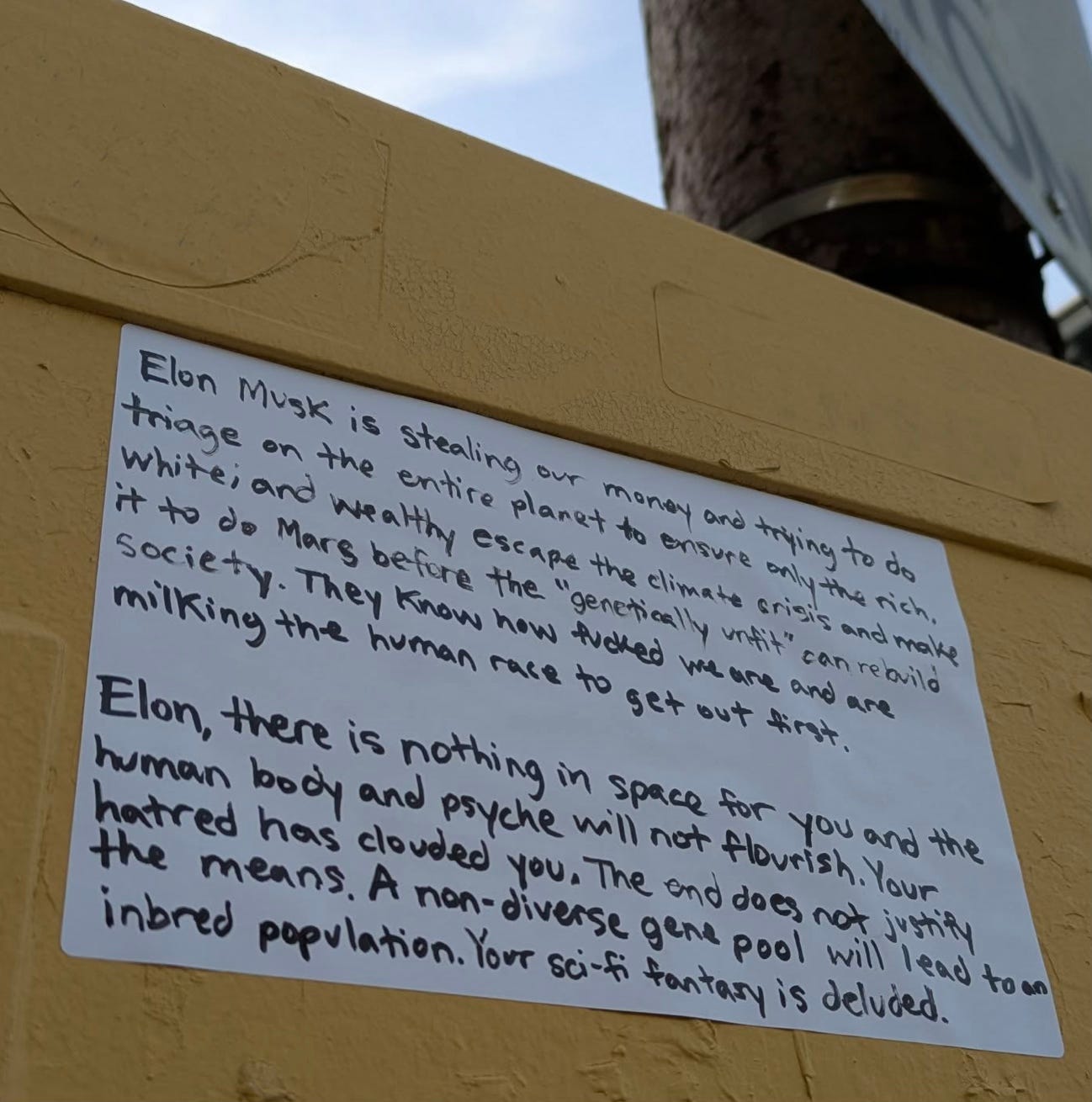
Print out little stickers. Write a message on them. Put them up on poles, in restrooms, at gas stations. Make them pithy, but focus on the person you might imagine reading it. Don’t lead with “Trump and Musk are fascists” however true that might be. The people for whom that message is appealing are already with us. Instead, say “Trump and Musk don’t care about you.”
Buy some chalk. Put it in your bag. Find a good spot and write in big bold letters “Trump and Musk look out for billionaires. Who is looking out for you?”
Go to a Federal Building. Go to a Tesla dealership. Stand on a highway overpass. Hold a lonely cardboard sign for an hour. Take a picture. Send it to everybody you know. Post it on social media. Yes, in a try-hard, show-offy, circa-2020 way. You’re not doing it for do-gooder credibility this time around (more on that in a bit). You want others to know that somebody is out there, that you too can be out there. Tell your friends that it felt inconsequential and awkward but that you’ll be back there next week, at the same time, and that you’d love it if they could join you.
The bigger protests are likely coming for your region, I promise. In the meantime, if you have the flexibility, find a way to D.C. Be like the woman from Alabama profiled in this lovely, bittersweet essay. Do you know how many protests are happening in Washington right now? So many. Show up at them. Meet the other people going to the protests (it’s still a tinier crowd than it should be). Meet the people organizing the protests. Ask how you can help.
Show up for and support other people’s efforts, even when you’re skeptical about them (I bet that you’re skeptical about many of the items on this list! I am too! But we should do some of them regardless!). Here’s another example: There’s currently a social-media driven call for a general strike. I’m nervous that it’s not the best approach, because I believe that successful general strikes require more coordination with labor movements and less with online influencers, but I could be wrong. And even if I’m right, the general strike proclaimers are trying! So I’m going to sign their strike card, and spread the word about what they’re doing. Because I don’t care about being right in this moment. I just want more people giving a damn and trying.
Call up the organization closest to you that supports your queer and trans neighbors, your undocumented neighbors, your homeless neighbors, your neighbors seeking abortions. Thank them for their work. Ask what they need right now.
If the organization needs volunteers, ask a friend to go with you to volunteer.
If the organization needs money, text five friends and say “I’m donating to _____ org and I’d like you to do so as well.” Think about something that brings you joy— baking or making music or writing strident essays on the Internet or dancing. Ask yourself, “could that be a fundraiser?”
Make cookies and deliver them to your neighbors. Ask if they’d be up to come to your house for coffee or a happy hour. Have the topic be, “Who in your life are you most worried about right now? What support do they need?” As neighbors, brainstorm what you all can do to care for everybody whose name came up around the circle.
Put up a little table outside of a grocery store with a sign that says ,“Have your grocery bills come down? Why not?” When people come to talk to you, give them instructions on how to call their Congresspeople right now. Listen to the voice in your head that says “nobody does that,” and then remember that actually conservatives have long done exactly that, and it’s been a big reason why they won some of their largest victories. You may be asked to leave. Do so politely. Go to another store.
Throw the best damn party you can imagine. Make it the party you’d like to attend. Do you like to bowl? Listen to death metal? Knit and sip tea? Dance through the night? Have a few beers at a kid friendly brewery while your offspring run about the place? Then let the party be about the thing, the thing you love. Put the word out so that people who also love that thing find about it. Get to know them. Tell them that the only cost of admission is you want ten minutes to speak about the actions they can take against Trump right now.
Speaking of Congress, yes keep calling them. Be nice to their staff, but don’t give a lick that Congressional Democrats are annoyed that constituents are lighting up their lines. If you are represented by a Republican, pick a specific policy that is hurting people in your district and tell them you disagree with their stance on the issue. If you are represented by a Democrat, tell them (politely, for the person who is answering the phone is overworked and underpaid) that they can shut down the government. The current funding deal is set to expire on March 14th. Tell them that they can hold sit-ins, or filibuster on the floor, or run non-stop press conferences with constituents whose services are already at risk. Pick a request and keep asking. Use this template. It’s good.
Text a few friends. Ask them, “Can we hold each other accountable to keep calling our reps? I keep forgetting to do it every day.” Make a text chain. Be kind to each other. Laugh a bunch. Celebrate the hell out each day’s Sisyphean-feeling calls. Ask how everybody’s doing, every single day.
A few days later, go back to the text chain. Ask, “has there been any movement from those elected officials we’ve been texting? Should we escalate? Should we consider sitting in at their local office? What would we need to know to do so?” Start planning.
Reach out to friends with care-giving responsibilities: for kids, for grand-kids, for elders. Ask them, “Hey, if a few of us were to watch your kids or run groceries to your dad tomorrow afternoon, what political action could you take? Would you spend some time researching what’s happening? Would you volunteer? Would you call? Would you hold your lonely sign?” Or alternately, if you’re somebody with care-giving responsibilities, take the risk of asking somebody— perhaps somebody who is a loose connection but that you want to get to know better— for help.
Subscribe to a newsletter that will keep the action alerts and the instructions about “what you can do” coming long after you forget about this list. Ignore, for the moment, whether you’re further to the left or further to the center than the list compiler. What matters is that there is always something to do, and blessed people have made it their life’s work to help make it easier for you. Every once in a while, send the action alert compilers a note. Tell them thank you. Ask if they need any help.
Recognize that so many of the boycotts whirling around the internet are probably too diffused and unorganized to truly bend the arc of history, but that they do matter, both for keeping the pressure on these cowardly profit-seeking, fascist-knee bending corporations, but also for the way they build intentionality and focus into our lives. Pick a company that’s been hard for you to boycott but that you’ve been tempted to quit– Target perhaps, or Meta, or Amazon. Start listing all the reasons why it’s hard. Text a friend “hey, I’d like to quit _____ but I can’t. Can you help me brainstorm how to make that change?”
Research mutual aid efforts in your area. If there isn’t one near you, research how to start one. Start showing up for their meal drop offs or their trash pick-ups or whatever it is that they’re doing. Discover that it’s simpler and more fun than you imagined. When people ask you how you’re doing, say “I’m trying a new thing– I’m getting involved with ______ mutual aid, have you heard of it?”
Regardless of whether you’re a parent, go to a school board meeting. During public comment, reiterate how much you value:
The district remaining a safe and welcoming place for queer and trans students.
The school district not cooperating with ICE.
The school continuing to teach accurate representations of U.S. history, multiculturalism and respect for all students’ backgrounds.
When you wonder “what right do I have to go to a school board if my topic isn’t on the agenda” remember those Moms For Liberty who caused all of that school board chaos a few summers ago… what right did they have to do so? And yet, there they were, creating a political moment out of nothing. You’re showing up for something real, something that matters. Your school board deserves to hear from you.
Remember that fascists hate unions, and one of the reasons why they’re winning is that union density is at an all time low. If your workplace has a union, throw yourself into it. If your workplace doesn’t, there are a whole bunch of people who would like to help you start one. If you don’t have a traditional workplace (like me), you might be surprised that there are unions for us as well. Join. Agitate. Know that we won’t turn the tide if we can’t get union density back in the double digits.
If you know and love a federal worker, particularly in a targeted agency, do something kind for them. If you’re a federal worker, particularly in a targeted agency, tell us what you need and how you’re doing.
Ask yourself how much of your political engagement is confined to spaces where everybody else is already aware of and angry about the same things that you are. Ask yourself, gently, “Should I just complain to the same friends?” “Do I need to spend all this time on Bluesky?” “Why am I only reading authors who tell me how bad everything is but not what we can do in response?” Instead, consider spending more time with folks who are highlighting everything that’s already being built and reminding us of how much power we actually have. I’m not saying that your time should be spent debating and getting in screaming matches with the most MAGA-loving person in your vicinity. Remember that most of your neighbors aren’t paying attention one way or another. This moment is about spreading the word: people are being hurt, and we should stand in opposition.
Again, whatever you do: broadcast it. It doesn’t have to be on social media, but that’s fine, too. Is that performative? Absolutely, but you’re not doing it for yourself. You’re doing it to model it for somebody else. Do you know why human beings attend artistic performances? To understand ourselves better through somebody else “performing” humanity in front of us. First comes the performance, then comes the repetition, then comes the integration into all of our lives.
Look back at this list. Think about the idea that you rolled your eyes at the hardest, the one that seemed least applicable or most scary to you. Look at it again. Ask yourself not “why can’t I do that?” but “what support would I need to do it?” Ask who in your life might be able to provide that support. Reach out to that person and say, “I have a crazy idea, but I need your help.”
If you don’t have anybody to reach out to, reach out to me. Really. I’m just a stranger on the Internet. I’m busy too. I’m balancing multiple day jobs and a couple kids (it’s a snow day today!) and piles of laundry that never disappear. I may take a while to get back to you. But I will. I won’t have all the perfect answers, but I’ll listen to you. My role, if you need it, isn’t necessarily to solve your problems. It’s to help you practice reaching out to others for support.
Both images from Pittsburgh Graffiti, a lovely account on a less than lovely website (Instagram)
One more thing you can do: Attend a training about how you can build and sustain activist communities. As luck would have it, I’m hosting those trainings and they’ve been so much fun. I call it the Barnraisers Project. There are five more coming up: free and virtual and (I am assured) a very good time. More info here and registration here.
If you appreciated this list (or the trainings, or my other essays) the biggest way you can help out is by sharing, spreading the word and subscribing (especially a paid subscription). This is my day job, and I’m doing my best to build a useful space for big-hearted but weary dreamers in this moment. Thanks for considering.
February 17, 1958 The first meeting of Britain’s Campaign for Nuclear Disarmament (CND) was held. CND developed the peace symbol which became its logo. CND history
February 17, 1975 Several hundred residents of Wyhl, Germany, occupied the site of a nuclear power plant with the intent of halting construction. The contractor had begun building despite a court order to suspend doing so. Police responded to the protesters with dogs, water cannon, and arrests. By the following week, however, over 25,000 had joined the occupation, and police withdrew for eight months. This is believed to have been the first such nuclear plant site takeover in the world. The occupation was nonviolent, and a sort of village sprang up with a “Friendship House” and a “popular university.” Local farmers supported the occupiers with food. Stand-off between anti-nuclear activists and police at Wyhl, Germany Following the negotiated withdrawal of the occupiers, a panel of judges permanently banned construction of the plant, and the land is now a nature preserve.