
The Associated Press reports:
Pete Hegseth, the Army National Guard veteran and Fox News host nominated by Donald Trump to lead the Department of Defense, was flagged as a possible “Insider Threat” by a fellow service member due to a tattoo on his bicep that’s associated with white supremacist groups.
Hegseth, who has downplayed the role of military members and veterans in the Jan. 6, 2021, attack and railed against the Pentagon’s subsequent efforts to address extremism in the ranks, has said he was pulled by his District of Columbia National Guard unit from guarding Joe Biden’s January 2021 inauguration. He’s said he was unfairly identified as an extremist due to a cross tattoo on his chest.
This week, however, a fellow Guard member who was the unit’s security manager and on an anti-terrorism team at the time, shared with The Associated Press an email he sent to the unit’s leadership flagging a different tattoo reading “Deus Vult” that’s been used by white supremacists, concerned it was an indication of an “Insider Threat.”
Read the full article. Last month Hegseth sat for an interview with anti-LGBTQ Christian nationalist Kirk Cameron.
Category: News / Information

CBPP Statement: November 14, 2024 – For Immediate Release
Republican Economic Proposals Would Harm the People Trump Promised to Help
Statement of Sharon Parrott, CBPP President, on key priorities for the 2025 policy agenda
While the new President and new Congress will not take office until early next year, they have already put forward an agenda — through Project 2025, Republican budget plans, and campaign proposals — that would increase poverty and diminish opportunity. Their proposals would raise costs for basics like housing, food, and health care and take health coverage away from people; slash funding for schools where our children learn, roads and bridges we use to get to work, and scientific and medical research that improve our health and strengthen our economy; double down on tax giveaways for wealthy households and corporations while imposing tariffs that fuel inflation; and further widen already glaring differences in people’s well-being and opportunity across income, race, and ethnicity.
These policymakers campaigned on promises to make the economy work better for people without big bank accounts who are trying to get ahead. But their proposals to date seldom match those promises.
Instead, a policy agenda designed to advance economic opportunity and racial justice and help families make ends meet would:
- Make it easier for people to afford housing, food, health care, and prescription drugs.
- Support children and families with an expanded Child Tax Credit, especially for children who don’t get the full credit today because their families’ incomes are too low; more affordable child care; and investment in our schools so that all of our nation’s children get what they need to thrive.
- Invest in the things that will keep the economy strong and growing, including basic building blocks like roads, bridges, and research, as well as protections that keep our communities’ food, air, water, and workplaces safe.
- Support these investments with a fairer federal tax system that requires wealthy households and corporations to pay their fair share and strengthens our fiscal outlook.
- Create an immigration system that recognizes the critical role that immigrants and their families play in our communities and the economy, eschewing harsh deportation regimes that separate families and embracing reforms that provide people with a workable opportunity to gain legal status and a pathway to citizenship.
This kind of policy agenda would build toward a nation where everyone — regardless of their income or their background — can get the health care they need, afford to put groceries on the table, live in safe homes and strong communities, and have the income, education, and child and home care they need throughout their lives. And it would reflect the truth that our nation succeeds only when all of us succeed.
We are eager to work with policymakers who put forward policies that advance this agenda and we — together with our partners — will work hard against policies that make people less economically secure, less healthy, and have less access to opportunity.
Peace & Justice History for 11/18:
| November 18, 1910 Hundreds of suffragists marched on the House of Commons in London, England, with reinforcements arriving to replace the “fallen” and arrested. Protesting government inaction on the Conciliation Bill, which would have enfranchised about a million women, they were brutally forced back by London police, leading to a public outcry. Read more |
November 18, 1964 FBI director J. Edgar Hoover publicly characterized Reverend Martin Luther King, Jr. as “the most notorious liar in the country.” King replied that Hoover “has apparently faltered under the awesome burden, complexities, and responsibilities of his office.”  The FBI vs. Martin Luther King Democracy Now |
| November 18, 1970 President Richard Nixon asked Congress for supplemental appropriations for the Cambodian government of Premier Lon Nol. Nixon requested $155 million in new funds for Cambodia — $85 million of which would be for military assistance, mainly in the form of ammunition. |
November 18, 1989 More than 50,000 people took to the streets of Sofia, the capital of Bulgaria, demanding political reform. In the biggest demonstration in the country’s post-war history, protesters held up banners and chanted: “We want democracy now.” Read more |
November 18, 1993 South Africa’s ruling National Party, and leaders of 20 other parties representing both blacks and whites, approved a new national constitution that provided fundamental rights to blacks and other non-whites, ending the apartheid system. South Africa held its first democratic multi-racial election on April 26, 1994.From the preamble: “WHEREAS there is a need to create a new order in which all South Africans will be entitled to a common South African citizenship in a sovereign and democratic constitutional state in which there is equality between men and women and people of all races so that all citizens shall be able to enjoy and exercise their fundamental rights and freedoms….”  South African citizens in line to vote. Constitutional history of South Africa (2 separate pages) |
| November 18, 2001 In London, 100,000 marched against the U.S. and British attacks against Afghanistan.  |
https://www.peacebuttons.info/E-News/peacehistorynovember.htm#november18
A Russian ballistic missile with cluster munitions kills 11 people and injures 84 in Ukraine’s north
https://apnews.com/article/russia-ukraine-missile-attack-sumy-5cd4f9fe2cee1ae8aed67d63c22b0703
Russia has been doing this, dealing out pain to the people of Ukraine while Biden refused to let him use the weapons to hit Russia making them feel the same pain. Biden now says OK when it looks like in three months there will be no choice but to give Russia what it wants or fight to the last person and lose anyway. It is sick, but tRump is a Russian / Putin toady. We failed to live up to a promise we made to Ukraine because of Biden’s out of touch fears from the 1950s. Hugs
========================================================
Share
KYIV, Ukraine (AP) — A Russian ballistic missile with cluster munitions struck a residential area of a northern Ukraine city, killing 11 people including two children and injuring 84 others, officials said Monday.
The two children killed in the strike on Sumy late Sunday were a 9-year-old boy and a 14-year-old girl, the regional prosecutor’s office said. Six injured children are in critical condition, it said.
The attack damaged 15 buildings, including two educational facilities, the prosecutor’s office said. A search and rescue operation continued Monday, on the eve of the war’s 1,000-day milestone.
Sumy lies 40 kilometers (24 miles) from the Russian border.
Also Sunday, U.S. President Joe Biden authorized for the first time the use of U.S.-supplied longer-range missiles by Ukraine to strike inside Russia, after extensive lobbying by Ukrainian officials.
The weapons are likely to be used in response to North Korea’s decision to send thousands of troops to support Russia in the Kursk region where Ukraine mounted a military incursion over the summer.
It is the second time the U.S. has permitted the use of Western weapons inside Russian territory within limits after permitting the use of HIMARS systems, a shorter-range weapon, to stem Russia’s advance in Ukraine’s Kharkiv region in May.
The first reaction from Ukraine to the long-awaited decision from the U.S. was notably restrained.
“Today, much is being said in the media about us receiving permission for the relevant actions. But strikes are not made with words. Such things are not announced. The missiles will speak for themselves,” Ukrainian President Volodymyr Zelenskyy said in his nightly video address.
Earlier, Zelenskyy said that Russia had launched a total of 120 missiles and 90 drones in a large-scale attack across Ukraine, including Sumy. Russia deployed various types of drones, he said, including Iranian-made Shaheds, as well as cruise, ballistic and aircraft-launched ballistic missiles.
The attack, which targeted Ukraine’s energy infrastructure, came as fears are mounting about Moscow’s intentions to devastate Ukraine’s power generation capacity ahead of the winter.
Ukrainian defenses shot down 144 out of a total of 210 air targets, Ukraine’s air force reported.
“The enemy’s target was our energy infrastructure throughout Ukraine. Unfortunately, there is damage to objects from hits and falling debris. In Mykolaiv, as a result of a drone attack, two people were killed and six others were injured, including two children,” Zelenskyy said.
Two more people were killed in the Odesa region, where the attack damaged energy infrastructure and disrupted power and water supplies, said local Gov. Oleh Kiper. Both victims were employees of Ukraine’s state-owned power grid operator, Ukrenergo, the company said hours later.
The combined drone and missile attack was the most powerful in three months, according to the head of Kyiv’s City Military Administration, Serhii Popko.
One person was injured after the roof of a five-story residential building caught fire in Kyiv’s historic center, according to Popko.
A thermal power plant operated by private energy company DTEK was “seriously damaged,” the company said.
Russian strikes have hammered Ukraine’s power infrastructure since Moscow’s all-out invasion of its neighbor in February 2022, prompting repeated emergency power shutdowns and nationwide rolling blackouts. Ukrainian officials have routinely urged Western allies to bolster the country’s air defenses to counter assaults and allow for repairs.
Russia’s Defense Ministry on Sunday acknowledged carrying out a “mass” missile and drone attack on “critical energy infrastructure” in Ukraine, but claimed all targeted facilities were tied to Kyiv’s military industry.
Although Ukraine’s nuclear plants were not directly impacted, several electrical substations on which they depend suffered further damage, the U.N.’s nuclear energy watchdog said in a statement Sunday. According to the International Atomic Energy Agency, only two of Ukraine’s nine operational reactors continue to generate power at full capacity.
The Russian military said Monday it intercepted and destroyed 59 Ukrainian drones overnight over several Russian regions. Two were downed over the Moscow region that surrounds the Russian capital, and three others over the neighboring Tula region. A total of 54 drones were destroyed over the Bryansk, Kursk and Belgorod regions on the border with Ukraine, according to a statement by the Russian Defense Ministry.
Moscow Mayor Sergei Sobyanin said the drones shot down outside of Moscow were heading toward the capital.
========================================
Follow AP’s coverage of the war in Ukraine at https://apnews.com/hub/russia-ukraine
Kullab is an Associated Press reporter covering Ukraine since June 2023. Before that, she covered Iraq and the wider Middle East from her base in Baghdad since joining the AP in 2019.

Numbers Don’t Lie
With thanks to Tengrain at MPS:
More Sunday AM General Reading
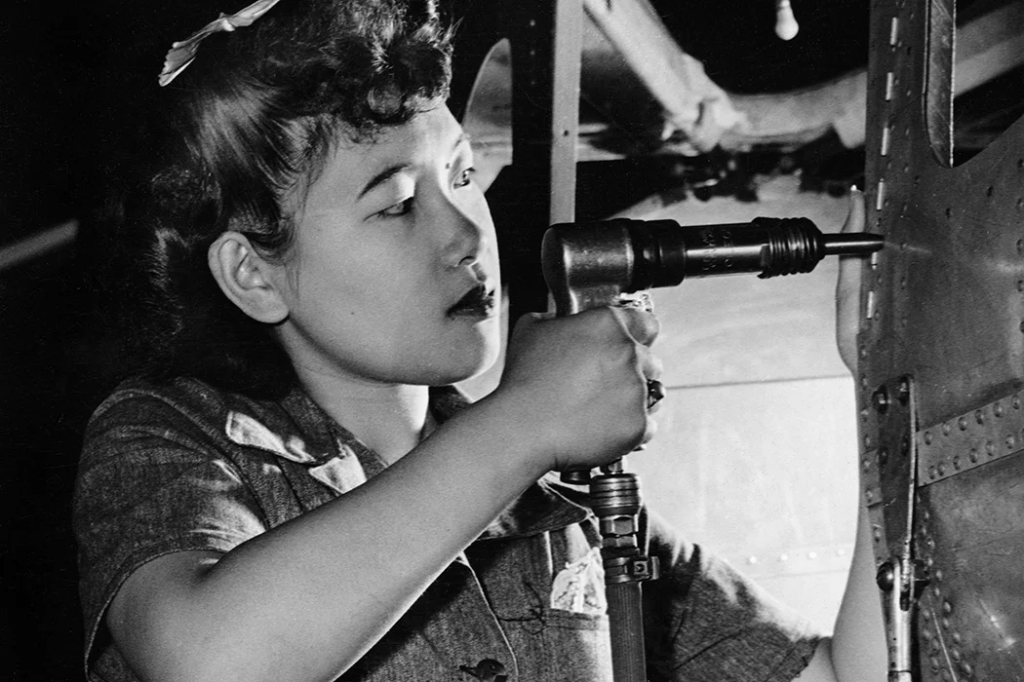
Could “Rosie the Riveter” Be Chinese American?
Despite having their citizenship withheld before the war, Chinese American women in the Bay Area made significant contributions to the wartime labor force.
By: H.M.A. Leow
Amid the social upheaval of World War II, women entered the American workforce on an unprecedented level. And, for younger Chinese American women in the San Francisco Bay Area, the war made it possible to smash not just entrenched gender barriers, but racial ones as well.
“To a large extent, the war provided an entry for Chinese American women into the larger American society, something for which their ancestors had struggled a hundred years,” writes historian Zhao Xiaojian, who argues that second-generation Chinese American women “grasped the wartime opportunity to enter the larger American society” by joining the Bay Area’s defense industry.
“Partly because of a scarcity of English-language sources on this topic, some scholars simply have assumed that Chinese American women did not share the experience of ‘Rosie the Riveter,’” she reports. But she uses newspapers, company records, and oral histories to push back on this view.
Many Chinese American women already worked out of economic necessity. Yet racial discrimination and social isolation typically restricted them to jobs in Chinatown enclaves.
“It was difficult for many Chinese American women to go outside their communities to work, even when they wanted to,” Zhao explains. “The decades-long isolation had also limited the ability of immigrant Chinese working women to communicate with the outside world.”
During the war, women were also encouraged to adopt domestic roles—preparing “nutritional food” for their families and “show[ing] our fighting men that we are… absolutely behind them.”
But World War II still marked a major turning point—especially for younger, unmarried daughters of Chinese immigrants. Many of these women had either a high school or college-level education.
“With relatively few household responsibilities, in contrast to their mothers, they had the freedom and independence to work outside the home,” Zhao writes. “Since most of them were already living in the Bay Area before the war, these younger Chinese American women were among the first American women to join the Bay Area’s defense labor force.”
In fact, Zhao’s research turned up only four women who were older than forty during their wartime jobs. Still, those wives and mothers capably juggled their duties at home and on the home front. (snip-More; it’s a worthy click!)
Portico’s Part in Telling the Story of Emmett Till
The Emmett Till Memory Project teaches new generations about the tragedy that kickstarted the Civil Rights Movement. Preserving its digital assets is vital.
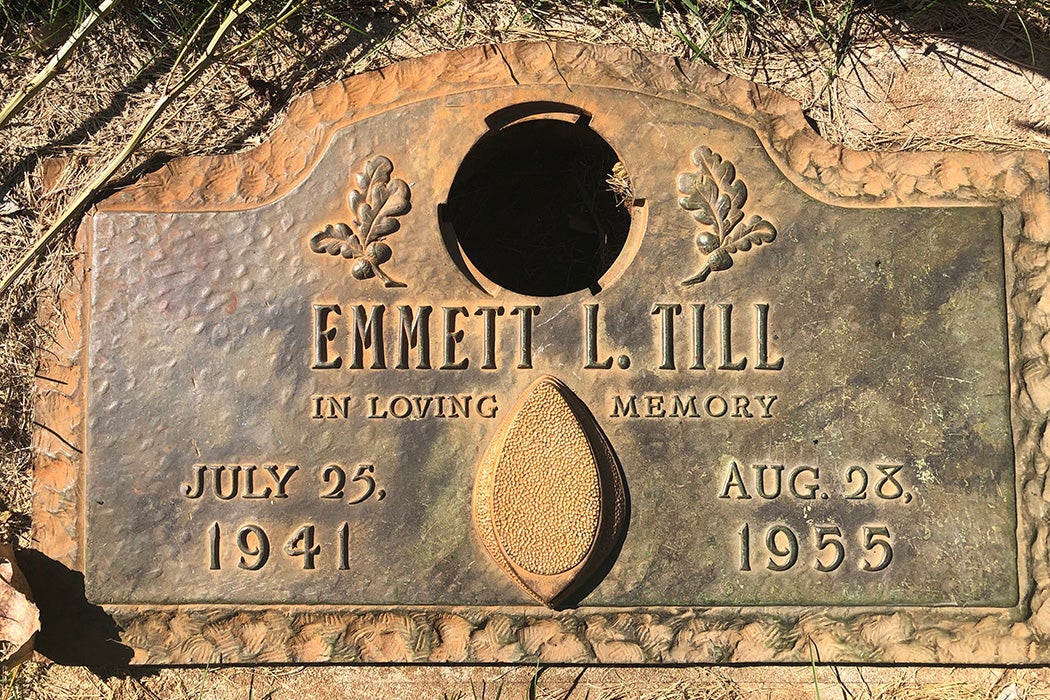
Emmett Till Headstone
Photo by Dave Tell via ETMP
By: Sara Ivry
On a late August day in 1955, Emmett Till was murdered in Mississippi. A fourteen-year-old African American from Chicago, Till stopped with his cousins at Bryant’s Grocery & Meat Market to buy chewing gum. There, Till whistled at the clerk, a brazen act that violated the norms of the Jim Crow South and so angered the clerk’s husband and brother-in-law that they killed the boy.
The events and locations that tell the story of Till’s life and death have been memorialized in different ways and forms over the ensuing decades. The Emmett Till Memory Project (ETMP), an app, is one of them. It uses digitized archival documents, photos of those involved and of sites central to that fateful August day, and more so that users may educate themselves about who Emmett Till was and why his death still resonates. The ETMP’s digital assets are vital to ensuring the ongoing preservation of Till’s memory as well as his legacy.
That’s where Portico comes in. Dedicated to digital preservation, Portico has partnered with the ETMP to ensure the safekeeping in perpetuity of these digital artifacts.
Historian Dave Tell, a professor of communication studies at the University of Kansas, as well as the co-founder and director of the Emmett Till Memory Project, spoke with JSTOR Daily’s Sara Ivry about the Project and why its partnership with Portico is so critical.
Sara Ivry: How did you first learn of Portico?
Dave Tell: Kate Wittenberg reached out to me as part of the DEI efforts of her organization, specifically, a pilot project to support the preservation of archival content about under-represented topics that might be at risk. Kate contacted me about the time that we were massively reorganizing the Emmett Till Memory Project. She asked if she could just come along and preserve the site as it existed. I said, “Well, yes, you can, but we’re also trying to make it way better.” She sat in on development meetings over the last few years with us and has been an integral partner, not only in helping us think about preserving the site but helping us make design decisions that would render the site preservable.
Can you describe a little what the site was before you revamped it and what you were trying to do in the renovation?
The short story is we went live in October of 2019, and then in the pandemic, we used our last $10,000 of grant money to pay a DEI consultancy to tell us what we did well and what we did poorly. They did this entire audit, focus groups, they talked to the family, they talked to scholars. They looked at analytics, and they came back to us. Essentially, they told us great content, very bad design, which in retrospect is not surprising. Everyone on the project had been a content expert; we had never had design people on board. We had never had UX people.
The design only works for people who already know the story, they told us, which of course was a devastating blow to us. They also said this reads as if it was written by a middle-aged white guy and I’m like, “Well, I wrote it and I’m a middle-aged white guy—so fair enough.”

So, we hired a woman named Renee Payne out of the Rhode Island School of Design who runs a graphic design firm called included. She specializes in computer design for veterans of the Civil Rights movement; her clients include the families of Andy Young, Harry Belafonte, and family of Malcolm X. She assembled a team of young designers of color, and I said to them, “Nothing is sacred here. Let’s make this as good of a project as it can be,” and they reimagined it from the ground up.
When exactly then did Portico come on board?
Kate came in in the middle of this revamped process, and one of the specific things she encouraged us to do was to avoid third-party dependencies. The example that I understood was if you embed a YouTube video, your content is only as secure as YouTube, which you have no control over.
We really thought long and hard about what technologies we could preserve, and Kate and her colleague Karen Hanson pushed us to think about what exactly we’re preserving. The technologies we are currently depending on do not last forever, right? We changed our mindset. We don’t want to preserve this project so that like it will look the same for everyone into the future, but we want to preserve the assets.
Make images preservable, the text—the component parts.
Eventually we’re going to have a lot of immersive stuff on there. It’s only halfway there now. Portico helped us understand better to preserve the components that make up immersive pieces. In the future, people can use whatever technology is then current, use our same data, and create their own project.
I hadn’t thought about the built-in obsolescence of technology, and that we have to account and plan for that in the design of an app or site as well as in the design of an archive. Had you considered that before Portico got involved?
No, I’m a humanist by training, so when I first started thinking about digital preservation, probably a decade ago now, my gut instinct was we make the website just like a book. It’ll sit there unchanged forever. And Portico has been instrumental in changing the way I think about preservation—that first of all, forever might not be the goal.

Second, what gets preserved is not necessarily the sort of same experience that our users have today. What really matters and what needs to be preserved is what we have. The Emmett Till Memory Project has amazing artifacts. We have hours of audio with the family that they’ve given us permission to use that no one else has. We can tell the story in incredibly intimate ways and that’s super important. When you open this app, you’ll hear the voice of Reverend Wheeler Parker, Till’s cousin, narrating the story as all this stuff flashes on the screen behind you—I don’t care if the flashy, immersive technologies are preserved forever. But I care deeply that the audio files—and the voice of Rev. Parker—gets preserved. Someone else can build their own tools with that stuff. My ability to make that distinction is a testament to Kate and Portico.
Why is digital preservation of these assets critical in any case?
It’s almost hard to answer this question without going into cliche other than to say: Ignoring the past is a critical component of white supremacy. Full stop. What we want to do and what the family wants to do is tell the story—not that telling the story is sufficient for the change that they and I want to see, but it’s a critical part of the change that they and I want to see.
The Interpretive Center—what’s the first line of their mission statement, “We believe that racial reconciliation begins with telling the truth,” right?—that’s a sentence that accurately describes the vision of the Till family and it certainly describes my vision.
What was the origin of this app?
If you start from the murder of Emmett Till in August 1955 you have to count 49 years and 11 months before the state of Mississippi dropped a single dollar on the Till story. Eighteen citizens of Tallahatchie County thought that was ridiculous; they put up a commemorative sign that got shot, defaced with acid, spray painted.

In 2014, I got invited to go down, I’d been writing about Till for a decade and a half by then, and the question was: How do we tell Till’s story in the context of vandalism?
It’s easy to shoot a sign in the middle of the country. It’s harder to shoot an app.
What are some of the assets on the app that stand out to you?
My favorite by far are the hours of audio, oral history we have of Reverend Parker that was taken in his church in Chicago. We also drove him from site to site; we put a microphone on his lapel and on the sun visor of the car. And we just asked him what these sites meant to him as we went from place to place. All that audio’s not up yet, but we have it. (snip-a bit More)
Some Resources
They’re accepting support, and offering support. Snippets here; there is more info about each on the page here:
https://www.them.us/story/trans-mutual-aid-funds-donate-support
This year’s Transgender Awareness Week (the leadup to Trans Day of Remembrance on November 19) has felt particularly macabre, arriving on the heels of a presidential election that will be disastrous for trans rights. Still, there’s never been a better time to help trans communities across the U.S. find shelter, obtain medical care, and protect themselves from state violence — and if you’re reading this, you can help by getting involved in mutual aid.
Although there are plenty of well-known LGBTQ+ nonprofit organizations and advocacy groups throughout the country, mutual aid funds prioritize giving directly to marginalized people in need, in order to survive crises and improve their material conditions. Numerous trans-led mutual aid funds exist on local, state, regional, and national scales, and while many may not be tax-deductible, we think that’s a small price to pay in order to help trans folks find safe shelter, obtain gender-affirming care, change legal identity documents, and more.
The phrase “we keep us safe” may have originated in prison abolition organizing, but it definitely applies to LGBTQ+ folks as well. Below, we’ve highlighted just a few trans mutual aid funds that are open to donations — or applications for assistance, if the trans person in need is you — as of November 2024. For more, check out our state-by-state list of mutual aid funds and advocacy groups. You can also search for #TransCrowdFund on your preferred social media platform to find individual trans people fundraising for their own needs.
Organized by the Louisville, Kentucky-based nonprofit Change Today, Change Tomorrow, the Black Trans Fund offers “unrestricted assistance” for Black trans, nonbinary, and gender-nonconforming people. According to organizers, the fund has distributed over $35,000 for “bills, travel, food, medical needs, and recreational needs” over its four years in existence. Donations are tax-deductible. (snip)
Based in Utah, Genderbands offers individual grants for trans people seeking help with medical costs (including surgeries for those over 18), travel, name and identity document changes, and special grants for trans youth with parental consent. Any trans person in the U.S., Canada, or Mexico may apply, although surgical grants are limited to U.S. residents; the application period for 2025 grants, including one dedicated grant for a masculinizing top surgery procedure in Salt Lake City, ends November 30. Donations of gently used binders are also accepted. (snip)
A project of the Iowa Mutual Aid Network, this fund is dedicated to providing aid for gender-affirming medical care throughout the state, and has distributed over $100,000 since 2021, according to its website. Grant seekers may apply every month, and may receive funding for hormone therapy, surgeries, therapy, and some other medical fees, as well as name change costs, travel expenses for medical care, and gender-affirming clothing. (snip)
One of the largest trans-led mutual aid networks in the U.S., Point of Pride has raised millions for trans mutual aid through its annual TikTok fundraisers. The organization funds gender-affirming surgeries, hormone therapy, hair removal, clothing, and more through its various dedicated funds, and offers free binders and shapewear for those who cannot afford to buy their own. In 2024, Point of Pride reported giving $163,000 to 117 trans people through their HRT Access Fund alone, including 49 Black recipients thanks to funding from the National Black Trans Advocacy Coalition. (snip)
Socialist Trans Initiative (STRIVE)
Based in Pensacola, Florida, STRIVE’s anticapitalist organizers say their mission is to “provide moral and material support to trans people who need it,” in the form of emergency housing, hormone therapy, food support, transportation, and “any other items needed for our survival.” In addition to its aid funds, STRIVE also holds trans community events and weekly political organizing meetings. (snip)
Although most of its organizers are based in Missouri, Transitional Justice seeks to facilitate travel and “temporary, transitional housing” for trans people fleeing harmful legislation throughout the U.S., as well as “people who have been evicted from their homes, fired from their jobs, or denied access to healthcare.” Applicants can request assistance by filling out the organization’s web form. (snip)
Founded in 2013 through the South Carolina nonprofit We Are Family, the Trans Love Fund offers microgrants up to $200 for assorted “medical, legal, and emergency living expenses.” Grants are available to trans South Carolinians ages 16 and older, with applications opening one week out of every month (usually the first week, per the fund’s FAQ). We Are Family also operates the “Closet Case Thrift Store,” which offers free gender-affirming clothing to trans and gender-nonconforming youth. (snip)
Got our vaccines and tRump’s admin plan to put migrants in for profit prisons
We got our vaccines and tRump’s plan for mass for profit prison detention camps for migrants.
There are some distortions because I moved a lot due to pain in my hips and back. But it looks OK but if you want just listen to the audio. I put a lot of effort into the video. Hugs
Peace & Justice History for 11/15:
| November 15, 1917 About 20 women peacefully picketing for universal suffrage (right to vote), who had been arrested in front of the White House a few days earlier, were subjected to beatings and torture at Occoquan workhouse in Virginia. The National Women’s Party and other organizations had been picketing the White House and President Woodrow Wilson as he traveled around the country ever since the inauguration of his second term.   Mary Winsor The incident became known as the “night of terror.” Wilson had led the country into the European war (later called World War I), by characterizing the U.S. mission as “making the world safe for democracy.” The women demonstrating outside in Lafayette Square called attention to the need for complete democracy at home, where half of its citizens lacked complete voting rights. Many women, including Lucy Burns and Alice Paul, had been arrested several times, usually for obstructing the sidewalk, and imprisoned before. When a judge learned of the abuse he freed the women. Public outrage over their treatment increased sympathy for the suffrage movement.   left: Lucy Burns in Occoquan Workhouse, Washington, DC. right: Alice Paul, New Jersey, National Chairman, Congressional Union for Woman Suffrage; Member, Ex-Officio, National Executive Committee, Woman’s Party, ca 1915. Amazing resources from the Library of Congress on women’s suffrage |
| November 15, 1940 75,000 men were called to Armed Forces duty under the first peacetime conscription.  Draft inductees leaving Wilmington, Delaware in November, 1941 |
| November 15, 1943 Heinrich Himmler, Adolf Hitler’s head of the SS (Schutzstaffel or protective rank), Gestapo, the Waffen SS and the Death’s Head units that ran the concentration camps, made public an order that Gypsies (more properly the Roma) and those of mixed Roma blood were to be put on “the same level as Jews and placed in concentration camps.”  Gypsy prisoners arriving at a Concentration Camp  Himmler was determined to prosecute Nazi racial policies, which dictated the elimination from Germany and German-controlled territories of all races deemed “inferior,” as well as “asocial” types, such as hardcore criminals. Gypsies fell into both categories according to the thinking of Nazi ideologues and had been executed in droves both in Poland and the Soviet Union. The order of November 15 was merely a more comprehensive program, as it included the deportation to the Auschwitz death camp of Gypsies already in labor camps. The Gypsies in Germany Gypsies: Forgotten Victims of the Holocaust |
| November 15, 1957 U.S. Committee for a Sane Nuclear Policy (SANE) was founded. Thirty years later on November 20, SANE merged with the Nuclear Freeze organization (dedicated to freezing all nuclear weapons testing worldwide) at a joint convention in Cleveland to form SANE/FREEZE. Its successor is known as Peace Action, the largest U.S. peace organization.  Sane Nuclear Policy poster, 1960 SANE history Peace Action |
| November 15, 1969 Following a symbolic three-day “March Against Death,” the second national “moratorium” against the Vietnam War opened with massive and peaceful demonstrations in San Francisco and Washington, D.C. Organized by the New Mobilization Committee to End the War in Vietnam (“New Mobe”), an estimated 500,000 demonstrators participated as part of the largest such gathering to date.   It began with a march down Pennsylvania Avenue in front of the White House (while Pres. Nixon watched the Purdue-Ohio State football game on TV) to the Washington Monument, where a mass rally with speeches was held. Pete Seeger, Arlo Guthrie, Peter, Paul and Mary, and four different touring casts of the musical “Hair” entertained the demonstrators. The rally concluded with nearly 40 hours of continuous reading of known U.S. deaths (to that date) in the Vietnam War. |
| November 15, 1986 A government tribunal in Nicaragua convicted American Eugene Hasenfus, a CIA operative, of delivering arms to Contra rebels and sentenced him to 30 years in prison. He had been arrested when his plane was shot down by Sandanista troops. He was pardoned a month after his conviction (his last name means “rabbit’s foot” in German).  Hasenfus under arrest |
https://www.peacebuttons.info/E-News/peacehistorynovember.htm#november15

