April 26, 1954 The Geneva Conference began for the purpose of bringing to an end the conflicts in Korea and Indochina. This followed the defeat of the French in Vietnam at Dien Bien Phu. France had been trying to reassert colonial control over Indochina following World War II. The conferees included Cambodia, France, Laos, the People’s Republic of China, the Democratic Republic of Vietnam, the Soviet Union, Vietnam, the U.S. and the United Kingdom. As a result, Vietnam was temporarily partitioned pending elections on reunification to be held in 1956; those elections were never held.
April 26, 1966 Rodolfo “Corky” Gonzales Rodolfo “Corky” Gonzales founded the Crusade for Justice, a Chicano activist group, in Denver, Colorado, and marked his departure from the Democratic Party. It was the beginning of a nationalist strategy for the attainment of Chicano civil rights. Read more video Democracy Now
April 26, 1968 A national student strike against the Vietnam war enlisted as many as one million high school and college students across the U.S.
April 26, 1986 A major accident occurred at the Chernobyl nuclear power plant in the Ukraine near the border with Belarus, both then part of the Soviet Union (Union of Soviet Socialist Republics). An explosion and fire in the No. 4 reactor sent radioactivity into the atmosphere. Only after Swedish authorities reported the fallout over their country 1385 km away (860 miles), did Soviet authorities reluctantly admit that an accident had occurred. During a fire that burned for 10 days, 190 tons of toxic materials were expelled into the atmosphere (3% of the reactor core). Winds blew 70% of the radioactive material into neighboring Belarus. The explosion at Chernobyl was the world’s largest-scale nuclear accident. Approximately 134 power-station workers were exposed to extremely high doses of radiation directly after the accident. About 31 of these people died within 3 months. Another 25,000 “liquidators”—Soviet soldiers and firefighters who were involved in clean-up operations — have died since the incident of diseases such as lung cancer, leukemia, and cardiovascular disease. 400,000 were evacuated and over 2,000 towns and villages were bulldozed to the ground in areas considered permanently contaminated. Deaths and illnesses directly attributable to radiation exposure continue. “Chernobyl is a global environment event of a new kind. It is characterized by the presence of thousands of environmental refugees, long-term contamination of land, water and air, and possibly irreparable damage to ecosystems.” – Christine K. Durbak, Chairwoman of the World Information Transfer, New York Chernobyl for Kids
April 26, 1998 Bishop Juan Gerardi Conedera Bishop Juan Gerardi Conedera, a leading human rights activist in Guatemala, was bludgeoned to death two days after a report he had compiled was made public. The report blamed the U.S.-backed Guatemalan military government and its agencies for atrocities committed during Guatemala’s 36-year civil war. About Bishop Gerardi’s murder (Democracy Now)
On Tuesday, the Department of Health and Human Services and the Food and Drug Administration announced a series of measures to phase out eight artificial food dyes and colorings from America’s food supply by the end of next year. Get ready for boring Cheetos.
RFK Jr, the nation’s laughingstock of a Health Secretary, said, to a crowd of “Make America Health Again” supporters (that’s a thing?), “I just want to urge all of you, it’s not the time to stop; it’s the time to redouble your efforts, because we have them on the run now, and we are going to win this battle.” Who do we have on the run? Food colorers? The Easter Bunny? He also said, “And four years from now, we’re going to have most of these products off the market, or you will know about them when you go to the grocery store.”
Are they sure that brain worm is dead?
FDA Commissioner Dr. Marty Makary said the agencies are looking to revoke authorization for two synthetic food colorings and to work with the food industry to eliminate six remaining synthetic dyes used in cereal, ice cream, snacks, yogurts, and more. They’re going to fuck up ice cream.
He said, “Today, the FDA is taking action to remove petroleum-based food dyes from the U.S. food supply and medications. For the last 50 years, American children have increasingly been living in a toxic soup of synthetic chemicals.”
Now get this. These bans will be voluntary with the food companies. RFK Jr. said, “We don’t have an agreement; we have an understanding.” Good luck with that, Mr. Wormy Bear Killer.
The food companies would like an agreement, and that is for there to be one federal regulation on food dyes, and regulations from every state. Remember state rights? That will be the case for abortions but not for the color in Cheetos. (Snip-MORE + Chicago trip stuff)
======================
The three branches of government, 2025 by Ann Telnaes
April 24, 1915 The Ottoman Turkish government arrested 200 of the most prominent political and intellectual leaders of the Armenian community in the capital, Constantinople (now Istanbul). These men and hundreds more were then imprisoned from throughout Anatolia (present-day Turkey) and, shortly thereafter, most were summarily executed. This is the day on which the genocide of more than a million Armenians is commemorated: when the intention of the Turkish government to eliminate the Armenian people became clear. Already Armenian recruits in the Ottoman Turkish army had been disarmed and organized as laborers working under slave-like conditions. The plan for Armenian genocide from University of Michigan-Dearborn
April 24, 1916 The Easter Uprising began when between 1,000 and 1,500 members of the Irish Republican Brotherhood attempted to seize Dublin and issued the declaration of Irish independence from Britain. The seven signatories of the Irish Proclamation Read about the Proclamation Read more
April 24, 1934 This editorial cartoon appeared in New Masses magazine. It refers to the attempt of anti-radical vigilantes and repressive college administrators to disrupt the first national student strike against war.
April 24, 1962 President John F. Kennedy authorized high-altitude atmospheric testing of nuclear weapons to determine whether missile-borne warheads could be used to black out military communications.
April 24, 1967 At a news conference in Washington, D.C., General William Westmoreland, senior U.S. commander in South Vietnam, said that the enemy (considered to be North Vietnam and the Viet Cong southern insurgents) had “gained support in the United States that gives him hope that he can win politically that which he cannot win militarily.”Though he said that ninety-five percent of the people were behind the United States effort in Vietnam, he asserted that the American soldiers in Vietnam were “dismayed, and so am I, by recent unpatriotic acts at home.” This criticism of the anti-war movement was not received well by many in and out of the movement, who believed it was both their right and responsibility to speak out against the war. General Westmoreland meeting President Lyndon Johnson later in 1967, Cam Ranh Bay, Vietnam
April 24, 1971 500,000 demonstrated against the Vietnam War in Washington, D.C. It was the largest-ever demonstration opposing U.S. war; 150,000 marched at a simultaneous rally in San Francisco.
April 24, 1987 On the World Day for Laboratory Animals, nationally coordinated demonstrations occurred in California, Arizona, Florida, New York, Minnesota, Louisiana, Michigan, Pennsylvania, Nevada, Tennessee, and other states. It was the largest display of civil disobedience for animal rights ever. Hundreds of activists across the country blocked access to university laboratories and more than 150 were arrested nationwide. The day was designated to bring attention to the treatment of lab animals used in testing of medical and other products, sponsored in Congress by the late Tom Lantos (D-California). World Day Laboratory Animals
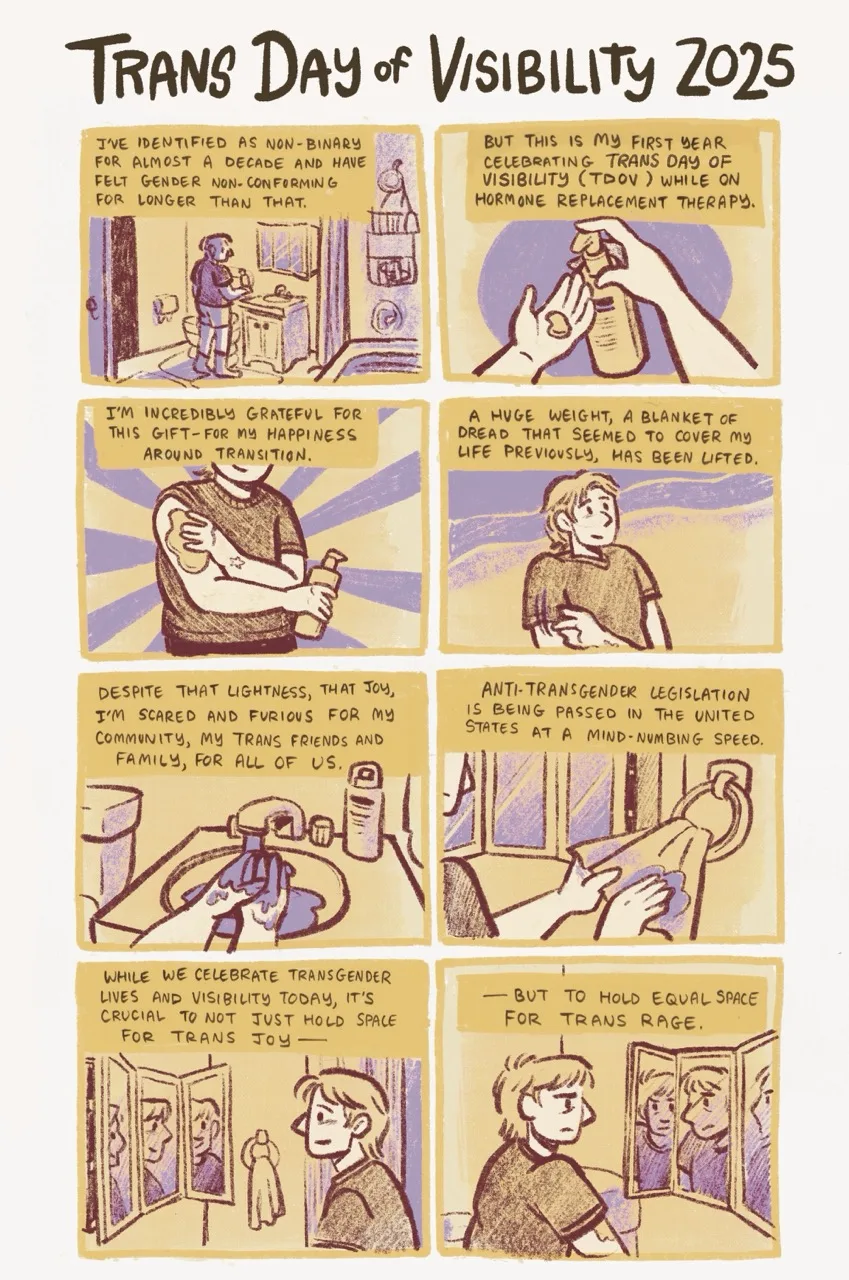
(Having only just now (10 PM Sunday) opened the email with this comic, I’m quite late; I’d saved it for a possible post, and it got buried. No matter, though; the message is good for more than one day, IMO. Everyone should be welcome everywhere every day, as they are welcome here. So, enjoy a comic. -A)
If you look past the Matt Walsh crap Hasan gets to talking about people who are passing as the gender they identify as. And that is one reason why the red states are pushing so hard to trans block kids from using puberty blockers while allowing them for cis kids, they work and are safe but the trans kids won’t go through the wrong puberty giving them the wrong features we normally associate with genders. These people are terrified they won’t recognize who is trans because they pass so well. It shouldn’t be the issue I know as many wonderful trans people who had to go through the wrong puberty are still the gender they know and identify as. Sadly two things are at work. The two groups working together to stop trans positive or any positive LGBTQ+ inclusion / equality are the fundamentalist religious groups who think the entire world should run according to their faith … yet they have different faiths so … and the republican politicians who use it as a way to win votes and keep their base outraged. Both groups have their own agenda and they both ignore science and facts to create the narrative / outrage they desire rather than create a peaceful loving inclusive society. Oh I guess I forgot the white supremacist Nazi’s but they really fall under the Fundamentalist Christian banner right? Hugs.
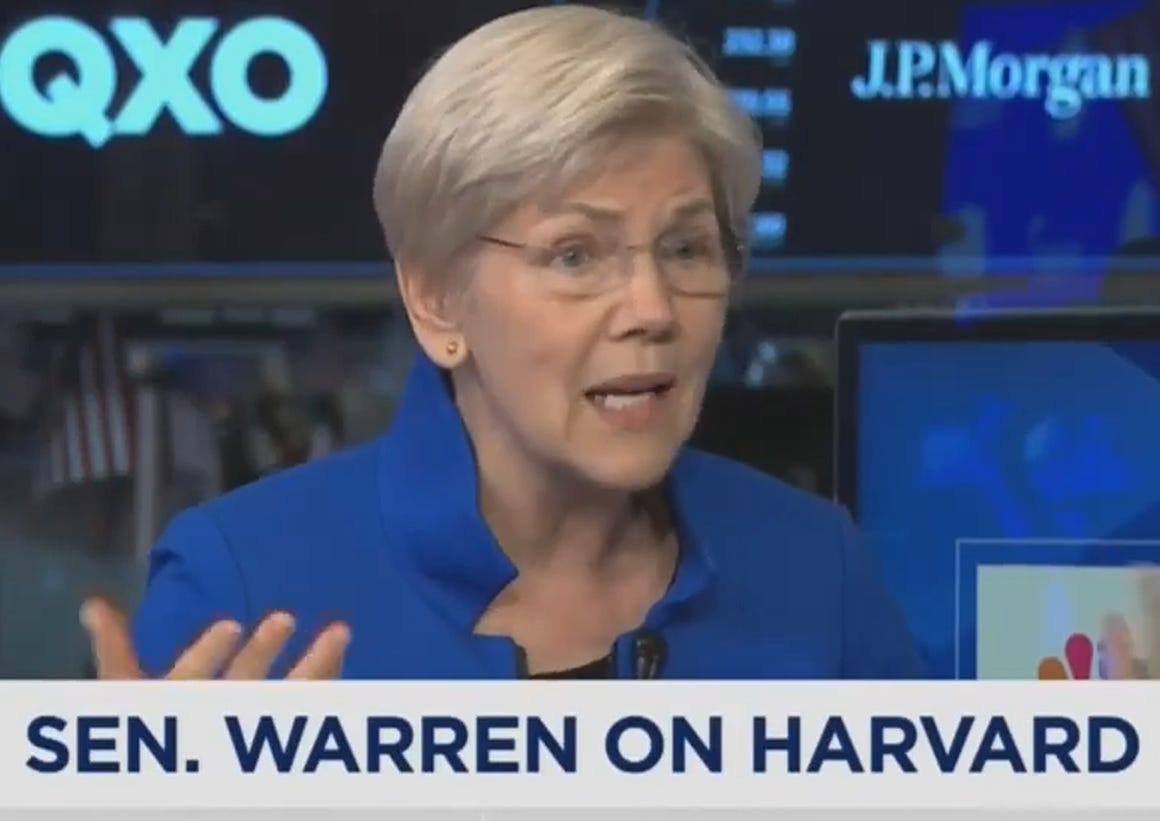
Snippet-go read this, the videos are delightful- Sen. Prof. Warren remains outstanding!
Oh yeah, baby, talk dirty to us.
Professor Senator Elizabeth Warren stopped by CNBC’s “Squawk on the Street”on Friday for some chattin’ and some rantin’ and some tarriffsplainin’ for the benefit of the show’s blow-dried hosts. We don’t normally watch financial news shows, because what are we, the Vanderbilts? But put Warren on anytime, and we’ll consider tuning in more. She can be entertaining!
Especially if your anchor isn’t following her argument, which sends her into her professorial did-you-not-do-the-reading voice. Which is what happened to Sara Eisen, who must have thought for one moment that she was back at the Medill School and had skipped that week’s assignment. (snip)
Black Mirror, eat your heart out. Researchers have apparently just figured out how to make people see a color completely new to humanity.
Scientists at the University of California, Berkeley conducted the research, published Friday in Science Advances. Using a technique called Oz, the research team induced human volunteers into seeing a color beyond the “natural human gamut.” Oz could allow scientists to conduct experiments previously not possible before, the authors say, and the lessons we learn from it might even someday help color-blind people regain their missing color vision.
Our retinas contain certain photoreceptive cells, known as cones, that allow us to see color. There are three cone types that correspond to different wavelengths of light: short-wavelength (S) cones, medium-wavelength (M) cones, and long-wavelength (L) cones.
Typically, when we try to reproduce color in front of someone’s eyes, we do so by manipulating the spectrum of light seen by the retina’s cones. But since some of our cones, particularly M cones, share overlap in how they respond to certain wavelengths, there are theoretically colors out there that our eyes can never truly see. The UC Berkeley researchers, based on their earlier work studying cone cells, say they’ve found a way around this limitation. (snip)
What is the South African Renewable Energy Masterplan?
It is an industrial strategy that sets out how South Africa can set up a new manufacturing industry in renewable energy and battery storage value chains.
The masterplan was developed by the government, some sections of organised labour, a non-profit organisation advocating for renewable energy, and representatives of the renewable energy industries. It sets out a framework to produce renewable technologies locally. These include solar photovoltaic panels, wind turbines and batteries.
The masterplan has been drawn up so that it aligns with South Africa’s existing national target of adding 3–5 gigawatts of renewable energy capacity each year to 2030. This is a scale that can support the development of local manufacturing hubs. (One gigawatt can supply electricity to about 700,000 average homes.) This steady supply will be enough to give businesses and investors the confidence to commit to long-term investments in local manufacturing hubs. These are zones where renewable systems and components are produced or assembled for domestic and export markets.
The state-owned electricity company, Eskom, has not directly guaranteed that it will buy 3-5 gigawatts of renewable energy each year. But the government’s national electricity plan (the Integrated Resource Plan) provides a strong indication of future demand. (snip)
A Texas doctor who has been treating children in a measles outbreak was shown on video with a measles rash on his face in a clinic a week before Health Secretary Robert F. Kennedy Jr. met him and praised him as an “extraordinary” healer.
Dr. Ben Edwards appeared in the video posted March 31 by the anti-vaccine group Kennedy once led, Children’s Health Defense. In it, Edwards appears wearing scrubs and talking with parents and children in a makeshift clinic he set up in Seminole, Texas, ground zero of the outbreak that has sickened hundreds of people and killed three, including two children.
This image from video posted on the Children’s Health Defense website on March 31, 2025, shows Dr. Ben Edwards with a measles rash on his face, while working in a makeshift clinic in Seminole, Texas. (AP Photo)
“Yesterday was pretty achy. Little mild fever. Spots came in the afternoon. Today, I woke up feeling good,” Edwards said in the video.
Measles is most contagious for about four days before and four days after the rash appears and is one of the world’s most contagious diseases, according to the U.S. Centers for Disease Control and Prevention. Doctors and public health experts said Edwards’ decision to go into the clinic put children, their parents and their community at risk because he could have spread it to others. They said there was no scenario in which Edwards’ conduct would be reasonable.
Kennedy met with Edwards about a week after the video was posted by Children’s Health Defense, the group Kennedy led for years until December. In an April 6 post on X, Kennedy said he “visited with these two extraordinary healers,” including Edwards and another doctor, and praised their use of two unproven treatments for measles.
Even as measles has exploded in Texas and spread across the country, Kennedy, the nation’s top health official, has declined to consistently and forcefully encourage people to vaccinate their children and remind them that the vaccine is safe. Kennedy’s post drawing attention to Edwards is inappropriate but unsurprising given Kennedy’s record, said Dr. Craig Spencer, a medical doctor who is also a professor at the Brown University School of Public Health.
Health and Human Services Secretary Robert F. Kennedy Jr., right, stands with Dr. Ben Edwards, left, outside the Reinlander Mennonite Church in Seminole, Texas, on Sunday, April 6, 2025, after a second measles death. (AP Photo/Annie Rice, File)
“I think is unfortunately perfectly on-brand for how he thinks that medicine should be practiced,” Spencer said. “And that is what makes me remarkably uncomfortable and extremely concerned and scared for the next three-and-a-half years.”
It was unclear whether Kennedy knew that Edwards had gone into his clinic while infected with measles before meeting him. A spokesperson for Kennedy said he is not anti-vaccine and that he is “committed to improving children’s health in America and has re-deployed resources to Texas to help with the current outbreak.” He did not answer why the health secretary chose to meet with and praise Edwards rather than any of the other doctors in West Texas who have been treating children in the outbreak.
Edwards told The Associated Press in an email that he “interacted with zero patients that were not already infected with measles” during the time he was infectious. “Therefore, obviously, there were no patients that were put in danger of acquiring measles since they already had measles.”
But Jessica Steier, a public health scientist, said the video shows Edwards in the room with people who do not appear sick, including parents of sick children and the people who visited the clinic from Children’s Health Defense. She also questioned what steps Edwards was taking to confirm people were sick with measles, rather than relying on guesswork.
Steier, who runs the Science Literacy Lab and co-wrote an article about Edwards’ conduct, said while there may be some extraordinary emergencies where it would be appropriate for a sick doctor to work, this is not one of those situations because there is no shortage of providers who are not infected. She also pointed out that the video shows Edwards was not wearing a mask.
“You have the HHS secretary lifting him up,” she said. “You know, it’s so, so dangerous. I really feel for the people who are on the ground.”
Children’s Health Defense has sued a number of news organizations, among them the AP, accusing them of violating antitrust laws by taking action to identify misinformation, including about the COVID-19 pandemic and vaccines.
Kennedy’s promotion of a doctor who has touted unproven measles treatments is “wholly irresponsible” but is in line with Kennedy’s long public record of anti-vaccine views, said Dr. Paul Offit, a pediatrician at Children’s Hospital of Philadelphia. He said Kennedy has carried those views to his new job as the head of the U.S. Department of Health and Human Services.
“He’s not the director of Children’s Health Defense anymore. He’s responsible for the health and well-being of children in this country,” Offit said. “It’s an emergency, but Kennedy is not treating it that way.”
How Crocodile Ancestors Survived The Dinosaur Extinction
Evrim Yazgin Cosmos science journalist
Crocodiles are often thought of as living fossils – unchanged over millions of years. New research has shown that their evolutionary history is a lot more complicated than that.
Crocodilia is the surviving family of a lineage which emerged about 230 million years ago (mya) called crocodylomorphs. This group split from other reptilian species including those that eventually became dinosaurs. Today, the crocodilia include crocodiles, alligators, caiman and gharials.
Ancestors of modern crocodilians survived through 2 mass extinctions, including the one which spelled the end of the “Age of Dinosaurs” 66 mya.
The teeth of this fossil Borealosuchus skull typify the toothy grin of semi-aquatic generalist predators that survived the end-Cretaceous mass extinction. Credit: Jack Rodgers/Natural History Museum of Utah.
The new study, published in the journal Palaeontology, shows that the secret to success of crocodylomorphs was their adaptability to new food sources and habitats.
“Lots of groups closely related to crocodilians were more diverse, more abundant, and exhibited different ecologies, yet they all disappeared except these few generalist crocodilians alive today,” says lead author Keegan Melstrom from the University of Central Oklahoma.
Today’s crocodilians are semi-aquatic generalists. The thrive in different habitats and aren’t picky eaters.
It was a different story with ancient crocodylomorphs.
Skulls of Araripesuchus gomesii (left), a Late Cretacious terrestrial predator and Cricosaurus suevicus (right), a Late Jurassic aquatic predator. Credit: University of Central Oklahoma.
The palaeontologists visited museum collections in 7 countries, across 4 continents to understand the evolution of crocodilian ancestors. They examined the skulls of 99 extinct crocodylomorph species and 20 living crocodilians.
Crocodylomorphs exploded after the end-Triassic mass extinction 201 mya which killed off ancient lineages of hypercarnivores and land-based predators.
“After that, it goes bananas,” says Melstrom. “Aquatichypercarnivores, terrestrial generalists, terrestrial hypercarnivores, terrestrial herbivores – crocodylomorphs evolved a massive number of ecological roles throughout the time of the dinosaurs.”
Toward the end of the time of the dinosaurs, however, crocodylomorphs started to decline.
Most of the specialised crocodylomorphs had died off by the end of the Cretaceous. Almost all 26 remaining species today are semi-aquatic generalists.
Some 215 million years ago in what is now northwestern Argentina, the terrestrial crocodylomorph Hemiprotosuchus leali prepares to devour the early mammal relative Chaliminia musteloides. Credit: Jorge Gonzalez.
“When we see living crocodiles and alligators, rather than thinking of ferocious beasts or expensive handbags, I hope people appreciate their amazing 200+ million years of evolution, and how they’ve survived so many tumultuous events in Earth history,” says co-author Randy Irmis from the Natural History Museum of Utah. “Crocodilians are equipped to survive many future changes – if we’re willing to help preserve their habitats.”
“Extinction and survivorship are 2 sides of the same coin,” Melstrom says. “Through all mass extinctions, some groups manage to persist and diversify. What can we learn by studying the deeper evolutionary patterns imparted by these events?” (snip-More)
US officials claim move was to curb drug trafficking while Quebec town says it ‘weakens collaboration’ among nations
View image in fullscreen A young girl walks over the Canada-US border line from the Haskell Free Library and Opera House in Derby Line, Vermont, on Friday. Photograph: Christinne Muschi/The Canadian Press via AP
The US has blocked Canadian access to a library straddling the Canada-US border, drawing criticism from a Quebec town where people have long enjoyed easy entry to the space.
The Haskell Free Library and Opera House is located between Stanstead, Quebec, and Derby Line, Vermont. It was built deliberately to straddle the frontier between the two countries – a symbol of cooperation and friendship between Canada and the US. (snip)
A nonprofit says it has raised enough money for Fairhope Public Library to cover state funds that the Alabama Public Library Service Board cut off last week.
Read Freely Alabama, a grassroots free speech advocacy organization that has fought restrictions on library content, said it had collected almost $39,000 from about 550 donors through Tuesday morning. Read Freely is organizing the campaign with EveryLibrary, an Illinois-based organization that promotes library funding and fights restrictions.
“We were trying to figure out what was the amount that they were pausing,” said Cheryl Corvo, a member of Read Freely Alabama and Fairhope resident. “Then, we found out it was $42,000 that they were pausing, and how it would affect our library.”
The Fairhope Public Library said it will have access to funding without interference from the state or any outside groups.
“We had a meeting with EveryLibrary, which is the group that has control of this particular fundraiser, and they take 10% and 90% of it comes to us,” said Randal Wright, a board member of the Fairhope Public Library.
The amount was not enough to severely debilitate the library’s operations, Corvo said. But it is enough to affect “some very vital resources that the library provided.” Corvo said the campaign should also make APLS aware of the magnitude of local support for the library.
Wright said that if the state continues to withhold money, the funds will go toward computers, books for the collection and paying for guest speakers. (snip)
Let’s make one thing clear. The immigrants the Trump regime seized off the street and sent to a Salvadoran prison were NOT deported. To be deported, you have to go through due process. Immigrants who are deported usually have to face a judge. The people sent to the prison in El Salvador never faced a judge before being shipped off or received due process. They were not deported. They were kidnapped.
And this prison in El Salvador, where the president referred to himself as the “coolest” dictator, isn’t so much a prison as it is a concentration camp or a gulag.
Mona Charen wrote, “We are outsourcing torture and murder. What kind of president, what kind of political party, can look at that with satisfaction?” And what American can not at least wonder about their own security?”
Speaking to the “cool” dictator while he was visiting the White House yesterday (and you thought it got weird when Zelensky visited), Donald Trump told President Nayib Bukele (He deserves a “sic” too. Sic) that “home growns” should be next. He said, “The home growns. You gotta build about five more places. It’s not big enough.” By the way, the cool dictator didn’t wear a suit and tie either. See what you started, Elon?
But what does Trump mean by “home growns?” He’s referencing American citizens, even those born in the United States, that he deems to be criminals, and they should be sent to rot in a Salvadoran super-max prison where human rights are not a thing.
Then Trump told reporters, “I just asked the president — it’s this massive complex that he built, jail complex — I said, ‘Can you build some more of them please?’ As many as we can get out of our country.”
He added, “If they’re criminals, and if they hit people with baseball bats over the head that happen to be 90 years old, if they rape 87-year-old women in Coney Island, Brooklyn, yeah, yeah that includes them.” Or, if they testify against you, or do their jobs in the Justice Department in prosecuting people who start insurrections and steal classified documents, or they draw mean cartoons about you, yeah, yeah, that includes them.
The prison Trump is referring to and that he wants duplicated several times over is a so-called “terrorism confinement center” (CECOT). Prisoners are kept in their cells for at least 23-and-a-half hours a day. They are starved and beaten. There’s no fresh water. People are tortured. There have been 368 deaths in the prison, and it’s only been around since 2022.
Trump said, “They’re great facilities. Very strong facilities. They don’t play games.” You know, games like due process, civil rights, and human rights…”games” like that.
Trump claims all the bad people he sent there without due process are gang members. Still, there’s a new report that claims 90 percent are not gang members, including Abrego Garcia, 29, a Maryland father who was sent to El Salvador on March 15, despite a 2019 court order prohibiting the return to his home country for fear of persecution by a gang there.
The Supreme Court has ordered the Trump regime to bring Garcia back home. The regime has admitted Garcia was mistakenly sent to this gulag, but the regime doesn’t want to bring him back. The dictator, El Salvador’s dictator, not ours, refuses to send Garcia back to the US. The decision by SCOTUS was unanimous. In case you’re a Republican, “unanimous” means all of them. Do you know how rare it is for all nine members of the Supreme Court to agree on anything? They can’t agree on lunch. There was a near revolt the time it was Clarence’s turn to choose, and he picked Blimpies.
So, if the regime can snatch legal residents off the street, then why can’t they do the same to US citizens? You may believe the Constitution protects you, and yeah…it’s supposed to. But the Constitution didn’t protect Abrego Garcia, Rumeysa Ozturk, Mahmoud Khalil, or Mohsen Mahdawi, who was arrested yesterday during an interview as part of his application for US citizenship. Ozturk, Khalil, and Mahdawi were arrested and then detained in Louisiana for protesting Israel’s bombardment of Gaza.
If you do get snatched up and sent away, you won’t be able to argue for your constitutional rights from a concentration camp in Central America that doesn’t even have toilets. The people who would argue for your rights may not even know you’re missing until you’re swatting at flying buzzy stingy things in a gulag in a Salvadoran mangrove swamp. They have jungles, snakes, giant spiders, crocodiles, gang bangers, and Blimpies down there. You won’t like it. I have two friends from El Salvador, and neither wants to go back…ever. And they weren’t in a concentration camp.
You know how people look at Indiana and say, “I don’t wanna be stuck there.” It’s kinda the same with Latin America and El Salvador. It’s the Indiana of the Americas.
Douglas Dunn, a friend of mine, posted on this cartoon at Facebook, “You are only as legal — you are only as much a U.S. citizen — as the nearest ICE agent (or his boss) says you are, if they can take you WITHOUT DUE PROCESS so you never get the chance to prove you are a citizen.” Doug is a great writer. He writes gooder than I do.
Trump has made it clear that he won’t bring you back, even if a federal court orders it, even if that court is the Supreme Court voting 9-0. Even Clarence and Sammy ordered Trump to bring Garcia back…with some Blimpies.
They can’t really start deporting American citizens, can they?
Last Friday, Nicole Micheroni, an American immigration lawyer born in Massachusetts, received a letter from the Department of Homeland Security (dog-killer Kristi Noem’s agency), saying her parole status has been revoked and she must self-deport within seven days. The letter (which was snail-mailed with a legal stamp and everything, so you know they’re serious) also said if she doesn’t self deport, then the government will take action. The letter ended with, “Again, DHS is terminating your parole. Do not attempt to remain in the United States – the federal government will find you. Please depart the United States immediately.”
Micheroni made calls and found out the letter was legitimate but intended for someone else. Maybe DHS is practicing for when they do start kicking Americans out of America. But still, if I was Ms. Micheroni, I’d sleep with one eye open for the next seven days, or four years, give or take.
Creative note: I’m never comfortable drawing myself, so consider this kinda-sorta me. When I put myself in a cartoon, I’m afraid I’ll come off as having delusions of grandeur, as though I think I’m important enough that the regime is paying attention to me. I also don’t want to be too kind to myself or even make myself too ugly. I’m still not happy with the self-caricature GoComics is using now (and I never sent this to them. I sent it to Cartooning for Peace. But maybe I should leave it alone in case the regime uses it like a mugshot when they come looking to snatch me off the street and send me to El Salvador.
Music note: I listened to The Beatles and The Rolling Stones. Are you a Beatles or Stones person? Tell me in the comments. I’m more Beatles than Stones.
Drawn in 30 seconds (Sorry for the earworm): (snip-Go see)
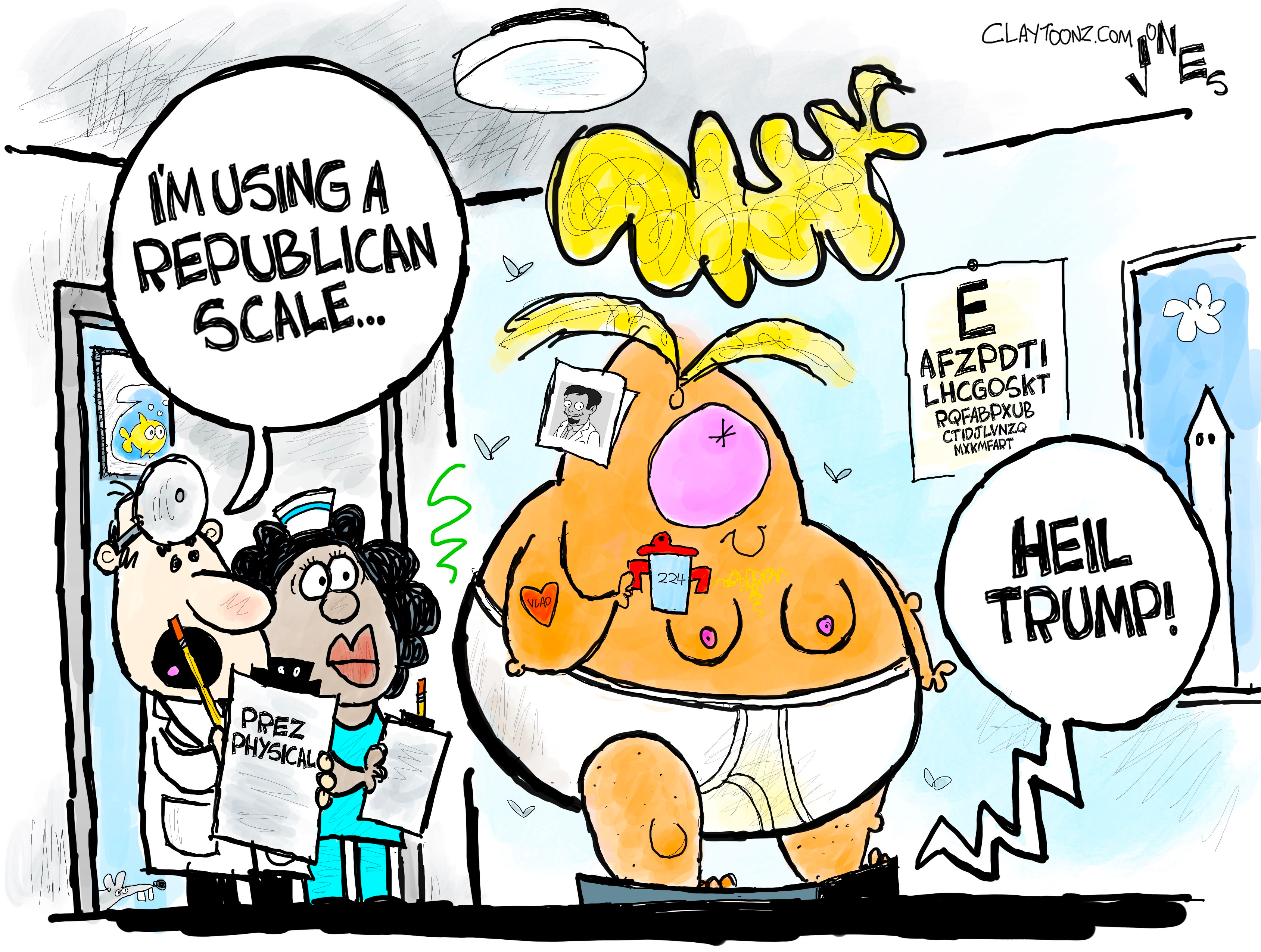
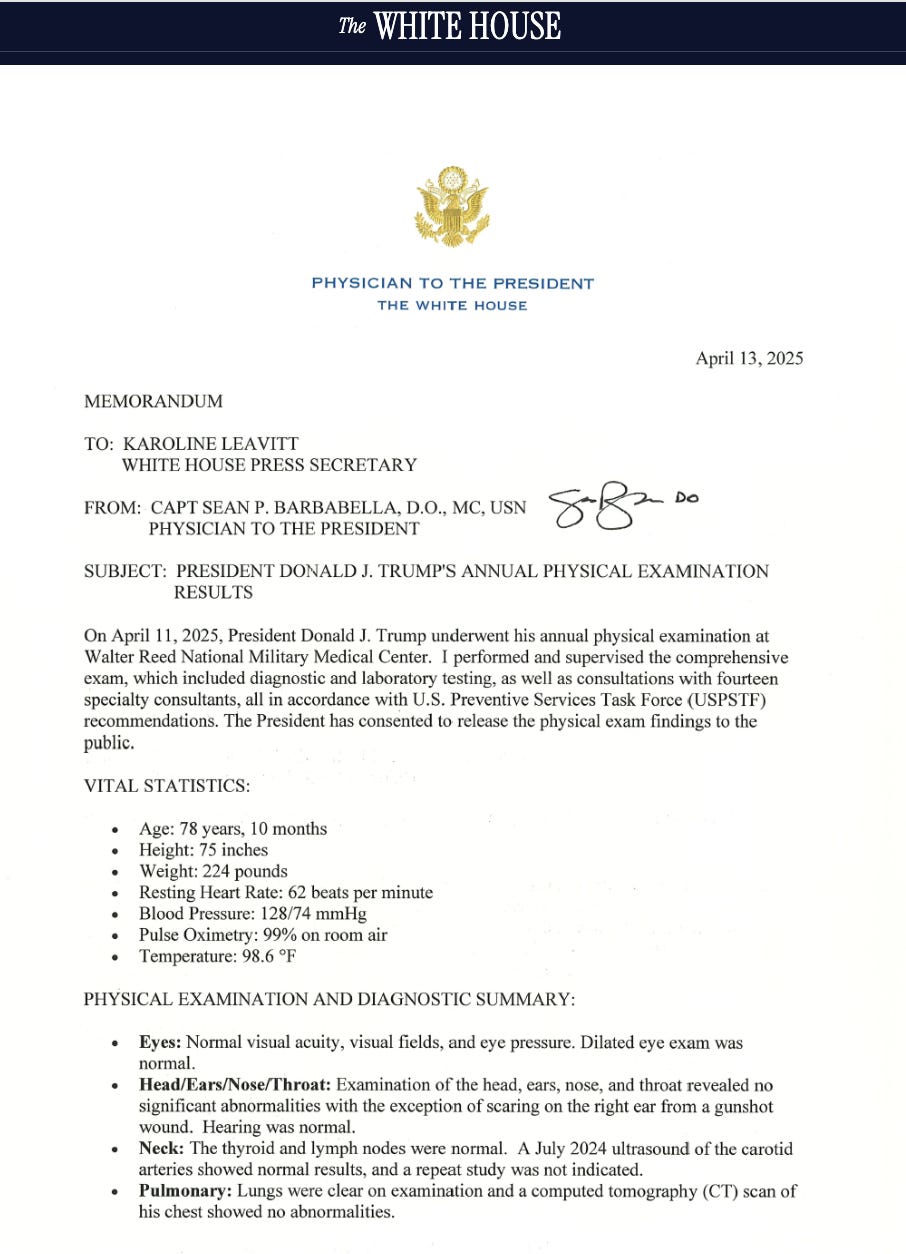
Rep. Jack Kimble tweeted that “President Trump is now 6’3” 224 pounds with 4.8% body fat. We might lose him to the NFL draft.”
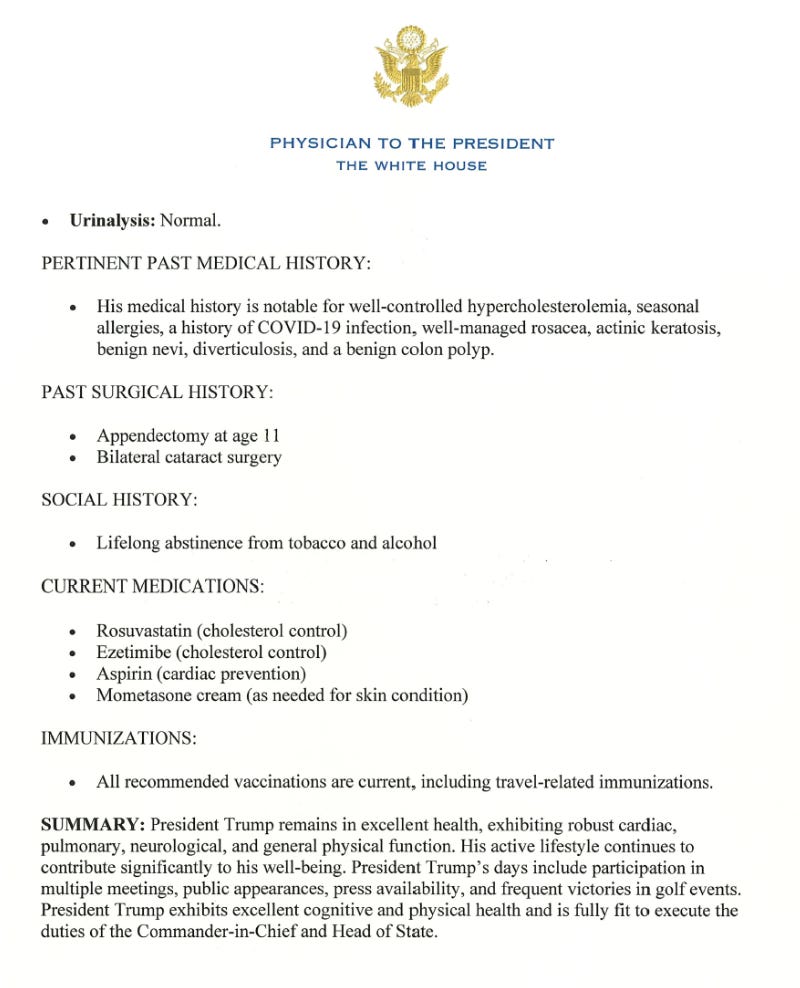
Captain Barbarella, the physician to the president (sic), failed to hide in his memorandum about Donald Trump’s physical that he’s a Trump sycophant. Or at least he failed to hide that he was controlled by a member of the cult.
His doctor’s name is actually Captain Sean Barbabella and NOT Barbarella, the title of the 1968 Jane Fonda space sex movie (I’ve never seen it). If congressman Kimble can accidentally refer to the El Salvadore President Nayib Bukele as President Bukake, I can use Barbarella. Also, I don’t know what “bukake” means because I’m a good boy.
While the report of the exam looks like it was written by a real doctor in most of the details, there are still little bits included to make it political and cultist.
For example, when the memorandum mentions his hearing, it mentions “scarring on the right ear from a gunshot wound,” reminding us that Trump was shot is a superhero to survive it (unlike that sucker standing behind him). The doc also wrote that Trump’s “active lifestyle continues to contribute significantly to his well-being,” with one of those activities being his “frequent victories in golf events,” which makes him “fully fit” to be president (sic).
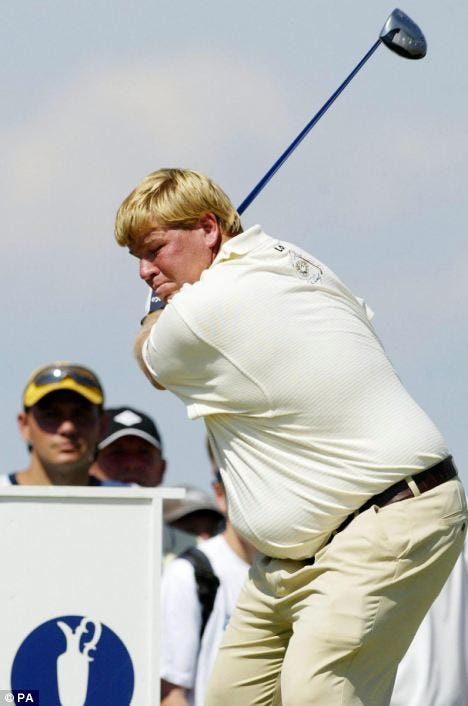
So it’s not the golfing that makes him physically fit to be president, but the golf victories. See what he did there? It’s like the champion is a Greek Adonis, but all the losers are donut-eating hose beasts. Have you seen John Daly? He also claims he’s 215 pounds.
Just how physically active is golfing when you don’t walk the course? Trump doesn’t even like stairs. Yes, there are elevators in the White House, and fortunately for Trump, one of them is a freight elevator. That brings us to Trump’s weight.
Captain Barbarella reports that Captain Big Mac only weighs 224 pounds. He also reports that Trump is 75 inches tall, which is six feet and three inches. I call bullshit.
Here’s what the White House released:
Unless you care about the president’s (sic) health (and I do not), it doesn’t matter to you or me what he weighs or how tall he is. What is important is that they’re dishonest. What’s important is the depth into which this regime sinks the cult into the government.
Trump, who is 78, needs to appear as a Superman to his cult. I’m shocked the memo mentions he takes aspirin for cardiac prevention. As we’ve learned, they lie about everything.
Right now, the regime is lying to the Supreme Court by claiming they can’t have a man they illegally snatched off the street and sent to a prison in El Salvador brought back to this country.
When Trump was running for president in 2016, Dr. Harold Bornstein stated that Trump would be the “healthiest individual ever elected to the presidency.” A couple of years later, we learned that Trump had dictated that letter, which didn’t surprise anyone. A doctor should lose his medical license over that. And it wouldn’t surprise us to learn he dictated “224” and “75 inches” to Captain Barbarella and wouldn’t allow him to mention that Trump’s cholesterol is just Big Mac Secret Sauce. His first White House physician was a lying alcoholic lunatic, Dr. Ronny Jackson, who doesn’t practice medicine anymore and is now in a place where he can’t hurt anybody, Congress.
Ronny Jackson claimed that Trump could live to be 200, and judging from the way our luck works, that might be true.
The memo does show that despite spreading debunked lies about vaccines, like his Health Secretary does, Trump is up to date on vaccines.
The part we should care about, and is more absurd than claiming he weighs 224 pounds, is the claim he scored 30 out of 30 on a cognitive test. I checked to be sure the memo didn’t state that he also has hands that are not tiny.
Anyone who believes Trump, the shark boat battery guy, scored 30 out of 30 on a cognitive test needs to take a cognitive test. I don’t believe this doctor would let us know if Trump scored less than 30.
Trump’s last presidential physical had him at 244 pounds. His 2023 arrest in Georgia listed him at 215 (they don’t weigh the prisoners but take their word for how much they weigh), and this exam says he’s 224.
If Trump does weigh 224 pounds, then that’s 224 pounds of walking/talking bullshit.
The one number that’s accurate about Trump is 34, as in 34 felony convictions.
Creative note: I still have a few other ideas I wrote last week that I want to get to, but I knew last night that I needed to cover this today. This idea hit me shortly after I woke up.
Music Note: I listened to The Beatles.
Drawn in 30 Seconds (with music): Sorry for the earworm. (Snip-go see/listen!)


































 Scottie's Playtime