Explanation: These people are not in danger. What is coming down from the left is just the Moon, far in the distance. Luna appears so large here because she is being photographed through a telescopic lens. What is moving is mostly the Earth, whose spin causes the Moon to slowly disappear behind Mount Teide, a volcano in the Canary Islands of Spain off the northwest coast of Africa. The people pictured are 16 kilometers away and many are facing the camera because they are watching the Sun rise behind the photographer. It is not a coincidence that a full moon sets just when the Sun rises because the Sun is always on the opposite side of the sky from a full moon. The featured video was made in 2018 during a full Milk Moon. The video is not time-lapse — this was really how fast the Moon was setting.
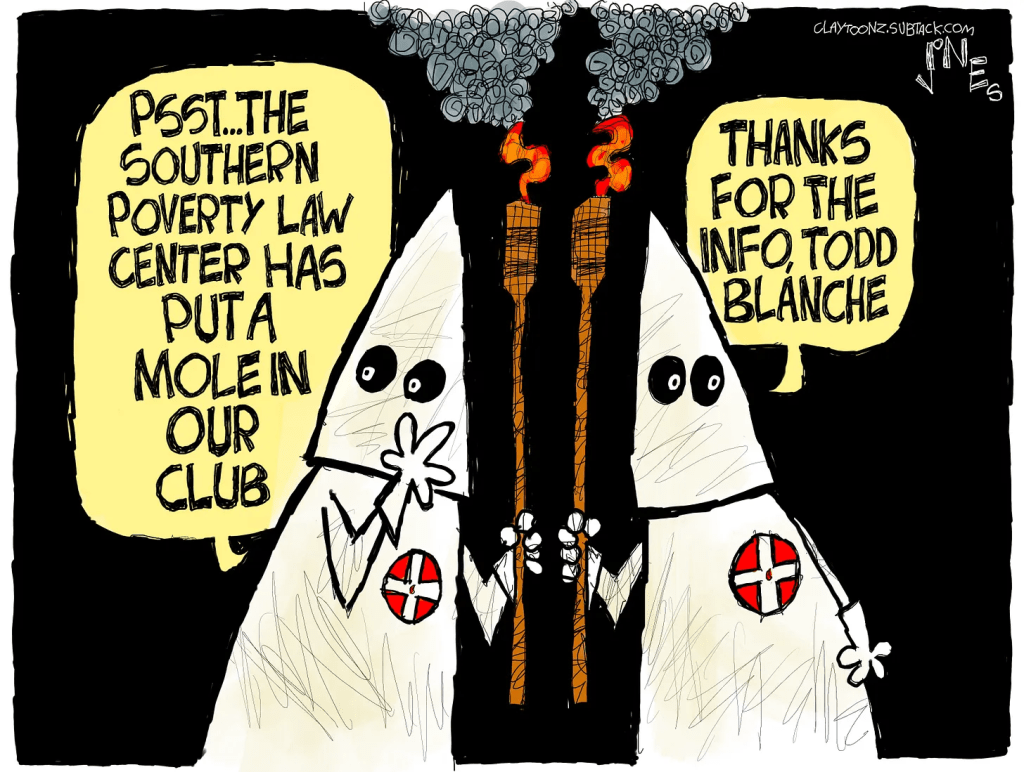
The Justice Department (DOJ) going after the Southern Poverty Law Center (SPLC) is another case where the Trump regime is going after its enemies. An enemy of hate groups, as SPLC is, is an enemy of the Trump regime.
SPLC has now been indicted on 11 counts, but remember where those indictments of James Comey and Letitia James went, straight into the trash. Donald Trump’s DOJ couldn’t obtain an indictment against the guy who threw a sandwich at Border Patrol agents. The DOJ just dropped its bogus case against Jerome Powell.
And remember the person in charge of the Justice Department is Donald Trump’s personal lawyer, who is angling to get the job permanently, or at least until Trump’s next mood swing, and he fires the Attorney General to replace him with Greg Gutfeld.
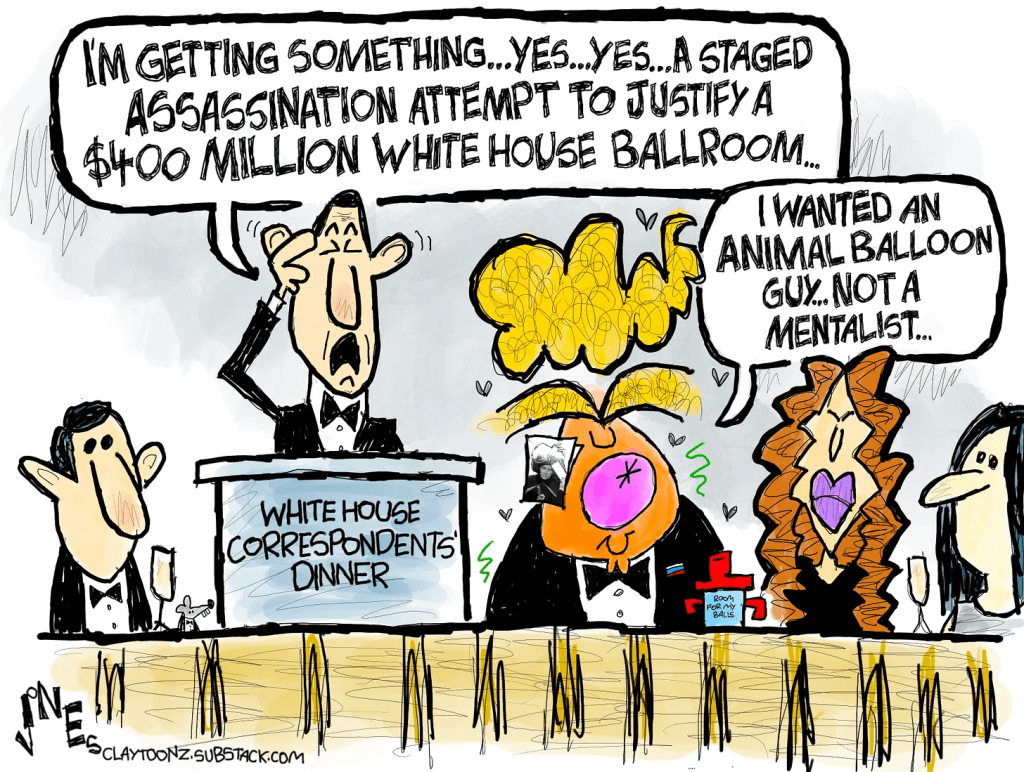
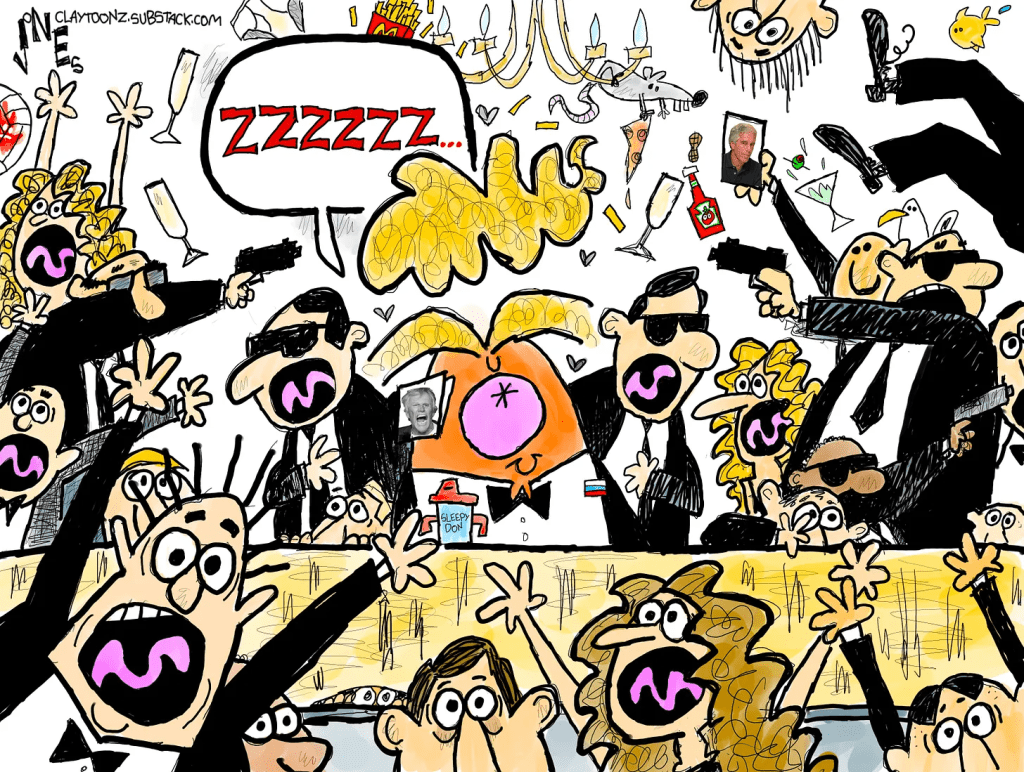
I think the mentalist who was scheduled to host last night’s White House Correspondents’ Dinner should have received combat pay. Not because of an assassination attempt, but for having to roam through Donald Trump’s empty head.
I don’t believe last night’s assassination attempt was staged or fake. I do believe there was a serious assassination attempt at last night’s WHCD dinner. I don’t want to jump into the rabbit hole of conspiracy theories. But from what we know at this point, the assassination attempt may not have been on Trump’s life, but maybe just on any cabinet member’s life that the attempted shooter could’ve found, or at least that’s how it sounds from the bits of his manifesto. I have read.
I do believe it was extremely shitty for Donald Trump to use the assassination attempt as an argument for his stupid illegal ballroom that is currently being held up by a court.
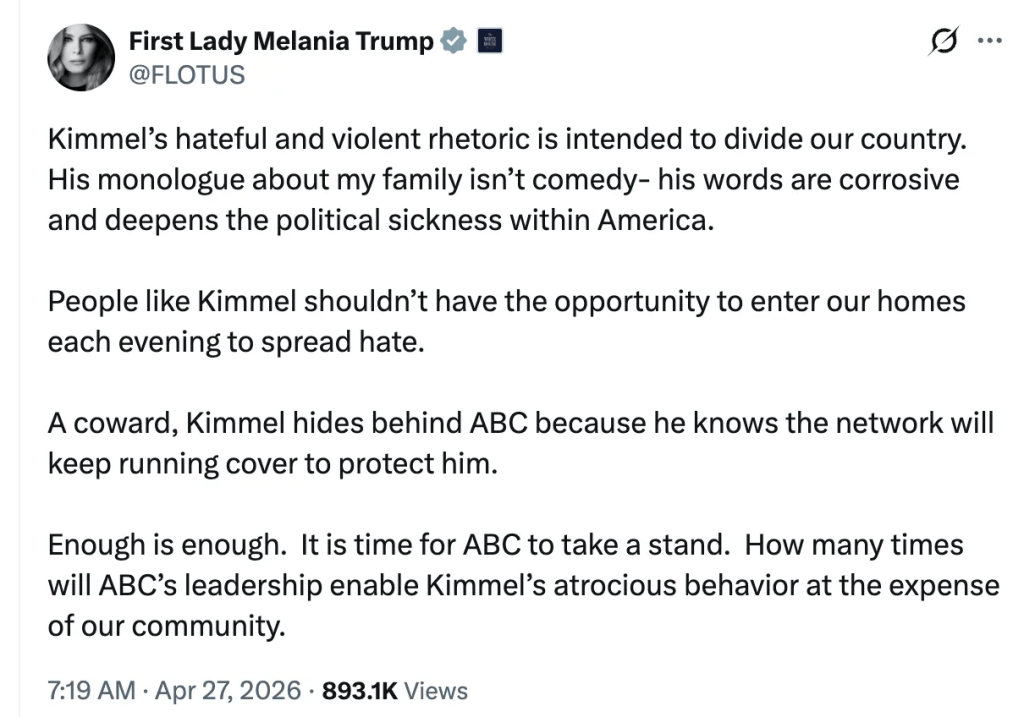
I’m infuriated by what Melania Trump tweeted today:
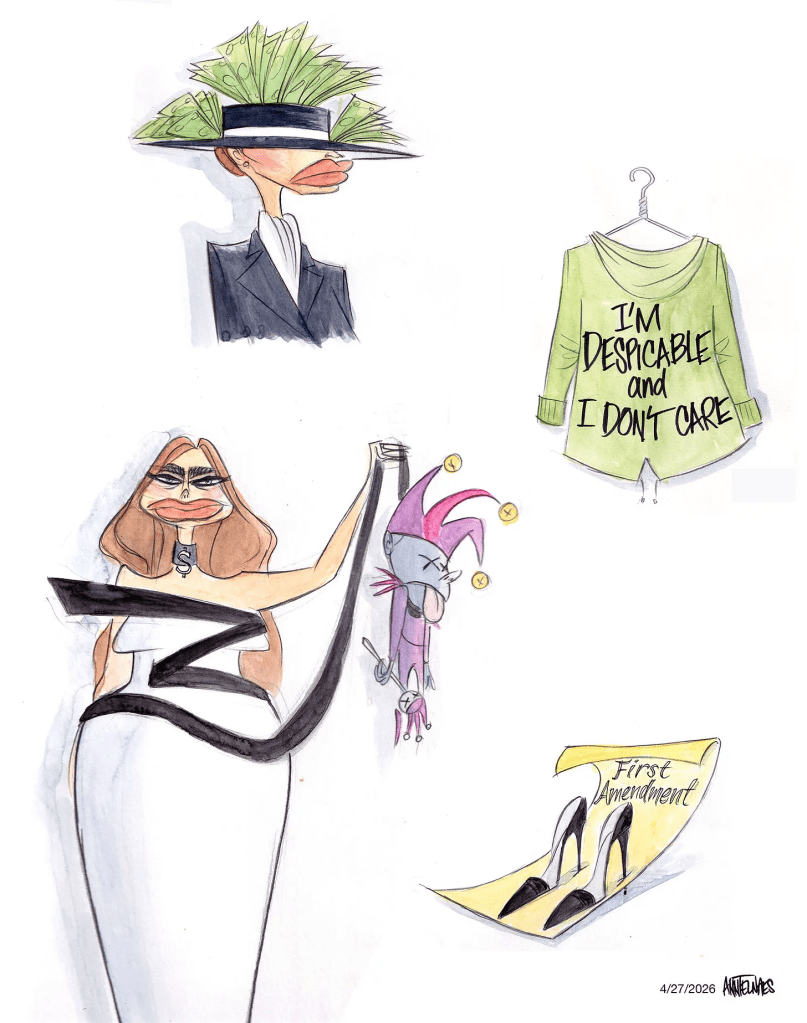
As a naturalized citizen and editorial cartoonist who has seen colleagues from around the world targeted, jailed, and even murdered for creating satire, I value our First Amendment. The First Lady, who is also an immigrant, should realize the importance of free speech and a free press but she lives in an entitled world and like her husband, is trying to control the news media to silence her critics. She is undermining the foundations of a democracy and is just as miserable a human being as her husband.
Donald Trump has been falling asleep during meetings lately. He’s fallen asleep during cabinet meetings, and here at the 26-minute mark, you can see that he falls asleep twice during a meeting about healthcare last week.
Tell me that he’s not falling asleep and instead is doing some deep thinking or is meditating. Yeah, I didn’t think so either.
Yesterday, I told you that I do not believe the assassination attempt was fake or staged. It’s not that I don’t believe the goons and the Trump regime would try that. It’s because I don’t believe these idiots could pull it off.
I hate this would-be assassin. First, he ruined my Saturday night. I had planned to clock out and go through at least a couple of the movies on my Netflix watchlist. Instead, I watched CNN all evening. Yeah, I’m a news buff, but I think it’s important to turn off sometimes, which I try to do on Saturdays and Sundays. I mean, I start the mornings with news programs and maybe through the middle of the day. But by late afternoon, I just want to turn all that shit off and not think about politics and, most importantly, not think about Donald Trump. This would-be assassin took my Saturday away from me. (snip-MORE)
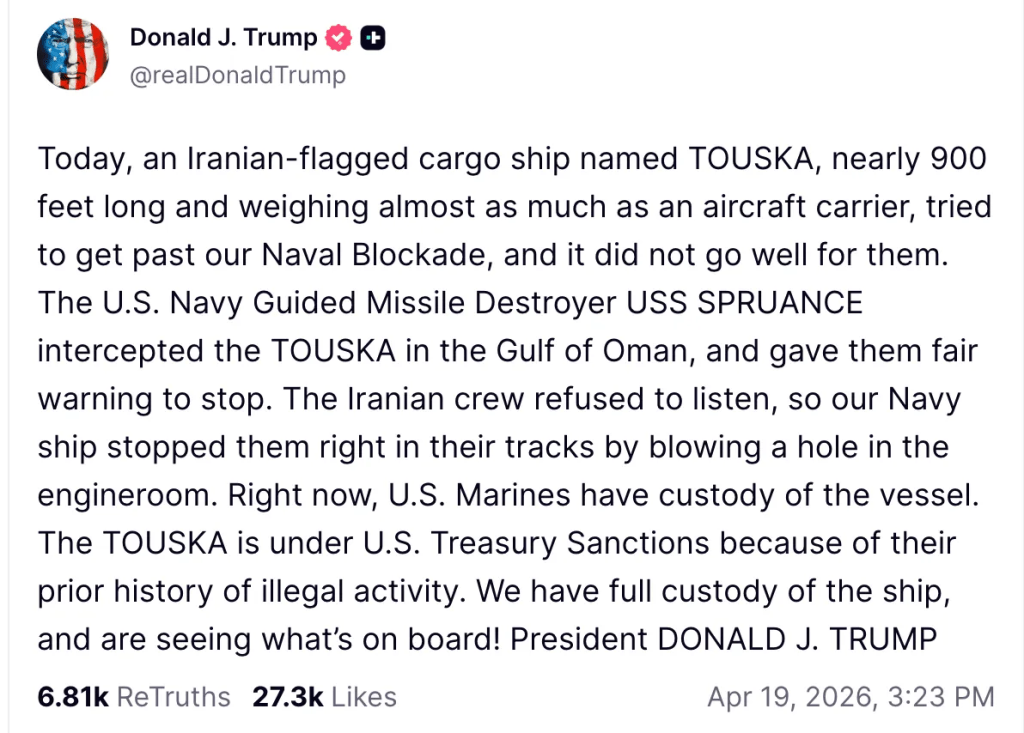
We seem doomed to another week of war news. On Sunday, Trump announced on Truth Social that the U.S. military seized an Iranian-flagged ship that he said tried to run the U.S. blockade in the Strait of Hormuz. Marines boarded the cargo ship Touska after it was disabled. Trump posted that the USS Spruance “gave them fair warning to stop,” but that “The Iranian crew refused to listen, so our Navy ship stopped them right in their tracks by blowing a hole in the engineroom.”
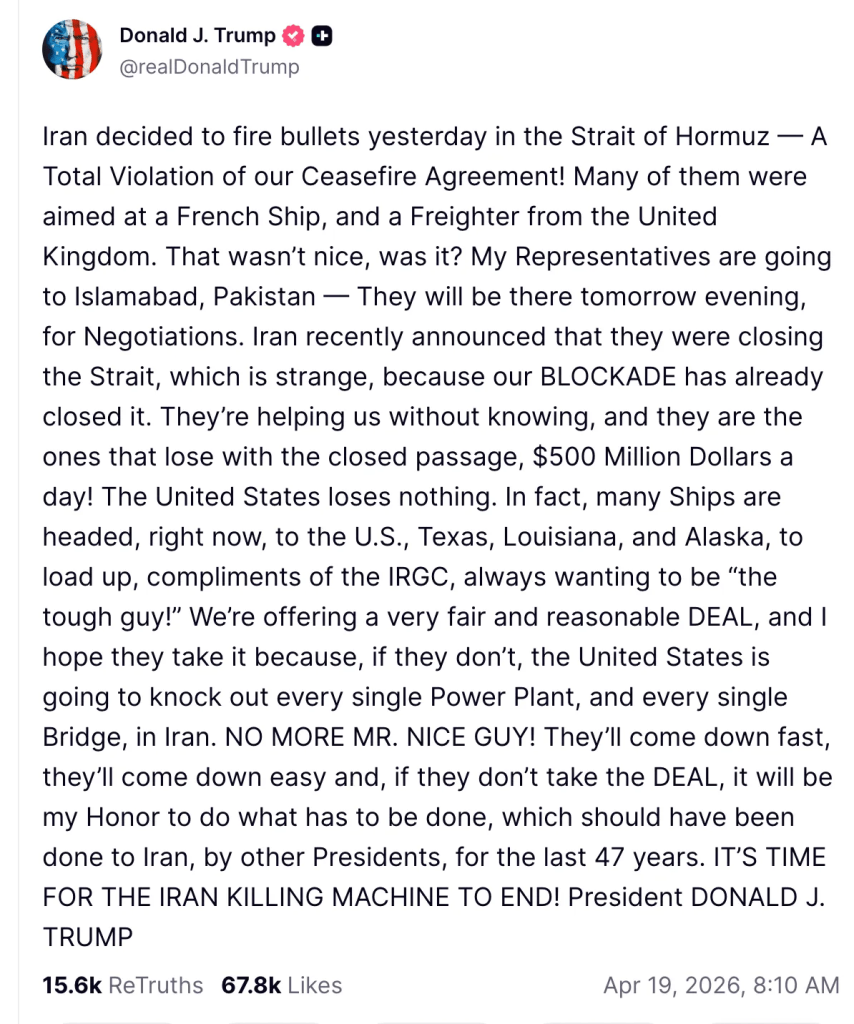
But what’s happening with the president as he conducts his war is now completely out of bounds. This morning, just after 8 a.m., he had a long rambling post on Truth Social that concluded, “if they don’t, the United States is going to knock out every single Power Plant, and every single Bridge, in Iran. NO MORE MR. NICE GUY!”
Notice how Trump speaks in the language of an all-powerful businessman, a CEO without a board to tell him what to do. He is sending “My Representatives” to Pakistan and “if they (Iran) don’t take the DEAL,” he’ll do “what has to be done.” It’s crazy on steroids, and well past the point where even his own party should be giving him a pass. The president of the United States is threatening to bomb civilian targets and devastate a civilian population. War crimes, plain and simple.
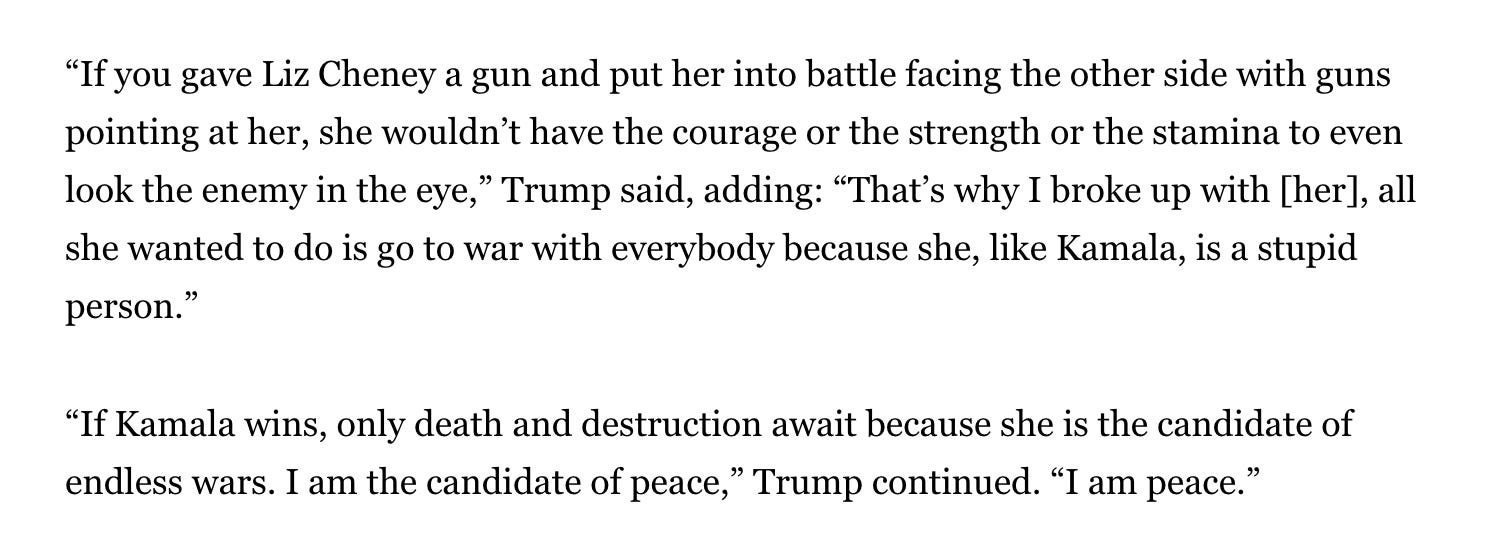
All of this from the candidate who, in November of 2024, in the closing days of his campaign for the White House, said that “If Kamala wins, only death and destruction await because she is the candidate of endless wars. I am the candidate of peace.”
Every accusation is a confession. And the Truth Social posts happened after Trump called NATO and our allies “absolutely useless” at a Turning Point USA event Friday night. If you’re exhausted, and honestly, at this point, who isn’t, take a deep breath, plan for a little extra fellowship with friends (more on my plans at the end), and remind yourself that we cannot afford to put our heads in the sand and that the effort to overwhelm us in intentional—that’s how authoritarians do it. It’s a good week to talk with people about what’s going on, to encourage them to stop and think, and then to make sure they’re registered to vote.
The U.S. Ambassador to the U.N., Mike Waltz, was on ABC’s “This Week,” Sunday morning, and he chimed right in with the president. Host John Karl asked if Trump was prepared to go back to “full-on war” and Waltz responded, “all options are on the table. We could take that infrastructure out relatively easily. The Iranian air defenses have been absolutely decimated.”
He continued, without being prompted, “And just to get ahead of a lot of the critics and hand-wringing, throwing out irresponsible terms like ‘war crimes’, attacking, destroying infrastructure that has clearly and historically been used for dual military purposes is not a war crime.”
Then Waltz did it again on NBC’s “Meet the Press,” where volunteering to Kristen Welker, who hadn’t asked about it, that the U.S. could still target civilian infrastructure in Iran if a ceasefire deal wasn’t reached, again claiming that wouldn’t amount to war crimes. “We have a long history of taking down bridges, power plants and other infrastructure that is powering Iran’s military,” Waltz said, as though that somehow made it acceptable. “In the laws of land warfare and the rules of engagement, any type of infrastructure that is co-mingled is absolutely a legitimate target.” He reiterated on CBS, appearing on “Face the Nation,” that because the IRGC is running bridges and power plants, they are “legitimate military targets,” again rejecting the notions that bombing them would be “some type of war crime.”
So bombing civilian targets seems to be top of mind for the president and one of his key spokespeople on these issues, which should concern all of us.
Waltz is a former Army Special Forces Officer, decorated for his bravery. He graduated from Virginia Military Academy, according to his bio from his time in Congress, but he is not a lawyer. Apparently, concerns about launching attacks against civilian populations didn’t stick. Waltz was Trump’s first National Security Advisor this term, but he resigned following Signalgate after serving for just 101 days. (Tonight’s trivia: That’s the second shortest tenure of any NSA. Mike Flynn, who was Trump’s first NSA in 2017, resigned after just 24 days, two Scaramuccis, and was ultimately convicted of lying to the FBI before Trump pardoned him.) Trump nominated Waltz to serve as the U.N. Ambassador the same day he stepped down.
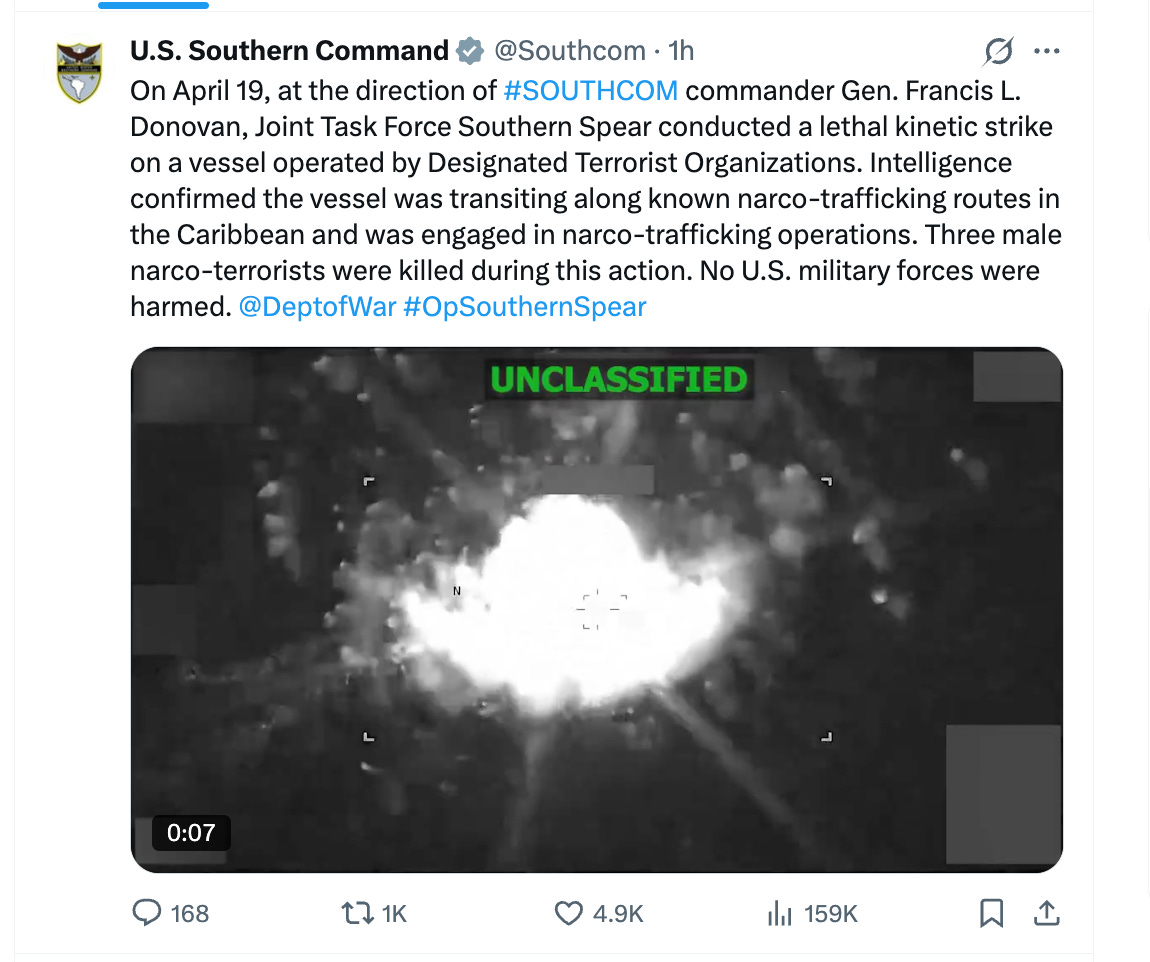
Today, the United States struck yet another vessel in the Caribbean. Three people were killed. The U.S. Southern Command account on Twitter said they were narco-terrorists. These attacks used to be shocking. Now, they barely garner notice. As of the last strike, four days ago, Reuters reported the death toll was “over 170.” Three people were killed in that strike last Wednesday, as well.
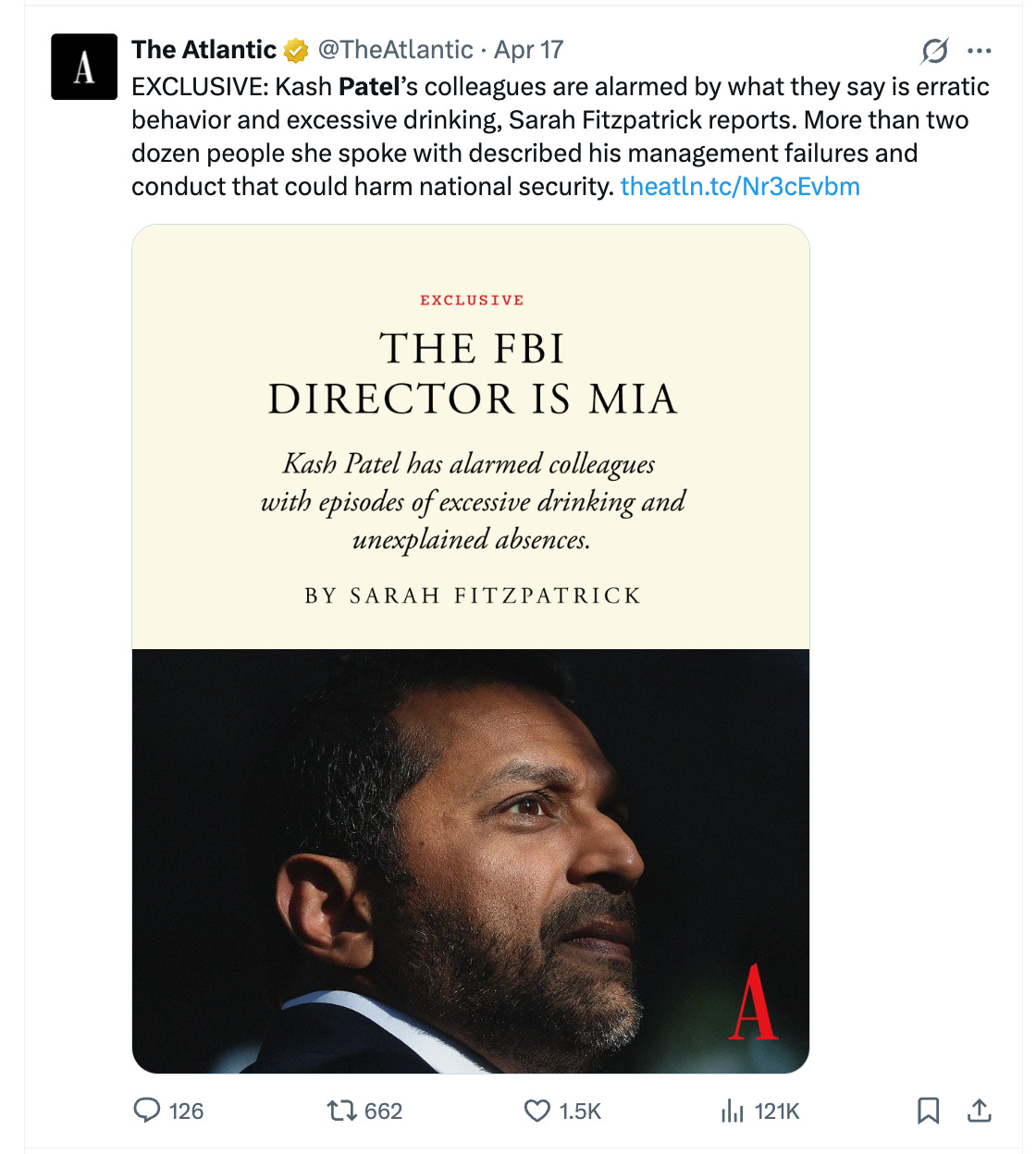
Also appearing on the Sunday shows, FBI Director Kash Patel said he would file a defamation case on Monday against The Atlantic, which reported last week, in a story headlined, “The FBI Director Is MIA,” that Patel’s colleagues are “alarmed” by “episodes of excessive drinking and unexplained absences.” Two dozen people interviewed for the story “described Patel’s tenure as a management failure and his personal behavior as a national-security vulnerability.”
Nominees for important government positions, and Director of the FBI is among the highest because of access to national security information, are heavily vetted before they take office. But as with so many other norms in the time of Trump, Patel’s questionable personal choices have continued to come to light since he took office. The report says that Patel is “drinking so heavily that meetings need to be rescheduled and his security detail has trouble waking him up. Among the report’s most chilling revelations, “Current and former officials told me that they have long worried about what would happen in the event of a domestic terrorist attack while Patel is in office, and they said that their apprehension has increased significantly in the weeks since Trump launched his military campaign against Iran. ‘That’s what keeps me up at night,’ one official said.”
Screen grab of Patel “celebrating” with the U.S. Men’s Hockey team after their Olympic victory.
This morning, Fox host Maria Bartiromo asked Patel, “So you’re gonna sue them?” “Absolutely,” he responded. “It’s coming tomorrow.” He added that it would be for defamation.
I’m looking forward to discovery. Especially the part where Patel is deposed, under oath. Expect the lawsuit, which he probably has to file to look tough for the audience of one, to be dismissed before it gets that far. Patel would face questioning about his drinking and other misconduct while in office. And he would be exposed to penalties of perjury.
The Atlantic’s report concludes with this story: “Patel has publicly proclaimed that the FBI needs to demonstrate that it is ‘fierce,’ and officials I spoke with said that he is fixated on that image in private as well.” So what is he doing about that? Apparently, Patel “recently expressed frustration with the look of FBI merchandise, complaining that it isn’t intimidating enough.” The Atlantic explains that “Officials have grown accustomed to such behavior, and they have learned to roll their eyes at it. But they said that the absurdity masks real concerns about what Patel’s leadership has meant for an institution that the country relies on for national security and the safety of its citizens. ‘Part of me is glad he’s wasting his time on bullshit, because it’s less dangerous for rule of law, for the American public,’ one official told me, ‘but it also means we don’t have a real functioning FBI director.’”
It’s likely that Patel has little support inside of the building, and that could mean this is just one of many stories that get launched in an effort to ease him out before it’s too late. When the “that” in “That’s what keeps me up at night,” is the Director of the FBI, not a foreign terrorist or criminal threat, then it’s highly likely the career folks, and maybe even some of the politicos, want a “real functioning FBI director” in place.
I started out by saying we’re entering this week already exhausted and it’s important to keep taking care of ourselves. My plan this week involves spending time in person with my #SistersInLaw cohosts Kimberly Atkins Stohr, Barb McQuade, and Jill Will-Banks, when we do the podcast live in Denver on April 23rd. If you’re in Denver, I hope I’ll see you there! If you’re in Atlanta, we’ll be live there on May 3. There is nothing as important as being with the people that we love right now.
Whether you are watching the Super Bowl on TV, scrolling make-up tutorials on Instagram or listening to a technology podcast, you are being fed advertising for artificial intelligence.
The commercials are everywhere. And they promise the world.
Since the release of ChatGPT in 2022, the companies that build AI have deployed advertising to recruit us as loyal users of their astronomically expensive software. Persuade us now, and perhaps we will be loyal customers later.
Meanwhile, Kansas Attorney General Kris Kobach — with some help from a nebulous technology group — has sounded an alarm about AI this week, releasing a PSA.
“The reports are very troubling,” he says about threats posed by artificial intelligence.
Over the next few years, our culture will decide whether we are AI skeptics or fanatics. For that reason, the language that is used to sell AI — or steer us away from it — matters. Let’s listen to what is being said about the technology that could define the 21st century.
From Silicon Valley
In their ads, technology companies describe AI as a wonderland: productivity at work, inspired hobbies at home and wellness nirvana at the gym. The word choices would make a spiritual guru proud.
In marketing AI app-building software, Base 44 urges us: “Consider yourself limitless.” It’s also described as “the next thing you can’t live without.” The company uses the language of religious cults swirled with rampant consumerism. “Elite” plans start at $160 per month.
Besides AI, what product from the past 50 years could have generated all of these promises in one commercial? In 78 seconds of advertising, Perplexity offers:
“Get your time back.”
“Access to knowledge is easier than ever.”
“Discover something new every day.”
“Knowledge on-demand anytime anywhere. For anything you wanna know.”
There’s no modesty — just hyperbole.
Judging by their advertising, tech companies agree on AI’s greatest virtue: efficiency.
The YouTube description for a Copilot AI ad claims that “Microsoft 365 Copilot isn’t just a better way of doing the same things. It’s an entirely new way of working.” Press play on the video and watch a layered flurry of chatbot prompts, all written simultaneously and feverishly, including: “Want to get a jump start on your day?” The message envisions AI as hyperactive multichannel problem solving.
Other AI advertising promises are more direct. ChatGPT’s advertisement, “What Codex unlocks,” features a technology CEO who boasts about what AI made possible. You don’t need to understand his jargon to understand the promised efficiency.
“We were able to create a JavaScript runtime in just two weeks,” says Syrus Akbary Nieto. “Without Codex, it would have taken us easily one year.”
For people outside Silicon Valley, ChatGPT’s advertising shows tangible AI efficiencies, such as opening a new restaurant.
“I found the perfect spot,” someone types into the chatbot. “Help me write the business plan.”
In another ad, ChatGPT is the elixir for fixing the family car: “Dad said the truck is ours if we fix it. Help us get it running.”
The pitches implicitly promise success when you combine your ambition with AI’s wisdom — never mind the skills required to cook spaghetti bolognese or handle a wrench.
The ad’s answer: Open the Gemini chatbot and ask it to visualize his new bedroom, complete with the family dog’s bed. The commercial closes with words carrying a double meaning: “It will be whatever we want it to be,” the boy’s mom says. Both the house and the Gemini chatbot, the script suggests, can be family dreams. (snip-MORE, including the ad transcript, and info about the organization behind the ads. It’s good, and not much more to read. I just don’t like lifting other people’s work.)
I was especially interested in the Justice Clarence Thomas comments, which I read, then became disinterested for reasons you’ll get if you read them. Lots of news of the day here.
A thin-skinned and prickly Defense Secretary Pete Hegseth went off on journalists in his press conference this morning, resorting to the classic “attack the messenger” defense to a unpopular war going poorly.
It’s not the first time Hegseth has succumbed to blaming a lack of patriotism among reporters for unfavorable headlines and critical reporting on a Middle East conflict ignited by the Trump administration. But today’s screed was striking for how it mixed the old worn-out reflexive questioning of the loyalty of reporters with biblical references that reflect Hegseth’s personal Christian nationalism:
“Sometimes it’s hard to figure out what side some of you are actually on,” Hegseth said. “It’s incredibly unpatriotic.”
In the decades since the Vietnam War, the Pentagon had haltingly moved away from the defensive crouch it often took in the face of criticism toward a more transparent and self-reflective public response to bad news. It was not always consistent and the backsliding was dramatic during periods of sustained setbacks, like in Iraq during the aughts, but the general trajectory was away from the kind of knee-jerk circle-the-wagons approach that Hegseth rolled out this morning.
Questioning the loyalty of journalists — or any regime critics — harkens to earlier dark eras of America history and to authoritarian regimes worldwide. But Hegseth’s diatribe came with a strong Christian twist, as he compared journalists to the Pharisees who rejected Jesus in the Bible:
“The Pharisees, the so-called and self-appointed elites of their time, they were there to witness, to write everything down, to record, but their hearts were hardened, even though they witnessed a literal miracle, it didn’t matter,” Hegseth said.
“They were only there to explain away the goodness in pursuit of their agenda. As the passage ends, the Pharisees went out and immediately held counsel against him, how to destroy him,” he continued.
“I sat there in church and I thought, our press are just like these Pharisees, not all of you, not all of you, but the legacy Trump-hating press, your politically motivated animus for President Trump nearly completely blinds you from the brilliance of our American warriors,” he added.
Hegseth — callow, reactive, driven by a warped theology of nationalism, and poorly grounded in history — personally represents a dramatic break from decades of training, education, and refining of a professional officers corps. In 15 months in office, Hegseth has done more to politicize the military than any secretary of defense in at least the last half century.
Third Boat Strike in Three Days
The accelerated pace of unlawful strikes against alleged drug-smuggling boats continued in the eastern Pacific, with the third such strike in the last three days. Three people were killed in the 51st strike of the U.S. campaign, bringing the death toll to at least 177 people.
What Trump Foreign Policy Looks Like
USA Today: Pentagon ramps up planning for possible military ops in Cuba
WSJ: Pentagon Approaches Automakers, Manufacturers to Boost Weapons Production
WaPo: Trump administration pushes nations to sign ‘trade over aid’ declaration
SCOTUS Watch
Justice Sonia Sotomayor apologized privately to Justice Brett Kavanaugh and followed up with a public apology released by the Supreme Court for remarks last week that, without naming him, attributed his defense of what have become known as “Kavanaugh stops” to his posh upbringing.
In a public appearance at Yale Law School, Justice Ketanji Brown Jackson blasted the Roberts Court’s handling of its emergency docket.
In unusually pointed remarks carried live by CSPAN, Justice Clarence Thomas launched a broadside at progressivism.
Jan. 6 Never Ends
Trump lawyer and coup plotter John Eastman was officially disbarred in California after the state Supreme Court declined to take up his appeal.
Trump I White House chief of staff Mark Meadows is seeking reimbursement from the Trump DOJ of his legal fees incurred as a witness in both of Special Counsel Jack Smith’s investigations.
Must Read
Heather Cox Richardson draws a straight line from Lincoln’s assassination to Jan. 6 and the events of this week.
Do as We Say Not as We Do
NBC News: “Anti-abortion advocates met with Justice Department officials Wednesday, just hours after the Trump administration fired prosecutors it accused of coordinating too closely with abortion-rights advocacy groups during the Biden administration.”
Election-Year Islamophobia
When all else fails and their election prospects look dire, Republicans fall back on various forms of racist appeals to solidify their base and wrong-foot Democrats. This year, top Texas Republicans have landed on Islamophobia as the racist appeal of choice. TPM’s Josh Kovensky reports on the ground from Grapevine, Texas, where he talks to right-wing activists who are back again to warning about Sharia law and portraying Muslims as an external threat to “real” Americans.
Too often, gullible national media outlets treat these racist effusions like an organic upwelling of nativism, rather than a calculated election year strategy. TPM, I’m proud to say, has never been suckered in.
Thread of the Day
The Corruption: Bitcoin Jesus Edition
ProPublica offers a casebook study in the erosion of white-collar crime prosecutions under Trump II that includes the intervention of DOJ political appointees and the retention of a former Trump criminal defense attorney to outright kill one of the largest-ever cryptocurrency tax fraud cases.
Creepy Text of the Day
“Hearing u/r in town. Wishing you would let me know. I could have made some excuses to get out and show u around. Please keep this private.”—Richard Chavez, father of Labor Secretary Lori Chavez-DeRemer, in a text to a young female staff member working for his daughter
Hot tips? Juicy scuttlebutt? Keen insights? Let me know. For sensitive information, use the encrypted methods here. (snip)