Life has been happening here with me this couple of weeks, and I have a few things I’ve picked up here and there to post when I’m busy. Most of this is positive, because why not?
Hey-today is World Environment Day! Let’s be proud to care for our home; we all get overheated.
June 5, [since 1972]
World Environment Day was established by the U.N. General Assembly to commemorate the opening of the Stockholm Conference on the Human Environment in Sweden. The United Nations Environment Program (UNEP) was established as a result of the conference.
UNEP’s mission: To provide leadership and encourage partnership in caring for the environment by inspiring, informing, and enabling nations and peoples to improve their quality of life without compromising that of future generations.
By James Jordan, Sumner Newscow — The month of May is barely over, and the wheat harvest has already started in Sumner County. That is not a good thing. Last year, the harvest didn’t get going well until mid-June, which is still on the early side.
Drought conditions over the winter and early spring caused the wheat to mature earlier than it should have, resulting in poorer yields.
Recent rains are likely too little too late; wet conditions may even hamper the harvest.
Last year, there was good wheat in the fields, but wet conditions prevented a bumper harvest.
State and local wheat officials say the wheat that is out there is not in very good shape.
According to the Kansas Wheat Association, the crop generally looked good as it went into its dormant stage in the late fall. There was not much rain in March and April, which is the primary growing stage, turning a promising crop into a dismal one.
The drought conditions in that growing stage force the wheat to develop faster. It limits the yield and accelerates growth, which is why we have wheat ready to harvest so early.
There are still some areas in Sumner and Cowley County that may get good yields. Conditions are much worse in western and central Kansas.
According to USDA statistics, as of the beginning of May, 41 percent of the wheat was very poor or poor, with 35 percent being fair. Only 24 percent was rated good or excellent.
As of last week, the wheat commission reported 55 percent as poor to very poor, and 30 percent as fair. Only 15 percent was rated good.
Last year at this time, 48 percent was rated as good to excellent.
The USDA estimates that this year’s crop could be the smallest nationwide since 1965 and 25 percent smaller than last year.
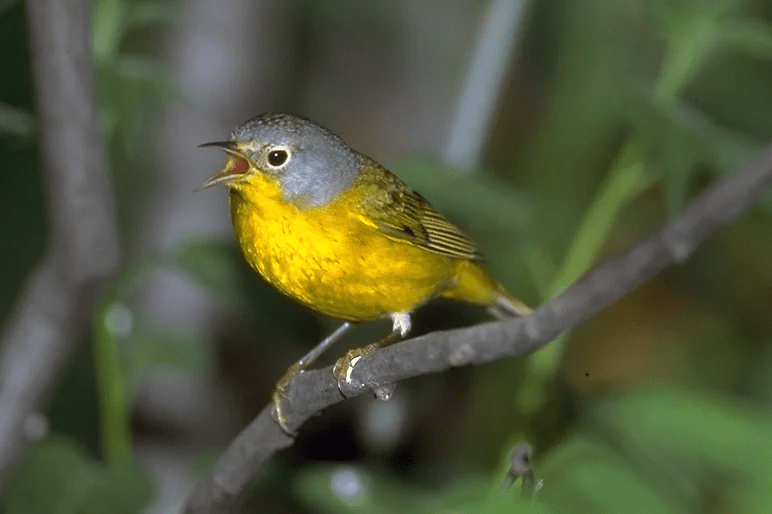
The Nashville Warbler is a lively songbird with elegant, understated plumage and a special fondness for sunny forests, brushy undergrowth, and juicy caterpillars. It is also one of several birds in the Western Hemisphere with a rather misleading name. This bird is only in the southeastern United States for a few weeks during migration on its way between the northern forests where it breeds and its wintering grounds in Mexico, Central America, and the California coast. The species was first documented in Tennessee, and the “Nashville” name stuck, although it only stops over in the area during migration.
The Latin name is also rather misleading to anyone watching this bird in the field — the species epithet ruficapilla refers to a small patch of reddish feathers on the bird’s crown, usually invisible among the gray feathers of the rest of the head. Like the Ruby-crowned Kinglet, Orange-crowned Warbler, and Yellow-rumped Warbler (scientific species name coronata, for the rarely seen yellow crown), this name may be mystifying to beginning birders, but it might also provide an avenue into the secret social life of the bird.
The ability to hide and reveal this bright, contrasting color patch allows these birds to produce a striking visual signal, which they use to communicate agitation and excitement, particularly in aggressive interactions between males at close range. The closely related Lucy’s and Virginia’s Warblers also have hidden reddish crowns, apparently used in similar contexts. In fact, colorful hidden crown patches have also evolved in distantly related species, like the Western Kingbird, suggesting they may play important roles in these birds’ lives. However, birds are rarely seen actually raising their crowns, and our understanding of their social use is only rudimentary.
Nashville Warblers are quite social. Once the young of the year are independent from their parents, these warblers begin to form large foraging flocks, numbering up to 100 birds. On their nonbreeding grounds, these birds are often at the center of equally large flocks with dozens of species, their persistent contact calls allowing other birds — and birders — to locate them in the forest canopy. In fact, Nashville Warblers may be a “nuclear species,” facilitating the formation of these large and diverse flocks with help from another energetic northern migrant, the Blue-gray Gnatcatcher. Typically, nuclear species are resident birds, not migrants. But when this warbler-gnatcatcher pair comes to town, they bring the party. (snip-MORE)
As we like reminding you, with Donald Trump trying to kill clean energy, Europe has become the source of much of our clean energy Nice Times lately. Here’s one more example: Spain is among the big sleeper hits on Europe’s energy transition pop chart. In just a decade, Spain has ramped up its use of wind and solar power, resulting in some of the lowest wholesale electricity prices on the continent.
In the first four months of 2026, the average wholesale electricity price in Spain was €44 per megawatt-hour. In Italy, it was €127. In Germany, €96. In the UK, €103. Spain is now cheaper than France, well below the central-European bloc, and within striking distance of the Nordic hydro-and-nuclear heavyweights that have always topped the cheap-power league.
The basic reason is pretty simple, Rosenow explains, although he also goes into further detail beyond this. “Spain increasingly pushed gas increasingly out of its electricity supply, and the price of electricity followed.”
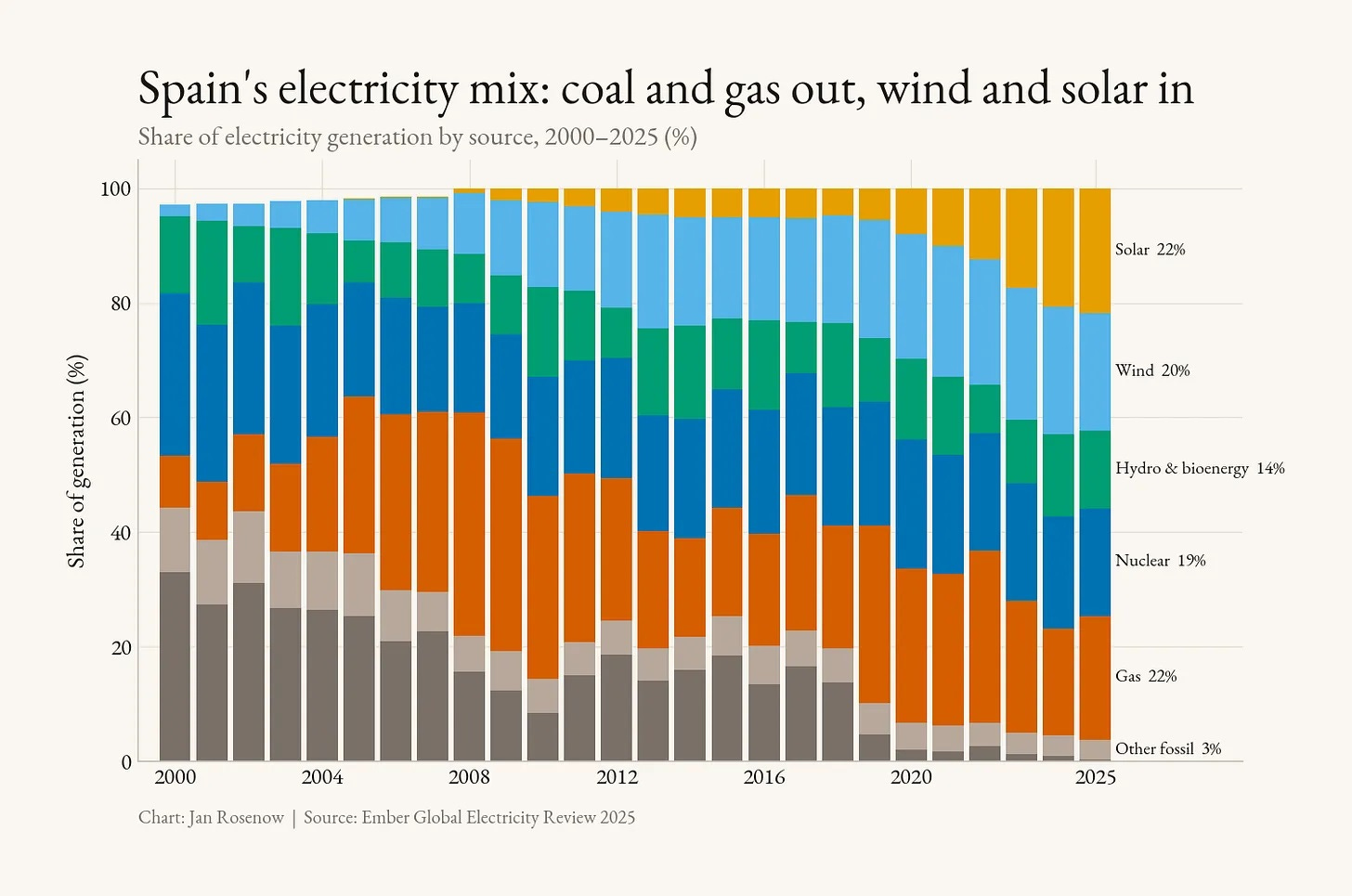
Over the last 25 years, Spain has gone from getting a third of its electricity from coal to effectively having zero coal power. Spain replaced most of that capacity with cheaper (and relatively cleaner but still climate-unfriendly) fossil gas, and it’s now replacing gas with renewables. Gas peaked at about 30 percent of Spain’s energy mix near the end of the 2000s, and is now down to about 19 percent. Another 19 percent comes from nuclear, which hasn’t changed over the last few decades and 14 percent is from hydro and bioenergy. The rest has been solar and wind, which combined are up to 42 percent of the mix in 2026. Here’s a pretty chart, with cheerful yellow solar energy and cool blue wind energy growing, and icky grey coal rapidly fading into nothing.
Here’s why the replacement of gas with renewables matters so much: Because wholesale electricity prices at any given time are set by the most expensive energy plants needed to meet demand, and gas is usually that most expensive source, getting more solar and wind on the grid during high-demand daylight hours brings down wholesale prices a lot. (snip-MORE)
Go and read, and click the links if you have time. It is heartening, even though it’s not happening here.
Boston has turned 30 bus shelters on the #28 route into pocket gardens. The drought-tolerant plantings sit atop waterproof trays, shading riders, soaking up rain, and greening a corridor long hit hard by summer heat, Boston.gov reports.
The project is a three-year demonstration tied to the city’s Heat Plan and its “Cool Commutes” strategy.
Photo: YouTube / Weston Nurseries Thirty bus shelters now host green roofs.
Heat Relief Where It’s Needed
The Route 28 line runs through Mattapan, Dorchester, and Roxbury. These neighborhoods are designated environmental justice areas and face higher, longer-lasting heat on hot days, Bay State Banner reports.
By replacing sun-baked clear panels with living roofs, the shelters cut radiant exposure and reduce the local heat-island effect.
Every downpour loads gutters, outfalls, and ultimately coastal waters. These roofs slow that flow. City officials estimate the 30 shelters will capture on the order of 1,400–1,500 gallons across the pilot period, helping curb runoff that can carry pollutants to drains and waterways, according to The Boston Globe. The city will also track water quality of roof runoff to understand filtration benefits.
The #28 route was chosen for high ridership.
Small Roofs, Big Biodiversity
Sedum forms the hardy base layer. Native plants will be added to attract bees, butterflies, birds, and other pollinators, building a tiny habitat network along Blue Hill Avenue, per Mass. Municipal Association. That boost matters in dense blocks with limited tree canopy.
Climate Action With Community Hands
Social Impact Collective designed the system and helped lead installation with YouthBuild Boston and Weston Nurseries, while JCDecaux, the city’s street-furniture partner, enabled the retrofit. The work revives a 2014 pilot and scales it across the city’s busiest bus corridor, The Architect’s Newspaper reports.
The #28 line is fare-free through 2026, positioning the program to reach riders who are most exposed to heat and least served by rapid transit.
Measuring Impact, Planning Scale
Over three years, Boston will collect data on temperatures, plant growth, stormwater retention, air quality, and pollinators to guide future standards for bus-shelter design, Mass. Municipal Association reports. If expanded to all 280 shelters, the city’s green roofs could hold roughly 15,000 gallons during storms—a meaningful dent in street flooding that also protects downstream marine habitats.