This is the same Bari Weiss that is rabidly anti-trans and a religious racist bigot. She is often used as a warrior to get the crimes against trans kids out, and Teldeb that used to come here and spew Weiss’s lies. No matter who many times I debunked and showed that everything Weiss had reported was lies and misinformation rabid trans haters like Teldeb kept pushing her lies. Because the truth doesn’t matter to them, making sure no child can be who they really are or fit the mold they demand children fit in. Now it is trans kids but as we have seen in the US they are coming for every not straight cis kid demanding they fit into the regressive world they demand everyone live in. Weiss is also a Jewish person who is an Islamophobe. She supports the genocide in Gaza. Hugs
ICE is a totally out of control rogue government agency that is simply lawless thugs. This was a civilian in medical distress in the ambulance. In a worse medical emergency the person could have died. The person was not in custody and a citizen but ICE demanded to be allowed to control them. Wake up people we have crossed all the lines. We barely have a functioning democracy. We all need to do what we can to fight this. Incredibly scary. ICE did not have the authority to hold the ambulance up but they did so at the point of a gun. What does that say about where the US is as “a nation of laws” and the republicans who for 50 years called themselves the party of law and order? Hugs
Late on Oct. 5, a Portland ambulance crew informed dispatchers over the radio that it was attempting to transport a patient from U.S. Immigration and Customs Enforcement to Legacy Emanuel Medical Center but that ICE officers were impeding its departure. Six minutes later, at 9:40 pm, according to publicly archived radio records, the medic driving the vehicle delivered an update: “We are still not being allowed to leave by ICE officers.”
Two confidential incident reports obtained by WW offer insight into what was going on inside the South Portland ICE facility at the time. The written accounts were filed by the ambulance crew members shortly after the incident—one report to their employer, American Medical Response, and another to a union representative—as documentation, as one report puts it, of a “conflict with federal agents.”
The two reports, filed by different medical workers, mirror each other’s accounts, and are consistent with publicly available audio recordings of emergency medical services radio communications, as well as 911 calls and dispatch reports obtained under public records law.
Both reports say that federal agents, in an effort to block the ambulance’s departure, stood directly in front of the vehicle. As the delay dragged on, according to the reports, the ambulance operator put the vehicle into park, causing it to lurch forward slightly.
The reports indicate the federal agents did not like this—so much so that an agent threatened to shoot and arrest the driver. The driver, frightened, asked why. An agent, according to the reports, responded that the driver had attempted to hit him with the ambulance.
“I was still in such shock,” the driver later wrote, “that they were not only accusing me of such a thing, but crowding and cornering me in the seat, pointing and screaming at me, threatening to shoot and arrest me, and not allowing the ambulance to leave the scene. This was no longer a safe scene, and in that moment, I realized that the scene had not actually been safe the entire time that they were blocking us from exiting, and that we were essentially trapped.”
The incident occurred at a contentious spot in the city. The ICE facility on South Macadam Avenue has in recent months been the scene of frequent and persistent protests, typically small in scale, which President Donald Trump has lately used to justify his effort to deploy military troops to Portland to protect federal facilities and the personnel that work in them.
Meanwhile, many, including Portland city officials, have alleged that federal agents have in several cases needlessly intensified situations that might have easily remained far more calm.
The incident described in the crew members’ two reports suggests that such hostility has been directed not only at demonstrators, but at first responders who were asked by the feds to assist. The ambulance was eventually allowed to leave the building with the patient. But the crew’s written reports of the preceding minutes offer a small but revealing sign of how on edge some federal agents working in the ICE facility are feeling—and how quick they are to take an aggressive posture when they perceive a physical threat, even from a fellow emergency worker.
WW first contacted U.S. Immigration and Customs Enforcement about the incident early last week. When WW followed up Friday, Oct. 10, with more details about what it planned to report, an ICE spokesperson wrote: “Please contact the Federal Protection Services for response.”
A subsequent email that day to the U.S. Federal Protective Service went unanswered. A media contact for the U.S. Department of Homeland Security, which contains FPS and ICE, did not respond to a request for comment either. None of the agencies responded to a follow-up email Oct. 11 asking for comment.
WW also sought comment from the ambulance crew members, the ambulance company, and the union representing the workers. None denied that the incident had occurred as described in the documents. The union added that when armed agents interfere with medical transport, they “cross a moral line.”
Public records provide greater context to the incident detailed in the crew members’ reports. The ambulance was called late in the evening on Oct. 5 to the ICE facility at 4310 S Macadam Ave. According to a publicly available dispatch document, the crew was responding to a medical call for a protester with a broken or dislocated collar bone.
By 9:13 pm, the ambulance was en route. According to a dispatch document, federal officials suggested at first that the ambulance enter the ICE facility through a side door, but then determined it should come in the main gate. The ambulance arrived on scene at 9:19. By 9:22, it had entered the building.
AMR ambulance on NE 82nd Avenue (Brian Burk)
A two-member crew was aboard. Both later documented the event in confidential reports. One record, reviewed by WW, appears on an event summary form produced for American Medical Response—the company that contracts to run ambulance services in Multnomah County. The document lists Oct. 5—the same day as the incident in question—as the “date submitted.” The other document is an email, sent by a crew member to a union representative. It is time-stamped the evening of Oct. 6.
The reports indicate that when the ambulance arrived, the patient was transferred into the vehicle without issue, and soon the crew was preparing to depart. This is consistent with other publicly available records. At 9:30 pm, the ambulance operator indicated plans over the radio to head to Legacy Emanuel Medical Center. Around 9:33 pm, dispatch records say, the ambulance seemed to be getting ready to bring the patient out.
And yet it was not emerging. What was going on? One crew member worked largely in the rear of the ambulance, while the other was sitting in the driver’s seat. Their respective reports offer consistent accounts from different vantages.
An initial delay, the driver’s report indicated, stemmed from federal agents’ desire to ride in the ambulance to the hospital. The driver recalls responding that, in the absence of arrest paperwork, officers could not ride in the ambulance, and that an agent responded this was OK—that agents would follow the ambulance to the hospital instead.
But the point was evidently not resolved. Before long, a report says, an agent again said the ambulance needed to wait for an agent who would ride along.
“I repeated again,” the driver’s report recounts, “that no officer is permitted to ride in the ambulance and that they can meet us at the hospital and that we needed to be let out of the facility. Officers then began walking away from me whenever I spoke. At that point, a group of 5-8 civilian-dressed men walked into the garage and just stared at me. No identification on any of them. I walked back to the ambulance and got into the driver’s seat. I flipped the emergency lights on and put the car into drive. I inched forward slowly out of the garage.”
At this point, a report says, a man in civilian clothes with a neck wrap covering the lower part of his face stepped in front of the ambulance and told the driver to halt. The ambulance driver, in the report, recalls telling the man not to stand in front of the ambulance, and that the man then yelled at the driver to stop, citing the risk of hitting federal agents.
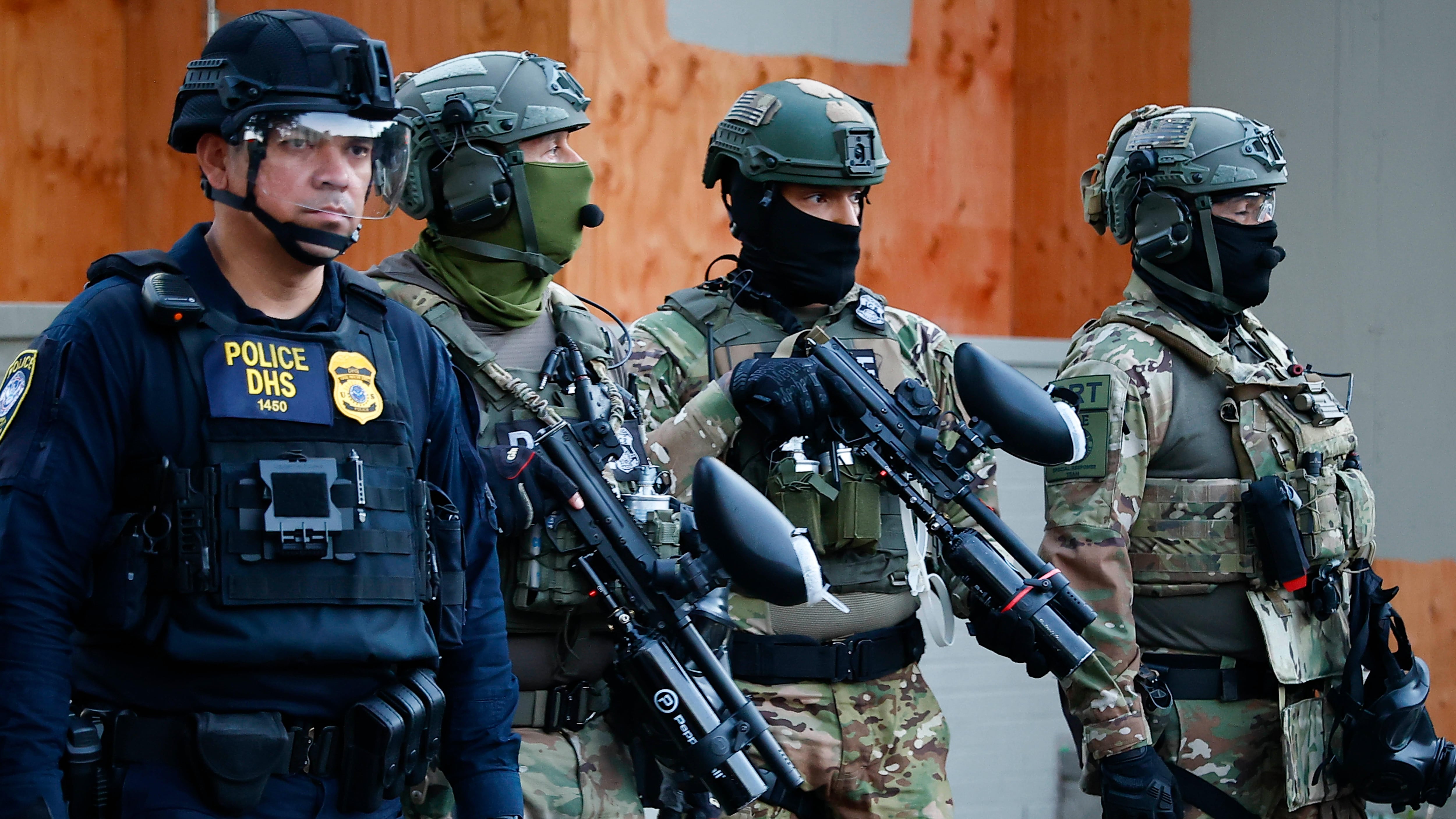
The driver recalled expressing skepticism about the risk of hitting the large group of officers in full riot gear, in plain view, about 15 feet in front and to the left of the ambulance. Sensing that departure was imminent, the driver inched forward further: “The group of about 30 officers in front of the ambulance were lining up in what I assumed to be preparation for the gate to open so they could escort the ambulance off of the property,” the report says.
Time went by. The crew was anxious to get the patient to the hospital. But they were still being impeded. Several federal agents, many in riot gear, moved to stand “incredibly close” to the front of the ambulance, the driver’s report recounts. An agent approached to inform the driver of the presence of “violent protesters” outside—a new reason the ambulance could not yet leave.
Around this time, dispatchers received one of the crew’s radio messages: The ambulance was still being held up.
Public records document this period as well: “50-60 fed agents completely blocking the road,” a dispatch report said at 9:39 pm, “but AMR still not driving out yet.”
The gate to the ICE facility had opened and dozens of officers in riot gear had marched out, revealing a clear exit path. Still, according to an incident report, the smaller group of officers continued to stand directly in front of the ambulance.
Around this time, the crew member in the rear, having determined, as a report says, that the “yelling and aggressive nature of the officers had created a scene safety issue,” exited the ambulance to have a word with them.
“My partner was still in the driver’s seat,” the crew member wrote, “and I left the ambulance to attempt to calm and deescalate the situation.”
In the other report, the driver recalled observing this and moving to secure the vehicle before also getting out: “I then placed the ambulance into park, took my foot off the brake, undid my seat belt and opened the driver’s side door. I looked up and suddenly the entire group of officers…were crowded around the open car door, some of them leaning forward towards me, inches from my face.”
An agent, the driver recalled, “pointed his finger at me in a threatening manner and began viciously yelling in my face, stating, ‘DON’T YOU EVER DO THAT AGAIN, I WILL SHOOT YOU, I WILL ARREST YOU RIGHT NOW.’”
According to the driver’s report, the crew member who had been in the rear of the ambulance told the agent that the vehicle rolled forward when the driver put it in park, and that no one was trying to hit him.
To this, the report recounts, another agent replied that this was not the first time this had happened.
According to the medics, the agents continued to yell. There was also further chatter of riding in the ambulance, but in time an accord was reached: Feds would follow along in their own car.
By 9:42 pm, a crew member radioed in: They were finally en route to the hospital. The driver, in the report, recounts making this radio call, and that dispatch copied. The report says an unmarked vehicle with state license plates followed closely behind the ambulance, and upon arriving at the hospital, multiple men in civilian dress exited the vehicle and walked in.
Presented by email with details of this story, a spokesperson for Global Medical Response, the parent company of American Medical Response, did not answer WW’s questions, but said, “We are reviewing the specifics of the situation and committed to a thorough review.”
WW reached out to the two ambulance crew members. Both declined to comment.
Asked for incident reports tied to the medical call, Austin DePaolo, a spokesman for Teamsters Local 223, which represents the ambulance workers, said in an email that the union “doesn’t have any incident reports that members have given us permission to share.”
DePaolo added: “Our Teamster EMS workers answer every call with courage and compassion. When armed agents interfere with medical care, they cross a moral line that could put lives at risk. We stand firmly behind our members who work in EMS.”
Andrew Schwartz writes about health care. He’s spent years reporting on political and spiritual movements, most recently covering religion and immigration for the Chattanooga Times Free Press, and before this as a freelancer covering labor and public policy for various magazines. He began his career at the Walla Walla Union-Bulletin.
Willamette Week’s reporting has concrete impacts that change laws, force action from civic leaders, and drive compromised politicians from public office.
ICE officers are facing backlash after a viral video showed them pepper-spraying a peaceful protester in the face without provocation during a chaotic street arrest.
Josh Johnson dives into the peace deal Trump brokered between Israel and Hamas, and the president’s heightened focus on a supposedly more dangerous and local enemy: Antifa. As troops menace Portland, Trump uses the Antifa bogeyman to justify military invasion, suspension of habeas corpus, and a bunch of other random agendas.