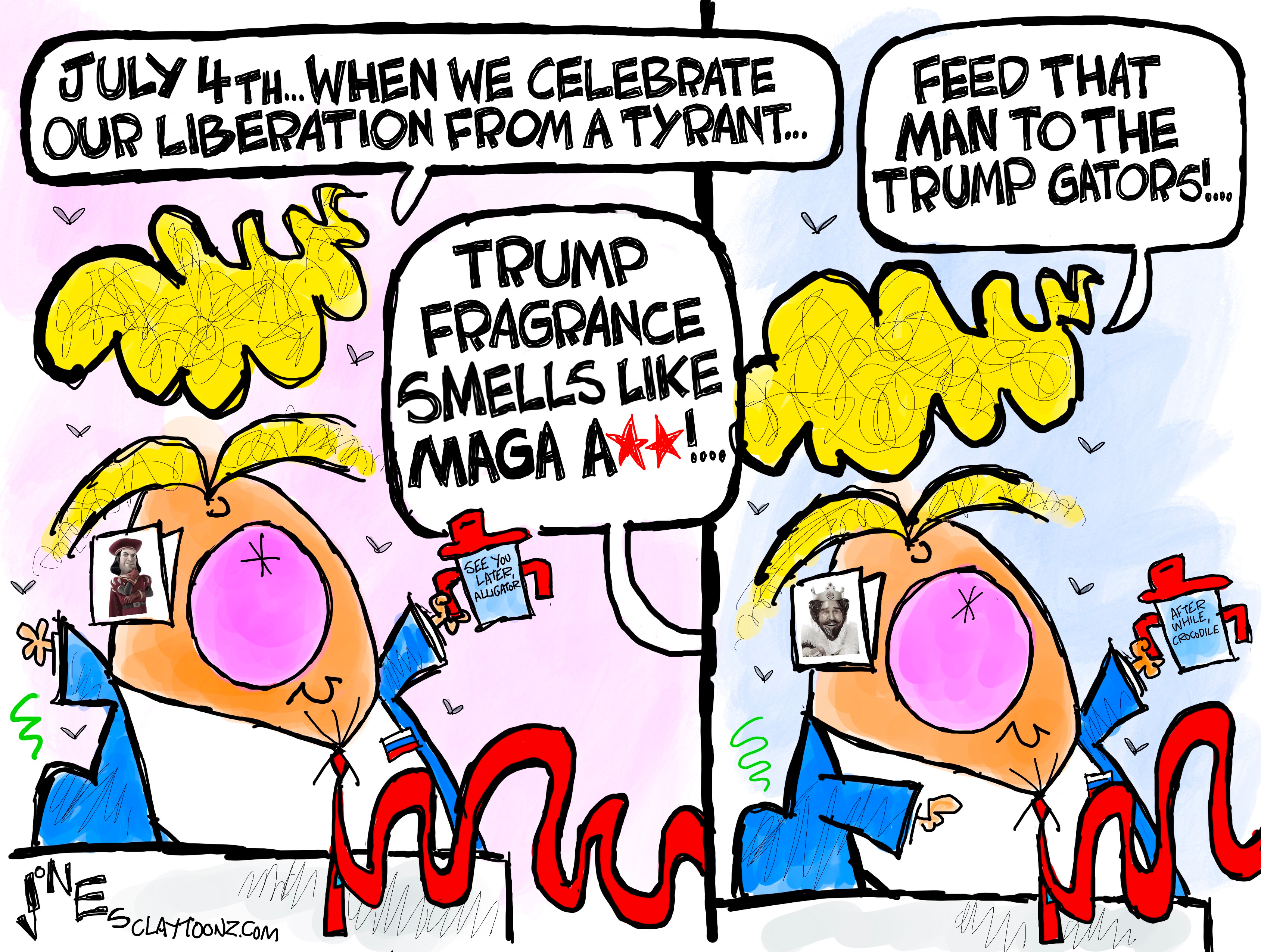
Tomorrow, we’re celebrating the anniversary of our independence from a monarchy. Yet, the guy in the White House envisions himself as a monarch.
He wants to ban protests, which is a First Amendment right. He didn’t send the military to California to stop riots. He sent them to stop the protests. Ice has arrested legal residents, without charges, but citing their protests. The regime is bullying colleges to stop protests against the war in Gaza. This is not freedom. This is not independence.
Trump asked the courts for immunity from criminal charges. Every court said no until it got to the Supreme Court. One man has been ruled to be above the rest of us, and he has immunity.
The Supreme Court allowed Trump to stay on the ballots despite his waging war against this nation.
Trump waged war against this nation to remain in office. He led a white nationalist coup attempt against our country. He attacked Congress to prevent it from doing its constitutional duty of certifying the 2020 election.
Now, Congress is in Trump’s pocket and failing to work as one of the three branches.
The Supreme Court has now ruled that lower courts shouldn’t make rulings against Trump that apply nationally.
The Supreme Court failed to address Birthright Citizenship, allowing Trump to violate a Constitutional amendment. Until SCOTUS acts on this, Trump will go unchallenged.
He is building concentration camps.
He’s ordering the Department of Defense to go after his enemies.
He’s violating the Emoluments Clause, using the White House to enrich himself.
He’s talking about running for a third term, but this would just be another violation of the Constitution. If he’s talking about running for a third term, then he will be running for a third term.
Trump will not allow another election to be fair.
He’s attacking the media, and soon, the only media that will be allowed to continue to exist will be Trump media.
I left a lot out, so go ahead and fill in the blanks in the comments.
(snip-MORE)
In 1776 we rejected a monarchy by Ann Telnaes
You can thank the oath breaking Republicans for where we are Read on Substack
July 2, 1776 New Jersey became the first British colony in America to grant partial women’s suffrage. The new constitution (temporary if there were a reconciliation with Great Britain) granted the vote to all those “of full age, who are worth fifty pounds proclamation money,” including non-whites and widows; married women were not able to own property under common law.
July 2, 1777 Vermont became the first of the United States to abolish slavery.
July 2, 1809 Alarmed by the growing encroachment of whites squatting on Native American lands, the Shawnee Chief Tecumseh called on all Indians to unite and resist. By 1810, he had organized the Ohio Valley Confederacy, which united Indians from the Shawnee, Potawatomi, Kickapoo, Winnebago, Menominee, Ottawa, and Wyandotte nations. For several years, Tecumseh’s Indian Confederacy successfully delayed further white settlement in the region. Chief Tecumseh Tecumseh’s efforts
July 2, 1839 Slave ship Early in the morning, captive Africans on the Cuban slave ship Amistad, led by Joseph Cinquè (a Mende from what is now Sierra Leone), mutinied against their captors, killing the captain and the cook, and seized control of the schooner. Jose Ruiz, a Spaniard and planter from Puerto Principe, Cuba, had bought the 49 adult males on the ship, paying $450 each, as slaves for his sugar plantation. More about Amistad Joseph Cinquè
July 2, 1964 Jobs and Freedom march April 28, 1963, Washington DC U.S. President Lyndon B. Johnson signed the Civil Rights Act of 1964 into law, thus barring discrimination in public accommodations (restaurants, stores, theatres, etc.), employment, and voting. The law had survived an 83-day filibuster in the U.S. Senate by 21 members from southern states. “I think we just delivered the South to the Republican party for a long time to come,” said President Johnson to his press secretary, Bill Moyers later that day. He anticipated a shift in white southern voting from the Democratic to the Republican party in response to the law. Massive demonstrations a year earlier ensured passage of the Act.
July 2, 1992 President George H.W. Bush (the elder) announced that the United States had completed the worldwide withdrawals of all its ground- and sea-launched tactical nuclear weapons [see September 27, 1991].
Yes, this passed in the Senate, thanks to the VP’s tiebreaking vote. However, it’s still got rows to hoe in the US House; Spkr. Johnson wants to vote tomorrow. The thing to remember about our US Reps is, they’re up for election each 2 years. So, while firmly directing them in dealing with this dreadful bill, also firmly yet lovingly remind them that the OBBB will be hanging around their necks every step of the way of their campaigns like a bubblegum machine golden giant dollar sign necklace, if they vote in favor.
(Actually, if you didn’t when you contacted your Senators last week, you can still remind them of the same thing, unless they voted against, in which case, Thank Them. It took bravery to vote against, and they need to know we have their backs. And thank you very much. Now call.)
I cannot add up the number of times I’ve been told by good, liberal Dems that these issues won’t float. And that was back in the 1980s and 90s, not to mention the 2000s. Anyway, take a look!
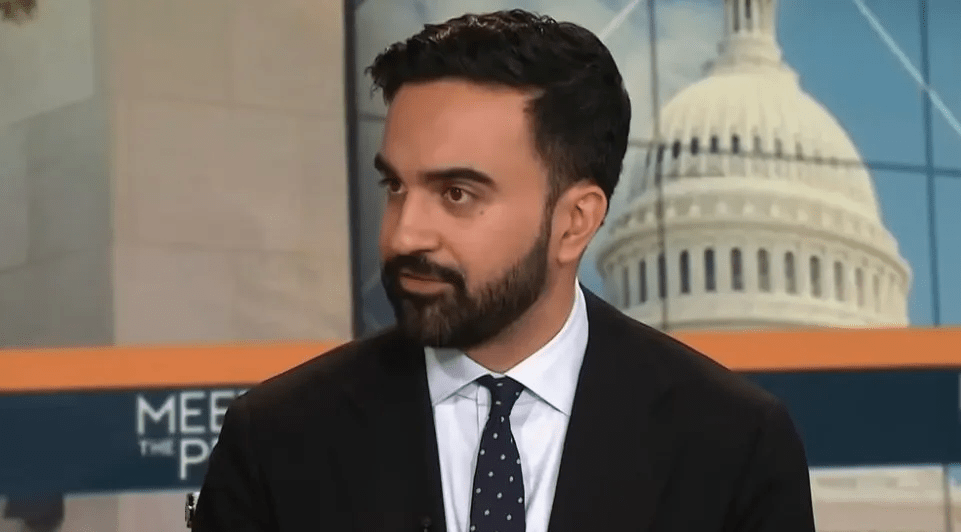
Mamdani And The Left Are Moving The Window – Good by Oliver Willis
What if everything you believed since you have been politically awake is wrong? It isn’t that you have bad intentions or you’re fundamentally stupid, but what if instead you believed for so long that the existing menu of political options was one group of beliefs but in reality, that was a really limited menu that excluded some really tasty items you never considered before?
When a rising progressive figure like Zohran Mamdani makes bold statements about what he wants to achieve, it can make regular old mainstream Democrats/liberals like myself wince. Government supermarkets? We shouldn’t have billionaires? Immediately that kicks in concerns about how Democrats are perceived. It isn’t just Mamdani. Ideas like defunding the police, universal basic income, free health care, etc.? Sure, we say, they may sound good on paper – but they also sound like left wing fantasyland, they’re just not “practical.”
And maybe they are impractical, unworkable, and election losers. But – what if not? We should at least have the conversation, I think.
Because for decades now American political discourse has been operating within the parameters set by the right wing, not the left. Since 1980 we have had 20 years of Democratic presidents and while I think they did a decent job of domestic politics between the three of them (Clinton, Obama, and Biden), much of what they did was within the narrow paradigm of what was acceptable behavior.
Clinton frequently talked about cutting the size of the government, Obama spoke about lowering the deficit, and Biden also used the language of “fiscal responsibility” as the right envisions it. All three men accepted the existence of billionaires and even pushed policies that would theoretically create even more of them. None of them would argue that the police needed to be defunded, and in fact they all oversaw federal spending that sent billions to police departments.
I was among the millions who supported these three presidents, along with other Democrats who ran for office with a similar world view both at the presidential and congressional level to varying degrees of success.
But these people have all been operating within the right’s paradigms. Collectively we never openly debated how we could have it all wrong. Maybe the prison system should be abolished? Maybe billionaires should be taxed out of existence?
Even if we don’t ultimately reach those conclusions, these are debates worth having.
Because while we have been limiting ourselves, the right hasn’t. Since Barry Goldwater in 1964, the right has been shifting the Overton Window – what is considered acceptable public discourse – steadily to the right. We have gone from Republicans like Nixon creating agencies like the EPA to Ronald Reagan and George W. Bush cutting funding for vital agencies to Donald Trump trying to completely destroy agencies like the Department of Education.
Things that Trump treats as uncontroversially right-wing today would have been laughed out of the room as the ravings of lunatics in 1958. The right has mounted serial challenges to what was the liberal orthodoxy (not on every issue but most issues) in the 1960s and they have molded public perception of what acceptable dialogue is.
We are worse off for this. One can praise what Democratic leaders have accomplished in a progressive manner (health care, infrastructure, overall policy) and still admit that the thinking has been severely limited and inhibiting.
Voters are making this clear to the party. They keep showing in multiple federal and state elections that they are unhappy with the status quo and in some instances, like with Trump, they are far too eager to flirt with fascism versus maintaining the system as-is.
Think about the world that millennials and Gen-Z have lived in for their entire lives. Not only has it been shaped by Reaganism and Trumpism, but it has also been peppered with Democratic leaders like Obama, Clinton, and Biden who didn’t fundamentally challenge the bedrock of what the right laid but instead focused on (well needed) nibbling at the edges.
It has been a very long time, probably not since the Great Depression, where Democrats articulated the notion that something beyond the acceptable was possible. When Franklin D. Roosevelt first took office, the consensus was that bad stuff just had to happen and that the government had to lie back, helpless. Herbert Hoover couldn’t truly conceive of a universe where the government swooped in and actively combated the forces making things worse for ordinary Americans. Roosevelt shifted the window and set up the infrastructure of the safety net that still exists today (for now). (snip-MORE, + Kal El photo. Click through!)
Also, to commemorate the final day of PRIDE month 2025, here’s an historic dance music video to celebrate. No matter what, we should never not dance again! 🎶 🌈 🎶 🫶
June 30, 1966 The first GIs—known as the Fort Hood Three, U.S. Army Privates James Johnson, Dennis Mora and David Samas—refused to be sent to Vietnam. All were members of the 142nd Signal Battalion, 2nd Armored Division stationed at Fort Hood, Texas. The three were from working-class families, and had denounced the war as “immoral, illegal and unjust.” They were arrested, court-martialed and imprisoned. The Pentagon reported 503,926 “incidents of desertion” between 1966 and 1971. 1961-1973: GI resistance in the Vietnam War View their pamphlet Ballad of The Fort Hood Three Pete Seeger
June 30, 1971 The 26th Amendment to the U.S. Constitution, lowering the minimum voting age to 18 in all elections, was ratified after ¾ of the 50 state legislatures had agreed to it, a mere 100 days after its passage by Congress.
June 30, 1974 The Selective Service law, authorizing the draft, expired, marking the official end of conscription in the U.S. and the beginning of the all-volunteer armed forces.
June 30, 2005 Spain legalized same-sex marriage by a vote of 187-147 in parliament. Such couples were also granted the right to adopt and receive inheritances. Prime Minister Jose Luis Rodriguez Zapatero spoke in support of the bill, “We are expanding the opportunities for happiness of our neighbors, our colleagues, our friends and our relatives. At the same time, we are building a more decent society. Read more
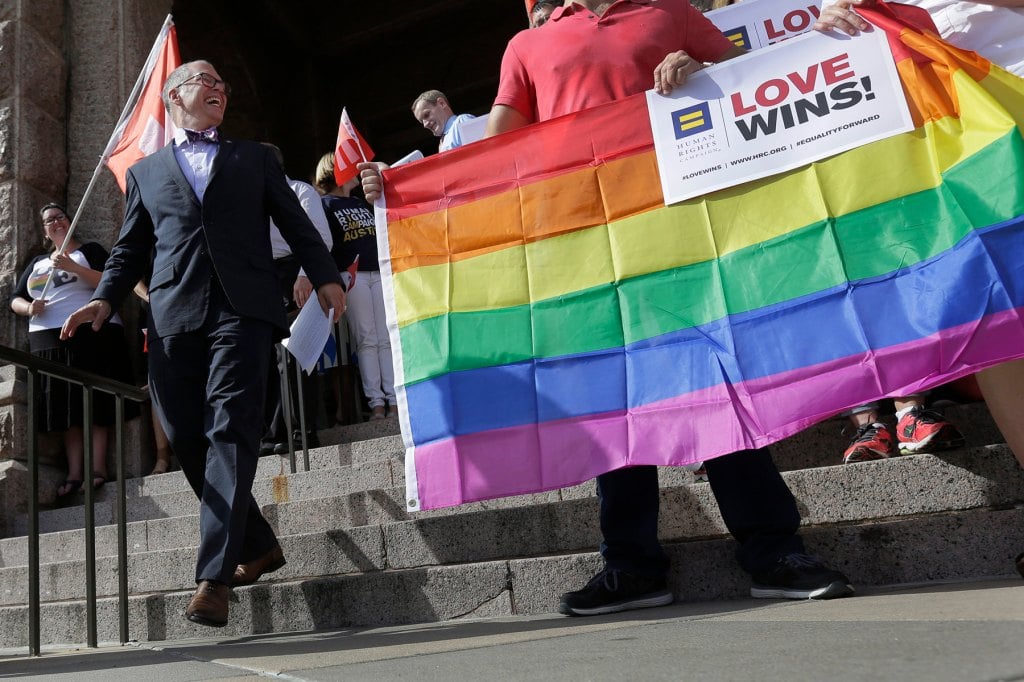
It happened just a few weeks ago: Jim Obergefell was moving things in his office when he came across the ashes of his late husband, John Arthur, now 12 years gone. Arthur had last wishes for his ashes. Obergefell had yet to fulfill them.
“And it struck me that, oh, I am actually now mentally, emotionally ready to take care of John’s ashes,” Obergefell told The 19th. “It was the first time that I had that feeling so clearly and so strongly.”
Obergefell, 58, is ready to move on. Not exactly from the love of his life or the history-making Supreme Court decision that came after Arthur died. But certainly from the insecurities straight America was grappling with a decade ago about same-sex unions.
Obergefell is that Obergefell: the named plaintiff in the landmark lawsuit that extended marriage equality to every state in the nation in 2015. Ten years later, he celebrates that win and the many ways it rewrote his life. And in a time when LGBTQ+ rights are again under assault, he is looking to the future — of the queer rights movement and also his own.
A journey to the Supreme Court
Obergefell’s journey to the Supreme Court was hardly destined. It began 12 years ago, on June 26, 2013, when the Supreme Court struck down the Defense of Marriage Act, a federal law that prohibited the government from recognizing same-sex marriages.
Obergefell and Arthur had been together for 21 years at the time. The two had discussed getting married before. But they wanted it to be legal, and their home state of Ohio didn’t offer same-sex marriages.
Arthur was gravely ill with ALS, a progressive neurodegenerative disease, and he barely left his home hospice bed.
After the ruling, Obergefell leaned over to Arthur, hugged, then kissed him.
“Let’s get married,” he said.
Arthur agreed.
The logistics were not easy. Arthur was in no shape to travel, and the couple could not wed in Ohio. Obergefell researched and found that Maryland would let him get a marriage license even with only one of them present. But both would need to arrive in the state for the ceremony.
When friends and family learned about their predicament, they pooled together money to charter a medical jet for Arthur. The two flew to Baltimore. Over the course of 45 minutes, they exchanged vows on the tarmac before flying home.
“In the days that followed, we said the word ‘husband’ hundreds of times a day,” Obergefell said on the Decidedly Podcast in 2023.
But just five days later, their joy was muted when civil rights attorney Al Gerhardstein informed them that because of Ohio’s ban on same-sex marriage, Arthur would be listed as single in death.
Arthur and Obergefell were angry. The couple sued the state of Ohio in federal district court and won. Three months later, Arthur died.
The following year, Obergefell, still in mourning, lost on appeal. But he refused to believe he might lose altogether.
“I just kept going,” Obergefell said. “It was the right thing to do.”
On June 26, 2015, he won. For the country, the win was immensely practical. Many told Obergefell it gave them so much hope it saved their lives. For Obergefell, it meant a legacy for the man he loved.
“I made promises to John to love, honor and protect him, and I was going to keep doing that,” he said.
In the decade since Jim Obergefell won his Supreme Court case that made same-sex marriage federally legal, hundreds of thousands of same-sex couples have married in the U.S. (Eric Gay/AP Photo)
Changing history
It’s difficult to overstate the impact of Obergefell’s case on the nation or the world. Since the 2015 ruling, the Williams Institute at the UCLA School of Law estimates, 591,000 queer couples have wed, generating an estimated $5.9 billion in wedding spending for state and local economies.
It has also radically transformed Obergefell’s life. Introverted and unassuming, he has spent the last decade campaigning for LGBTQ+ rights. He helms Equality Vines, a wine company that donates its proceeds to advancing civil rights causes.
It’s a position that makes him deeply proud if not a little fatigued.
“I’m not tired of talking about it,” he said of the 10-year anniversary of the ruling. “I’m just physically tired from all of the interviews and the photographers and the speaking gigs and the events. Yes, I’m exhausted.”
For 12 years, Obergefell has kept Arthur alive through retelling their story countless times in courtrooms and for the media. That exercise, of telling and retelling, helped Obergefell process his profound loss.
But he has never recoupled. It wasn’t that Arthur didn’t want him to. In fact, Arthur told him regularly that he wanted him to find love again. He asked his friends and family to tell Obergefell that he wanted him to find love after he was gone.
“I know it was sincere, because he told me that he had other people tell me that,” Obergefell said.
It isn’t about the pressure he feels as the face of marriage equality, he said, though part of him wonders what it would be like to date after making history.
“I don’t know how to date,” he confessed. “I’m clueless when people flirt with me, and as much as I hate it, and I don’t go into any conversation or anything like this, but you know, there’s that part of me that sometimes wonders, you know, are they interested in me as a person, or are they interested in me as Jim Obergefell, named plaintiff?”
Obergefell’s name has become synonymous with marriage equality in the United States, an issue that has not always united the LGBTQ+ community. Some queer activists have argued that same-sex marriage was a misguided goal for the movement as queer youth continue to face high rates of homelessness and transgender people grapple with police violence and incarceration, among other issues.
More work to do
Obergefell, too, is worried that the needs of the community’s most vulnerable have gone unmet. He has watched horror-struck over the last five years as state legislatures have moved to restrict transgender rights.
“We need to fight for every marginalized community, because the queer community includes every marginalized community, and equality for one is pointless without equality for all,” he said. “I didn’t go to the Supreme Court just so White, cisgender, gay men like me could get married.”
Despite all of the setbacks in LGBTQ+ rights, and even threats to Obergefell’s game-changing victory, he is hopeful — and feels stronger than ever. People assume his case was difficult for him. It was, but the path was also obvious, to him and to Arthur. They loved each other.
“If we weren’t willing to fight for each other and for what was right, then what’s the point?”
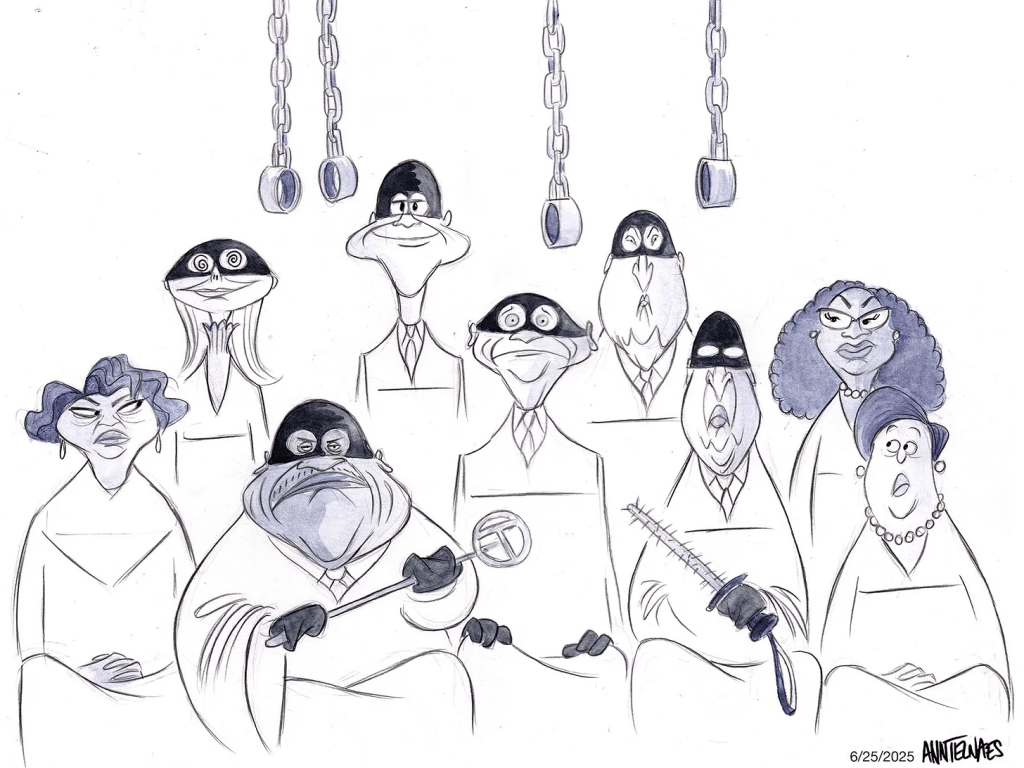
SCOTUS allows deportations to “third party countries” by Ann Telnaes
The Supreme Court justices pauses a federal judge’s ruling Read on Substack
Justice Sonia Sotomayor dissented and was joined by Justices Elena Kagan and Ketanji Brown Jackson. Sotomayor wrote, “the Court finds the idea that thousands will suffer violence in far-flung locales more palatable than the remote possibility that a District Court exceeded its remedial powers when it ordered the Government to provide notice and process to which the plaintiffs are constitutionally and statutorily entitled.”
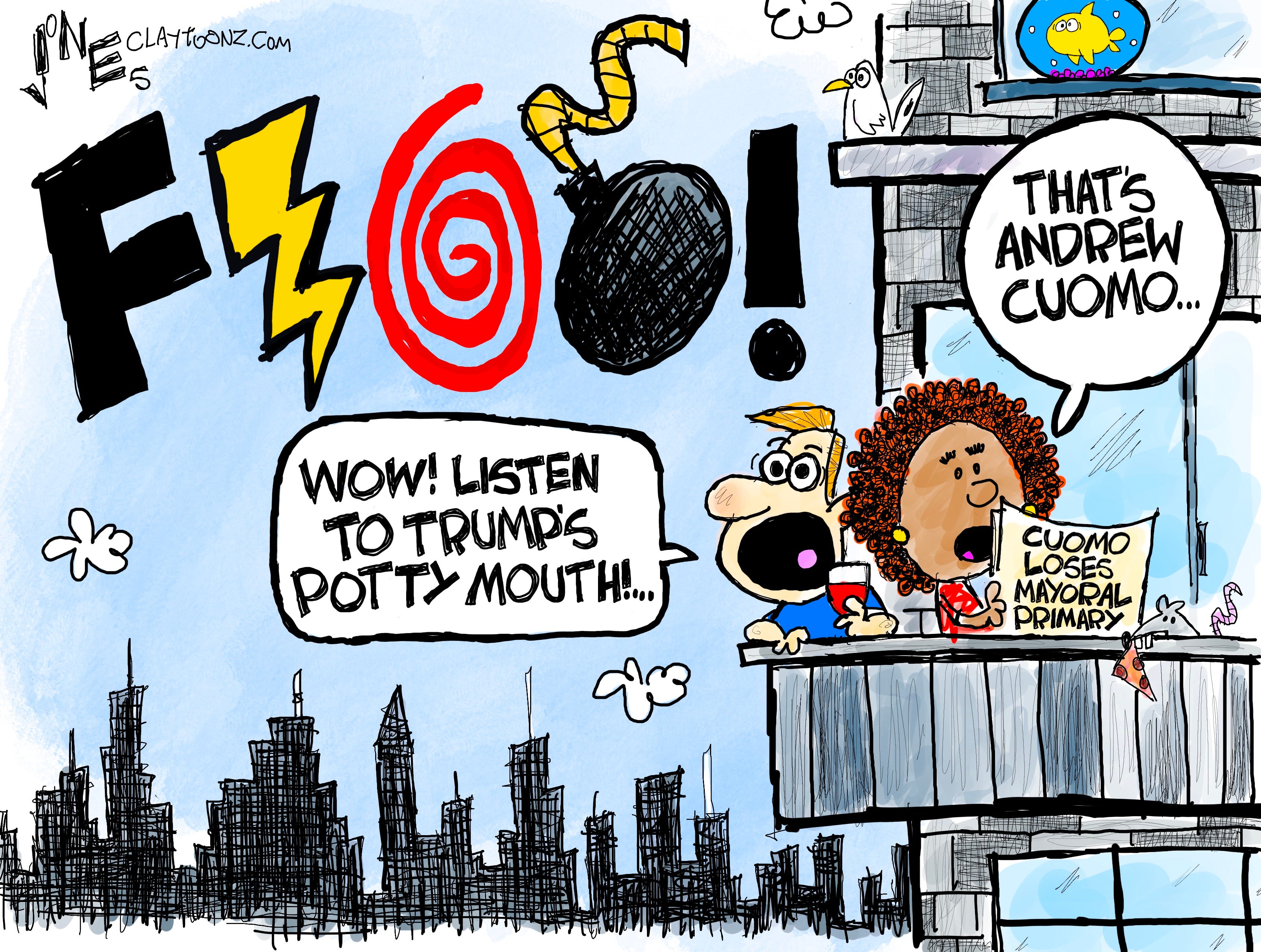
I gotta be honest with you. I didn’t think Trump’s F-bomb was anything unique or scandalous in the New Normal. Sure, it’s not presidential for a president to say, “They don’t know what the fuck they’re doing” to reporters while standing in the White House driveway, but none of this has been presidential.
So, I didn’t think it was cartoon worthy, but then I saw one yesterday, and another one today, and then another one, and then another one, which means there are going to be at least 12 more by the end of the day. I decided to use it myself in doing a cartoon on the New York City Democratic mayoral primary, but put a little twist on it.
Political Cartooning 101 lesson: Use the F-bomb in your cartoon as a tool, but don’t make the cartoon about the F-bomb…unless it’s too funny to resist.
Former New York Governor Andrew Cuomo was and maybe still is trying to resurrect his political career after resigning in disgrace after being accused of sexual harassment by at least 11 women, which is less than half the number of women who have accused Donald Trump, yet his political career is still going. And former senator Al Franken is now playing a fictional senator in a limited Netflix series.
Cuomo was the favorite to win the Democratic primary, but unfortunately for him, it was rank-choice voting, where voters rank candidates for office in order of their preference. This system gave the nomination to young upstart Zohran Mamdani, an Islamic democratic- socialist state assemblyman with very few legislative accomplishments. And this is what I meant when I said Cuomo was/is trying to resurrect his political career.
Of course, Cuomo’s bid to become the Democratic nominee for NYC’s mayor is over, but not his bid to become mayor…unless he changes his mind and removes himself from the ballot, as Cuomo is now running as an Independent.
Previously, victory in the Democratic primary all but guaranteed a move to Gracie Mansion, as Democrats outnumber Republicans 6-1 in the Big Apple. But now, it may be a five-way race.
Rank-choice will not be implemented in the general election, where Mamdani will have to compete once again against Cuomo, but also against current mayor and bribe-taker Eric Adams (who will have Donald Trump’s support), Guardian Angels founder and Republican nominee Curtis Sliwa (who had no opposition for the nomination), and former federal prosecutor Jim Walden, who is also running as an Independent. And I’m sure there are a few dozen other never-heard-of-before dingbats on the ballot.
While some pollsters may predict that Mamdani will win the general election, you can’t be too sure with his socialist platform, that Cuomo’s still in the race, and NYC has the largest Jewish population in the world outside Israel. If Cuomo does drop out, I’d predict Mamdani to win.
One thing you can expect during the race is chaos, and more of this… (snip-MORE, and though well-written, the story is not pretty)
“Zohran Mamdani would do to New York City what Khomeini and Khamenei did to Tehran,” Fine said. “We cannot let radical Muslims turn America into a Shiite caliphate.”
The proposal is unlikely to generate much revenue for the government; there is almost no private-sector interest in the mail trucks, and used EV charging equipment — built specifically for the Postal Service and already installed in postal facilities — generally cannot be resold.
“The funds realized by auctioning the vehicles and infrastructure would be negligible. Much of infrastructure is literally buried under parking lots, and there is no market for used charging equipment,” Peter Pastre, the Postal Service’s vice president for government relations and public policy, wrote to senators this month.
Read the full article. $10 billion into the sewer to please their Glorious Leader. Something something DOGE.
My wife and I recently returned from a Danube River cruise — no, it’s not blue, the waltz notwithstanding — and we had a wonderful time.
One of the many pleasures of these relatively small river cruises is all the interesting people you get to meet from around the world. This time around, we spent most of our time with Canadians and Australians, who seemed to enjoy our company once they determined we shared their low opinion of our president.
When one of the Canadians we dined with several times learned that we had signed on for a “Sound of Music” tour of Salzburg, Austria — featuring fountains, mountains, cityscapes, trees, a church and other locations from the movie — he told a nice story about an Austrian who emotionally described to him his love for their traditional folk song, “Edelweiss.”
I had read that the song actually was written just for the movie and had no significance for Austrians, which our guide confirmed the next day. So when our new friend repeated his story at dinner that evening, I politely corrected him, explaining that although some Austrians may have embraced the song — the Edelweiss is their national flower — it was a Rodgers and Hammerstein creation.
I won’t say our friend was crestfallen, but he did seem disappointed. I should add that I have a long tradition of spoiling people’s favorite stories, in part through the urban legend columns I used to write semiregularly.
So here’s the question. Is the truth really that important, if it spoils a good narrative?
After all, we’re in what some people have characterized as the Post-Truth Era, ushered in most recently by Donald Trump, his congressional lapdogs and Fox News but immortalized much earlier by Adolf Hitler and his Nazi regime. Falsehoods abound, not just in the White House but all over social media.
Here’s how the European Center for Populism Studies explained the Big Lie technique.
The big lie is the name of a propaganda technique, originally coined by Adolf Hitler in “Mein Kampf,” who says “The great masses of the people … will more easily fall victim to a big lie than to a small one,” and denotes where a known falsehood is stated and repeated and treated as if it is self-evidently true, in hopes of swaying the course of an argument in a direction that takes the big lie for granted rather than critically questioning it or ignoring it.
Pssst. If that doesn’t sound familiar, wake up.
Hitler used it to blame his country’s problems on his best available scapegoat, Jewish people. Trump and company have broadened this approach to encompass multiple scapegoats — immigrants, foreigners, transgender people, people who are “woke” because they encourage social justice and care about the future health of our planet — and to big lies involving the 2020 election and so many other subjects that we’re numb to it. He lies about everything, and his supporters don’t seem to know or care.
I remember when the idea of act checking first emerged in political coverage. Instead of just quoting politicians who were fudging the truth, the fact-checkers would point out when they were lying or exaggerating, in the case of The Washington Post by assigning up to four Pinocchios for the most egregious falsehoods.
Some politicians would correct themselves in future pronouncements. Others wouldn’t bother.
Trump, the ultimate Pinocchio, is oblivious to Fact Checking. He just plows ahead — “They’re eating the dogs, they’re eating the cats!” — repeating the same misinformation over and over at rallies, news conferences, debates. Facts are irrelevant.
Perhaps most amazingly, his long-since-debunked fraud allegations regarding the 2020 election are being incorporated into Oklahoma’s public-school curriculum. Elsewhere, facts about racial injustice, climate change and our nation’s history have been altered or eliminated from public school curricula to suit the MAGA agenda. Kinglike, Trump even is punishing colleges, states and others who won’t go along with his determination to impose “1984”-style Newspeak.
I think at least some Trump followers — particularly Republican elected leaders — know he is lying. But because it suits their preferred narrative, they go along. That’s frightening enough. Even scarier, though, are the people who are too dim, lazy or Foxcentric to figure out that we’re not being overrun by bloodthirsty killer immigrants or that non-straight men and women aren’t a threat to our military, our children or anything else, not to mention that Trump really lost the 2020 election, that the rioters storming the Capitol weren’t the true victims of Jan. 6, that indiscriminate ICE goon squads aren’t the best solution to illegal immigration and that vaccinating our children continues to be a very good idea.
They don’t just accept the lies. They spread them. That’s why we must be advocates for the truth, correcting and even confronting falsehoods, at rallies, on social media, in conversations. Ignorance is not bliss. It’s fueling our country’s descent into unrecognizable autocratic chaos.
“Eidelweiss” may be trivial. But innocent people being demonized? Trust in our elections destroyed? Our constitutional guarantees shredded? Our planet’s climate threatened? Long-dead diseases given new life?History rewritten?
Speak up. The truth is worth defending.
This is a contributed opinion column. Bill White can be reached at whitebil1974@gmail.com. His Threads handle is whitebil2000. The views expressed in this piece are those of its individual author and should not be interpreted as reflecting the views of this publication. For more details on commentaries, read our guide to guest opinions at themorningcall.com/opinions.
The Senate Judiciary subcommittee held a hearing Wednesday digging into the cognitive abilities of former President Joe Biden and claims of whether his aides helped what they say was a cover up of his alleged mental decline — claims the former president and many on his staff have denied.
The probe didn’t uncover any new information on the former president — with Democratic members of the subcommittee boycotting the hearing.
Democratic senators on the committee walked out of the hearing shortly after it began, with Democratic Sen. Dick Durbin blasting the panel for even holding the hearing, while he says a number of timely investigations should be going on related to President Donald Trump’s current actions.
“So far this year, the Republican majority on this committee has not held a single oversight hearing, despite numerous critical challenges facing the nation that are under our jurisdiction,” Durbin said.
The GOP panel repeatedly accused Democrats — and the media — of concealing the former president’s alleged real health conditions in order to prevent Trump’s 2024 victory.
“Today’s hearing is about competency, corruption and cover up within the Biden administration. Simply put, the last administration was rudderless from one crisis to another. The Biden Administration failed and folded. The partisan media did their best to cover up those failures,” Senate Judiciary Chairman Chuck Grassley claimed.
Former White House Press Secretary Sean Spicer listens to questioning during Senate Committee on the Judiciary hearings on how the Biden Cover-Up Endangered America and Undermined the Constitution in the Dirksen Senate office building in Washington, DC, June 18, 2025.
Mattie Neretin/Sipa USA via AP
Former White House press secretary Sean Spicer, who was among the witnesses, compared his time working under Trump in his first term to his observations of Biden, praising Trump’s energy and mental focus. Spicer never worked for the Biden administration.
Spicer also criticized “legacy media” for questions raised about Trump’s fitness for office in his first term, while he claims they were not questioning Biden the same way.
“Many, rightly so, believe the media in this country is culpable in covering up the obvious decline of the 46th president and leaders of the free world — the president of the United States. The scrutiny that was baselessly directed at President Trump during his first term was wholly absent from the media coverage of the Biden White House,” Spicer claimed.
Republicans on the committee also focused on Trump — saying he is in command and makes skillful decisions.
“The public is counting on us to ensure this never happens again, because we won’t always be fortunate enough to have a leader like President Trump, who is so unmistakably in command,” Republican Sen. Eric Schmitt said.
Joe Biden speaks during a conference of the Advocates, Counselors and Representatives for the Disabled (ACRD) at the Sofitel Hotel in Chicago, Illinois, on April 15, 2025.
Tannen Maury/AFP via Getty Images
In May, Senate Republicans announced their plans to launch the probe into Biden’s mental fitness while in office — including his use of autopen, a mechanical device to automatically add a signature to a document that’s been utilized by several past presidents, including Trump in his first term.
The hearing also comes after Trump earlier this month ordered Attorney General Pam Bondi to investigate whether Biden’s administration sought to conspire to cover up his alleged mental state while in office. The move by the White House represents a significant escalation, as it is a directive to the Justice Department to formally investigate.
Biden responded to the Trump order, saying “Let me be clear: I made the decisions during my presidency.”
“I made the decisions about the pardons, executive orders, legislation, and proclamations. Any suggestion that I didn’t is ridiculous and false,” Biden said in a statement.
In May, House Oversight Chairman James Comer requested Biden’s White House physician, Kevin O’Connor, appear for a transcribed interview as part of an investigation into Biden’s mental fitness and use of a presidential autopen while in office. Comer asked O’Connor to sit for an interview on June 25.
Sean Spicer, Heritage Foundation Visiting Fellow for Law and Technology Theodore Wold, and University of Virginia Law Professor John Harrison testify during a Senate Judiciary Committee hearing on the alleged cover up of former President Joe Biden’s alleged incapacity to serve on Capitol Hill June 18, 2025.
In response to the book’s release, a Biden spokesman said “there is nothing in this book that shows Joe Biden failed to do his job, as the authors have alleged, nor did they prove their allegation that there was a cover up or conspiracy.”
On Wednesday morning, Trump — who often criticizes Biden — lambasted the former president’s use of autopen and claimed that Biden didn’t have control while leading the country.
“All these people, all the scum that was around the Oval, you know, the Oval Office, or around the beautiful Resolute desk, telling this guy here, ‘Do this,’ ‘Do that,’ and not even tell him. They just go over to the autopen and sign whatever the hell they wanted to sign,” he said.
Trump claimed that it was aides who were making decisions for Biden — employing the autopen to carry out an agenda.
“He wasn’t for open borders, he wasn’t for transgender for everybody. He wasn’t for men playing in women’s sports. But he has no idea what the hell — he has no idea,” Trump claimed.








 Scottie's Playtime