This is about the save act. Chip Roy and the republicans constantly say it is no problem for people in the US to get a identifcation or be able to vote if they have changed their name via marriage. Fact is even Chip Roy’s own staff is struggling to get it done. And as Sam says that staff member gets the time off work and has the backing of a high level boss. The Save Act allows states to let people use the marriage license as a document but doesn’t require it. So only the blue states run by democrats will. Florida wont. And the state I was born in doesn’t allow for birth certificate changes without a court order. Roy says he doesn’t want to publicize this flaw or give it credit because the republicans want women / and gay men who might have changed their names to be blocked from voting. Again it is about promoting their view of a perfect world / and voter. A straight cis Christian white male who votes only for restrictive republicans and has a right wing ideology. Hugs
and, I hope, NOT misogynist. The other Dem candidate still has some answering to do in regard to that. That being said, he’d still be better than Susan Collins.Emphasis below is mine.
On Monday, days after Republican Sen. Susan Collins voted in favor of an amendment to Trump’s SAVE Act that would ban transgender students from girls’ sports nationwide, Maine Gov. Janet Mills—who is running in a Democratic primary to unseat her—came out with a forceful statement in favor of transgender youth in sports. Mills was asked about her position on a new ballot referendum that will likely go before voters this November—which would ban transgender girls from sports, bar transgender students from bathrooms in schools across the state, and carve transgender students out of the Maine Human Rights Act in certain cases. It is Mills’ first time directly opposing the referendum, and a significant case of a Democratic candidate running for a swing seat standing up for transgender people.
“I would not support a ballot measure that demonizes children and demonizes and uses as a political ploy, as the Republicans have done, the right-wing Republicans have done, with this kind of initiative. It targets some of the most vulnerable people in our society,” Mills said at a press conference. “I brought up five daughters in Maine. They all played sports. They should all have an opportunity to play sports. My husband was a coach, a high school coach, and I saw, I always saw in the eyes of those kids, new energy, new feeling about life, a new way to engage in teamwork, to make new friends, and that’s what sports does—gives you a different perspective on life, makes you a better human being.”
Her statement was in response to a referendum from “Protect Girls Sports in Maine,” an anti-transgender organization funded by far-right Republican megadonor and billionaire Richard Uihlein, of Uline office supplies, who donated $800,000 to bankroll the signature drive. The referendum successfully collected enough signatures to appear on the ballot this November. It would define sex for school purposes as “a person’s biological status as male or female recorded at birth on the person’s original birth certificate”—a definition that would bar transgender students’ legal recognition. It would require schools to “maintain separate restrooms, locker rooms, shower rooms, and other private spaces for each sex,” going beyond sports, and would create a transgender sports ban across the state. It would also create a private right of action allowing individuals who encounter transgender students in bathrooms to sue the school that permitted their access—while carving all of these provisions out of the Maine Human Rights Act.
This is not Mills’ first foray into the fight over transgender athletes. In February 2025, Trump singled out Maine at a meeting with Republican governors, threatening to pull federal funding unless the state banned transgender girls from girls’ sports. The next day, Mills confronted Trump at the White House, telling him, “See you in court.” What followed was an unprecedented federal pressure campaign: six federal agencies launched investigations targeting the state—all over a handful of transgender athletes out of roughly 53,000 high school sports participants statewide. When Maine refused to comply, the Department of Justice sued the state in April 2025—that lawsuit is still ongoing.
Mills’ stance in support of transgender athletes is a notable position for a Democratic governor running for a purple Senate seat in an era where well-funded political pundits and organizations have aimed to push Democrats to the right on transgender issues. Her approach stands in stark contrast to that of fellow Democratic Governor California Gov. Gavin Newsom, a likely 2028 presidential contender, who has repeatedly thrown transgender people under the bus. In March 2025, Newsom told conservative activist Charlie Kirk on the debut of his podcast that trans participation in girls’ sports was “deeply unfair.” And just weeks ago, in an interview with Katie Couric, he said he could not see a way for trans women to fairly compete on women’s sports teams—while insisting he was not throwing the community under the bus. Mills, by contrast, is running toward the issue rather than away from it, and doing so in a competitive seat.
Mills, who is term-limited and cannot run for a third consecutive term as governor in 2026, is running against fellow Democrat Graham Platner for the chance to unseat Collins. Platner, for his part, has also been ardently pro-transgender rights. He opposed the referendum as early as November 2025, telling NOTUS that it “targets transgender kids and takes Maine backwards.” After Collins voted for the Tuberville amendment this weekend, Platner criticized her on social media, writing, “At a time when Mainers are dealing with rising gas prices and airport chaos, this is what she’s focused on—attacking kids and taking away your right to vote.” Of the referendum itself, Platner has said, “I think banning people from playing in sports in the gender that they see themselves as and identify as, doing that in a wholesale way, is going to be restrictive of people’s rights. So, I do not think that banning is the answer.”
The Maine Democratic primary is June 9, with the winner facing Collins in the November general election—the same ballot where voters will likely decide the fate of the anti-trans referendum. That means the fight over transgender rights in Maine will play out simultaneously on two tracks: the Senate race, where both Democratic candidates have now staked out firm positions in defense of transgender youth, and the referendum. How both play out could reshape the political calculus around transgender issues for Democrats nationwide.
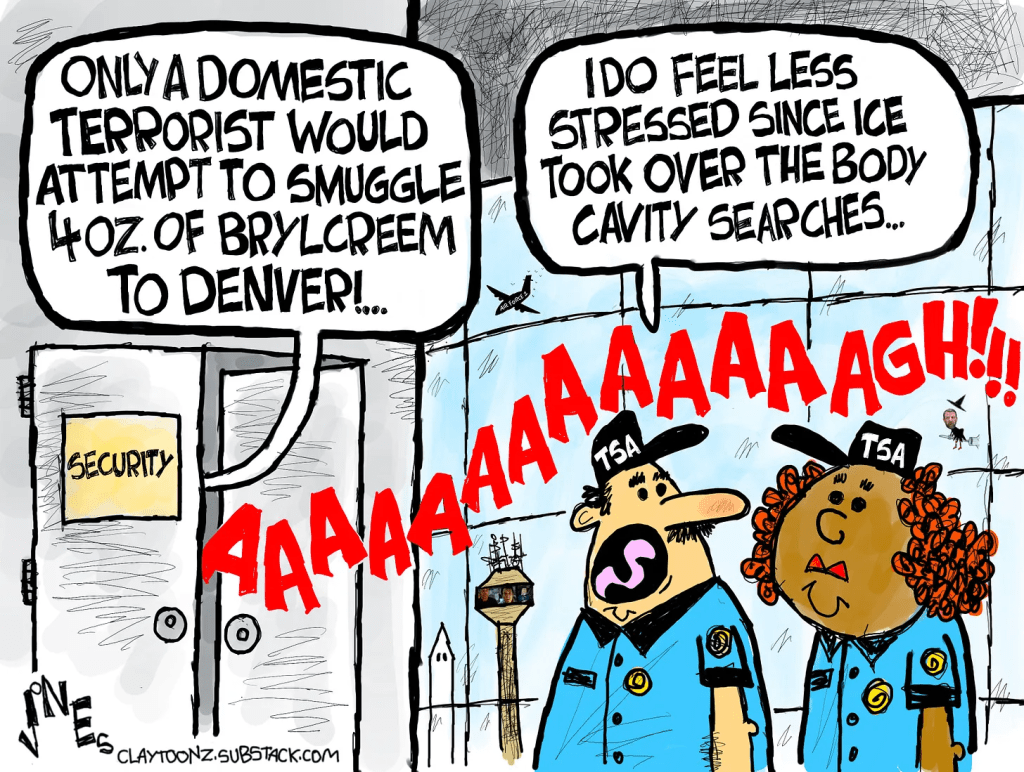
As Belle says tRump started a war and is blocking the funding for the very department in charged with securing the country against foreign threats until the all important trans people playing sports are banned. tRump is putting paid unmasked ICE agents in airports so why can’t they go unmasked on the streets of our towns and cities to stand around watching TSA agents work for free all because his feelings are hurt by trans people. She said something similar about FEMA but it all comes down to tRump using the scape goat of trans people and the Christian nationalists need to have a white male straight cis nation to live in even though those people are not representative of most of the nation nor of all Christians. But to not fund FEMA during horrific flooding and wildfires, to not fund DHS and TSA for security, to not fund the coast guard for our protection and assistance in local waters, and more just because he has a hard time understanding the truth that trans people exist and are normal members of society that deserve full unconditional civil rights and equality. Hugs
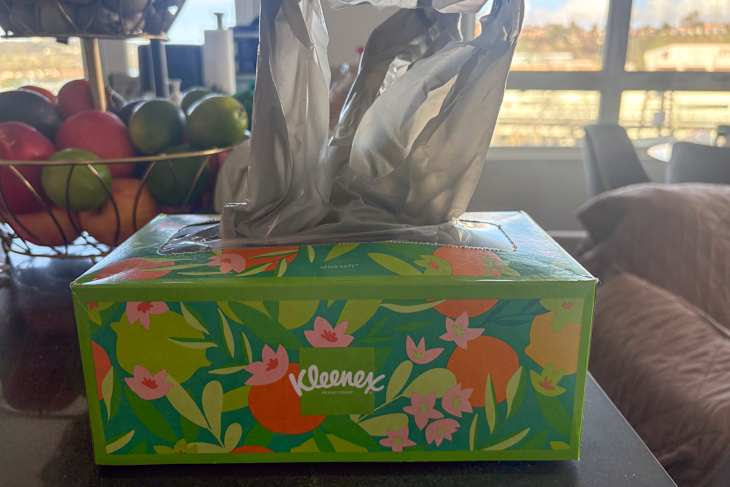
Here’s how I repurposed my empty tissue box as a plastic grocery bag dispenser in a few easy steps:
Take a plastic shopping bag and stuff it horizontally into the tissue box with the handles sticking out of the slit on top.
Grab another plastic bag and weave it through the handles of the bag sticking out of the box, then stop once it’s about three-quarters the way through.
Stuff both bags into the box, with the handles of the second bag sticking out again like you had before.
Repeat the process until all of the plastic bags are in the box (I was able to fit about 12 bags in mine!)
Gently pull a bag out of the box when you want to use it, just like a regular Kleenex box! Follow steps 1 through 4 to refill when you have more bags to store.
A few things I ran across before lunch, in one post with links. Ollie and I had a good lunch, got a few things done, then took a nice walk on a cooler day when his thick black fur coat is not too heavy for him to be on a jaunt before 7 AM; it was 2 PM.😃
Back to reality, I saw this Reuters story about Iran hacking US FBI, but it was a subscriber only story (I agree-WTF? Why should profit be made on a story like that, when some of the free articles are such dreck…) But, here is a free one:
The vigilante group Handala Hack Team said that it had successfully gained access to Patel’s personal email account.
Then, I know many of us, if we didn’t yawn, noticed the hypocrisy in wrangling for a law that includes banning mail-in voting while on the way to the post-box. If you’re busy, just click through; the money phrase is right there at the top.
The young woman who is running for my district’s US House seat, Katy Tindell, has a website now! I’ve mentioned her, but couldn’t link because all there was was an Act Blue contribution page. But now, she has her own website.
Every one of our states has at least one candidate like this running. Please choose a campaign anywhere (But work from your home district/state first, if you can,) and sign up. Money’s tight everywhere, but give the candidate some time if you want to see them in office. There are many things that need doing, and campaigns are better off with volunteers helping.
(I don’t care for twangy folk music that would be country&western if it wasn’t U.S. Folk music, but. I have high regard for Woody Guthrie, really like the lyrics of this song, and Bette Midler covers it well, updating lyrics a bit while retaining its folk integrity. Thanks, Ten Bears!)
It’s a blog entry by Jenny Lawson, about one of her books. I haven’t been able to open her WP blog for a few weeks, now; I get the page that says it’s an unsafe connection. I either don’t know how, or can’t get a whole post in the WP Reader, but I did get this whole post in email, so I’ll copy & paste it here. Jenny is funny, but this is not good news about Texas and literacy.
This is not what I wanted to write. I wanted to write about how I’m about to go on book tour for my new book in a few days. Instead I am writing about the fact that I was just informed that my first book Let’s Pretend This Never Happened was banned from the high school library of a nearby town I love and visit often.
Honestly, I’m not that upset about my book being banned. I’ve had so many letters from young people who felt they’d been helped by my books but it does have some profanity and so I can understand the reasoning even if I disagree with it. What I am upset about is the stories about how New Braunfels ISD has pulled more that 1,500 books from their school library shelves after the Texas’ Republican-backed book banning law (senate bill 13) passed. The bill ordered all public school libraries to review books for “profane” and “indecent” content and I guess Let’s Pretend This Never Happened was deemed too dangerous for high schoolers.
Weirdly, my book was not on the original list of the 1,500 books triggered for review on March 13 but a week ago it was added to the New Braunfels ISD website as being removed for being “non-compliant”. (I’ve been called worse.) I guess 1,500 books weren’t enough. But then, it’s never enough for book banners.This is going to happen more and more. It used to be a rarer thing…almost a badge of courage to have a book banned. Now? It’s everywhere…this war against books and ideas and people. Reading is how you fall in love with people different from you, and how you develop compassion for them…because if you love them, you want to protect them. But there are some people who don’t want you to love others. They need you to fear them.
Books save lives. They have saved mine. Books are safety nets for so many of us, and right now those nets are being cut.The list of banned books is incredible in length and includes so many that I adore. Equally upsetting is the fact that so many classics that shaped me have been pulled from the shelves and placed into restricted sections where they can only be accessed by students enrolled in Advanced Placement Literature, because God forbid a normal high school student would want to read the works of dangerous writers like *checks the list* Jane Austen and Emily Brontë (whose name they misspelled).
Sometimes it feels like we’re living in A Brave New World (restricted) and that the book burning of Fahrenheit 451 (restricted) is closer than ever, with no Sense and Sensibility (restricted) about what this will cost. It feels like we’re going through The Crucible (restricted) and are caught in a Catch-22 (restricted) where we can’t convince people how terrible it is to ban books because they either don’t know the power of books or they absolutely know it and fear it. It’s An Absolutely Remarkable Thing (banned) how book banners go out on some kind of A Discovery of Witches (banned) and fight against Acceptance (banned) and of diversity, while we are losing All The Beauty in the World (banned). America is a Beautiful Country (banned) in so many ways, but we will lose so much of that beauty if we don’t make Changes (banned) to cherish and embrace and grow what makes us Educated (banned) and compassionate. The diversity of voices is necessary…it is a reflection of who we are and who we want to be. A plethora of ideas and voices and experiences…This Is What America Looks Like (banned). We can’t just pretend that Everything’s Fine (banned) and that this is just an overreaction of Anxious People (banned). Do you think this is what the founding fathers like Alexander Hamilton (banned) envisioned? I’m going to stop here because I’m sure you can see that this dumb paragraph is WAY TOO EASY TO WRITE because there are so many books they have issues with and you probably get the picture already but y’all….Jane Eyre? The Color Purple? The Odyssey? Crime and Punishment?? THIS IS WHAT WE’RE SAVING TEENAGERS FROM?
So what can you do? You can buy books that are being targeted, especially those written by the LGBTQ+ authors or authors of color because they are being targeted the most. Supporting those authors tells publishing to keep producing those books because they are needed. Publishers will lose money if libraries become afraid to purchase books and so we need to make sure that they know the audience is there and greedy for diverse voices. Get a library card and start checking out those books and more, to prove to the government that libraries need funding and that people care about reading. Read to your children. Read in front of your children. Talk online about the books that you love so that your passion ignites others. If you’re a parent you can get involved with your school to make sure this doesn’t happen in your school and you can protest it if it happens. You can vote out the people who seem to be obsessed with freedom, but mainly when it’s their freedom to take away yours and your children’s. You can run against school board members who are book banners and show up at the meetings. You can keep updated by following organizations like PEN AMERICA, or the Texas Freedom to Read Project or Authors Against Book Bans.
*deep breath*
This is probably filled with typos and is not really the sort of thing that I should be writing the day before I leave to start my book tour but it’s important. When books and thoughts and people are suppressed, we all lose. Keep fighting the good fight, friends. It’s worth it.







 By thebloggess on March 25, 2026
