This is a great clip on the situation with the democratic party, democratic leadership, and the democratic message. Also the polls on democratic leader ship is in the negative numbers. One reason is the Israeli genocide in Gaza and the minority leader in the Senate, Chuck Schumer has said his number 1 priority is making sure the left keeps supporting israel. The democratic party leadership has been totally captured by the big money donors, corporations, and large lobbying groups like the Israeli lobby AIPAC. It doesn’t make the people feel they are important to him or the party leaders. Hugs
Ketanji Brown Jackson stood out from several justices appearing to be skeptical of the president’s argument against the Citizenship Clause in the 14th Amendment.
As the Supreme Court continues to debate President Donald Trump’s case to end birthright citizenship, Justice Ketanji Brown Jackson is going viral after clips of her questioning Trump’s interpretation of the 14th Amendment began circling the internet.
(embedded social media post-see it on the page)
As we previously told you, the high court heard arguments on Wednesday (April 1) for the landmark case. Jackson stood out from several justices, appearing to be skeptical of the president’s argument against the Citizenship Clause in the 14th Amendment. Specifically, the first Black woman Supreme Court Justice grilled Solicitor General D. John Sauer about how enforcing Trump’s January 2025 executive order would actually work.
“How does this work? Are you suggesting when a baby is born people have to present documents,” Jackson asked. “Is this happening in the delivery room? How are we determining when or whether a newborn child is a citizen of the US under your rule?”
The Root reported that the president attempted to axe birthright citizenship on his first day back in the White House and was met with serious backlash from folks who saw the order as an attack against immigrants and an attack on the U.S. Constitution.
Online, folks praised Jackson for getting straight to business. “Had his a** sounding like he just smoked a whole carton of Newport box short cigarettes,” @PatrickJnmarie said.
(embedded post, visible on the story page)
Pew Research estimated that 320,000 infants were born on American soil to immigrant parents without authorization in 2023. Under Trump’s order, babies of millions of migrants who enter the country– legally or not– wouldn’t automatically be eligible for citizenship. This is a complete turnaround from the way the U.S. has viewed birthright citizenship since 1868.
“This isn’t just a misstep it’s a fundamental misunderstanding of the Fourteenth Amendment to the United States Constitution,” @Popular_EY said.
Other folks online gave President Joe Biden credit for choosing Jackson for her position on the court. “Shoutout to President Joe Biden. You did good, kid,” @CarolDright said. “God love ya.” @WmAG_V agreed, writing, “Joseph Robinette Biden Jr did his MF job when he got Justice KBJ on the bench!”
Jackson became the first Black woman to serve as Supreme Court justice back in 2022. Since then, she’s positioned herself as a liberal leader unafraid to go against her fellow justices on the bench. “Justice Ketanji is head and shoulders above trumps DEI pics on the Supreme Court,” @ClaudetteGGibs1 tweeted.
(embedded tweet or whatever they are on X, on the story page)
But while many Black folks rallied behind Jackson’s Wednesday remarks, she was also met with conservative and MAGA supporters like Fla. Gov. Ron Desantis, who called her bluff.
Still, it seems Jackson is supported by plenty of Black Americans rooting for her. “Ketanji Brown Jackson has more real, hands-on experience in the justice system than any current Supreme Court Justice—including the Chief,” @lab_ftwtx pointed out. “She’s been a public defender, a trial judge, and an appellate judge. She’s actually worked at every level, not just one side of it. Facts.”
There were a lot of reasons to fire Pam Bondi as United States Attorney General, but Donald Trump picked a bad one.
Bondi was never qualified for the job, which was the second choice after Matt Gaetz, who would have been another ridiculous choice. Bondi made it clear after the 2020 election that she didn’t need evidence to make legal claims, as she declared that Donald Trump was cheated out of that race. She had been in his pocket ever since he bribed her in the 2000s not to investigate Trump University in Florida, when she was the state’s Attorney General.
After Bondi misled the country about her initial disclosures in the Jeffrey Epstein case, Congress responded by passing a law forcing the Justice Department to release its files on the pedophile and his allies. (snip-MORE; click on the title above)
PUBLISHED: 31 March 2026 LAST UPDATED: 31 March 2026
“Everyone is on high alert, constantly watching the sky with fright and exhaustion […] We also keep our eyes on our mobile phone connections — the moment the signal drops, we immediately take cover in underground shelters. We’ve come to understand that a loss of communication signals an impending airstrike.— Humanitarian aid worker on the internet shutdown that took place in Myanmar during air strikes near Tamu township in the Sagaing region.
The 2025 data and analysis confirm a horrific reality: internet shutdowns are increasing, not decreasing — and their impact on people’s lives is devastating. Shutdowns reached a new record high in the past year, continuing the steady increase since 2020. Our new report, Rising repression meets global resistance: Internet shutdowns in 2025, documents how democratic and autocratic governments alike deploy them to silence, collectively punish, and terrorize populations, as well as to hide human rights violations and killings. At the same time, we highlight how resistance is growing and people’s power is rising, and offer recommendations for stakeholders to push back. From Myanmar to Iran, Tanzania to Nepal, communities are challenging repression, demanding accountability, and devising new ways to reconnect during blackouts.
In 2025, Access Now and the #KeepItOn coalition documented 313 shutdowns in 52 countries, surpassing the appalling records from 2024 (304) and 2023 (289). Seven new countries joined the offender list in 2025, meaning that people in 100 countries have now experienced a shutdown since we started tracking in 2016. As 2026 began, there were 75 shutdowns in 33 countries that persisted from 2025, a significant increase from the 54 shutdowns in 26 countries that were ongoing from 2024 into 2025. This shows that perpetrators are increasingly attempting to permanently block communications platforms or even keep entire populations cut off from the internet indefinitely.
If you can’t see the highlights below, please check your privacy-enhancing browser extensions. Open in desktop view for the best experience.
(snip-go see. The site is Access Now, it’s safe, the subject of this story (internet access) is its specialty, and my Ad Blocker even shows no blocked ads on the page! Go finish reading this, because forewarned should be forearmed, as to organizing locally.)
Last April, the president unleashed a tidal wave of tariffs on ‘liberation day’. Analysts say the policy has failed, even by the Trump administration’s own terms
Before Donald Trump declared “liberation day” on 2 April 2025 and shocked the world by raising import tariffs on nearly every country the US did business with, he had spent almost three months causing chaos in Washington.
The wholesale slashing of government jobs under Doge (the “department of government efficiency”) and the defunding of US aid agencies had shown White House watchers that the US president was in a hurry to upset institutions he considered profligate or useless.
Investors quickly understood that chaos was an essential tool in Trump’s armoury. Almost as soon as he was inaugurated, there was a steady decline in the value of the dollar against other currencies. Investors sold assets denominated in dollars and bought assets elsewhere: Europe, Asia, South America.
“If you think that discouraging investors from buying assets in the US is a victory, then you don’t believe in a growing economy,” said Dario Perkins, the head of global research at the consultancy TS Lombard. “If it was possible for Trump to have spent the last 14 months on the golf course, we would be in a better place.”
Russ Mould, the investment director of the British stockbroker AJ Bell, said: “America is still home to the world’s largest economy and its reserve currency, as well as the globe’s largest equity and bond markets, but investors continue to reassess their exposure one year on from liberation day.”
The economy has either gone sideways or declined, depending on the preferred measure. Data from the Bureau of Labor Statistics shows that US companies, which were supposed to be the victors in Trump’s new tariff war, stopped hiring almost as soon as liberation day was announced.
Significant revisions in February to data covering 2025 pushed down payroll employment by 403,000 jobs, resulting in the addition of 181,000 jobs last year. This small boost is set against the 163 million people who are employed in the US.
Figures from the Conference Board, a US thinktank, show consumer confidence sliding after Trump took office. A brief recovery appears to coincide with a huge climbdown on 12 May – the day the US and China agreed to defuse their post-liberation day tariff escalation.
I am unable to figure out if the Florida Real ID driver’s license that the state forced everyone to get a bunch of years ago. I remember having to go to the driver’s license place with a folder of information including utility bills in my name and with my birth certificate and my marriage license. It was touted as the “Real Id” that was the only one we would need. It was OK even for flying. When I told Ron about this he was adamant that after his surgery we get me a passport no matter the cost. I explained that we both should have them in case our same sex marriage gets invalidated. We have one out that I am sure my abusive adoptive parents did not plan to give me. They were Canadian citizens here on green cards and my birth certificate shows me as their kid, something I have always hated. Current Canadian laws let me apply to Canada for asylum or simply to immigrate with my spouse. But it clearly shows this is an attempt to restrict those who have the right to vote to do so. Hugs
The law’s requirements for proof of citizenship to register to vote and stricter voter ID rules won’t take effect until next year.
Florida Gov. Ron DeSantis signed a bill into law that is akin to President Donald Trump’s SAVE America Act at the national level.Matias J. Ocner / Miami Herald via Getty Images file
Republican Gov. Ron DeSantis signed a bill Wednesday that will require proof of citizenship to vote and impose stricter voter ID restrictions on Floridians.
The new law, most of which won’t take effect until after the midterm elections, is Florida’s version of the federal SAVE America Act, a bill President Donald Trump has championed. That measure is currently stalled in the U.S. Senate, where it lacks the 60 votes needed to advance under current rules.
“This bill protects and expands integrity in our voter registration process,” DeSantis said. “Our Constitution in the state of Florida says only American citizens are allowed to vote in our elections, so we need to make sure that is the law.”
Democrats and voting rights advocates warn Florida’s law will disenfranchise eligible voters who lack ready access to the documents that are needed to vote.
Already, the League of Women Voters of Florida and a coalition of advocacy groups, represented by the American Civil Liberties Union, have filed a federal lawsuit to block the law.
“We are most concerned about impact as it relates to the most vulnerable Florida voters,” said Jonathan Topaz, attorney at the American Civil Liberties Union. “This could mean older Black voters who grew up in Jim Crow South who don’t have access to birth certificates, this could be naturalized citizens — we know naturalized citizens are flagged as noncitizens all the time.”
Voters who were born in Puerto Rico, have changed their name or have lost documents may struggle to meet the requirements of the new law, he said.
Supporters of the legislation note that millions of Floridians have already shown government officials their passports or birth certificates when obtaining a REAL ID. They also argue the law is necessary to prevent voter fraud, despite little evidence of it occurring.
More than 9% of American citizens of voting age do not have proof of citizenship documents readily available, according to a study commissioned by the Brennan Center for Justice. Based on that metric, advocates fear that more than 1 million Floridians could struggle to cast a ballot starting next year, when the law will be fully implemented.
Other states have tried to impose documentary proof of citizenship requirements in the past, but courts have ruled they violate federal law. To comply with one such ruling, Arizona now has a bifurcated election system that allows those who haven’t proved their citizenship to only vote in federal elections.
The system offers a window into the kinds of people who do not have access to the documents required by proof of citizenship laws. In Arizona, they are disproportionately voters of color and younger voters, according to an analysis by the Brennan Center. Votebeat reported that Arizonans who are only eligible to vote in federal elections often live around college campuses, suggesting they are students without their citizenship documents on hand.
Florida’s law has different requirements than Arizona’s, however. It asks election officials to verify voters’ citizenship after registration. For Floridians who have shown their passport or birth certificate to government officials when getting a driver’s license, their citizenship will be affirmed and their registration approved.
Those without this information on file will be asked to prove their citizenship within a month or they could be removed from the voter rolls.
Wendy Sartory Link, the supervisor of elections for Palm Beach County, said implementing this law will be a major challenge for election officials, particularly those in larger, more diverse counties.
Link said her office will need to roll out new rules and forms — all of which do not yet exist and will need to be written by the state — and rush to begin preparing for the proof of citizenship requirements that go into effect in January.
She said that computer systems will need to be updated — the voter file doesn’t currently include a space for citizenship proof — and that new systems will need to be created among agencies to share data. Link also said she will need to hire new staffers to handle the increased workload, though the bill didn’t give her any additional funding to pay for it. Once voters are asked for proof, she said, she’s worried long lines will form with voters bringing proof of citizenship.
She also said she has many unanswered questions: Can she accept proof of citizenship over email even if she can’t touch the raised seal to be sure it’s an original document? Does she need to ask voters to prove their citizenship every time they update their voter registration? Does she need new trainings to evaluate the proof that voters may bring her?
“If somebody brings a birth certificate and it’s an Idaho birth certificate, I don’t know what that looks like. Am I supposed to know whether or not that’s a fraudulent birth certificate, or do I just accept it because it says Idaho birth certificate?” Link said.
Florida’s new law also restricts the kind of photo IDs that voters can use to prove their identities at the poll, eliminating the use of retirement community and student IDs.
At polling sites near college campuses and retirement communities, Link said, this change could trigger long lines as more students fill out provisional ballots and need to later affirm their identities.
Out-of-state students may struggle to obtain the required ID unless they plan months ahead, too. In her community, she said, it also takes time to get an appointment for a Florida driver’s license.
Lawmakers in a dozen states have advanced legislation this year that would require residents to prove their U.S. citizenship to register to vote or bring photo ID to the polls, according to the Voting Rights Lab, a nonpartisan group that tracks election legislation. Utah and South Dakota have also sent bills imposing a proof of citizenship requirement on to their governors.
I read LGM when I have time; haven’t been there in a couple of weeks. But here is this. I thank another friend of the blog for the link to this. It’s concise.
Graham Platner, son of wealthy parents, is cosplaying as a salt-of-the earth oyster farmer who sells his product to his mother and is running to become the Democratic candidate for Senate in Maine, against Susan Collins. He was outed as having a Nazi tattoo, which he had tattooed over with a slightly less Nazi tattoo. His earlier writings and activities include slurs against women and wearing a Blackwater hat to own the libs.
He is now running ahead of Governor Janet Mills, who is an older woman but who actually has experience in government, something Platner lacks.
Why is Platner doing so well? We can look to Donald Trump for that.
All of our politics today are gender politics. It’s very difficult to talk about that, because it permeates everything we do, leaving us fish unaware of the water. The response is frequently that no, it’s something else, maybe power. But power is gender infused too. So let’s focus on gender if only for the amusement of seeing something through a new lens.
We have multiple models in our heads of what women and men are. Mute eye candy, intellectual, blue collar are some general descriptors, but more specifically, we associate particular groups of characteristics with particular manifestations of gender. Graham Platner and Donald Trump are avatars of a particular way to be a man. I will enumerate some of them.
Men tell it like it is. This means that they can say things that are associated with this type of masculinity, like referring to women by their genitals and using slurs against other groups that are not able-bodied white men.
Men are muscular and do hard work. This means that blue-collar men are Real Men™.
Men are strong. This is different from being muscular, but the two bleed into each other. A man can take on emotionally difficult tasks and bull his way through.
Men never apologize. From what I have read, Platner has acknowledged the tattoo and his earlier actions but has not apologized. Trump, well.
Men are by nature fit to lead. Platner has no experience in government, as was the case with Trump in 2016. But they were/are questioned very little on this issue.
Men may become violent. Platner was in the military and Blackwater, with a violent tattoo. Trump shouts, rages, and talks about violence all the time.
To my mind, this type of masculinity is disqualifying for elected office. But obviously others disagree.
He’s a plain-talking guy you could have a beer with. Or at least a man could have a beer with. The comfort factor is enormous, and Platner and Trump give people permission to be comfortable in a particular way. Ezra Klein interviewed (gift link) one of conservatism’s intellectuals, Christopher Caldwell. Caldwell writes at the Claremont Review of Books and is one of the New York Times’s resident conservatives.
One of the things he settles on as an aspect of Trumpism is what he calls free speech. He has felt throttled by woke and was delighted to be able to be comfortable in what he says. That banker interviewed by the Financial Times said it out loud: He can say the “r” word and refer to women’s bodies in conversation. It’s what all conservatives mean by “free speech,” sometimes with Nazi phrases or concepts thrown in. When they say “free speech,” they mean whatever speech white men in charge want to use.
Those “free speech” advocates are given permission to speak freely by Platner and Trump.
There are other reasons people vote for men displaying this cluster of traits considered masculine. It’s a comfortable stereotype – much in the media and what people who don’t have close contact with blue-collar men may believe of them.
Even Rahm Emanuel feels he has to put on a muscular performance of eating his salad.
Medicaid cuts threaten hundreds of hospitals, new report finds
Together, the hospitals provide care for nearly 7 million patients across the U.S., according to the analysis.
Across the country, hospitals have already warned they may need to lay off staff members or scale back care, including maternity and mental health care, because of Medicaid cuts.Image Source / Getty Images
More than 400 hospitals across the United States are at high risk of closing or cutting services because of the Medicaid cuts in President Donald Trump’s “big, beautiful bill,” according to an analysis from the progressive watchdog group Public Citizen.
The fallout could make it harder for millions of people to get care and put thousands of health care workers’ jobs at risk as hospitals lose a key source of federal funding. Medicaid covers about a fifth of all hospital spending.
The Medicaid cuts come in phases, with more significant changes, including work requirements, in 2027 and limits on how states raise funds in 2028. Overall, the law is expected to reduce federal Medicaid funding by roughly $1 trillion over the next decade.
“We’re seeing hospitals that are already under severe financial strain having to make decisions about how to stay financially solvent,” said Eileen O’Grady, a researcher in Public Citizen’s Congress Watch division and the report’s author. “That has pretty clear implications for people who live in that community. It also has ripple effects on other hospitals in those communities.”
The analysis draws on hospital financial data from the Centers for Medicare and Medicaid Services from 2022 through 2024, covering about 95% of U.S. hospitals. The group defined at-risk hospitals as those in which Medicaid and other low-income government programs made up at least 20% of revenue and that have been operating at a loss in recent years.
The report doesn’t estimate when hospitals could close or cut services.
“Closure is the worst-case scenario, but it also doesn’t preclude hospitals from having to make really tough decisions about cutting services that might be essential to those communities but are just no longer financially viable,” O’Grady said.
Across the country, hospitals have already made statements warning they may need to lay off staff or scale back care, including maternity and mental health care, because of the Medicaid cuts.
For many patients, hospitals are the last place to turn when there are few or no other options for care.
“When hospitals close, patients have less access to the care that they need,” said Gideon Lukens, director of research and data analysis on the health policy team at the Center on Budget and Policy Priorities, a nonpartisan research group. “They have to travel further or wait longer in other hospitals that become overcrowded. That additional time can be the difference between success and failure of time-sensitive, potentially life-saving treatments.”
The closures also add strain to the hospitals that take on the extra patients. O’Grady said doctors end up having “less patience, less time, less capacity to provide the highest quality care.”
“It can be very dangerous for hospitals to be under this kind of strain,” she said.
The analysis found a total of 446 at-risk hospitals, with at least one at-risk hospital in 44 states and Washington, D.C.
About 60% of the at-risk hospitals — 267 facilities — are in urban areas, even as much of the debate around Medicaid cuts has focused on rural hospitals. Black and Latino people stand to be the most affected by the cuts.
The hospitals span both Democratic and Republican-led states, though the states with the largest number of at-risk hospitals are California, New York, Illinois and Washington.
Republicans also represent several congressional districts with the highest number of at-risk hospitals. House Republicans who voted for the Medicaid cuts have 196 at-risk hospitals in their districts, while Senate Republicans — all of whom back the cuts — represent 146 at-risk hospitals in their states, according to the analysis.
The cuts could lead to a worsening crisis, especially for rural hospitals, said Zachary Levinson, the project director of the KFF Project on Hospital Costs.
He said that by his estimates, Trump’s law sets aside $50 billion to support rural communities, but could reduce federal Medicaid spending in rural areas by far more — about $137 billion over a decade.
James Jackson, the CEO of Alameda Health System in Oakland, California, said the Medicaid cuts represent an “existential threat.”
Alameda Health System, which gets 60% of its revenue from Medicaid payments, announced in December that it would lay off nearly 300 employees and lose more than $100 million annually by 2030. (The health network was not included on Public Citizen’s at-risk list, though the report notes its financial troubles.)
The layoffs, set to take effect in March, have since been delayed.
Proposed cuts included mental health services, care for patients with chronic conditions and an ambulatory plastic surgery program. Jackson said closing hospitals is not on the table, but the system has continued to look at scaling back services.
“I don’t think the impact is going to be a positive one,” he said. “We are often the provider of last recourse, so if we’re not able to provide a service, there will be a delay in receiving care at one of the other systems in the area or they may not provide it at all.”
Trinity Health, a Michigan-based hospital system with facilities in other states, said it’s projected to lose $1.5 billion due to “recent and future government policy changes.”
In January, it said it was laying off 10.5% of its billing staff. One of its hospitals, St. Mary’s Sacred Heart Hospital in rural northeast Georgia, announced last October it was closing its maternity unit.
In a statement, a Trinity Health spokesperson shared a previous statement that said in part that “more reductions” are being considered by the federal government and it’s “not possible to simply absorb such a significant financial impact without making thoughtful, forward-thinking changes.”
Berkeley Lovelace Jr. is a health and medical reporter for NBC News. He covers the Food and Drug Administration, with a special focus on Covid vaccines, prescription drug pricing and health care. He previously covered the biotech and pharmaceutical industry with CNBC.
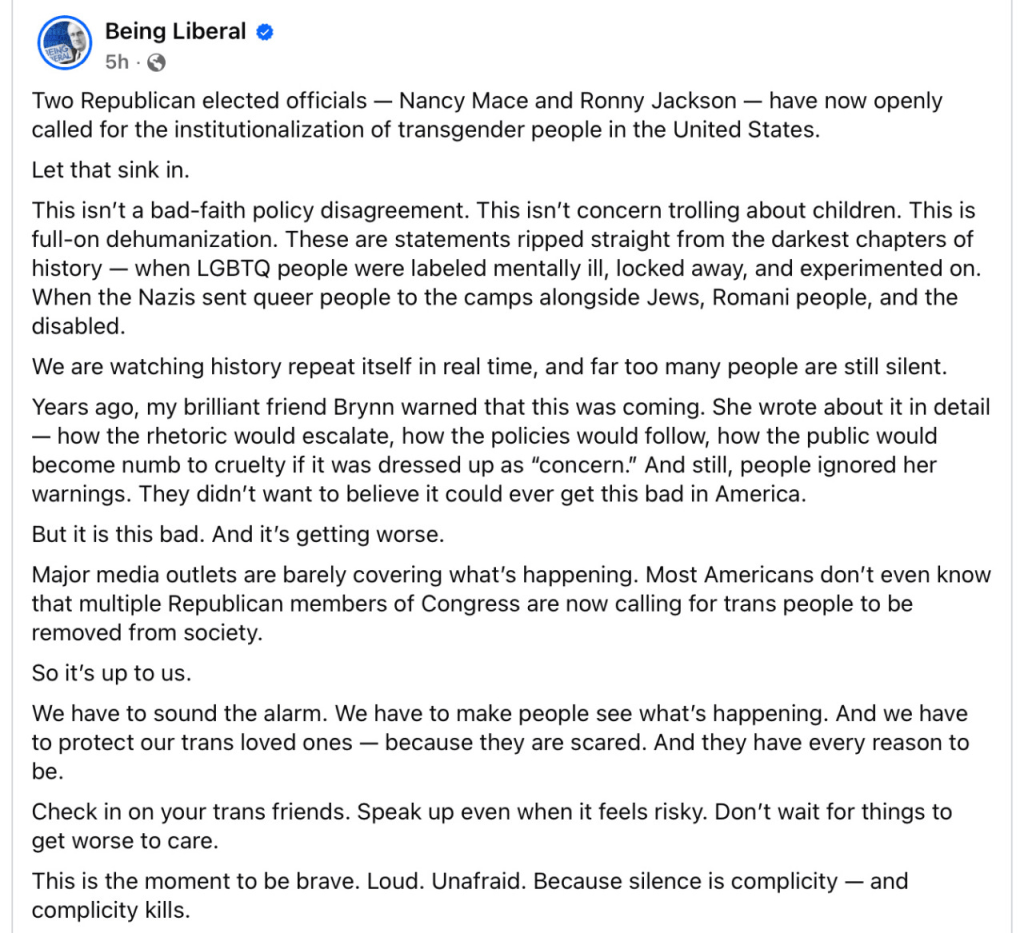
I got up at 3 am this morning and was able to respond to almost all the comments. That gave me a few minutes while I ate some apple oatmeal for breakfast to read some news from Joe My God that he posted yesterday. Here they are in no particular order. Hugs
Yes it would make me want to sign up to work grueling hours and possibly die for a country that wants to use my graduation to arrest and deport my family members. Great move. Hugs.
I wonder what makes a person so hateful, bigoted, and racist. How much do you fear not being in a super majority and why? Do they worry that the new majority will treat them the way they treated the minorities when they were the majority? Hugs
More racism. This program they are now stopping claiming it is DEI and woke is because the first program illegally excluded black people in an attempt to be racist. Hugs
I was not sure whether to put this under corruption or racism. But as they are clearly using race, skin color, and language/accents to stop and detain people, racism won the toss. Hugs
OK more bigotry if not racism. The joy these people get from forcing kids to be cis or straight rather than let people just express themselves as they are is something I don’t understand. Seriously, why the need to go against all the medical science, medical studies that show conversion therapy to not only not work but to be very harmful to those who experiance it. It is torture and child abuse. Kids who are forced into it, who have to suffer through conversion therapy are much more likely to try to commit suicide. For what goal, to please their god? Their god created the trans / gay person as trans or gay.
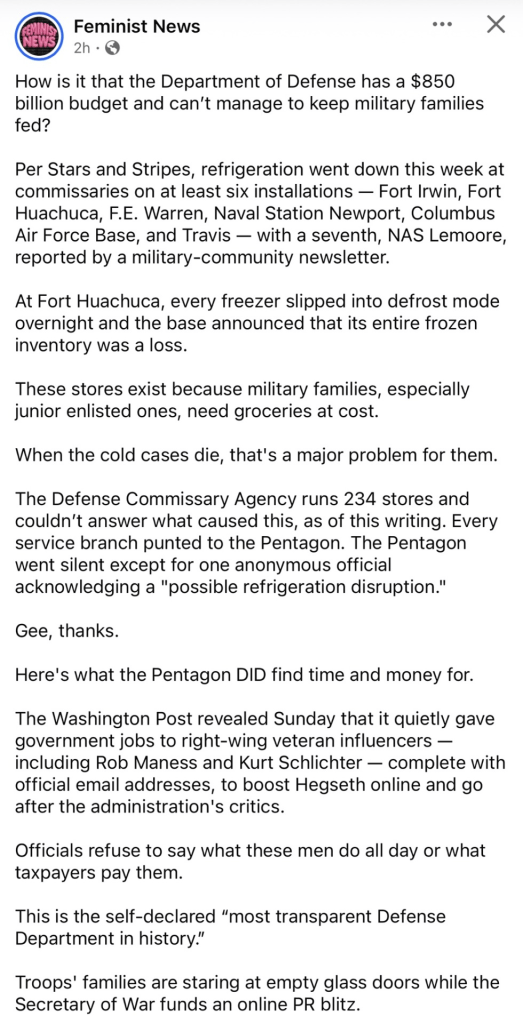
The Army felt it was important enough breach of regulations and rules along with a waste of taxpayer money to suspend and investigate those involved. Pete Kegseth our Fox host wannabe big time war general secretary of defense over ruled their decision and undermined their authority because it looked cool. He is acting like a 10 year old boy playing army with his toys. Kegseth also illegally removed 4 officers from being promoted to flag rank. Two because they were female and two because they were black. The rest he wanted to be promoted were white men of course. Hugs
More illegal actions by the wannabe dictator and his administration who believe anything tRump mumbles is the law of the land and they do not have to follow any rule or law. Hugs
tRump illegally deciding that his administration can decide who gets to vote and how voting is done. All by his decree. The dear leader has spoken. Hugs
More crime? Why am I surprised that people that rioted and attacked the US Capitol, breaking in and causing mass damage might not respect the laws? In that act they assaulted police, staff, and tried to kill congress members. Hugs
Rev. Barber: We have to start teaching people that when we talk about politics, there is not an aspect of your life—from your birth to your death—that is not impacted.
When we look at the midterm elections, we have to start with the basics. We are electing every member of the United States House of Representatives and one-third of the United States Senate. In most places, we are electing their entire state general assemblies, and many are electing governors, attorney generals, and so forth. We are electing the very people who impact every aspect of our lives. These elections determine whether we will have people in office who want to ensure everyone has health care or who want to take health care away; whether we want people in office who will vote to make sure everyone is paid a living wage versus just giving more money to corporations; whether they will care about poor and low-wage voters and the resources for people to afford a basic life, or whether all they will care about is giving more wealth to the already wealthy. That is what’s on the line.
Rev. Dr. William Barber, co-chair of the Poor People’s Campaign speaks at the Poor People’s Campaign: A National Call For Moral Revival Rally at the US Supreme Court on October 27, 2021 in Washington, DC. (Photo by Jemal Countess/Getty Images for Repairers Of The Breach)
What is at stake is whether or not you have a Congress that will demand that the President, whoever that President is, cannot just act unilaterally, but must get congressional approval for war; whether or not we have a budget; whether or not TSA agents are paid; whether or not government employees are paid; whether or not we have a Congress that will stand up and not just be a rubber stamp to what an authoritarian President wants to do or will just “go along to get along.”
We have to start teaching people that when we talk about politics, there is not an aspect of your life—from your birth to your death—that is not impacted. You’re not officially recognized without a birth certificate, which is the result of a political decision. You can’t guarantee your Medicaid, Medicare, or Social Security without political decisions. Even as you die, people must understand that politics is not just about personality; it’s about people being put in place and the kinds of policies and vision they will enact.
Rev. Dr. William J. Barber II, is a Professor in the Practice of Public Theology and Public Policy and Founding Director of the Center for Public Theology and Public Policy at Yale Divinity School. He serves as President and Senior Lecturer of Repairers of the Breach, Co-Chair of the Poor People’s Campaign