
Category: Written Media / Books
Mid Century Women’s Publications Did Important Medical Work
It reminds me of how “Cosmopolitan” was one of the early ‘mainstream’ magazines honestly discussing the AIDS virus, where to find care, and knowledge to avoid contracting it. They knew and reported early on that any- and everyone can catch what we now know as HIV. This piece is about early cancer info dissemination.
How Midcentury Women’s Magazines Fought Cancer
At a time when people wouldn’t even say the word, journalists at Good Housekeeping, Redbook, and other women’s magazines were informing readers how to recognize, protect against, and talk about cancer.
Maxine Davis wrote about plenty of tough topics during her long career in journalism, but none of them frightened her as much as the assignment she received in the spring of 1940. Her editors at Good Housekeeping wanted her to cover cancer, a disease so cloaked in stigma that Davis, like many other Americans, was afraid to say its name out loud.
The sweeping series of articles she produced that year changed her thinking. “My research has dispelled that terror,” she wrote in an article that appeared in Good Housekeeping’s April 1940 issue, declaring that cancer could be cured especially if it was caught early through education and hypervigilance. Cancer, she explained, was “sneaking, insidious. Only you and you alone can guard yourself against it.”
At the time Davis wrote these words, cancer was a taboo topic. The term itself wouldn’t be spoken on the radio until 1945. Rumors about its causes were rampant. (Many Americans at the time believed it to be contagious or a sign of poor character.) Physicians routinely withheld cancer diagnoses from patients to spare them shame. Although it wasn’t always a death sentence, the treatments we rely on today were nascent or nonexistent. And yet, the editors at Good Housekeeping still decided to devote pages and pages to in-depth coverage of the disease.
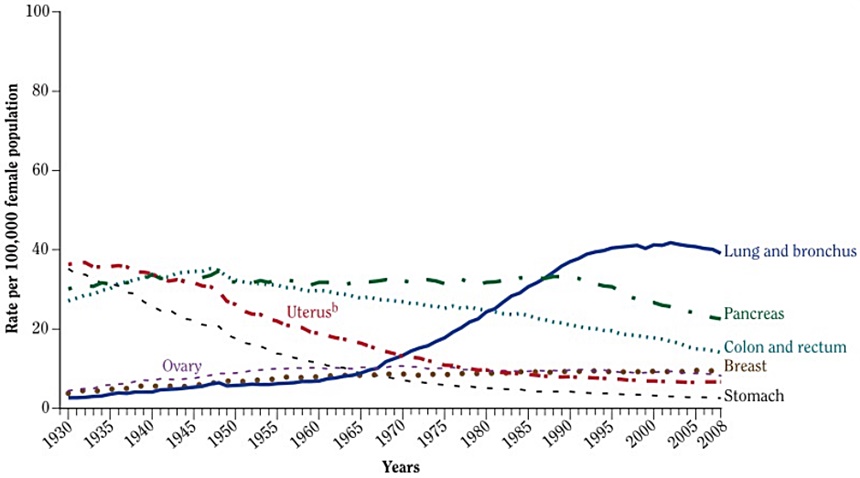
This is one example of how, during the 1940s and 1950s, women’s magazines played a vital and largely forgotten role in educating average Americans about burgeoning efforts to prevent and treat cancer. It was a pivotal era for modern medicine thanks to scientific advancements and increased attention to public health. Cancer was among the leading causes of death, and rates were increasing in part because people were living longer. Print media in all its forms played a major role in normalizing public conversations about cancer, but women’s magazines took a unique approach. They made disease prevention personal, calling upon women to become cancer watchdogs for themselves and their families.
Davis was among the best-known of the women’s magazine journalists covering cancer. By the early 1940s, she had reported on the League of Nations, driven all over the United States to research a book about American youth, and founded a wire service aimed at explaining politics to women. Her cancer stories for Good Housekeeping launched her to a new level of prominence, one akin to modern day health influencers. Her editors promoted her work heavily, framing her as a lay expert with carefully cultivated sources. “Doctors like to work with her,” they wrote in an introduction to her spring 1940 cancer series, “and they give her all the help they can.”
Writing in May of 1940, Davis introduced readers to the basics of cancer treatment, explaining in plain language how surgery, X-rays, and radium were being used to help patients.
Sometimes X-ray, radium, and surgery are all used to treat a malignant condition. Take the case of Ada Johnson. Ada put off going to hospital longer than she should have after she felt a lump in her breast; but the doctor didn’t think the situation was hopeless. This is what he did:
First, there was a surgical operation. When that had been successfully accomplished, the specialist in cancer of the breast applied radium to the chest wall. That wasn’t all. The doctor then used deep X-ray therapy on Ada’s breast and armpit….This was repeated for thirty-five treatments. Ada is perfectly well today.
Davis was not, however, the only women’s magazine reporter working the cancer beat at midcentury. Seventeen magazine’s beauty editor Jean Campbell urged her young readers to get involved in efforts to bring specialized cancer to more communities. “Demand them,” she wrote in the April 1948 issue, “and raise funds for them.” That same year Miriam Zeller Gross deftly described the history of stomach cancer treatment in a gripping feature story that appeared in Better Homes and Gardens. In the early 1950s, Redbook’s Collie Small encouraged women to overcome “false modesty” and allow physicians to screen them for breast cancer. Women’s magazines were publishing hundreds of articles on cancer by dozens of writers. Women also wrote about cancer for general magazines including The Saturday Evening Post, which featured a handful of stories in the 1950s by female cancer survivors.
Stories about cancer were far less common before World War II, but they did sometimes appear in women’s magazines. Ladies Home Journal has been credited by medical historians with publishing the very first general interest article about cancer detection in 1913. Others, including Good Housekeeping, featured occasional educational columns by physicians during the 1920s.

In addition to becoming quick experts on complex medical topics, these journalists managed often-fraught relationships with health professionals who tended to distrust journalists. It became common practice during this time for physicians to review stories before they were published. Sometimes, one of those physicians would write a sidebar: In 1955, American Cancer Society vice president Dr. Charles S. Cameron had reviewed a draft of an April 1955 article on cervical cancer by health journalist Gladys Denny Shultz for Ladies Home Journal, and wrote a public note of thanks, proclaiming that the magazine was “offering its readers a great service by publishing this excellent article. It should be a means of saving thousands of lives.”
While most of the bylines atop women’s magazine stories about cancer belonged to female journalists, editors did occasionally invite physicians, almost always men, to contribute. Cosmopolitan published a 14-page essay by Walter Alvarez, who had just retired from clinical practice to pursue a second career in medical writing. The piece, which appeared in January of 1953, sprawled across 14 pages under the headline “Danger Signals in Your Life” and includes tips to spot illnesses like cancer in children, teens, and adults. Alvarez assured readers he wasn’t out to scare them. Instead, he hoped to save “wise persons from avoidable illness or death.”
Much of this coverage was driven by coordinated public relations campaigns initiated by the American Cancer Society and similar organizations. In addition to connecting journalists with expert sources and organizing junkets to prominent research centers, such campaigns included advertising blitzes promoting new treatments, championing medical breakthroughs, and reminding Americans of the importance of cancer screenings. Women’s magazines were a popular venue for such ads, so it wasn’t uncommon for some issues to feature a reference to cancer on nearly every page.
While groundbreaking, the cancer coverage provided by midcentury women’s magazines was imperfect. Race and class were seldom addressed because these publications — like much of the news media — assumed their audience was white and financially stable. Some coverage also illustrates the era’s rudimentary and fast-evolving scientific knowledge. One example is a story that appeared in Parents magazine in 1943. Written by journalist Constance J. Foster and prominently endorsed by the New York City Cancer Committee, the article proclaimed that “cancer is not hereditary.” A piece that appeared in Redbook a decade later explained new research showing that some forms of cancer do run in families.
The role of women’s magazines in the fight against cancer is a fascinating chapter in media history, one laced with a type of gender politics that feels familiar today. The cancer beat gave women journalists like Davis access to male-dominated sectors like medicine, public policy, and journalism, but it also kept them firmly tethered to domestic matters and subservient to male physicians. Their work, while educational, put undue pressure on individual women to spot the signs of cancer. But it also brought hope to families facing a terrifying diagnosis. As Davis wrote in the October 1948 issue of Good Housekeeping, “Cancer is not necessarily fatal. Cures do exist.”
Northeastern University student Elsa O’Donnell contributed archival research for this article.
Late-breaking Poetry
And Another One
It’s an excellent poem, with more background on the page, of interest to us here. Click the title.
I never feel so alive as when I am
writing and have no right
answer for what this means
for the lives of others, how
to live in the after which after
all means the now of our living
together when together
means death for all
those forbidden from
entering the home so
methodically built until after
they are dead. Only
after will locked doors
swing amply open to
admit the murdered
into rooms of vast
crushed comfort, whose
inhabitants eat and sleep
on furnishings carved
with corpses, stepping
with hospitable sorrow
around the bodies of the
dead, speaking dirges
into the phantom
darkness. What happens
in the quiet grave where
the living make themselves
at home, where noisily
they intend to thrive, where
the poem itself concedes
to suffering so it might persist
in blazing against it.
Copyright © 2025 by Youna Kwak. Originally published in Poem-a-Day on February 5, 2025, by the Academy of American Poets.
Enjoy Some Harlem Renaissance Poetry This Morning:
Click the poem title for more about this poet and her poem.
Things Said When He Was Gone
Blanche Taylor Dickinson 1896 – 1972
My branch of thoughts is frail tonight
As one lone-wind-whipped weed.
Little I care if a rain drop laughs
Or cries; I cannot heed
Such trifles now as a twinkling star,
Or catch a night-bird’s tune.
My whole life is you, to-night,
And you, a cool distant moon.
With a few soft words to nurture my heart
And brighter beams following love’s cool shower
Who knows but this frail wind-whipped weed
Might bear you a gorgeous flower!
This poem is in the public domain. Published in Poem-a-Day on February 2, 2025, by the Academy of American Poets.
Julia Hare in “Wee Pals” Today

Literally Watching Again In Real Time, Peace & Justice History For 2/2
| February 2, 1779 Anthony Benezet and John Woolman, both prominent Quakers (Society of Friends), urged refusal to pay taxes used for arming against Indians in Pennsylvania. Since William Penn established the state two generations earlier, the Friends had dealt with the Indian tribes nonviolently, and had been treated likewise by the native Americans. Benezet and the Quakers were also early and consistent opponents of slavery.  More about Anthony Benezet |
| February 2, 1848 The Treaty of Guadalupe Hidalgo was signed in the Mexican city of the same name, ending the Mexican War. In 1845 Congress had voted to annex Texas, and President James K. Polk sent General Zachary Taylor and troops to patrol the border, newly defined by Congress as the Rio Grande, though it previously had been the Nueces River. Following an encounter between Mexican and U.S. troops, Polk called for Congress to declare war on Mexico. General Winfield Scott and troops eventually seized Mexico City.The treaty’s provisions called for Mexico to cede 55% of its territory (present-day California, Nevada and Utah, New Mexico, most of Arizona, and portions of New Mexico, Wyoming and Colorado), and to recognize the Rio Grande as the southern border of Texas, in exchange for fifteen million dollars in compensation for war-related damage to Mexican property. According to the treaty, U.S. citizenship was offered to any Mexicans living in the 500,000 sq miles (1.3 million sq km) of new U.S. territory.  Land ceded to the U.S. after the Mexican War. The Treaty of Guadalupe Hidalgo |
| February 2, 1931 The first of well over 400,000 Mexican-Americans from across the country, some of them citizens and many of them U.S. residents for as long as 40 years, were “repatriated” as Los Angeles Chicanos were forcibly deported to Mexico. More on those deported, Los Repatriados |
| February 2, 1932 The Conference on the Reduction and Limitation of Arms, the world’s first disarmament meeting, opened in Geneva, Switzerland. Sponsored by the League of Nations, and attended by delegates from 60 nations, no agreement was reached. The U.S. delegation called for the abolition of all offensive weapons as the basis for negotiations but found little support. |
| February 2, 1966 The first burning of Australian military conscription papers as a protest against the Vietnam War occurred in Sydney, Australia.  |
February 2, 1970 Bertrand Russell later in life Bertrand Russell, mathematician, Nobel laureate in literature and philosopher of peace, died in Penryndeudreaeth, Merioneth, in Wales at age 97.  Bertrand Russell at age 10 “Patriots always talk of dying for their country but never of killing for their country.” — Bertrand Russell More of Russell’s wisdom |
| February 2, 1980 Reports surfaced that the FBI had conducted a sting operation targeting members of Congress. In what became known as ”Abscam,” members suspected of taking bribes were invited to meetings with FBI agents posing as Arab businessmen, offering $50,000 and $100,000 payments for special legislation. Audio and video recordings of the meetings were made surreptitiously. Six members of the house were convicted of accepting bribes. Another member of the House and one senator were targeted but took no money.  FBI agents in Abscam sting operation Actual FBI videotape of one attempted scam |
February 2, 1989 Soviet participation in the war in Afghanistan ended as Red Army troops withdrew from the capital city of Kabul. They left behind many of their arms for use by Afghan government forces. They were driven out principally by the insurgent mujahadin, armed through covert U.S. funding. Read more “Charlie Wilson’s War” movie trailer |
| February 2, 1990 South African President F.W. De Klerk unbanned (lifted the legal prohibition on) opposition parties: the African National Congress (ANC), the Pan-Africanist Congress and the South African Communist party were officially considered legal. He also announced the lifting of restrictions on the UDF, COSATU and thirty-three other anti-apartheid organizations, as well as the release of all political prisoners and the suspension of the death penalty. This was the result of his negotiations with the imprisoned Nelson Mandela, a leader of the ANC. The ecstatic reaction to De Klerk’s beginning the end of apartheid on BBC video |
Yes, I believe it is worthwhile to challenge hate speech.
And this is a blog well worth following, though I don’t read there often enough.
I Found This Beautiful To Read, So I Want To Share
The writing style is frank. The title directly beneath is the link. -A
“Sex, Love, And Longing In 1970’s New York: Edmund White on His Past Lovers“
“He was a Peter Pan, the puer aeternus. I was abject in my longing for him.”
By Edmund White
Throughout the 1970s I was in love with Keith McDermott, ten years younger than me. When I first met him, I was living in a third-floor walk-up studio on Horatio Street in the West Village. He was living across the street with Larry Kert (he’s dead), the original young male lead in West Side Story. I was one of Larry’s rainy-day fucks—he’d call me midday or early evening when he was horny and the weather forbade open-air cruising (snow, rain, or tropical heat).
Maybe I met Keith at Larry’s or through someone else; I don’t remember. Keith was living rent-free with Larry. They’d started out as lovers but now, after a year, Keith was expected to help in maintaining their big, luxurious apartment by cleaning and doing chores—and disappearing when Larry had a trick he was bringing home.The sound of the whirring wheels as he came racing around the corner and glided to a halt became the very whisper of desire for me.
Keith wanted to move and I had a lead on an eight-room prewar apartment on the Upper West Side, a block away from Central Park and just four hundred dollars a month. The landlady lived downstairs from us and had decided to rent only to gays—but, what narrowed the field, gay men without dogs. In those days gay couples had dogs, not yet children. We were too poor and unsettled to think of wanting a dog. It never crossed our minds.
Keith was a famous beauty (famous in the West Village and Fire Island among gay men). He was blond, blue-eyed, just twenty-one, and perfectly formed (an expert gymnast). In good weather he rode his bike everywhere. The sound of the whirring wheels as he came racing around the corner and glided to a halt became the very whisper of desire for me. He was fleet, funny, and so handsome that Bruce Weber, the most famous photographer of handsome men back then (Abercrombie & Fitch, GQ, Calvin Klein), took his picture. Weber’s men, often nude or in wet white underpants, were twenty-something, athletic, Ivy League, and passably heterosexual—perfect eye candy for gay men of the period, who liked their men to be iconic and unobtainable, i.e. straight.
Of course I wanted to sleep with this beauty, but he found a way to forestall my lust. He said he was sick of “meaningless” sex and invited me to join his chastity club. We could sleep side by side as long as we never touched. I was content to have that constant access to his beauty and company—and he was happy, I guess, to reap the devotion of a fit, charming, bewitched man in his early thirties who was just publishing his first novel. Before long we were living in our vast eight-room apartment. Whenever I would buy an ugly but big dining room table and six high-backed chairs at Goodwill, Keith would be so outraged that he would drag the furniture out the front door into the hallway. He was a resolute artist and had a horror of looking or being middle-class.
Keith was careful with his “instrument,” i.e., his body. He drank tiny cups of liquid buffalo grass, ate sparingly, mainly vegetables, and visited the gym daily for two hours, where he’d twist and turn on the exercise rings, climb ropes, and strengthen his arms and core, his shoulders and legs, but he never wanted to become a heavily built muscleman. He was a Peter Pan, the puer aeternus. I was abject in my longing for him. I can’t bear to recall the scenes of my crawling toward him, arms outstretched, or the moment when I saw him as an emanation of God. Once I organized an orgy of several guys I dragged back from the Candle Bar in the neighborhood, hoping to be able to touch Keith in the melee. It worked.I can’t bear to recall the scenes of my crawling toward him, arms outstretched, or the moment when I saw him as an emanation of God.
Larry Kert had had a cruel streak—maybe that had rubbed off on Keith. Or maybe my idolatry was just that absurd and I needed vinegar poured in my wounds. I suppose some of the mystical strains in Nocturnes for the King of Naples, the book I was writing then, were a spillover from my almost religious love for Keith.
And then Keith was cast in the Broadway hit Equus, in which he was naked onstage eight performances a week for years. Dirty old men would sit with binoculars in the front row night after night. A pimple on his ass would send Keith into an anxiety attack. He was brilliant in the role; I saw him in the play dozens of times opposite Richard Burton or Anthony Perkins. It was such a titanic strain (no colds, no hemorrhoids, no weight gain or perceptible loss), thousands of lines, gymnastic feats blinding the “horses” (dancers dressed as stylized horses), rowdy adolescents seated in the cheap seats onstage making wisecracks, kids who were so used to TV that they thought these performers, too, couldn’t hear their remarks. His life became one of iron discipline. I like to think he even came to appreciate our domestic life.
He moved to Los Angeles but was a little too openly, rebelliously gay for Hollywood in those days (no one wanted to see the fag kiss the girl and there were almost no gay roles in the seventies). Then I moved to Paris for sixteen years. When I came back to New York in the late nineties, Keith was living with a sweet, talented Israeli painter; he’d mellowed, was just as funny as ever, became a close associate of the avant-garde director Robert Wilson.
Keith himself directed plays at La MaMa and had published a book. We’re great friends. He insists that I helped form some of his tastes in music and literature. His own curiosity and experience in so many domains of the arts, however, didn’t need my influence, I’m sure. When I told him I’d be writing about him in my sex memoir, he said, “Just say I have a big dick.” That’s easy—his dick is huge.
________________________________
Observing Black History Month, Because This Is The Fkn’ US, Dammit!
The Negro’s “America” by Frank Barbour Coffin 1870–1951
My country, ’tis of thee,
Sweet land of liberty,
Would I could sing;
Its land of Pilgrim’s pride
Also where lynched men died
With such upon her tide,
Freedom can’t reign.
My native country, thee
The world pronounce you free
Thy name I love;
But when the lynchers rise
To slaughter human lives
Thou closest up thine eyes,
Thy God’s above.
Let Negroes smell the breeze
So they can sing with ease
Sweet freedom’s song;
Let justice reign supreme,
Let men be what they seem
Break up that lyncher’s screen,
Lay down all wrong.
Our fathers’ God, to Thee,
Author of liberty,
To Thee we sing;
How can our land be bright?
Can lynching be a light?
Protect us by thy might,
Great God our king!
This poem is in the public domain. Published in Poem-a-Day on February 1, 2025, by the Academy of American Poets.
As always, click the title to get more about the poet and their work. Today’s background is especially poignant, and work the click.
 Scottie's Playtime