Sorry this article is so old. I have dozens more older than this in open tabs with the hope of one day being able to get what I think is important news out to those who may have missed it at the time. Here is the southern states patriarchy punishing women for not bringing forth a well formed offspring of a male who bred them. That is the way this reads to me. The woman means nothing, just the fetus, zygote, the failed issue of a man must be the fault of a woman. Think of this being promoted as prolife while they are willing to torture live females for a few cells in the human body that act parasitic. Remember no man is required to give any part of his body to another even his own dying child. Tht is the law. But a woman, a female is required to give her body over entirely and all actions of her life entirely to that male inserted parasitic entity that will drain her life force and can cause life long medical problems. It tells you exactly how these male law makers and their Christian supports see women. Hugs
Hundreds of US women charged with pregnancy-related crimes since fall of Roe
Study finds prosecutors targeting low-income women mainly in US south – and figure likely to be an undercount
Abortion rights supporters protest outside the supreme court in Washington in June last year. Photograph: Aashish Kiphayet/Middle East Images/AFP via Getty Images
In the first two years after the US supreme court overturned Roe v Wade, prosecutors in 16 states charged more than 400 people with pregnancy-related crimes, new research released on Tuesday found.
Of the 412 cases tracked by Pregnancy Justice, the vast majority took place in the US south, targeted low-income women and involved allegations that women broke laws against child abuse, endangerment or neglect, according to the research, which was compiled by the reproductive justice group. About 300 prosecutions took place in Alabama and Oklahoma. In 16 cases, law enforcement charged women with homicide.
Because there is no national database of US arrest or court records, the group believes the tally is likely to be an undercount. In a report released in September 2024, Pregnancy Justice said it had recorded 210 pregnancy-related prosecutions in the first year after Roe fell – the highest number ever recorded at that time. Pregnancy Justice is now devoting more resources to unearthing records of pregnancy-related prosecutions, so the group can’t say for sure whether these prosecutions are on the rise post-Roe or whether they are simply tracking them more closely.
Louisiana issues warrant for California doctor accused of mailing abortion pills
Read more
Nearly 400 of the cases included in the new report involved allegations of substance use during pregnancy. In an example described to the Guardian, after one woman gave birth, the hospital tested her umbilical cords for drugs. When the test came back positive for marijuana, the woman was arrested for felony child neglect, even though she had a medical marijuana card.
The laws used in most of these prosecutions, Pregnancy Justice pointed out, are typically meant to protect children, not fetuses. By prosecuting pregnant women under them, the group says, states are cementing the legal doctrine of “fetal personhood”, which seeks to grant embryos and fetuses full legal rights and protections – sometimes at the cost of the rights of the woman carrying them. Alabama and Oklahoma are both hubs for the growing fetal personhood movement.
“That is the ultimate goal of the anti-abortion movement,” said Dana Sussman, the senior vice-president at Pregnancy Justice, which scoured court and police records to find the cases. “It wasn’t just to overturn Roe. It is to establish full personhood, full rights for embryos and fetuses.”
Sussman said a number of women have faced criminal consequences for taking substances that were legal or prescribed to them. For that reason, Donald Trump’s claim last week that pregnant women who take Tylenol may give their children autism, raised alarms. Scientific research does not support this claim.
“It’s a perfect storm of all of the things that we work on: stigmatizing pregnant people for not being perfect pregnant people, blaming them for their perceived failures, and relying on misinformation and junk science to create a panic when there shouldn’t be one or isn’t one – while also increasing surveillance in the police state to monitor and potentially criminalize people when they don’t meet these impossible ideals,” Sussman said.
Only 31 of the cases documented by Pregnancy Justice included a stillbirth or miscarriage, while almost 300 of the cases led to a live birth.
A woman whose case was included in the Pregnancy Justice report reportedly didn’t realize she was pregnant until she started to feel intense pain in her stomach. The woman, a new immigrant to the US, suspected that she had food poisoning and decided to drive herself to the hospital.
Before she could get in the car, however, the woman started to give birth. She ultimately delivered what police records listed as a stillbirth. Pregnancy Justice did not factcheck the cases in the report and could not say whether the fetus was past 20 weeks of pregnancy, after which the term stillbirth is used. After police found the remains, the woman was charged with abuse of a corpse.
Abortion pill providers targeted by new Texas law refuse ‘anticipatory obedience’
Read more
The report indicates there are far more cases of miscarriage criminalization than have made national headlines. In one widely covered case in late 2023, police charged an Ohio woman with felony abuse of a corpse after she miscarried into a toilet. In another, earlier this year, a Georgia woman who had been found bleeding and unconscious after a miscarriage faced one count of concealing the death of another person, and one count of throwing away or abandonment of a dead body. The charges against both women were ultimately dropped.
Nine cases discovered by Pregnancy Justice involved allegations that women had considered abortions, such as ordering abortion pills or looking for information about abortion online. Only one woman in those cases was charged with violating a criminal abortion ban, likely because it is legal in most states to “self-manage” one’s own abortion. US abortion bans tend to penalize providers and people who help abortion patients, not the patients themselves.
In 2025, lawmakers in at least 12 states – including Alabama and Oklahoma – introduced legislation that would treat fetuses as people, which would leave women who have abortions vulnerable to being charged with homicide. In several of those states, that charge would carry the death penalty.
“What our work has proven is that, unfortunately, anything is possible when it comes to policing pregnancy,” Sussman said.
Texas is at the forefront of pushing Christian nationalism along with all its prejudices. Misogyny, strict gender stereotypes, and enforced being straight. They require young people to marry in opposet gender marriages and produce as many children as possible. Why? It promotes their faith while filling church pews which funds more money for the church. Hugs
Suit against Debra Lynch is latest from Texas’s Republican attorney general amid ongoing attacks on abortion pills
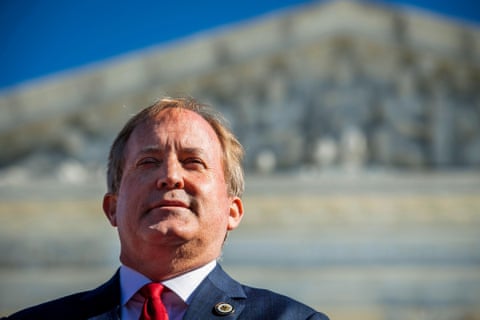
Ken Paxton, Texas’s attorney general, outside the US supreme court in Washington DC on 1 November 2021. Photograph: Rod Lamkey/Newscom via Alamy
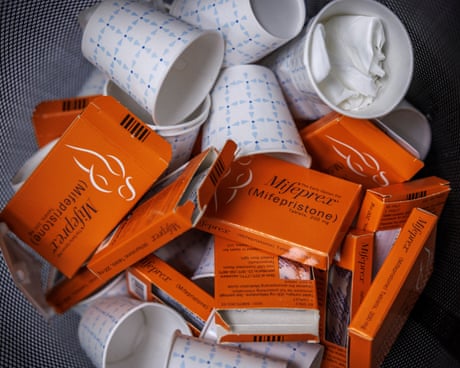
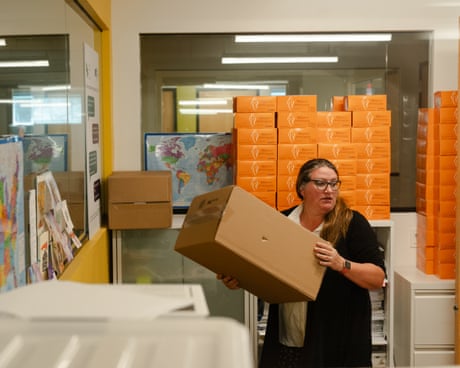
As part of its ongoing crusade against abortion pills, Texas sued a nurse practitioner on Tuesday, accusing her of shipping pills into Texas in defiance of the state’s abortion ban.
The nurse practitioner, Debra Lynch, operates a Delaware-based group called Her Safe Harbor, which mails abortion pills to women living in states with abortion bans. Now, Texas wants a court to block Lynch from “performing, inducing or attempting abortions” in Texas, on the grounds that Texas law only permits physicians to facilitate abortions in cases of medical emergencies.
Groups like Her Safe Harbor have proliferated in the four years since the US supreme court overturned Roe v Wade, as Delaware and a handful of other blue states have enacted so-called “shield laws”. These laws typically aim to protect abortion providers from out-of-state prosecutions, lending legal cover to providers who ship pills across state lines.
But such efforts have enraged anti-abortion advocates and sparked a legal war between states that protect abortion rights and states that ban the procedure. Texas has already sued a New York-based doctor, Margaret Carpenter, over allegations that she mailed abortion pills into the state, while Louisiana has indicted both Carpenter and a California-based doctor named Remy Coeytaux. Officials in New York and California, which also have shield laws on the books, have refused to cooperate with those efforts.
The safeguards offered by each state’s shield law vary. Eight states, including New York and California, clearly allow providers to use telemedicine to prescribe abortion pills to patients located in states where the procedure is banned. But legal experts have questioned whether Delaware’s shield law, which was first passed in 2022, always protects providers who offer telemedicine across state lines.
Delaware’s law was expanded in late 2025, in part to clarify that officials may not aid out-of-state investigations into abortion providers – a move that may offer Lynch additional protection. The Texas case may then depend on when, exactly, Lynch mailed abortion pills into the red state, according to Mary Ziegler, a professor at the University of California, Davis school of law, who studies the legal history of reproduction.
But, Ziegler added: “It doesn’t sound like they know when any of the abortions happened.”
The cases against Carpenter and Coeytaux largely rest on allegations of specific abortions. The Texas case against Lynch, however, focuses on media reports that feature Lynch saying she mails pills to Texans or advises Texans who want abortions.
After Ken Paxton, the Republican attorney general of Texas, sent a cease-and-desist letter to Her Safe Harbor and other abortion-providing groups in August, Lynch said she had no plans to stop mailing pills. In fact, in the hours after news of the letter broke, the group received more than 150 requests for pills from Texas, Lynch said at the time.
“None of our providers are primarily concerned with our own wellbeing or our own legal status,” Lynch previously told the Guardian. “All the horrors that women are facing because of these ridiculous bans and restrictions outweigh anything that could possibly happen to us as providers, in terms of a fine or a lawsuit or even jail time, if it were to come to that.”
Lynch did not immediately respond to a request for comment on Tuesday.
Anti-abortion and abortion rights protesters confront each other outside a Planned Parenthood office in Missouri in 2022.Robert Cohen/St. Louis Post-Dispatch vía AP
One might have thought that last November, when Missourians voted to enshrine “reproductive freedom,” including abortion, in the state constitution, that would be the end of the conversation. In overturning Roe v. Wade in 2022, the US Supreme Court professed that the question of whether abortion should be legal was now up to states. And the people of Missouri made it very clear: They wanted abortion rights (at least until fetal viability).
Alas, the Missouri Supreme Court doesn’t seem to be inclined to listen.
Thanks to the passage of Amendment 3, Missouri’s criminal abortion ban is gone. But local Planned Parenthood affiliates are still fighting in court to overturn the web of restrictions, known as TRAP laws, that made providing abortions virtually impossible in the state even when Roe was the law of the land. These include a 72-hour waiting period, hallway width requirements for abortion clinics, and a rule that providers must have admitting privileges at a hospital 15 minutes away, to name just a few. In a pair of decisions in December and February, Jackson County Judge Jerri Zhang agreed to temporarily suspend enough of those old laws to allow abortions to resume in Missouri while the court case heads to a January 2026 trial.
But on Tuesday, the state supreme court overturned Zhang’s rulings, ordering her to reconsider the temporary block on the TRAP laws using a different legal standard. As a result, abortion providers have once again been forced to halt their work, rendering the constitutional right to abortion effectively moot, for now. For the second time since 2022, abortion clinics had to call pregnant people this week to let them know their scheduled abortions had been canceled, the Associated Pressreported.
“This decision puts our state back under a de facto abortion ban and is devastating for Missourians and the providers they trust with their personal health care decisions,” Emily Wales and Margot Riphagen, leaders of the two Planned Parenthood affiliates that operate in Missouri, said in a joint statement. “We will continue to fight for their freedom to the constitutionally protected health care they voted for.”
Planned Parenthood lawyers have already filed a brief asking Zhang to re-issue her preliminary injunction under the new standard and block the TRAP laws again. But even if Zhang agrees, and abortions do resume again in Missouri in a few weeks—or after a January 2026 trial—abortion rights in the state will remain far from settled.
That’s because, two weeks ago, Missouri lawmakers voted to put yet another constitutional amendment on the ballot—this one repealing the reproductive freedom amendment and banning virtually all abortions. Voters will see that question on their November 2026 ballots—or sooner, if Republican Gov. Mike Kehoe decides to call a special election.
PLEASE—BEFORE YOU CLICK AWAY!
“Lying.” “Disgusting.” “Scum.” “Slime.” “Corrupt.” “Enemy of the people.” Donald Trump has always made clear what he thinks of journalists. And it’s plain now that his administration intends to do everything it can to stop journalists from reporting things it doesn’t like—which is most things that are true.
We’ll say it loud and clear: At Mother Jones, no one gets to tell us what to publish or not publish, because no one owns our fiercely independent newsroom. But that also means we need to directly raise the resources it takes to keep our journalism alive. There’s only one way for that to happen, and it’s readers like you stepping up. The deadline’s almost here. Please help us reach our $150k membership goal by May 31.

Abortion rights supporters protest outside the supreme court in Washington in June last year. Photograph: Aashish Kiphayet/Middle East Images/AFP via Getty Images



 Scottie's Playtime