Transgender Kansans are being informed on the eve of a new state law going into effect that their driver’s licenses will be considered invalid as of Thursday.
“Please note that the Legislature did not include a grace period for updating credentials. That means that once the law is officially enacted, your current credentials will be invalid immediately, and you may be subject to additional penalties if you are operating a vehicle without a valid credential,” read letters mailed by the Kansas Department of Revenue’s vehicles division.
“Pursuant to the new law, if the gender/sex indication on the face of your current credential does not match your sex assigned at birth, you are directed to surrender your current credential to the Kansas Division of Vehicles,” reads the letter, which The Star reviewed multiple copies of.
Why is the most intense bigotry always seem to be pushed by Christians? I don’t understand the hate because no one is walking around nude in bathrooms, and women’s bathrooms do not have urinals just enclosed stalls. No one can see in the stalls. All the talk of protecting little girls is BS because if a man ws going to hurt a child he wouldn’t have to pretend to be trans, he would just walk in and do it. Nope this is all about making trans lives miserable and keeping them out of the public / society. This is all about forcing their religious views on everyone else. There church doctrines don’t accept trans people so no one can accept trans people or be trans in public according to them. They see no problem forcing their religious views on everyone else but scream to their highest heaven when they are told they have to respect other people’s views. Hugs
Just last week, the Kansas legislature passed some of the most far-reaching measures to push trans and gender-nonconforming people out of public life to date. Bathroom bans that bar trans people from restrooms aligned with their gender identity have become grimly common; over 20 states have such a law on the books. But Kansas’s new anti-trans bathroom bill adds a dangerous twist: a bounty hunter provision.
The law would permit private citizens to sue and seek monetary reward based on claiming to encounter a trans person in the bathroom. That’s on top of some of the harshest punishments of any existing bathroom bans, such as criminal charges, steep fines and even jail time.
The language of the bill, while vague, says that any person who alleges to be “aggrieved” by the presence of a trans person they encounter in a restroom facility can file a civil suit against that individual for “damages” of at least $1,000. Kansas Republicans rushed through the bathroom ban, skirting public comment by essentially sneaking the bill into another piece of legislation aimed at denying trans people correct government IDs.
The following veto message is from Governor Kelly regarding her veto of House Substitute for Senate Bill 244:
“This poorly drafted bill will have numerous and significant consequences far beyond the intent to limit the right for trans people to use the appropriate bathroom. Under this bill: If your grandfather is in a nursing home in a shared room, as a granddaughter, you would not be able to visit him. If your wife is in a shared hospital room, as a husband, you would not be able to visit her.
“If your sister is living in a dorm at K-State, as a brother, you would not be able to visit her in her room. If you feel you have to accompany your nine-year-old daughter to the restroom at a sporting event, as a father, you would have to either enter the women’s restroom with her or let her use the restroom alone.
“I believe the Legislature should stay out of the business of telling Kansans how to go to the bathroom and instead stay focused on how to make life more affordable for Kansans. “Therefore, under Article 2, Section 14(a) of the Constitution, I hereby veto House Substitute for Senate Bill 244.”
The bill passed with a veto-proof majority in both chambers, so an override is probably likely. The bill’s author is GOP Rep. Susan Humphries, whose bio notes that she is a graduate of Texas Christian University. Humphries last appeared here in 2024 for her bill that would somehow ban minors from visiting any website that mentions LGBTQs.
This is just hate and bigotry. It is a group of people who hate trans people for some unknown reason and have made their life / career the harassment of trans minors who play sports. I can not see how this harms this reporter and his group in any way. To make your life about harming others is a real petty way to exist. Many conservatives use their religion to justify such hate but the Jesus of the bible never said a word against the entire LGBTQ+ community. So their hate is internally driven and they must be such miserable people. So Sad. The drive to regress the world’s most progressive countries back to an uneducated straight cis white male controlled society is really causing a lot of damage to people and freedom to express your life as you wish. It seems driven by two groups, the older people who are uncomfortable with the progression of society and younger religious people driven by wealthy religious hate groups. Hugs
Since Sept. 5, right-wing sports publication OutKick has published 19 articles about a 12th grade girls’ volleyball player at Skyline High School in Ann Arbor, Michigan. The player caught the attention of reporter Dan Zaksheske after he obtained public documents that appear to show her requesting a legal name change from a traditionally masculine first name to a traditionally feminine one.
Over the next three months, Zaksheske would write 18 of the 19 articles OutKick would publish about this student. He and other OutKick reporters attended multiple high school girls’ volleyball games where they recorded and reported on Skyline High’s volleyball season. At the heart of each article was a focus on the girl, who Zaksheske refers to as a “trans-identifying biological male.”
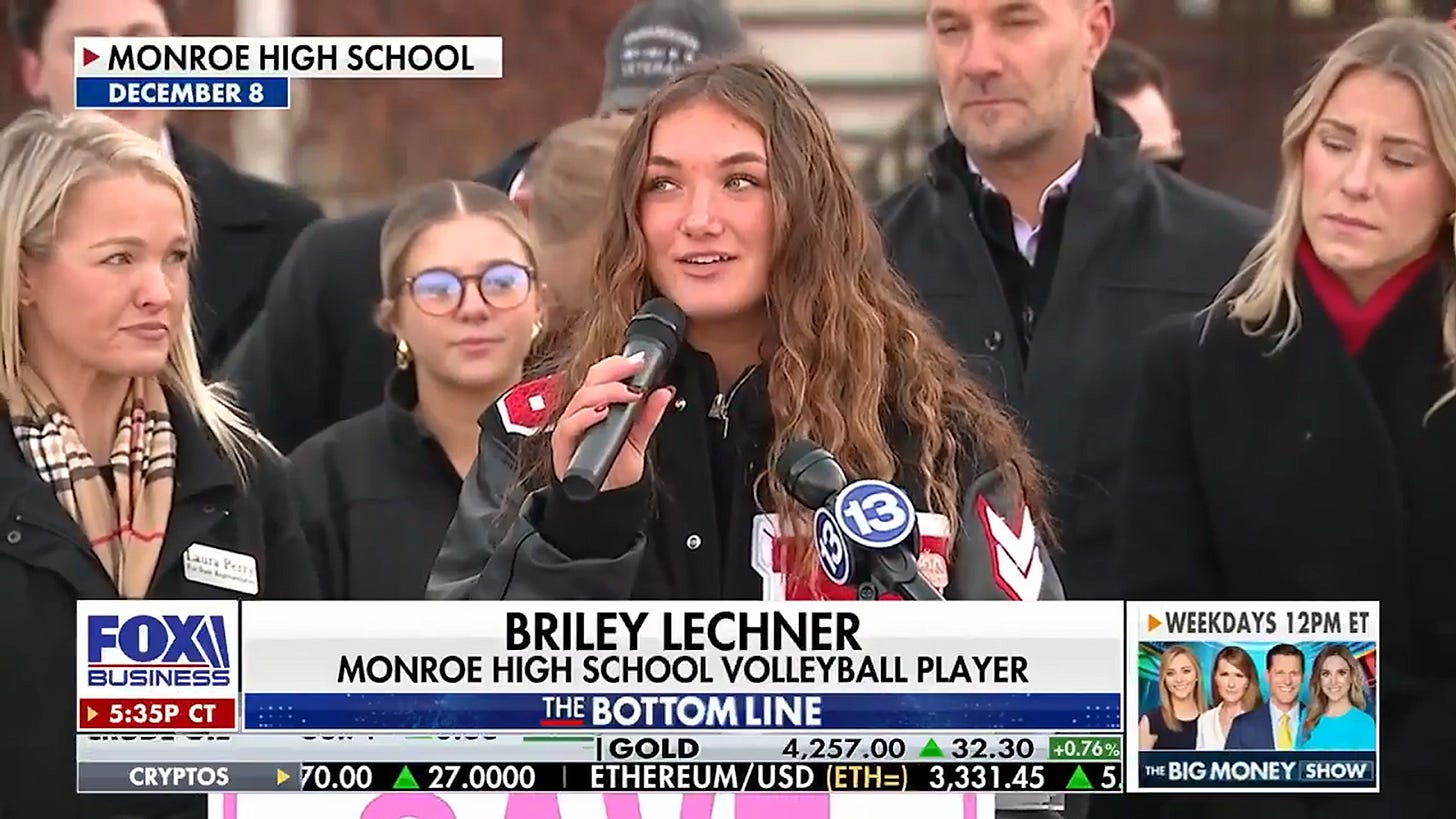
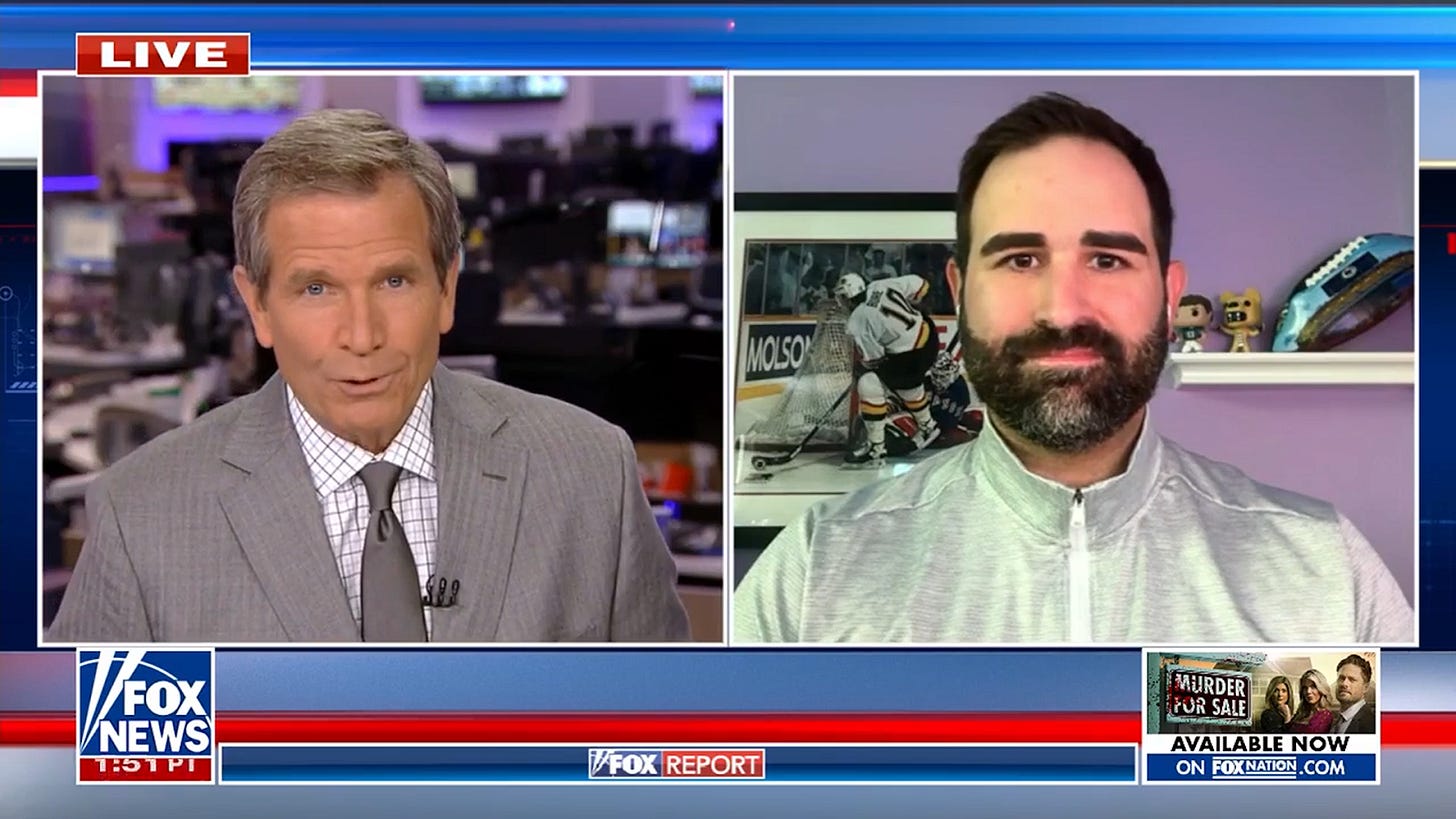
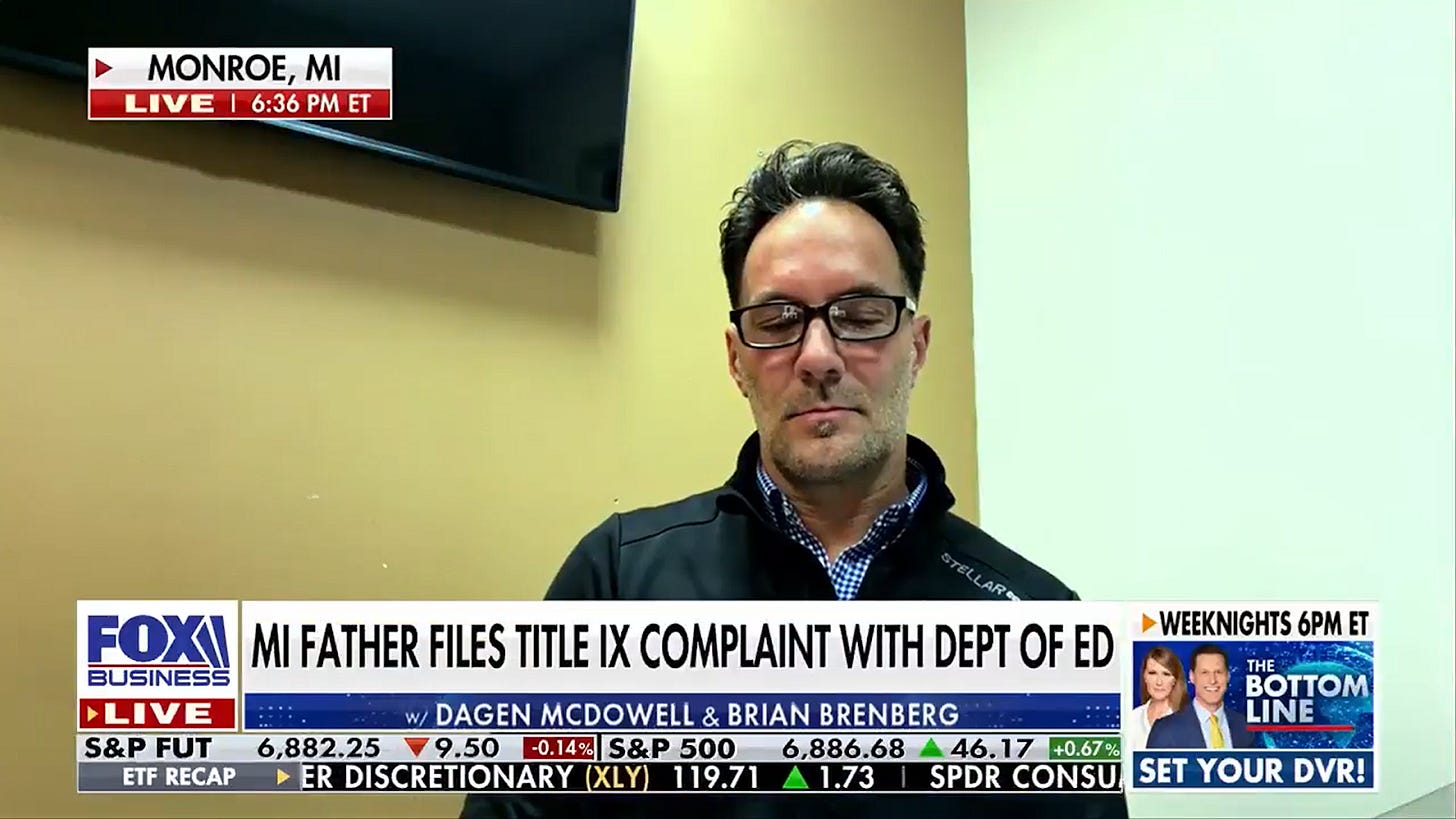
Zaksheske’s reporting stoked a controversy that drew the attention of multiple right-wing publications, politicians and influencers. This coverage led Sean Lechner, whose cisgender daughter played against Skyline and allegedly shared a locker room with their team, to file a Title IX complaint.
Lechner’s daughter at a press conference about the complaint. Screenshot via Fox Business.
While the Michigan High School Athletic Association (MHSAA) does require trans athletes to get a waiver approved to compete in official state tournaments, the Democrat-majority state Senate outright rejected the idea of a trans athlete sports ban earlier this year. In addition, LGBTQ Michiganders have strong anti-discrimination protections under the state’s Elliott-Larsen Civil Rights Act.
In the complaint, Lechner calls for a ban on “biological males from competing in female sports” and for a “full investigation into actions and communications of Ann Arbor Public Schools/Monroe High/Chet Hesson,” citing a Trump executive order that declares that trans-inclusive policies are in violation of Title IX.
Shortly after the complaint was filed, Uncloseted Media published an interview clip with Hesson, the athletic director of Monroe Public Schools, in which he simply said his “heart goes out” to the player for being under such scrutiny. Less than 24 hours later, he was put on administrative leave.
As this story spreads like wildfire, experts in journalistic ethics are raising concerns about Zaksheske’s reporting.
“OutKick’s inflammatory reporting on a Michigan high school volleyball player who may or may not be trans disregards several core principles of the Society of Professional Journalists’ [SPJ] Code of Ethics,” Dan Axelrod, chairman of the SPJ’s ethics committee, told Uncloseted Media. SPJ’s Code of Ethics, originally drafted in 1973, has been embraced and used by thousands of journalists from numerous newsrooms and schools.
“The Code cautions reporters to ‘show compassion for those who may be affected by news coverage,’ and to ‘use heightened sensitivity when dealing with juveniles,’ while ‘weigh[ing] the consequences of publishing or broadcasting personal information,’” Axelrod says. “[OutKick] has essentially ignored all those ethical principles, given [Zaksheske’s] relentless coverage of the player, which has led the public to easily infer who she is, and its negative framing of her story.”
The player, whose mother did not respond to an interview request, does not appear to have publicly come out as trans prior to the publication of Zaksheske’s first article.
Chad Painter, associate professor and chair of the communications department at the University of Dayton, says this “brings up a whole host of issues.” While Zaksheske wrote that he did not name the girl “because the student athlete is under 18,” Painter says that doesn’t do enough to conceal her identity.
In his reporting, Zaksheske references the existence of publicly accessible name change documents, the girl’s county of residence and the name of a local volleyball club she’d been a part of. “Someone who is reasonably well-versed in being able to Google someone can figure this out pretty easily,” Painter, who has co-authored multiple media ethics textbooks, told Uncloseted Media.
“There’s longstanding norms in newsrooms that we don’t out people, that that is a very personal decision that an individual gets to make, and unless there is a massively compelling reason to do that, it’s not our role,” he says. “The idea that he is in the clear because he didn’t specifically write this person’s name in a story, it wouldn’t hold up to journalistic scrutiny.”
And Zaksheske’s reporting appears to have outed the girl. The same day that he published his first article on the matter, an X account whose mission is “to call out these male athletes and expose the damage that they have each caused to women and girls in sports” published the girl’s full name and deadname along with multiple photos and videos of her. (Uncloseted Media has chosen not to link to these posts directly in the interest of her privacy.)
In addition to the 18 articles Zaksheske wrote, he also tweeted about the situation at least 41 times and attendedatleastfourhigh school girls’ volleyball games. While watching, he recorded videos of the girls playing and then posted them to X and OutKick’s website.
“Having 19 stories about one athlete … to me, that seems like this coverage is out of line with how we’d normally talk about, especially high school sports, which, frankly, no one outside of this little area in Michigan are going to really care about,” says Painter.
“Outside of the culture war stuff, I don’t see where this is a story.”
When Zaksheske was confronted by multiple people at the school about attending and recording one of the games, he published another article accusing them of harassment. “I was shadowed by the school principal and harassed and stalked by Skyline supporters,” he wrote.
Painter notes that while Zaksheske was within his rights as a journalist and citizen to be attending and recording such events, he understands why the school would approach him with skepticism.
“I have a feeling that if I just started showing up randomly to high school volleyball games and taking photos and videos, there would probably be questions,” Painter says. “Because, again, we are talking about minors.”
“The reporter has a right to pursue news … and that right especially exists at a public school,” says Axelrod. “However, one has to wonder at what point is the coverage just pandering to curiosity as opposed to serving a valid societal purpose in informing and facilitating larger discussions about real and valid questions regarding the participation of trans athletes in sports.”
Misinformation and Animus
Zaksheske has pushed back against similar criticism on X, accusing those who question the ethics of his reporting of being “in favor of sterilizing, mutilating and castrating children” and characterizing his reporting as “exposing their heinous acts.”
“I don’t see that as an ethical problem because it doesn’t even enter into the world of ethics,” Painter says of Zaksheske’s rhetoric. “It is wrong factually and it doesn’t really have a place in what we do in terms of the journalism field.”
Misleading rhetoric about trans health care is common throughout OutKick’s reporting. Zaksheske has written several articles about gender-affirming care, where he has claimed that puberty blockers “take healthy children and sterilize them for life.”
Puberty blockers have been FDA-approved for treating precocious puberty in cisgender children since 1993. Multiplestudies have found no evidence of them causing permanent infertility, and gynecologists and endocrinologists have said that they do not cause sterilization.
Much of Zaksheske’s coverage of trans people has been negative. Of adult trans women, he wrote that “that person might see himself as a woman, but we are under no obligation to ‘affirm’ that.” He also wrote that doctors who provide gender-affirming care “have to answer to their consciences.”
OutKick also generally misgenders trans women and girls, referring to them as “males,” “biological males” or “trans-identifying males,” additionally using masculine pronouns to refer to them.
Painter notes that this goes against the “Associated Press Stylebook,” which he says “any newsroom worth its salt is going to follow.”
“The journalist and the news outlet squander their credibility covering these types of societal questions when they use language … that fails to recognize and respect the underlying humanity of an entire group of people,” he says.
In an email, Brian Karpas, OutKick’s director of media relations, told Uncloseted Media that the publication “stands by the thorough and responsible reporting of Dan Zaksheske and will continue to protect women from competing against biological males.”
Beyond Michigan
OutKick’s extensive reporting of the Michigan volleyball player is reflective of the publication’s increasingly conservative bent since it launched in 2011. In 2021, it was acquired by Fox Corporation. Since then, it has partnered with Fox News and has become home to numerous right-wing personalities known for anti-trans rhetoric. These include founder Clay Travis, who has said World Aquatics is “encouraging …super young kids to be transitioned”; Tomi Lahren, who said that liberals “don’t know what a woman is”; and Riley Gaines, who referred to an eighth-grade trans girl as a “mediocre man.”
This story in Michigan is not the first time OutKick and Zaksheske have hyperfocused on one trans girl. They were one of the first national publications to report on California-based track and field athlete AB Hernandez, who later became the center of a feud between the Trump administration and Gov. Gavin Newsom. Since March, OutKick has published at least 24 articles about Hernandez, 10 of which were written by Zaksheske. They sent reporters to at least twogames to photograph Hernandez and other teenage players. Additionally, OutKick published 15 articles and attended at least four games covering the story of a trans softball player in Minnesota, whose presence on the team became a key point of a lawsuit by the Southern Poverty Law Center-designated anti-LGBTQ hate group, Alliance Defending Freedom.
This massive amount of coverage is common for U.S. conservative media: A report published this year from Media Matters for America found that Fox News ran over 400 weekday segments mentioning trans athletes from Feb. 5 to June 6.
All of this has had an impact. While the Title IX investigation is still pending, Hesson, who was named in the complaint, told Uncloseted Media that he had been targeted with harassment and vitriol online.
Uncloseted Media on Instagram: “Last Friday, Uncloseted Media p…
In the comments of the Instagram post, Hesson was attacked by numerous users: squaredbeach9 wrote, “Stop normalizing these freaks. You don’t give a bulimic chick a bucket and some gum.”
And others chimed in, saying:
“Guaranteed he has child pron on an electronic device.”
“Fuck off, poor tranny hates attention, give me a fn break.”
“So a male playing in women’s sports. And this cuck is defending it.”
All of this has come even though Hesson is not directly affiliated with Skyline High School, which is part of a different district. As such, he was not involved in the decision to allow the girl to play, and he was also not privy to whether she had a waiver.
In addition, numerous right-wing lawmakers and candidates have endorsed Lechner’s complaint. Republican state Rep. James DeSana posted a statement to Facebook “calling for Chet Hesson to be removed immediately.”
“The public cannot have good discourse, debate, or dialogue without good information,” Painter says. “Supplying that information is the fundamental duty of the news media. When journalists are distracted by inconsequential stories, then we’re not spending the time to cover interesting and important news that our readers really need.”
Both Painter and Axelrod took note of the small number of known trans athletes in the U.S. Last year, the NCAA’s president told a Senate panel that fewer than 10 of the 510,000 college athletes affiliated with the organization were transgender.
“This controversy is part of a much larger national narrative about transgender athletes and the LGBTQ+ community as a whole,” Painter says. “The entire national conversation is based on virtually nothing, so this particular set of stories are based on an inconsequential premise.”
Going Forward
If the Department of Education does find that Title IX was violated, the school district could risk losing federal funding if it continues to allow trans athletes to compete.
Zaksheske has been pressuring the MHSAA to confirm whether a waiver was approved for the volleyball player to compete, citing a statement from early September in which the association said it had not yet approved any waivers for the semester. On Dec. 9, MHSAA confirmed that one waiver was granted in the fall season, though no details were given in the interest of the student’s privacy.
While research into the relative athletic capabilities of trans and cis women is ongoing, numerous experts and athletes say that politicized vitriol, misleading information and outsized media attention about trans athletes makes girls’ sports less safe for all athletes.
“There are real, valid, and necessary societal discussions to be had about trans athletes participating against competitors who don’t match their birth gender, and ethical journalism can have a place in informing those discussions,” Axelrod says. “At the end of the day, this woman is still a human, and a child at that, not a canvas for OutKick to paint a distorted picture of one individual who’s a tiny part of a much bigger societal dialogue about trans athletes.”
If objective, nonpartisan, rigorous, LGBTQ-focused journalism is important to you, please consider making a tax-deductible donation through our fiscal sponsor, Resource Impact, by clicking this button:
I am not trans even though I have been asked because of my super strong support of trans people. I have lost friends who wouldn’t accept trans people using a public bathroom with them even though all private functions happen in enclosed little stalls. I do have distant family members who are trans and fully supported by family. More important I can clearly see the same negative vile things said about trans people are the same things pushed against gay people when I was a struggling gay teen being pushed by the same groups on the same ideas of victimhood. They were mostly driven by hyper Christian Nationalist religious groups and those who demanded that traditions along with society never change from when they were young and happy. These same groups and feelings are in play against trans people. They are simply the homosexual aids scare of the 1980s. Just as I as a young gay person needed allies and support so do trans people today. Please give as much vocal and upfront support for trans people you can. It is easier to make progress as a society if we don’t have to undo hateful laws outlawing our very existence. Hugs
An important report on how the tRump bigots and trans people haters are targeting trans people. It shows how clearly they are lying and spreading disinformation so they can erase trans people from society. They flood the media at the first sign of violence yet never correct the misinformation when they are found to be wrong. The goal is to make the US a straight cis only society. They will be coming for the rest of the LGBTQ+ community as soon as they feel they win erasing the trans people. Remember they have made the pride flag political and forbidden to be displayed but the southern confederate battle flag is still allowed. Hugs
Investigative journalist, Ken Klippenstein joins the show to discuss the Trump administration’s manipulation of recent shootings to bolster their war on trans people. Live-streamed on September 25, 2025
These bans have been successful in part because of a toxic and ruthless ecosystem of far-right influencers, like Riley Gaines, who have formed entire careers around attacking trans athletes by prioritizing hate and misinformation.
“So much of what we see … just seems like it’s wrapped up in really hateful and negative messages that aren’t good for anyone,” says Mary Fry, a professor of sport and exercise psychology at the University of Kansas. “We’re creating issues where maybe we don’t need to.”
The anti-trans attacks in sports are also affecting cis women. Ayala, a competitive cyclist, remembers one race where she and her trans friend both made the podium. When photos of the event were posted on Facebook, people accused her of being trans, and she was added to a “list of males who have competed in female sports” maintained by Save Women’s Sports.
Earlier this year, 16-year-old AB Hernandez became the target of nationwide hate and harassment when the president of a local school board publicly doxxed the track and field athlete and outed her as transgender. Right-wing activists misgendered her and called her mom “evil;” swarms of adults showed up to heckle her at games; Charlie Kirk pushed state governor Gavin Newsom to condemn her; and President Donald Trump threatened to withhold federal funding from California over her participation.
While transgender athletes are very rare, this type of harassment towards them is playing out across the country and internationally. A trans girl was harassed at a soccer game in Bow, New Hampshire, by adult protestors wearing XX/XY armbands, representing an anti-trans sports clothing brand. And in British Columbia, a 9-year-old cis girl was accosted by a grown man who accused her of being trans and demanded that she prove her sex to him.
While research into the relative athletic capabilities of trans and cis women is ongoing, far-right groups, including the Alliance Defending Freedom and the Leadership Institute, have been putting hate before science to turn the public against trans athletes since at least 2014. And it’s working.
Laws, rules or regulations currently ban trans athletes from competing in sports consistent with their gender identity in 29 states, with 21 beginning the ban in kindergarten. The majority-conservative Supreme Court announced this month that it’ll be taking on the question of the constitutionality of the bans. Meanwhile, the federal government is pressuringstates without bans to change their policies in compliance with a Trump executive order that attempts to institute a nationwide ban.
Trump signs an executive order calling for bans on trans women and girls from women’s sports. Photo by: The White House.
These bans have been successful in part because of a toxic and ruthless ecosystem of far-right influencers, like Riley Gaines, who have formed entire careers around attacking trans athletes by prioritizing hate and misinformation.
“So much of what we see … just seems like it’s wrapped up in really hateful and negative messages that aren’t good for anyone,” says Mary Fry, a professor of sport and exercise psychology at the University of Kansas. “We’re creating issues where maybe we don’t need to.”
Harassment and Mental Health
Grace McKenzie has been deeply affected by these hate campaigns. A lifelong athlete, McKenzie has stayed healthy by playing multiple sports where she’s met “amazing people.” Shortly after she transitioned in 2018, she was thrilled when she was invited to join a women’s rugby team at the afterparty of a Lesbians Who Tech conference.
Grace McKenzie. Photo courtesy of McKenzie.
“Rugby became my home, it was my first queer community, it was the space where I really discovered my own womanhood,” McKenzie told Uncloseted Media. “I could be the sometimes-masculine, soft-feminine person who play[s] rugby and loves sports.”
But that started to change in 2019, when McKenzie and others on her team started to hear rumors that World Rugby was considering a ban on trans athletes. Fearing the loss of her community, she started a petition that racked up 25,000 signatures—but it wasn’t enough, and the ban took effect in 2020.
As anti-trans rhetoric in sports has ramped up, McKenzie says she’s had soul-crushing breakdowns that have left her “sobbing uncontrollably and unconsolably.”
“It would be these waves of such intense despair and rage—it was like going through grief for five years,” she says. “I have to wake up every single day and read about another state or another group of people who say that they don’t want me to exist.”
While McKenzie says she’s found the strength to keep playing where she can, sports psychologist Erin Ayala has seen clients leave sports altogether due to the hate toward trans athletes.
“It can be really difficult when they feel like they’re doing everything right … and they still don’t belong,” says Ayala, the founder of the Minnesota-based Skadi Sport Psychology, a therapy clinic for competitive athletes. “Depression can be really high. They don’t have the strength to keep fighting to show up. And then that can further damage their mental health because they’re not getting the exercise and that sense of social support and community.”
That was the story of Andraya Yearwood, who made national headlines in high school when she and another trans girl placed first and second in Connecticut’s high school track competitions. The vitriol directed at her was intense: Parents circulated petitions to have her banned; crowds cheered for her disqualification; the anti-LGBTQ hate group Alliance Defending Freedom launched a lawsuit against the state for letting her play; and she faced a torrent of transphobic and racist harassment.
“It’s a very shitty experience,” Yearwood, now 23, told Uncloseted Media.
Fearing more harassment, she quit running in college.
“I understood that collegiate athletics is on a much larger and much more visible scale. … I just didn’t want to go through all that again for the next four years,” she says. “Track obviously meant a lot to me, and to have to let that go was difficult.”
It’s understandable that Yearwood and other trans athletes struggle when they have to ditch their favorite sport. A litany of research demonstrates that playing sports fosters camaraderie and teamwork and improves mental and physical health. Since trans people disproportionately struggle from poor mental health, social isolation and suicidality, these benefits can be especially crucial.
“In some of these cases, kids have been participating with a peer group for years, and then rules were made and all of a sudden they’re pulled away,” says Fry. “It’s a hard world to be a trans individual in, so it’d be easy to feel lonely and separated.”
Caught in the Crossfire
The anti-trans attacks in sports are also affecting cis women. Ayala, a competitive cyclist, remembers one race where she and her trans friend both made the podium. When photos of the event were posted on Facebook, people accused her of being trans, and she was added to a “list of males who have competed in female sports” maintained by Save Women’s Sports.
Ayala isn’t alone. Numerous cis female athletes have been “transvestigated,” or accused of being trans, including Serena Williams and Brittney Griner. During the 2024 Paris Olympics, Donald Trump and Elon Musk publicly accused Algerian boxer Imane Khelif of being trans after her gold medal win, as part of a wave of online hate against her. She would later file a cyberbullying complaint against Musk’s X.
While women of all races have been targeted, Black women have faced harsher scrutiny due to stereotypes that portray them as more masculine.
Yearwood remembers posts that would fixate on her muscle definition and compare her to LeBron James.
“I think that is attributed to the overall hyper-masculinization and de-feminization of Black women, and I know that’s a lot more prevalent for Black trans women,” she says. “It made it easier to come for us in the way that they did.”
Subscribe
A Big Distraction
Joanna Harper, a post-doctoral scholar at Oregon Health & Science University and one of the world’s leading researchers on the subject, says that the jury is still out on whether the differences in athletic performance between trans and cis women are significant enough to warrant policy changes.
“People want simple solutions, they want things to be black and white, they want good guys and bad guys,” Harper says, adding that the loudest voices against trans women’s participation do not actually care about what the science says.
“This idea that trans women are bigger than cis women, therefore it can’t be fair, is a very simple idea, and so it is definitely one that people who want to create trans people as villains have pushed.”
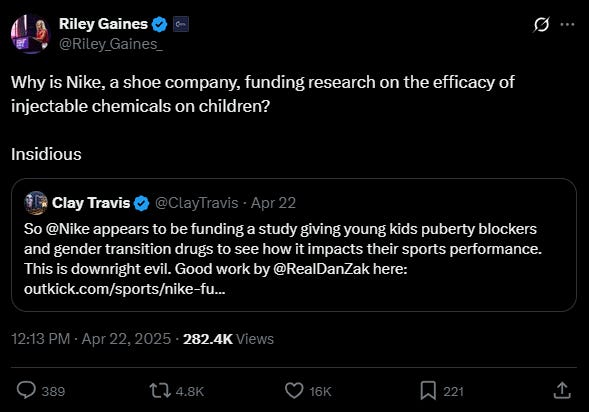
Even Harper herself has been the victim of the far-right’s anti-trans attacks. Earlier this year, she was featured in a New York Times article where she discussed a study she was working on with funding from Nike into the effects of hormone replacement therapy (HRT) on adolescents’ athletic performance.
Riley Gaines and OutKick founder Clay Travis attack Harper’s study on X.
“That Nike chose to fund a study on trans athletes doesn’t actually say that they’re supporting trans athletes. They’re merely supporting research looking into the capabilities of trans athletes,” Harper says. “You don’t know what the research will show until you get the data … but the haters don’t want any data coming out that doesn’t support what they want to say.”
Harper says this anti-trans fervor and HRT bans are making it more difficult to conduct studies in the first place.
And while the far-right argues that they are “protecting women’s sports” in their war on trans athletes, multiple athletes and experts told Uncloseted Media that this distracts from bigger issues in women’s sports, including sexualharassment by coaches and a lack of funding.
“If the real goal was to help women’s sports, they would try to increase funding [and] support for athletes,” says Harper, noting that women’s sports receive half as much money as men’s sports at the Division I collegiate level. “But that’s not what they’re doing, and it becomes pretty evident the real motivation behind these people.”
Since Trump’s reelection, Grace McKenzie has somewhat resigned herself to the likelihood of attacks on trans people getting worse. Despite this, she finds hope in building community with other trans athletes, such as the New York City-based trans basketball league Basketdolls.
“If that’s the legacy that [the anti-trans movement] wants to leave behind, good for them,” McKenzie says. “Our legacy is going to be one about hope, and collective solidarity, and mutual aid, and I would much rather be on that side of the fence.”
Meanwhile, Fry remains hopeful that conflicts can be resolved and that trans people may be able to find a place in sports over time.
“If we could all have more positive conversations and not create such a hateful environment around this issue, it would just benefit everyone.”
If objective, nonpartisan, rigorous, LGBTQ-focused journalism is important to you, please consider making a tax-deductible donation through our fiscal sponsor, Resource Impact, by clicking this button:


February 13, 2026











 Scottie's Playtime
