| Link to Original Art Curious to see of more of the original art? Click the link to read the entire vintage comic book for free on ComicBookPlus.com. —John |


| Link to Original Art Curious to see of more of the original art? Click the link to read the entire vintage comic book for free on ComicBookPlus.com. —John |

Queer History 745: Patricia Highsmith – The Brilliant Fucking Architect of Queer Hope by Wendy🏳️⚧️🏳️🌈🌈
Read on Substack
In the suffocating landscape of 1950s America, when being queer could land you in a mental institution, prison, or worse, one woman sat down at her typewriter and decided to tell the truth. Patricia Highsmith didn’t just write a fucking love story—she carved out a piece of literary real estate where lesbian love could exist without punishment, where two women could find each other and actually keep each other. In a world determined to erase queer joy, she smuggled hope onto bookshelves disguised as pulp fiction.

But let’s not paint Highsmith as some sanitized literary saint. This woman was complicated as hell, brilliant as fuck, and carried enough psychological baggage to sink a goddamn ship. She was an alcoholic, a recluse, and often cruel to the people who loved her. She was also one of the most important queer voices of the 20th century, whether she wanted that label or not. Her story isn’t just about one woman’s struggle with her sexuality—it’s about the price we all pay when society forces us to live fractured lives, and the revolutionary act of refusing to let that fracture define us.
Mary Patricia Plangman was born in Fort Worth, Texas, on January 19, 1921, into a world that would spend the next several decades trying to convince her that everything she was constituted a crime against nature. Her parents, Jay Bernard Plangman and Mary Coates, divorced before she was born, and her mother married Stanley Highsmith when Patricia was three. The family moved to New York, where young Patricia would grow up surrounded by the kind of suffocating heteronormative expectations that could drive anyone to drink—and eventually did.
From childhood, Highsmith knew she was different, and not in the precious, special-snowflake way that adults like to romanticize. She was different in the way that made her feel like she was constantly walking on broken glass, knowing that one wrong step could cut her to pieces. She was attracted to women in an era when that attraction was classified as a mental illness, when “treatments” ranged from electroshock therapy to lobotomies. The psychological pressure of living with this secret would shape not just her personal relationships but every fucking word she ever wrote.
At Barnard College, Highsmith studied English literature and began to understand that stories could be weapons—tools for survival in a hostile world. She was already writing, already crafting the psychological precision that would make her famous. But she was also falling in love with women, conducting relationships in shadows and whispers, learning the exhausting choreography of the closet that would define her entire adult life.
After graduation, she moved to Greenwich Village, ostensibly to pursue her writing career but really to find some semblance of community among other artists and outcasts. The Village in the 1940s was one of the few places in America where queer people could exist with some measure of freedom, though even there, the threat of police raids and social destruction loomed constant. Highsmith found work writing for comic books, including scripts for Captain America and other superheroes—ironic, considering she was creating stories about characters who could live openly as their authentic selves while she remained trapped behind a mask of heterosexual respectability.
In 1951, while working at Bloomingdale’s during the Christmas rush—because even future literary legends had to pay rent—Highsmith had an encounter that would change queer literature forever. She served a beautiful blonde customer buying a doll for her daughter, and something about the interaction sparked what would become “The Price of Salt.” Later, walking through the city, Highsmith felt what she described as a “strange happiness” and knew she had to write this story.
But let’s be clear about what she was attempting: in 1952, lesbian novels ended one of two ways—with the queer character dying or going insane. Those were the only narratives society would tolerate. Happy queers were not allowed to exist in fiction because they weren’t allowed to exist in real life. Publishers, critics, and readers had been thoroughly conditioned to expect punishment for sexual deviance. A lesbian love story with a happy ending wasn’t just revolutionary—it was practically seditious.
Highsmith wrote “The Price of Salt” under the pseudonym Claire Morgan because she knew that attaching her real name to a lesbian novel would be career suicide. Even with the pseudonym, the book was relegated to the pulp fiction ghetto, sold alongside other “deviant” literature in bus stations and drugstores. The literary establishment wouldn’t touch it with a ten-foot pole, and most critics dismissed it as sensational trash designed to titillate straight male readers.
They were wrong, and they were missing the fucking point entirely.
“The Price of Salt” tells the story of Therese Belivet, a young woman working in a department store who becomes infatuated with Carol Aird, an elegant older woman going through a divorce. What follows is a love story that unfolds with the psychological complexity and emotional honesty that would become Highsmith’s trademark. But more importantly, it’s a love story where both women survive, where love is possible, where the ending doesn’t require sacrifice or punishment.
The novel found its audience despite the literary establishment’s best efforts to ignore it. Queer women passed dog-eared copies between friends, smuggled them in suitcases, hid them between mattresses. For the first time, they could read a story where people like them weren’t doomed, where lesbian love wasn’t portrayed as inherently tragic or destructive. The psychological impact was immeasurable—here was proof that queer happiness was possible, that their desires weren’t automatically poisonous.
Understanding Highsmith’s impact on LGBTQIA+ people requires understanding the psychological landscape they were navigating in mid-20th century America. This was an era of institutionalized homophobia so complete and systematic that it’s hard to imagine from our current perspective. Homosexuality was classified as a mental illness. Same-sex relationships were illegal in every state. Queer people were barred from government employment, discharged from the military, subjected to police harassment, and often rejected by their families.
The psychological effects of living under this kind of systematic oppression were devastating. Queer people internalized shame, developed elaborate systems of concealment, and often struggled with depression, anxiety, and suicidal ideation. The absence of positive representation in media and literature reinforced the message that queer love was inherently destructive, that happiness wasn’t possible for people like them.
Into this psychological wasteland, Highsmith dropped a fucking bomb of hope.
“The Price of Salt” didn’t just tell queer women that love was possible—it showed them what that love might look like. Carol and Therese weren’t tragic figures destroyed by their desires; they were complex, flawed, human women who found each other and fought to stay together. The novel’s ending, with Therese choosing Carol over societal expectations, was nothing short of revolutionary.
But Highsmith’s psychological insight went deeper than just providing positive representation. She understood the specific ways that homophobia warped relationships, the paranoia and secrecy that poisoned even the most genuine connections. Carol’s ex-husband uses their daughter as leverage, threatening to take the child away if Carol doesn’t renounce her “perversion.” The constant threat of exposure hangs over every tender moment, every stolen glance, every whispered conversation.
This wasn’t melodrama—this was documentary realism for queer people living in the 1950s. Highsmith captured the specific psychological toll of living in the closet, the way fear could poison love, the exhausting vigilance required to maintain a double life. But she also showed that despite all this, love could survive, relationships could endure, happiness was fucking possible.
The immediate impact of “The Price of Salt” was profound but largely invisible. Queer women didn’t write letters to newspapers praising the book—that would have been social suicide. Instead, they quietly bought copies, passed them along to friends, and felt something shift inside themselves when they read about Carol and Therese’s love story.
Dr. Eli Coleman, a sexologist who has studied the impact of literature on LGBTQIA+ identity formation, argues that positive representation in fiction serves a crucial psychological function for marginalized communities. “When people see themselves reflected positively in stories,” Coleman explains, “it validates their experiences and provides a roadmap for possibility. For queer people in the 1950s, who had almost no positive representation anywhere, a novel like ‘The Price of Salt’ could literally be life-saving.”
The psychological impact extended beyond individual readers to the broader cultural conversation about homosexuality. While the book didn’t immediately change mainstream attitudes—that would take decades—it planted seeds that would eventually bloom into the gay rights movement. Young people who read Highsmith’s novel grew up with the revolutionary idea that queer love didn’t have to end in tragedy, that happiness was possible for people like them.
This shift in narrative possibilities had profound philosophical implications. If queer love could be portrayed as beautiful, complex, and worthy of a happy ending, then the entire moral framework that condemned homosexuality began to crack. Highsmith wasn’t just telling a love story—she was challenging the fundamental assumptions that justified queer oppression.
While Highsmith was creating revolutionary representation for other queer people, her own relationship with her sexuality remained deeply complicated. She never publicly came out, never became an activist, and often seemed uncomfortable with the idea that “The Price of Salt” had become a touchstone for lesbian readers. This wasn’t just garden-variety internalized homophobia—though that was certainly part of it—but a complex psychological response to a lifetime of navigating hostile territory.
Highsmith’s personal relationships were often tumultuous and self-destructive. She drank heavily, maintained emotional distance even from intimate partners, and seemed to prefer the company of her numerous cats to most humans. Friends and lovers described her as brilliant but difficult, generous but cruel, capable of profound empathy and stunning callousness sometimes within the same conversation.
This psychological complexity was both a source of her literary genius and a reflection of the damage caused by a lifetime in the closet. Highsmith had spent so many years concealing her true self that authenticity became nearly impossible. She developed what psychologists call “minority stress”—the chronic psychological tension experienced by stigmatized groups who must constantly monitor and modify their behavior to avoid discrimination.
The effects of minority stress on LGBTQIA+ individuals are well-documented: higher rates of depression and anxiety, difficulty forming intimate relationships, substance abuse, and a persistent sense of alienation from mainstream society. Highsmith exhibited many of these symptoms throughout her life, but she also channeled that psychological complexity into her writing, creating characters whose inner lives were as intricate and contradictory as her own.
Her later novels, including the famous Tom Ripley series, explored themes of identity, deception, and the psychology of outsiders—all subjects she knew intimately from her own experience as a closeted lesbian. While these books weren’t explicitly queer, they were infused with the psychological insights that came from a lifetime of living on society’s margins.
“The Price of Salt” didn’t exist in a vacuum—it was part of a slowly building wave of cultural change that would eventually reshape American attitudes toward sexuality. But Highsmith’s contribution was unique in its subtlety and psychological sophistication. Unlike the explicitly political gay rights literature that would emerge in later decades, her novel worked by stealth, smuggling queer humanity into mainstream consciousness through the back door of popular fiction.
The book’s classification as pulp fiction was actually crucial to its impact. While “serious” literature was consumed primarily by educated elites, pulp novels reached a much broader audience. Working-class people, teenagers, small-town residents—people who might never encounter openly queer individuals in their daily lives—were reading about Carol and Therese’s love story. The seeds of empathy were being planted in unexpected soil.
This demographic reach had significant social implications. When the gay rights movement began to gain momentum in the 1960s and 1970s, it wasn’t starting from scratch. Thanks to novels like “The Price of Salt,” millions of Americans had already been exposed to positive portrayals of queer relationships. The ground had been prepared, even if most people didn’t realize it.
The philosophical implications were equally profound. For centuries, Western society had constructed elaborate theological and pseudo-scientific justifications for condemning homosexuality. These arguments depended on portraying queer love as inherently unnatural, destructive, and incapable of producing genuine happiness. Highsmith’s novel didn’t engage these arguments directly—it simply rendered them irrelevant by showing that none of them were true.
Carol and Therese’s relationship was portrayed as natural, nurturing, and fulfilling. They weren’t predators or victims, sick or sinful—they were simply two women who fell in love. This narrative simplicity was actually a sophisticated philosophical assault on the entire edifice of heteronormative ideology.
When “The Price of Salt” was reissued in 1990 under Highsmith’s real name with the new title “Carol,” it found a new generation of readers who could appreciate its revolutionary impact. The AIDS crisis had decimated the gay male community, and lesbian feminism was providing crucial leadership in the broader LGBTQIA+ rights movement. Highsmith’s novel was rediscovered as a foundational text, a reminder of how far the community had come and how much further it still needed to go.
The 2015 film adaptation, starring Cate Blanchett and Rooney Mara, introduced Highsmith’s story to an even broader audience and sparked new conversations about queer representation in media. The film’s lush cinematography and devastating emotional honesty brought Carol and Therese’s love story to life for a generation raised on increasing LGBTQIA+ visibility but still fighting for full equality.
For contemporary LGBTQIA+ people, particularly young people struggling with their sexual or gender identity, Highsmith’s work continues to provide crucial psychological support. In an era of increasing political backlash against queer rights, when transgender youth face legislative attacks and gay marriage remains under threat, the simple existence of stories like “Carol” serves as a reminder that queer love has always existed, has always been beautiful, and has always been worth fighting for.
The psychological impact is particularly powerful for young people from conservative backgrounds or regions where LGBTQIA+ visibility remains limited. Reading about Carol and Therese’s love story can be the first time these individuals encounter the revolutionary idea that their desires are valid, that happiness is possible, that they aren’t broken or sinful or destined for tragedy.
Highsmith’s greatest achievement wasn’t just creating positive lesbian representation—it was constructing a philosophical framework for queer joy that transcended the specific circumstances of her characters. “The Price of Salt” argues, through narrative rather than polemic, that love itself is the highest human value, that authentic relationships matter more than social approval, and that individuals have the right to pursue happiness even when that pursuit challenges conventional morality.
This philosophical stance was radical in 1952 and remains challenging today. American society continues to struggle with the tension between individual freedom and social conformity, between traditional values and evolving understanding of human sexuality and gender identity. Highsmith’s novel doesn’t resolve these tensions—it simply insists that love transcends them all.
The book’s ending is particularly significant in this regard. Therese’s choice to pursue a relationship with Carol isn’t portrayed as a rejection of society or a declaration of war against heteronormativity. It’s simply a young woman choosing love over fear, authenticity over approval, joy over safety. The philosophical implications are profound: if individuals have the right to pursue happiness, and if love between consenting adults is inherently valuable, then society’s objections become irrelevant.
This isn’t the angry politics of later gay liberation movements—it’s something more subtle and perhaps more subversive. Highsmith wasn’t arguing that society should accept queer people; she was arguing that queer people didn’t need society’s acceptance to live full, meaningful lives. The audacity of that position, especially in 1952, cannot be overstated.
The most important measure of Highsmith’s impact isn’t literary criticism or sales figures—it’s the immeasurable number of LGBTQIA+ lives that have been saved by her willingness to imagine queer happiness. In a community where suicide rates remain tragically high, where young people continue to face rejection and violence for their sexual or gender identity, stories matter in ways that straight, cisgender people often struggle to understand.
Dr. Ryan Watson, who studies the relationship between media representation and LGBTQIA+ mental health, explains: “For young people questioning their sexuality or gender identity, seeing positive representation in media can literally be the difference between life and death. When you’re told by your family, your school, your church, and your government that you’re fundamentally wrong or broken, finding stories where people like you are happy and loved can provide the hope necessary to survive.”
“The Price of Salt” has been providing that hope for over seventy years. It sits on countless bookshelves, gets passed between friends, appears on recommended reading lists, and continues to whisper the same revolutionary message to each new generation of readers: you are not alone, your love is valid, happiness is possible.
The novel’s impact extends beyond individual readers to the broader cultural conversation about LGBTQIA+ rights and representation. Every positive portrayal of queer relationships in contemporary media owes a debt to Highsmith’s pioneering work. Every time a young person sees themselves reflected positively in a book, movie, or television show, they’re benefiting from the foundation she laid in 1952.
As LGBTQIA+ people continue to fight for full equality and acceptance, Highsmith’s work remains remarkably relevant. The psychological insights she provided about the costs of closeting, the importance of authentic relationships, and the possibility of queer joy continue to resonate with contemporary experiences.
Young transgender people facing legislative attacks and social rejection can find solidarity in Therese’s struggle to live authentically despite social pressure. Gay men navigating family rejection might recognize themselves in Carol’s battle to maintain relationships with her loved ones while refusing to deny her true self. Lesbian couples fighting for the right to parent can draw strength from Carol and Therese’s determination to build a life together despite legal and social obstacles.
The philosophical framework Highsmith constructed—that love transcends social convention, that individual happiness matters, that authenticity is worth fighting for—remains a powerful tool for contemporary LGBTQIA+ activism. While the specific battles have evolved, the underlying struggle between individual freedom and social control continues.
Perhaps most importantly, Highsmith’s work reminds us that representation matters, that stories have power, that the simple act of imagining queer happiness can be a revolutionary force. In an era when politicians and pundits continue to debate the “appropriateness” of LGBTQIA+ visibility, her novel stands as proof that queer people have always existed, have always loved, and have always deserved the chance to pursue happiness.
Patricia Highsmith died in 1995, long enough to see some of the changes her work helped create but not long enough to witness marriage equality, widespread LGBTQIA+ representation in media, or the growing acceptance of transgender rights. She remained complicated and contradictory until the end—a brilliant writer who struggled with intimacy, a queer pioneer who never fully embraced that role, a woman who gave hope to millions while often seeming to have little hope for herself.
But her legacy isn’t diminished by her personal struggles—if anything, it’s enhanced by them. Highsmith’s psychological complexity, her understanding of the costs of closeting, her ability to create characters who were both strong and vulnerable, all stemmed from her own experiences navigating a hostile world. She transformed her pain into art, her isolation into empathy, her struggle into a story that continues to save lives.
“The Price of Salt” stands as proof that individual acts of courage can have ripple effects that extend far beyond what their creators ever imagine. When Highsmith sat down to write about Carol and Therese’s love story, she probably thought she was just crafting another novel to pay the bills. Instead, she created a piece of revolutionary literature that challenged fundamental assumptions about sexuality, provided hope to countless individuals, and helped lay the groundwork for the LGBTQIA+ rights movement.
In a world that continues to tell queer people that their love is wrong, that their happiness is impossible, that they should be grateful for tolerance rather than demanding full equality, Highsmith’s novel remains a radical document. It insists that queer love is beautiful, that happiness is possible, that authenticity is worth any price society might demand.
That message, delivered with all the psychological sophistication and emotional honesty Highsmith could muster, continues to resonate with each new generation of readers who discover that they are not alone, that their love is valid, and that despite everything society might tell them, happiness is not only possible—it’s their fucking birthright.
The woman who wrote comic book heroes while hiding behind a mask of heterosexual respectability ultimately became a hero herself, not through superhuman powers but through the simple, revolutionary act of telling the truth about love. In doing so, she proved that sometimes the most powerful weapon against oppression isn’t anger or violence—it’s the audacious insistence that joy is possible, that love conquers all the bullshit society tries to pile on top of it, and that everyone deserves the chance to pursue their own beautiful, complicated, fucking magnificent version of happiness.
Eat Mor Sundays by Clay Jones
And no, you can’t get your healthcare at Subway Read on Substack

This cartoon was drawn (in California) for the FXBG Advance. Is it weird to draw a cartoon on Fredericksburg while in California? Not really. I did it in Huntsville, Alabama, and Montreal. I didn’t do one while traipsing the UK, Ireland, and Iceland.
Fredericksburg has lost Moss Free Clinic, and very important, and the only source for many for healthcare.
I covered this issue back in February 2024, way before I even started my Substack.
Creative note: I was out Thursday night in downtown Carlsbad when my editor sent me a few subjects. I knew this was the most important one. I wrote it in my head while having a Modelo. I got it approved the next day (Friday) and drew it that night.
Music note: I listened to Tom Petty’s Wildflowers album. (snip)
==========
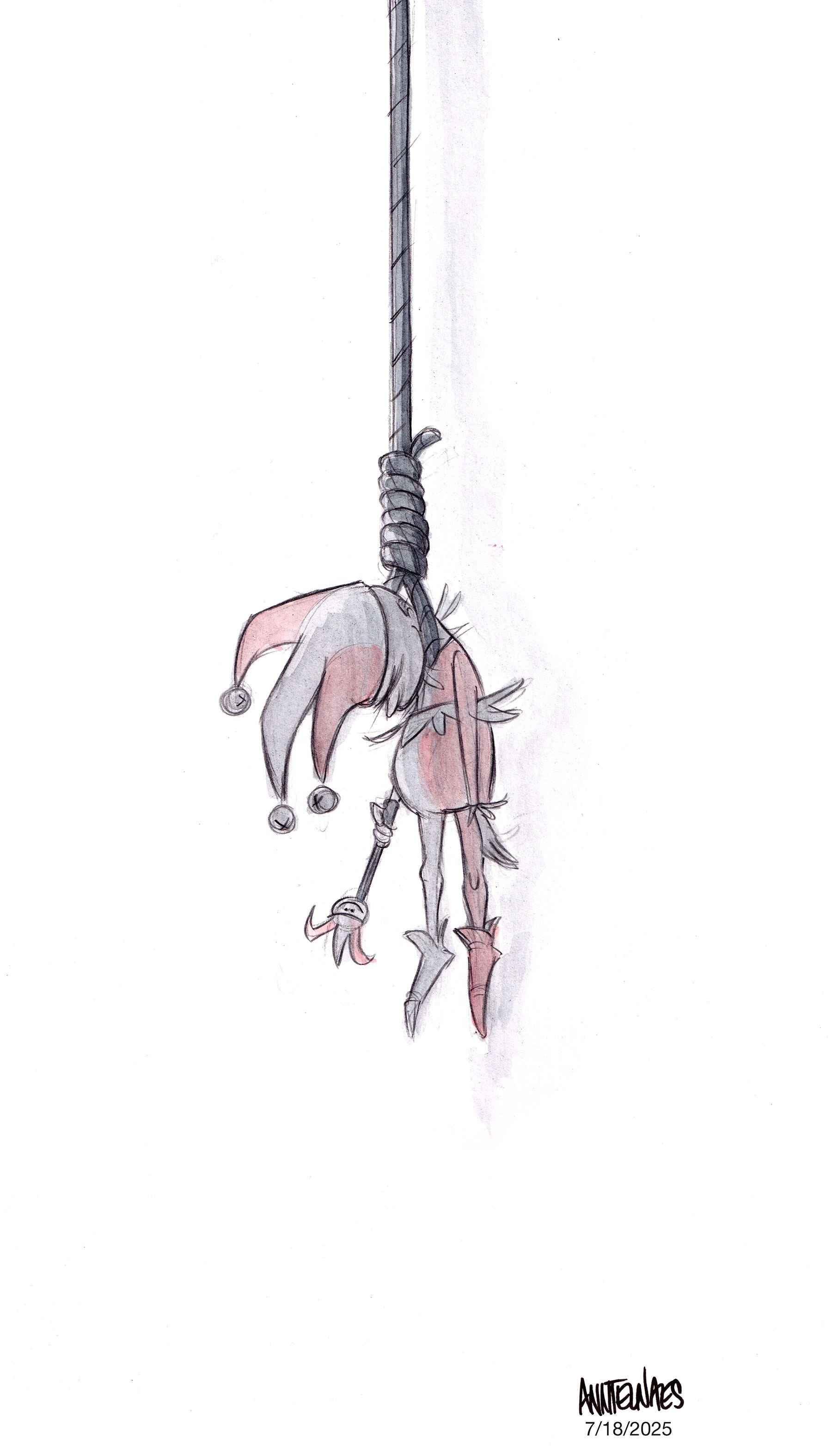
Trump orders strike on Iran by Ann Telnaes
Operation Midnight Shammer gets to play strongman Read on Substack
Yesterday Trump announced the bombing of three nuclear sites in Iran, claiming “the strikes were a spectacular military success. Iran’s key nuclear enrichment facilities have been completely and totally obliterated”.
Timothy Snyder, author of “On Tyranny”, posted on bluesky last night: “Many things reported with confidence in the first hours and days will turn out not to be true”.
Yes, indeedy…

(cartoon from 2003) (snip)
==========
Bunker-Busting Bonespurs by Clay Jones
The forecast calls for bombs and TACOs Read on Substack

The decision to go to war shouldn’t be left to a low-IQ racist, narcissistic toddler with impulse issues. I wonder if our generals feel like Hitler’s generals. In both cases, experienced and trained military professionals had to follow very stupid orders. In Hitler’s case, those orders cost Germany thousands of soldiers, either through death or capture.
Hitler was a veteran while Trump dodged the Vietnam War, citing bone spurs.
To the idiot conspiracy-theory spreading trolls at GoComics believing yesterday’s cartoon signals I’m for bombing Iran, no, morons. How could you come to that conclusion after years of reading my work?
To be clear, I do NOT support starting a war against any nation that hasn’t attacked us. This case is particularly stupid.
Donald Trump is demanding peace from Iran, which has never attacked us, after he dropped massive bombs on it. We HAD peace with Iran.
Years ago, Trump falsely predicted that President Barack Obama would start a war with Iran because he would be incapable of negotiating. Except it was President Obama who successfully negotiated for Iran to end its nuclear program, and the treaty was working. Iran was complying with all the conditions.
It was Trump who canceled the agreement and is now bombing Iran because he’s incapable of negotiating. And why would Iran want to negotiate with Donald Trump when they know they can’t trust him. How many treaties and agreements has Trump broken?
Iran doesn’t have a nuclear bomb today, or Trump and Bibi would not have bombed them. But Donald Trump just taught Iran that they need a nuclear weapon.
We may be slow learners of history, but the Iranians may not be. We forgot the history lessons of Vietnam and invaded Iraq. Iran probably remembers our demands on Iraq and Libya to lose their nuclear programs, only to see their regimes overthrown later.
Another history lesson we’re forgetting is our regime changes in Iraq and Afghanistan. How long is Trump prepared to commit US troops to this war? It’ll be a lot longer than Trump will be in office.
Last night, Trump said to the nation, “Iran’s key nuclear enrichment facilities have been completely and totally obliterated.” And then he said there are other targets. (snip)
National Guarding Caitlin by Clay Jones
Shut up and dribble Read on Substack

An appeals court is allowing Donald Trump to retain control of the California National Guard.
A three-judge panel of the San Francisco-based 9th U.S. Circuit Court of Appeals said Trump “probably” acted within his authority, and added that his administration “probably” complied with the requirement to coordinate with Governor Gavin Newsom, and even if it did not, he had no authority to veto Trump’s directive.
The panel, with two Trump-appointed judges and one Biden-appointed judge, is using “probably” a lot in their ruling. That’s probably a bunch of bullshit.
The law sets out three conditions that a president can federalize state National Guard forces; an invasion (which isn’t happening here), a “rebellion or danger of a rebellion” against the government (which isn’t happening here), or a situation in which the U.S. government is unable with regular forces to execute the country’s laws (another thing not happening here).
The appeals court said the final condition had probably been met because protesters hurled items at immigration authorities’ vehicles, used trash dumpsters as battering rams, threw Molotov cocktails, and vandalized property, frustrating law enforcement. There was that probably again. What about the cops shooting reporters? Which cop agency is enforcing that?
Yet, the governor never called the president (sic) to say that Los Angeles or California couldn’t execute the nation’s laws because ICE agents were having items thrown at them. And lately, ICE and Trump have been breaking more laws than protesters. Can we deploy a state’s National Guard to enforce laws on Trump?
The courts need to factor in that Trump deployed the National Guard to fight Californians. (snip-MORE, including Caitlin Clark)
============================
Isn’t It Ironic? by Clay Jones
Don’t ya think? Read on Substack

I was admiring the view from my buddy’s backyard late yesterday afternoon when a hawk, or some kind of bird of prey, almost flew into my head. What?
The backyard overlooks a ravine. So the hawk was flying as usual, but his height decreased as he approached the hill, him not approaching the ground but the ground coming to him, and the next thing you know, he comes closer to objects on the ground, in this case, me. Bear with me, I’m making a point.
This did not happen on Tuesday, but it did happen yesterday, which was Wednesday (there may be some MAGAts reading, and they probably can’t figure out how a calendar works). What I’m telling you is that yesterday, there was a 100 percent increase in hawks nearly flying into my head.
Of course, I’m exaggerating. While the hawk did make me jump as it came from behind, it was probably about 15 to 20 feet away. Still, it was at my head level, though it wasn’t ever about to slam into me. I still jumped, but my point remains.
Immigration and Customs Enforcement and the Department of Homeland Security have both claimed multiple times since May that there’s been a 413 percent increase in assaults against their agents to justify their wearing of masks to conceal their identities.
OK, DHS and ICE…since when? Since Trump took over the White House? I mean, gosh and golly gee wilikens, 413 percent is a lot. That is huge, right? You would think with such a huge increase in assaults that we’d hear more about it, especially since ICE agents are such huge victimized crybabies.
What action justifies being classified as an assault? I mean, if it’s the action New York City Comptroller and mayoral candidate Brad Landers committed when ICE illegally arrested him, then it’s not really much of an assault. When I was a kid, my mother used to threaten to beat me with a wet noodle. That threat of an “assault” never really scared me, and I was afraid of everything. The three things I was afraid of the most were sharks, tornadoes (before we even had Sharknadoes), and my mother. If you beat an ICE agent with a wet noodle, Kristi Noem would probably call it an assault.
I would have to know what kind of noodle would classify as an assault, only if it’s wet, of course. Would it have to be a spaghetti noodle, a linguine noodle, or a cork screw noodle? How about one of those Asian flat noodles? Maybe that could do some damage.
In a column for The Washington Post, Phillip Bump wrote, “That ICE uses a percentage is telling. A 413 percent increase could mean that the number of assaults went from 200 in 2024 to 1,026 in 2025 — or that it went from eight to 41.” Bump points out, “But there’s a big difference between an increase of 826 assaults and an increase of 33 — especially if some of those ‘assaults’ are of the Lander variety.”
If the assaults are of the Lander variety, then DHS and ICE are lying about the assaults. Also, if the assault by Landers was so bad, then why did ICE drop the charges, including assault, against him? (snip-MORE)
Urgent Breaking News by gene weingarten
Special to The Washington Pist from The Washington Ghost Read on Substack


Hello. Today…

… is proud to re-publish, here, an unsigned parody newspaper that showed up on the streets around The Post building today, tucked under windshield wipers, etc. It’s four pages. That is the front page above, top and bottom, and the back page. It appears to be generated by Brits — they use the word “lorries” and “toilet rolls” — and is about Jeff Bezos’s revoltingly, ostentatiously tone-deafedly expensive upcoming marriage in Venice to the generously bodiced Lauren Sanchez at a time when his Post is drastically contracting its operation and jettisoning sections to save money, and when his overworked Amazon employees earn peanuts and have to pee in jars to meet their quotas.
That’s really all I have to report. Whoever is responsible for it is clearly a journalist and clearly paid quite a bit to produce it. It is very worth reading.
More stuff tomorrow.
—
Gene Pool Gene Poll: (snip-Go Vote! Click above on “Read On Substack”.)
(My cup emoji is not yellow. sigh)

APOD is 30 Years Old Today
Image Credit: Pixelization of Van Gogh’s The Starry Night by Dario Giannobile
Explanation: APOD is 30 years old today. In celebration, today’s picture uses past APODs as tiles arranged to create a single pixelated image that might remind you of one of the most well-known and evocative depictions of planet Earth’s night sky. In fact, this Starry Night consists of 1,836 individual images contributed to APOD over the last 5 years in a mosaic of 32,232 tiles. Today, APOD would like to offer a sincere thank you to our contributors, volunteers, and readers. Over the last 30 years your continuing efforts have allowed us to enjoy, inspire, and share a discovery of the cosmos.
Homeless Geese by Clay Jones
And no, it’s not about Gary Read on Substack

This was drawn for the Fredericksburg Advance, which wrote with the cartoon:
The Advance prides itself on attracting superior talent to our pages, and Clay Jones may well be at the top of the totem pole if awards are the measure. In 2022 he won the Robert F. Kennedy Award, and he has been a finalist for the Herblock Prize. What makes a great political cartoonist? That’s tough to say, but certainly the ability to make connections that others miss, and that force us to both laugh and think about issues in ways we may not have previously imagined — even (perhaps especially) when it makes us uncomfortable. That’s precisely what Jones has accomplished today, building off this week’s seemingly unrelated stories about geese and the endless struggle in our community over the homeless.
Dawwwww. Thank you, guys. That’s super nice.
I was just being silly with this, but proofer Laura said it was “silly, but kinda accurate.” I was afraid my editor would hate it because it was so weird.
Creative note: I wrote this Thursday night, and drew at home Friday night at the end of a long day. I wanted it to be finished before Saturday so I could focus on all the DC stuff.
Music note: Dammit, I don’t remember because I drew it two nights ago.
Drawn in 30 seconds: (snip-go see!)
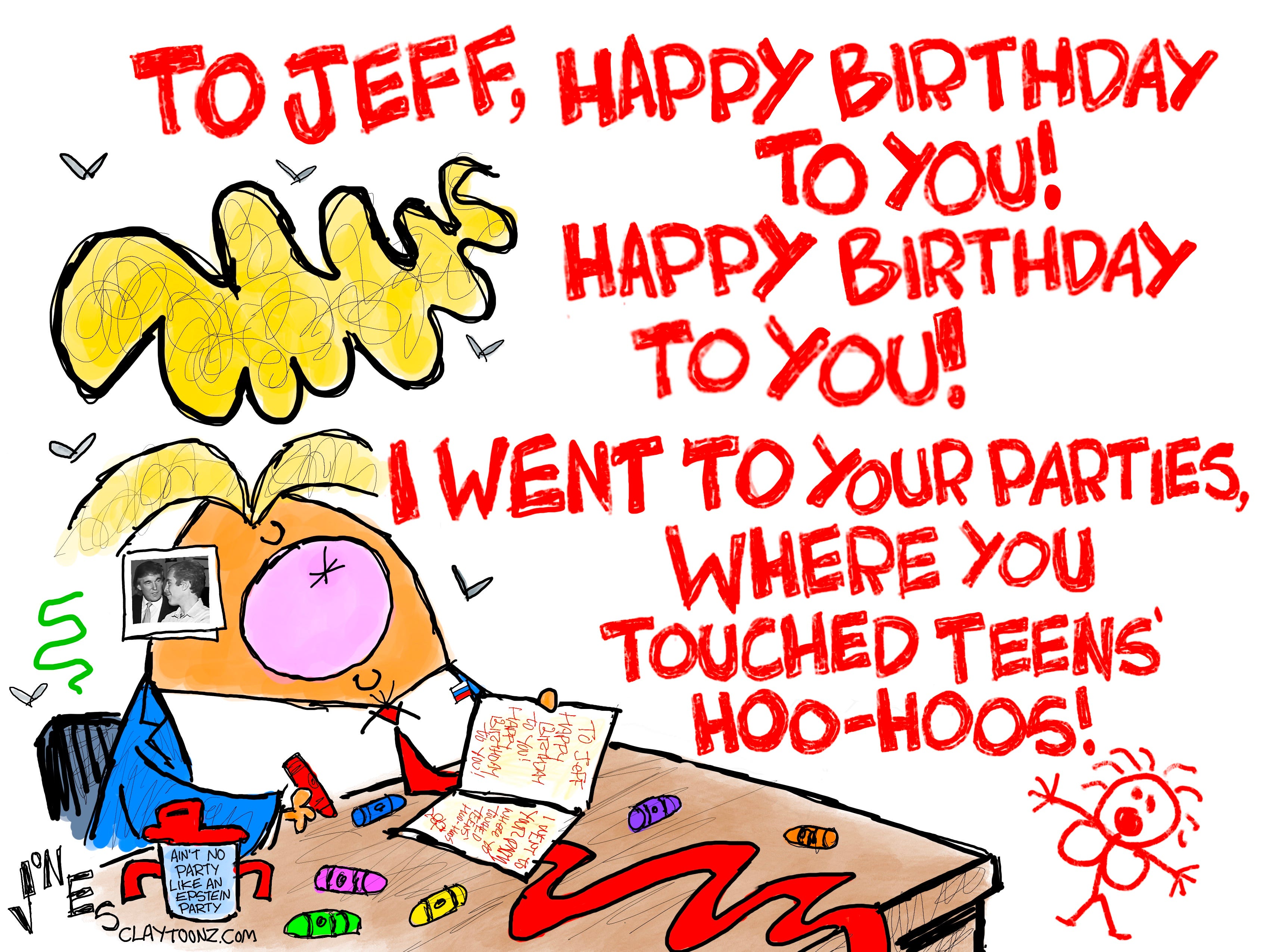
Birthday Fascist by Clay Jones
Not even on your birthday Read on Substack

I’m sorry I made you wait for today’s blog, but I thought it would be more interesting to write the blog about Trump’s birthday parade after I actually attended his birthday parade.
And let’s not make mistakes about this. This military parade was not for the Army, but for Donald Trump.
Here’s the funny thing: I didn’t make it to the parade. Yes, I got a hotel room, and I planned to attend the parade, but three things happened. There were fences. Long long long fences. There was not a huge crowd, but it was tough to get through the snake of fences. Then, there were lines. But didn’t I just say the crowds were not huge? They weren’t, but the Trump organization likes to make people wait because it gives the impression that the crowds are large when they’re not.
And they must have expected much larger crowds because there were MAGA merchants everywhere. Yet, it didn’t seem like they were having a lot of customers. The street vendors selling ice cream had longer lines. I bought a cone.
If you want a huge crowd, go back to President Barack Obama’s inauguration. That was a huge crowd. Go back to Kamala Harris’ speech last November. That was a huge crowd. Or, go back to the last time I went to a Washington Capitals game. It was incredible if you could find a seat on the metro because the crowds were so large. But today, I took a metro at 5 p.m. and it was easy to find a seat. It wasn’t packed. And it wasn’t packed after the event either.
The parade started early because they wanted to beat the rain that never came. There were sprinkles, but nothing that should be able to stop a tank.
I said there was a thing that kept me from making it to Constitution Avenue, where the parade was held. The first were the fences, the second were the lines, and the third were the protests. The protests distracted me.
The official No Kings protests did not happen in Washington, DC. They didn’t want to start a fight. But, that didn’t stop independent protesters who did outnumber the MAGAts in my opinion. And readers, I feel bad because I wasn’t very nice to the MAGAts. You’ll see.
The closest thing I saw to violence was when a woman took a wild swing at a man holding a sign. They crossed paths, and she took a swing as they passed each other, which I don’t think she intended to connect. But he turned around and said, “Did you just take a swing at me?” She did not turn around, so he yelled, “Fuck Trump.” Yes, she was a MAGAt. And no, the man didn’t try to do anything violent. He kept on his way after yelling, “Fuck Trump.”
I had to know what was on his sign that made her want to take a swing, and here it is.

He hit a nerve. Here are some other scenes.

And then things got weird.
First, I saw this. (snip-yeah, go see it!!)
Ear Diaper Hater Club by Clay Jones
Read on Substack

In a telephone interview this morning with ABC’s Rachel Scott, Donald Trump said he “may” call Minnesota Governor Tim Walz about the targeted attack in Minneapolis that killed Melissa Hortman, a state legislator, and her husband.
In a moment that needs bipartisanship, empathy, and for a president to actually act presidential, Donald Trump said, “Well, it’s a terrible thing. I think he’s a terrible governor. I think he’s a grossly incompetent person. But I may, I may call him, I may call other people too.”
He just can’t do it. He gave it a shot yesterday, issuing a statement someone else obviously wrote, “I have been briefed on the terrible shooting that took place in Minnesota, which appears to be a targeted attack against state lawmakers. Our Attorney General, Pam Bondi, and the FBI, are investigating the situation, and they will be prosecuting anyone involved to the fullest extent of the law. Such horrific violence will not be tolerated in the United States of America. God Bless the great people of Minnesota, a truly great place.”
Forgive me if I don’t put a lot of faith into the investigative skills of Pam Bondi and FBI Director (sic) Kash Patel.
Trump blamed “hateful rhetoric” from the left when an assassin took aim at his ear. You’re not going to hear the term “hateful rhetoric” from Trump over the assassination of a state legislator in Minnesota.
We’re going to hear a lot of hypocrisy this week coming from MAGA Land.
For Trump, it was “hateful rhetoric” that got his ear shot, but the “targeted attack” on the left is a mystery.
I wanted to give you a long and in-depth blog on this, but I totally forgot while waiting at the airport. The worst part is, my flight was delayed for over two hours, so I had time to write it. Now, my flight is boarding and I’m still typing.
The next time you hear from me, I’ll be in California.
The view from my room:
I’m staying at the Sheraton by the Pentagon. Here’s the view I took yesterday afternoon. (snip-MORE)
(I’ve seen, as I’ve followed her, that Jeannine is a brilliant writer, and this is seriously O.Henry-level work. Enjoy! -A.)
The future belongs to the children… though maybe not OUR children. Read on Substack
Scoot’s Assignment: Write about a smoke break, including corrosive judgement, a character who is overjoyed, and the phrase, “wouldn’t you know it.”
The party was loud and boisterous, but the drinking games were boring for sober spectators like Ellie. She’d just stepped outside for some fresh air and a break from the nonsensical cacophony when she noticed a strange, red light out near the garden shed. Thinking it might be a fellow teetotaler having a smoke break, she walked out towards the red glow to say “hello,” but paused when she realized that she didn’t smell any smoke… and what had appeared in the dark to be a garden shed was actually some sort of spacecraft. But by then it was too late.
“Ah, hello, I’m overjoyed to meet you,” rasped the figure. It stepped closer, and Ellie saw a reptilian face, gazing at her through the ruddy illumination cast by some sort of penlight. “Wonderful, I can’t detect any of that alcoholic poison in your bloodstream. You’ll make a lovely host mother,” the creature proclaimed. Ellie promptly fainted.
She was awakened by bird song as the sun began to rise. She realized that she was lying on the ground in her host’s backyard, but the UFO and ET were both gone. She leaped up as she heard a voice behind her, dripping with corrosive judgement, “Well, wouldn’t you know it? Here she is. What are you doing out here, you scared the hell out of us!” It was her buddy, Harry, the one who’s dragged her to this disastrous shindig. Great, now he thinks she was passed out drunk, and he’ll never invite her anywhere again. Though considering how this night had gone, that might not be such a bad thing. She decided that it would be best not to mention Lizardman, though, lest she incur even more criticism.
🦎🦎🦎🦎🦎🦎🦎🦎🦎🦎🦎🦎🦎🦎🦎🦎
A few weeks later, Ellie missed her period. She’d been worrying about what the reptilian extraterrestrial might have done to her during the hours that she’d spent lying unconscious on Harry’s lawn. The positive pregnancy test confirmed one of her worst fears.
After a lot of soul searching, she decided to keep the unexpected baby. At 42, she wasn’t likely to have another opportunity. So she duly set off to visit Doctor Abrams. “Well, because of your advanced maternal age, you’ll need to be more careful than usual. Let’s do an ultrasound and see how the little guy is doing.” He ran the probe over Ellie’s belly, commenting as he worked: “Hmmmm, nice strong heart beat. Good, it seems very healthy. But… what the hell is that? It looks like a tail!” Dr. Abrams was getting more worked up by the second. Ellie stared at the screen, realizing that her unborn child looked familiar… the tiny fetus bore a strange resemblance to the lizard-like creature from Harry’s garden. Her contemplations were interrupted by the thudding sound of Dr. Abrams falling to the floor in a dead faint. Ellie quickly dressed and rushed home.
But she knew she couldn’t stay home. She was nervous that somebody from the hospital might show up, demanding that she abort her alien pregnancy. She needed to find a place that would be safe for her and her future offspring.
🦎🦎🦎🦎🦎🦎🦎🦎🦎🦎🦎🦎🦎🦎🦎🦎
Ellie’s childhood friend, Bert, lived out in the country. Bert was a lovable goofball and they’d always been best friends. He liked animals better than most humans, and worked as a veterinarian. Even though he was legally limited to the treatment of nonhuman animals, he was always open to helping out with a little illicit medical aid to his human friends when necessary. Bert was a bit ‘out there,’ but Ellie knew he was someone she could trust. Bert always accepted absolutely everything at face value. He not only believed Ellie’s bizarre story about her immaculate conception of a baby space lizard, he was super excited at the prospect of being allowed to deliver the scaly child.
“Ellie, this is so COOL,” he crowed. “I can’t wait to meet your baby! Can I be its godfather?”
Ellie smiled and nodded. Maybe the next few months wouldn’t be so bad after all.
🦎🦎🦎🦎🦎🦎🦎🦎🦎🦎🦎🦎🦎🦎🦎🦎
Ellie’s pregnancy was uneventful. The labor wasn’t too bad, either. Ellie supposed the fact that her baby girl was smaller than an average human child made everything easier. Bert was great. He coached her through the whole thing, and was only slightly freaked out as he examined the newborn, announcing, “Whoa, no umbilical cord! I wonder how she was nourished? Maybe sort of like a parasite?” Realizing that such thoughts were unworthy of a doting godfather, he contented himself with cooing at the little lizard girl as he cuddled her. At least HE didn’t pass out. Ellie named her Ignatia, but affectionately called her Iggy.
🦎🦎🦎🦎🦎🦎🦎🦎🦎🦎🦎🦎🦎🦎🦎🦎
Ellie and Bert raised young Iggy together. His veterinary skills helped in figuring out how to tend and feed the growing creature. They home-schooled her, realizing that there was no way that she would be able to attend a public school. She was a bright and affectionate child, and as her dietary needs progressed from crickets and mealworms to larger sources of protein, she respected the squeamishness of her foster parents and was discreet in the capture and consumption of her prey.
Eventually, the day that Ellie had expected and feared arrived. She looked out the window into the backyard one night and saw that the spaceship had returned. This time, she invited the extraterrestrial into their home and introduced Bert and young Iggy. “You’ve done very well! Thank you for taking such good care of the young one! She has grown up stronger and wiser than I could have ever hoped.” She — for as it turned out the older lizard creature was female — explained how her race had been scouting around various planets, seeking a home for their future children. When a possibly suitable planet was located, they then sought out suitable hosts to carry their eggs and raise the offspring to adulthood. Ellie’s pregnancy had been the result of an implanted lizard person egg.
Bert was worried. “But what about us humans? I’m not sure that the average Homo sapiens is sapient enough to get along with your species.”
The lizard woman grinned, a potentially terrifying sight if not for the fact that they knew she was friendly. “You’re right,” she agreed, “but fortunately for us and unfortunately for your species, your race is slowly dying out. Iggy’s children will have a clear playing field, someday in the distant future.”
Ellie was sad, but she realized that this fate had been a long time coming. At least she would be able to help raise Earth’s next dominant species. “But how will she reproduce,” she asked, “are there more like her?”
“Iggy’s the only one of her kind on Earth, but she will someday be able to handle the job herself. You see, we reproduce by parthenogenesis, one offspring every twenty years. That is why we are all female, and is also why our species will never overrun the resources of this planet,” she explained. “I must fly off to check on the others. I am most grateful and will see to it that you will never lack for anything.”
Ellie and Bert knew that their biological genetics would be lost to history. The human race was doomed. But their values, their beliefs, their thoughts, their legends, their dreams — these would live on in Iggy’s memory and she would teach her descendants to remember as well. And maybe that would be enough.
Note: This story was inspired by a comment by Theresa Greene
in Chris J. Franklin’s most recent House of Haiku prompt post, “Alien.”
Here is the conversation that sparked the peaceful takeover: (snip-go see!)