(My cup emoji is not yellow. sigh)
It’s Just Nice; No Doubt Each of Us Can Do This- 🍵
(My cup emoji is not yellow. sigh)

(My cup emoji is not yellow. sigh)

APOD is 30 Years Old Today
Image Credit: Pixelization of Van Gogh’s The Starry Night by Dario Giannobile
Explanation: APOD is 30 years old today. In celebration, today’s picture uses past APODs as tiles arranged to create a single pixelated image that might remind you of one of the most well-known and evocative depictions of planet Earth’s night sky. In fact, this Starry Night consists of 1,836 individual images contributed to APOD over the last 5 years in a mosaic of 32,232 tiles. Today, APOD would like to offer a sincere thank you to our contributors, volunteers, and readers. Over the last 30 years your continuing efforts have allowed us to enjoy, inspire, and share a discovery of the cosmos.
Homeless Geese by Clay Jones
And no, it’s not about Gary Read on Substack
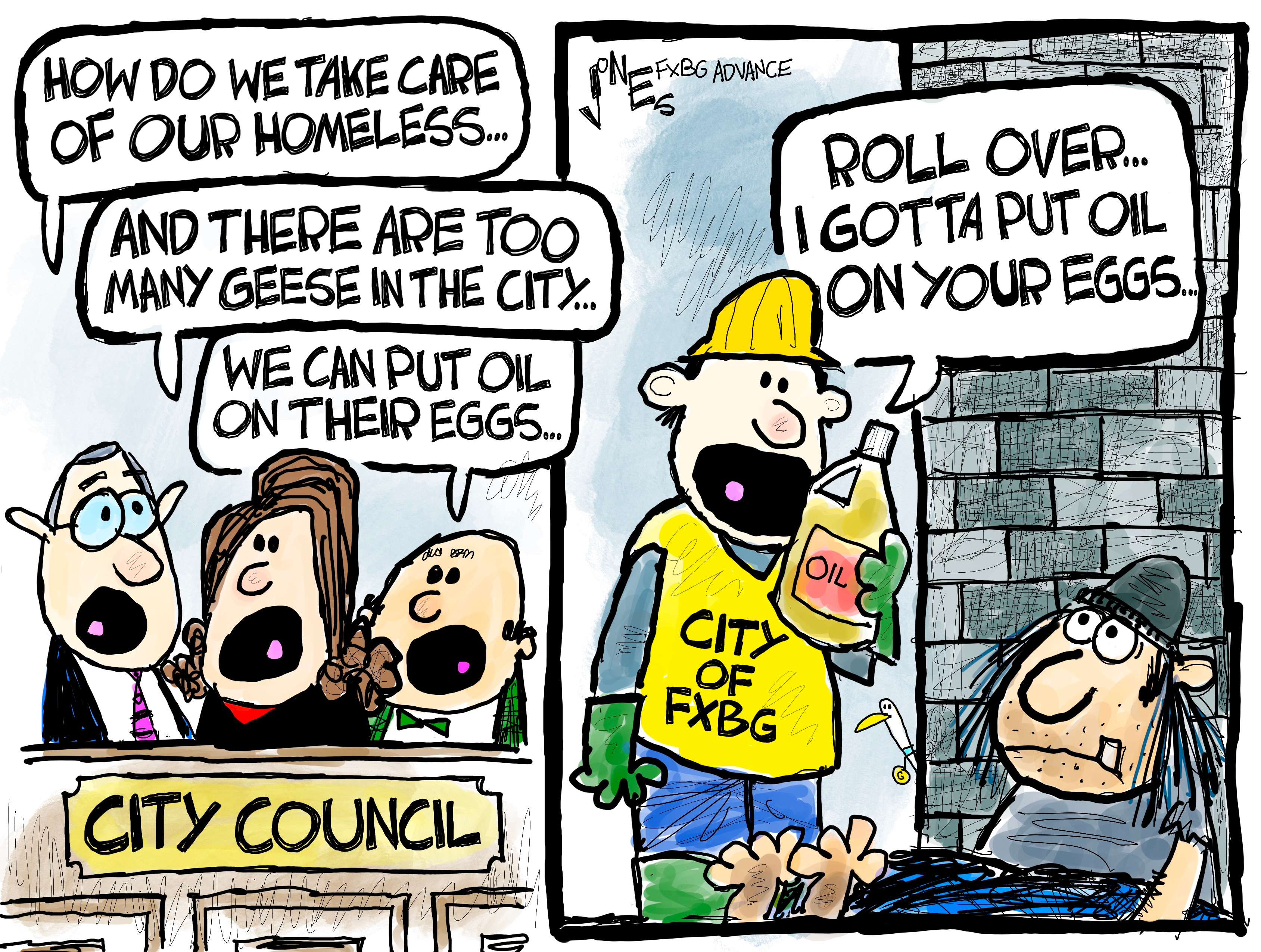
This was drawn for the Fredericksburg Advance, which wrote with the cartoon:
The Advance prides itself on attracting superior talent to our pages, and Clay Jones may well be at the top of the totem pole if awards are the measure. In 2022 he won the Robert F. Kennedy Award, and he has been a finalist for the Herblock Prize. What makes a great political cartoonist? That’s tough to say, but certainly the ability to make connections that others miss, and that force us to both laugh and think about issues in ways we may not have previously imagined — even (perhaps especially) when it makes us uncomfortable. That’s precisely what Jones has accomplished today, building off this week’s seemingly unrelated stories about geese and the endless struggle in our community over the homeless.
Dawwwww. Thank you, guys. That’s super nice.
I was just being silly with this, but proofer Laura said it was “silly, but kinda accurate.” I was afraid my editor would hate it because it was so weird.
Creative note: I wrote this Thursday night, and drew at home Friday night at the end of a long day. I wanted it to be finished before Saturday so I could focus on all the DC stuff.
Music note: Dammit, I don’t remember because I drew it two nights ago.
Drawn in 30 seconds: (snip-go see!)
Birthday Fascist by Clay Jones
Not even on your birthday Read on Substack
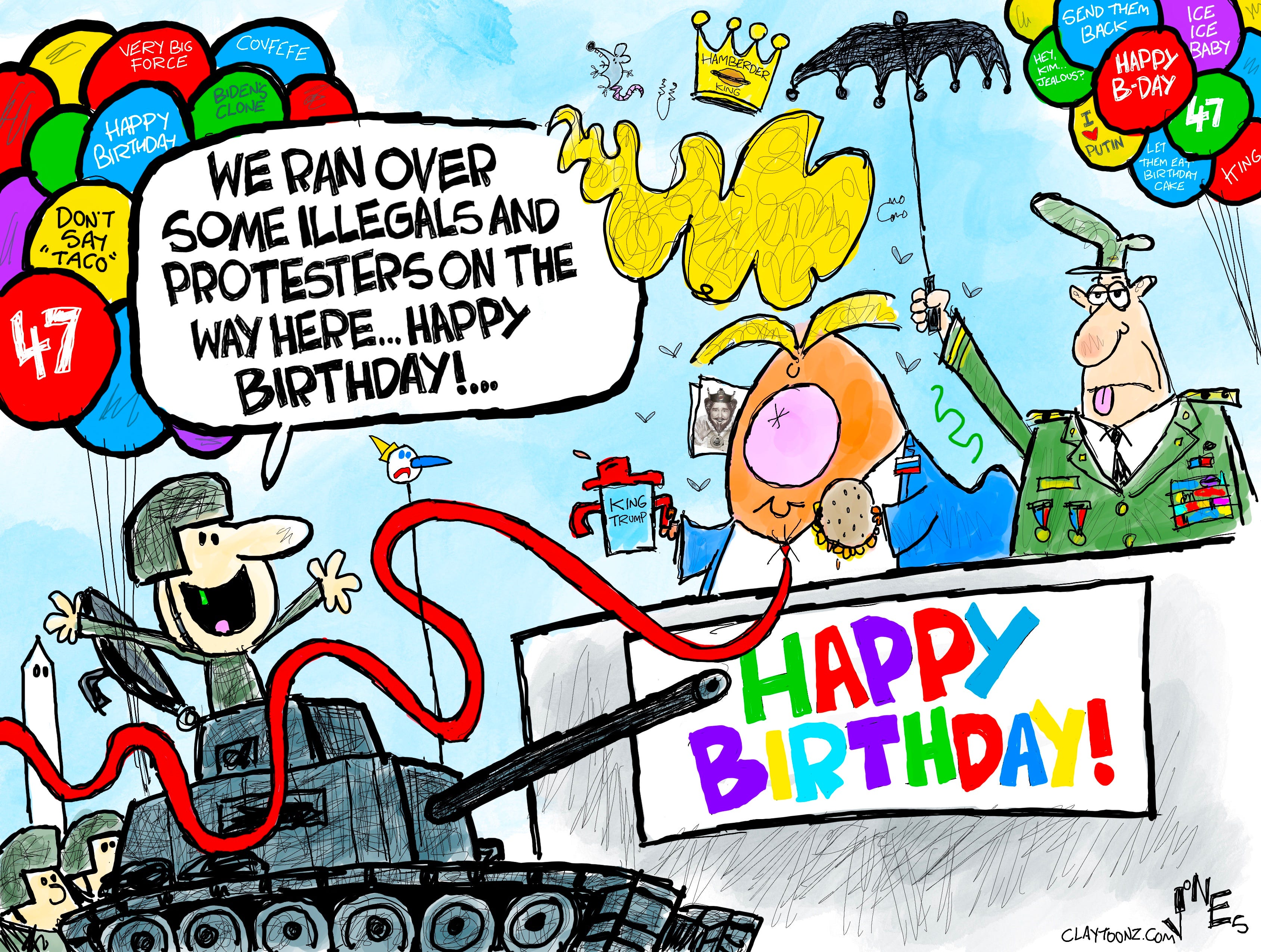
I’m sorry I made you wait for today’s blog, but I thought it would be more interesting to write the blog about Trump’s birthday parade after I actually attended his birthday parade.
And let’s not make mistakes about this. This military parade was not for the Army, but for Donald Trump.
Here’s the funny thing: I didn’t make it to the parade. Yes, I got a hotel room, and I planned to attend the parade, but three things happened. There were fences. Long long long fences. There was not a huge crowd, but it was tough to get through the snake of fences. Then, there were lines. But didn’t I just say the crowds were not huge? They weren’t, but the Trump organization likes to make people wait because it gives the impression that the crowds are large when they’re not.
And they must have expected much larger crowds because there were MAGA merchants everywhere. Yet, it didn’t seem like they were having a lot of customers. The street vendors selling ice cream had longer lines. I bought a cone.
If you want a huge crowd, go back to President Barack Obama’s inauguration. That was a huge crowd. Go back to Kamala Harris’ speech last November. That was a huge crowd. Or, go back to the last time I went to a Washington Capitals game. It was incredible if you could find a seat on the metro because the crowds were so large. But today, I took a metro at 5 p.m. and it was easy to find a seat. It wasn’t packed. And it wasn’t packed after the event either.
The parade started early because they wanted to beat the rain that never came. There were sprinkles, but nothing that should be able to stop a tank.
I said there was a thing that kept me from making it to Constitution Avenue, where the parade was held. The first were the fences, the second were the lines, and the third were the protests. The protests distracted me.
The official No Kings protests did not happen in Washington, DC. They didn’t want to start a fight. But, that didn’t stop independent protesters who did outnumber the MAGAts in my opinion. And readers, I feel bad because I wasn’t very nice to the MAGAts. You’ll see.
The closest thing I saw to violence was when a woman took a wild swing at a man holding a sign. They crossed paths, and she took a swing as they passed each other, which I don’t think she intended to connect. But he turned around and said, “Did you just take a swing at me?” She did not turn around, so he yelled, “Fuck Trump.” Yes, she was a MAGAt. And no, the man didn’t try to do anything violent. He kept on his way after yelling, “Fuck Trump.”
I had to know what was on his sign that made her want to take a swing, and here it is.
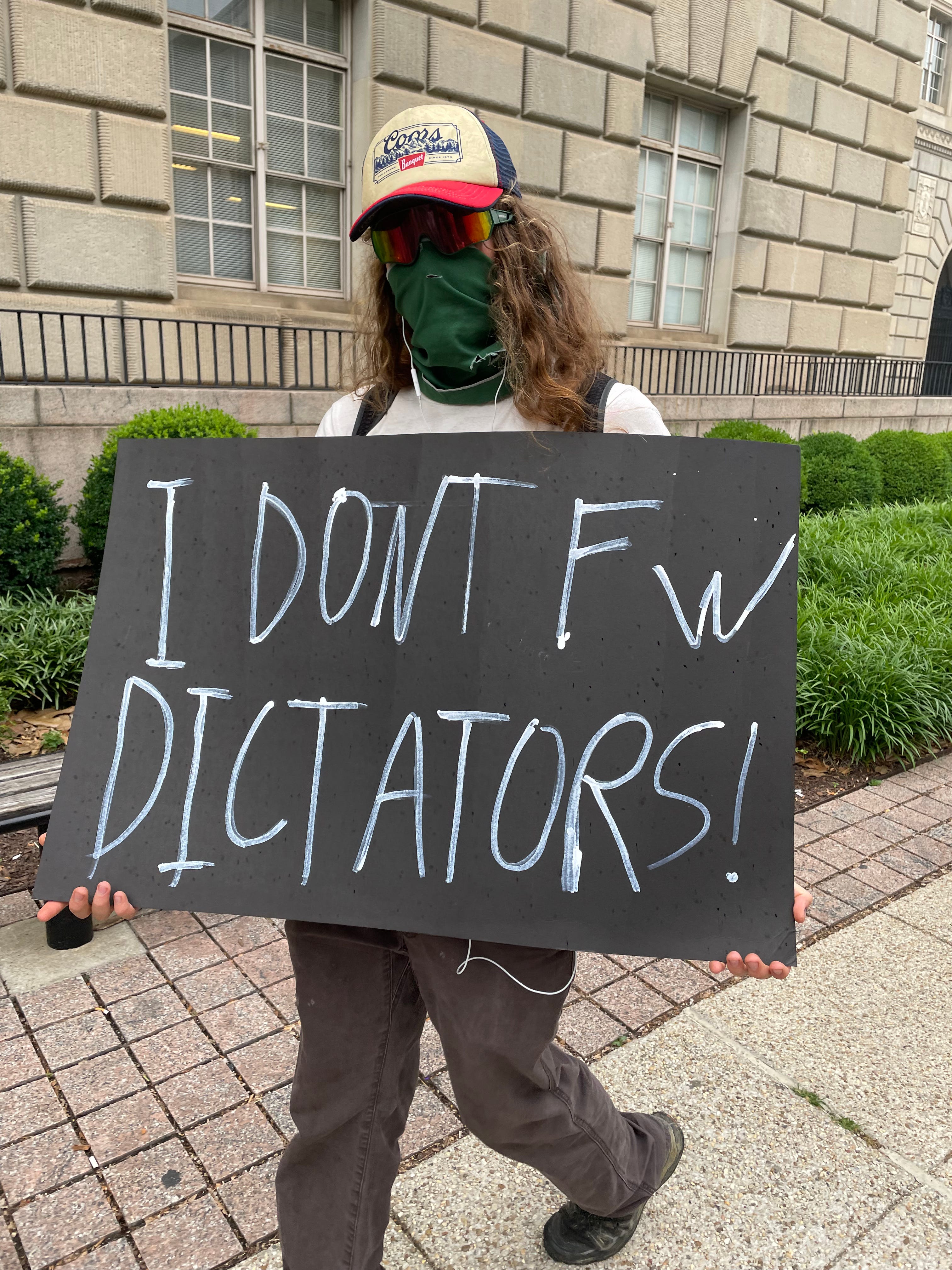
He hit a nerve. Here are some other scenes.
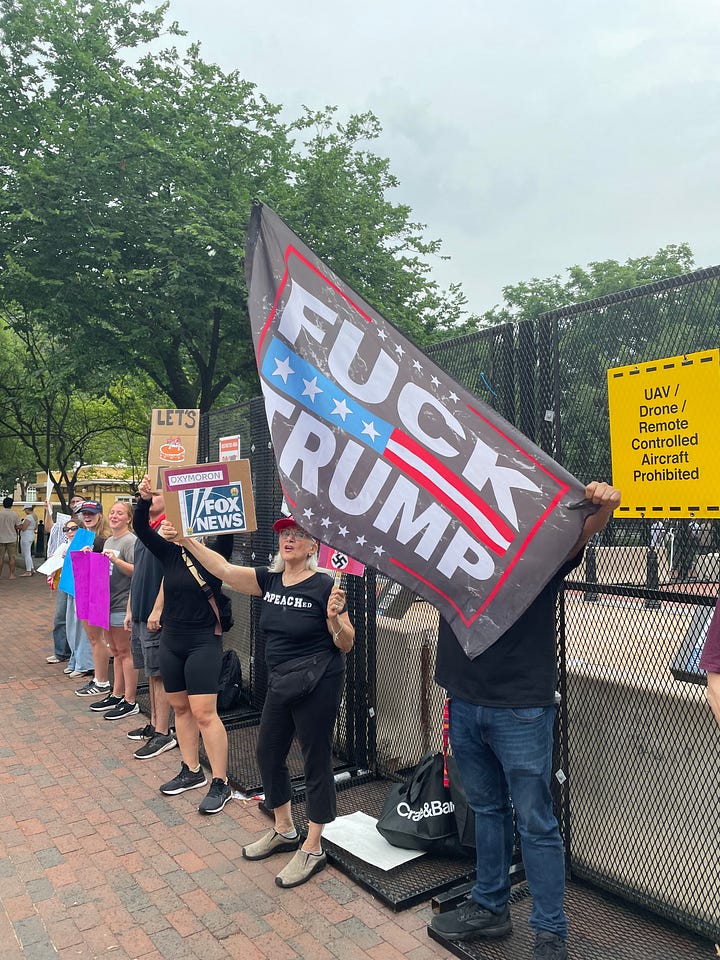
And then things got weird.
First, I saw this. (snip-yeah, go see it!!)
Ear Diaper Hater Club by Clay Jones
Read on Substack
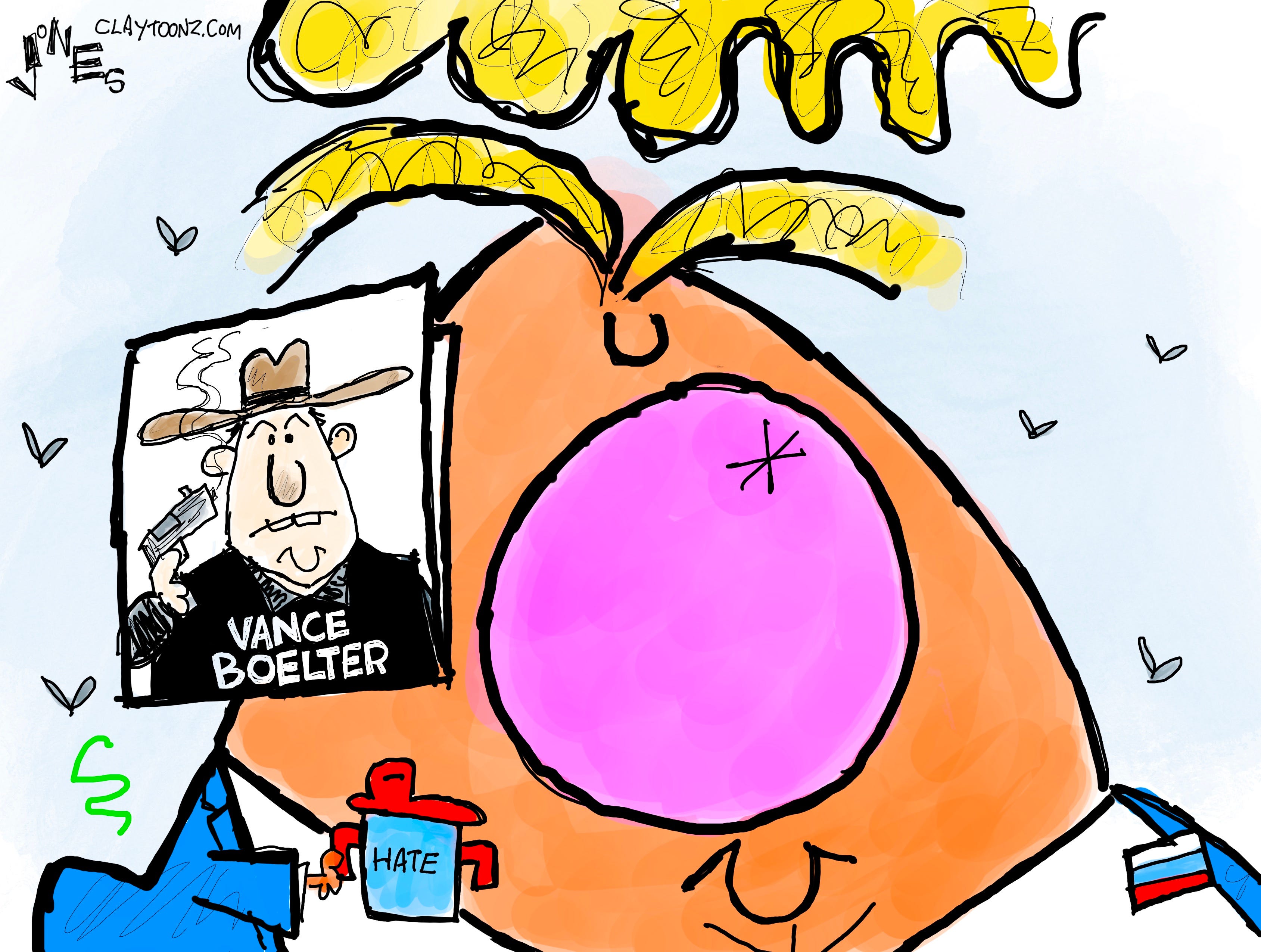
In a telephone interview this morning with ABC’s Rachel Scott, Donald Trump said he “may” call Minnesota Governor Tim Walz about the targeted attack in Minneapolis that killed Melissa Hortman, a state legislator, and her husband.
In a moment that needs bipartisanship, empathy, and for a president to actually act presidential, Donald Trump said, “Well, it’s a terrible thing. I think he’s a terrible governor. I think he’s a grossly incompetent person. But I may, I may call him, I may call other people too.”
He just can’t do it. He gave it a shot yesterday, issuing a statement someone else obviously wrote, “I have been briefed on the terrible shooting that took place in Minnesota, which appears to be a targeted attack against state lawmakers. Our Attorney General, Pam Bondi, and the FBI, are investigating the situation, and they will be prosecuting anyone involved to the fullest extent of the law. Such horrific violence will not be tolerated in the United States of America. God Bless the great people of Minnesota, a truly great place.”
Forgive me if I don’t put a lot of faith into the investigative skills of Pam Bondi and FBI Director (sic) Kash Patel.
Trump blamed “hateful rhetoric” from the left when an assassin took aim at his ear. You’re not going to hear the term “hateful rhetoric” from Trump over the assassination of a state legislator in Minnesota.
We’re going to hear a lot of hypocrisy this week coming from MAGA Land.
For Trump, it was “hateful rhetoric” that got his ear shot, but the “targeted attack” on the left is a mystery.
I wanted to give you a long and in-depth blog on this, but I totally forgot while waiting at the airport. The worst part is, my flight was delayed for over two hours, so I had time to write it. Now, my flight is boarding and I’m still typing.
The next time you hear from me, I’ll be in California.
The view from my room:
I’m staying at the Sheraton by the Pentagon. Here’s the view I took yesterday afternoon. (snip-MORE)
(I’ve seen, as I’ve followed her, that Jeannine is a brilliant writer, and this is seriously O.Henry-level work. Enjoy! -A.)
The future belongs to the children… though maybe not OUR children. Read on Substack
Scoot’s Assignment: Write about a smoke break, including corrosive judgement, a character who is overjoyed, and the phrase, “wouldn’t you know it.”

The party was loud and boisterous, but the drinking games were boring for sober spectators like Ellie. She’d just stepped outside for some fresh air and a break from the nonsensical cacophony when she noticed a strange, red light out near the garden shed. Thinking it might be a fellow teetotaler having a smoke break, she walked out towards the red glow to say “hello,” but paused when she realized that she didn’t smell any smoke… and what had appeared in the dark to be a garden shed was actually some sort of spacecraft. But by then it was too late.
“Ah, hello, I’m overjoyed to meet you,” rasped the figure. It stepped closer, and Ellie saw a reptilian face, gazing at her through the ruddy illumination cast by some sort of penlight. “Wonderful, I can’t detect any of that alcoholic poison in your bloodstream. You’ll make a lovely host mother,” the creature proclaimed. Ellie promptly fainted.
She was awakened by bird song as the sun began to rise. She realized that she was lying on the ground in her host’s backyard, but the UFO and ET were both gone. She leaped up as she heard a voice behind her, dripping with corrosive judgement, “Well, wouldn’t you know it? Here she is. What are you doing out here, you scared the hell out of us!” It was her buddy, Harry, the one who’s dragged her to this disastrous shindig. Great, now he thinks she was passed out drunk, and he’ll never invite her anywhere again. Though considering how this night had gone, that might not be such a bad thing. She decided that it would be best not to mention Lizardman, though, lest she incur even more criticism.
🦎🦎🦎🦎🦎🦎🦎🦎🦎🦎🦎🦎🦎🦎🦎🦎
A few weeks later, Ellie missed her period. She’d been worrying about what the reptilian extraterrestrial might have done to her during the hours that she’d spent lying unconscious on Harry’s lawn. The positive pregnancy test confirmed one of her worst fears.
After a lot of soul searching, she decided to keep the unexpected baby. At 42, she wasn’t likely to have another opportunity. So she duly set off to visit Doctor Abrams. “Well, because of your advanced maternal age, you’ll need to be more careful than usual. Let’s do an ultrasound and see how the little guy is doing.” He ran the probe over Ellie’s belly, commenting as he worked: “Hmmmm, nice strong heart beat. Good, it seems very healthy. But… what the hell is that? It looks like a tail!” Dr. Abrams was getting more worked up by the second. Ellie stared at the screen, realizing that her unborn child looked familiar… the tiny fetus bore a strange resemblance to the lizard-like creature from Harry’s garden. Her contemplations were interrupted by the thudding sound of Dr. Abrams falling to the floor in a dead faint. Ellie quickly dressed and rushed home.
But she knew she couldn’t stay home. She was nervous that somebody from the hospital might show up, demanding that she abort her alien pregnancy. She needed to find a place that would be safe for her and her future offspring.
🦎🦎🦎🦎🦎🦎🦎🦎🦎🦎🦎🦎🦎🦎🦎🦎
Ellie’s childhood friend, Bert, lived out in the country. Bert was a lovable goofball and they’d always been best friends. He liked animals better than most humans, and worked as a veterinarian. Even though he was legally limited to the treatment of nonhuman animals, he was always open to helping out with a little illicit medical aid to his human friends when necessary. Bert was a bit ‘out there,’ but Ellie knew he was someone she could trust. Bert always accepted absolutely everything at face value. He not only believed Ellie’s bizarre story about her immaculate conception of a baby space lizard, he was super excited at the prospect of being allowed to deliver the scaly child.
“Ellie, this is so COOL,” he crowed. “I can’t wait to meet your baby! Can I be its godfather?”
Ellie smiled and nodded. Maybe the next few months wouldn’t be so bad after all.
🦎🦎🦎🦎🦎🦎🦎🦎🦎🦎🦎🦎🦎🦎🦎🦎
Ellie’s pregnancy was uneventful. The labor wasn’t too bad, either. Ellie supposed the fact that her baby girl was smaller than an average human child made everything easier. Bert was great. He coached her through the whole thing, and was only slightly freaked out as he examined the newborn, announcing, “Whoa, no umbilical cord! I wonder how she was nourished? Maybe sort of like a parasite?” Realizing that such thoughts were unworthy of a doting godfather, he contented himself with cooing at the little lizard girl as he cuddled her. At least HE didn’t pass out. Ellie named her Ignatia, but affectionately called her Iggy.
🦎🦎🦎🦎🦎🦎🦎🦎🦎🦎🦎🦎🦎🦎🦎🦎
Ellie and Bert raised young Iggy together. His veterinary skills helped in figuring out how to tend and feed the growing creature. They home-schooled her, realizing that there was no way that she would be able to attend a public school. She was a bright and affectionate child, and as her dietary needs progressed from crickets and mealworms to larger sources of protein, she respected the squeamishness of her foster parents and was discreet in the capture and consumption of her prey.
Eventually, the day that Ellie had expected and feared arrived. She looked out the window into the backyard one night and saw that the spaceship had returned. This time, she invited the extraterrestrial into their home and introduced Bert and young Iggy. “You’ve done very well! Thank you for taking such good care of the young one! She has grown up stronger and wiser than I could have ever hoped.” She — for as it turned out the older lizard creature was female — explained how her race had been scouting around various planets, seeking a home for their future children. When a possibly suitable planet was located, they then sought out suitable hosts to carry their eggs and raise the offspring to adulthood. Ellie’s pregnancy had been the result of an implanted lizard person egg.
Bert was worried. “But what about us humans? I’m not sure that the average Homo sapiens is sapient enough to get along with your species.”
The lizard woman grinned, a potentially terrifying sight if not for the fact that they knew she was friendly. “You’re right,” she agreed, “but fortunately for us and unfortunately for your species, your race is slowly dying out. Iggy’s children will have a clear playing field, someday in the distant future.”
Ellie was sad, but she realized that this fate had been a long time coming. At least she would be able to help raise Earth’s next dominant species. “But how will she reproduce,” she asked, “are there more like her?”
“Iggy’s the only one of her kind on Earth, but she will someday be able to handle the job herself. You see, we reproduce by parthenogenesis, one offspring every twenty years. That is why we are all female, and is also why our species will never overrun the resources of this planet,” she explained. “I must fly off to check on the others. I am most grateful and will see to it that you will never lack for anything.”
Ellie and Bert knew that their biological genetics would be lost to history. The human race was doomed. But their values, their beliefs, their thoughts, their legends, their dreams — these would live on in Iggy’s memory and she would teach her descendants to remember as well. And maybe that would be enough.
Note: This story was inspired by a comment by Theresa Greene
in Chris J. Franklin’s most recent House of Haiku prompt post, “Alien.”
Here is the conversation that sparked the peaceful takeover: (snip-go see!)
The Autocrat’s Parade by Ann Telnaes
Your tax dollars at work Read on Substack

Brain Quack by Clay Jones
Never mind the new quack hole Read on Substack
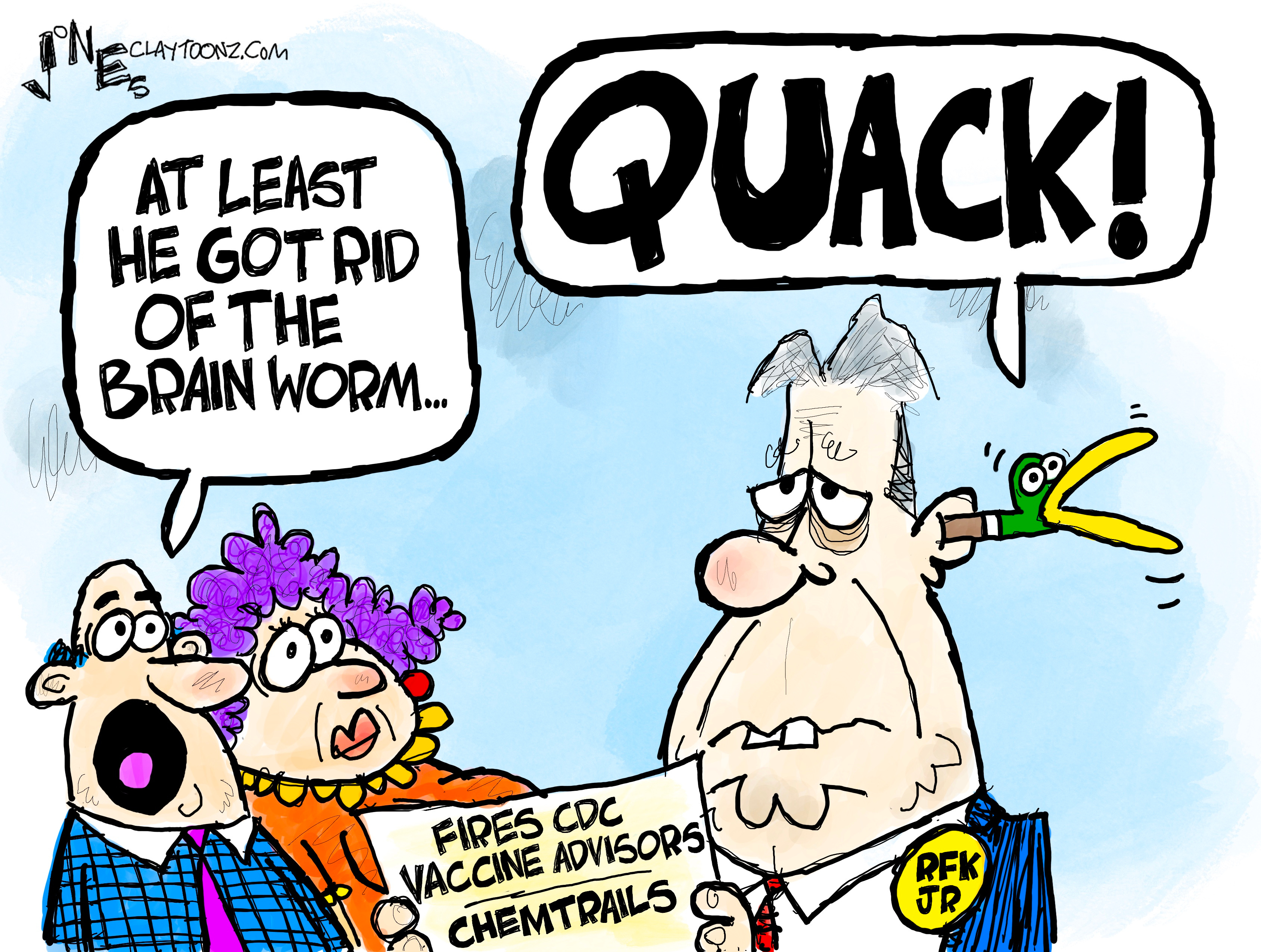
On Monday, Secretary of Health (sick) Robert F. Kennedy Jr. removed all 17 members of the vaccine advisory committee for the Centers for Disease Control and Prevention.
RFK Jr. said in a statement, “A clean sweep is necessary to reestablish public confidence in vaccine science. ACIP (Advisory Committee on Immunization Practices) new members will prioritize public health and evidence-based medicine. The Committee will no longer function as a rubber stamp for industry profit-taking agendas.”
RFK Jr. is a rubber stamp for conspiracy theories.
The American Medical Association said Kennedy’s decision undermines “trust and upends a transparent process that has saved countless lives.”
In 2019, RFK Jr. engaged in spreading conspiracy theories and misinformation that helped spread a measles outbreak in Samoa that killed at least 83 people, mostly babies, in that nation.
RFK Jr is an agent of bullshit and only an insane person would listen to him, less enough, put him in charge of the nation’s health. (snip-MORE, and it’s really good!)
Handcuffing Padilla by Clay Jones
This is a bunch of bullshit Read on Substack
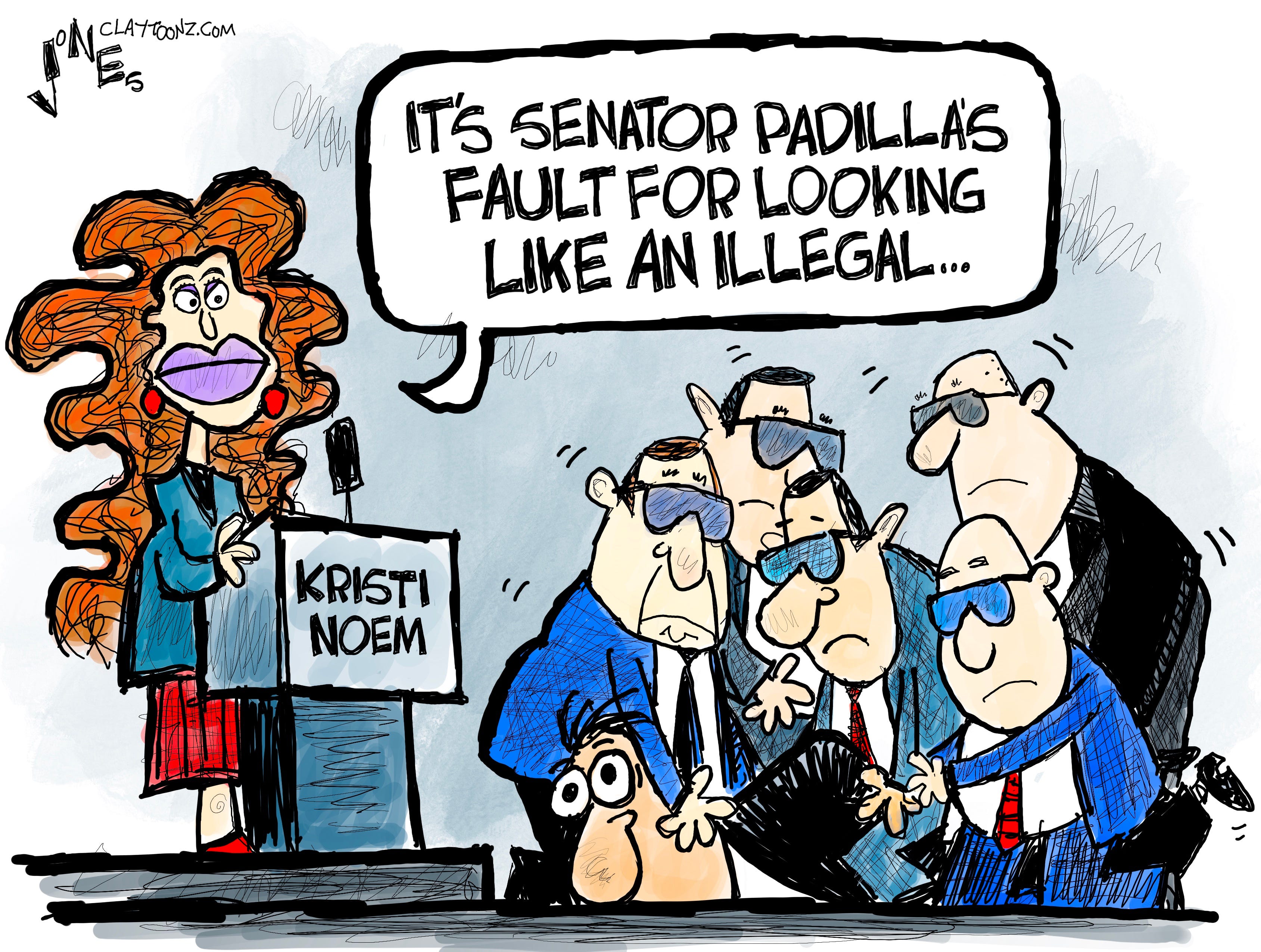
Right before Senator Alex Padilla of California was frog-marched out of the room and handcuffed, Secretary of Homeland Security Kristi Noem said she was going to “liberate” Los Angeles “from the socialists and the burdensome leadership this governor and mayor have placed on this country and this city.”
What happened to the National Guard and the Marines being deployed to Los Angeles to stop non-existent riots? Now it’s “liberate” the city from socialist and “burdensome” leadership? Does that mean Noem plans to overthrow Mayor Karen Bass and Governor Gavin Newsom with the military?
On one hand, the regime is trying to portray what’s going on in LA as a rebellion or insurrection, and on the other hand, they’re talking about staging their own rebellion and insurrection.
Noem, the lying pig she is (I want to use another word that many wouldn’t like), claims Senator Padilla “lunged” toward the stage, and after hearing her plans to “liberate” Los Angeles, who could blame him? Except he didn’t “lunge” toward her.
If you’re in the right in a situation, then why are you lying? Kristi Noem is lying about what happened yesterday with Senator Alex Padilla.
Was Padilla “lunging” here? You don’t see it. You don’t see it from this angle, either. But you do hear him identify himself. So when Noem and other Republicans say he didn’t, you know they’re lying. If they’re lying to cover their actions, then you know they’re wrong. They know they’re wrong.
Noem also claims the senator “barged” into the building. That’s a lie. He was escorted into the building and into the room where Noem was having her press conference. He was escorted into the room by an FBI agent and a member of the California National Guard. It was a federal building, which means nobody is getting in there without going through security first. There’s no way she could think Padilla was an angry “illegal” there to steal her purse.
Padilla, who has a reputation in Washington of being extremely nice and kinda nerdy, was no threat to Noem in this federal building. She didn’t seem concerned at all about a guy “lunging” toward her, as she barely paused her yammering while he was being dragged away by her goons.
Noem and her security detail claim they didn’t recognize Padilla, but I call bullshit on this one. It seems before going to California, Noem would familiarize herself with some of the players, like the mayor of Los Angeles, the governor of California, House reps of the area, and the state’s two senators. I’m sure she would have recognized Adam Schiff and Gavin Newsom, so why didn’t she recognize Senior Senator Alex Padilla? Why didn’t her security? If nothing else, he was identifying himself and wearing a shirt with the Senate logo.
She’s also the director of Homeland Security, which deals with immigration. So, shouldn’t be somewhat familiar with the ranking member of the Senate Judiciary Committee’s Subcommittee on Immigration, Citizenship, and Border Safety.
The only somewhat acceptable reason that Kristi Noem didn’t recognize Senator Alex Padilla is that she’s fucking stupid. I can believe that she’s a moron, but I don’t buy that she nor her security could recognize United States Senator Alex Padilla. Plus, you can’t trust the word of anyone who would shoot a puppy.
And because Republicans are vile evil scum, Speaker Mike Johnson, even without looking this, wants to censure Padilla for his actions. What actions? Being brown? Being a child of Mexican immigrants? This is like the cop who pulls people over for being Black.
Padilla’s crime here is that he cares about the people ICE is going after, that he does his job, he’s a Democrat, and he’s non-White. I would love to see that in the empty censure Johnson is dreaming up.
Padilla’s biggest crime might be that he dared to question Kristi Noem.
The goons are using the military to shut down protests. They don’t want to be questioned. For the love of god, they literally handcuffed a United States Senator for challenging them.
Noem admitted it. The military is in Los Angeles to replace its elected leadership.
Republicans want to punish Padilla, but for what? Interrupting? After saying she was there to use the military to replace elected leadership, she should be interrupted. She needs to be questioned after proposing replacing California’s leadership with a military junta.
Every American needs to question Noem about this. Every Republican should question her. And for the love of god, every journalist needs to question, so long as the LAPD doesn’t shoot them in the process.
Alex Padilla stood up and questioned her, just like he should have. Alex Padilla didn’t just do his job, but did his duty as a patriotic American, which is more than can be said for every Republican who has folded to Donald Trump.
Every single one of us needs to be more like Alex Padilla. Today, Alex Padilla is my hero.
What would Alex Padilla do? He would do the right thing, and he did. (snip-MORE)
https://www.gocomics.com/comics/a-to-z
Snippet:
“There is a free printable PDF or PNG at their KoFi, along with a pre-order for stickers and tshirts, which will ship later in June.
More than 1800 NO KINGS rallies are planned for this Saturday, June 14, as counter programming to the most embarrassing example of fascist onanism ever.
And, since June is Pride month, there are a lot of Pride activities going on that date, too. Perhaps yours also overlap, and this sign will work for you, too!
Thanks to Chris for permission to share – this design is so great, I had to share it.
Stay safe out there, and wherever you are, please know that you are loved exactly as you are. Whether you can live your life openly or keep parts of yourself hidden, you’re seen and welcomed and loved.”

Queer History 135: Let’s Go to the Cinema by Wendy🏳️⚧️🏳️🌈🌈
Queer Movie watching Read on Substack
Picture this: It’s 1970, and America’s movie theaters reek of stale popcorn, cigarette smoke, and something else—the acrid stench of fear. Fear of bodies that didn’t conform, desires that couldn’t be spoken, identities that existed only in shadows and whispered confessions. Then, like a fucking earthquake splitting the earth’s crust, came The Boys in the Band—not tiptoeing through Hollywood’s garden of heteronormative roses, but kicking down the door with combat boots and declaring war on silence.
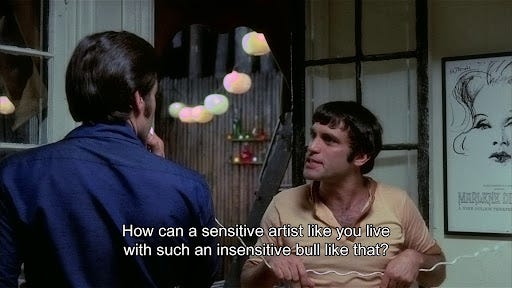
William Friedkin’s adaptation of Mart Crowley’s play didn’t just put gay men on screen; it threw them there bleeding, bitching, and beautifully broken. The audience could taste the bitter cocktail of self-loathing mixed with razor-sharp wit, could feel the electric tension crackling between characters who wielded words like switchblades. This wasn’t representation—this was revolution disguised as entertainment, a Molotov cocktail hurled at the pristine facade of American cinema.
The psychological impact on LGBTQ+ viewers was seismic. For the first time, queers sitting in darkened theaters saw themselves reflected not as tragic figures destined for suicide or sanitized saints, but as complex, contradictory, gloriously fucked-up human beings. The film’s unflinching portrayal of internalized homophobia—characters tearing each other apart with vicious precision—served as both mirror and exorcism. Viewers could finally name the demons that had been eating them alive, could see their own struggles projected thirty feet high in Technicolor fury.

Before there was language, before there were support groups or pride parades, there was The Rocky Horror Picture Show—a glittering, sequined middle finger raised high against every gender binary that dared exist. Tim Curry’s Dr. Frank-N-Furter didn’t just cross-dress; he obliterated the very concept of fixed identity, serving looks that could melt steel and charm that could seduce a nun. The film became a weekly religious experience for outcasts and misfits, transforming movie theaters into sanctuaries where “abnormal” became sacrament.
The sensory assault was deliberate and intoxicating: the smell of cheap makeup mixing with nervous sweat, the sound of fishnet stockings ripping as audience members transformed themselves into their truest selves, the taste of liberation on tongues that had been silenced for too long. Rocky Horror created a space where gender became performance art, where conformity went to die, and where every Saturday night became a resurrection.
The psychological liberation was profound. Trans viewers found validation in Frank-N-Furter’s unapologetic embrace of fluidity, while questioning viewers discovered permission to explore identities they’d never dared name. The film’s interactive nature—audiences shouting back at the screen, participating in the narrative—created a communal catharsis that individual therapy could never match.
Orlando arrived two decades later like a ethereal fever dream, with Tilda Swinton embodying centuries of gender transformation through Sally Potter’s lens. Here was gender not as costume but as evolution, not as crisis but as natural progression. The film’s languid pacing forced viewers to marinate in ambiguity, to sit with discomfort until it transformed into acceptance, then into celebration.

The Crying Game hit different—like a sucker punch followed by a tender kiss. Neil Jordan’s thriller weaponized audience assumptions, then forced viewers to confront their own transphobia in real-time. The revelation about Dil became a cultural watershed moment, dividing film history into before and after. Suddenly, dinner table conversations across America were grappling with questions that had never been asked out loud.
The psychological impact on trans viewers was complex and often contradictory. Some found validation in seeing trans characters as more than punchlines or victims, while others felt exploited by the shock-value treatment of trans identity. The film sparked conversations that were long overdue, even when those conversations were messy, uncomfortable, and occasionally hostile.
Cruising descended into theaters like a demon emerging from hell’s own basement, dragging audiences through New York’s leather underground with the subtlety of a sledgehammer to the skull. William Friedkin didn’t just film gay culture; he dissected it with surgical precision, exposing the raw nerves where desire meets violence, where identity becomes performance, where the line between hunter and hunted dissolves in strobe lights and poppers.

The film’s sensory assault was overwhelming: the throb of disco basslines that you felt in your chest cavity, the smell of leather and sweat and something darker, the visual overload of bodies in motion, muscles straining against restraints both literal and metaphorical. Al Pacino’s descent into this world became every viewer’s journey into their own shadow self, the parts of desire that polite society pretended didn’t exist.
The psychological effects were explosive and divisive. Gay men in theaters found themselves simultaneously aroused and terrified, seeing their community’s most extreme margins projected for mainstream consumption. Some felt exposed, violated, their private world stripped naked for heterosexual titillation. Others felt liberated by the film’s refusal to sanitize gay desire, its acknowledgment that sexuality could be dangerous, transgressive, and transformative.
Sunday Bloody Sunday offered a different kind of revelation—mature, sophisticated, unapologetically honest about love’s messy realities. John Schlesinger’s triangular love story featuring Peter Finch as an openly gay man navigating desire without shame created a new template for queer cinema. This wasn’t tragedy or comedy; this was life, served neat without the chaser of societal judgment.
The film’s matter-of-fact treatment of gay relationships was revolutionary in its ordinariness. No coming-out trauma, no tragic endings, no apologetic explanations—just human beings loving, losing, and continuing to breathe. For LGBTQ+ viewers, this representation was oxygen for souls that had been suffocating on a diet of tragic queers and comedic stereotypes.
Lesbian cinema in this era moved from whispered suggestions to bold declarations, from tragic endings to triumphant beginnings. The Killing of Sister George emerged from the underground like a feral cat, all claws and snarls and magnificent rage. Robert Aldrich’s brutal examination of lesbian relationships didn’t flinch from ugliness—the manipulation, the internalized homophobia, the way oppression could turn love into a weapon.
Beryl Reid’s performance was a masterclass in controlled demolition, watching a woman destroy everything she touched while desperately grasping for connection. The film’s unflinching portrayal of lesbian relationships—complex, messy, and occasionally toxic—provided representation that was real rather than idealized. For lesbian viewers, seeing their community portrayed with full humanity, including its shadows, was both painful and profoundly validating.
Desert Hearts offered redemption and possibility, Donna Deitch’s adaptation of Jane Rule’s novel serving up hope like cold water in a desert. Set in 1950s Reno, the film followed an academic’s journey from divorce to self-discovery, from social conformity to authentic desire. The Nevada landscape became a metaphor for internal transformation—vast, beautiful, and dangerous.

The sensory details were crucial: the crack of pool balls echoing like gunshots, the smell of cigarettes and whiskey mixing with perfume and possibility, the heat radiating from skin finally allowed to want what it wanted. For lesbian viewers, Desert Hearts offered a template for their own coming-out narratives—messy, beautiful, and ultimately triumphant.
Lianna brought lesbian experience into the suburban mainstream with John Sayles’ sensitive direction. The film’s psychological realism was groundbreaking—showing the internal process of sexual awakening without sensationalizing or pathologizing it. Viewers could taste the protagonist’s confusion, feel her excitement and terror as she navigated new desires while dismantling old assumptions about herself.
Longtime Companion arrived like a punch to the solar plexus, chronicling AIDS’ devastating impact on a circle of gay friends with unflinching honesty. Norman René’s ensemble piece transformed personal tragedy into universal human drama, forcing audiences to confront the epidemic’s toll not through statistics but through faces, voices, and stories.
The film’s emotional brutality was necessary and healing. Viewers experienced the full spectrum of grief—denial, anger, bargaining, depression, and something resembling acceptance. The beach scene, where surviving characters imagine their dead friends joining them one last time, became a collective catharsis for a community drowning in loss.
For LGBTQ+ viewers, Longtime Companion provided validation for their grief, rage, and resilience. The film acknowledged that gay relationships were worth mourning, that gay lives had value, that gay love deserved recognition. In a world that often seemed indifferent to queer suffering, the film became a memorial, a battle cry, and a love letter all at once.

Parting Glances offered a different perspective on the crisis—intimate, funny, and heartbreakingly human. Bill Sherwood’s New York snapshot captured gay life with humor and tenderness, refusing to let AIDS define the entire gay experience. The film’s portrayal of friendship, love, and community in the face of mortality provided a blueprint for survival.
The revolution wasn’t contained by borders. My Beautiful Laundrette mixed racial politics with queer desire against Thatcherite Britain’s backdrop, creating social dynamite that exploded conventions about class, race, and sexuality. Stephen Frears’ direction transformed a love story between Omar and Johnny into a meditation on identity, economics, and the price of conformity.
The film’s sensory details were crucial—the smell of industrial detergent mixing with forbidden desire, the sound of washing machines providing rhythm for secret encounters, the visual contrast between public respectability and private rebellion. For viewers navigating multiple marginalized identities, the film offered recognition that oppression could be intersectional and resistance could be revolutionary.
Entre Nous explored female friendship and desire in post-war France with Diane Kurys’ autobiographical honesty. The film’s examination of emotional intimacy challenging conventional marriage provided a template for understanding relationships that existed outside traditional categories. The psychological complexity of female friendship—its intensity, its potential for transformation, its threat to established order—was portrayed with rare sensitivity.
These films didn’t just tell different stories; they created new visual languages for desire, identity, and rebellion. The Adventures of Priscilla, Queen of the Desert transformed the Australian outback into a canvas for drag performance and self-discovery, proving that authenticity could flourish in the most unlikely places.
The film’s sensory explosion was deliberate—the clash of sequins against red dirt, the sound of high heels on desert sand, the taste of dust and dreams mixing in the desert air. For drag performers and gender-nonconforming viewers, Priscilla offered validation that their art was transformative, their visibility was revolutionary, their existence was celebration.

Death in Venice provided a different aesthetic—operatic, obsessive, and devastatingly beautiful. Luchino Visconti’s adaptation of Thomas Mann’s novella used Gustav Mahler’s music to underscore Dirk Bogarde’s descent into forbidden desire on plague-ridden Italian shores. The film’s lush visuals and overwhelming music created a sensory experience that bypassed rational thought, speaking directly to the subconscious where desire lives.
The psychological impact of these films on LGBTQ+ viewers cannot be overstated. For generations raised on invisibility or tragic representation, seeing complex, fully-realized queer characters was transformative therapy. These films provided:
Validation: Characters who experienced similar struggles, desires, and triumphs Language: Words and concepts for experiences that had been nameless Community: The knowledge that others shared these experiences Hope: Evidence that queer lives could include joy, love, and fulfillment Rage: Permission to be angry about oppression and discrimination Pride: Models for living authentically despite social pressure
The films also created psychological discomfort that was productive. They forced viewers to confront internalized homophobia, challenge assumptions about gender and sexuality, and grapple with the contradictions between public personas and private desires.
These 24 films didn’t just reflect cultural change; they catalyzed it. Each screening became an act of resistance, each ticket purchase a vote for visibility, each conversation sparked by these films a crack in the foundation of heteronormative assumptions.
The films created cultural currency for LGBTQ+ experiences. References to Rocky Horror became shorthand for gender fluidity. The Boys in the Band provided vocabulary for gay male relationships. Desert Hearts offered a template for lesbian coming-out narratives. These films became cultural touchstones, reference points for understanding and discussing queer experience.
The broader cultural impact was seismic. Mainstream audiences encountered LGBTQ+ characters as fully-realized human beings rather than stereotypes or cautionary tales. The films forced conversations that hadn’t happened before, challenged assumptions that had gone unquestioned, and planted seeds of empathy in hostile soil.
These 24 films from 1970-1995 created the foundation for everything that followed. They proved that LGBTQ+ stories could be commercially viable, critically acclaimed, and culturally significant. They trained audiences to expect complexity rather than stereotypes, authenticity rather than exploitation.
The psychological impact on LGBTQ+ viewers created ripple effects that continue today. Viewers who found validation in these films went on to create art, build families, fight for rights, and live openly. The films provided models for resistance, templates for authenticity, and permission to exist unapologetically.
The cultural impact was equally profound. These films shifted the conversation from whether LGBTQ+ people deserved representation to how that representation should evolve. They created space for the explosion of queer cinema that followed, from Brokeback Mountain to Moonlight to The Danish Girl.
These 24 films didn’t just entertain; they waged war against invisibility, fought battles against shame, and won victories for authenticity. They transformed movie theaters into battlegrounds, screens into mirrors, and stories into weapons of mass liberation.
The revolution they started continues in every Pride parade, every coming-out conversation, every film that dares to show LGBTQ+ characters as complex, worthy, and fully human. These films proved that visibility is power, that stories can change hearts, and that cinema can be a force for liberation.
For LGBTQ+ viewers who discovered these films in darkened theaters, on late-night television, or through word-of-mouth recommendations, the impact was profound and lasting. These films didn’t just reflect their experiences; they validated their existence, honored their struggles, and celebrated their humanity.
The blood, sweat, and tears that went into making these films—both literally and metaphorically—created a legacy that continues to inspire, challenge, and transform. They remind us that art can be revolutionary, that visibility is political, and that sometimes the most radical act is simply refusing to disappear.
These 24 films blazed a trail through the wilderness of cultural invisibility, creating a path that others could follow. They proved that LGBTQ+ stories weren’t just worth telling; they were essential to telling the complete story of human experience. The revolution they started continues, and their impact will be felt for generations to come.
Snippets:
Love and Boogers by Clay Jones
It’s a very public breakup Read on Substack
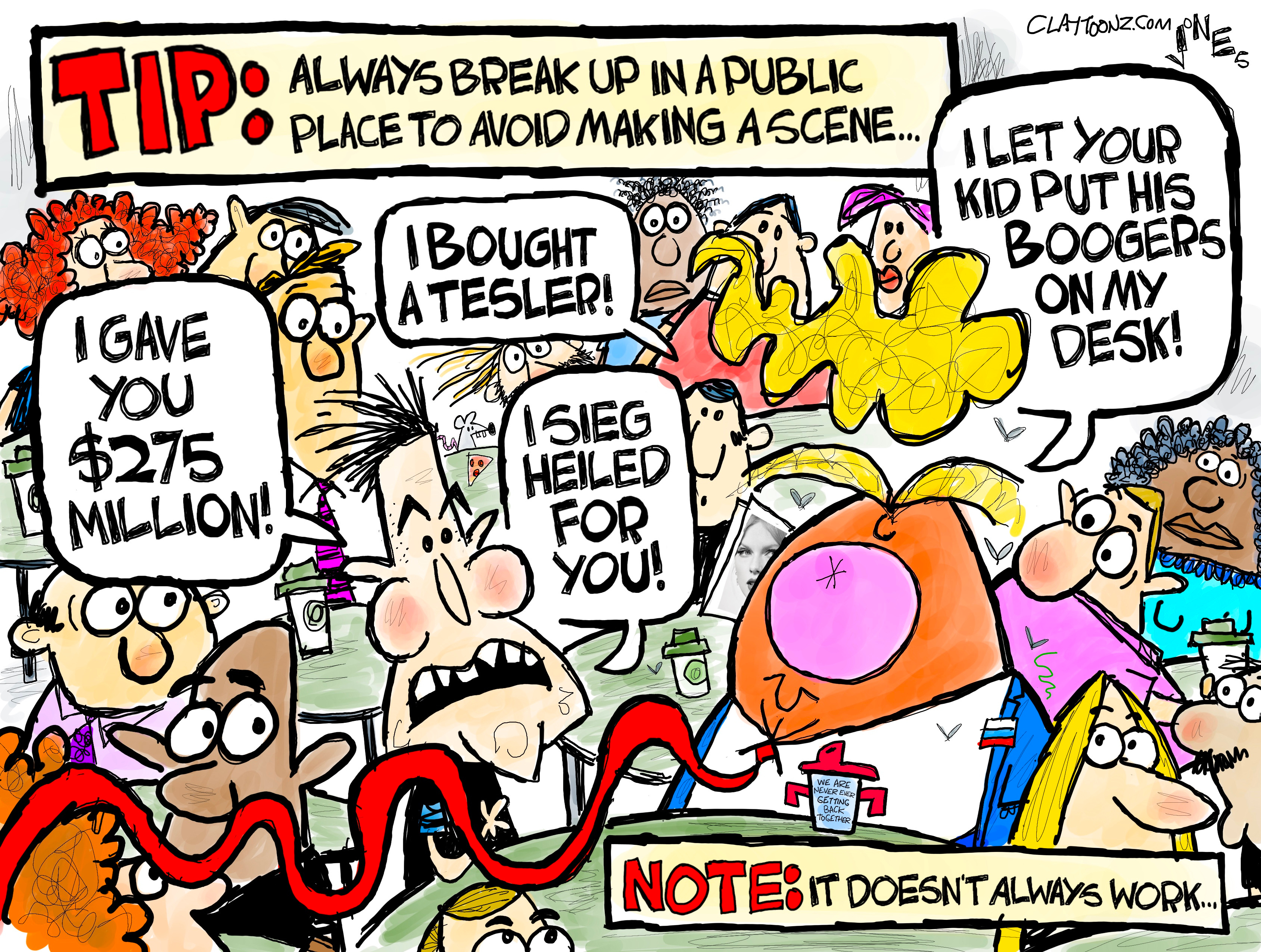
Since I blogged about this issue yesterday, and I just finished my second cartoon of the day (for the FXBG Advance, which you’ll see tomorrow), we’re going to talk about some of the fallout of the Elon/Trump War.
Trump is thinking of selling the cherry red Tesla S he bought from Elon to throw some public support and propaganda his way after Tesla’s stock took a huge hit. Since Elon started gutting the government, a lot of Tesla owners have buyer’s remorse and have been selling their cars. Now, Trump has buyer’s remorse.
Presidents can’t drive on public roads, and Trump can’t drive at all. Trump buying a car would be like me buying a helicopter. I can’t fly a helicopter. If anything, Trump should buy Jeffrey Epstein’s plane. That would be more accurate symbolism, especially if what Elon said about the Epstein Files is true.
I’m sure there’s a MAGAt out there with too much money who would overpay for Trump’s Tesla, other wise, the value has dropped about 28 percent, even if it’s slightly used and fart-free (though Trump did sit in it for a minute which is probably long enough for him to blast a few dozen and christen the car. (snip-MORE)
I Predict A Riot by Clay Jones
Trump is inviting a fight Read on Substack
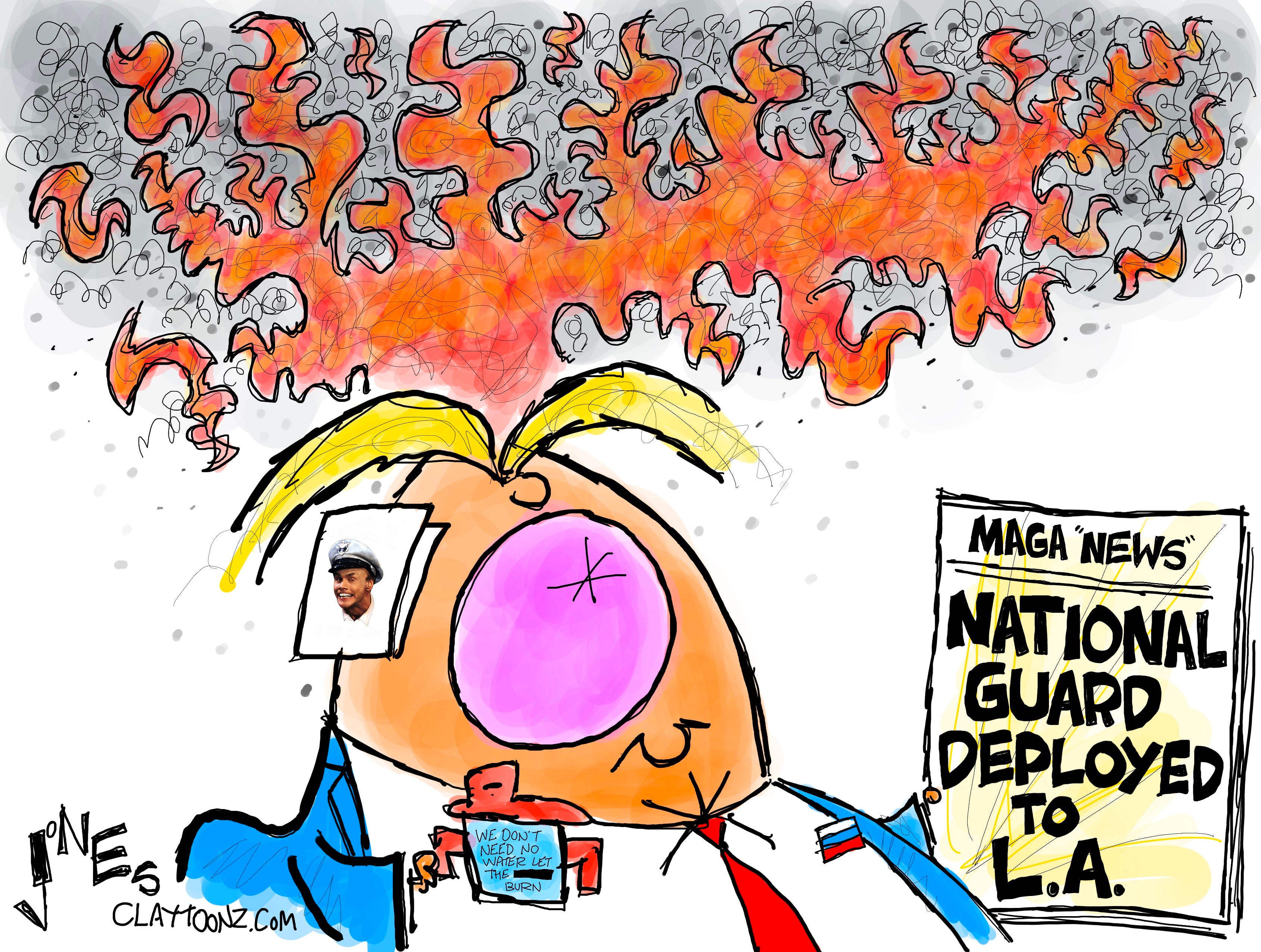
I thought I’d be up super late last night, and planned to watch news coverage of the L.A. protests until the wee hours of the morning. But I felt out of sorts all day yesterday, which infected my cartooning, and sleepiness hit me heavy at 11 p.m. after a dinner of runny egg salad sandwiches (I had to do something with a dozen recently-expired eggs before leaving town Saturday, and I used too much mayo), so I went to bed.
I woke up at 5 a.m. this morning, and I was ready to go. But I dreaded turning on my TV. I was afraid I’d find nothing but coverage of deaths and a city burning. But no, I didn’t find any of that. The most disturbing thing I learned was that Lauren Tomasi, a reporter from Australia’s Channel 9 News, was struck by a rubber bullet while she was doing her job. (snip-MORE)
Alternative Post Office by Clay Jones
We’re having mail issues in the Commonwealth Read on Substack
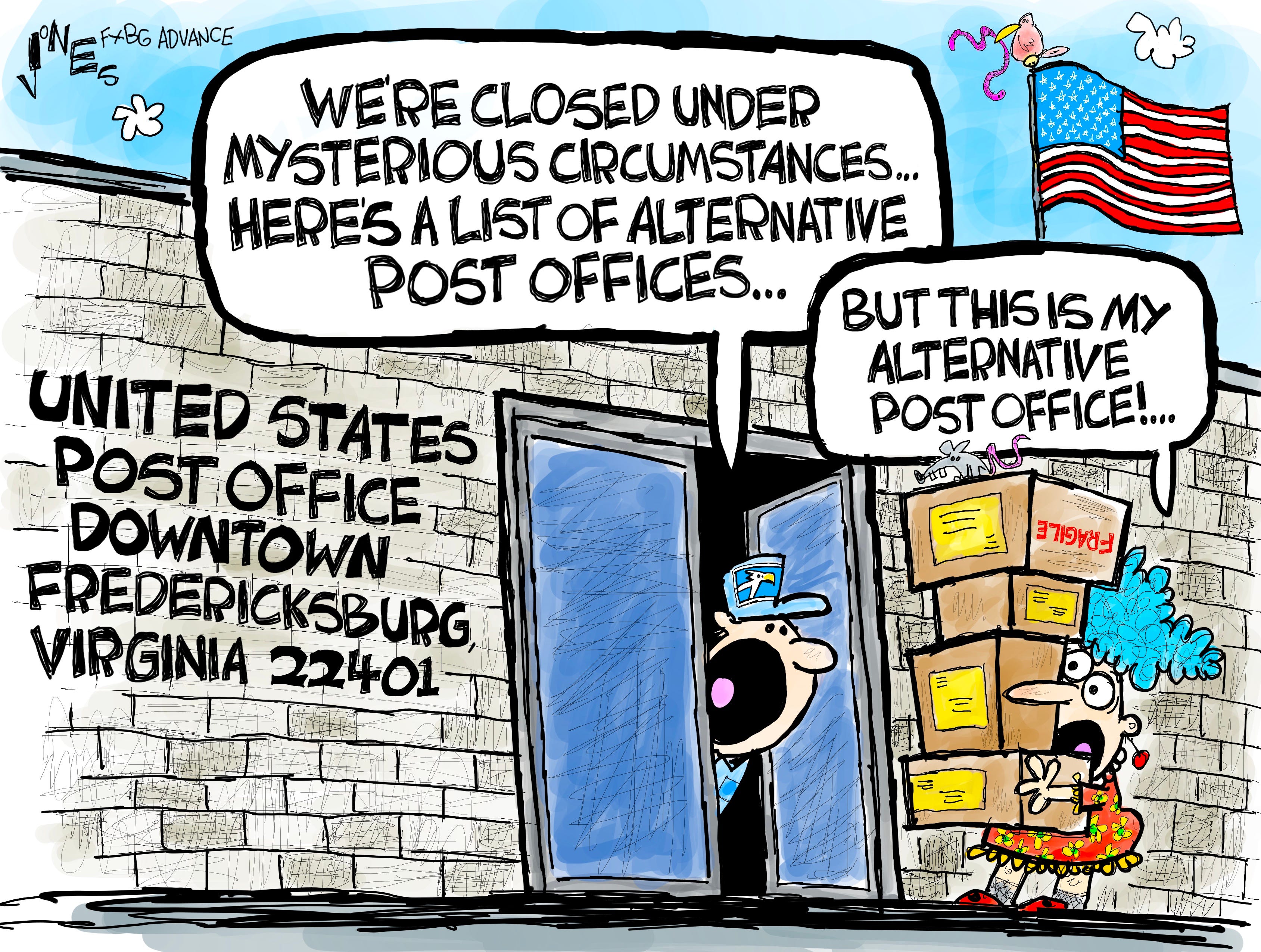
This cartoon was drawn for the FXBG Advance.
The Advance included a note with my cartoons this morning as it often does, and today’s said:
Mail delivery in our area — indeed, in the Commonwealth — is a problem. Don’t take our word for it. Take former Congresswoman Abigail Spanberger’s word for it. Her work uncovered delays galore, and the state consistently rates as one of the worst in the country for mail delivery. So when the downtown post office recently shutdown for, well, whatever reason it was closed for, there was mumbling, but not much of an uproar. Clay certainly noticed, however.
This cartoon was inspired by my own grievances, and it’s the second time the local post office has pissed me off enough to draw a cartoon. Louis DeJoy has inspired others.
The first time was back in December, when they raised the rates to my mailbox and then shut down the branch containing that mailbox. (snip-MORE)
Iced by Clay Jones
Trump is canceling free speech Read on Substack

Donald Trump is deploying the National Guard, not to stop riots or for safety, but to start a fight. And he’s doing it illegally.
ICE is conducting raids in the Los Angeles area. They’re not going after criminals, but average citizens who may just so happen to be undocumented. I don’t use the word “illegal” to describe humans unless it’s in the context of someone else using it. Humans are not illegal.
When the National Guard is deployed, it’s usually at the request of a governor or other officials. Yet, neither the mayor of Los Angeles, Karen Bass, nor Governor Gavin Newsom has requested military aid, like what happened during the Rodney King riots in 1992.
There has been some violence, such as cars being set on fire and other property damage, but to a small extent. The L.A.P.D. can handle these protests, which are legal.
Governor Newsom said Trump’s decision to call in the National Guard is “purposefully inflammatory.” He’s right.
Trump wants everyone to sit back and allow him to do whatever he wants. Not getting that, he wants a fight. He wants protesters to get violent. He wants L.A. to burn. He wants blood. He wants to point at the city and blame a Democratic mayor and a Democratic governor. He wants to blame liberals and Democrats. He wants to portray himself as the law-and-order president (sic), while he’s the president (sic) who pardoned the white nationalist J6 terrorists who attacked law enforcement. (snip-MORE)

