I haven’t made a Women’s History Month post in a while; it’s difficult to feel celebratory in the face of what both very bad men and women are doing in our names in the US these days. However, to make up for being remiss in re-recording history, please accept this post about Rose O’Neill. I first learned of her when my grandparents moved to Springfield, MO in 1970, and took us to her small museum at the small, then-non-commercial Shepherd Of The Hills area. (It was great back then!) I knew of Kewpies (I don’t care for the cutesiness, but they are art nonetheless,) but had no idea a woman created them, nor that she did so much art right in the area where we were then living. I began to be a fan, but sort of let it go as I got older. Below will be a PBS documentary that is excellent, and inspired me to make this post for March 21st. There is also some other info. Enjoy, and remember, we all have history, and it doesn’t go away just because someone makes it more difficult to find (yes, that is encouraging myself as well as readers who’ve made it this far!)
Here is a link with a snippet, about the museum now in Walnut Shade, MO. I bet all the things I remember will be there. Maybe I’ll make it over there and try again.It looks far less commercialized than Shepherd of the Hills last time I was there.
Bonniebrook is a historic home and museum located in Walnut Shade, Missouri, just a short drive from Branson. Our museum is dedicated to preserving the life and legacy of artist, writer, and activist Rose O’Neill, best known for her creation of the Kewpie dolls.
Bonniebrook Museum features Rose’s original drawings, paintings, and sculptures, artifacts from the O’Neill home, a large collection of Kewpies and other characters, the O’Neill family cemetery, and much more!
As one of the only art museums and historical homes in the Branson area, Bonniebrook is a must-see destination for those looking for things to do in Branson, Missouri and the surrounding areas. Come visit this well-preserved piece of history!
Mission Statement: Bonniebrook Historical Society (BHS) was founded in 1975. Its purpose is to collect, preserve, and make available for educational and historical purposes artifacts, documents, personal items, and any work or items directly relating to the history and life of Rose O’Neill. In addition, BHS accumulates research, materials that document, authenticate, explain, and provide detailed information about the character, personality, and accomplishments of the talented and generous Rose O’Neill.
O come now, friend, and rest your bones,
the week’s been fierce and long;
but Ease comes stepping down the lane
to hum you its soft song.

A Lantern glows along the path,
a stubborn, golden spark;
the kind our grandfolks swore was left
to guide us through the dark.

Stillness drapes its woolen shawl
around your weary frame;
it whispers like an old seanchaí
who’s long forgotten blame.

The Hearth is warm for wanderers,
its welcome deep and wide;
it keeps a chair for every soul
the world has weathered tired.

Then Solace pours a quiet cup
the colour of the dawn;
it doesn’t ask what burdens ache—
it simply sits till they’re gone.

Your Breath returns like gentle rain
across an Irish hill;
it fills the fields inside your chest
and bids your heart be still.

And Grace—ah sure, it comes uncalled,
the way good blessings do;
it settles on your shoulders light
as morning’s silver dew.

An Ember glows beneath it all,
a spark that won’t give in;
the same that warmed our ancestors
through storm and winter’s din.

So walk with Gentle in your step,
let kindness be your guide;
for those who move with softened hands
find strength they need not hide.

And Here you stand, upon the earth,
your troubles set to rest;
the world leans in a little close
and wishes you its best.
Should you wish, please feel free to subscribe (no Paywalls): (Link up top as the title)
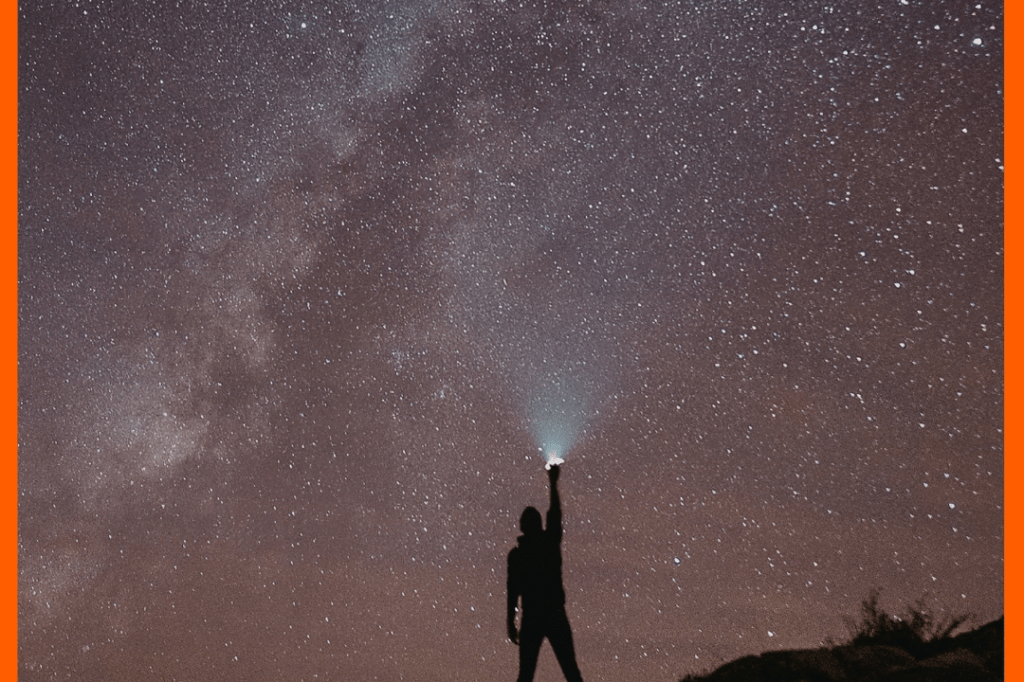
The simple ritual of going outside to welcome nightfall can be extremely relaxing. Of course, this has been done since the dawn of time. However, the practice of “dusking” has recently regained popularity and has become a trend for people looking to boost their mental well-being. The Dutch have been doing this for ages. In…
(I can attest to this; I go outside with Ollie while he does his night-night wee & poo, and while I wasn’t aware it’s an actual thing, it is a calming little ritual, to look at the sky and see what I see. There is more than one way to do it. Soon, it’ll be time to repel mosquitoes, of course, but right now, I just wear a little jacket because it’s nice and cool bordering cold outside.)
A person watches the sky as night falls. – Photo credit:Canva
The simple ritual of going outside to welcome nightfall can be extremely relaxing. Of course, this has been done since the dawn of time. However, the practice of “dusking” has recently regained popularity and has become a trend for people looking to boost their mental well-being.
The Dutch have been doing this for ages. In the Netherlands, dusking is referred to as “schemeren,” which translates to “be dusky, to be in twilight.” It’s the idea of letting the lights turn off while the starry night envelops the day. Watching the color of the sky subtly fade can do wonders for a busy mind.
In a piece for The Guardian, writer Rachel Dixon describes her time at the Dark Skies “dusking event” in the United Kingdom in February 2026. “The darkening sky is faintly illuminated by a sharp sliver of crescent moon and the first stars. Bats are swooping in search of supper, an owl is softly hooting, and the dark outline of a ruined castle looms beyond the walls.”
She explains how this ritual has resurged, writing, “The custom had all but died out until it was revived by Dutch poet and author Marjolijn van Heemstra a few years ago. Now she is encouraging other countries to adopt dusking, running events in Ireland, Germany, and here in Yorkshire.”
Dixon shares that van Heemstra also spoke at the event she attended. “Dusking is about looking at one point and seeing it fade. Don’t look around too much; focus. Trees are very good – they rise up for a moment and then fade away,” van Heemstra eloquently said.
Discover the cosmos! Each day a different image or photograph of our fascinating universe is featured, along with a brief explanation written by a professional astronomer.
2026 March 14
A Year for K2-315b Artist’s Illustration Credit: NASA Ames/JPL-Caltech/T. Pyle, Christine Daniloff, MIT
Explanation: Want to visit a planet that has 3.14 days in a year? Then plan a trip to K2-315b, an earth-sized planet orbiting around a cool, red, M dwarf star about once every 3.14 days. The exoplanet’s discovery, based on publicly available data from the planet-hunting Kepler Space Telescope’s extended K2 mission, was announced in 2020. K2-315b’s measured orbital period in days is nearly equal to the extremely popular irrational number Pi. That puts the exoplanet so close to its parent star that its surface is likely very warm, baking-hot in fact. And this Pi planet is over 185 light-years away. So instead of trying to arrange for an interstellar vacation to K2-315b, there may be easier and more comfortable ways for you to celebrate Pi day on planet Earth.
Explanation: Ever wonder what it would look like to crack open the Sun? The Egg Nebula, a dying Sun-like star, can unscramble this question. Pictured is a combination of several visible and infrared images of the nebula (also known as RAFGL 2688 or CRL 2688) taken with the Hubble Space Telescope. The star has shed its outer layers, and a bright, hot core (or “yolk”) now illuminates the milky “egg white” shells of gas and dust surrounding the center. The central lobes and rings are structures of gas and dust recently ejected into space, with the dust being dense enough to block our view of the stellar core. Light beams emanate from that blocked core, escaping through holes carved in the older ejected material by newer, faster jets expelled from the star’s poles. Astronomers are still trying to figure out what causes the disks, lobes, and jets during this short (only a few thousand years!) phase of the star’s evolution, making this an egg-cellent image to study!
In November 1973, 10 Black models helped put American fashion on the map in an epic runway face-off with well-known French designers. In honor of the start of New York Fashion Week, here’s their story!
Models dressed in midriff-bearing tops and oversized bottoms of solids, stripes and plaids worn with headresses during the fashion show to benefit the restoration of the Chateau of Versailles, five American designers matching talents with five French couturiers at the Versailles Palace on November 28, 1973 in Versailles, France…Article title:’One night and pouf! It’s gone! (Photo by Fairchild Archive/Penske Media via Getty Images)
We know that for most people, February is all about the Super Bowl, Valentine’s Day and Black History Month. But if you love style, you know it’s also about New York Fashion Week – a time for some of the hottest designers to showcase the latest trends — kicking off Wednesday (Feb. 11).
While we’re going to be all over covering what’s new from Sergio Hudson and Public School, we thought this week was also a perfect time to show some love to the Black designers and models who paved the way for future generations.
We’re kicking things off with the story of 1973’s Battle of Versailles fashion show –an epic stand-off between French and American designers in Paris. The highly-hyped event not only put American fashion designers on the map, but it also put a spotlight on a group of 10 Black models who shut down the red carpet and showed the rest of the world the beauty in having a diverse runway that looked more like the rest of the world.
A Palace in Need of Repair
Fragment of golden entrance gates to the Versailles Palace (Chāteau de Versailles) on a sunny summer day. The Versailles is a Royal Palace in Versailles which is a suburb of Paris, some 20 kilometres southwest of the French capital.
The Palace of Versailles is an iconic French landmark. The stunning estate became the official royal residence in 1682. But while it has been a tourist destination for quite some time, in the early 1970s, the 17th century palace was in desperate need of a $60 million glow-up to repair years of damage.
A Fabulous Fundraiser
American Fashion co-ordinator, Miss Eleanor Lambert (Mrs Berkson) who arrived by Qantas today to finalise arrangements for a major all-American fashion show in Sydney and Melbourne later this year. May 25, 1967. (Photo by Trevor James Robert Dallen/Fairfax Media via Getty Images).
American fashion publicist Eleanor Lambert knew $60 million dollars wasn’t small change, so she proposed the idea of a fashion show to raise money for the Versailles repair project. Working with the palace curator, Gerald Van der Kemp, she wanted to invite some of the wealthiest elites from around the world to view collections from fashion designers from France and the United States. Lambert believed the ticket sales would help bring in much-needed funds for the palace project and give American designers a chance to prove their talent on the world stage.
The French Designers
Fashion designer Pierre Cardin stands in his studio surrounded by models. (Photo by Pierre Vauthey/Sygma/Sygma via Getty Images)
Lambert’s idea got the green light, and the date was set for Nov. 28, 1973. The French assembled an all-star lineup of designers, including Hubert de Givenchy, Yves Saint Laurent, Pierre Cardin, Marc Bohan (Creative Director for Christian Dior) and Emmanuel Ungaro. Ready to show the international audience that Paris was the fashion capital of the world, they planned more than an ordinary runway show, but a production that featured live music, dance and an extraordinary set.
The American Designers
NEW YORK, NY – JANUARY 24: Designer Stephen Burrows attends the Tribute To The Models Of Versailles 1973 at The Metropolitan Museum Of Art on January 24, 2011 in New York City. (Photo by Stephen Lovekin/Getty Images)
The American team accepted the challenge and built a roster that included designers Oscar de la Renta, Halston and Bill Blass. Unlike the French, Team USA brought a little more diversity to the event, with the only woman designer, Anne Klein, and Stephen Burrows, a Black graduate of New York’s Fashion Institute of Technology, who made a name for himself with his colorful, lightweight knit designs and signature lettuce hem.
News of the show got lots of press in both the United States and France. John Fairchild, who was the editor of Women’s Wear Daily at the time, helped add to the hype, billing the event “The Battle of Versailles.”
Choosing Models
Norma Jean Darden, Bethann Hardison, Billie Blair (Getty Images)
The budget for the event was tight, causing some of the more well-known models of the time — like Jerry Hall and Lauren Hutton — to turn down the $300 job. But their decision left the door open for a group of talented and beautiful Black models who were happy to step in and help bring the designer’s clothing to life. In the end, the American show featured 10 Black models – Billie Blair, Bethann Hardison, Pat Cleveland, Amina Warsuma, Charlene Dash, Ramona Saunders, Norma Jean Darden, Barbara Jackson, Alva Chinn and Jennifer Brice – making it one of the most diverse runways the fashion industry had ever seen at a major show.
Americans in Paris
Models Bethann Hardison and Armina Warsuma arrive in Marseille, Paris. (Photo by Michel Maurou/Reginald Gray/WWD/Penske Media via Getty Images)
Although they weren’t paid much for the gig, many of the Black American models chosen for the show jumped at the chance to participate in a high-profile international event. Pat Cleveland remembers how excited many of the models were when they first set foot on French soil.
“They got out of the bus and kissed the ground, they were so happy,” she said.
A Not-So-Warm Welcome
Model Pat Cleveland eats a sandwich backstage during the Battle of Versailles fashion show to benefit the restoration of the Chateau of Versailles on November 28, 1973. The Battle of Versailles featured the top five American designers matching their talents with five French couturiers. The Americans triumphed. (Photo by Reginald Gray/WWD/Penske Media via Getty Images)
Although the city of lights was beautiful, the American designers and models did not feel the love in France. Designer Stephen Burrows confirmed that their accommodations were far from five-star.
“There was no toilet paper in the bathroom. It was terrible,” Burrows said. “They had the girls there working all day long and didn’t feed them.”
Rehearsal Drama
Oscar de la Renta watches American team model Billie Blair practicing in a breakout rehearsal space within the palace complex. (Photo by Michel Maurou/WWD/Penske Media via Getty Images)
The French weren’t any more gracious when it came to the rehearsal time, using up most of the days leading up to the show to run through their performance –leaving the American team to make the most of the middle of the night.
A Star-Studded Guest List
Marisa Berenson, Roy Halston, Liza Minnelli and friends attend the fashion show to benefit the restoration of the Chateau of Versailles, five American designers matching talents with five French couturiers at the Versailles Palace on November 28, 1973 in Versailles, France. (Photo by Fairchild Archive/Penske Media via Getty Images)
The idea of a showcase featuring some of the best in American and French fashion attracted a who’s who of high-profile stars, including Elizabeth Taylor, Liza Minelli (who took the stage during the American show) and Andy Warhol.
The French Performance Was a Production
American born-French entertainer Josephine Baker in costume rehearses on stage before her performance during the “Battle of Versailles” fashion competition in Paris on November 29, 1973. (Photo by Reginald Gray/WWD/Penske Media via Getty Images)
On the night of the show, the French took the stage first, with a 40-piece orchestra, more than $30,000 worth of props and performances from well-known Soviet ballet dancer Rudolf Nureyev and legendary performer Josephine Baker along with their designer’s collections. American model Bethann Hardison remembered the French designer’s elaborate presentation that lasted for more than 2.5 hours.
“They had everything. You just couldn’t believe all the entertainment they had,” she said. “It was like a circus. The only thing they didn’t do was shoot a man out of a cannon.”
The Americans Met the Moment
After the French showcase, it was Team USA’s turn to take the stage. Although they walked to music on a cassette tape instead of a live orchestra, they met the moment, with the Black models showing off their rhythm as they floated down the runway. Although their show was only 35 minutes, they left the audience – who gave them a standing ovation – wanting more.
Making Fashion Ready-to-Wear
Battle of Versailles (Photo by Reginald Gray/WWD/Penske Media via Getty Images)
While the French showcased classically tailored clothing conceived with a wealthy client in mind, the American designers were looking toward the future and embracing a growing shift towards ready-to-wear pieces that were accessible to a wider audience. The designers weren’t afraid to add color and pattern to a collection that was made for time.
The Power of Diversity
Models dressed in gowns take the stage during the fashion show to benefit the restoration of the Chateau of Versailles, five American designers matching talents with five French couturiers at the Versailles Palace on November 28, 1973 in Versailles, France…Article title: ‘One night and pouf! It’s gone! (Photo by Fairchild Archive/Penske Media via Getty Images)
Filmmaker Deborah Riley Draper captured the magic of the Battle of Versailles in the documentary, “Versailles ’73: American Runway Revolution.” In an interview with CBS, she emphasized the importance of this groundbreaking moment in fashion history.
“What America was able to do was to demonstrate that diversity and inclusion on the stage was the most powerful weapon they could have,” she told CBS in an interview.
A bag of tiny chocolate chip cookies from the company who was here a few weeks ago working in my bathroom. I’m off cookies until my jeans are looser again like they were in November, so these will go into the freezer, but anyway, they still brightened the day!
Next, a cool Substack post from Worriedman. I’ve shared his posts here before. Today’s is extra cool.
February

by Margaret Atwood

Winter. Time to eat fat
and watch hockey. In the pewter mornings, the cat,
a black fur sausage with yellow
Houdini eyes, jumps up on the bed and tries
to get onto my head. It’s his
way of telling whether or not I’m dead.
If I’m not, he wants to be scratched; if I am
He’ll think of something. He settles
on my chest, breathing his breath
of burped-up meat and musty sofas,
purring like a washboard. Some other tomcat,
not yet a capon, has been spraying our front door,
declaring war. It’s all about sex and territory,
which are what will finish us off
in the long run. Some cat owners around here
should snip a few testicles. If we wise
hominids were sensible, we’d do that too,
or eat our young, like sharks.
But it’s love that does us in. Over and over
again, He shoots, he scores! and famine
crouches in the bedsheets, ambushing the pulsing
eiderdown, and the windchill factor hits
thirty below, and pollution pours
out of our chimneys to keep us warm.
February, month of despair,
with a skewered heart in the centre.
I think dire thoughts, and lust for French fries
with a splash of vinegar.
Cat, enough of your greedy whining
and your small pink bumhole.
Off my face! You’re the life principle,
more or less, so get going
on a little optimism around here.
Get rid of death. Celebrate increase. Make it be spring.

Presented complete for educational purposes. And because no page celebrating the work of the great Margret Catwood is complete without the phrase "Cat, enough of your greedy whining and your small pink bumhole."

It's the last Saturday before February. It's wicked cold  - 2 degrees with a breeze.

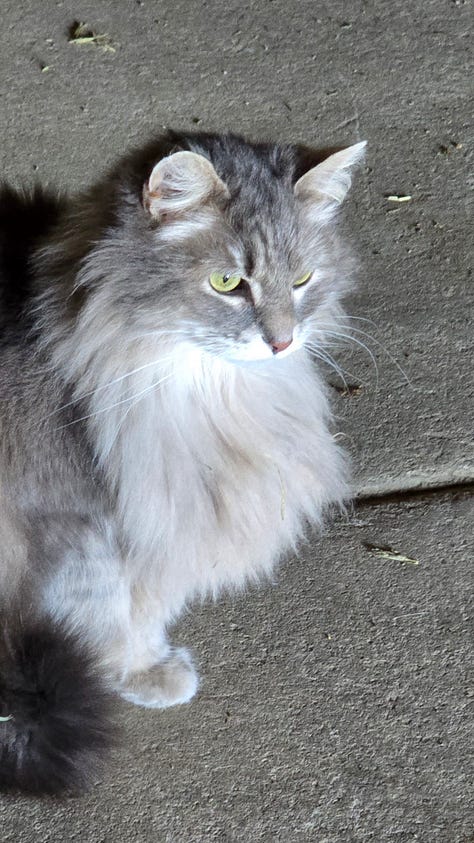
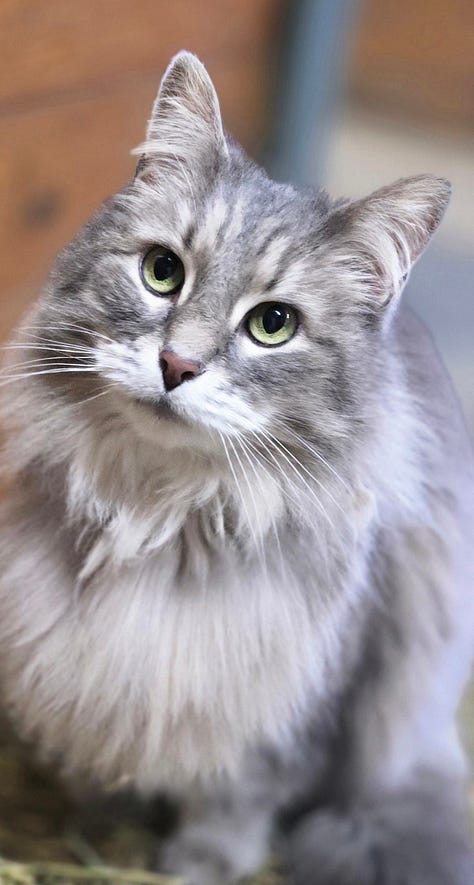
It's Caturday, though Hello  Barncat!
Sam, in repose
Amos , paying attention!
Cold assed….ass.
One more !
Soon ...
That's all I got room for - Thanks for dropping by !
As I keep repeating these bathroom bills hurt cis women because it is based solely on how someone looks to some other people. If as in this case a cis woman did not look feminine enough for the server and so this woman was forced to show her breasts. How is that feminism work going TERF people. These bathroom bills and the hype of fake false stories of danger to women only make all women less safe. See now people that look like men legally might have to use a female’s bathroom, so all a cis man has to say is he is trans and they can legally be in the woman’s bathroom. Same for any female that wants to go into the men’s room only needs to claim to be a trams women. All due to hate and bigotry making a problem where none existed. Think of it, the only assaults I have heard about in female restrooms is from cis people attacking cis females because they think they are trans. Hugs
The 18-year-old high school student said she unzipped her hoodie to show she had breasts after a Buffalo Wild Wings server didn’t believe she is a woman.
A Minnesota teenager filed a charge of discrimination against a Buffalo Wild Wings restaurant Tuesday, alleging a server followed her into the women’s restroom and demanded she “prove” she was a girl.
Gerika Mudra, 18, went to dinner in April with a friend in Owatonna, about an hour south of Minneapolis. When she went to the restroom, a server followed her inside and banged on the stall door while saying: “This is a women’s restroom. The man needs to get out of here,” according to Gender Justice, a Minnesota gender-equality organization that filed the charge on Mudra’s behalf.
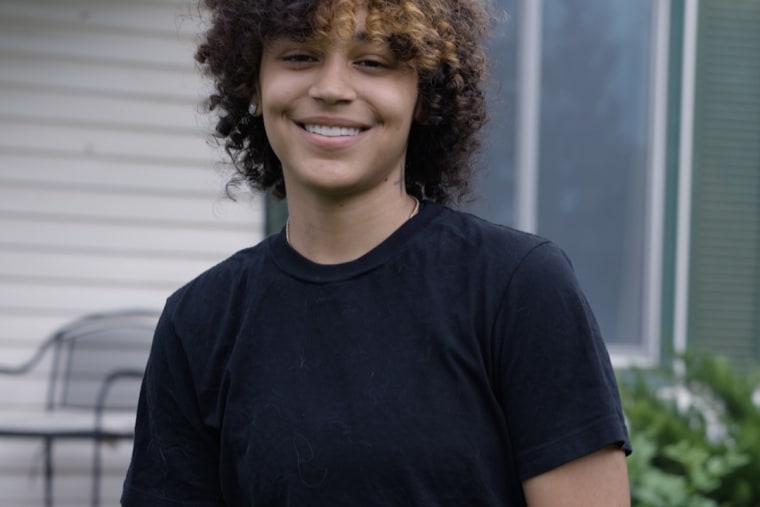
Gerika Mudra, 18, says she was harassed by a server who accused her of being a boy in the girls’ bathroom.Gender Justice
Mudra, a biracial lesbian who isn’t transgender, said that she has been in similar situations before, when people have suggested she’s in the wrong restroom, but that when she tells them she’s a woman they leave her alone. However, when she came out of the stall at Buffalo Wild Wings and told the server, “I am a lady,” she said, the server responded, “You have to get out now,” Gender Justice said in a statement.
Mudra said she felt she had to prove to the server that she is a woman, so she unzipped her hoodie to show she has breasts. The server didn’t say anything in response but left the restroom, Mudra said.
“She made me feel very uncomfortable,” Mudra said. “After that, I just don’t like going in public bathrooms. I just hold it in. … I want to be able to use the bathroom in peace.”
Inspire Brands, which represents Buffalo Wild Wings, didn’t immediately respond to a request for comment.
Buffalo Wild Wings in Owatonna, Minn.Google Maps
Gender Justice filed the charge of discrimination with the Minnesota Department of Human Rights, arguing that what happened to Mudra violates the state’s Human Rights Act, which protects people from discrimination based on gender identity and sexual orientation, among other protected statuses.
Sara Jane Baldwin, senior staff attorney at Gender Justice, said at a news conference Tuesday that even though Mudra isn’t trans, the server’s actions “were based on assumptions that she made about” Mudra, and that Minnesota’s law protects against discrimination based on stereotypes or assumptions about protected characteristics like gender identity.
“Businesses have a legal obligation not to just have antidiscrimination policies on paper, but to train staff and ensure that those policies are followed in real time,” Baldwin said. “When that doesn’t happen, the business is liable for the harm caused.”
Gender Justice said Mudra’s experience “reflects a broader climate of fear and suspicion aimed at anyone who doesn’t conform to narrow expectations of what girls and women ‘should’ look like.” That suspicion has been driven largely by the wave of state legislation targeting trans people, particularly their access to school sports and bathrooms that align with their gender identities, though Minnesota hasn’t enacted any such legislation.
Nineteen states have laws that prohibit trans people from using bathrooms that align with their gender identities in K-12 schools, and in many of those states the restrictions apply to other government-owned buildings, as well, according to the Movement Advancement Project, an LGBTQ think tank. Twenty-seven states prohibit trans people from playing on school sports teams that align with their gender identities.
“This kind of gender policing is, unfortunately, nothing new,” Megan Peterson, executive director at Gender Justice, said in a statement. “And yet, in our current climate we have to ask: What if Gerika had been a trans person? Would this story have ended differently? That’s the terrifying reality too many trans people live with every day.”
Even if Mudra had been trans, she would be able to file a discrimination complaint under state law in Minnesota, which is one of 21 states and Washington, D.C., that explicitly prohibit discrimination based on sexual orientation and gender identity in public accommodations, according to the Movement Advancement Project. Two states explicitly prohibit discrimination based on sexual orientation only, and six additional states interpret existing measures against discrimination based on sex to also include discrimination based on sexual orientation and gender identity. Twenty-one states don’t have explicit protections from discrimination based on gender identity in public accommodations.









 Scottie's Playtime