I like what he says about the idea that you have to earn god’s love, you have to earn salvation. This is in relation to the maga in congress not wanting to give aid to California for the fire assistance. He points out that if you have to earn your salvation then you did it not Jesus. And if you can do it on your own why need god? He points out that the Jesus never required people to prove they were worth before he helped them. Hugs
I keep saying these people won’t stop ever until they get their way. They believe they are on a mission from their god to turn the entire country Christian. But not just Christian, the kind of Christian they themselves are. They want to force everyone to live according to their church doctrines. Why? I don’t understand it, but they think taking away the public’s freewill will make their god so happy he will return to give them their reward of a paradise on earth. But I thought god’s kingdom was in heaven, not on earth? But this idea that they and they alone know what god wants, that they and they alone have the right to tell others how to live, how to think, how to have sex, who to have sex with, what they can watch or listen to, even what god they can believe in, and how they are to pray to that god. As they demand. I do not get or understand what makes these people think they can rule other people, rule others lives, do all to others I have written above. Why can they not give others the same rights they demand for themselves, the right to live their lives and worship as they please? But please notice the wealthy person bankrolling so much of the effort to turn Texas in to a theocracy. Think about his actions when others try to stop him to protect democracy? He smears them to try to destroy them. This is the type of Christian warrior he is and they are. Do as I say not as I do, or the big one, it is OK to do bad things in the name of Jesus. Hugs.
AFPI has provided money, an institutional home, and political platforms to many of the people Trump has nominated to run the country; quite a few high-level Trump nominees have AFPI connections, including:
Pam Bondi, Attorney General (Chair, AFPI Center for Litigation; co-chair Center for Law and Justice)
Kash Patel, FBI (Senior Fellow, AFPI Center for American Security)
Linda McMahon, Education (Board chair; chair, Center for the American Worker)
Lee Zeldin, Environmental Protection Agency (Chair, China Policy Initiative & Pathway to 2025)
John Ratcliffe, Central Intelligence Agency (C-chair Center for National Security)
Doug Collins, Veterans Affairs (head of Georgia AFPI Chapter)
Brooke Rollins, Agriculture (Co-founder, President and CEO)
Kevin Hassett, National Economic Council (Chair, Board of Academic Advisors)
Matthew Whitaker, NATO (Co-chair, Center for Law & Justice)
Casey Mulligan, Small Business Administration, chief counsel (Board of Academic Advisors)
Trump’s first public speech after winning the 2024 election was at an AFPI gala at Mar-a-Lago, where he was joined by other MAGA luminaries, including HHS nominee Robert F. Kennedy, Jr. and “Department of Government Efficiency” leaders Elon Musk and Vivek Ramaswamy.
AFPI founder Rollins has bragged about the group’s “revolutionary” plans to seize control of the “administrative state.” The group’s agenda for the incoming administration—its “transition project”—is in some ways even more radical than the Heritage Foundation’s Project 2025. AFPI believes Trump should be allowed to fire and replace any federal employee at will – potentially converting the entire federal workforce into a massive and corrupt political patronage system. AFPI has reportedly prepared 300 executive orders for Trump.
As an officer at the America First Policy Institute, Bondi tried to undermine special counsel Jack Smith’s investigation of Trump by arguing that his appointment was unconstitutional. She oversaw what the Brennan Center has called “a number of troubling voting rights and election lawsuits,” leading the pro-democracy organization to conclude, “Her record on voting and elections raises questions about her ability to be the attorney general the American public deserves.”
In a case in which AFPI sought to empower local election officials to delay or block certification of elections, AFPI’s arguments were “meritless and radical,” according to the Brennan Center. In another case filed shortly before, even notorious pro-Trump Judge Matthew Kacsmaryk rejected AFPI’s “emergency” request to block a Biden executive order on voter registration that had been in place for several years. Kacsmaryk wrote that AFPI’s request provided “no direct evidence” to support its claims. The Brennan Center noted that the lawsuit “served to amplify baseless conspiracy theories about noncitizen voting.”
AFPI is funded in part by Tim Dunn, who the Texas Monthly has called “the billionaire bully who wants to turn Texas into a Christian theocracy.” Dunn is notorious for funding smear campaigns against Texas Republicans who don’t fall in line with his demands. Dunn poured millions of dollars into the effort to elect Trump to a second term, and supports other right-wing causes, like the Convention of States’ efforts to rewrite the U.S. Constitution. In a 2019 speech to Convention of States, Dunn argued that the Bible is “mainly about politics” and said that COS is triggering a Great Awakening.
Not so surprisingly, AFPI promotes Christian nationalist rhetoric; AFPI leaders have described their efforts as part of a “spiritual war.” AFPI’s political arm, which is chaired by Dunn, partnered with dominionist Lance Wallnau—who believes right-wing Christians are meant to control the government and every other sphere of influence in society–to help Trump return to power. Dunn himself reportedly told former Texas House Speaker Joe Straus, who is Jewish, that only Christians should be in leadership positions in the legislature.
Also in leadership at AFPI is Trump spiritual and political adviser Paula White, who has repeatedly called Trump’s opponents demonic and kicked off his pre-insurrection rally with a prayer for “holy boldness.” White chairs AFPI’s Center for American Values.
AFPI’s faith director RichardRogers, who took part in Wallnau’s “Courage Tour,” appeared on The Jim Bakker show this week, where he said there will be a “faith director” in every government agency in the new administration. He predicted that the “prayer warriors” who “rose up” on Trump’s behalf in 2024 will “have more power than Elon Musk.” He described AFPI as a “data-driven machine” that worked “hand-in-hand” with the RNC to boost turnout among low-propensity voters.
AFPI claims “biblical foundations” for each of the ten “pillars” of its right-wing policy agenda, which it calls “10 Pillars for Restoring a Nation Under God.” It asserts, “The Ten Commandments and Christian teachings have been the foundation that created the American legal system.” AFPI’s website declares, “This fight is not just about the culture of America; it’s about the kingdom of God and the Church’s divine mission to be the salt and light of our day in an era of increasing darkness.”
Richard Rogers of the AFPI says that under Trump, there will be a "faith director in every single agency" tasked with ensuring that anti-Christian policies are not enacted. https://t.co/RPLmEAlAJEpic.twitter.com/GaZv2yE9iP
The US is not the only people who have indigenous people who they have not treated fairly or with respect. Friend of the blog Barry has a wonderful video detailing how simple it is if you want to respect the agreements and the people. Best wishes.
Now it turns out that he not only did his big set of moderation changes to please Trump, but did so only after he was told by the incoming administration to act. Even worse, he reportedly made sure to share his plans with top Trump aides to get their approval first.
That’s a key takeaway from a new New York Times piece that is ostensibly a profile of the relentlessly awful Stephen Miller. However, it also has a few revealing details about the whole Zuckerberg saga buried within. First, Miller reportedly demanded that Zuckerberg make changes at Facebook “on Trump’s terms.”
Mr. Miller told Mr. Zuckerberg that he had an opportunity to help reform America, but it would be on President-elect Donald J. Trump’s terms. He made clear that Mr. Trump would crack down on immigration and go to war against the diversity, equity and inclusion, or D.E.I., culture that had been embraced by Meta and much of corporate America in recent years.
Mr. Zuckerberg was amenable. He signaled to Mr. Miller and his colleagues, including other senior Trump advisers, that he would do nothing to obstruct the Trump agenda, according to three people with knowledge of the meeting, who asked for anonymity to discuss a private conversation. Mr. Zuckerberg said he would instead focus solely on building tech products.
Even if you argue that this was more about DEI programs at Meta rather than about content moderation, it’s still the incoming administration reportedly making actual demands of Zuckerberg, and Zuckerberg not just saying “fine” but actually previewing the details to Miller to make sure they got Trump’s blessing.
Earlier this month, Mr. Zuckerberg’s political lieutenants previewed the changes to Mr. Miller in a private briefing. And on Jan. 10, Mr. Zuckerberg made them official….
This is especially galling given that it was just days ago when Zuckerberg was whining about how unfair it was that Biden officials were demanding stuff from him (even though he had no trouble saying no to them) and it was big news! The headlines made a huge deal of how unfair Biden was to Zuckerberg. Here’s just a sampling.
Also conveniently omitted was the fact that the Supreme Court found no evidence of the Biden administration going over the line in its conversations with Meta. Indeed, a Supreme Court Justice noted that conversations like those that the Biden admin had with Meta happened “thousands of times a day,” and weren’t problematic because there was no inherent threat or direct coordination.
Yet, here, we have reports of both threats and now evidence of direct coordination, including Zuckerberg asking for and getting direct approval from a top Trump official before rolling out the policy.
And where is this bombshell revelation? It’s buried in a random profile piece puffing up Stephen Miller.
It’s almost as if everyone now takes it for granted that any made-up story about Biden will be treated as fact, and everyone just takes it as expected when Trump actually does the thing that Biden gets falsely accused of.
With this new story, don’t hold your breath waiting for the same outlets to give this anywhere near the same level of coverage and outrage they directed at the Biden administration.
It’s almost as if there’s a massive double standard here: everything is okay if Trump does it, but we can blame the Biden admin for things we only pretend they did.
I’m used to hypocrisy in the political world, but this is beyond ridiculous. It’s now being made clear that the Trump admin is actually doing the exact thing that people were (falsely, misleadingly) blaming Biden for.
And it’s just a random aside in a story, and no one seems to be calling it out. Other than us here at Techdirt.
An example of actual “cancel culture” within, plus more.
January 18, 1919 The peace conference to negotiate the end of the Great War (now know as World War I) opened in Paris, France. President Woodrow Wilson spent several months in Europe personally negotiating details of what became the Treaty of Versailles with heads of the allied powers or their foreign ministers.
January 18, 1962 The U.S. began spraying herbicides on foliage in Vietnam to eliminate jungle canopy cover for Viet Cong guerrillas (a policy known as “territory denial”).The U.S. ultimately dropped more than 20 million gallons of such defoliants, sparking charges the United States was violating international treaties against using chemical weapons. Many of the herbicides, particularly Agent Orange, manufactured by Dow Chemical, Monsanto and others, were later found to cause birth defects and rare forms of cancer in humans. Agent Orange: An Ongoing Atrocity
January 18, 1968 Invited to a Women Doers luncheon at the Johnson White House, Eartha Kitt, singer and actor, spoke out about the effect of the Vietnam War on America’s youth. Lady Bird Johnson had convened 50 whites and Negroes to discuss President Lyndon Johnson’s anti-crime proposals. Ms. Kitt first asked the President, “what do you do about delinquent parents, those who have to work and are too busy to look after their children?” He said that there was Social Security money for day care, and the group should discuss such issues. Later, she told the women that young Americans were “angry because their parents are angry . . . because there is a war going on that they don’t understand . . . You send the best of this country off to be shot and maimed. They rebel in the street. They will take pot . . . and they will get high. They don’t want to go to school because they’re going to be snatched off from their mothers to be shot in Vietnam.” Eartha Kitt and Lady Bird Johnson Eartha Kitt’s career took a severe downturn after this; for years afterward, Kitt performed almost exclusively overseas, while being investigated by several federal agencies. “The thing that hurts, that became anger, was when I realized that if you tell the truth – in a country that says you’re entitled to tell the truth – you get your face slapped and you get put out of work,” Kitt told Essence magazine two decades later.
January 18, 1971 In a televised speech, Senator George S. McGovern (D-South Dakota) began his anti-war campaign for the 1972 Democratic presidential nomination. He vowed to bring home all U.S. soldiers from Vietnam if elected. McGovern had served in the Army Air Corps during World War II, earning the Silver Star and the Distinguished Flying Cross. George McGovern “. . . we must have the courage to admit that however sincere our motives, we made a dreadful mistake in trying to settle the affairs of the Vietnamese people with American troops and bombers . . . . “ But while our problems are great, certain steps can be taken to recover the confidence of the nation. The greatness of our nation is not confined to the past, but beckons us to the future.
January 18, 1985 Though a member of the World Court since 1946, the United States walked out during a case. The Court had charged the U.S. was in violation of international law through its support of paramilitary (Contra) activities against the Nicaraguan government. Efforts to undermine the Sandinista government in Nicaragua had been a keystone of Pres. Reagan’s anti-communist foreign policy from its inception. Congressman Michael Barnes (D-Maryland) said he was “shocked and saddened that the Reagan Administration had so little confidence in its own policies that it chose not even to defend them [in the World Court].” The Court still heard Nicaragua’s case and decided against the United States, and ordered it to pay reparations to Nicaragua in June 1986.
January 18, 1996 The Zapatista National Liberation Army (EZLN) and the Mexican government reached an agreement in San Andres to recognize and guarantee the constitutional, political, social, cultural, and economic rights of indigenous peoples in Mexico. Treated as second-class citizens since the first colonial entry into their country, the document guaranteed the autonomy and right to self-determination of native communities within the pluricultural Mexican nation. The Zapatistas took their name from Emilano Zapata who played a major role in the Mexican Revolution early in the 20th century.When they began their revolt in Chiapas state on New Year’s Day of 1994, They wrote: “We have nothing to lose, absolutely nothing, no decent roof over our heads, no land, no work, poor health, no food, no education, no right to freely and democratically choose our leaders, no independence from foreign interests, and no justice for ourselves or our children. But we say enough is enough! We are the descendants of those who truly built this nation, we are millions of dispossessed, and we call upon all our brethren to join our crusade, the only option to avoid dying of starvation!” The Mexican government, despite their signature on the agreement, refused later to implement it. More background on the Zapatistas
January 18, 2003 In frigid temperatures, 500,000 converged on Washington, D.C. There were also joined by many more elsewhere around the world to oppose the threatened U.S. war on Iraq. Anti-war protesters march past the U.S. Capitol during the start of an anti-war protest that will culminate by a march to the Washington Naval Yard.Egyptian riot police and anti-war demonstrators face off in Cairo, Egypt. Banners at top read, ” Iraq . . . Another war for oil and American supremacy. “This was the largest U.S. peace demonstration since the Vietnam era. < Pakistani peace activists hold a rally in Karachi. > Crowds estimated at 80,000 fill the civic center of San Francisco, California
The fact is these kids are exposed to sex and gender as soon as they learn there is a difference between boy and girl. Hey what do you tell a boy in kindergarten when they need to go to the bathroom. That’s right in all their younger grades they are instructed to use the bathroom of their gender, boy go to the boys bathroom, girls go to the girls bathroom. That teaches them gender regardless of these cis straight religious people want to admit it or not. Plus their goal seems to deny their kids the idea that some people are different, have different feelings when those very kids are in their class and maybe their friends? They seek to deny these kids friendships with people who are different from them. It reminds me of the segregation issues in the southern state. White supremacist did not want their pretty white kids in the same class as the black kids they felt were … something. It is like they thought the black was able to spread and be caught. No matter if these religious people like it or not the world has changed, society has changed and it is not the time of their bible nor the fabled 1950s they dream existed. Trying to deny the existance of the LGBTQ+ is like trying to deny black people exist. Hugs.
Parents in Montgomery County, Maryland, want to be able to opt out of instruction on gender and sexuality that they say goes against their religious convictions.
January 17, 2025 at 6:54 p.m.
A large group of parents protested in Rockville, Maryland, on June 27, 2023, in an effort to allow their children to opt out of books that feature LGBTQ+ characters in Montgomery County schools. (Sarah L. Voisin/The Washington Post)
The Supreme Court agreed Friday to hear a case about whether public schools must give parents ofelementary schoolchildren a chance to opt out of instruction on gender and sexuality that they saygoes against their religious convictions.
Parents, who are Muslim,Roman Catholic and Ukrainian Orthodox, filed suit in 2023, saying the policy violates their First Amendment rights to freedom of religion.
The case puts the high court at the center of a contentious national debate over how to teach and treat gender and sexuality in schools, which has spurred fights over books, bathroom use and on which teams transgender athletes should be allowed to play.
Eric Baxter, an attorney for the families, said in a statement that the school system’s decision to disallow opt-outs was “cramming down controversial gender ideology” to 3-year-old pupils. Becket, a public interest institute that pushes for religious liberty, is representing the families, and has been involved in other cases on LGBTQ+ issues.
“The Court must make clear: Parents, not the state, should be the ones deciding how and when to introduce their children to sensitive issues about gender and sexuality,” Baxter said.
Montgomery County schools declined to comment, citing the pending litigation. Butthe districtwrote in filings to the high court thatan adverse ruling could upend long-standing legal precedent that guides how schools teach.
“Petitioners seek to unsettle a decades-old consensus that parents who choose to send their children to public school are not deprived of their right to freely exercise their religion simply because their children are exposed to curricular materials the parents find offensive,” attorneys for the schools wrote.
During the 2022-2023 school year, Montgomery County schools introduced a reading list of books that included LGBTQ+ characters as part of an effort to be more inclusive to its diverse student population. The lists were intended for students from prekindergarten to 12th grade and were created with parental feedback.
The school system required teachers to read at least one storybook a year from a group of titles that included “Pride Puppy,” which is about a gay pride parade; “Intersection Allies,” which is about a group of children discussing their differences; and “Love, Violet,” which is about a girl who has feelings for a female classmate.
“The storybooks are not used in any lessons related to gender and sexuality,” the school district wrote in itsfiling. “Nor is any student asked or expected to change his or her views about his or her own, or any other student’s, sexual orientation or gender identity. Instead, the books are made available for individual reading, classroom read-alouds, and other educational activities designed to foster and enhance literacy skills.”
The parents wrote in court documents that the Montgomeryschool board also issued guidance that instructed teachers to emphasize that “not everyone is a boy or girl” and that some “people identify with both, sometimes one more than the other and sometimes neither.”
As teachers started using the books in the classroom, some families wanted to opt their children out of the discussions due to concerns that the lessons and subsequent discussions would conflict with their religious views. The books that targeted elementary-aged students were particularly controversial.
Originally, some principals let families pull their children out of the classroom when the books were read. But in March 2023, the school system’s central office announced that opt-outs would not be permitted.
More than 1,100 parents signed a petition asking the district to restore the opt-out right and hundreds protested the decision. Maryland is one of 47 states and the District of Columbia that have opt-out or opt-in provisions for sex education in schools, according to the parents’ filing.
In May 2023, a group of parents filed a lawsuit against the school system, alleging that the district violated their First Amendment rights and that the decision went against a district policy that allows for religious accommodations. The parents are not asking the school system to drop the curriculum.
Other parents did not support opting out of the curriculum.
After the lawsuit was filed, the school system quietly stopped teaching two of the books referenced in the lawsuit because of concerns that it would “require teachers to explicitly teach vocabulary terms outside of the context of the lesson,” according to a district database.
The parentswho sued the district asked a federal judge in Maryland for a preliminary injunction to restore the opt-out provision, but the judge denied the request, ruling the parents were unlikely to succeed because they could not show “that the no-opt-out policy burdens their religious exercise.”
That ruling was upheld by a divided panel of the U.S. Court of Appeals for the 4th Circuit in Richmond, before the parents petitioned the Supreme Court to hear the case. Oral arguments in the case will be scheduled later.
Mark Eckstein, a Montgomery County schools parent and LGBTQ+ advocate, said he wasn’t surprised the Supreme Court agreed to hear the case, given that discussions around gender and sexuality have roiled school communities across the country.
“I strongly believe that the district court ruled correctly, and I’m hoping there will be a vigorous defense of the wisdom of that decision and MCPS’s policy,” he said.
Montgomery is one of a number of school districts where controversy has flared over books dealing with sexuality and gender. In 2023,a Georgia teacher was fired after she read a book about gender conformity to her fifth-grade class. She sued.
A group of parents in Dearborn, Michigan, sued the school district in 2022, seeking to remove books from school libraries they felt had inappropriate sexual content. Hundreds of mostly Muslim parents also protested at a school board meeting.
The effort was part of a broader push to pull somebooks from schools and libraries. The American Library Association found more than 4,200 book titles were targeted for removal from schools in libraries in 2023, greatly outpacing the 2,500 targeted the year before. Almost 50 percent of the titles dealt with gay and minority themes.
The Supreme Court has moved in recent terms to expand religion in education and the rights of the religious.
In 2o22, a divided court ruled that Washington state discriminated against a football coach who prayed at midfield after a high school football game. The same year, the high court ruled Maine could not exclude religious schools from a voucher program that provides public assistance for education.
Last year, the high court ruled that the constitution’s free speech provisions shield some businesses from being required to provide services to same-sex couples, after a web designer argued she should not have to do such work because of her religious beliefs.
Justin Jouvenal covers the Supreme Court. He previously covered policing and the courts locally and nationally. He joined The Post in 2009. follow on X@jjouvenal
The case was filed by the Catholic anti-LGBTQ hate group, the Becket Fund, whose senior counsel celebrates below.
The Becket Fund last appeared here in July 2024 when they sued to overturn Michigan’s ban on ex-gay torture.
In 2014, the Becket Fund joined with NOM, San Francisco Archbishop Salvatore Cordileone, and Alliance Defending Freedom to form an anti-LGBTQ “supergroup” to battle same-sex marriage.
In 2013, the Becket Fund joined with major Catholic groups in sponsoring the so-called Manhattan Declaration, signers of which avow that they will “civilly disobey” laws that protect LGBTQ people from discrimination.
The Becket Fund was founded in 1994 by a former Reagan administration Justice Department lawyer who worked under future Supreme Court Justice Samuel Alito.
The group is named for Saint Thomas Becket, who was Archbishop of Canterbury under King Henry II until he was murdered by followers of the King in the year 1170.
Outside of LGBTQ issues, the Becket Fund is best known for winning cases on behalf of the Little Sisters of the Poor and Hobby Lobby.
Tuesday afternoon, Politico ran a very good story about media and political attacks against Los Angeles Mayor Karen Bass and her response to the ongoing wildfires. The piece, by reporter Melanie Mason, points out that much of the criticism has been unfair and often baldface lies. It also notes that Bass’s public persona as a detail-oriented consensus builder has in part led to the perception that she’s not an action-oriented take-charge leader in this crisis. It’s one of the better discussion of Bass and the wildfires we’ve read, in addition of course to our own, ahem.
“Nationally, there’s just a pile-on. […] If you look at her replies [on social media] now, she could be posting a video of her literally running into a burning building and taking a child out of there, and people would still be replying ‘resign!’”
Mason’s piece is a smart, thoughtful look at how an accomplished politician is being dragged in the media, and how her own political instincts and strengths aren’t proving to be much help in countering the overwhelmingly negative coverage. Kind of like having a municipal water system that’s perfectly capable of handling building fires, but not designed to contain a fire hurricane made far more catastrophic by climate change. By all means, you should read it!
But because we are doing a Doktor of Rhetoric post today, we’re only going to discuss Mason’s very good reporting and analysis in the context of how Politico distorted its own goddamn coverage for the sake of adding more cheap shots to the shitstorm of belligerent bellyaching with which Bass is contending.
Later yesterday afternoon, Politico’s “California PM Playbook” column took Mason’s thoughtful, nuanced reporting and ran it through a bullshit filter, resulting in a column that mentions the pile-on of disinformation that Bass has faced, but ultimately paints Bass as responsible for her own unfair coverage, darn her.
California Playbook editor Lindsay Holden quotes and paraphrases Mason liberally, but hypes up the negatives almost to the exclusion of all else, leaving the reader with the impression that Bass, as Holden’s headline puts it, “has lost the plot.”
Mason depicts Bass as a competent leader whose substance-over-style political instincts aren’t necessarily a great match for a crisis where cable news and rightwing social media are driving the narrative:
Bass has also been hampered by instincts she honed as a deal-making legislator and coalition-building community activist. Never someone to actively seek the spotlight, her unflashy demeanor now comes off as uninspiring for people seeking a leader projecting command.
An unnamed Democratic consultant says that right now, LA needs a media hero, “someone to stand up in the middle of the Pacific Palisades or the middle of Sylmar or the middle of Hollywood every day and say, ‘This is our community, and we will rebuild.’”
The consultant added, “I want her to show some emotion, that she’s tapping into the fear and anxiety that so many people feel, and not reflect this soft brand of optimism that she’s been known for.”
Soft optimism bad, Henry V filtered through Independence Day good. But Mason also notes that after the widespread devastation of the first horrible hours, when high winds kept water bombers grounded and blew the fires out of control,
firefighters have been remarkably successful in halting additional damage — despite new fires cropping up throughout the week.
“All of those could have been massive conflagrations had they expanded, and they didn’t,” said Doug Herman, a Democratic strategist who works with Bass.
That note doesn’t make it into Holden’s version, which instead seems to be cheering on style, and the hell with substance. After noting that Elon Musk’s attacks on Bass are “often half-baked or outright false,” Holden adds in an anecdote that wasn’t in Mason’s piece, bizarrely framing a dishonest video clip as somehow one more example of Bass’s “painfully poor messaging strategy” (a phrase Mason does not use):
The latest example came Tuesday afternoon, when CBS News sent out a misleading tweet suggesting its reporter asked Bass whether she “regrets” taking an overseas trip while the wildfires erupted. The accompanying video clip showed Bass answering “No.”
In fact, CBS’ Jonathan Vigliottiasked Bass whether, looking back, she still would’ve taken the diplomatic trip to Ghana.
CBS News subsequently revised the tweet to get the question right, and added a note to clarify that Bass was saying no, on reflection she wouldn’t have taken the trip. For all the good it did.
Here’s where we lost our patience with the Playbook piece: Holden went right ahead and insisted that Bass had fucked up:
The episode served as a mini illustration of Bass’ problems — specious information, followed by her own unwillingness to provide a fuller explanation, let alone a broader acknowledgement of her mistake. The narrative about her trip might have been put to bed last week, but Bass’ resistance to engage on it has allowed her enemies to continue painting her as an absent and ineffective leader.
Apparently, Bass should have anticipated that CBS would send a tweet distorting what she said, and she should have pre-debunked it, too. Shame on her! She really has lost the plot, all right.
Perhaps Mason should update her own piece with a close look at how her own outlet indulged in the kind of bullshit she was analyzing, but that might be a little too meta. And god knows Meta has enshittified itself plenty already.
These people are driven and a serious threat to democracy. They demand a theocracy of their god and a government enforcing their church doctrines. No non-Christians may be tolerated. Look at what they say, we don’t want government in our churches but we should be in government, and there is no separation of church and state. Plus how would these people react if a Muslim group did this, a Hindu church, or even a Jewish temple? They would lose their minds. Somewhere in the past the atheist stopped fighting these people and let them use their endless supply of church members contributions to push their goals ever closer to taking over. We must again fight back, get the people to understand the risk and what is true in history. These people will rewrite every thing to prove their lies. Hugs.
“There is no separation between church and state,” Republican Party of Texas Chair Abraham George said at a small rally with clergy and GOP lawmakers. “We don’t want the government in our churches, but we should be in the government.”
Polling from the Public Religion Research Institute found that more than half of Republicans adhere to or sympathize with pillars of Christian nationalism, including that the U.S. should be a strictly Christian nation. Of those respondents, roughly half supported having an authoritarian leader who maintains Christian dominance in society. Experts have also found strong correlations between Christian nationalist beliefs and opposition to immigration, racial justice and religious diversity.
One of his movement’s ultimate goals, he said Tuesday, is to draw a lawsuit that they can eventually take to the U.S. Supreme Court, which they believe will ultimately overturn the prohibition and unleash a new wave of conservative, Christian activism.
One Christian nationalism expert said Tuesday’s events showed how normalized the ideology has become among broad swaths of the Republican Party. “I’ve argued for years that, in the Trump era, charismatic evangelicals have displaced the old guard of the (Religious Right) and brought in a new, more aggressive evangelical politics,” Matthew Taylor, a senior scholar at the Institute for Islamic, Christian, & Jewish Studies, wrote on social media. “That was on vivid display in (Texas) today.”
Taylor has spent much of his career focused on the New Apostolic Reformation, a movement of “charismatic” Christians who often weave prophecy, “spiritual warfare” and demonology into their calls for Christians to take control over all spheres of society.
Abraham George’s comments are the latest sign of the state GOP’s embrace of fundamentalist ideologies that seek to center public life around their faith.
Landon Schott, pastor of Mercy Culture, leads a worship service in the state Capitol extension auditorium on the first day of the 2025 state legislative session in Austin on Tuesday, Jan. 14, 2025. Credit: Eli Hartman/The Texas Tribune
Two hours after Rep. Dustin Burrows of Lubbock was elected Texas House speaker on Tuesday, Christian worshippers gathered in a Capitol meeting room to prepare for “spiritual war” and protect lawmakers from demonic forces.
“Pray for the fear of the Lord to come into this place,” Landon Schott intoned from the stage as a small band played acoustic hymns and 100 or so faithful laid their hands on walls, hoping to bless the room and ward off evil spirits. “Let the fear of the Lord return to Austin. In Jesus’ name.”
Schott is the pastor of Mercy Culture Church in Fort Worth, and was among the Christian leaders who spent Tuesday rallying fellow believers ahead of a legislative session that they hope will further codify their conservative religious views into law. He was joined in those efforts by a throng of pastors and Republican leaders, who throughout the day claimed that church-state separation isn’t real, called progressive Christians heretics, or vowed to weed out “cowardly” clergy who refuse to politick from the pulpit.
“There is no separation between church and state,” Republican Party of Texas Chair Abraham George said at a small rally with clergy and GOP lawmakers. “We don’t want the government in our churches, but we should be in the government.”
George’s comments — delivered some-50 yards from another rally that focused on interfaith unity — are the latest sign of the Texas GOP’s embrace of fundamentalist ideologies that seek to center public life around their faith by claiming church-state separation is a myth or that America’s founding was God-ordained, and its laws should thus favor conservative Christianity.
Polling from the Public Religion Research Institute found that more than half of Republicans adhere to or sympathize with pillars of Christian nationalism, including that the U.S. should be a strictly Christian nation. Of those respondents, roughly half supported having an authoritarian leader who maintains Christian dominance in society. Experts have also found strong correlations between Christian nationalist beliefs and opposition to immigration, racial justice and religious diversity.
Worshippers link hands in prayer while attending a worship service led by a variety of religious groups from across Texas, including My God Votes, in the Capitol extension auditorium. Credit: Eli Hartman/The Texas Tribune
The party’s embrace of those separate-but-overlapping ideologies has come as it has increasingly aligned with far-right megadonors Tim Dunn and Farris Wilks, two West Texas oil billionaires who have sought to cleanse the Texas GOP of moderate voices and push their hardline religious views. At the same time, some Republican lawmakers have adopted an increasingly existential view of politics that paints opponents — unwitting or not — as part of a concerted effort to destroy Christianity, including by normalizing LGBTQ+ acceptance or undermining “traditional” family structures.
Such claims have been used as the pretext for a litany of bills and reforms that would further infuse Christianity into public life. During the 2023 legislative session, lawmakers passed a law allowing unlicensed chaplains to supplant counselors in public schools; sought to weaken Texas’ constitutional ban on providing taxpayer money to religious institutions, a core plank of the school voucher movement; and almost passed a bill that would require the Ten Commandments to be posted in public school classrooms.
Lawmakers are expected to continue that trend during this year’s legislative session (the Ten Commandments bill already has been refiled). And pastors, emboldened by President Donald Trump’s reelection and the ultraconservative U.S. Supreme Court, said Tuesday that they believe they have their best shot yet to topple the church-state wall and the Johnson Amendment, a federal rule that prohibits churches from engaging in overt political activity.
Rick Scarborough has spent decades working to do exactly that. A former Southern Baptist pastor in Pearland, he has become a leader in a movement that seeks to mobilize pastors and undermine the Johnson Amendment, which he says is toothless but has been used by “cowardly” pastors who don’t want to engage in politics. The result, he said, has been an ineffectual Texas Legislature that has often cowered to the LGBTQ+ community and their heretical, progressive Christian allies. (Texas lawmakers have passed dozens of anti-LGBTQ+ bills in recent years, overriding opposition from a large majority of Democrats).
One of his movement’s ultimate goals, he said Tuesday, is to draw a lawsuit that they can eventually take to the U.S. Supreme Court, which they believe will ultimately overturn the prohibition and unleash a new wave of conservative, Christian activism.
“The Johnson Amendment is nothing but a fig leaf to cover the fear that pastors already have,” he said in an interview after praying over GOP lawmakers on the Capitol lawn. “Most pastors are so fearful of their reputation that they won’t stand, and they don’t know how much God will defend them if they get out there and stand up and speak fearlessly.”
Few congregations have taken up Scarborough’s mantle like Mercy Culture Church, the Fort Worth congregation that Schott pastors. In recent years, Mercy Culture has become an epicenter of Texas’ fundamentalist Christian movement, helping push the state and local GOP further right, demonizing their detractors — Schott has called critics of the church “warlocks” and “witches,” and claimed Christians can’t vote for Democrats — and rallying voters behind church leaders as they campaign for public office. Among the church’s pastors is Rep. Nate Schatzline, who was elected to the Texas House in 2022 and has since continued to frame his political life as part of broader, spiritual struggle.
“This isn’t a physical battle,” Schatzline said in a Tuesday interview. “It’s not a political battle we’re in. We really believe this is a spiritual battle.”
Hours later, Schatzline kicked off the worship session at the Capitol with a bold promise.
“We’re going to give this space back to the Holy Spirit,” he said. “We give You this room. … The 89th Legislative session is Yours, Lord. The members of this body are Yours, Lord. This building belongs to You, Jesus.”
One Christian nationalism expert said Tuesday’s events showed how normalized the ideology has become among broad swaths of the Republican Party. “I’ve argued for years that, in the Trump era, charismatic evangelicals have displaced the old guard of the (Religious Right) and brought in a new, more aggressive evangelical politics,” Matthew Taylor, a senior scholar at the Institute for Islamic, Christian, & Jewish Studies, wrote on social media. “That was on vivid display in (Texas) today.”
Taylor has spent much of his career focused on the New Apostolic Reformation, a movement of “charismatic” Christians who often weave prophecy, “spiritual warfare” and demonology into their calls for Christians to take control over all spheres of society.
Members of that movement played central roles in the Jan. 6, 2021 insurrection, and were well-represented at the Texas Capitol on Tuesday: Schatzline and Mercy Culture have deep ties to the New Apostolic Reformation, as does Brandon Burden, a Frisco pastor who led a caravan of buses and activists to pressure lawmakers ahead of the House speaker vote. In January 2021, he told his congregants to keep weapons loaded for what he prophesied would be a national blackout orchestrated to keep Trump out of office.
Burden repeatedly appeared alongside Republican officials on Tuesday. Minutes after George, the Texas GOP chair, claimed that church-state separation doesn’t exist, Burden led a group of pastors and activists as they prayed over a small group of GOP lawmakers. “We take charge and authority of the 89th legislative session,” he prayed. “We, the people of God, called by the name of Jesus and covered in the blood of the lamb, have been given spiritual jurisdiction over the affairs of men.”
At the Texas Capitol, Christian worshippers are blessing the walls of a hearing room to protect lawmakers from spiritual forces and the “Jezebel” spirit.
“Pray for the fear of the Lord to come into this place,” says MercyCulture pastor Landon Schott. pic.twitter.com/1NAIOYkRtC
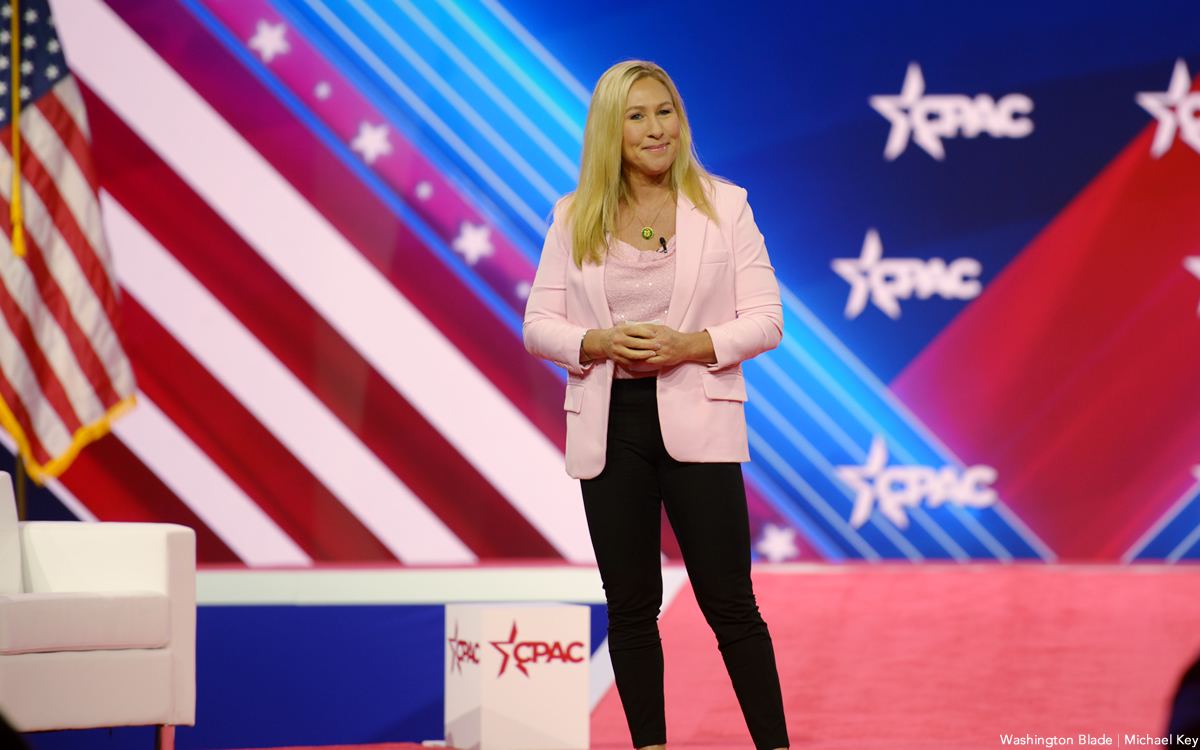
Notice that Marge Greene has not volunteered to read to kids. Maybe she struggles with the words, but I am sure the kids would help her sound them out. I am tired of the internet troll wannabees that are masquerading as Federal congress people now. All this is for is to get her name in the press, get hate generated at a marginalized group for doing what she can’t. It is for the clicks. It is the chimp standing on the rock beating her chest shouting “look at me”. The thing is we have tried to ignore it but they won’t go away, and the louder they get the more the fellow monkeys believe them. So we must take the offense and show them the clowns they are. We must fight back. Hugs.
Far-right congresswoman dead named transgender colleague
Far-right U.S. Rep. Marjorie Taylor Greene (R-Ga.) leveled the baseless and false accusation that U.S. Rep. Sarah McBride (D-Del.) a “groomer” and “child predator” in a post on X Monday, responding to a video shared by the anti-LGBTQ account Libs of TikTok in which the freshman congresswoman is seen reading to kids in a classroom.
According to the signage featured in the clip, McBride, who is the first transgender member of Congress, was participating in the Human Rights Campaign Foundation’s “Jazz and Friends National Day of School and Community Readings.”
The program is part of the organization’s Welcoming Schools initiative, which provides “trainings and resources for elementary school educators” to help “welcome diverse families, create LGBTQ and gender inclusive schools, prevent bias-based bullying, and support transgender and nonbinary students.”
Prior to her first election to the Delaware state legislature, McBride served as press secretary for HRC from 2016-2021.
Monday’s post was not the first time in which Greene has, without evidence, accused LGBTQ people and allies of child sexual abuse or grooming, often for their support of age-appropriate classroom instruction on matters of LGBTQ history, sexual orientation, and gender identity.
She is not alone. As culture wars over issues of sexual orientation and gender identity have intensified in recent years, conservatives have increasingly used false allegations of pedophilia, bringing back a smear that was historically used against gay, queer, and trans people but until recently was considered out of bounds in mainstream political discourse.
RAINN, a national anti-sexual violence group, has highlighted the ways in which these baseless allegations are harmful not just to LGBTQ people but also to children, because they can diminish the experience of survivors and steal the focus away from real cases of child sexual abuse.
After her election to Congress in November, Greene and other House Republicans like U.S. Rep. Nancy Mace of South Carolina began attacking McBride, personally — proposing rules to prohibit her from using women’s restrooms in the Capitol and deliberately dead-naming and misgendering her.
By contrast, McBride last week introduced bipartisan legislation with GOP U.S. Rep. Young Kim (Calif.) to protect consumers from fraudulent scams that offer false promises to repair poor credit scores, becoming the first first-year member to introduce a bill designed to help American families.
The Washington Blade has reached out to representatives from HRC, McBride’s office, and the Congressional Equality Caucus for comment on Greene’s post.




/https://static.texastribune.org/media/files/c90055f3b0c100c7842a6bf549dea640/011425%20Capitol%20Church%20Service%20EH%20TT%2014.jpg)
/https://static.texastribune.org/media/files/12a85b3c5d5127a0ac100aa0a40ceada/011425%20Capitol%20Church%20Service%20EH%20TT%2013.jpg)

 Scottie's Playtime