Sam Seder and Emma Vigeland unpack Bernie Sanders’s high-energy “Fight Oligarchy” rally featuring Zohran Mamdani. They discuss the disconnect between this grassroots enthusiasm and the lack of support from mainstream Democratic leaders. The MR crew argues that this demonstrates a core ideological conflict within the Democratic Party itself.
————————————————————————————————————————————-
Republican Josh Breecheen spews Islamophobic rhetoric at a recent town hall, connecting to a broader pattern of fear-mongering and political attacks against Muslims in America. Emma Vigeland and Francesca Fiorentini draw a direct line from the “Sharia law” conspiracies of the Bush and Obama eras to the current dehumanization of Muslim Americans and the use of technology from the war on terror against citizens at home.
——————————————————————————————————————————————–
The latest jobs report paints a grim picture, with job losses under Donald Trump’s administration mounting and key industries sliding into decline. While Trump’s team struggles to blame Biden while also promising explosive growth in the future, economists and analysts are sounding the alarm that a US recession, or worse, is near.
Billionaire hedge fund manager, Ray Dalio, is in the news for warning about the dangers of extreme wealth inequality. Sam Seder and Emma Vigeland highlight how Dalio’s comments, which are a major news story because of his status, echo what many others have been saying for years.
The U.S. government has acknowledged Donald Trump’s military strike on a boat in international waters, resulting in the deaths of 11 individuals. This action, targeting Venezuelans en route to Trinidad, has raised significant questions about Trump’s legal authority behind such a strike, particularly given the lack of clear evidence of the individuals’ involvement in drug trafficking or any threat to U.S. interests. Despite the gravity of the situation, the incident has reportedly garnered minimal attention in mainstream news, with some segments of the media appearing to endorse the action.
Trump was asked about a bizarre video showing someone throwing bags out of a second-floor White House window by Peter Doocy of Fox News. Trump insisted that the video was “AI-generated” because, according to him, the windows of the White House are “heavily armored and bulletproof,” sealed shut, and each one weighs 600 pounds. Trump also added that if anything “really bad” were to happen, he could simply “blame AI.”
This is an article but one I wanted to share as I will soon be posting on what is a corporate democrat. The Democratic Party went to the right under Pelosi’s management / guidance. She pushed that for two reasons, one to chase the mythical center voters that as the republicans went ever harder right the center moved and the Democratic Party rather than staying where they were moved right to keep the “center voters”. Also Pelosi and the older elected members of congress felt they needed corporate money so they had to stop fighting businesses so hard to help the workers and the poor to instead play nice with the upper incomes. Hugs
Ever since Donald Trump won the election last month, bringing the GOP not just the White House but the House, the Senate, and the popular vote for the first time in 20 years, Democratic pundits, consultants, elected officials, and influencers have written think pieces, taken to social media, and sat down on podcasts to theorize why Democrats lost in the spectacular fashion they did. They blame this constituency group or that constituency group, this policy tweak or that policy tweak, this campaign decision or that campaign decision, but the truth is very simple:The Democratic Party is trying to serve two masters—the people and the corporate donors. And until it picks the people over its corporate masters, the Democratic Party will keep losing.
For as long as I can remember, the Democratic Party has marketed itself as the party of working class people, while the Republican Party has been painted as the out-of-touch, elitist, uncool party. When you’ve marketed yourself as the party of the working class, you cannot spend years in power and say the economy is booming while people struggle to afford rent and groceries. It was out of touch, and Democrats lost credibility by claiming “Bidenomics” was successful.
While some will point to the fact that the U.S. economy fared better than others during the pandemic in terms of inflation, that does not mean the economy is “good.” Working-class Americans from all backgrounds have been hurting. I cannot go to someone’s doorstep in my hometown of Cleveland, Ohio, one of the poorest big cities in America where one out of every two children lives in poverty, and tell them that the economic pain they are feeling is not bad because other countries have it worse.
US President Joe Biden speaks to the press during his visit to the National Slavery Museum in Morro da Cruz, near Luanda, on December 3, 2024. ANDREW CABALLERO-REYNOLDS/AFP via Getty Images
Democrats should have spent the past four years tackling corporate greed aggressively, fighting for those communities hit hardest by this greed. They should have championed bold policies like Medicare for All and tuition-free college, things that would ease economic burdens on working class Americans.
“You should not go into debt if you get sick or pursue an education” would be one hell of a rallying cry for the Democratic Party. Currently, the Democratic Party cannot stand for policies that get at the root causes of corporate greed.
Why? Because the corporate donor class, those who write the checks, have ensured that those who hold titles in the Democratic Party do not champion policies that might hurt their profits.
When I hear from Democratic voters as I travel this country, I notice that most believe that Democrats broadly support things like universal healthcare and raising the minimum wage, but the Republican Party is standing in the way. While the Republican party does stand in the way of those policies, so too does the Democratic Party establishment. For instance, when Democrats held power in the Senate in 2021, the unelected Senate Parliamentarian, the official advisor to the United States Senate on the interpretation of Standing Rules of the United States Senate and parliamentary procedure, would not allow the Senate to vote on raising the federal minimum wage to $15 per hour. However, the Senate Parliamentarian can be overruled by the Vice President. The Biden-Harris administration decided against overruling the decision and allowing the Democratic-controlled Senate to vote on raising the minimum wage.
Decisions like these are made with donors in mind. I always say that inaction is bought. Eventually in politics, inaction catches up to you. On November 5, inaction caught up to the Democratic Party.
Everyday Americans do not live the same lives as the ultra-wealthy donor class. Everyday Americans sit at tables and make tough budget cuts for things they may need because bills start piling up. Sixty percent of Americans are living paycheck to paycheck. If Democrats continue to prioritize policies that benefit their ultra-wealthy donors over policies that help the working class, they can expect to see Republicans harness the anger of those feeling left behind.
On February 1, the Democratic National Committee will meet in Maryland to elect a new party Chair. Currently, the DNC Chairman is Jaime Harrison, formerly a lobbyist for tobacco companies, coal producers, and big banks. These are industries that have repeatedly hurt the working class.
If Democrats want to win back the trust of the people, they must champion bold policies that help people. To do that, they cannot take money from the very corporations that stand in the way of those bold policies.
When the Democratic National Committee votes on a new chair, it must be someone who commits to getting corporate money out of the party. Otherwise, Democrats will be stuck in the same position: fighting for corporate interests while trying to convince the people the party is on the side of the working class.
Nina Turner is a former Ohio state senator, a senior fellow at the Institute on Race, Power and Political Economy at the New School, and the founder of We Are Somebody.
The views expressed in this article are the writer’s own.
To win, Democrats must inspire the public in a fractured information age, engage meaningfully with the cultural shifts around race, gender, family, and migration, make democracy work despite obstructionists like Manchin and Sinema, and—most critically—deliver tangible results that improve people’s lives.
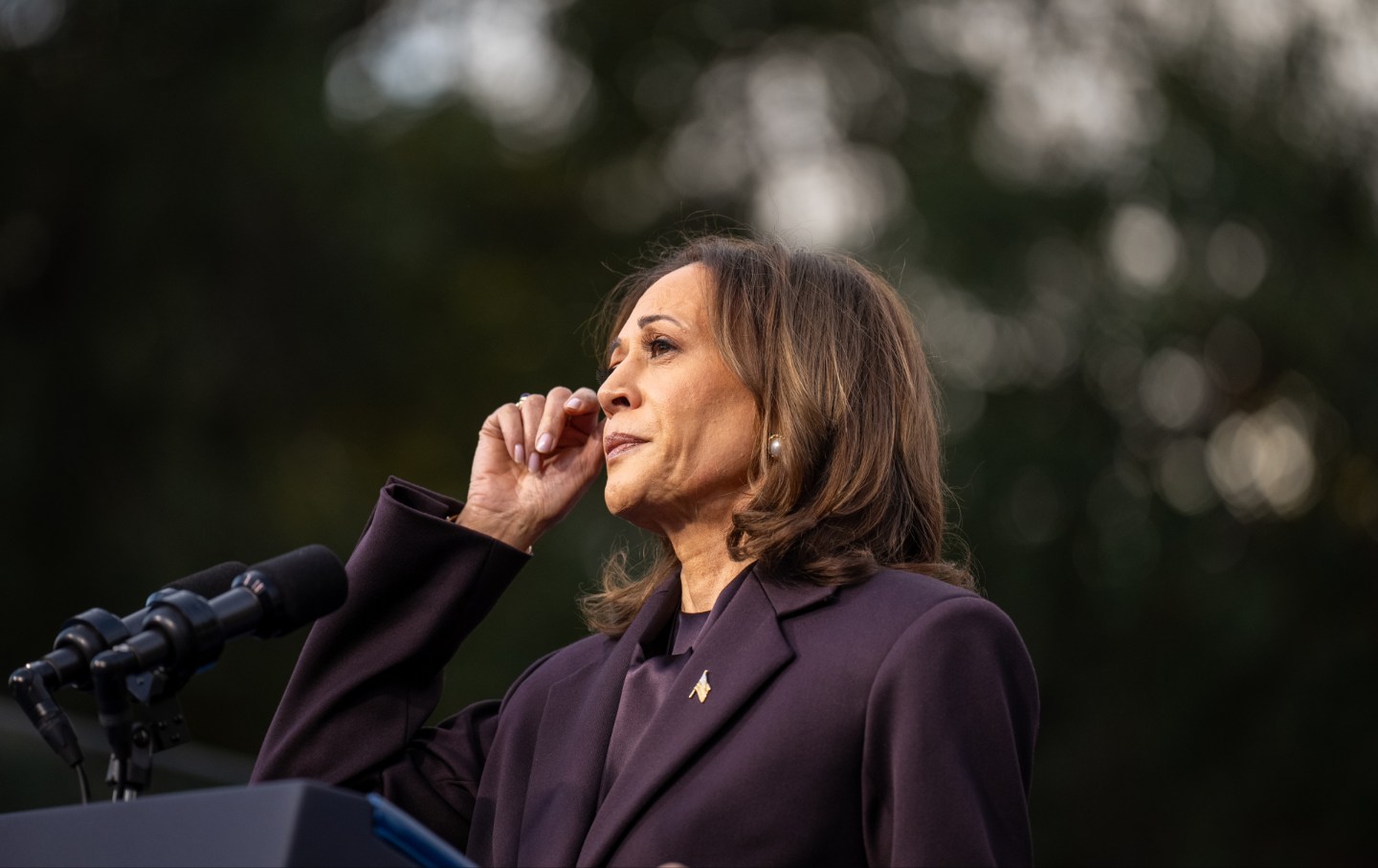
Kamala Harris pauses while speaking on stage as she concedes the election, at Howard University on November 6, 2024, in Washington, DC.
(Andrew Harnik / Getty Images)
In the aftermath of Kamala Harris’s loss, many pundits and politicians are turning to a familiar scapegoat. Critics like Adam Jentleson, a former aide to senators Harry Reid and John Fetterman, claim that “woke” advocacy groups made Democrats adopt extreme policies and drove voters away from the Democratic Party, sealing Donald Trump’s victory. But the truth is simpler—and more uncomfortable for the Democratic establishment. Despite the noise, voters didn’t reject Harris because of leftist rhetoric or activist slogans. They rejected her because she and her party failed to address the economic pain of working-class voters, who chose change over more of the same.
There’s a generation of Black and brown organizers, often the first in their families to step into positions of power, navigating institutions historically dominated by others. Alongside them are downwardly mobile white millennials, raised with expectations of stability but battered by an economy that delivers none. These activists, working within nonprofits and campaigns, fighting for causes once central to Democratic values, have somehow become scapegoats for the party’s electoral woes.
Why, after every electoral loss, is the left always the scapegoat? It’s easier to blame activists for pushing a progressive agenda than confront the real issue: the Democratic Party has long been shaped by far more powerful forces—corporate interests, lobbyists, and consultants—whose influence has neglected the real crises facing everyday Americans. We see this cycle again and again.
Contrary to establishment narratives, the Democratic leadership has often resisted advocacy organizations pushing for bold reforms on immigration, Big Tech, climate, debt, healthcare, rent, mass incarceration, Palestinian rights, and for policies like the Build Back Better agenda. This tension isn’t just about differing priorities—it reveals the actual balance of forces in the party. Corporate donors on Wall Street and Silicon Valley pour billions into campaigns, shaping agendas to suit their interests.A consultant class reaps millions from flawed strategies and failed candidates yet continues to fail upward, perpetuating a pattern of mediocrity. They, not progressives, are the roadblock preventing Democrats from becoming a populist force that could disrupt the status quo and win back voters of all stripes.
It was these elements within the party that kneecapped the Democrats’ most ambitious efforts to help ordinary Americans. The Biden administration entered with huge plans, notably Build Back Better, which would have delivered immediate relief: expanded child tax credits, free community college, universal child care and pre-K, paid leave, and more. Progressives pushed mightily for Build Back Better to pass. It was centrist obstruction—namely Senators Manchin and Sinema—that blocked those policies. The result was a patchwork of long-term measures like the Inflation Reduction Act and the Bipartisan Infrastructure Deal, whose benefits won’t be felt until 2025 at the earliest, if at all. By failing to pass Build Back Better, Democrats lost the chance to deliver easy-to-understand, tangible economic benefits and solidify their image as the party of working people.
And it was corporate Democrats—particularly lobbyists like Harris’s brother-in-law, former Uber executive Tony West, and David Plouffe—who held the most sway over Harris’s campaign. They advised her to cozy up to ultra-wealthy celebrities, Liz and Dick Cheney, and Mark Cuban, and avoid populist rhetoric that could have distanced her from the corporate elites who dominate the party. In 2024, the biggest spenders in Democratic Party politics weren’t progressives—it was AIPAC, cryptocurrency PACs, and corporate giants like Uber, all of whom poured millions into Democratic campaigns without regard for public opinion or the will of the people.
The Harris campaign’s messaging failed because, while populist economic appeals resonated with voters, the public face of the campaign was discouraged from embracing them. Instead, the focus was on issues like democracy and abortion, which, while important, couldn’t by themselves capture the priorities of working-class voters. In her public remarks and interviews, Harris, drawing on the advice of corporate leaders, frequently adopted a Wall Street–friendly tone that resonated with business interests, even if it alienated many of her core supporters.
It’s easy to forget that in 2020, Democrats saw historic turnout, driven largely by young voters who were energized by the largest left-wing and Black freedom protests since the 1960s. Biden won, and Democrats seemed to capture the nation’s hunger for justice and change, even as protesters marched with polarizing slogans like “Defund the Police.” Despite the controversy surrounding these messages, Biden triumphed decisively, calling for racial justice. The energy in the streets reflected a moment of possibility, a vision that real change was within reach. But by 2024, that grassroots energy had dissipated, and the Biden-Harris administration did little to revive it.
The loss of energy that Biden and Harris presided over showed up in youth turnout, which dropped to 42 percent in 2024, down from 50 percent in 2020 and closer to 2016 levels. However, battleground states saw higher youth turnout, around 50 percent. Young voters favored Harris over Trump by four points (51 percent to 47 percent), a sharp decline from Biden’s 25-point lead in 2020. The administration’s failure to offer a compelling narrative or deliver meaningful economic reforms alienated many young voters, especially on issues like unconditional weapons transfers to Israel.Trump capitalized on this vacuum with false promises and an anti-war message. Meanwhile, young workers, hit hardest by inflation and stagnant wages, saw little relief from the administration’s policies, leaving them feeling unseen and unmotivated. The simplest explanation may be the most accurate: after four years in opposition, Democrats under Biden had no plan for countering centrist obstruction from Manchin and Sinema. Nor did they have a clear strategy for transitioning to a new candidate, as Biden once suggested, or supporting a contested 2024 primary.
This disconnect was made worse by the administration’s lackluster communication strategy. Biden has avoided the media more than any modern president. In contrast, Mexico’s President Andrés Manuel López Obrador (AMLO) dominated the narrative with daily, three-hour, entertaining, and combative press conferences that have earned him one of the largest YouTube followings in Mexico. AMLO’s approach to the attention economy helped his party to secure another presidential term, defying global anti-incumbent trends.
Biden and Harris’s reluctance to embrace what some Democratic elites might view as “tasteless” or “uncouth” populist appeals allowed their opponents to seize the public’s attention, creating a void that ultimately drained the administration of the energy and momentum it once had. Trump’s simple, emotionally charged narrative about fixing the economy, winding down foreign wars, restoring order, and protecting “traditional” American values may have been filled with bigotry and lies. But it commanded the public discourse, pushing the Biden-Harris administration off center stage.
It’s true that some younger leftists embrace purity politics. But as Semafor’s Benjy Sarlin points out, the most polarizing moments in recent Democratic campaigns—like Beto O’Rourke’s “Hell yes” remark on gun confiscation or Julián Castro’s call to decriminalize border crossings during the 2020 primaries—were driven by the candidates themselves, not external activist pressure. Why did Kamala Harris take the positions she did in 2019? Because she was trying to distinguish herself in a crowded Democratic primary, where Bernie Sanders and Elizabeth Warren were surging and Biden seemed to have the center locked down. Ultimately, these moves were about gaining media attention in a competitive primary, not a direct result of pressure from advocacy groups—many of which, like Sunrise Movement, Working Families Party, and Justice Democrats, with which I was affiliated, have spent years working within the system to create lasting change and deliver real policy results that resonate with voters
The backlash against “wokeness” often rests on vague critiques, offering little more than cultural hand-wringing without any clear solutions. And when those solutions do emerge, they’re often morally indefensible. Jentleson’s criticism of progressive advocacy groups rings especially hollow when you consider the track record of his own political mentors. In 2010, his former boss, Harry Reid, publicly opposed the “Ground Zero mosque,” a proposed Islamic cultural center near the World Trade Center. While technically acknowledging the developers’ rights, Reid capitulated to Republican culture wars by suggesting Muslim Americans build the mosque elsewhere. This wasn’t a principled stance—it was a political maneuver that lent legitimacy to Islamophobia, feeding into narratives from figures like Sarah Palin and Newt Gingrich, who compared the center to a Nazi building next to the Holocaust Museum. In doing so, Reid allowed bigotry to flourish, leaving a vulnerable community to bear the brunt of political scapegoating.
From asylum seekers to transgender rights, today’s debates mirror the “Ground Zero mosque” controversy. From 2017 to 2020, Democrats, including Harris, were eager to condemn Trump’s cruel immigration policies. Now, however, they seem more focused on dodging the topic altogether. These are issues demanding a new approach, one that emphasizes year-round persuasion and agenda-setting over political convenience. Thermostatic public opinion might be a reality of politics, but voters appreciate when you stand for something with conviction and authenticity.
This is where movements and parties work best together: movements push the boundaries of what’s possible, creating the political space to reframe issues like transgender rights and immigration in majoritarian terms, and politicians follow when the political weather aligns with their self-interest. These two sides will clash, but it’s in that tension that progress lies.
Democrats can’t be scared of that process. They must stop ceding the narrative to far-right framing and instead invest in populist campaigns that aren’t afraid to antagonize villains, highlight the humanity of marginalized communities, and expose the Republican Party’s divide-and-conquer tactics. Only then can they build the political power necessary to shift the conversation and secure real change.
Anyone who knows me knows I’m critical of the academic jargon and misguided tactics that sometimes dominate activist circles. But to blame activists for the party’s struggles is to overlook the much larger battles they’re engaged in: 11 million undocumented Americans left in limbo, a prison system that incarcerates more people than any other in history, and an economy where three people hold more wealth than the bottom half of the country. These are the moral tests of our time—tests that any party claiming to stand for justice will be judged by. Scapegoating those pushing for change isn’t just unfair; it’s counterproductive, fracturing necessary coalitions and undermining the ability of the party to tackle the crises ahead.
Harris’s defeat should prompt serious introspection for Democrats—but not the narrow, one-sided critique Jentleson offers. Everyone, including progressive advocacy groups, has lessons to learn. The path forward isn’t about hippie-punching—it never has been. Time and again, the center-left’s response to electoral defeat has been to blame the unpopular and disruptive activists pushing for progress, whether abolitionists, suffragettes, labor unions, civil rights leaders, or environmentalists.
History reveals that oversimplified approaches often sidestep the harder questions. Success doesn’t come from rejecting the complexity of a diverse coalition but from learning to navigate it. To win, Democrats must inspire the public in a fractured information age, engage meaningfully with the cultural shifts around race, gender, family, and migration, make democracy work despite obstructionists like Manchin and Sinema, and—most critically—deliver tangible results that improve people’s lives.And if the corporate, status quo–loving forces within the party are standing in the way of that mission, they must be moved aside.
Success will come not by pointing fingers but by telling a story of transformation—with clear villains, bold vision, and conviction that democracy can, indeed, make a difference.
about what was happening with the Dem presidential ticket prior to Sunday’s culmination. It hasn’t been easy for any of us to just pivot to our new candidate, though her wondrousness makes it easier. There are still feelings about it. I like how this writer termed it.
Joe Did What? Trafalgar Edition by Yastreblyansky
“No captain can do very wrong if he places his ship alongside that of the enemy.”Read on Substack
Well, I guess this certainly does change everything, and that’s refreshing.
I’m going to stay angry for a long time at The Times and Politico and other big media and the “liberal” tech billionaires for the dishonest backdoor trick they pulled, when they couldn’t succeed in turning the public against Biden and shifted instead to convincing us that we had turned against Biden by ourselves, or rather that our neighbors had, through the bogus “age issue”, warning us not that Biden was a bad president, but that he’d lose because other people thought he was too old, and our punishment for supporting Biden would be another Trump term (on the basis of a polling model that has consistently failed by underestimating the Democratic vote for six years now). They recognized our deep fear of the consequences of another Trump term and exploited it, in a way that actually made Trump’s reelection more likely, using the debate disaster as evidence of a permanent degeneration (which it obviously wasn’t—Biden had never showed up in that condition before and never has since). It was irresponsible and disgusting.
I’m not too angry with the congressional party leaders, or the “centrist” representatives in their precarious suburban seats, or even the bedwetter commentariat. The fear is real, and it’s justified. What could be lost in another four years of Trumpery is almost incalculable; I’m thinking especially of the backsliding in the elimination of fossil fuels, but the “deconstruction of the administrative state” as prefigured in the Project 2025 document turns the entire civil service into an easily corrupted tool for tearing down regulations, and reduces the Justice Department into the president’s personal police agency. It really is the end of the republic, alongside plans for a federal ban on abortion, vigilante takeovers of school libraries, the insane powers for evil conceded to the presidency by the Supreme Court even as it strips the office of its power to do good. The thing is, fear is a lousy counselor, and their Fantasy Politics League plan to get rid of Biden by obliterating the primary results with some kind of pantomime competition, before or during the Democratic convention, as somebody leaked the plan to the abominable Mark Halperin (now working for Newsmax), was a terrible, senseless plan that would have flung us into even worse uncertainty than we already had. Don’t panic.
I’m certainly not angry at Biden for making the decision. Far from it! Remember that (as @nycsouthpaw just pointed out) there are two parts to what he did: stepping down from the campaign, and giving his endorsement to Vice President Harris. The first was the thing he was being pressured to do by the congressional party leadership, the timorous representatives from Nassau County and North Jersey and the Hudson Valley, the readers of Friedman and Brooks and Ezra Klein, and so on; the second was the thing those people absolutely didn’t intend for him to do, spoiling the open convention plan. He was not supposed to endorse Harris.
So it was one of those audacious, perfectly timed Biden moves that looks like a gaffe (the most famous example would be the one during his vice presidency that made marriage equality a federal reality) and changes the whole situation. Harris quickly announced her candidacy (to “earn and win” the nomination, she said, carefully), all the other conceivable candidates endorsed her too, and the campaign had raised $50 million from small donors ($100 million after 24 hours, suck on that, billionaires). Like one-eyed, one-armed Nelson at Trafalgar—I’m not kidding, folks!—the 81-year-old Biden had sacrificed his own (political) life, but had won the battle, for his legacy of a better, more free and equal America.
At least I hope so. A battle, of course, not the war. Anyway, it seems clear that Democrats are in a much better position than they were a couple of days ago, with a unity in the party we’ve seen nothing like in years, pro-Biden and anti-Biden voices embracing in the social media. Of 263 Democratic congressmembers and 23 governors, the Washington Post tally 24 hours after the announcements has 243 who have endorsed Harris and 43 who haven’t (non-endorsers include convicted felon Robert Menendez and the federally indicted Henry Cuellar, but the New York and New Jersey centrists I’ve been watching the most have endorsed, except for that freak Tom Suozzi, and so, I’m glad to report, has Speaker Emerita Pelosi). There are no alternative candidates except Marianne Williamson (old Joe Manchin sent out feelers, but was roundly rebuffed). As of this afternoon convention delegations from ten states—Tennessee, South Carolina, North Carolina, New Hampshire, Florida, Louisiana, Kentucky, Pennsylvania, Alaska, and Wisconsin, plus Guam, had pledged support to Harris, for a total of 770 delegates out of the needed 1,986.
Meanwhile the Trump campaign, now led (with Biden’s withdrawal) by the oldest and unquestioned most cognitively disabled presidential candidate in history, is having to completely reconfigure its tactics. They are running ads complaining that Vice President Harris laughs too much and that she’s opposed to plastic drinking straws. Their vice presidential candidate “JD” Vance looks like a feeble impostor and baffles his audiences with his complaints.
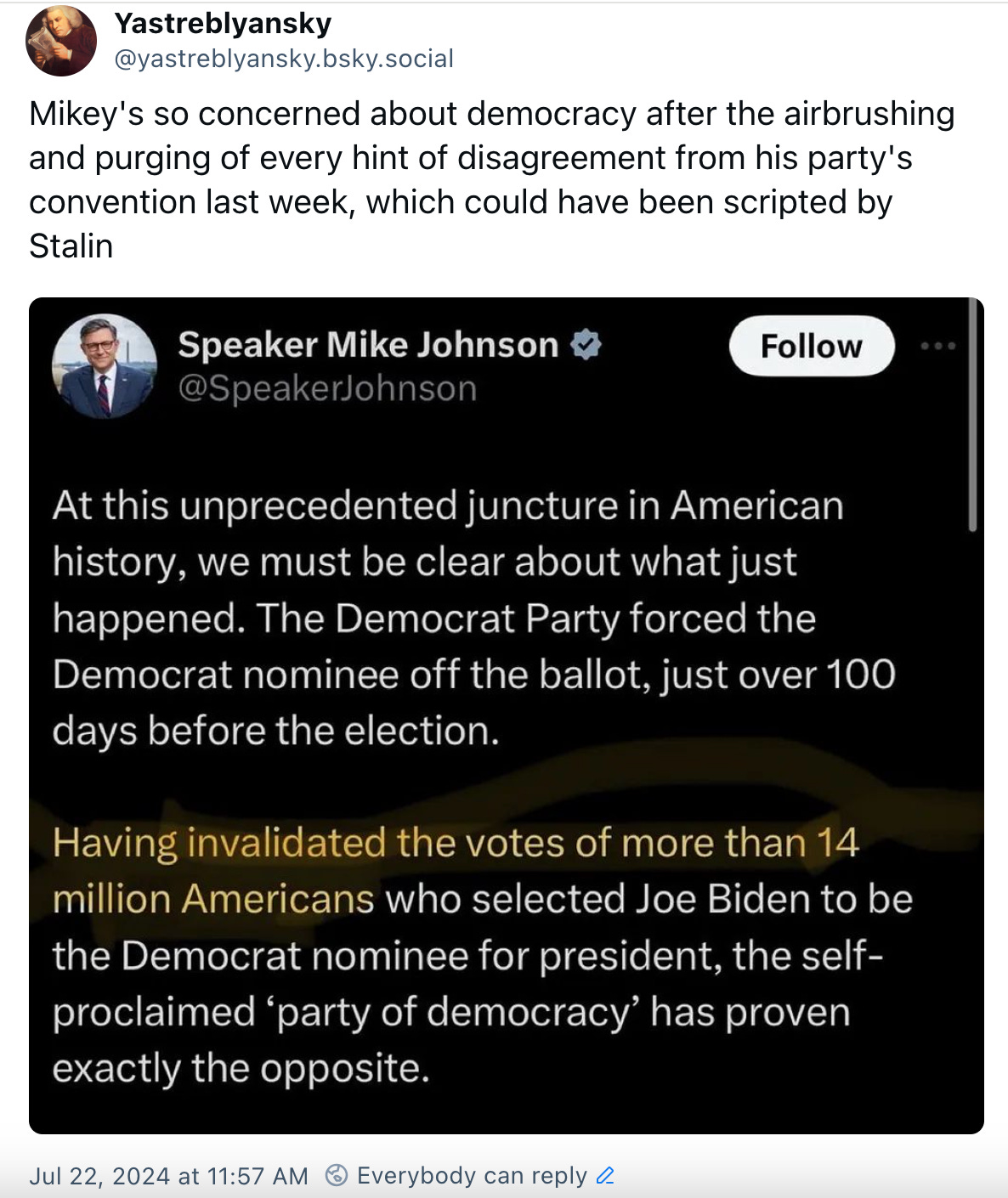
Republicans have been trying to characterize the surge of support for Harris as some kind of coup attempt against Biden, as if Biden hadn’t sparked himself it with his bold move, and as undemocratic, which is somewhat ironic—
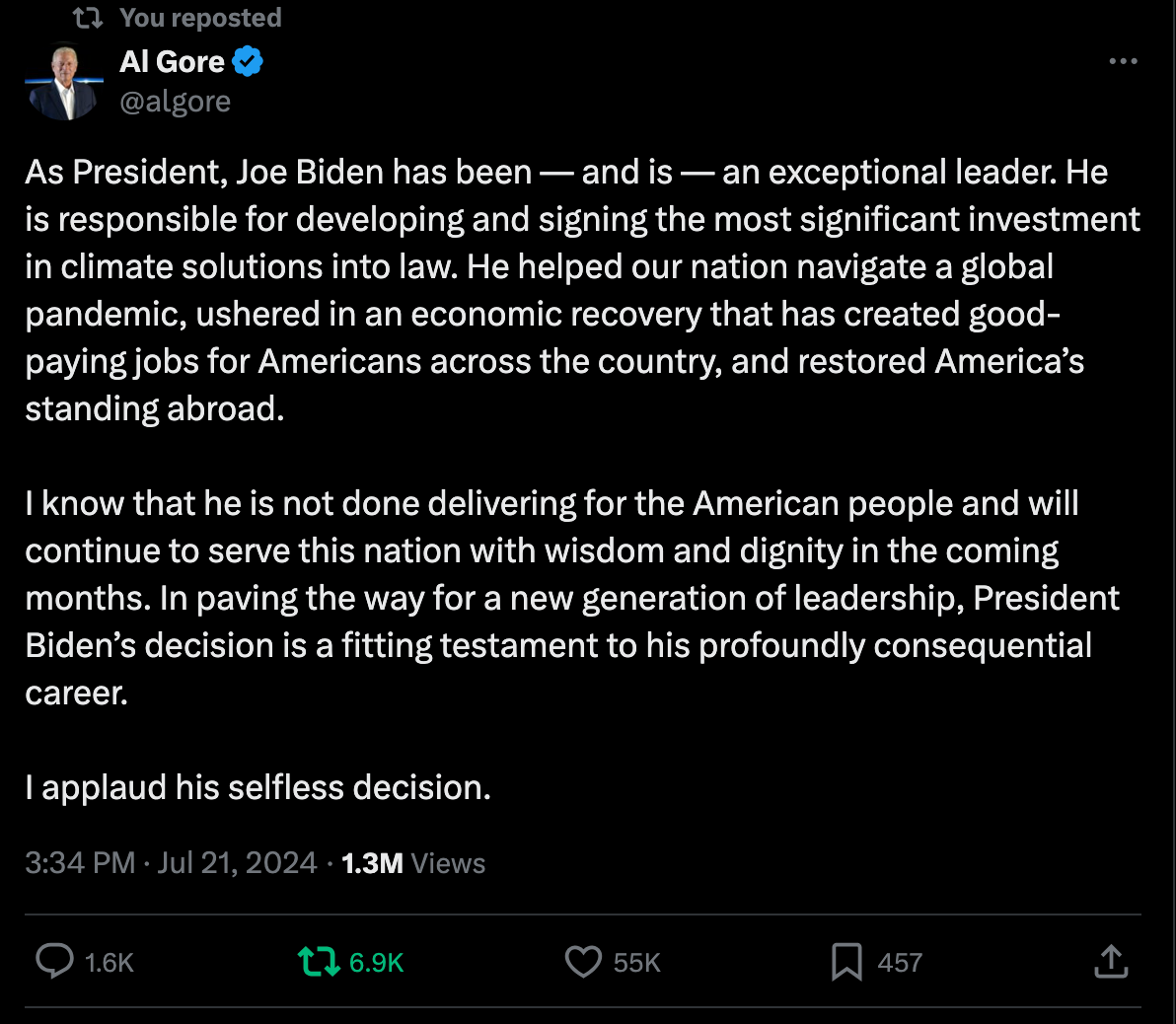
One of the most gratifying aspects of the excitement is the way the discussion of Biden’s age has given way to the discussion of his accomplishments from all quarters:
I’ll be getting to that, no doubt, but in the meantime check out this magisterial survey, “Why Biden Outclasses Every American President Since FDR,” by Nathan Newman.
Oh, and maybe one of his most surprising accomplishments will be the election of the nation’s first Black woman president.
(For me, that cleans the Anita Hill slate. It may not for her, and I wouldn’t blame her, but I’m over it now that this has happened. People learn, grow, and remediate wrongs over time. Well, good people do.)

 Newsweek Is A Trust Project Member

 Scottie's Playtime