A crop field in Oxnard, California, U.S., June 18, 2025. REUTERS/Pilar Olivares
Lisa Tate is a sixth-generation farmer in Ventura County, California, an area that produces billions of dollars worth of fruit and vegetables each year, much of it hand-picked by immigrants in the U.S. illegally.
Tate knows the farms around her well. And she says she can see with her own eyes how raids carried out by agents from U.S. Immigration and Customs Enforcement in the area’s fields earlier this month, part of President Donald Trump’s migration crackdown, have frightened off workers.
“In the fields, I would say 70% of the workers are gone,” she said in an interview. “If 70% of your workforce doesn’t show up, 70% of your crop doesn’t get picked and can go bad in one day. Most Americans don’t want to do this work. Most farmers here are barely breaking even. I fear this has created a tipping point where many will go bust.”
In the vast agricultural lands north of Los Angeles, stretching from Ventura County into the state’s central valley, two farmers, two field supervisors and four immigrant farmworkers told Reuters this month that the ICE raids have led a majority of workers to stop showing up.
That means crops are not being picked and fruit and vegetables are rotting at peak harvest time, they said.
One Mexican farm supervisor, who asked not to be named, was overseeing a field being prepared for planting strawberries last week. Usually he would have 300 workers, he said. On this day he had just 80. Another supervisor at a different farm said he usually has 80 workers in a field, but today just 17.
A Guatemalan immigrant works on a crop field at a farm in the Kern County, California, U.S., June 19, 2025. REUTERS/Pilar Olivares
BAD FOR BUSINESS
Most economists and politicians acknowledge that many of America’s agricultural workers are in the country illegally, but say a sharp reduction in their numbers could have devastating impacts on the food supply chain and farm-belt economies.
Douglas Holtz-Eakin, a Republican and former director of the Congressional Budget Office, said an estimated 80% of farmworkers in the U.S. were foreign-born, with nearly half of them in the country illegally. Losing them will cause price hikes for consumers, he said.
“This is bad for supply chains, bad for the agricultural industry,” Holtz-Eakin said.
Over a third of U.S. vegetables and over three-quarters of the country’s fruits and nuts are grown in California, according to the California Department of Food and Agriculture. The state’s farms and ranches generated nearly $60 billion in agricultural sales in 2023.
If they show up to work, they don’t know if they will ever see their family again.
Migrant worker
Of the four immigrant farmworkers Reuters spoke to, two are in the country illegally. These two spoke on the condition of anonymity, out of fear of being arrested by ICE.
One, aged 54, has worked in U.S. agricultural fields for 30 years and has a wife and children in the country. He said most of his colleagues have stopped showing up for work.
“If they show up to work, they don’t know if they will ever see their family again,” he said.
The other worker in the country illegally told Reuters, “Basically, we wake up in the morning scared. We worry about the sun, the heat, and now a much bigger problem – many not returning home. I try not to get into trouble on the street. Now, whoever gets arrested for any reason gets deported.”
Item 1 of 4 An immigrant worker harvests crops during the weekend, as labor shortages risk leaving fields unpicked, in Oxnard, California, U.S., June 22, 2025. REUTERS/Pilar Olivares
[1/4]An immigrant worker harvests crops during the weekend, as labor shortages risk leaving fields unpicked, in Oxnard, California, U.S., June 22, 2025. REUTERS/Pilar Olivares
To be sure, some farmworker community groups said many workers were still returning to the fields, despite the raids, out of economic necessity.
The days following a raid may see decreased attendance in the field, but the workers soon return because they have no other sources of income, five groups told Reuters.
Workers are also taking other steps to reduce their exposure to immigration agents, like carpooling with people with legal status to work or sending U.S. citizen children to the grocery store, the groups said.
ICE CHILL
Trump conceded in a post on his Truth Social account this month that ICE raids on farmworkers – and also hotel workers – were “taking very good, long-time workers away” from those sectors, “with those jobs being almost impossible to replace.”
Trump later told reporters, “Our farmers are being hurt badly. They have very good workers.” He added, “They’re not citizens, but they’ve turned out to be great.”
He pledged to issue an order to address the impact, but no policy change has yet been enacted.
Trump has always stood up for farmers, said White House spokeswoman Anna Kelly in response to a request for comment on the impact of the ICE raids to farms. “He will continue to strengthen our agricultural industry and boost exports while keeping his promise to enforce our immigration laws,” she said.
Bernard Yaros, Lead U.S. Economist at Oxford Economics, a nonpartisan global economics advisory firm, said in a report published on June 26 that native-born workers tend not to fill the void left by immigrant workers who have left.
“Unauthorized immigrants tend to work in different occupations than those who are native-born,” he said.
ICE operations in California’s farmland were scaring even those who are authorized, said Greg Tesch, who runs a farm in central California.
Farmers and laborers in California told Reuters that many field workers have stopped showing up to pick fruit and vegetables. Emma Jehle reports.
“Nobody feels safe when they hear the word ICE, even the documented people. We know that the neighborhood is full of a combination of those with and without documents,” Tesch said.
“If things are ripe, such as our neighbors have bell peppers here, (if) they don’t harvest within two or three days, the crop is sunburned or over mature,” said Tesch. “We need the labor.”
The Reuters Tariff Watch newsletter is your daily guide to the latest global trade and tariff news. Sign up here.
Reporting by Tim Reid, Sebastian Rocandio, Pilar Olivares and Leah Douglas. Editing by Mary Milliken and Rosalba O’Brien.
No one forced these people to read the book. But just having the book there in open view enraged them. How dare this librarian admit that trans kids exist, that they are real. They wouldn’t have an issue with a book on child angels or mythical creatures, but humans that are different from the majority straight cis must be denied and destroyed. Forbidden knowledge seems big in the Christian extremest world. They seem to live for and delight in harming anyone or thing different from the way they want the world to be. They seem to think it fine for them to force their views on others but requiring factual teaching about science, biology, geology, race history is oppressing them. Imposing the idea that some people dress up in costumes to read books to children on them is a violation of their rights, but a kid’s desire to see themselves represented in media they feel they have a right to prevent. Hugs
The cover of the offending book, When Aidan Became a Brother by transgender male author Kyle Lukoff. | Lee & Low Books
Lavonnia Moore, a 45-year-old library manager, had worked at the Pierce County Library in Blackshear, Georgia, for 15 years. She was ultimately let go when a Christian extremist group filed a complaint to the library after Moore approved the display of a children’s book about a transgender boy.
According to Moore, the display (entitled “Color Our World”) included the book When Aidan Became a Brother (by trans male author Kyle Lukoff), a story about a family accepting a trans child named Aiden while also preparing for the birth of Aiden’s sibling. Library volunteers created the display as a part of a regional-wide summer theme featuring books that celebrate diversity.
“I simply supported community involvement, just as I have for other volunteer-led displays. That’s what librarians do — we create space for everybody… I did not tell the parents and children what they could or could not add to the display, just as I do not tell them what they can or cannot read,” she wrote in a statement.
However, the book caught the attention of a group calling themselves the Alliance for Faith and Family (AFF), not to be confused with the anti-LGBTQ+ legal group Alliance Defending Freedom. The AFF had previously been in the public eye for demanding the removal of a mural in the Waycross-Ware County Public Library, which included a Pride theme declaring, “Libraries Are For Everyone.”
The AFF campaigned on Facebook, urging their followers to pray and take a few moments out of their day to email the Three Rivers Library System and Pierce County Commissioners to “put a stop to this and show them the community supports them in taking a stand against promoting transgenderism at our local library,”
In an update post, the group wrote, “The display has been removed, and LaVonnia is no longer the Pierce County Library Manager. Please thank the Pierce County Commissioners and Three Rivers Regional Library System for quickly addressing our concerns.”
Moore and her sister Alicia confirmed that LaVonnia Moore had been fired. A statement to The Blackshear Times from the Three Rivers Library System Director Jeremy Snell explained that the library board leadership decided to move to new leadership for the Pierce County Library. He specifically cited the display of an “inappropriate” book as his reasoning.
“The library holds transparency and community trust in the highest regard,” Snell said.
“Instead of investigating, talking to me or my team, or exploring any kind of fair process, they used the ‘at-will’ clause in my contract to terminate me on the spot. No warning. No meeting. No due diligence. Just the words ‘poor decision making’ on a piece of paper after 15 years of service,” Moore claimed.
“I am just heartbroken,” she said of her dismissal.
According to Moore’s sister Alicia, “She messaged the family group and said ‘I was just fired.’”
“I don’t think she’s doing emotionally good, because imagine having to pack up 15 years in two days,” Alicia Moore told First Coast News.
“She’s heartbroken that a place she gave so much of herself to turned its back on her so quickly. And yes, she’s still in disbelief. She didn’t expect to be punished for doing her job with integrity and love for all patrons — especially children.” the sister explained.
The sisters are currently seeking legal counsel, and Alicia is urging people to reach out to the library board and county commissioners.
“I’m hoping the same method will be useful to get her justice,” Alicia said.
Subscribe to the LGBTQ Nation newsletter and be the first to know about the latest headlines shaping LGBTQ+ communities worldwide.
Crackdown on Pride is part of effort to curb democratic freedoms ahead of a hotly-contested election next year
Tens of thousands march against Hungary’s government for LGBT rights – video
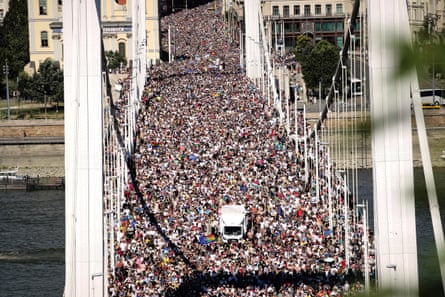
Tens of thousands of people have taken to the streets of Budapest in defiance of the Hungarian government’s ban on Pride, heeding a call by the city’s mayor to “come calmly and boldly to stand together for freedom, dignity and equal rights”.
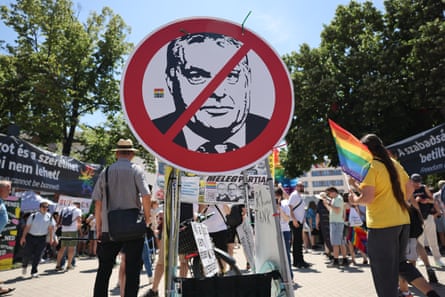
Jubilant crowds packed into the city’s streets on Saturday, waving Pride flags and signs that mocked the country’s prime minister, Viktor Orbán, as their peaceful procession inched forward at a snail’s pace.
Organisers estimated that a record number of people turned up, far outstripping the expected turnout of 35,000-40,000 people.
“We believe there are 180,000 to 200,000 people attending,” the president of Pride, Viktória Radványi told AFP. “It is hard to estimate because there have never been so many people at Budapest Pride.”
The mass demonstration against the government was a bittersweet marking of Budapest Pride’s 30th anniversary; while the turnout on Saturday was expected to reach record levels, it had come after the government had doubled down on its targeting of the country’s LGBTQ+ community.
Hungary Pride participants in the march cross the Elisabeth Bridge in Budapest, Hungary. Photograph: Rudolf Karancsi/AP
“We came because they tried to ban it,” said Timi, 49. The Hungarian national was marching with her daughter, Zsófi, 23, who had travelled from her home in Barcelona to join the rally.
After the ruling Fidesz party, led by the rightwing populist Orbán, fast-tracked a law that made it an offence to hold or attend events that involve the “depiction or promotion” of homosexuality to minors, many Hungarians vowed to show their disapproval by attending Pride for the first time.
Viki Márton was among those who had made good on the promise, turning up with her nine-year-old daughter.
The pair had come equipped with hats, water spray, and a swimsuit, more worried about heat than rightwing protesters. “I want her to see the reality,” said Márton. “And I’m so excited to be here!”
Tens of thousands of Hungarians took to the streets on Saturday, despite Orbán’s warning on Friday that those who attend or organise the march will face ‘legal consequences’. Photograph: János Kummer/Getty Images
Earlier this month, police announced they would follow the government’s orders and ban the march. The progressive mayor of Budapest, Gergely Karácsony, was swift to respond, saying that the march would instead go ahead as a separate municipal event, with Karácsony describing it as a way to circumvent the need for official authorisation.
On Saturday, the mayor reiterated why the city had decided to host the event, hinting at how the march had become a symbol of discontent against a government that has long faced criticism for weakening democratic institutions and gradually undermining the rule of law.
“The government is always fighting against an enemy against which they have to protect Hungarian people,” said Karácsony.
“This time, it is sexual minorities that are the target … we believe there should be no first and second class citizens, so we decided to stand by this event.”
Akos Horvath, 18, who had travelled two hours from his city in southern Hungary to take part in the march, described it as an event of “symbolic importance”.
Speaking to news agency AFP, he added: “It’s not just about representing gay people, but about standing up for the rights of the Hungarian people.”
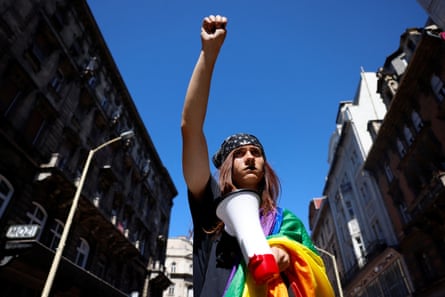
The sentiment was echoed by fellow marcher Eszter Rein-Bódi. “This is about much more, not just about homosexuality,” Rein-Bódi told Reuters “This is the last moment to stand up for our rights.”
‘This is about much more, not just about homosexuality,’ one participant told Reuters. Photograph: Lisa Leutner/Reuters
Tens of thousands of Hungarians, including senior citizens and parents with their children, plus politicians and campaigners from 30 countries, took to the streets on Saturday, despite Orbán’s warning on Friday that those who attend or organise the march will face “legal consequences”.
The Hungarian prime minister sought to minimise concerns over violence, however, saying that Hungary was a “civilised country” and police would not “break it up … It cannot reach the level of physical abuse”.
Still, in a video posted to social media this week, the country’s justice minister, Bence Tuzson, warned the Budapest mayor that organising a banned event or encouraging people to attend is punishable by up to a year in prison.
Speaking to reporters on Friday, the mayor brushed off the threat and downplayed concerns that police would later impose heavy fines on attende s. “Police have only one task tomorrow: to guarantee the safety and security of those gathered at the event,” said Karácsony.
The potential for violence had been amplified after three groups with ties to the extreme right said they were planning counter-marches. As the Pride march got under way, local news site Telex reported that the route of the march had to be changed after one of these groups blocked off a bridge.
Analysts had described the government’s bid to crackdown on Pride as part of a wider effort to curb democratic freedoms ahead of a hotly contested national election next year.
Orbán is facing an unprecedented challenge from a former member of the Fidesz party’s elite, Péter Magyar, leading Pride organisers to suggest they are being scapegoated as Orbán scrambles to shore up support among conservative voters.
Orbán’s government had also prompted concerns across Hungary and beyond after it said it would use facial recognition software to identify people attending any banned events, potentially fining them up to €500 (£425).
Ahead of the march, as campaigners scrambled for clarity on whether or how this technology would be used, AFP reported that newly installed cameras had appeared on the lamp-posts that dotted the planned route.
The threat had been enough to rattle some. Elton, 30, a Brazilian living in Hungary wore a hat and sunglasses as he took part on Saturday, explaining that he had been worried about jeopardising his job and immigration status, but that his Hungarian boyfriend had persuaded him to attend.
“This is my second time at Pride, but the first time I feel insecure about it,” he said.
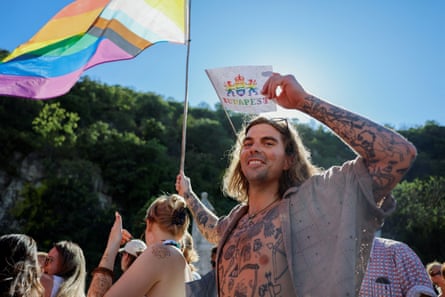
Orbán’s government had also prompted concerns across Hungary and beyond after it said it would use facial recognition software to identify people attending any banned events. Photograph: Lisa Leutner/Reuters
Mici, a 21-year-old Budapest resident, said she had attended Pride marches in the past but this time had weighed whether to join in after she was spooked by reports of the facial recognition system.
“At first, I was scared to come out because of the news, but I feel safe with so many people.”
She hoped that the massive turnout for the march would be enough to push the Orbán government to change its stance.
“I think the crowd that has come from across Europe, the record numbers, will make Hungarian people see that this cause is well-supported.”
BREAKING: The three liberal Supreme Court justices release a scathing dissent after the Republican-controlled judges issue an anti-LGBTQ ruling that “ushers in a new reality” that will deny children the “opportunity to practice living in our multicultural society.”
This is only the third time that Sonia Sotomayor has read her dissent from the bench, indicating strong disapproval…
“Exposing students to the ‘message’ that LGBTQ people exist, and that their loved ones may celebrate their marriages and life events, the majority says, is enough to trigger the most demanding form of judicial scrutiny,” Justice Sonia Sotomayor wrote, supported by justices Elena Kagan and Ketanji Brown Jackson.
The ruling was made in favor of a group of parents who want to opt their children out of elementary school lessons that include LGBTQ storybooks. The case will now go back to a lower court for final decision on whether schools must provide such an opt-out option.
Thanks to the Republican justices, school districts must now inform parents in advance of the books being read in class and allow them to pull their children if they choose. For underfunded schools, this additional burden will be too much to bear. It adds administrative costs and distracts teachers who are already struggling to teach overcrowded classrooms. Taken in tandem with the Trump administration’s efforts to completely eliminate the Department of Education, it’s a grim omen of things to come.
Crucially, the decision is a blatant handout to the religious radicals who helped put Donald Trump in power, which in turn tilted the court even more conservative. Such people want to pretend that LGBTQ people don’t even exist.
“Given the great diversity of religious beliefs in this country, countless interactions that occur every day in public schools might expose children to messages that conflict with a parent’s religious beliefs. If that is sufficient to trigger strict scrutiny, then little is not,” Sotomayor continued.
She predicted that the decision will cause “chaos for this Nation’s public schools.”
“Requiring schools to provide advance notice and the chance to opt out of every lesson plan or story time that might implicate a parent’s religious beliefs will impose impossible administrative burdens on schools,” she continued. “The harm will not be borne by educators alone: Children will suffer too. Classroom disruptions and absences may well inflict long-lasting harm on students’ learning and development.”
“Worse yet, the majority closes its eyes to the inevitable chilling effects of its ruling,” she went on. “Many school districts, and particularly the most resource strapped, cannot afford to engage in costly litigation over opt-out rights or to divert resources to tracking and managing student absences. Schools may instead censor their curricula, stripping material that risks generating religious objections.”
“The Court’s ruling, in effect, thus hands a subset of parents the right to veto curricular choices long left to locally elected school boards,” she added. “Because I cannot countenance the Court’s contortion of our precedent and the untold harms that will follow, I dissent.”
Here’s how the deficit performed under Republican and Democratic presidents, from Reagan to Trump
This article was updated Aug. 2 to include a graph with the annual federal deficit in constant dollars.
A viral post portrays Democrats, not Republicans, as the party of fiscal responsibility, with numbers about the deficit under recent presidents to make the case.
Alex Cole, a political news editor at the website Newsitics, published the tweet July 23. Within a few hours, several Facebook users postedscreenshots of the tweet, which claims that Republican presidents have been more responsible for contributing to the deficit over the past four decades.
Those posts racked up several hundred likes and shares. We also found a screenshot on Reddit, where it has been upvoted more than 53,000 times.
“Morons: ‘Democrats cause deficits,’” the original tweet reads.
Screenshots of the tweet on Facebook were flagged as part of the company’s efforts to combat false news and misinformation on its News Feed. (Read more about our partnership with Facebook.)
At PolitiFact, we’vereportedextensively on how Republicans and Democrats often try to pin the federal deficit on each other — muddying the facts in the process. So we wanted to see if this Facebook post is true.
We reached out to Newsitics, the media outlet that Cole founded and works for, to see what evidence he used to compose the tweet and didn’t hear back. Our review shows the numbers basically check out, but they don’t tell the full story.
What even is the deficit?
Some people confuse the federal deficit with the debt — but they’re two separate concepts.
The Department of the Treasury explains it like this: The deficit is the difference between the money that the government makes and the money it spends. If the government spends more than it collects in revenues, then it’s running a deficit.
The federal debt is the running total of the accumulated deficits.
Following the money
Now let’s take a closer look at each president’s impact on the federal deficit.
To check the numbers in Cole’s tweet, we went to the Federal Reserve Bank of St. Louis, which has an interactive database for these kinds of figures. Here’s what we found for each claim:
“(President Ronald) Reagan took the deficit from 70 billion to 175 billion.” This is more or less accurate. The federal deficit went from about $78.9 billion at the beginning of Reagan’s presidency to $152.6 billion at the end of it. At points between 1983 and 1986, the deficit was actually more than $175 billion.
“(George H.W.) Bush 41 took it to 300 billion.” Close, but not exactly. The number was around $255 billion at the end of Bush’s term. The deficit spiked at around $290.3 billion the year before he left office.
“(Bill) Clinton got it to zero.” This is true. During his presidency, Clinton managed to zero out the deficit and end his term with a $128.2 billion surplus.
“(George W.) Bush 43 took it from 0 to 1.2 trillion.” This is in the ballpark. Ignoring the fact that he actually started his presidency with a surplus, Bush left office in 2009 with a federal deficit of roughly $1.41 trillion.
“(Barack) Obama halved it to 600 billion.” This is essentially accurate. Obama left the presidency with a deficit of approximately $584.6 billion, which is more than halving $1.41 trillion. The deficit was even lower in 2015 at around $441.9 billion.
We had to look for more recent data to back up Cole’s allegation that “Trump’s got it back to a trillion.”
A Treasury Department statement from June put the federal deficit at about $747.1 billion so far this fiscal year. But the agency also reported that Washington is on track to post a $1.1 trillion deficit by the end of September, which backs up Cole’s claim.
After we published this story, some readers asked us to look at the annual deficit in terms of constant dollars, which adjust for inflation. Data since 1940 show that the deficit was highest in 2009, 2010 and 2011 — the height of the Great Recession and the aftermath of the 2009 stimulus package.
Presidential power
How much power do presidents have to change the deficit anyway?
The president does affect the budget by negotiating and signing appropriations bills. But there’s a lot more to it.
First, the country’s economic situation has a big impact on the federal deficit. The Great Recession affected the deficit near the end of George W. Bush’s administration and the beginning of Obama’s, said Stephen Ellis, executive vice president of the nonprofit Taxpayers for Common Sense. There was more spending on safety net programs like food stamps and Medicaid and less income from taxes.
Second, new presidents take office in January and, for the most part, inherit the budget from the previous administration for the remainder of the fiscal year — not to mention legislation passed in years prior. “Even the ‘dream budget’ that the president proposes is tied by all sorts of historical obligations and economic conditions,” Tara Sinclair, an associate professor of economics and international affairs at George Washington University, told PolitiFact.
None of that is to say that the president doesn’t have any effect on the deficit, Ellis said. He used Reagan’s tax cuts and Obama’s stimulus package as examples of how the president can affect deficit spending.
The combination of spending hikes and tax cuts amplifies deficits. Trump oversaw both. While the rise in spending was bi-partisan, the tax cuts were a Republican effort that Trump championed. In the time since Trump signed his landmark Tax Cuts and Jobs Act in December 2017, the deficit has increased by more than $100 billion. A Congressional Budget Office report from April 2018 found that the law could add almost $1.9 trillion to the deficit over 10 years.
But Cole’s tweet still lacks some nuance.
Our ruling
A viral tweet made several claims about how the deficit has grown under Republican presidents and shrunk under Democrats.
On the whole, the numbers presented for each president are basically accurate. However, it’s worth clarifying that presidents alone are not responsible for the rise and fall of the federal deficit.
The tweet is accurate but needs additional information. We rate it Mostly True.


 Arin Waller (She/They)June 24, 2025, 4:00 pm EDT
The cover of the offending book, When Aidan Became a Brother by transgender male author Kyle Lukoff. | Lee & Low Books






 Scottie's Playtime