A court in Japan has decided the ban on equal marriage is constitutional (usuke Harada/NurPhoto via Getty Images)
A court in Japan has decided the ban on equal marriage is constitutional (usuke Harada/NurPhoto via Getty Images)
In a blow to the Japanese LGBTQ+ community, a court has ruled the country’s ban on same-sex marriage is constitutional.
The decision handed down by Tokyo’s High Court on Friday (28 November) outlined that Japan‘s ban on equal marriage does not violate Article 24(1) and (2) or Article 14(1) of the Constitution.
The judgement is the final ruling in a series of six high court lawsuits on same-sex marriage that were filed between 2019 and 2021 in cities including Tokyo, Osaka and Sapporo. With all the high court decisions now made, a Supreme Court ruling is expected.
Judge Ayumi Higashi said a unit between a heterosexual couple and their children is a rational legal definition of a family and the exclusion of same-sex marriage is valid. Alongside this, the court also dismissed damages of one million yen ($6,400) which was sought by each of the couples in the lawsuits.
“I’m outraged and appalled”
Speaking outside court, as quoted by the Associated Press, plaintiff Hiromi Hatogai said the decision left her “disappointed”: “Rather than sorrow, I’m outraged and appalled by the decision. Were the judges listening to us?”
Her partner, Shino Kawachi, said it was “difficult to comprehend”, adding: “What is justice? Was the court even watching us? Were they considering the next generation?”
“We only want to be able to marry and be happy, just like anyone else,” another plaintiff, Rie Fukuda, told reporters.
“I believe the society is changing. We won’t give up.”
Japan is the only G7 country that does not recognise equal marriage or offer legal protection to queer couples, whilst in wider Asia only Taiwan, Thailand and Nepal offer same-sex marriages.
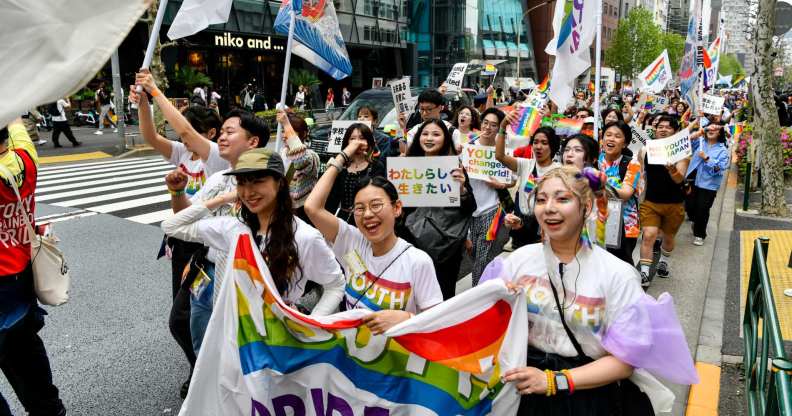
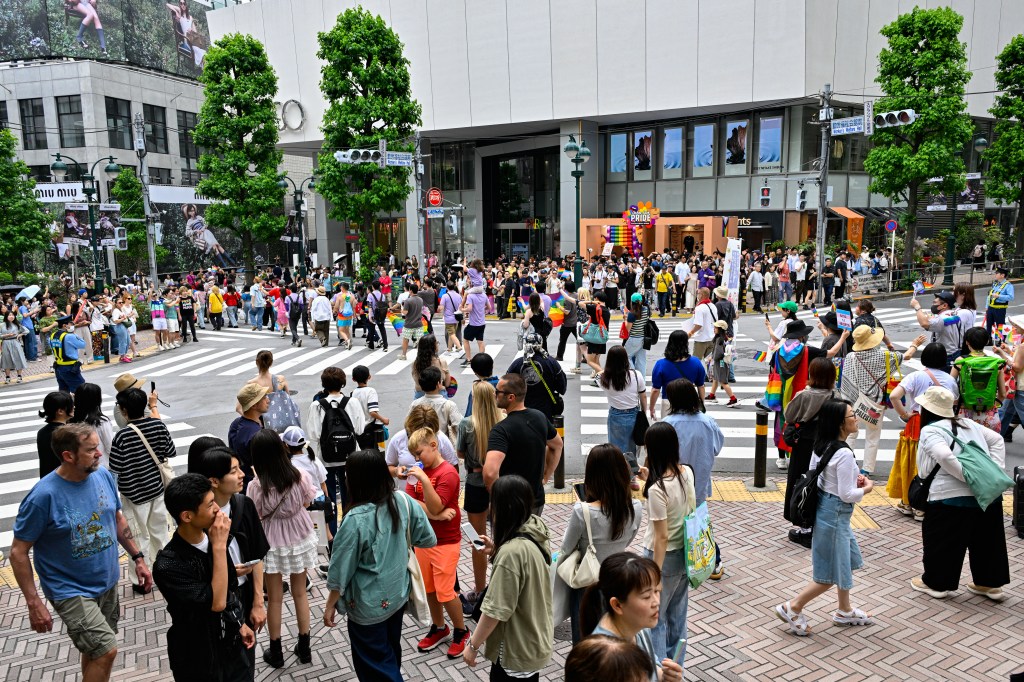
Participants for Tokyo Pride events march on the busy streets of Shibuya in Tokyo, Japan, on June 8, 2025. (Yusuke Harada/NurPhoto via Getty Images)
Commenting on the decision, Amnesty International criticised the ruling and said it effectively means discrimination against LGBTQ+ couples in Japan is permissible under the law.
“The court’s decision today marks a significant step backwards for marriage equality in Japan,” Amnesty International’s East Asia researcher Boram Jang said.
“The ruling in Tokyo – the final high court ruling of six lawsuits filed across the country and the only ruling to say, in effect, that discrimination against same-sex couples is constitutional – cannot be allowed to hamper progress.
“But it should serve as a warning of the reluctance to acknowledge the concept of same-sex marriage and the reality of same-sex couples living in Japan.
“While these cases work their way to the Supreme Court, the government can resolve this issue through legislation without further delay.
“The Japanese government needs to be proactive in moving towards the legalisation of same-sex marriage so that couples can fully enjoy the same marriage rights as their heterosexual counterparts.
“Japan remains the only G7 country without legal recognition for same-sex couples. The law passed by the government in 2023 to promote understanding of LGBTI people is not enough.
“There need to be solid, legal measures in place to protect same-sex couples and the LGBTI community in Japan from all forms of discrimination.”
Previously, in 2024, Sapporo District Court in northern Japan came to an opposite conclusion and ruled the civil code which limits marriage to between a man and a woman is “unconstitutional [and] discriminatory”.
“Enacting same-sex marriage does not seem to cause disadvantages or harmful effects,” the High Court said in its ruling, adding it was “strongly expected” that parliament would “institutionalise an appropriate law” in the future.
“Living in accordance with one’s gender identity and sexual orientation is an inalienable right rooted in important personal interests,” the court also said.
The Sapporo decision followed prior decisions by courts in Nagoya and Tokyo – a separate lawsuit to the one detailed above – which also declared the ban unconstitutional.
What happens next?
Now that each of the six high court cases are completed, Japan’s highest court – the Supreme Court of Japan – is expected to manage the appeals and make a final decision on the matter.
Research has previously shown that most of the Japanese population is in favour of legalising same-sex marriage, with an opinion poll from 2023 revealing that two-thirds of Japanese people believe equal marriage should be legally recognised.
However, the legalisation of same-sex marriage still looks set to be a long way off, with Japan’s first female prime minister, Sanae Takaichi, has expressed opposition to same-sex marriage, describing it as a “very difficult problem” in the past.
What amazes me is how frightened straight cis hegemony is over anything that is different from how they live / perceive the world. They can’t seem to be able to live in a society with people who are different from them or how they live. It scares them to their core and makes them think the world is ending. They reject anything that moves from their past comfort zones. The idea of coexistence with others is emotionally shattering to them. They are so fragile. So small in their thinking. They need to make sure anything different is not seen as if removing all evidence of it makes it not exist anymore. That is so stupid I shouldn’t have to address it. But OK let me explain, in the 1950s the only representation of homosexuality was negative and strongly biased toward hating, yet gay kids were born to straight parents, the entire LGBTQ+ had no representation yet all existed. Hugs
Lawmakers in Kazakhstan are following the lead of Russian President Vladimir Putin with a bill to ban so-called “LGBTQ propaganda” in the former Soviet republic.
The lower house of Kazakhstan’s parliament on Wednesday approved the measure outlawing “LGBT propaganda” online and in the media, with fines mandated for violators, and up to 10 days in jail for repeat offenders, Reuters reports.
The legislation now moves to the Kazakh senate, where it’s likely to pass.
President Kassym-Jomart Tokayev has expressed support for the anti-LGBTQ+ bill, which, like similar laws passed in Russia, Georgia and, Hungary, has been promoted as a bulwark against “degenerate” values imported from the West.
“Children and teenagers are exposed to information online every day that can negatively impact their ideas about family, morality, and the future,” Kazakh Education Minister Gani Beisembayev told lawmakers before the vote.
Deputy Irina Smirnova cited library books and cartoons featuring same-sex relationships as examples of the “propaganda” addressed by the bill.
“I saw books in the library that promote LGBT, where a prince falls in love with a prince, two boys,” she told lawmakers. “There are cartoons that allow this to be shown, there are magazines and comics where all this is promoted.”
For months, President Tokayev has lobbied hard for passage of the bill — which is essentially copycat legislation of Russia’s own “anti-LGBTQ propaganda” measure — stressing the need to uphold what he and Putin call their countries’ “traditional values”.
Parties loyal to Tokayev dominate the lower house and voted unanimously in favor of the ban.
With the fall of the Soviet Union in the 1990s, Kazakhstan legalized homosexuality as it drew politically closer to Europe and the West.
But while the Muslim-majority nation is officially secular, it remains deeply conservative when it comes to social issues. With Putin‘s prodding, far-right politicians have exploited those social fissures to push the country back into Russia’s sphere of influence.
“We live in an independent and sovereign republic. Or are we already a colony of the Russian Federation?” Zhanar Sekerbayeva, co-founder of the feminist initiative, Feminita, asked at a recent LGBTQ+ rights roundtable in the country.
Arj Tursynkan, an activist with the NGO Education Community, explained that language in the legislation was sweeping.
“Because of these amendments, people can be punished for anything – jokes, drawings, hugs,” he said.
The activist argued that the legislation is not just a legal text, but a test of Kazakhstan’s commitment to international norms of dignity and freedom.
Ahead of the vote, Belgium-based group International Partnership for Human Rights condemned the measure, saying it would “blatantly violate Kazakhstan’s international human rights commitments.”
Subscribe to the LGBTQ Nation newsletter and be the first to know about the latest headlines shaping LGBTQ+ communities worldwide.
Sarah Rainsford,Eastern and Southern Europe correspondentand
Guy Delauney,Balkans correspondent
AP Photo/Jerome Delay
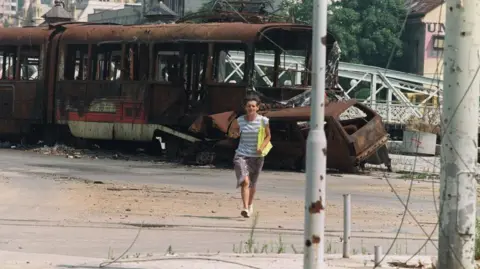
Civilians risked their lives to cross Sarajevo’s main boulevard during the Bosnian war
The public prosecutor’s office in Milan has opened an investigation into claims that Italian citizens travelled to Bosnia-Herzegovina on “sniper safaris” during the war in the early 1990s.
Italians and others are alleged to have paid large sums to shoot at civilians in the besieged city of Sarajevo.
The Milan complaint was filed by journalist and novelist Ezio Gavazzeni, who describes a “manhunt” by “very wealthy people” with a passion for weapons who “paid to be able to kill defenceless civilians” from Serb positions in the hills around Sarajevo.
Different rates were charged to kill men, women or children, according to some reports.
More than 11,000 people died during the brutal four-year siege of Sarejevo.
Yugoslavia was torn apart by war and the city was surrounded by Serb forces and subjected to constant shelling and sniper fire.
Similar allegations about “human hunters” from abroad have been made several times over the years, but the evidence gathered by Gavazzeni, which includes the testimony of a Bosnian military intelligence officer, is now being examined by Italian counter terrorism prosecutor Alessandro Gobbis.
The charge is murder.
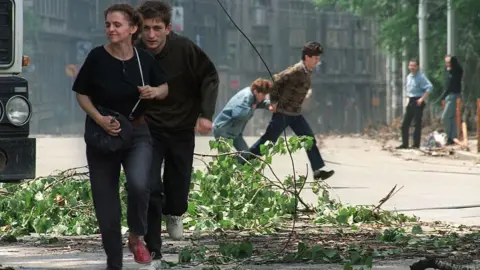
CHRISTOPHE SIMON/AFP
More than 11,000 civilians died in the siege of Sarajevo
The Bosnian officer apparently revealed that his Bosnian colleagues found out about the so-called safaris in late 1993 and then passed on the information to Italy’s Sismi military intelligence in early 1994.
The response from Sismi came a couple of months later, he said. They found out that “safari” tourists would fly from the northern Italian border city of Trieste and then travel to the hills above Sarajevo.
“We’ve put a stop to it and there won’t be any more safaris,” the officer was told, according to Ansa news agency. Within two to three months the trips had stopped.
Ezio Gavazzeni, who usually writes about terrorism and the mafia, first read about the sniper tours to Sarajevo three decades ago when Italian newspaper Corriere della Sera reported the story, but without firm evidence.
He returned to the topic after seeing “Sarajevo Safari”, a documentary film from 2022 by Slovenian director Miran Zupanic which alleges that those involved in the killings came from several countries, including the US and Russia as well as Italy.
Gavazzeni began to dig further and in February handed prosecutors his findings, said to amount to a 17-page file including a report by former Sarajevo mayor Benjamina Karic.
MICHAEL EVSTAFIEV/AFP
Snipers would shoot at civilians from areas controlled by the Bosnian Serbs overlooking Sarajevo
An investigation in Bosnia itself appears to have stalled.
Speaking to Italy’s La Repubblica newspaper, Gavazzeni alleges that “many” took part in the practice, “at least a hundred” in all, with Italians paying “a lot of money” to do so, up to €100,000 (£88,000) in today’s terms.
In 1992, late Russian nationalist writer and politician Eduard Limonov was filmed firing multiple rounds into Sarajevo from a heavy machine gun.
He was being given a tour of hillside positions by Bosnian Serb leader Radovan Karadzic, who was later convicted of genocide by an international tribunal in the Hague.
Limonov didn’t pay for his war tourism, though. He was there as an admirer of Karadzic, telling him: “We Russians should take example from you.”
Italian prosecutors and police are said to have identified a list of witnesses as they try to establish who might have been involved.
However, members of the British forces who served in Sarajevo in the 1990s have told the BBC that they never heard of any so-called “sniper tourism” during the Bosnian conflict.
They indicated that any attempts to bring in people from third countries who had paid to shoot at civilians in Sarajevo would have been “logistically difficult to accomplish”, due to the proliferation of checkpoints.
British forces served both inside Sarajevo and in the areas surrounding the city, where Serb forces were stationed and they saw nothing at the time to suggest that “sniper tourism” was taking place.
One soldier described the allegations that foreigners had paid to shoot at civilians as an “urban myth”.
Participants in a World AIDS Day event light candles along a red ribbon. | Shutterstock
The U.S. government will no longer commemorate December 1 as World AIDS Day, the State Department recently notified its workers. The U.S. has commemorated the international observance annually since 1988, including every year of the current president’s first term.
An email to State Department workers notified employees and grant recipients not to publicly promote the day “through any communication channels, including social media, media engagements, speeches or other public-facing messaging” nor to use U.S. government funds towards any World AIDS Day observances, The New York Times reported.
The email said employees and grantees could still mention various anti-HIV programs and attend World AIDS Day events.
The email also reportedly said that the current U.S. government’s policy is “to refrain from messaging on any commemorative days, including World AIDS Day.” However, the current president has signed proclamations for various awareness days and other commemorative observances.
World AIDS Day is an international day for raising awareness about HIV/AIDS, remembering those who have died from it, and celebrating progress in prevention, treatment, and care. Two World Health Organization (WHO) public information officers started World AIDS Day in 1988 as a way to raise awareness about the global health challenge.
The current administration has drastically cut federal funding for HIV prevention worldwide. An estimated 127,073 adult and 13,527 infant deaths have been caused by the effects of HIV/AIDS due to the current president’s cuts in funding for the President’s Emergency Plan for AIDS Relief (PEPFAR), a program that has saved an estimated 25 to 26 million lives since its inception in 2003.
The State Department usually issues an annual PEPFAR report on World AIDS Day. It’s unclear if the department will do so this year.
Subscribe to the LGBTQ Nation newsletter and be the first to know about the latest headlines shaping LGBTQ+ communities worldwide.
Whistleblower Rutherford County Library Systems Director Luanne James claims the RCLS Board Chair, Cody York, instructed her to remove multiple books from the public library system without following the rules to do so.
James claimed York had checked out books he wanted banned and kept the books for so long they were marked as lost and then removed from the system. James also said York asked her to gather a list of library patrons’ personal information, including which books they checked out.
“Names of the patrons, their addresses, their ZIP codes, their barcodes, how many children and how many adults were in each household and what they were checking out,” James told the RCLS Board Monday night.
According to RCLS, James was appointed as the new Library Director, which went into effect on July 28. James claimed she was at her job for only two days before she was instructed to remove books.
During Monday’s meeting, York denied all James’ allegations and denied any wrongdoing, saying he requested patrons’ ZIP codes to see which patrons lived outside the county so they could pay an additional $25 fee to hold a library card. With regard to the missing books, York shifted the blame back to James.
“Does policy allow one board member or the chair to remove books?” York asked James during the board meeting.
“No,” James replied.
“So why did you do it [remove books]?” York said. “…I’m not denying that I told you these books should not be in the library, but I can’t make a decision to remove them — that’s your decision.”
A local advocacy group called the Rutherford County Library Alliance believes the following books listed are missing and had been removed from the library:
“Forever” by Judy Blume
“Over the River and Through the Wood: A Holiday Adventure” by Lisa Marie Francis Child
“The Antiracist Kid” by Tiffany Jewel
“Making a Baby” by Rachel Greener
News 2 hasn’t been able to independently confirm these specific titles are missing.
“If a librarian has put a book in our library, it’s because our community needs it, so by bypassing all of the professionals and saying, ‘Well, I don’t like it, so it should go because I don’t want my kid reading it,’ that goes against the First Amendment,” Keri Lambert, Vice President of the Rutherford County Library Alliance, told News 2.
“I believe it’s all driven by one motive only: to basically eliminate a certain class of people from the library collection as if they didn’t exist … To figuratively put them back in the closet, if you will,” Frank Lambert, a Library and Information Science Associate Professor at Middle Tennessee State University, told News 2.
News 2 reached out to Chair York, who responded with a statement:
“I categorically deny the allegations made against me last night.
The Rutherford County Library System has only two approved methods by which a title may be removed from the collection under our policies. Library staff may remove a title if it no longer meets the collection standard, such as relevance, condition, accuracy, or other established criteria, through the normal weeding process. A title may be removed by a vote of the Library Board, but only after the formal reconsideration process is completed. This process includes a written request, staff review, and a vote in an open public meeting.
Those are the only mechanisms permitted. No board member can direct the Executive Director to bypass either process. Raising questions about whether books in the collection meet our collection standards is not inappropriate.”
When News 2 reached out to the whistleblower, Luanne James, we received an Out of Office email, indicating she may still be employed by the library system.
Item 1 of 2 A general view on the Spasskaya tower of the Kremlin and St. Basil’s Cathedral in Moscow, Russia May 16, 2024. REUTERS/Maxim Shemetov
[2/2] The Russian flag flies on the dome of the Kremlin Senate building behind Spasskaya Tower in Moscow, Russia June 2, 2025. REUTERS/Evgenia Novozhenina
Summary
Kremlin praises US National Security Strategy
Kremlin says NATO statements are encouraging
Kremlin cautions that some in US will see it differently
MOSCOW, Dec 7 (Reuters) – The Kremlin on Sunday welcomed U.S. President Donald Trump’s new national security strategy and said it largely accorded with Russia’s own perceptions, the first time that Moscow has so fulsomely praised such a document from its former Cold War foe.
The U.S. National Security Strategy described Trump’s vision as one of “flexible realism” and argued that the U.S. should revive the 19th century Monroe Doctrine, which declared the Western Hemisphere to be Washington’s zone of influence.
The Reuters Daily Briefing newsletter provides all the news you need to start your day. Sign up here.
The strategy, signed by Trump, also warned that Europe faces “civilizational erasure”, that it was a “core” U.S. interest to negotiate an end to the war in Ukraine, and that Washington wanted to reestablish strategic stability with Russia.
“The adjustments that we see correspond in many ways to our vision,” Kremlin spokesman Dmitry Peskov told state television reporter Pavel Zarubin when asked about the new U.S. strategy.
Such fulsome public agreement between Moscow and Washington on the tectonic plates of global politics is rare, though they did cooperate closely after the 1991 fall of the Soviet Union on returning nuclear weapons from former Soviet republics to Russia, and after the deadly Sept. 11, 2001, attacks on the United States.
TRUMP’S STRATEGY LARGELY ACCORDS TO RUSSIA’S VIEW
During the Cold War, Moscow portrayed the United States as a decadent capitalist empire doomed by the historical certainties of Marxism, while U.S. Ronald Reagan in 1983 called the Soviet Union an “evil empire” and the “focus of evil in the modern world.”
After the Soviet collapse, Moscow expressed hopes for a partnership with the West but as Washington moved to support the enlargement of the NATO alliance, as outlined in President Bill Clinton’s 1994 strategy, tensions began to mount. They were pushed to breaking point under President Vladimir Putin, who rose to the top Kremlin job on the last day of 1999.
Asked about the pledge in the U.S. document to end “the perception, and preventing the reality, of the NATO military alliance as a perpetually expanding alliance”, the Kremlin’s Peskov said it was encouraging.
But Peskov also cautioned that what he said was the U.S. “deep state” saw the world differently to Trump, who has used the term to refer to an allegedly entrenched network of U.S. officials who seek to undermine those who challenge the status quo, including Trump himself.
Critics of Trump say there is no such thing as a “deep state,” and that Trump and his allies are trafficking in a conspiracy theory to justify an executive-branch power grab.
WASHINGTON AND MOSCOW LOOK TO CHINA
Since Russia’s 2014 annexation of Crimea and its 2022 invasion of Ukraine, U.S. strategies have designated Moscow as an aggressor or a threat that was trying to destabilise the post-Cold War order by force.
In comments to the state-run TASS news agency, Peskov said calling for cooperation with Moscow on strategic stability issues rather than describing Russia as a direct threat was a positive step.
The Trump strategy describes what it calls the Indo-Pacific as one of the “key economic and geopolitical battlegrounds”, saying it would build up U.S. and allied military power to prevent a conflict with China over Taiwan.
Russia pivoted to Asia – and China in particular – after the West imposed sanctions on Russia for the war in Ukraine and Europe sought to wean itself off Russian oil and gas.
Trump in March told Fox News that “as a student of history, which I am — and I’ve watched it all — the first thing you learn is you don’t want Russia and China to get together.”
Reporting by Lidia Kelly in Melbourne and Guy Faulconbridge in Moscow; Editing by Jacqueline Wong and Philippa Fletcher
So Ron and his sister arrived two days ago. Lucky for me she is a doer who jumps in to do stuff and doesn’t wait for others to do for her. She has really helped Ron get a lot of stuff done. She helps when my back goes out. She is doing supper right now so I can catch up on the last few days of news. I really hope she finds a place to her tastes here as she is a good influence for Ron. Hugs, loves to all, and best wishes to all who wish them. Scottie
Thanks to Ron’s sister jumping in and doing all the extra stuff I have been trying to do I can rest my back while doing my posting. I could get used to this. Hugs
tRump’s illegal war for profit to please the corporations he told to give him a billion dollars for his campaign and he would do what ever they asked. Wow US military young adults sold for tRump’s profit. Hugs
The $1,776 per person bonuses, unveiled by Trump in his nationwide address Wednesday night, will be covered with funding approved in the Big Beautiful Bill that passed in July, according to the congressional officials and later confirmed by the Pentagon. The payouts — which will cost roughly $2.6 billion — will be a “one-time basic allowance for housing supplement to all eligible service members,” said the official.
The Trump administration announced several moves Thursday that will have the effect of essentially banning gender-affirming care for transgender young people, even in states where it is still legal.
The second would block all Medicaid and Medicare funding for any services at hospitals that provide pediatric gender-affirming care.
Really stupid things say and blame democrats for just because they think it sounds good not realizing how dumb it seems.
As Democracy Docket previously reported, in his previous role as a prosecutor in the Los Angeles district attorney’s office, Neff was put on leave after bringing charges against an election software executive based on information from conspiracy-driven election denier group True the Vote. The saga ultimately cost taxpayers $5 million to settle a lawsuit over the flawed prosecution.
Neff is also affiliated with True The Vote, the far-right QAnon group featured in Dinesh D’Souza’s debunked “2000 Mules” film.
Slumped over in his chair at the Resolute desk, Trump’s face slackened—eyes drooping, the corners of his mouth sagging—as he fought off sleep. The elderly president has now been caught appearing to doze off at four official events in six weeks.
As many know I found this artist and her work on trans awareness as a grand resource to show how trans people / kids are being treated in our surging hateful nation. Below is a personal note from her. I wish her and her family the very best even as I will miss her voice supporting the trans people. Hugs
This year was the most prolific of my life, but also the most anxiety-inducing. I wrote and published a new novel and drew about two hundred pages of comics, as if to numb the things I was feeling. But life has ways to tell us we’re burning out.
I am not known for sharing much about my private life – probably a consequence of a whole decade of harassment and stalking from anti-trans zealots – but allow me to do it today. You might know that at the start of the pandemic, my husband and I decided to move into a century-old cabin in the woods. We have slowly been turning it into an artist retreat for trans and queer people. I really needed the seclusion, the quiet and the natural beauty of the place, especially after many years of being the target of hate campaigns, doxxing and death threats. This place that we call home has been a blessing, but it was always meant to be temporary.
Due to life and health situations, it’s now time for my husband and I to come back to civilisation. I won’t go into details, but I’ll just say that our nearest hospital is a 3h round trip drive, and that living 10h away from my husband’s relatives is becoming impossible. Furthermore, we still believe in our dream of turning that space into a retreat for trans and queer artists, but the renovations left to do are simply incompatible with my husband’s pregnancy.
That is why we are getting prepared to move back to the city. It’s a hard and lifechanging decision for us, but there is no avoiding it. It’s also going to be costly : another reason we moved in our current ruin of a home in the first place was to be able to focus more on making art and less on making rent. If you feel so enclined, you can contribute to our relocation effort by getting a coffee at www.ko-fi.com/sophielabelle or supporting my work at www.patreon.com/assignedmale . It always means the world to us, now more so than ever!
I’ve decided to spend the last few weeks of the year focusing on catching my breath, preparing for the move and trying to get through the 15 000 emails that I’ve let piled in my inbox since my beloved cat, my bestest friend, passed earlier this year, and hopefully finishing the children’s book I’ve been working on for way too long. I still have a few new comics lined up for the Holidays, so don’t expect me to stay quiet!
So that’s what’s up. Thank you for reading, thank you for being there, I love you all, even the ones who rage-read my comics. Keep shining!


 Russian President Vladimir Putin | Shutterstock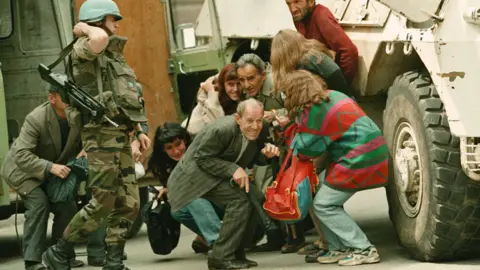

 Participants in a World AIDS Day event light candles along a red ribbon. | Shutterstock