As I keep repeating these bathroom bills hurt cis women because it is based solely on how someone looks to some other people. If as in this case a cis woman did not look feminine enough for the server and so this woman was forced to show her breasts. How is that feminism work going TERF people. These bathroom bills and the hype of fake false stories of danger to women only make all women less safe. See now people that look like men legally might have to use a female’s bathroom, so all a cis man has to say is he is trans and they can legally be in the woman’s bathroom. Same for any female that wants to go into the men’s room only needs to claim to be a trams women. All due to hate and bigotry making a problem where none existed. Think of it, the only assaults I have heard about in female restrooms is from cis people attacking cis females because they think they are trans. Hugs
The 18-year-old high school student said she unzipped her hoodie to show she had breasts after a Buffalo Wild Wings server didn’t believe she is a woman.
A Minnesota teenager filed a charge of discrimination against a Buffalo Wild Wings restaurant Tuesday, alleging a server followed her into the women’s restroom and demanded she “prove” she was a girl.
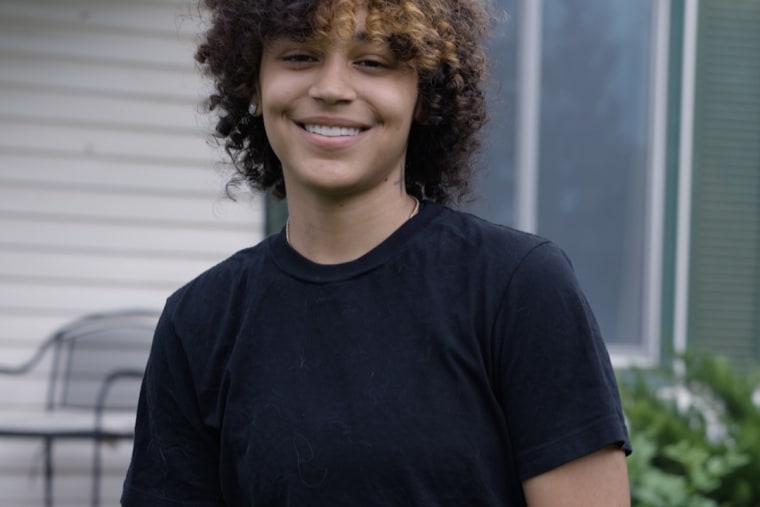
Gerika Mudra, 18, went to dinner in April with a friend in Owatonna, about an hour south of Minneapolis. When she went to the restroom, a server followed her inside and banged on the stall door while saying: “This is a women’s restroom. The man needs to get out of here,” according to Gender Justice, a Minnesota gender-equality organization that filed the charge on Mudra’s behalf.
Gerika Mudra, 18, says she was harassed by a server who accused her of being a boy in the girls’ bathroom.Gender Justice
Mudra, a biracial lesbian who isn’t transgender, said that she has been in similar situations before, when people have suggested she’s in the wrong restroom, but that when she tells them she’s a woman they leave her alone. However, when she came out of the stall at Buffalo Wild Wings and told the server, “I am a lady,” she said, the server responded, “You have to get out now,” Gender Justice said in a statement.
Mudra said she felt she had to prove to the server that she is a woman, so she unzipped her hoodie to show she has breasts. The server didn’t say anything in response but left the restroom, Mudra said.
“She made me feel very uncomfortable,” Mudra said. “After that, I just don’t like going in public bathrooms. I just hold it in. … I want to be able to use the bathroom in peace.”
Inspire Brands, which represents Buffalo Wild Wings, didn’t immediately respond to a request for comment.
Buffalo Wild Wings in Owatonna, Minn.Google Maps
Gender Justice filed the charge of discrimination with the Minnesota Department of Human Rights, arguing that what happened to Mudra violates the state’s Human Rights Act, which protects people from discrimination based on gender identity and sexual orientation, among other protected statuses.
Sara Jane Baldwin, senior staff attorney at Gender Justice, said at a news conference Tuesday that even though Mudra isn’t trans, the server’s actions “were based on assumptions that she made about” Mudra, and that Minnesota’s law protects against discrimination based on stereotypes or assumptions about protected characteristics like gender identity.
“Businesses have a legal obligation not to just have antidiscrimination policies on paper, but to train staff and ensure that those policies are followed in real time,” Baldwin said. “When that doesn’t happen, the business is liable for the harm caused.”
Gender Justice said Mudra’s experience “reflects a broader climate of fear and suspicion aimed at anyone who doesn’t conform to narrow expectations of what girls and women ‘should’ look like.” That suspicion has been driven largely by the wave of state legislation targeting trans people, particularly their access to school sports and bathrooms that align with their gender identities, though Minnesota hasn’t enacted any such legislation.
Nineteen states have laws that prohibit trans people from using bathrooms that align with their gender identities in K-12 schools, and in many of those states the restrictions apply to other government-owned buildings, as well, according to the Movement Advancement Project, an LGBTQ think tank. Twenty-seven states prohibit trans people from playing on school sports teams that align with their gender identities.
“This kind of gender policing is, unfortunately, nothing new,” Megan Peterson, executive director at Gender Justice, said in a statement. “And yet, in our current climate we have to ask: What if Gerika had been a trans person? Would this story have ended differently? That’s the terrifying reality too many trans people live with every day.”
Even if Mudra had been trans, she would be able to file a discrimination complaint under state law in Minnesota, which is one of 21 states and Washington, D.C., that explicitly prohibit discrimination based on sexual orientation and gender identity in public accommodations, according to the Movement Advancement Project. Two states explicitly prohibit discrimination based on sexual orientation only, and six additional states interpret existing measures against discrimination based on sex to also include discrimination based on sexual orientation and gender identity. Twenty-one states don’t have explicit protections from discrimination based on gender identity in public accommodations.
As I keep saying this is a small very loud mostly religious driven minority using ever tool and lie they can to change perception of the LGBTQ+ to erase them from society to create the cis straight society they want to force on everyone. We must counter them by being as loud and forceful to not only refute their lies but also promote the joy of living freely as an inclusive society. Hugs
Close-Up of rainbow flag with crowd In background during LGBT Pride Parade. Getty Images.
Ohio lawmakers on both sides of the aisle have introduced several LGBTQ-related bills so far this General Assembly.
Republicans have put forth a drag ban bill, a piece of legislation that would make it harder for a student to use a different name or pronoun at school, and a bill requiring transgender political candidates to list their deadname, among others.
On the other side of the aisle, Democrats have introduced the Ohio Fairness Act and a bill that would ban conversion therapy.
An Ohio court partially overturned a ban on gender-affirming care for LGBTQ youth earlier this year, meaning doctors can still prescribe puberty blockers and hormone therapy.
Anti-LGBTQ bills
Ohio House Bill 249 would ban drag performers from performing anywhere that is not a designated adult entertainment facility. State Reps. Angie King, R-Celina, and Josh Williams, R-Sylvania Twp., introduced the bill, which has had sponsor testimony.
This is a re-introduction of a bill from the previous General Assembly that did not make it out of committee and faced much opposition.
Ohio House Bill 190 would require parental permission for schools to use different pronouns or different names for students that don’t match up with the biological sex or birth name.
Williams and state Rep. Johnathan Newman, R-Troy, introduced the bill, which has had sponsor testimony.
Ohio House Bill 172 would ban children 14 and older from receiving mental health services without parental consent. Newman also introduced this bill, which has had sponsor testimony.
Ohio House Bill 196 would require political candidates to list their former names on candidacy petitions. This, however, would not apply to names that have been changed due to marriage. King and state Reps Rodney Creech, R-West Alexandria, introduced the bill, which has had sponsor testimony.
Ohio House Bill 262 would designate the weeks from Mother’s Day to Father’s Day as Natural Family Month. Williams and state Rep. Beth Lear, R-Galena, introduced the bill, which has had sponsor and opponent testimony.
Pro-LGBTQ bills
Ohio Senate Minority Leader Nickie Antonio, D-Lakewood, has introduced a few bills that support LGBTQ people. Antonio is the only openly gay lawmaker in the Ohio General Assembly.
Ohio Senate Bill 70, also known as the Ohio Fairness Act, would expand anti-discrimination laws to include sexual orientation and gender identity. House Bill 136 is a companion bill.
Antonio has introduced the Ohio Fairness Act in every General Assembly since she was elected to the Ohio House of Representatives in 2011 and this is the first time since 2018 the bill has no Republican support.
Ohio Senate Bill 71 would ban any licensed health professionals from doing conversion therapy when providing mental health treatment to minors. Antonio and state Sen. Beth Liston, D-Dublin, introduced the bill. House Bill 300 is a companion bill.
Ohio Senate Bill 211 would designate the first full week of June as “Love Makes a Family Week.” Antonio introduced this bill as well.
None of these bills have had any hearings so far this General Assembly. Ohio lawmakers are on summer break and will come back to the Statehouse this fall.
Very informative and heart felt. Aron Ra is well known for his thought approach to atheism and science, delivering it in a way that a normal person can understand. The things he says at the end and the pictures he shows makes clear that as he says this is not about protecting anyone but about enforcing bigotry. Hugs
Pedro Pascal has once again stood for trans rights (Gerald Matzka/Getty Images)
Our lord and saviour Pedro Pascal has showed his trans-ally credentials in public once again.
Speaking at the premiere of his latest film, The Fantastic Four: First Steps, Pascal said the trans community filled him with inspiration.
Pascal, whose sister Lux is trans, has long been an advocate for the LGBTQ+ community and in recent months has been vocal in his support of trans people, catching heat from certain people for calling gender-critical author JK Rowling’s actions those of a “heinous loser”.
On the red carpet in Berlin, he said: “It’s important to protect people, especially those simply asking for the right to exist in bodies that belong to them and in the world that they never asked to be brought into.
Pedro Pascal has once again spoken out for the trans community at the premier of The Fantastic Four: First Steps. On the red carpet for the film in Berlin, Pascal was asked why it’s so important to stand up for the trans community, to which he responded: “It’s important to stand up for those who are simply asking for the right to exist.” This isn’t the first time Pedro Pascal has stood up for the trans community. Earlier this year he trolled transphobes in his Instagram comments, he regularly shows support for his trans sister, Lux Pascal, and has most recently spoken out multiple times against JK Rowling. #pedropascal#jkrowling#fantasticfour#transcommunity#transrights#lgbtqia
Pedro Pascal has once again spoken out for the trans community at the premier of The Fantastic Four: First Steps.
On the red carpet for the film in Berlin, Pascal was asked why it’s so important to stand up for the trans community, to which he responded: “It’s important to stand up for those who are simply asking for the right to exist.”
This isn’t the first time Pedro Pascal has stood up for the trans community. Earlier this year he trolled transphobes in his Instagram comments, he regularly shows support for his trans sister, Lux Pascal, and has most recently spoken out multiple times against JK Rowling.
Earlier this year, Pascal wore a Protect The Dolls t-shirt, in support of trans rights, at the Thunderbolts* premiere in London.
“Dolls” is term used mainly by the LGBTQ+ community to describe transgender women. Its roots lie in ballroom culture.
Pascal’s wardrobe choice came just days after the UK Supreme Court handed down an 88-page judgement deeming the legal definition of the words “sex” and “woman” in the 2010 Equality Act referred to “biological sex” and “biological women”, thus excluding transgender people.
The ruling was the culmination of legal action by gender-critical group For Women Scotland, who were backed in their case by Harry Potter author Rowling to the tune of £70,000 (more than $95,000).
After the verdict was announced, Rowling, well-known for her gender-critical views, posted a photo on social media of herself celebrating with a cigar and a cocktail. “I love it when a plan comes together,” she wrote, before revealing that her husband has dubbed the announcement date TERF VE Day.
In response to a viral video post by writer Tariq Ra’ouf, in which Rowling’s celebration was branded “serious Voldemort villain sh*t, Pascal wrote: “Awful, disgusting sh*t is exactly right. Heinous loser behaviour.”
Pedro Pascal is a long-time supporter of trans rights. (Joe Maher/Getty Images)
Following his comment, which was widely praised by LGBTQ+ people, but criticised by the anti-trans brigade, Pascal told Vanity Fair that he was wondering if it had been the right thing to do in terms of helping the transgender community.
He felt like “that kid [who] got sent to the principal’s office a lot for behavioural issues in public schools in Texas, feeling scared and thinking: what’d I do?”
The star, who will be seen reprising his Fantastic Four Reed Richards role in next year’s Avengers: Doomsday, went on to say: “The one thing I agonised over a little bit was: am I helping? Am I f**king helping? It’s a situation that deserves the utmost elegance so that something can actually happen and people will actually be protected.
“I want to protect the people I love. But it goes beyond that, bullies make me f**king sick.”
Rowling responded to Pascal’s comment by saying: “Can’t say I feel very shut down but keep at it, Pedro. God loves a trier.”
Ohio Republicans split the Ohio Equal Rights Amendment into two separate ballot issues.
One issue addresses overturning Ohio’s same-sex marriage ban, while the other expands anti-discrimination protections for LGBTQ+ individuals.
This move requires proponents to collect double the signatures or sue the Ohio Ballot Board.
Ohio Republicans added another hurdle for proponents of a measure to overturn Ohio’s dormant ban on same-sex marriage and expand anti-discrimination protections for LGBTQ residents.
In a party-line vote, Ohio Ballot Board divided the Ohio Equal Rights Amendment into two issues: one to overturn a 2004 vote that defined marriage as between one man and one woman and another that would prohibit state and local government from discriminating against more than a dozen protected groups, including transgender Ohioans.
To make the ballot, proponents will either have to collect double the number of signatures to get both proposals approved or sue the Ohio Ballot Board to overturn its decision. Backers are eyeing the 2026 ballot at the earliest, said Lis Regula, a member of Ohio Equal Rights’ leadership committee.
During the July 9 meeting, the ballot campaign’s attorney Corey Colombo argued that the proposed constitutional amendment was one issue because it encompassed equal rights for all Ohioans.
But Republicans contended that transgender issues and marriage equality are two different things with two different levels of support from voters.
While Ohioans might support marriage between any two people in the Ohio Constitution, “they may not want to support creating 12 new protected classes under a bunch of different circumstances,” said Ohio Secretary of State Frank LaRose, a Republican who leads the Ohio Ballot Board.
Rep. Terrence Upchurch, D-Cleveland, said Republicans divided the measure because of politics. “It’s one issue. It’s cut and dry.”
“There’s definitely political will for using trans people to divide Ohioans,” Regula said. “The hopeful side of me appreciates that they are recognizing the support for same-sex marriage. That’s great. We’ve made progress. We still have progress to make.”
What is the Ohio Equal Rights Amendment?
If approved by voters, the Ohio Equal Rights Amendment would prohibit state and local government from discriminating based on: “race, color, creed or religion, sex, sexual orientation, gender identity or expression regardless of sex assigned at birth, pregnancy status, genetic information, disease status, age, disability, recovery status, familial status, ancestry, national origin or military and veteran status.”
The sweeping measure would expand the list of protected individuals far beyond the national Equal Rights Amendment, which aims to prohibit discrimination based on sex. Ohio ratified that amendment in 1974, but it has not been recognized as part of the U.S. Constitution because of missed deadlines and other disputes.
The proposal would also overturn a 2004 vote that defined marriage as between one man and one woman.
This language has been dormant since a 2015 U.S. Supreme Court decision led by Ohioan Jim Obergefell legalized gay marriage in America. As of 2023, Ohio had 22,400 same-sex married couples, according to the most recent federal census data.
“Marriage equality has been going strong now for 10 years, and the sky hasn’t fallen. Society hasn’t collapsed,” said Senate Minority Leader Nickie Antonio, D-Lakewood. “What happened is you have families who have standing, whose children can feel good and talk about their families just like every other kid at school, no matter what the configuration of their family is.”
But proponents of marriage equality worry that the Obergefell decision could be overturned by an unfriendly U.S. Supreme Court. “I think it is reasonable to believe that it is under threat,” said Regula, citing the language used in the decision overturning Roe v. Wade.
What are the arguments for and against this measure?
“Those discriminatory laws make Ohio less of a welcoming place and make it a place where fewer people are interested in coming,” Regula said.
Opponents say these are losing issues at the ballot box.
“To bring such an unpopular constitutional amendment like this forward is one, shockingly appalling, but also really dumb after Sherrod Brown just lost his Senate seat over these issues,” said Aaron Baer, president of the Center for Christian Virtues.
Republicans crafted attack ads against Brown for voting against amendments that would have stripped funding from schools and colleges that allowed transgender girls to play in women’s sports.
“I have a hard time seeing them get a lot of traction with this,” Baer said. CCV was a driving force behind the 2004 constitutional amendment to ban same sex marriage in Ohio.
What happens next?
The group looking to put the Ohio ERA before voters faces a tall task. If they want voters to approve both measures, they must collect an additional 1,000 valid signatures for each proposal, go before Ohio Attorney General Dave Yost for initial approval and return to the ballot board.
Then, proponents would have to collect at least 413,487 valid signatures, or 10% of votes cast in the most recent governor’s race, for each measure or 826,974 in total. Those signatures must meet a minimum threshold in half of Ohio’s 88 counties.
“While I applaud the spirit of the work that they are trying to do, I just think it’s a real uphill battle that they’re going to be faced with,” said Antonio, the state’s first and currently only openly gay lawmaker.
For more than a decade, Antonio has repeatedly introduced the Ohio Fairness Act to prohibit discrimination based on sexual orientation or gender identity. The GOP-controlled Legislature has not moved forward on the fairness act.
Antonio said a legislative fix is still the right path for protections against LGBTQ discrimination.
“I struggle with asking the majority of people, the majority of the population, to grant equality by a vote to a marginalized group,” Antonio said. “I will continue to fight for the Ohio Fairness Act, because I think it’s the right thing to do.”
Reporter Laura A. Bischoff contributed to this article.
State government reporter Jessie Balmert can be reached at jbalmert@gannett.com or @jbalmert on X.





Jessie Balmert
Cincinnati Enquirer

 Scottie's Playtime