It was cold out in Ollie’s potty area this morning!
Later this evening and overnight, we should get between 2-4 in. of snow, which is fine, then the temps will be below 20 degrees for a few days. Poor little guy’s gonna have to chase his favorite ball inside for a while.
———–Other Thoughts————————————–
I enjoy spicing my oatmeal differently each morning. I think I especially like ginger with a dash of vanilla, but my top favorite is cocoa and cayenne pepper. It’s really awesome, and puts a fine shine on the day, for me. Ollie can’t clean my bowl for me, though, when I do that one.
Our kid’s birthday is this week. I have no good ideas; he himself has no good ideas; we’re all sort of at the place where if we need something, we just get it. I’m thinking of something to cook. And trying to decide between ice cream cake, or lava cake, both of which are his favorites.
I’ve been really relishing a TV show on Tuesdays, now at 8PM but used to be at 9PM on ABC, called “High Potential.” It’s really good, and I don’t want to spoil it for anyone who might try it; it’s a mystery show with a high IQ neurodivergent (show’s description) woman who becomes a detective while juggling family life and a missing husband. I really like it, and recommend it to anyone with an hour at 8PM on a Tuesday night! They stream it on Hulu, too.
I know no one thinks it’s much justice for We The People to see the FBI reports on the stolen documents found at Mar-A-Lago. It isn’t, really, except we’ll know if we want to, and will be yet better informed as we go about our civic duty of directing our government. And he’s still a convicted felon, as well.
I hope everyone’s got sun today, at some point. I usually prefer cloudy days with temps between 35-48 degrees, but since the election, for some reason, I’ve noticed I prefer a sunny day after a cloudy day, and maybe slightly higher temps, like between 42-60. Go figure.
That’s what I’ve got. I need to sweep the floor to make room for the new dog hair!
(I used to do 10-20 minutes of some yoga each day during W’s admin while the kid was in school. I sort of let it go over time, though I suppose technically I use it when generally stretching, and during some exercises. This is linked on Oliver Willis’s news page, and I thought it could help all of us.)
The news is all shit right now. Sure, there are more artful, creative, and writerly, ways to say that, but time is precious and writing something like that would prove nothing more than ownership of a thesaurus.
If you’re like me and millions of others, you are absorbing all this and wondering, “What can I do?” You can subscribe to journalism (which you probably already do! Yay!), donate money, volunteer, show up for your family, friends, and neighbors, and then what? That’s the thing about the battle for a real democracy—it is not won in flashy, Hollywood fight scenes, though those do make for excellent inspirational images for sharing amid said battle for democracy. It’s won in federal workers showing up to do their jobs. It’s won in reporters showing up to do their jobs. It’s won in a lot of us, in our own ways, showing up, doing our jobs, and not being assholes, even to the person who irritates you—and they are so, so annoying—but dammit we’ll deal with that after we make sure there’s still a republic.
Except, after all that showing up, there’s still a lot of time left for the mind to spiral. It can be easy to forget that our brains, for much of human history, did not take in this much news every day. Not even 100 years ago, most people got their news from a newspaper or magazine. They read it and went about their day, unless they listened to a radio broadcast. Then came television, then cable, then 24-hour news, then smartphones, then apps with push notifications, then social media and its endless firehouse of likes and lives. If we do not know how to log off it is because, in part, for most of human history, nobody had to. You could read to the end of the newspaper or reach the end of the newscast; you cannot ever scroll to the end of Instagram or TikTok. The endlessness is the point. We sacrificed true boredom to the gods of engagement.
So here’s my advice: Stretch your hips. Yes, even if you aren’t naturally stretchy, which I am not, and even if you can’t touch your toes, a feat I can barely accomplish myself. Those of you who have followed my work for a while probably will be unsurprised to know that I completed a 200-hour yoga teacher training in 2018. I didn’t become a yoga teacher afterward, but it did deepen my practice and gave me more tools for stress management. Mostly, it taught me that one secret to leading a good yoga class is setting aside time for a hip stretch. Everyone gets so excited for a hip stretch, almost as much as savasana, and everyone feels really good afterward.
For my money, the best hip stretch is deer pose. You won’t run into it in a ton of classes; I find the defaults tend to be pigeon pose or figure four. But figure four doesn’t provide me much relief, and my hips are too inflexible to pull off a proper pigeon pose without bolsters and time to settle in. But deer pose? It requires less flexibility, no props, and provides a nice hip stretch.
In lieu of giving you an entire explanation of how it works, here’s a good video to walk you through the pose because, c’mon, you were just gonna skip to this part anyway. Though, if you want to read more about the pose, you can do that here. Also, remember you gotta do both sides!
To be clear, I’m not saying occasional hip stretches will stop fascism; I’m saying they help you stay level while you’re trying to survive the fascism. Tomorrow you will wake up, grab your phone, and scroll through what will feel like an endless stream of bad news and horrors. But then what? Maybe you go on a walk. Maybe you actually touch grass. Or maybe you take a few minutes to do deer pose. (snip)
It reminds me of how “Cosmopolitan” was one of the early ‘mainstream’ magazines honestly discussing the AIDS virus, where to find care, and knowledge to avoid contracting it. They knew and reported early on that any- and everyone can catch what we now know as HIV. This piece is about early cancer info dissemination.
At a time when people wouldn’t even say the word, journalists at Good Housekeeping, Redbook, and other women’s magazines were informing readers how to recognize, protect against, and talk about cancer.
Maxine Davis wrote about plenty of tough topics during her long career in journalism, but none of them frightened her as much as the assignment she received in the spring of 1940. Her editors at Good Housekeeping wanted her to cover cancer, a disease so cloaked in stigma that Davis, like many other Americans, was afraid to say its name out loud.
The sweeping series of articles she produced that year changed her thinking. “My research has dispelled that terror,” she wrote in an article that appeared in Good Housekeeping’s April 1940 issue, declaring that cancer could be cured especially if it was caught early through education and hypervigilance. Cancer, she explained, was “sneaking, insidious. Only you and you alone can guard yourself against it.”
At the time Davis wrote these words, cancer was a taboo topic. The term itself wouldn’t be spoken on the radio until 1945. Rumors about its causes were rampant. (Many Americans at the time believed it to be contagious or a sign of poor character.) Physicians routinely withheld cancer diagnoses from patients to spare them shame. Although it wasn’t always a death sentence, the treatments we rely on today were nascent or nonexistent. And yet, the editors at Good Housekeeping still decided to devote pages and pages to in-depth coverage of the disease.
This is one example of how, during the 1940s and 1950s, women’s magazines played a vital and largely forgotten role in educating average Americans about burgeoning efforts to prevent and treat cancer. It was a pivotal era for modern medicine thanks to scientific advancements and increased attention to public health. Cancer was among the leading causes of death, and rates were increasing in part because people were living longer. Print media in all its forms played a major role in normalizing public conversations about cancer, but women’s magazines took a unique approach. They made disease prevention personal, calling upon women to become cancer watchdogs for themselves and their families.
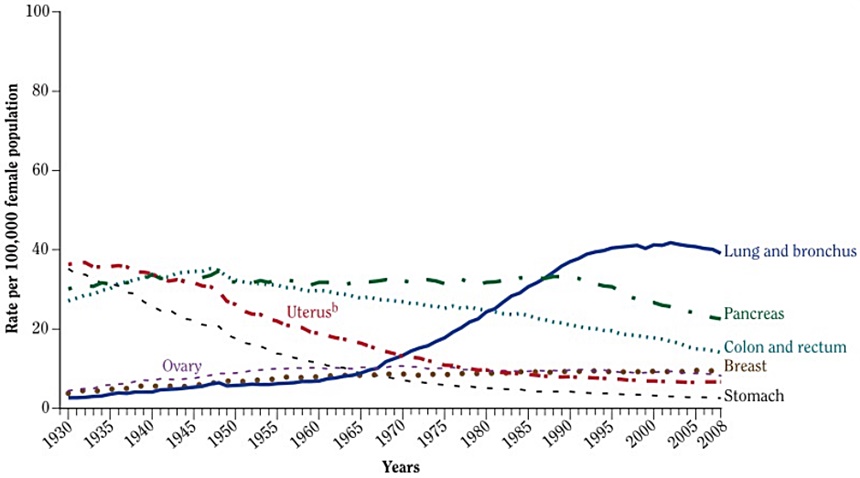
Mortality rates from selected cancers among women in the United States, 1930–2008 (Surveillance, Epidemiology, and End Results Program 2013, National Library of Medicine)
Davis was among the best-known of the women’s magazine journalists covering cancer. By the early 1940s, she had reported on the League of Nations, driven all over the United States to research a book about American youth, and founded a wire service aimed at explaining politics to women. Her cancer stories for Good Housekeeping launched her to a new level of prominence, one akin to modern day health influencers. Her editors promoted her work heavily, framing her as a lay expert with carefully cultivated sources. “Doctors like to work with her,” they wrote in an introduction to her spring 1940 cancer series, “and they give her all the help they can.”
Writing in May of 1940, Davis introduced readers to the basics of cancer treatment, explaining in plain language how surgery, X-rays, and radium were being used to help patients.
Sometimes X-ray, radium, and surgery are all used to treat a malignant condition. Take the case of Ada Johnson. Ada put off going to hospital longer than she should have after she felt a lump in her breast; but the doctor didn’t think the situation was hopeless. This is what he did:
First, there was a surgical operation. When that had been successfully accomplished, the specialist in cancer of the breast applied radium to the chest wall. That wasn’t all. The doctor then used deep X-ray therapy on Ada’s breast and armpit….This was repeated for thirty-five treatments. Ada is perfectly well today.
Davis was not, however, the only women’s magazine reporter working the cancer beat at midcentury. Seventeen magazine’s beauty editor Jean Campbell urged her young readers to get involved in efforts to bring specialized cancer to more communities. “Demand them,” she wrote in the April 1948 issue, “and raise funds for them.” That same year Miriam Zeller Gross deftly described the history of stomach cancer treatment in a gripping feature story that appeared in Better Homes and Gardens. In the early 1950s, Redbook’s Collie Small encouraged women to overcome “false modesty” and allow physicians to screen them for breast cancer. Women’s magazines were publishing hundreds of articles on cancer by dozens of writers. Women also wrote about cancer for general magazines including The Saturday Evening Post, which featured a handful of stories in the 1950s by female cancer survivors.
Stories about cancer were far less common before World War II, but they did sometimes appear in women’s magazines. Ladies Home Journal has been credited by medical historians with publishing the very first general interest article about cancer detection in 1913. Others, including Good Housekeeping, featured occasional educational columns by physicians during the 1920s.
While less common, articles about cancer did appear in women’s magazines in the early 20th century, such as this piece by Dr. Harvey W. Wiley in the November 1922 issue of Good Housekeeping. (Cornell University Library)
In addition to becoming quick experts on complex medical topics, these journalists managed often-fraught relationships with health professionals who tended to distrust journalists. It became common practice during this time for physicians to review stories before they were published. Sometimes, one of those physicians would write a sidebar: In 1955, American Cancer Society vice president Dr. Charles S. Cameron had reviewed a draft of an April 1955 article on cervical cancer by health journalist Gladys Denny Shultz for Ladies Home Journal, and wrote a public note of thanks, proclaiming that the magazine was “offering its readers a great service by publishing this excellent article. It should be a means of saving thousands of lives.”
While most of the bylines atop women’s magazine stories about cancer belonged to female journalists, editors did occasionally invite physicians, almost always men, to contribute. Cosmopolitan published a 14-page essay by Walter Alvarez, who had just retired from clinical practice to pursue a second career in medical writing. The piece, which appeared in January of 1953, sprawled across 14 pages under the headline “Danger Signals in Your Life” and includes tips to spot illnesses like cancer in children, teens, and adults. Alvarez assured readers he wasn’t out to scare them. Instead, he hoped to save “wise persons from avoidable illness or death.”
Much of this coverage was driven by coordinated public relations campaigns initiated by the American Cancer Society and similar organizations. In addition to connecting journalists with expert sources and organizing junkets to prominent research centers, such campaigns included advertising blitzes promoting new treatments, championing medical breakthroughs, and reminding Americans of the importance of cancer screenings. Women’s magazines were a popular venue for such ads, so it wasn’t uncommon for some issues to feature a reference to cancer on nearly every page.
While groundbreaking, the cancer coverage provided by midcentury women’s magazines was imperfect. Race and class were seldom addressed because these publications — like much of the news media — assumed their audience was white and financially stable. Some coverage also illustrates the era’s rudimentary and fast-evolving scientific knowledge. One example is a story that appeared in Parents magazine in 1943. Written by journalist Constance J. Foster and prominently endorsed by the New York City Cancer Committee, the article proclaimed that “cancer is not hereditary.” A piece that appeared in Redbook a decade later explained new research showing that some forms of cancer do run in families.
The role of women’s magazines in the fight against cancer is a fascinating chapter in media history, one laced with a type of gender politics that feels familiar today. The cancer beat gave women journalists like Davis access to male-dominated sectors like medicine, public policy, and journalism, but it also kept them firmly tethered to domestic matters and subservient to male physicians. Their work, while educational, put undue pressure on individual women to spot the signs of cancer. But it also brought hope to families facing a terrifying diagnosis. As Davis wrote in the October 1948 issue of Good Housekeeping, “Cancer is not necessarily fatal. Cures do exist.”
Northeastern University student Elsa O’Donnell contributed archival research for this article.
(There’s a slideshow on the user-friendly page; click through here.Some of these companies have been sued by Stephen Miller’s lawyer group, but were found by the Justice Dept. to be well within law. So there’s a thing I guess we watch, also…)
Despite a slew of companies like Walmart, Meta and Amazon rolling back their diversity, equity and inclusion efforts, other companies have remained firm in continuing these vital initiatives. Donald Trump has attacked diversity on both the campaign trail and now during his second presidential term. Even though Trump set on getting rid of inclusive practices, here’s a list of places advocating for marginalized communities to be part of their workforce.
A few things I’ve run across while doing other things. We’re having freezing rain until noon, though it’s mostly not slick out. Still cloudy. Yesterday it was heaven, but today, Ollie is sad about no sun. There are fewer visitors to the trees and lawn for him to watch and play with!
Here’s one about Dems getting in the middle of DOGE. It sounds collegial, but the plan, of course, is oversight. They have no majority, but they can tell us what’s happening.
A new GOP-led congressional caucus that supports President-elect Donald Trump’s push to cut trillions in federal spending has welcomed a Democrat.
This week, Rep. Jared Moskowitz of Florida joined the Department of Government Efficiency caucus in the U.S. House of Representatives, becoming the first Democrat to do so.
Moskowitz, who represents a “middle of the road” Florida district that includes Boca Raton and Ft. Lauderdale, said joining doesn’t mean he fully shares Trump’s agenda. <snip>
This I saw this morning, and it’s really heartening to see Kansas businesses organizing on behalf of customers! Here’s hoping businesses organizing for people becomes a thing.
by: Jeremiah Cook Posted: Feb 3, 2025 / 07:24 AM CST Updated: Feb 3, 2025 / 09:34 AM CST
KSNF/KODE — More than 100 Sunflower State pharmacies will close shop next week—to help send a message to lawmakers.
Wolkar Drug president and pharmacist Brian Caswell says on Wednesday, February 5, roughly 100 stores in 56 Kansas counties will close—including Wolkar Drug in Baxter Springs.
Roughly 400 people from those stores will be headed to Topeka—hoping to make a change in healthcare laws.
Caswell says pharmacy benefit managers—or PBM’s—have had a big, and negative, impact on the healthcare industry.
Caswell tells us PBM’s act as the middlemen between insurance companies and pharmacies—and can cause higher deductibles and even dictate what medications are covered, based on what makes them more money.
“PBM’s have been around for, like, well over 40 years, and they’ve slowly kind of changed the industry altogether and taken over. With the success of money and power, they’ve actually created a healthcare industry that’s just unsustainable right now,” said Brian Caswell, Wolkar Drug president & pharmacist. (snip-MORE)
*** Posting from me will be sparse or disjointed as will me responding to comments. More on that later ***
I had everything set up to answer all the comments I have saved. I have like 70 open tabs of all the comments I really want to read and address. I know a few have said never feel like you need to respond to me, but I really like to. I don’t have the ability to get out and see many people is because I am disabled, so I love interacting with people online. Maybe I get the community / personal interaction to them people who interact with other people get.
I also had cued up 8 tabs from Male Survivor I was trying to read and respond to. Understand that reading and responding to those posts are very draining to me. But before I could get to much of that, Ron wanted to take a walk before he went to his doctor’s appointment.
Please notice the change of color. I am very tired as I write this and Ron is cooking the supper we worked on during this crisis. But I need to get this written and eat then I fall into bed exhausted.
For weeks or months I have been telling my wonderful husband I smelt sewer shit smell. He kept telling me it was the wind on the air vent for the toilets. But it got worse and worse. So he said turn on the vent fans and see it will go away. But then it did not. I kept telling him there was a leak under the house. He was telling me I was just being reactionary … sound familiar, just what the republicans accuse the democrats of being. Turned out I was correct.
So today after he got home from his doctor’s appointment, he walked into the house a said wow this place smells like shit. I replied I kept telling you that. It did not go over well. But I convinced him to take up our bathroom floor which has a trap door to the underneath of the house. When he did that he came to me and admitted he was very, very wrong. We had a large pool of sewage under our home. Oh fuck, fuck. It appears one of our toilets has been dumping all its waste on to the ground. But worse the break was not under our second bathroom toilet. It was between the bathrooms. He would have to take up both bathrooms to fix it. Oh be still my racing heart.
I spend the entire afternoon showing him how if he had to rip up everything to fix the sewage leak, I had long been wanting a change to both bathrooms. See the second bathroom was added as only a sink and toilet but when James moved back in he needed a bathroom shower so he did not come into our room to get a shower … sometimes in the middle of us having sex. I did not mind, and James said it did not bother him, but Ron being old school was mortified. So he carved a large chunk out of our bathroom to put a shower in the “guest” bathroom.
So I have chafed about that intrusion preventing me from having the bathroom I wanted in my own bedroom. But it has been years since James moved out. I have told Ron we could have a much better bigger shower and the rest … as I have been telling him for years. But now that he has to rip it all out anyway … he suddenly seen the light. So I spent the last part of the time I have awake showing him my vision of the two bathrooms and helping him do the measurements to show I was correct. He agreed with me and that is the plan moving forward. Then he shut down. And so will I. I am going to bed. If I post it will be hit or miss or reply to comments it will be even more sporadic than what I already do. Trust me to put the comment in an open tab backed up by my computer program. I will some year get to them. Best wishes, Hugs, and lots of love. Scottie
Last week I drank a coffee so strong it gave me Homelander heat vision. A beverage so powerful, that there I was, eight feet tall, head hovering above me like a helium balloon on a string, able to see people’s bones through their skin.
Another cortado please.
Bad news though; I squandered that supercharged power of sight on those hideous confirmation hearings, results TBD. There were three to watch and have bad feelings about, but I reserved most of my wrath for Bad Boy With A Sex Diary, RFK Jr. Look it up if you must, but I do not recommend it.
I DO, however, recommend reading Caroline Kennedy’s plea to lawmakers, if you haven’t already. I myself have read it ten times, and I hope it works (though I am not confident that it will.)
I simply cannot get over how many people are saying out loud and writing in print, and I am paraphrasing here but you get the idea: “You can say a lot of things about RFK Jr., but his charisma is undeniable.”
Pause.
Pause.
Pause.
It IS? His charisma is undeniable? To whom? Because actually I find it quite deniable. Thoroughly deniable.
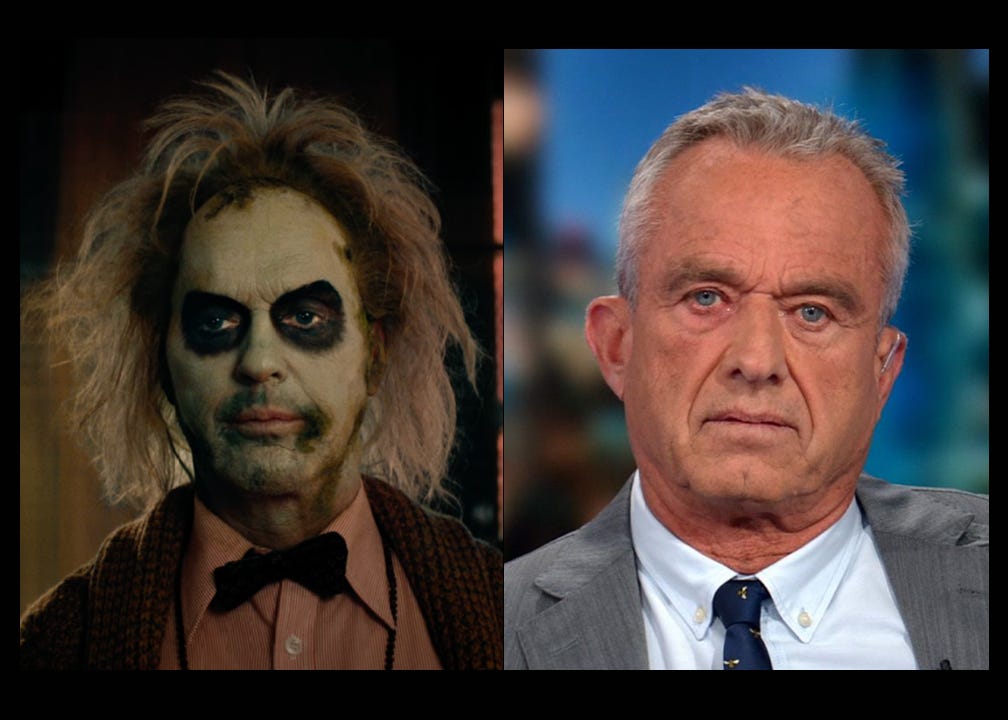
So when you say charisma…you must mean less Han Solo, and more Beetlejuice, right? Because that guy was decently charismatic.
Undeniable Rizz
I mean they certainly both command attention. One for being overall revolting and a predator, the other for being a predator from the underworld, who is also revolting. I could definitely imagine both of them putting baby chicks into a blender for the pleasure of scaring teens. And they each have a kind of startling skin texture.
Don’t forget about the brain worm
RFK Jr is dangerous. He is a lunatic. He doesn’t understand science, and financially benefits from fomenting mistrust around vaccines such as Gardasil, which have immeasurably helped humanity and are nothing short of miraculous. His scaly claw is hovering over the delete button when it comes to critical research funding, health care access, and… my GOD, my 75 year old father cannot be the only person with open access to Misoprostol.
At his best he does not even begin to comprehend the organizations he would be called upon to lead; his nomination to this position is a joke, and a sham, and a disgrace. He is there to break it, not to run it.
How could I trust him to handle a syphilis outbreak across the country when I wouldn’t even trust him to handle a syphilis outbreak in his own jeans.
OK. Well, we will see how it all shakes out, and good luck to us all.
To soothe my soul after the confirmation hearings I ate TWO full pastries from Librae Bakery, an epic salad from this amazing cookbook by Sohla El-Waylly, had a piping hot shower – and was pajamas up by 3:30pm.
To soothe your soul, please consider checking out THIS episode of Choice Words, in which I interview Chris Hayes and together, we basically solve the whole thing. His new book is suuuuper interesting, and we, two very needy people discussing the attention economy, are asking for your attention.
And if you are NOT YET AWARE, and what?? And HOW???? I also co-host The Daily Beast podcast with my friend, the always spicy Joanna Coles. Consider liking! Consider subscribing!
Together we are quite good at shenanigans, if I do say so. This week I indicated that I believe The New Mark Zuckerberg is the type of person who *might* recline on a surfboard in an attempt to tan his perineum, *allegedly* *possibly* *seems on brand in our new world*. How long will we be permitted to continue saying things like this? Let’s find out together.
This interview appeared in a small zine, and it’s appearing here as well. Check out Charles Brubaker’s LAUREN IPSUM on this site! He does everything on paper!Read on Substack
INTERVIEW WITH NANCY BEIMAN SEPTEMBER 1, 2023
By Charles Brubaker
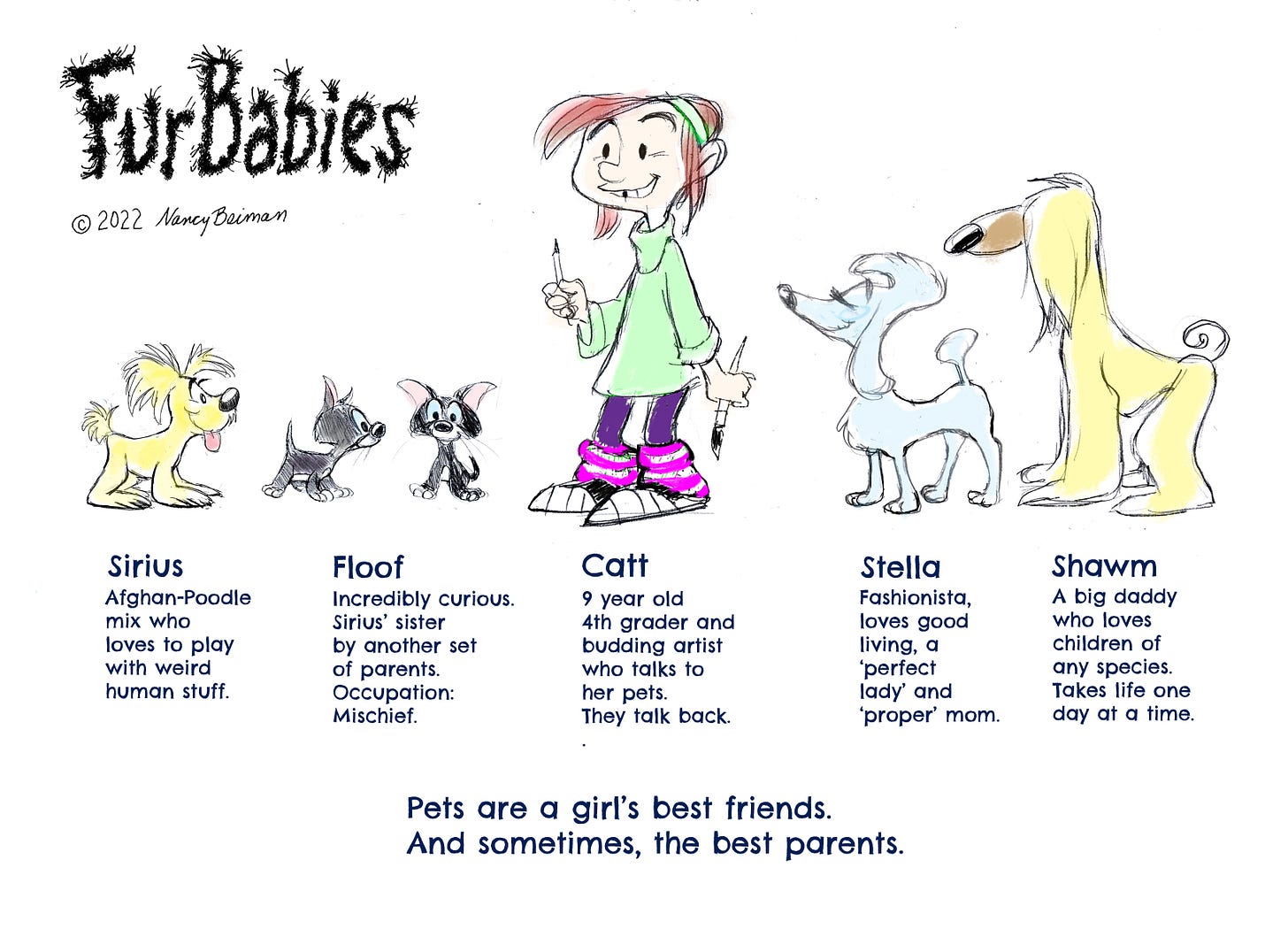
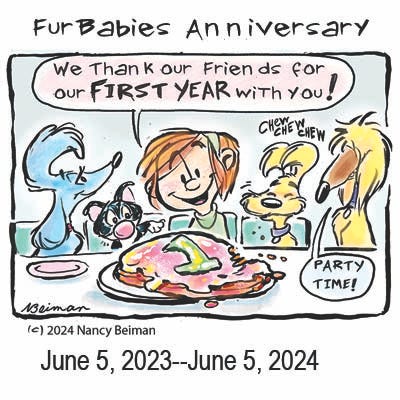
Nancy Beiman is best known for her decades-long work in animation, having animated for Warner Bros., Disney, Bill Melendez Productions, among others. However, on December 2022, at the age of 65, she ventured into a world of cartooning she hasn’t tried yet: a comic strip. The result was FurBabies, which made its debut on GoComics.com on June 5, 2023. The strip features Kate Buffet (pronounced boo-fay), an imaginative 9-year-old girl who can talk to her pets, dogs Stella and Shawm and their puppy Sirius, and Floof the kitten.
I interviewed Nancy about the comic via email. The following interview took place between August 12 to 16, 2023, and has been lightly edited for clarity.
What were your earliest cartooning influences?
My influences in animation were Chuck Jones, Charles M. Schulz, Robert Osborn, and Walt Kelly. I loved Zoltan Grgic’s work for the Zagreb animation studio. I was very fond of the UPA style but at the time did not know any of the artists’ names.
I met two of my influences and worked for one of them.
Speaking of Schulz, I remember you discussing your work on It’s the Girl in the Red Truck, Charlie Brown (1988) and how you animated Spike for it. What was your most memorable experience on that special?
Just working on a pantomime character was a liberating experience. I asked Bill Melendez who was the lead animator on Spike, and he said “You are. He’s never been animated before!” I loved using my knowledge of silent film comedy to block action on Spike. He walked like Chaplin (with those big feet) and did deadpan comedy like Keaton. He was a lot of fun to animate. That film is the most obscure of the Peanuts specials and should not be. It combined live action and animation (with the animated characters considered a ‘normal’ part of the live action world) two years before Who Framed Roger Rabbit. But CBS didn’t see any opportunity to sell toys, and it was not associated with any holiday, so they did not broadcast it until after Roger Rabbit was a hit. The Girl in the Red Truck was there first.
While you were getting started in animation did you think of doing comics? Were you published anywhere during your early days in the field?
I never considered doing comics at any time before December, 2022.
So FurBabies really is your first in the world of comics? What was the development process like? Which characters were created first?
I first got the idea for a comic strip about a kid who can talk to her pets as family members (rather than pets) in mid-December 2022. I drew up some sketches on December 24 and got Stella, Sirius, and Shawm immediately. They have changed very little since then. Kate has changed a lot. Here are the first sketches of her.
“Catt” drawn on December 24, 2022.
Floof is adapted from a cat design that I made for an unfinished film, Old Tricks. I used only the head and redesigned a kitten body. Floof has changed a bit since then. The head was that of an adult cat; she became more kittenish and cute after I drew about 10 strips. I had to go back and redraw some early Floofs when the strip was picked up by Andrews McMeel/GoComics. Kate was the hardest to create, and she was originally named Catt. She is inspired by Pippi Longstocking and a few students I have known (and they don’t know.) I had the character lineup, with Kate as Catt, on December 23, and changed her name to Katt, then Kate, on December 29. That’s when the characters were copyrighted.
Lynn Johnston saw the lineup on the 29th and instructed me to write 24 short story outlines, one sentence or so each, with dialogue. I got them done on New Year’s Eve. “You’ve got something. Can you keep this up?” Lynn asked me. I answered “Yes”. “Then draw 24 comics and let me know when they are done.” The first FurBabies comic strip, which is actually the first one on the GoComics site, was drawn on January 4, 2023. I used a 1926 Esterbrook “Radio” 914 pen nib once owned by Charles M. Schulz, on hot pressed Bristol board. It’s a gorgeous nib, but it is difficult to use a dip pen when you have inquisitive cats in a small apartment/studio. All subsequent strips were inked with a Pentel brush pen. All character art and backgrounds are drawn on paper, then scanned.
While we’re on art tools used in the comic, how big do you draw the strips? How do you color the comics?
I don’t draw ‘the strips’. I do rough scribbly thumbnail layouts for them, the most detailed are done for the Sundays. Each Sunday strip has a different layout. The characters and backgrounds are inked on paper, all of them separately. I use old animation paper or Italian hot press paper and draw a light rough, then ink with a Pentel brush pen. Characters can fill the entire page or be smaller, depending on the complexity of the drawing. I’ll do a drawing over if I don’t like the first one, and sometimes modify the scan in Photoshop. The backgrounds are often reused. I save each image as a 300dpi .bmp file and composite them on digital templates for 2, 3, or 4 panel strips. The digital dailies are 17 inches wide. Sundays are 24 inches wide. The finals are saved as TIFF files at GoComics’ recommended size…which means they are half to 2/3 of the size of the PDF files I work on. Only the first strip (June 5) was drawn with characters and backgrounds all on paper, like a traditional comic…I work much faster using animation methods. I use whatever works, the technology is not important.
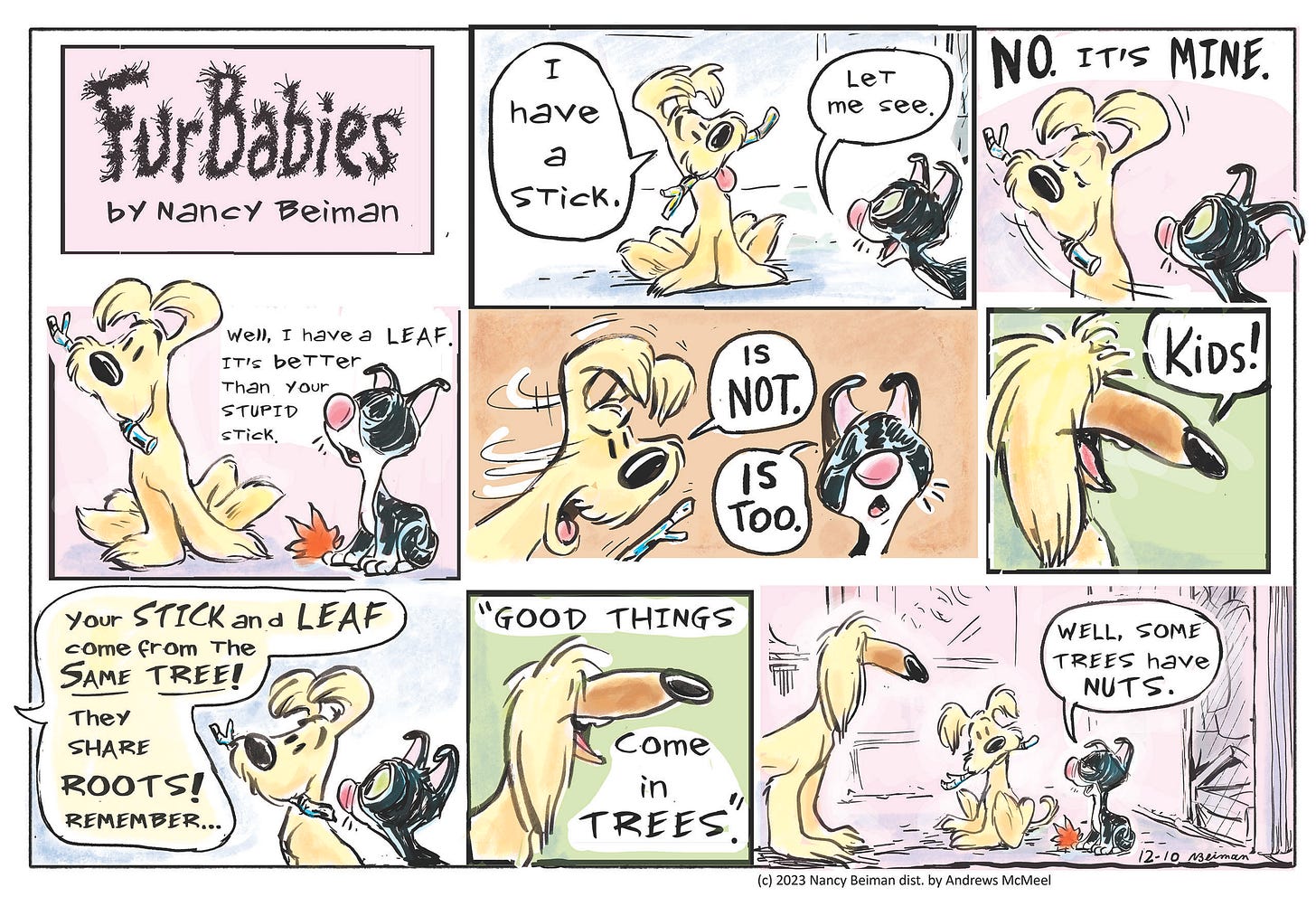
Coloring is done in Photoshop using brushes that mimic pastel and watercolor wash. I work on top of the black line to continue the illusion that it was ‘painted’ on paper. Even the borders of the strip are ‘fuzzy’ and characters sometimes break through the panels. Sunday strips are designed to be graphically pleasing and planned on paper but still done piecemeal, animation style.
Sunday strip, December 10, 2023.
The writing method Lynn Johnson suggested, with 24 one-sentence outlines, is an interesting technique for plotting out comic strips. What’s your overall writing method like once you got your strip off the ground?
I continue to follow Lynn’s method. It’s not a one sentence log line: dialogue and location, sometimes action, is always included. I often change things when I actually draw the characters since I still think in visual story, like an animator. Lynn’s method is the best way to keep a comic on track. It shows you where you are going and what characters can do. You can change the script order before you draw the strips.
Like animation dialogue, scripts and action for the comic are often changed when I get down to the drawing. Short scripts are the best way to get a series going, to plan when new characters are introduced, and develop characters. Lynn also suggested that I use a monthly planner (a book with the entire month on one page) to plan and time the storylines. That was a lifesaver. Several storylines have been moved since I started drawing the strip in January and wintry themes were out of place in June.
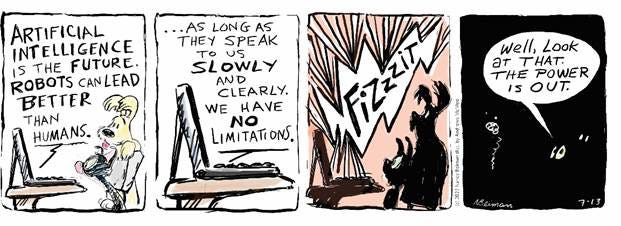
You recently introduced Pratt-L, an AI chatbot Kate uses to cheat on her homework. Do you have concerns about the use of AI in creative fields? What was on your mind when you wrote the arc?
I tried out AI’s writing and art programs when they were available for free trial and found them completely incompetent. Pratt-L combines the worst features of both. It is the perfect villain for this strip since the main conflict is between organic lifeforms and technology. This conflict developed as I got to know Kate better. She was the hardest one to write for.
Some modern comics have child characters that never stream videos, play video games, or use cell phones. Tauhid Bondia deliberately set Crabgrass in 1985 before these things became common and life changed for children. Kate Buffet is nine years old, lives in the 21st century, grew up in the age of smartphones, influencers, and streaming videos. Kate is not lazy or stupid but has a quirky way of thinking that does not match what is expected of her, especially in school. She has a lot of curiosity and it’s only natural that she would try the new AI technology. She has the latest digital technology. I made the rest of the apartment furnishings very dated, to show the contrast between Kate and her parents. There are some subliminal messages (family friendly ones) in the backgrounds. For example, the refrigerator is a Calder, named after the artist. Pratt-L wants to be a friend, is completely incompetent, sometimes snarky, in need of constant approval and self-pitying (depending on what it is scraping), but not a dangerous threat the way it is in real life.
There will also be an ‘influencer’ in FurBabies. It will not be human.
AI is not a matter of concern; it is literally going to be a matter of life and death. There is a bill in Parliament recommending that it be allowed to write medical prescriptions in Canada. What could possibly go wrong? People are not taking it seriously as a threat because artists and writers are the first ones affected by it, and most people do not consider art to be a ‘real job’ (My Labor Day strip addresses that issue.) I am most surprised by artists who keep insisting that it is ‘a tool’ like Photoshop. There is a difference. Photoshop allows you to personally modify artwork and photos. I use my own photos for backgrounds, and I sometimes use pictures from the Web for dogs and cats, but always redraw and redesign what I see. Photoshop does not use a bot to ‘scrape’ material from a million other artists and then ‘create’ art which you claim as your own.
My biggest surprise is that some artists think that it is fun to play with it. I think that they are like rabbits admiring the scales on the snake that is about to kill them.
Pratt-L’s quotes are from an actual ‘robot press conference’ held in Zurich a few days before this strip was published.
There’s a strong “family” theme in your comic, with how Kate views her pets to Sirius and Floof referring to Stella and Shawn as their mom and dad. Will this dynamic be explored more further as the strip continues?
The animals are definitely a family. The Dog Family has accepted Floof as one of their members. Kate is a link between the Dog Family and the Human family; she can speak to both, but only one of them understands her. She knows that she really is not a Dog or a Cat. It’s an interesting dynamic, and since the characters generally ‘tell’ me what they will and will not do, I am not sure if Kate’s situation will change. I also don’t think the human parents will appear, except as offscreen character voices. It’s not that they don’t interact with Kate…I just don’t find them interesting enough to include in the strip. It’s told very much from the animals’ point of view unless Kate is in school without them.
June 5, 2024. The Dog Family.
Early in the run most of the strip focuses on Kate and her pets, although newer strips start to include more characters, like in the recent Scavenger Hunt story arc. In addition to Kate’s classmates you also had her interact with Little Fingers the raccoon. Will we see more of Kate interacting with other kids in her class, and more of Little Fingers and other animals Kate can talk to?
Optima “Poppy” Populare and Iris, the two girls on the scavenger hunt, are not interesting enough to do much more than snark. “Poppy” returns in school and in some Halloween strips. There will probably be a few more kids appearing later on, with their own pets, probably in the dog park or maybe in the apartment building. Little Fingers the raccoon returns in November, but he’s a wild raccoon. He won’t ever interact with the other animals.
You indicated in your newsletter that you have a backlog for your comic. How far ahead are you currently?
I am currently working on strips that will air in October. I am proud to say that not one of them involves a pumpkin! (Charles M. Schulz covered that territory very well.) I like to stay about two weeks ahead of deadlines, and originally was two months ahead due to the late start in 2023! That gave me the option of shifting the cartoons, or changing them, as I got to know the characters better. I can also take a week off without worrying about comics not appearing.
Since FurBabies is still a very new comic and I am still redefining myself as a comic strip creator, I moved story lines or reworked some existing strips after I had enough comics that showed the characters’ developing personalities. Some people who have seen months of the strips in continuity tell me that they read better ‘as a whole’ but that is not the way comics work; it’s taken one day at a time. FurBabies is not a ‘gag’ strip, it’s character driven, so there were a lot of changes. Some of the cartoons that ran in June were originally drawn for September.
Things are settling down now. Some readers are adjusting to the fact that Kate is not a ‘perfect’ little girl, she sometimes tries to cheat on homework with AI (and gives up), or that she can be a distraction in class. I finally figured out who she was when she took her burned cookies and sold them as dog biscuits. Kate makes plenty of mistakes, but she has a creative way of dealing with them.








 Scottie's Playtime