Marlon Wayans is opening up about his 24-year-old trans son Kai, and the importance of parenting with “complete acceptance.”
The comedian appeared alongside his brother Damon Wayans on the April 30 episode of the IMO with Michelle Obama and Craig Robinson podcast. While discussing parenting advice, Marlon said that Kai’s transition “taught me what real, unconditional love was.”
“When they went through the transition, I actually went through the transition,” he said. “I went from denial to complete acceptance, and it took me a week to get there.”
Wayans joked that although he believes “only God can judge… If that’s a mistake and we get to heaven and God don’t let my child in, I’m going to shave a beard and sneak them in through the back.”
“I’m going to love my baby… I’m a father, and I’m always going to defend them,” he continued. “I’m always going to protect them. I’m always going to respect them. And there’s nothing anybody could ever tell me.”
The White Chicks star added that when it comes to the public’s reaction to him supporting Kai, he could care less about losing fans in the process.
“I lost people that are small-minded, small-hearted, and self-loathing,” he said. “So, goodbye… For every one I lose, I gain 150 more.”
This isn’t the first time that Wayans has used his platform to support Kai and other trans youth. Back in February, the actor defended his son after Soulja Boy called him a transphobic slur while publicly feuding with Wayans.
“You know you can get cancelled for transphobic slander like this,” he tweeted at the time. “Fortunately for you that you don’t have a career. Apparently, You BEEN cancelled for the last 17 years. Crank that was 2007. We waiting.”
Wayans previously opened up about supporting Kai during a September 2024 appearance on The Jennifer Hudson Show, explaining that after his son came out, “I went through the five stages of grief to get to the beautiful, magical place called acceptance.”
“I learned that my family, my brothers, my sisters, have prepared me to be a rock in our family,” he said. “[Kai is] the same child they was before, they’ve just got a beard now. Okay. Same baby.”
May 4, 1961 A group of Freedom Riders left Washington, DC for New Orleans in a first challenge to racial segregation on interstate buses and in bus terminals; it was organized by the Congress of Racial Equality (CORE). The Freedom Riders dining at a lunch counter in Montgomery before traveling to Jackson, Mississippi and New Orleans, Louisiana. Read more about the freedom riders 50 Years After Their Mug Shots, Portraits of Mississippi’s Freedom Riders
May 4, 1970 Ohio National Guard troops opened fire on anti-war protesters at Kent State University, killing four students and wounding nine others, one permanently disabled. The previous day, President Nixon had announced a widening of the Vietnam War with bombing in neighboring Cambodia. There were major campus protests around the country with students occupying university buildings to organize and to discuss the war and other issues. Read more about that day at Kent State with pictures
May 4, 1983 A “sense of the Congress” resolution, intended to urge a halt to all testing of nuclear weapons, was approved by the U.S. House of Representatives (287-149). The support for a nuclear freeze, ending all American and Soviet nuclear weapons testing, was widespread. In ballot resolutions in 25 states, the freeze had passed in all but one, losing in Arizona by just two points.
After seeing this cartoon, my friend John Kovalic wrote, “Sesame Street is brought to you today by the letter ‘F’ and the number 47.”
Late last night (Thursday), Donald Trump issued another illegal executive order, with this one ordering the board of directors for the Corporation for Public Broadcasting to “cease federal funding for NPR and PBS” because Trump claims they’re woke and liberally biased.
The problem with liberal bias is that facts have a liberal bias. If everything you say is a lie and everything you do is corrupt, illegal, sick, depraved, inhumane, racist, and fucked up, then factual reporting is not your friend.
Trump can’t do anything official against the free press, but he can put his weight on them, which seems to be working on The Washington Post and CBS News, but he can meddle with government programs…to an extent.
The order says, “Neither entity presents a fair, accurate, or unbiased portrayal of current events to tax-paying citizens. The CPB Board shall cancel existing direct funding to the maximum extent allowed by law and shall decline to provide future funding.”
The good news is, the government will continue to fund Trump’s golf games.
PBS President and CEO Paula Kerger called it a “blatantly unlawful Executive Order, issued in the middle of the night.” The middle of the night is when authoritarian governments tend to do their best work, like sending stormtroopers to break down your door, drag every member of your family out, and then put them in a train cattle car.
CPB issued a statement saying, “CPB is not a federal executive agency subject to the President’s authority. Congress directly authorized and funded CPB to be a private nonprofit corporation wholly independent of the federal government.”
I bet Trump’s thinking that’s the kind of biased reporting that is costing PBS and NPR their funding. He’s probably also thinking, “Respect my authority!”
The CPB noted that the statute Congress passed to create it “expressly forbade any department, agency, officer, or employee of the United States to exercise any direction, supervision, or control over educational television or radio broadcasting, or over [CPB] or any of its grantees or contractors.”
Congress said that such funds “may be used at the discretion of the recipient” for producing or acquiring programs to put on the air.
Trump has already asked Congress to rescind funds already approved for public broadcasting. Fascists always murder a free press.
CPB is already suing the regime over Trump’s executive order seeking to fire three of its five board members.
Trump recently attacked PBS and NPR on his platform ShitSocial, saying, “REPUBLICANS MUST DEFUND AND TOTALLY DISASSOCIATE THEMSELVES FROM NPR & PBS, THE RADICAL LEFT ‘MONSTERS’ THAT SO BADLY HURT OUR COUNTRY!”
Does Big Bird look like a radical left monster?
Conservatives have been howling for years that NPR and PBS are liberally biased while the progressive group Fair (Fairness in Accuracy in Reporting) once issued a report blasting PBS and NPR for being too conservative.
That’s the thing with the media. It’s never conservative enough for conservatives or liberal enough for liberals.
We got that complaint all the time when I was at The Free Lance-Star. Our page at that time was conservative, but we ran liberal columns and my pinko and unpatriotic cartoons. My editors sought balance, but there was still more conservative content than liberal, yet the conservatives still howled.
Each week, Politico publishes what they call the “Cartoon Carousel,” which is a collection of cartoons from the past week (USA Today and The Washington Post both used to do this, but they stopped). It too seeks balance and publishes an equal number of conservative and liberal cartoons, which means half the cartoons suck. I support diversity in news content, but I hate when it’s chosen over quality.
Now, one of those who complain irrationally about balance is in the White House, and he’ll abuse his power to do things the Constitution doesn’t give him the power to do.
Trump’s first 100 days have been a total disaster. Defunding public broadcasting is the kind of messed up crap we can expect for the next 100 days and every day after that until we get this orange ogre out of the White House.
Creative note: My brain was slow-moving today, and I have about ten subjects written down to choose from. Sometimes it’s harder to choose your subject than it is to write the cartoon. When you have a long list of subjects, it’s nice when you can combine two of them, which I did today. Oscar came to me around noon. I need to move on to those other subjects, but while writing this blog, I got a great idea featuring Bert and Ernie.
Music note: Have you ever noticed that the Sesame Street theme is the same song as Sunshine Day by The Brady Bunch?
Drawn in 30 seconds: From TikTok, and with music. (snip-MORE)
May 3, 1808 Civilians were executed by Napoleonic forces putting down a rebellion by the citizens of Madrid, Spain on Principe Pio Hill. The event was memorialized in the painting by Francisco de Goya, “The Third of May 1808: The Execution of the Defenders of Madrid.” Aspects of the painting inspired the design of the peace symbol by Gerald Holtom in 1958.
May 3, 1886 At Haymarket Square in Chicago, a rally was being held because of a strike at the McCormick Harvester plant, just two days after an enormous May Day turnout. Though the mass meeting was peaceful, a force of 176 police officers arrived, demanding that the meeting disperse. Someone, unknown to this day, then threw a bomb at the police. In their confusion, the police began firing their weapons in the dark, killing at least three in the crowd and wounding many more. Seven police died (only one by the bomb), the rest probably by police fire. Read more
May 3, 1963 In Birmingham, Alabama, Public Safety Commissioner and recently failed mayoral candidate Theophilus Eugene “Bull” Connor used fire hoses and police dogs on children near the 16th Street Baptist Church to keep them from marching out of the “Negro section” of town. With no room left to jail them (after arresting nearly 1000 the day before), Connor brought firefighters out and ordered them to turn hoses on the children. Most ran away, but one group refused to budge. The firefighters turned more hoses on them, powerful enough to break bones. The force of the water rolled the protesters down the street. In addition, Connor had mobilized K-9 (police dog) forces who attacked protesters trying to re-enter the church. Pictures of the confrontation between the children and the police were televised across the nation. Read more about the Birmingham Campaign
May 3, 1968 More than 100 black students took over a building at Northwestern University in Evanston, Illinois. They were demanding attention to their advocacy for inclusion of African-American history, literature and art in the curriculum. Their efforts led to the establishment of an African-American studies department which now offers a doctoral program. How it happened
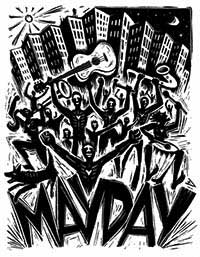
May 3, 1971 The Nixon administration ordered the arrest of nearly 13,000 anti-war protesters calling themselves the Mayday Tribe who had begun four days of demonstrations in Washington, D.C. on the first. They aimed to shut down the nation’s capital by disrupting morning rush-hour traffic and other forms of nonviolent direct action, skirmishing with metropolitan police and Federal troops throughout large areas of the capital. The slogan of the Mayday tribe: “If the government won’t stop the [Vietnam] war, we’ll stop the government.“ Read more
May 3, 1971 The first broadcast of National Public Radio’s evening news and public affairs program, “All Things Considered,” was aired on about 90 public radio affiliates around the country. The main story was the disruptive anti-Vietnam protests in Washington.It is now the fourth most listened-to radio program in the U.S. More about that first program
May 3, 1980 Sixty thousand marched on the Pentagon to urge the end of U.S. military involvement in El Salvador.
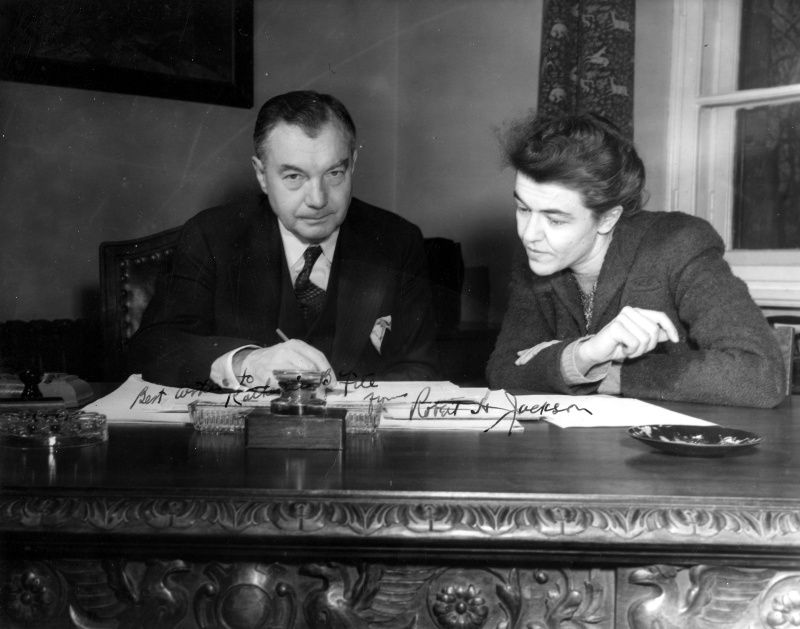
Clockwise from top left: Katherine Fite, Belle Mayer Zeck, Harriet Zetterberg, and Cecelia Goetz
When Katherine Fite arrived in London in the summer of 1945, her role in the post-World War II justice process was so novel that the New York Times took notice. “Woman joins staff of war crimes group,” the paper proclaimed. Fite told the Times that “she would not know the scope of her assignment until she had arrived overseas, but that she had been conversant with most phases of the work of the State Department on war crimes.” As the quest for postwar justice continued, Fite became one of just a few women lawyers participating in what became known as the Nuremberg Trials.
On May 2, 1945 — just six days before Victory in Europe, or V-E Day — Supreme Court Associate Justice Robert H. Jackson agreed to serve as chief prosecutor. That summer, as Europe emerged from the war, Jackson worked with his team and the Allies to prepare for the first ever international war crimes trials. Fite joined both the negotiations and legal research that led to the August 8 signing of the London Charter, creating the International Military Tribunal.
Katherine Fite (right) with Justice Jackson, ca. 1945 (National Archives)
Fite was the only woman lawyer present in the preparation phase. In September 1945, a month before the trials began, Fite toured Dachau Concentration Camp outside of Munich. She wrote home about the experience: “The gardens might well look fertile — human ashes were readily available for fertilizer.” A Polish-Jewish man who had survived Dachau showed her the gas chambers, disguised as shower rooms.
After the first trial, which lasted until October 1946, the United States launched 12 more trials that continued through 1949. Men dominated the courtroom — both as lawyers and as defendants — so women’s contributions were often overlooked. From the beginning, however, the American legal team relied on women’s work in key ways, from Fite’s work in the planning through the execution of the final trials, to Belle Zeck’s foundational work investigating German manufacturer I.G. Farben, to Cecelia Goetz’s key role prosecuting Krupp Industries.
Fite was not the only woman present at the Nuremberg Trials, but she was the highest-level female attorney in the early phases. Harriet Zetterberg was another early participant, the only woman lawyer assigned to the main prosecution team for the first Nuremberg trial, beginning in mid-August and lasting until June of 1946. Zetterberg arrived in Nuremberg in mid-September and prepared trial briefs, including one on slave labor and how it was used as a method to kill. Zetterberg felt the weight of the work, calling the six interrogations she witnessed “extremely interesting — one gets a sense of listening to history in the making.” (snip-MORE. This is really good.)
I’ve even made plans, presuming some of this becomes legal in the next 10 years where I live. I have high hopes for sky burials and terramation, at least those are my 2 favorites.) I have links to more info, but this is good for some who maybe haven’t thought of this aspect of the circle of life.
Think Outside the Coffin: Green Burials Gain Popularity
Green burials have been gaining favor for nearly 30 years, offering an eco-friendly way to say goodbye.
As Ben Franklin once said, “In this world, nothing can be said to be certain except death and taxes.” While the subject of taxes may be unpleasant, conversations about death don’t have to be.
“Most families are close enough to know what their loved ones want, [but] a lot of people don’t learn about death care until a loved one dies,” says B. Milton, a retired death care industry professional in Indiana. End-of-life discussions can be uncomfortable to broach — a lot of people don’t pre-plan, according to Milton — but having direction for your post-life care allows for peace of mind, both emotionally and financially.
As most people know, conventional burials — those that include options like a viewing, a funeral service, and burial in a casket — can be very expensive. The national median cost of a funeral with a burial in 2023 was $8,300, according to the National Funeral Directors Association. Caskets alone can cost thousands of dollars. Of course, the sentiment is wonderful; there is a true gift in being able to choose a beautiful vessel as a loved one’s final resting place. A growing number of people, however, prefer to keep funeral costs lower and more eco-friendly with green burial options, including burial shrouds, terramation, and aquamation.
Burial Shrouds
“Green burials are in their infancy,” says Russ Burns, director of All Saints Cemetery and The Preserve, a natural burial site in Michigan. “In 20 to 30 years, they’ll be up there with traditional burials,” noting that customers interested in green burial are well-informed and concerned less about themselves post-mortem and more about how the area where they will be interred will remain green.
A cenotaph wall at The Preserve. The wall is a collection of rocks engraved with names of those buried on the property. It offers a physical place for family and friends to visit their loved ones as graves are inaccessible after the burial service. (Image courtesy of Mt. Elliott Cemeteries)
The use of a burial shroud is simple: The deceased is placed in a shroud made of a biodegradable material like canvas and committed to the earth about three feet underground. The shallower depth allows for more oxygen flow than the standard six-foot depth for coffins, which helps the body decompose and return to the soil. The process takes about a year and costs, at the lower end, around $1,800.
Burns cautions customers to do their research and make sure they work with an organization that is fully funded and has “more than good intentions.” Following burial, the land continues to require maintenance you would expect, like mowing and landscaping, but may also need an environmental impact study or a controlled burn to get rid of invasive plant species.
Terramation
Terramation, to put it simply, is human composting. If you’ve ever joked about having a green thumb, now you can have green everything and quite literally be turned into soil.
The first stage of terramation takes about a month. The deceased is placed in a vessel and covered in organic materials like straw, alfalfa, and wood chips. Families who attend the preparation of the body also known as a laying-in ceremony — sometimes bring garden clippings and assist in the process. The vessel is then closed and stored while microbes break the body down to roughly one cubic yard (or several hundred pounds) of soil. The material is examined for any remaining organic matter like bone or non-organic matter like surgical implants and then left to cure. Before being released to the family, the soil must pass safe compost regulations, including tests for the presence of arsenic or lead.
The process of composting people has only been around for about 10 years and is currently legal in 12 states, including Minnesota, Arizona, California, Colorado, New York, and Washington state. Cost can range from $5,000 to $7,000. In the video below, mortician and green death advocate Caitlin Doughty chats with Katrina Spade, the founder and CEO of Recompose, a green funeral home near Seattle that specializes in terramation.
May 2, 1963 Hundreds of children ranging in age from six to eighteen were arrested in Birmingham, Alabama, as they marched from Kelly Ingram Park, across from 16th Street Baptist Church, to downtown singing, “We Shall Overcome.”Part of an ongoing effort to end segregation in that city, and following the arrests of many adults including Rev. Martin Luther King, Jr., the children had volunteered to minimize the threat to families if a breadwinner were jailed. A judge had issued an order preventing any of 133 civil rights leaders from organizing a demonstration. Birmingham, the capital of Alabama, had been the site of 18 unsolved bombings in black neighborhoods over recent years, and the place where mobs had attacked Freedom Riders on Mother’s Day in 1961. Leaving the park in groups of fifty, the kids were put in vans by police, led by Eugene “Bull” Connor, until there were 959 filling the city jails.
May 2, 1968 The Poor People’s Campaign began with groups from several locations around the U.S. setting out for Washington, D.C., to draw attention to the living conditions of the poorest Americans. It was conceived and organized by Reverend Martin Luther King, Jr. and, following his assassination the previous month, led by his successor at the head of the Southern Christian Leadership Conference (SCLC), Reverend Ralph David Abernathy. The first wave of demonstrators arrived in Washington on May 11. One week later, Resurrection City was built on the Washington Mall, a settlement of tents and shacks to house the protesters. Resurrection CityA Read more
Note From Ali in 2025: Not a dream, and while not yet fulfilled, the goal is not unfulfilled (“A Dream Unfulfilled” from the link above,) as The Poor People’s Campaign is still very active, operating in many US states. See if there’s a committee near you!
By: Susan J. Kressly, MD, FAAP, president, American Academy of Pediatrics
“The American Academy of Pediatrics (AAP) is deeply alarmed by the report released by the U.S. Department of Health and Human Services (HHS) today on medical care for transgender and gender-diverse individuals and the process that informed its development. For such an analysis to carry credibility, it must consider the totality of available data and the full spectrum of clinical outcomes rather than relying on select perspectives and a narrow set of data.
This report misrepresents the current medical consensus and fails to reflect the realities of pediatric care.
As we have seen with immunizations, bypassing medical expertise and scientific evidence has real consequences for the health of America’s children. AAP was not consulted in the development of this report, yet our policy and intentions behind our recommendations were cited throughout in inaccurate and misleading ways. The report prioritizes opinions over dispassionate reviews of evidence.
Patients, their families, and their physicians—not politicians or government officials —should be the ones to make decisions together about what care is best for them based on evidence-based, age-appropriate care.
We urge government officials and policymakers to approach these conversations with care, humility, and a commitment to considering the full breadth of peer-reviewed research. The AAP remains focused on supporting pediatricians in delivering the best possible care to every child, informed by science and the lived experiences of patients and families. We will continue to support the well-being of all children and access to high-quality care that meets their needs.”
May 1, 1865 Memorial Day was started by former slaves in Charleston, South Carolina to honor 257 dead Union Soldiers who had been buried in a mass grave in a Confederate prison camp. They dug up the bodies and worked for 2 weeks to give them a proper burial as gratitude for fighting for their freedom. They then held a parade of 10,000 people led by 2,800 Black children where they marched, sang and celebrated. More of the story
May 1, 1886 May Day was called Emancipation Day in 1886 when 340,000 went on strike (though it was Saturday it was a regular day of work) in Chicago for the 8-hour workday.
May 1, 1890 May Day labor demonstrations spread to thirteen other countries; 30,000 marched in Chicago as the newly prominent American Federation of Labor threw its weight behind the 8-hour day campaign. More May Day info
May 1, 1933 Dorothy Day The Catholic Worker newspaper was founded by Dorothy Day and Peter Maurin. Dorothy Day said, “God meant things to be much easier than we have made them,” and Peter Maurin wanted to build a society “where it is easier for people to be good.” Peter Maurin Read more about the Catholic Worker
May 1, 1948 Senator Glen Hearst Taylor Senator Glen Hearst Taylor (D-Idaho) was arrested in Birmingham, Alabama, for trying to enter a meeting through a door marked for “Negroes” rather than using the “whites only” door, and convicted of disorderly conduct. Taylor was the Progressive Party candidate for Vice President, running mate of Henry Wallace. He was in Birmingham to address the Southern Negro Youth Congress.
May 1, 1965 Second Factory for Peace opened in Onllwyn, Dulais Valley, in south Wales, employing disabled miners. Tom McAlpine, active in the Committee for Nuclear Disarmament, and a supporter of cooperatives and industrial democracy, established Rowen Engineering in both Wales and Glasgow, Scotland.
May 1, 1966 500,000 Vietnamese marched for an end to the war dividing their country.
May 1, 1967 Soviet youths openly defied police and danced the twist in Moscow’s Red Square during May Day celebrations. In the early ‘60s the Twist had been banned in Buffalo, New York, and Tampa, Florida. The religious right claimed the Twist was actually a pagan fertility dance. Are you old enough to remember Chubby Checker?
May 1, 1971 Five days of anti-war May Day protests began in Washington, D.C., resulting in over 14,000 arrests—the largest mass civil disobedience in U.S. history.
May 1, 1986 One million South Africans demonstrated their opposition to apartheid in a strike organized by the Congress of South African Trade Unions (COSATU) COSATU: a brief history
May 1, 2003 President George W. Bush landed in a jet on the aircraft carrier USS Abraham Lincoln off the California coast and, in a speech to the nation, declared major combat in Iraq over. The banner his staff posted on the ship read, “Mission Accomplished.” Since that presidential declaration more than 4500 American and allied troops and nearly 9000 members of Iraqi security and police forces (Jan. 2005 through July 2011) have lost their lives. In addition, tens of thousands (more than 32,000 Americans) injured in the hostilities. The number of Iraqi civilian deaths is open to dispute, but minimally stands at well over 100,000. Details of Iraq military casualties Civilian casualties
This Substack writer followed me, for some reason, so I followed him back on the free plan. He’s a heck of an author! Here is this that came out today. Just click on the Read on Substack hyperlink to get the whole piece. It’s a worthy click.
Canadian 🇨🇦 Speaking with American 🇺🇸 of Goodwill by Dr. Richard Francis Hogan Read on Substack
Canada K1R 7X1 Tuesday April 29, 2025 17:39
My dear American friend,
As a Canadian—rooted in the North’s enduring landscapes, shaped by the intellectual rigor of Princeton, Harvard, and Alistair—the perspective I bring carries both the weight of my country’s values and the lens of scholarship. Canada itself is a testament to resilience: vast, unyielding, and profoundly ethical, it stands as a quiet lodestar amid a fractured Western Alliance.
The Alliance, once a cathedral of shared ideals—its pillars of democracy, its arches of trust, and its foundation of justice—has weathered quakes of greed and waves of corruption. Criminal actors, conspiring in darkness, have sought to erode these sacred stones, testing the integrity of the principles that bind nations and people alike. Yet Canada, like the glacier’s edge cutting through stone, does not yield. It understands that sovereignty is not merely a possession, but a responsibility—a covenant to protect truth and justice, not only for itself but for all who look to it as a beacon.
Ethically, Canada reflects what true kinship should embody: colleagues whose integrity is a bridge over tumultuous waters; partners who root themselves in mutual respect, like the intertwining roots of the great boreal forests; and friendships, which are the wildflowers that flourish even in the harshest tundra, bringing color and life to the frostiest of divides. To betray these values, through complicity or complacency, is to allow darkness to encroach upon what light remains. (snip-MORE)