Short one today, very bad one tomorrow but also some light.
November 8, 1892 Thirty thousand Black and White factory and dock workers staged a general strike in New Orleans, demanding union recognition, closed shops (where all co-workers join the union), and hour and wage gains. They were joined by non-industrial laborers, such as musicians, clothing workers, clerks, utility workers, streetcar drivers, and printers.
November 8, 1935 United Mine Workers president John L. Lewis and other labor leaders formed the Congress of Industrial Organizations (CIO). They had split with the existing labor union umbrella organization, the American Federation of Labor (AFL), which was not interested in organizing unskilled workers, such as those in the steel, rubber, textile and auto industries. John L. Lewis CIO history
Rep. Marjorie Taylor Greene, R-Ga. speaks during the first day of the Republican National Convention.
Fresh off of her Election Night victory, anti-LGBTQ+ Rep. Marjorie Taylor Greene (R-GA) has expressed excitement that she, President-elect Donald Trump, and their MAGA cohorts will no longer tolerate “turning our kids trans.”
“I am so excited!” Greene said from Trump’s Mar-a-Lago Election Night party to convicted former Trump advisor Steve Bannon on the Real Americas Voice network. “America will no longer tolerate this communist regime, ripping our border wide open, turning our kids trans, and promoting abortion as reproductive rights. The American people are fed up with a weaponized government. President Trump is going back to the White House!”
She said that “Big Pharma” is lying to people about gender-affirming care.
She also claimed that Republicans will have to “continue to fight for election integrity…. because the Democrats will steal elections if they’re given the opportunity.” She and Trump have baselessly claimed that Trump only lost the 2020 election due to an unprecedented nationwide conspiracy of voter fraud that only occurred in the states that Trump lost.
She also said that Trump will pardon the insurrectionists who were jailed for the January 6, 2021 attack on the U.S. Capitol, “end the climate change scam,” and “go after the people” who persecuted Trump and his supporters, including former U.S. Rep. Liz Cheney (R-WY), U.S. Attorney for the District of Columbia Matthew Graves, U.S. Rep. Bennie Gordon Thompson (D-MS), and former House Speaker Nancy Pelosi (D-CA). Trump has referred to Pelosi as a “sick, crazy b**ch” and “an enemy from within.”
In July, Greene spoke at a press conference heralding the start of Bannon’s four-month sentence in the Danbury Federal Correctional Institution today for defying a congressional subpoena investigating his assistance in inciting the January 6, 2021 Capitol riots.
Greene has previously said that an airplane never hit the Pentagon during the September 11 terrorist attacks, claimed that all school shootings are fake, said that California wildfires were started by a Jewish-owned space laser, and accused former Secretary of State Hillary Clinton of slicing off a child’s face and wearing it.
Trump has promised to ban gender-affirming care for minors nationwide and prohibit federal agencies from “promot[ing] the concept of sex and gender transition at any age.” He has pledged to deny federal funding to schools that push “radical gender ideology, and other inappropriate … sexual or political content on our children.” He has also promised to repeal Biden-era protections for LGBTQ+ students “on Day One.”
Trump insulted Bannon when he was convicted of a crime
On the last day of Trump’s presidency, he pardoned Bannon who served as chief executive officer of Trump’s 2016 presidential campaign. Bannon also served as White House chief strategist and senior counselor to Trump from January 2017 until August 18, 2017, when Trump fired him.
In August 2020, Bannon was indicted by a federal grand jury for allegedly spending $1 million of a $25 million GoFundMe campaign to help Trump construct a U.S.-Mexico border wall. Bannon pleaded not guilty and was set to face trial in May 2021 before Trump pardoned him.
Trump initially said the Mexican government would pay for the wall — they never did, and Trump only built 458 total miles of barriers, PolitiFact reported.
In January 2018, Trump and Bannon’s relationship soured after Bannon was quoted in Michael Wolff’s book Fire and Fury: Inside the Trump White House as calling the president’s daughter Ivanka Trump “dumb as a brick” and calling Trump “a crooked business guy” and a “scumbag.”
In response, Trump said in a statement, “Steve Bannon has nothing to do with me or my Presidency. When he was fired, he not only lost his job, he lost his mind,” adding, “Steve had very little to do with our historic victory.” Trump later referred to Bannon as “Sloppy Steve” on Twitter (now X) and claimed that Bannon “cried when he got fired and begged for his job.”
This is the growing anti-LGBTQ+ that the right has been working on creating since the first tRump term. The person who helped craft the don’t say gay bill in Florida was a fundamentalist Christian who said he did it because it horrified him that fellow students, other kids welcomed the LGBTQ+ kids that came out. He felt they should be attacked, beaten, ostracized, made friendless, scared, and stay in hiding. That is what these people want. We must find a messaging to fight back. Blue states have it but it must find a way to reach into red states. My husband is terrified to even let me fly a progressive pride flag in one of our front facing windows. That is what these people want, they want us afraid. I don’t want to live that life, I stopped living like that when I was 23. I took the hits for it. I am almost 62. I don’t want to live the rest of my life in a closet I never fitted in. Hugs
——————————————————————————————————–
“No one in the restaurant intervened. No one screamed ‘stop.’”
Sebastian Thomas Robles Lascarro before and after the attack
A group of 10 to 15 individuals allegedly attacked Sebastian Thomas Robles Lascarro, a 22-year-old Colombian model, inside a Washington, D.C., McDonald’s fast food restaurant after a member of the group uttered homophobic slurs. The attack left Lascarro hospitalized, and he criticized both emergency personnel and local police for their responses to the violence.
The attack allegedly occurred in the early morning hours of Sunday, October 27, after Lascarro and his husband left two nearby LGBTQ+ nightclubs: Crush Bar and Bunker. While Lascarro was in line to use a McDonald’s self-service kiosk to place his order, Lascarro’s spouse, Stuart West, said a woman then screamed at his husband to “watch where the f**k he was going,” he told WTTG.
Lascarro reportedly tried to leave in order to avoid a conflict, when a group of 10 to 15 individuals — who were reportedly the woman’s friends — blocked Lascarro from leaving and allegedly called him homophobic slurs like “fa**ot” and demanded he apologize to the woman. Lascarro refused, and the assault allegedly began.
“Five to 10 individuals started just punching him all over his face, all over his body,” West said. “No one in the restaurant intervened; no one screamed ‘stop.’”
The attack reportedly left Lascarro injured and bleeding on the sidewalk outside the restaurant while the mob threw food, trash, and drinks at him. Two passers-by eventually contacted emergency medical services to assist Lascarro.
At Howard University Hospital, Lascarro was treated for a busted lip, scrapes, and bruises. He was placed in a neck brace and photos show him with bruises and blood on his face. Lascarro is reportedly recovering from his injuries.
“I fear for his mental health,” West said. “We’ve had conversations about whether D.C. is safe for us and whether the United States was the right choice.” Lascarro is originally from Colombia, moved to Washington, D.C., last year, and became a permanent resident of the U.S. this year, NBC News reported.
West and Lascarro said that they felt dismissed by both the emergency medical technicians (EMTs) who arrived at the scene and police who took a report of their incident later on. Lascarro said the EMTs failed to “acknowledge the severity of the assault and his experience as a gay man,” and West said police initially refused to acknowledge the attack as a possible hate crime until he contacted the police department’s LGBTQ+ liaison.
West launched a GoFundMe crowdfunding campaign to help pay for Lascarro’s medical bills, as the attack has made it difficult for him to keep modeling. The campaign had raised $7,037 of its $20,000 goal by Monday morning.
“Thomas is a loving, compassionate person who did not deserve this, and no one in our community should face this kind of hatred,” West wrote for the campaign website. “Any help to ensure he gets the care he needs to regain his health and peace of mind will be a blessing.”
Remember all we have to do is tie his every policy change up in courts for two years just like the republicans did with Biden. Then work like hell to flip the Senate. Once we do that all of his minions plans for a white straight cis Christian paradise will mostly end. Hugs
———————————————————————————————————
The ACLU already have an anti-Trump ‘battle plan’ drawn up to fight his policies (Michael M. Santiago/Getty Images)
The American Civil Liberties Union (ACLU) already has plans in place to “take action” against president-elect Donald Trump’s policies.
The not-for-profit organization took to social media as soon as news outlets called the US presidential election in favor of Trump, saying it was fed up with “waiting anxiously”, and was ready to “ensure that erosion of civil rights or civil liberties will be hotly contested”.
A spokesperson on X/Twitter said: “We are ready to take action the minute Trump takes the oath of office [on 20 January].
“We’re clear-eyed about the chaos and destruction a second Trump administration will cause to our nation. That’s why we’re done with hand-wringing, admiring the problem, or waiting anxiously to see which unlawful action Trump will take on day one.”
The ACLU claimed it was the “first organization to challenge [Trump’s] Muslim ban” when the Republican was elected eight years ago, adding that its legal battles “stopped the inhumane practice of separating immigrant families” and won the fight to prevent “a citizenship question on the 2020 census”.
It filed “434 legal actions against the first Trump administration” including to support the LGBTQ+ community, which were won in front of “Trump-appointed judges”, the spokesperson went on to claim.
“At the ACLU, we play the long game. We’ve been here for 105 years, through 19 presidents.”
In recent years, the ACLU has been in the forefront of the battle against discriminatory legislation in the US, keeping track of every anti-LGBTQ+ law that has been introduced across the country.
“The ACLU will not stop speaking out against these cruel attacks nationwide, LGBTQ people have a right to live in safety, to thrive and to be treated with dignity,” the spokesperson continued.
Experts have warned that a second Trump term, with JD Vance as his vice-president, could be catastrophic for queer rights in the US, with the pair having pushed anti-LGBTQ+ rhetoric during the long campaign.
Among other measures, Trump claimed that he would cut federal funding to school districts that adopt trans-friendly policies, exclude transgender women from women’s sports, and restore his ban on trans people serving in the military.
And, in the wake of the overturning of abortion rights case Roe v Wade in 2022, campaigners have expressed fears that the conservative-controlled Supreme Court could next turn its attention to Obergefell vs Hodges, which gave the fundamental right to marry to same-sex couples in 2015.
Project 2025, assuming it still needs to be explained at this point, is an infamous proposed manifesto for the ultra-conservative faction of the Republican Party and, many believe, Donald Trump’s second term.
And with many LGBTQ+ Americans waking up on 6 November to the bleak and shocking reality of a second Trump presidency, it feels like a particularly good time to unpick what the document could signify for queer peoples’ rights in the US over the next four years.
Unsurprisingly, while Project 2025 promises to “take down the ‘Deep State’ and return the government to the people”, it also threatens to shred the rights and advancements of the LGBTQ+ community in the US.
The handbook’s authors claim that one of the biggest problems facing the US today is the “toxic normalization of transgenderism with drag queens and pornography invading school libraries.”
Project 2025 goes on to say that “transgender ideology” is one form of “pornography” linked to the “sexualization of children”. In total, “gender” is mentioned 111 times, and “LGBT” or “LGBTQ” 18 times, in the handbook.
LGBTQ+ rights would all but disappear if Project 2025 came to fruition. (Getty)
Viewed as a sort of right-wing wish-list, Project 2025 pledges to strip away anti-discrimination policies, making it easier to target and discriminate against LGBTQ+ people.
Published by the hard-line right-wing Heritage Foundation, the document calls for the removal of terms such as “sexual orientation” and “gender identity” from federal rules and legislation, and the revoking of regulations prohibiting discrimination based on sexual orientation, gender identity, transgender status and sex characteristics.
Project 2025 set out plans to restrict the application of the Supreme Court’s decision in Bostock vs. Clayton County, which extended workplace protections against sex discrimination to LGBTQ+ employees.
In addition, it plans to restrict access to healthcare for transgender people, something it refers to as a form of “child abuse”. Its authors also want to see trans healthcare no longer being covered by insurance schemes Medicare and Medicaid, and an end to anti-discrimination rules based on gender identity and sexual orientation.
In addition, there are plans to reverse policies allowing transgender people to serve in the military, a ban that was initially brought in under the Trump administration but reversed by president Joe Biden. If enacted, Project 2025 would expel transgender servicemen and women as well as those living with HIV.
Donald Trump has tried to distance himself from the hard-line right-wing document. (Getty)
The State Department’s LGBTQ+ equality initiatives in Africa would also be axed. In other words, there would be no effort to stop draconian anti-queer laws being passed in countries such as Uganda.
In terms of education, the conservative blueprint is even more staunchly anti-LGBTQ+. It calls for a ban on students using names or pronouns that don’t match the sex on their birth certificate, and no school employee would be “forced” to use a pupil’s chosen pronouns.
It document outlines ideas to remove LGBTQ+-inclusive curriculums and policies from schools, claiming that “critical race theory and gender ideology” are “poisoning and indoctrinating children with leftist ideologies”. Instead, families “comprised of a married mother, father and their children” would be prioritized.
Despite many of its authors being one-time Trump administration advisors, the former president claims to know “nothing about Project 2025” or who is behind it, saying: “I disagree with some of the things they’re saying and some of the things they’re saying are absolutely ridiculous and abysmal.”
And two of his campaign advisors insisted: “President Trump’s campaign has been very clear that Project 2025 had nothing to do with the campaign, did not speak for the campaign, and should not be associated with the campaign in any way.”
A spokesperson for Project 2025 has even told CNN that it “does not speak for any candidate or campaign.”
However, Democrats have continued to point to links between the 922-page document and Trump. As he’s now won the election, will Trump finally admit to having any involvement with Project 2025? Only time will tell.
Why is it only the southern border that the right is concerned with? Most undocumented people in the US are here on visas and flew into the country legally. They just never then went home when the visa ended. Why is it only some country the right whines about immigrating to the US? Racism and bigotry is the answer. Think about it. The right is terrified that white people will be replaced by non-white people. Elon Musk is always claiming white people need to have more babies. But only white people. Also the right fails to understand that Puerto Rico is part of the US and the Puerto Ricoian people are US citizens. But remember how tRump wanted to sell the island because it was full of … those brown people. Hugs
—————————————————————————————————————
In an exclusive interview with NBC News, Trump talked about his campaign promise to carry out the largest mass deportation of immigrants in U.S. history.
President-elect Donald Trump told NBC News on Thursday that one of his first priorities upon taking office in January would be to make the border “strong and powerful.” When questioned about his campaign promise of mass deportations, Trump said his administration would have “no choice” but to carry them out.
“We obviously have to make the border strong and powerful and, and we have to — at the same time, we want people to come into our country,” he said. “And you know, I’m not somebody that says, ‘No, you can’t come in.’ We want people to come in.”
As a candidate, Trump had repeatedly vowed to carry out the “largest deportation effort in American history.” Asked about the cost of his plan, he said, “It’s not a question of a price tag. It’s not — really, we have no choice. When people have killed and murdered, when drug lords have destroyed countries, and now they’re going to go back to those countries because they’re not staying here. There is no price tag.”
It’s unclear how many undocumented immigrants there are in the U.S., but acting ICE Director Patrick J. Lechleitner told NBC News in July that a mass deportation effort would be a huge logistical and financial challenge. Two former Trump administration officials involved in immigration during his first term told NBC News that the effort would require cooperation among a number of federal agencies, including the Justice Department and the Pentagon.
In Thursday’s phone interview, he partially credited his message on immigration as a reason he won the race, saying, “They want to have borders, and they like people coming in, but they have to come in with love for the country. They have to come in legally.”
“I started to see realignment could happen because the Democrats are not in line with the thinking of the country,” the president-elect said. “You can’t have defund the police, these kind of things. They don’t want to give up and they don’t work, and the people understand that.”
Trump also spoke about his phone calls with Harris and President Joe Biden since the election.
“Very nice calls, very respectful both ways,” Trump said, describing the conversations, adding that Harris “talked about transition, and she said she’d like it to be smooth as can be, which I agree with, of course.”
In her concession speech at Howard University on Wednesday, Harris said she told Trump, “We will help him and his team with their transition and that we will engage in a peaceful transfer of power.”
Biden, addressing the nation in remarks from the White House on Thursday morning, urged voters to “accept the choice the country made” in re-electing Trump.
Trump also said that he and Biden on the phone agreed to have lunch together “very shortly.”
He also said he’s spoken to “probably” 70 world leaders since Wednesday morning, including Israeli Prime Minister Benjamin Netanyahu, which the president-elect described as “a very good talk.”
Trump also said that he spoken with Ukrainian President Volodymyr Zelenskyy, but didn’t divulge details about that conversation.
He added that he had not yet spoken with Russian President Vladimir Putin, but “I think we’ll speak.”
Over the course of the campaign, Trump promised to end Russia’s war with Ukraine if elected, saying in September that he would negotiate a deal “that’s good for both sides.“
Donald Trump has been outspoken against the LGBTQ+ community. (Getty)
At the time of writing, it seems almost inevitable that Donald Trump will become the 47th President of the United States, meaning LGBTQ+ rights are under serious threat.
The election was one of the closest in history according to voting polls over the past few weeks, with polling group FiveThirtyEight reporting that Harris just barely reached a 1.2 per cent lead on Trump a day before the results were counted.
The last Trump presidency led to a roll-back of protections and anti-discrimination laws for LGBTQ+ people, and it doesn’t look as if a second term would be any different if he is re-elected, based on campaign promises and the detailed policy proposals outlined in Project 2025 – although Trump has tried to distance himself from the right-wing proposals.
In anticipation of a Trump win, the American Civil Liberties Union (ACLU) suggested a new Trump administration would “reinstate and significantly escalate the removal of anti-discrimination policies… proactively require discrimination by the federal government [and] weaponize federal law against transgender people across the country”.
So, what are Trump’s views about LGBTQ+ rights, and what exactly might he do?
Erase federal non-discrimination protections for LGBTQ+ people
Trump’s first term was extremely detrimental to the rights and protections of LGBTQ+ people, and a second term could roll back protections once again.
LGBTQ+ people might no longer be guaranteed to be free of discrimination across several federal government programs, such as Social Security, Medicare, housing and employment.
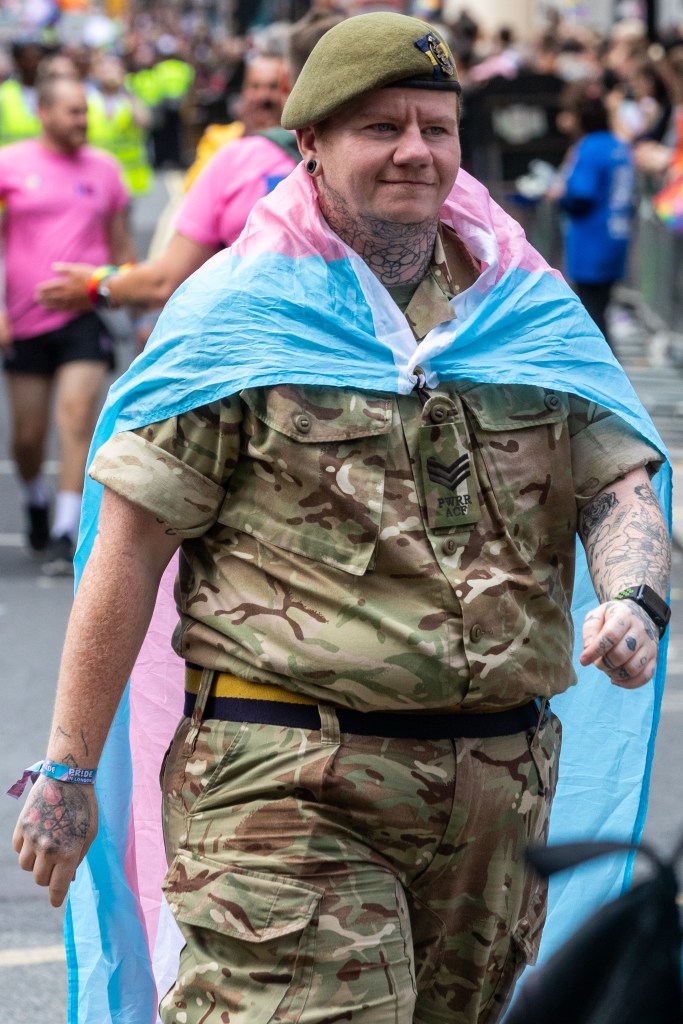
Exclude openly transgender people from the military
The first Trump administration reversed policies allowing trans people to serve in the military, and it is not difficult to foresee the president doing so again.
Another ban on trans people in the military would force out active-duty transgender service personnel as well as prevent trans people enlisting in the future.
This is despite a report in 2016 revealing that trans-inclusive policies have “little or no impact on unit cohesion, operational effectiveness, or readiness”.
In fact, trans-inclusive military policies could benefit all active service members by “creating a more inclusive and diverse force.”
Trans people could once again be banned from serving. (Getty)
Withhold federal funding if school officials affirm transgender students
Trump has said he would act to stop any school district introducing or maintaining trans-inclusive policies and practices.
This would include withholding federal funding that allow trans students to use toilets and changing rooms that align with their gender identity, or even acknowledging that they are trans, as well as arguing that trans-inclusive policies violate the rights of cisgender pupils.
Discrimination against trans students, causing significant harm to the community as a whole, would be the likely result of such a move.
During a recent campaign rally, Trump said he was not going to “let” trans women compete in sporting events at all if he becomes president again.
He said invoking the ban would “not [be] a big deal”, citing recent sporting events in which trans women competed against cisgender women, claiming that the trans athlete had a competitive edge over their opponent.
“Physically, from a muscular standpoint… look at what’s happened in swimming. Look at the records that are being broken,” he said.
Prohibit gender-affirming care in federal healthcare programmes
His website also promises that on his first day in the Oval Office, he would issue an executive order “instructing every federal agency to cease all programs that promote the concept of sex and gender transition, at any age”.
The administration would also probably deny Medicaid funding for hospitals that provide gender-affirming care, forcing medics to deny trans people the care they require.
Access to healthcare for more than 100,000 transgender youngsters in 24 states has already been halted in the past three years.
Allow employers to discriminate against LGBTQ+ staff
A second Trump administration could bring in provisions to allow employers to discriminate against LGBTQ+ members of staff based on the boss’ stated religious beliefs, a reversal of existing non-discrimination laws.
This would not require congress or bipartisan support, and could be pushed through using an executive order from the president.
The administration could go one step further to prevent state and local governments enforcing non-discrimination laws if the defendant says the discrimination was based on religious belief.
Laws protecting LGBTQ+ people and other minorities from discrimination based on protected characteristics might also disappear.
Donald Trump has continued to target the LGBTQ+ community. (Getty)
Criminalize gender-non-conformity in public life
Project 2025 – a hard-line right-wing blueprint for a future Republican president – suggests the use of criminal laws to punish gender-non-conformity in public life, with pornography being the crux of the issue.
The authors of the plan, the Heritage Foundation, inexplicably link pornography with “transgender ideology” and argue that neither has a “claim to First Amendment protection” and therefore should be outlawed.
“The people who produce and distribute it should be imprisoned,” they demand. “Educators and public librarians who purvey it should be classed as registered sex offenders, and telecommunications and technology firms that facilitate its spread should be [closed down].”
That means any discussion of transgender people in schools and libraries could be criminalized, and trans people might face jail time for being themselves.
Trump would only be able to put this into practice with congress’ approval and there is unlikely to be bipartisan support for such a law, but even the slim possibility is terrifying.
Finally – could gay marriage be reversed?
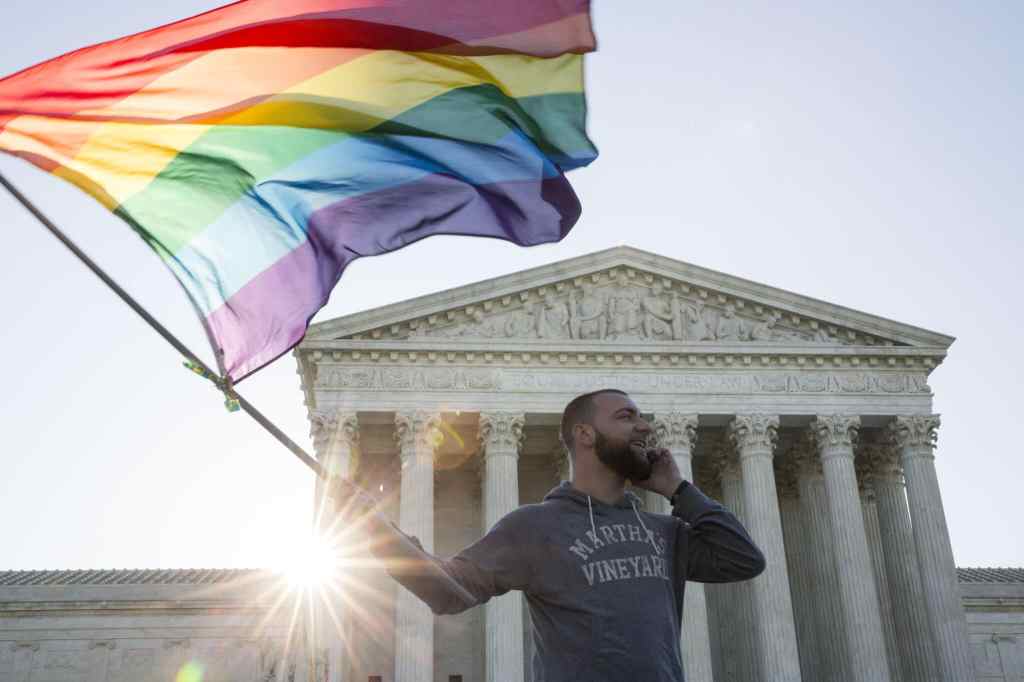
Same-sex marriage supporter Vin Testa, of Washington DC, waves a rainbow pride flag near the Supreme Court. (Drew Angerer/Getty Images)
Unfortunately, yes, it could.
After crucial abortion legislation Roe v. Wade was overturned by the Supreme Court, many people said that next, they would be coming for Windsor and Obergefell and Lawrence – three rulings that unlocked a national right to same-sex marriage.
Whether a same-sex couple could marry varied by state before 2015. With its 5-4 decision in Obergefell v. Hodges, the Supreme Court extended the full federal right to marry to all same-sex couples.
So would – or could it be taken away? Many people think that the Supreme Court wouldn’t dare. Same-sex marriage is now too accepted in American society, they argue. It would cause “legal chaos.”
However, it remains the case that some justices, particularly Samuel Alito and Clarence Thomas, appear to be itching to overturn Obergefell. In 2022, Justice Thomas said the Supreme Court “should reconsider” its past rulings codifying rights to contraception access, same-sex relationships and same-sex marriage.
It’s important to remember in all of this Pride is a protest, and it continues to be. We can fight any and all of these attacks by standing up, speaking out and refusing to stay silent.
My friend Mayvella used to say, “If you woke up, put your feet on the floor, the lights turned on, and the toilet flushed, the day will be OK.” I wish more than that for each of us, but seriously, my friend Mayvella was correct. She was a woman of color, very wise when I met her. I’m fortunate to have had her for a friend. She got up, got around, and went and volunteered at the food bank every Monday, Wednesday, and Friday, and brightened lots of days for many people just by being herself. When she passed, it was suggested we close for a day in observance of love and respect. I’m glad we decided she would have taken that as disrespect, and that she would have gone in and worked if one of the rest of us had passed away. So, rest a bit, and hope. (Then, we organize again.)
What We Know About How Trump Will Approach LGBTQ+ Rights, Abortion, and Other Issues
Much is still unknown about how Trump will carry out some of his big promises on issues like the economy and immigration, or how he may curb abortion access and LGBTQ+ rights. Project 2025 and what he’s said so far offer some clues.
Sign up for The Agenda— Them’s news and politics newsletter, delivered to your inbox every Thursday.
Throughout his campaign, President-elect Donald Trump has made big promises on issues of enormous consequence to Americans, from the economy to reproductive health care — but offered few details on how he would see those promises through.
What he’s said in his campaign and what he did during his first term offer some clues, as does Project 2025, the blueprint for a second Trump term written by the conservative Heritage Foundation. Though Trump has distanced himself from Project 2025, saying he has “no idea who is behind it” and that he has not read it, six of his former cabinet secretaries contributed to it in some form and much of what is in the 920-page document aligns directly with statements Trump has made this year.
Though there are still many unknowns, here is what we know so far about how a second Trump term will approach reproductive rights, LGBTQ+ rights, the economy, education, immigration and aging and disability care.
Abortion
Throughout his campaign, Trump has repeatedly taken credit for the fall of Roe v. Wade. He appointed three of the Supreme Court justices who helped overturn the decades-old case protecting federal abortion rights. His stance on abortion access has wobbled over time between a national ban and state-by-state laws.
Though Trump has said he would not support a federal abortion ban and he’s called restrictive abortion laws like Florida’s six-week ban “a terrible mistake,” it’s unclear how much he will stick to those statements: A day after he said people needed “more time” than six weeks, he said he would vote to uphold the ban in Florida, where he lives. About 57 percent of Floridians voted in favor of an amendment to undo the six-week regulation, but it fell short of the 60 percent threshold it needed to pass.
The biggest question mark heading into the election was his support of a federal ban. During the presidential debate in September, Trump said “there’s no reason to sign a ban, because we’ve gotten what everybody wanted, Democrats, Republicans and everybody else, and every legal scholar wanted it to be brought back into the states,” meaning the issue had been returned to the states. A majority of Americans disapproved of the Supreme Court decision that led to a patchwork of abortion decisions, according to polling from the nonpartisan Pew Research Center.
What Trump will ultimately do will likely come down to who he appoints — and listens to — in his administration. Some of his closest supporters, including Vice President-elect JD Vance, have said they support a national ban on abortion, though during the vice presidential debate in October, Vance acknowledged that his position is not popular with “a lot of Americans.”
Trump has also said he’s open to limiting whether mifepristone, one of the pills used in medication abortions, can be sent by mail.
Economy
Much of Trump’s win Tuesday was likely due to Americans’ view on how he could improve the economy — and particularly their own personal finances. Early exit polls show that the economy was a lead motivator for many after record inflation during the Biden administration brought on by a confluence of factors, including supply chain issues, Russia’s war in Ukraine and coronavirus stimulus checks.
In the end, the reason for the inflation — and how much of it was Biden’s doing — didn’t matter. Trump presented himself as the person to “fix” the economic troubles that have plagued Americans over the past four years, and it appears to have been a salient message.
Trump inherits an economy in repair: Inflation is back down to 2.1 percent from 9 percent, hovering at the Federal Reserve’s 2 percent goal. And the country has been adding jobs consistently for months, though the most recent report shows fewer jobs added in October than expected. Still, the unemployment rate is down to about 4.1 percent from 6.3 percent when Trump left office in January 2021.
The biggest economic showdown of a second Trump term will likely come next year, when parts of Trump’s 2017 tax bill expire. Among those provisions is the child tax credit, which was expanded in 2017 to $2,000 per child. Trump has expressed support for the credit, but has not said what he’d do with it in 2025. Vance has floated increasing the credit further to $5,000 per child. Trump has also called for further lowering the corporate tax rate, which he brought down from 35 to 21 percent in 2017, to 15 percent.
The president-elect has also proposed several tax breaks — on tips, Social Security and overtime pay — but it’s unclear how he would pursue those aims.
Cutting taxes on tips would impact the women who make up the majority of tipped workers directly, but only those who earn enough to be taxed in the first place. Nearly 40 percent of tipped workers already don’t earn enough to pay federal income taxes.
If Trump also eliminates payroll taxes on tips, most workers would see some impact, but could also see their Social Security benefits diminish (payroll taxes fund Social Security and Medicare). The same would happen if taxes are cut on overtime pay, though it’s also unclear what the impact of that would be. Trump has offered no details on how he would approach the policy.
Trump has also called for eliminating taxes on Social Security benefits, a proposal that would impact about half of recipients, most of them higher income, who currently pay taxes. But that proposal alone could make Social Security insolvent three years earlier than predicted, by fiscal year 2031, rather than 2034, according to the Committee for a Responsible Federal Budget, a nonpartisan nonprofit organization.
It is likely that the second Trump administration will vigorously pursue curbing the rights of trans Americans. Trump’s campaign has proposed terminating Medicare and Medicaid funding for hospitals that provide gender-affirming care to trans youth, attempting to charge teachers with sex discrimination for affirming students’ gender identities and ordering federal agencies to “cease all programs that promote the concept of sex and gender transition at any age.” Trump has also pledged to ask Congress to halt the use of federal funds to promote or pay for gender-affirming care, without distinguishing between care for adults or minors.
Leading up to the election, Trump falsely claimed that schools were performing gender-affirming surgeries on children without parental knowledge or consent — a claim divorced from reality that marked a particularly bizarre moment in a campaign littered with anti-trans misinformation. At an October 28 rally, as Trump did at multiple rallies on the tail end of his campaign, he doubled down on framing anti-trans policies as key to his vision for the Republican party, saying: “We’re the party of common sense. That means no open borders, and no transgender operations.”
In October, about 41 percent of the campaign’s ad spending was focused on messaging around trans people, particularly trans athletes and children receiving gender-affirming care.
When polled, most Americans do not rank trans issues highly compared to issues like the economy or abortion rights. It is currently unclear if these ads motivated Trump voters to turn out in 2024 or if they were incidental to issues that voters rank more highly.
Education
Trump has called repeatedly for an end to the Department of Education and presented himself as a champion for school choice, a position that will likely take center stage in a second term.
That stance aligns with details in Project 2025, which also supports eliminating the agency, as well as gutting protections for LGBTQ+ students and what he sees as progressive curriculum. Trump has vowed to cut federal funding for schools that teach lessons related to race or that teach “gender ideology.” Much of the impact will be on trans students, especially in sports.
Under his previous administration, then-Education Secretary Betsy DeVos worked to limit trans women’s participation in women’s sports, arguing it violated the anti-discrimination law Title IX.
DeVos also sparked outrage by revising Title IX regulations to make it harder for sexual misconduct survivors on college campuses to hold perpetrators accountable.
Earlier this year, the Biden administration reversed these controversial DeVos-era regulations and offered protections for LGBTQ+ students in schools, but the incoming Trump administration will almost certainly introduce their own updates to this federal law. Specifically, Trump is expected to go further by defining “sex” to exclude transgender students from playing on teams or experiencing school generally in ways that align with their gender identity.
Gutting the Department of Education would also have a major negative impact on disabled students, who rely on federal enforcement of civil rights laws to protect them from discrimination, lack of access to appropriate education, unnecessary segregation and abuse.
Immigration
Some of Trump’s most divisive rhetoric during his campaign was toward Latinx people and immigrants, who he blamed as the reason for many of the country’s challenges, from safety to job loss to affordable housing. In the final days of his campaign, at a Trump rally in Madison Square Garden, comedian Tony Hinchcliffe called Puerto Rico “a floating island of garbage.”
Throughout his campaign, Trump has called immigrants “the enemy from within,” saying undocumented immigrants are “poisoning the blood of our country.”
His response as president, he said, would be to mount the “largest deportation in the history of our country,” but he has offered very little information on how that would happen, who would be targeted and with what resources.
Much of what Project 2025 has to say about immigration overlaps with Trump’s campaign promises. The document discusses reinstating “every rule related to immigration that was issued” during Trump’s first term, and the president-elect has specifically called for putting back into place his “Remain in Mexico” policy, by which some asylum seekers had to wait out the outcomes of their U.S. immigration cases in Mexico.
Plans laid out in Project 2025 would also make it even more difficult for undocumented students to attend college. It calls for the Department of Education to deny loan access to students who aren’t in the country with authorization and for loan access to be denied to students at schools that offer in-state tuition to the undocumented population. Nearly 20 states, including California, Texas and New York, offer in-state tuition to undocumented students.
Disability and aging
During the presidential debate in September, Trump indicated that he had “concepts of a plan” for replacing the Affordable Care Act, which protects disabled, chronically ill and older Americans from being excluded from standard health insurance coverage.
Opposition to the Affordable Care Act was a centerpiece of Trump’s 2016 campaign, and his first year in office was characterized by a failed, widely unpopular attempt to repeal and replace it, in addition to cutting Medicaid funding. Medicaid, a federal poverty program, funds the majority of long-term care for disabled and older adults in the United States.
Republican House Speaker Mike Johnson has indicated that he is willing to commit to dismantling the Affordable Care Act during a Trump presidency. While Trump promises on his website not to cut Medicare, which provides health insurance for Americans over 65, he has made no such promises about Medicaid.
Affordable drug pricing may also take a hit during a second Trump term. The Biden administration vigorously pursued Medicare price negotiation to lower the cost of some particularly expensive prescription drugs for older adults. While Trump promised to pursue a similar policy during the 2016 race, he never implemented that promise.
Both Vance and Trump have promised a tax credit for family caregivers of older and disabled adults between $5,000 to $6,000 per year. The average cost of home care in the United States, per the most recent data from the Federal Long Term Care Insurance Program, is $42,120 per year. The average cost of a shared room in a nursing home is $100,740 per year.
Nadra Nittle and Orion Rummler contributed to this reporting.





 Scottie's Playtime