
Reform-led Durham council cut off funding to the annual Pride celebrations.
— Trades Union Congress (@The_TUC) May 26, 2026
So trade unions launched a fundraiser to save it, eventually raising more money than was cut.
Which means this year's Pride will be bigger than ever.
In the 1980s, the LGBT+ community raised thousands… pic.twitter.com/M2BYBrD6uC
Tag: Justice
That Public Notice About NDA’s for Government Workers:
We have 29 more days to make our views known in regard to the executive wishing all federal workers to sign a very broad NDA. This will crush transparency and notice of abuse, and there will likely be no more whistleblowing.
Anyway, here it is, along with the link so we can make our comments (of course it is not hyperlinked on the page, we need to copy it and paste it into our browser. WP has made it a live link in this post, but it doesn’t work.) It’s our duty and a right we still have; if we do not use it, we will most certainly use it. I found out about this yesterday on MPS’s post; it just took me a bit to get to this.
You can find this here. (This hyperlink is good; I made it myself and it works.) It is a .pdf. The NDA notice begins in the lower right-hand column.
From within the public notice, here is the info for submitting our comments:
ADDRESSES: You may submit comments
using the Federal eRulemaking Portal at
https://www.regulations.gov. Follow the
instructions for sending comments.
The general policy for comments and
other submissions from members of the
public is to make these submissions
available for public viewing at https://
http://www.regulations.gov without change,
and including any personal identifiers
or contact information. Before finalizing
the NDA, OPM will consider all
comments received on or before the
closing date for comments. OPM may
make changes to the NDA after
considering the comments received.
And a little more:
Request for Comment
OPM welcomes public comments on
all aspects of the draft NDA, including
whether the Privacy Act statement’s
description of the authority, principal
purposes, routine uses, and effects
provide sufficient notice to employees.
The draft NDA is available in the docket
for this notice on regulations.gov. See
https://www.regulations.gov/document/
OPM-2026-0100-0003. OPM specifically
requests comment on the following
issues.
- What scope of information should
be covered by the NDA? Should it cover
only unclassified information? How do
you understand the terms confidential
and confidentiality in the context of this
NDA? What customization of the NDA,
if any, may be necessary for agencies to
ensure it covers the appropriate
information? - Does the NDA clearly communicate
the types of information that would be
subject to non-disclosure requirements?
If not, how could OPM better describe
what information can or cannot be
disclosed to ensure employees have
appropriate notice of their
responsibilities? - Are there other statutes to which
OPM should cite in Appendix A of the
NDA when describing the nondisclosure
requirements applicable to individuals
working for or on behalf of the Federal
government? - Do you have suggestions regarding
the layout or formatting of the NDA? - Does the Privacy Act statement in
the NDA provide sufficient notice to
employees of the authorities, principal purposes, routine uses, and effects of - the form?
- Does the OPM/GOVT–1 system of
records notice provide sufficient notice
that the government-wide system of
records would maintain records related
to the signing of, or failure to sign, the
NDA? - What are the appropriate actions, if
any, for agencies to consider taking if
existing employees choose not to sign
the NDA? - What are the appropriate actions, if
any, for agencies to consider taking if
new employees choose not to sign the
NDA? - Does the NDA clearly communicate
the potential consequences of refusal to
sign the form for both existing and new
employees, along with whether signing
the form is voluntary or mandatory? - What else should OPM consider
with regard to the NDA??
OPM will consider comments
received before finalizing the NDA.
There are several other things there, if you have some time and want to see what the exec is doing besides trying to hide all they do and finally/fully cut off our representation, even as we are taxed for government work. I don’t believe we can let this slide, but maybe that’s only me. Anyway, if you also don’t like this, please go, read the bit, and write what your conscience tells you. I’m certain you will not be alone in doing so. The thing is, our government, for which we all pay, is not a business. The only parts that should not be public are those that actually shield the actual security of the country, things such as when we go after Osama Bin Laden, and locations of items that other countries might like to drone. There should be no covering of regular day-to-day government business-that is our business and we have the right to know.
Go Figure-Did They Cheat?
Maine Trans Sports/Bathroom Ban Referendum Invalid Over Signature Forgery Concerns And Improper Gathering
The initiative was funded by billionaire anti-trans donor, Richard Uihlein, and used out-of-state paid signature gatherers.
On Tuesday, Maine Secretary of State Shenna Bellows ruled that a proposed ballot initiative banning trans students from school sports and bathrooms will not appear before voters this November. The billionaire-funded campaign initially submitted 79,692 signatures—well over the 67,682 required to qualify—and the Secretary of State’s office certified the question for the ballot in March. But indications soon emerged that the signature-gathering process was riddled with improper procedures and, in at least one documented case and potentially many others, outright forgery. After a court remand, an evidentiary hearing, and a sworn-testimony review of the petitions, 12,542 signatures were invalidated, leaving the campaign 532 short of the threshold. Barring an appeal—which is likely though its success is far from certain—transgender students in Maine can rest a little easier this election cycle.
The infractions are striking. One out-of-state circulator left his petition forms unattended at a Topsham polling place on Election Day—twice—allowing voters to sign without a witness present, in direct violation of Maine law. Another circulator did the same at a Saco polling place, leaving her table for extended periods while crowds of voters signed unwitnessed petitions. When asked under oath whether she had destroyed the unwitnessed forms as required, she said yes—but a photograph submitted into evidence showed one of those forms was in fact turned in for validation. Most troubling of all, an out-of-state signature gatherer paid per signature submitted forms that appear to contain outright forgeries: one voter listed on her petition testified under oath that she had never signed it and had never even heard of the initiative. After the Oxford town clerk flagged additional suspicious signatures, an Elections Division review compared every name on the circulator’s forms against voter registration applications—and concluded that every single one of her validated signatures should have been thrown out as signed by another person.
Based on the evidence, Bellows ruled Tuesday that the initiative had failed to qualify for the November ballot. The decision marked a reversal of her own March certification, when her office initially determined that the petition contained enough valid signatures to move forward. That earlier ruling was challenged in Cumberland County Superior Court by three Maine voters, who alleged that thousands of signatures had been collected in violation of state law. In April, Justice Deborah Cashman agreed that the original review had been incomplete and remanded the case back to the Secretary of State’s office for further factfinding, ordering a new determination of validity within thirty days. That process produced the May 12 evidentiary hearing—where witnesses, including town clerks and voters whose names appeared on petitions, testified under oath—and ultimately the decision invalidating thousands more signatures than the initial review had caught. Bellows adopted that recommendation in full.
The initiative would have done far more than what its sports-focused branding suggested. It would have defined a person’s sex for school purposes as “a person’s biological status as male or female recorded at birth on the person’s original birth certificate”—a definition that would have stripped transgender students of legal recognition in Maine schools. It would have required public schools to “maintain separate restrooms, locker rooms, shower rooms, and other private spaces for each sex,” extending the ban well beyond athletics and into every gendered space in a school building. It would have created a private right of action allowing any student to sue their school for “direct injury” suffered from a violation of the act, effectively turning every transgender student’s presence in a bathroom or on a sports team into potential litigation. And it would have specifically carved transgender students out of the Maine Human Rights Act.
The anti-trans signature drive was not a grassroots effort. It was bankrolled by Illinois billionaire Richard Uihlein, the co-founder of Uline office supplies, who donated $800,000 to fund the entire effort. Uihlein has given more than $250 million to political causes since 2016, and is a major funder of the American Principles Project, which routinely spends tens of millions on anti-trans campaign ads during election years. He is not alone: an independent analysis published by Atmos and HEATED found that 80% of 45 major anti-trans organizations in the U.S. have received funding from fossil fuel companies or billionaires. The Maine initiative was part of that broader pattern—an attempt by a small handful of extraordinarily wealthy donors to use direct democracy as a workaround in states where elected legislatures have refused to engage in anti-trans legislation.
The decision was greeted with relief by the LGBTQ+ coalition that has fought the initiative since the day it was filed. “Maine has strict rules in place to protect the integrity of our elections and our system of direct democracy. The paid, out-of-state signature gathers and the billionaire who paid to try to put this question on the ballot failed to follow the rules,” said David Farmer, campaign manager for the Campaign for Free and Fair Schools, the coalition led by EqualityMaine, GLAD Law, and the Maine Women’s Lobby. “We believe that the appeals process and the reviews by the Secretary of State are working as the law intends. They are protecting the integrity of our elections.”
The Maine ruling is not the end of fight. Similar billionaire-backed initiatives have been certified for the November ballot in Washington and Colorado, where voters will decide whether to bar transgender students from sports as well as medical care restrictions. Both efforts are also funded by conservative megadonors, and both are part of the same strategy that produced the Maine initiative: use ballot initiatives to roll back trans rights in states whose elected legislatures have refused to do so. The Maine anti-trans campaign is expected appeal Bellows’ decision to Maine Superior Court within the ten-day window the law allows.
Women Need To Run Things-
Women Have Sacrificed Too Much for the Careers of Powerful Men: Analysis
May 12, 2026, 8:30am
Cesar Chavez, Eric Swalwell, Justin Fairfax, and the gender politics of keeping their dirty secrets.
News about powerful men committing violence against women has bombarded the United States in recent months.
On April 16, 2026, Virginia’s former Lieutenant Gov. Justin Fairfax killed his wife, Dr. Cerina Fairfax, and then himself inside their family home. The shocking news came days after Rep. Eric Swalwell, a Democrat from California, resigned from Congress following multiple sexual misconduct allegations.
A few weeks prior, in March 2026, an investigation about labor movement leader Cesar Chavez revealed a decades-long pattern of sexual abuse, including against another farmworker icon, Dolores Huerta.
All three of these powerful men had known patterns of alleged predatory sexual behavior. But their secret was protected—in some cases for decades—not only by other men, but also by some of the same women they’d hurt.
Somehow, no matter how much progress we think we’ve made, women keep being sacrificed—or sacrificing ourselves—for men’s accomplishments and legacy. Our lives and futures and mental health are even sacrificed on the altar of their potential political accomplishments and legacy.
The Al Franken effect
I’m a legal historian and commentator on sexism and gender-based violence. I’ve studied violence against women and the criminal trials that let male perpetrators off the hook. I’m also a woman who experiences sexual harassment so often that it has become a dull hum following me throughout my day.
This self-sacrifice seemingly stems from what seems to me to be a societal belief that the men who commit harm are more needed than the women who are harmed. Our ideas, organizing, and logistical labor—often dismissed as “secretarial” work—can’t compete with the fear of losing a single powerful man.
When the allegations against Swalwell first broke, some on the left rushed to defend him. Some on social media claimed it was a Republican smear job because he’s been opposed to Trump’s policies and was running to be the next governor of California.
Eventually, as more women came forward and D.C. insiders said that they’d heard rumors about Swalwell’s behavior for years, Democratic leadership called for Swalwell to drop out of the governor’s race.
Women often come forward with their stories when a man is running for political office because they feel that information is relevant to voters. Or, they may speak out because it’s difficult to see one’s abuser portrayed so incompletely in the news.
Yet some people cast doubt on the timing of the Swalwell accusations, suggesting people were out to get attention or take a “good man” down before he can further ascend in his career. On social media, posts compared the situation to Al Franken resigning from Congress in 2017 over sexual misconduct allegations.
Franken’s resignation is often treated as an example of #MeToo going “too far,” because some reporting suggests that the initial accusation against Franken may have been trumped up. But he was sexually inappropriate with women both before and after taking office. His resignation was important to live up to progressive values, and the left didn’t actually lose any political clout over it: Franken’s replacement, Tina Smith, has been a fantastic senator.
It’s relatively rare for members of Congress to resign after being accused of sexual misconduct. According to the National Women’s Defense League, 23 lawmakers with public accusations are running for reelection in 2026 in 16 states, including nine people running for Congress.
The group held a press conference on April 21, 2026, to discuss two new reports on sexual misconduct in Congress and state government. According to its research, 80 percent of candidates publicly accused get reelected.
Cesar Chavez’s legacy
The calculus for marginalized women to come forward about sexual assault is even tougher.
The first line of Dolores Huerta’s public statement about her abuse says she kept quiet for nearly 60 years because she “believed that exposing the truth would hurt the farmworker movement I have spent my entire life fighting for.”
I believe many women stay quiet when they think coming forward could hurt a movement—in this case, one Huerta helped to build. But they may tell their story if they’re worried not doing so could cause even more harm.
Her story details two incidents of sexual assault that resulted in two hidden pregnancies. She gave both children up for adoption.
Soon after the investigation broke, Chavez’s name was erased from monuments across the country. That’s not necessarily an indication of local leaders taking sexual violence seriously. In some places, it may just as well reflect a desire to erase Mexican American achievements and the progress of the United Farmworkers Union in securing rights for migrant laborers, some of the most marginalized workers in the country.
I say that because we have the perfect replacement for Chavez’s legacy in Huerta herself. It would be so easy to simply rename every street and monument after her, rather than simply erase commemorations of the movement.
Huerta was already forced to sacrifice so much by Chavez, must she now watch as her life’s work goes down with him, too?ire News Group is a reader-supported, independent nonprofit newsroom.
Jewish history
In my own Jewish community, there is a long history of pressuring victims of domestic violence and sexual assault to stay quiet—and not air their suffering outside the community.
Doing so would be an example of “lashon hara,” or evil speech or gossip. If we report our abuse to police, we are contributing to negative ideas about the Jewish men in our community. Some men in the Jewish community even claim that because of Jewish teachings and customs, Jewish men can’t ever actually abuse their wives, because domestic violence is a Christian affliction of gentile culture—that is, a non-Jewish problem.
This myth persists outside the Jewish community, and it can impact how Jewish women are treated in secular American courts.
My doctoral dissertation research covered a case of a Jewish woman in New York City murdered in 1875. Both suspects in her killing were Jewish men protected by the community. During the trial, the victim was used as a cudgel against her own people to prove that Jews were dangerous.
If she had survived and was given the choice to report the violence she faced would she have feared exposing a man from her community to the criminal justice system?
This concern is even more heightened for Black women. If their abusers are Black, they know that reporting them means increasing exposure to a racist criminal justice system.
Research also suggests Black women are less likely to be seen as victims by the dominant society and more likely to be blamed for harming men of their own community, or accused of trying to “take down a good man.” (Think back to how accusations against R. Kelly, Mike Tyson, Bill Cosby, and Clarence Thomas were greeted.)
As Aishah Simmons, Black feminist and activist, explains, many people “think that exposing and addressing intra-racial sexual violence against Black women divides the community … and we should only focus … on racism since that is the ‘real problem.’”
This community protection can feel even more important when the abuse comes from a so-called “good Black man,” as author Kaitlyn Greenidge wrote on April 19, 2026, of Cerina Fairfax’s killing. The promise of a Black middle class life with a politician husband like Justin Fairfax is supposed to guarantee a safe and protected life.
Cerina Fairfax stood by her husband even after two women accused him of sexually assaulting them; one alleged incident occurred back when he and his accuser were undergraduates at Duke University.
The accusations against Fairfax came to light during a crisis in Virginia politics when he was poised to possibly take over the governorship from the scandal-plagued Ralph Northam. Fairfax denied any misconduct and refused to resign. No criminal charges were filed. He ran for governor in 2021, and lost.
Fairfax later sued CBS for defamation (the suit was thrown out) and claimed he was experiencing a form of lynching (taking a page out of Justice Clarence Thomas’ book after Anita Hill’s accusations).
In this case, Democrats did lose leadership of the state. Before the sexual assault allegations, Fairfax was seen as a rising star in the Democratic Party. Had his accusers not gone public, he might have become the state’s next governor.
But it’s equally true that had he resigned in 2019, after they did, a new Lt. governor could have stepped in and potentially run successfully in 2021.
Sacrificing for the cause
It irks me that Fairfax ran for governor after being accused of sexual misconduct. It irks me that Swalwell did, too.
Swalwell’s name remains on the primary ballots in the California governor race, and that will hurt the Democrats’ chances to hold onto that post. It was Swalwell’s hubris and entitlement hurt his party—not the women who came forward to prevent him from accruing more power.
I wonder: How many young staffers left politics because Swalwell was allowed to prey on his subordinates? What progress could have been made in the labor movement if the women abused by Chavez had instead been in leadership roles? Would Cerina Fairfax still be alive if her husband had been prosecuted in 2019?
We’ll never know how the world would look if the well-being of the women in these cases had been prioritized over the careers of their abusers. What I know is that the harm done to us as women is more important than the potential of the men who hurt us. And I know that the goals of movements or political gains can no longer rest on our silence and our labor.
How God Made the 10 Commandments
I really enjoy this creator and how he has done this entire series on the Christian god and the inconsistancies of the bible and the figures in it. In this series the god is a self centered older teenager who only thinks of themselves and their needs/ wants. The full series starts out with a future highly technological civilization having graduates from school take a psychological test as them an omnipotent being and their assistant is actually their teacher in real life. But in this case “god” is so narcissistic it causes problems in the simulator they are all connected with. But the series does show how narcissistic and only thinking of their feelings, wants, and needs this Christian god is. Sadly the creator has moved on from making the series and the spin-offs from them as his main YouTube product but he still produces these videos which I am grateful for. But try to remember that God is a student and Jefferies is in reality his teacher still trying to teach him how to be a good person. Reverse the roles of the characters and you get the joke. Hugs.
“Bowen Yang Offers Hilariously NSFW Clapback After Troll Questions Why He’s Grand Marshal Of NYC Pride”
After it was announced that SNL alum Bowen Yang would be one of the Grand Marshals for New York City Pride, a troll questioned his selection—and Yang offered a hilarious reason.
By Peter Karleby
One good thing about trolling comedians, they always know exactly how to respond.
New York City Pride recently announced the Grand Marshals for its annual Pride parade, scheduled for June 28.
It’s quite a roster, featuring trans actress Dominique Jackson, drag star Peppermint, trans journalist and radio personality Bernie Wagenblast, activist group Gays Against Guns and SNL alum Bowen Yang.
Of course someone was gonna have an opinion on this lineup, and one of them tried to come for Yang in the comments of the announcement on Instagram.
And Yang, ever the seasoned comedian, had the perfect response. The troll demanded to know “why bowen,” and Yang didn’t miss a beat, quipping:
“showed hole to the board.”
(snip-embedded social post)
Perfect.
It’s a strange question in the first place: Yang made history when he joined the SNL cast in 2019.
In a statement, NYC Pride wrote:
“Bowen Yang became a household name as the first Chinese-American cast member on Saturday Night Live in 2019.”
“With that platform, he helped usher in an era of authentic queer humor in mainstream media, earning an Emmy® for writing and becoming the most-nominated Asian male performer in Emmy® history in the process.”
The better question is “why not Bowen?”
(🤣 🤣 🤣 snip-MORE ; lots of embedded social media posts; enjoy!)
Been Wondering About Kat Abughazaleh? Here Is News:
Kat Abughazaleh shows us how to fight fascists
Q+A with one of the Broadview Six, who had all charges dropped against them after grand jury misconduct.
Marisa Kabas
For the last seven months, Kat Abughazaleh wasn’t allowed to go to Alaska. It’s not that she had any particular reason to, but being under felony indictment meant that she was only allowed to travel throughout the lower 48 United States. And forget leaving the country. But on Thursday, those restrictions were suddenly lifted when all charges against her were dropped.
Abughazaleh, 27, woke up Friday a free woman. The former Illinois congressional candidate was charged in October along with five others for conspiring to impede an officer near the Broadview ICE facility just outside of Chicago. In reality, Abughazaleh and her co-defendants were there to protest the federal government’s increasingly public cruelty and the human rights abuses happening inside Broadview specifically, and broadly by ICE. The Trump administration, not surprisingly, did not appreciate their very public pushback and responded with brutality and violence. But with all charges against them now dropped, the only thing they’re an example of is why fighting fascists is good.
With the trial scheduled to begin just after Memorial Day, US district judge April Perry called an emergency hearing Thursday to discuss missing pieces of the trasncript from the grand jury proceedings where DOJ lawyers convinced jurors to indict Abughazaleh, her campaign field director Andre Martin, Michael Rabbitt, Brian Straw and two others who had the charges against them dropped earlier.
The case was already on the decline, with prosecutors dropping the felony charges against the remaining four in April as questions about the grand jury transcripts popped up. They still faced a full trial on misdemeanor charges and up to one year in jail. But Judge Perry ruled the DOJ’s handling of the grand jury and subsequent redactions constituted grave misconduct, making it impossible to move forward.
I spoke with Abughazaleh by phone Friday morning about right wing fuckery, ridiculous rumors, and how she plans to reclaim her life after the federal government tried to destroy it. Our conversation has been edited and condensed for clarity.
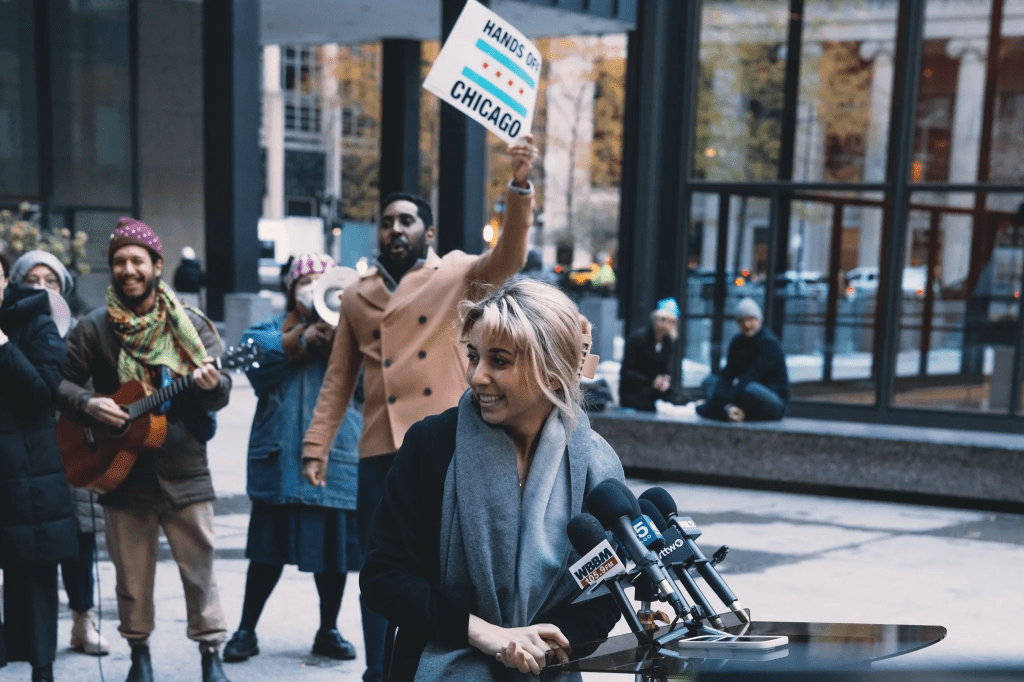
MARISA KABAS, THE HANDBASKET: How did it feel waking up this morning?
KAT ABUGHAZALEH: I had to get up at like 5am to go on Morning Joe, but I woke up and I was like, oh yeah, I don’t have to go to trial this week—which is not a statement I thought I’d have to say ever in my life.
KABAS: Walk us through what you thought the next week or so was supposed to be like before yesterday’s hearing.
ABUGHAZALEH: I was supposed to have not just trial prep with my lawyers, but having to get my clothes dry cleaned. Going to get a manicure because my nails always always look awful. I spent way too long at a Nordstrom Rack picking out shoes that I thought looked fashionable but also modest and wouldn’t make jurors think I was a bitch. On Tuesday we were supposed to have jury selection. On Wednesday we were supposed to have opening arguments, which is a shame that we don’t get to hear our lawyers spit absolute fire. But yeah, it’s nice not to do it in the first place.
KABAS: Absolutely. So what do you think you’re gonna do instead?
ABUGHAZALEH: I have a 12-hour live stream tomorrow to raise money for our legal funds because, despite not having to go to trial, we’re still picking up the pieces of our lives both emotionally and financially. Every single one of us as co-defendants, we have very real fears of bankruptcy and being in debt for the rest of our lives because of this. And then, I don’t know, sleep a bunch. Get my passport renewed, something that I couldn’t do for the last seven months. I couldn’t even go to Alaska.
KABAS: Are you serious? Could you go to Hawaii?
ABUGHAZALEH: No, just the lower 48. Couldn’t even go to Puerto Rico.
KABAS: So this has really restricted your movement as a human being for the last seven months.
ABUGHAZALEH: Yeah, and it’s something that’s really scary, especially as the government gets more and more aggressive, just being like, oh, you’re stuck here no matter what happens.
KABAS: So when did you get a sense that things might be changing this week?
ABUGHAZALEH: So we’ve been requesting to see the grand jury transcripts or just have the judge look at them for months. And ahead of trial Chris Parente—Brian Straw’s lawyer—just asked the judge, “Can you just look at the unredacted version?” And her understanding was that the redactions were referring to some IT issues, and the prosecution had never corrected her. So she looked at the unredacted transcript and then called a hearing the next morning. And it was sealed. Now the transcript is public.
She was saying “I’m not sure that the charge will get dismissed without prejudice because there’s not a lot of precedent for that, especially for a misdemeanor.” And then we broke for an hour for the government to talk it over, and then they came in. I remember one of my lawyers looking at me as one of the government’s lawyers [Andrew Boutros] started talking, and she just turns to me and says, “Congratulations.” And I went, “What?” And then Boutros said, “dismissed with prejudice.” [Meaning the case was permanently closed.] And it was just surreal. Absolutely surreal.
KABAS: Did you have a sense of where things were heading or were you totally shocked by the outcome?
ABUGHAZALEH: I truly did not think it would get dismissed yesterday. I did not want to get my hopes up. I thought that we were going to trial for sure, just because it’s very unusual to try a federal misdemeanor. I knew we would win in that case, but I was completely shocked.
KABAS: How do you think this will change or impact anti-ICE protests and prosecutions in the future?
ABUGHAZALEH: I hope that it does have impact. It was meant to intimidate us into silence, and none of us took a deal. None of us sold each other out (not that there was anything to sell each other out on.) But, you know, we were charged with conspiracy. We were facing like 10 years in prison.
(snip-there is MORE, but this is already a long post, and I’m a free subscriber to Handbasket, and don’t want to just lift their work. Click on through!)
From Keith, Who’s Not Really An Old Fart:
OK. Time To Rock and Roll.
I’ve been away a bit, but am back, and just finished reading this great Guardian piece about The Boss. Enjoy!
Bruce Springsteen is a model for how celebrities should resist Trump
His recent concerts are a thunderous call to fight for democracy. The nation could use more like him
The Bruce Springsteen concert I went to in Brooklyn last week was unlike any concert I’ve attended in decades. It was far more than a fabulous, joyous concert; it was also an inspiring resistance event.
From the get-go, the Boss made clear that this concert would be part of the anti-Trump resistance. It was a three-hour-long ode to the resistance and a thunderous call to Springsteen fans to step up and do more to fight for democracy and against authoritarianism. In this way, Springsteen is serving as a model for how celebrities can stand up against Trump and fight for what’s right.
As in the other concerts in his Land of Hope and Dreams tour, Springsteen began his Brooklyn concert with some uncontroversial, patriotic words: “We begin tonight with a prayer for our men and women in service overseas. We pray for an end to this conflict and for their safe return.” But in his very next sentence, the Boss plunged into full-scale resistance mode: “The E Street Band is here tonight in celebration and defense of the American ideals and values that have sustained our country for 250 years. We call upon the righteous power or art, of music, of rock’n’roll in these dangerous times.
How do we get more men to join the anti-Trump resistance?Read more
“Our democracy, our constitution, our rule of law,” he continued, “are being challenged right now as never before by a reckless, racist, incompetent, treasonous president and his ship of fools administration. So tonight we ask all of you to join with us in choosing hope 0ver fear, democracy over authoritarianism, the rule of law over lawlessness, ethics over unbridled corruption, resistance over complacency, truth over lies, unity over division and peace over war.”
As soon as Springsteen uttered the word war, the E Street Band began blasting Motown’s leading anti-Vietnam war song, War (What Is It Good For). Immediately came the roaring answer: “absolutely nothing.” It was Springsteen’s not-so-subtle way of dissing Trump’s disastrous war against Iran. Next, to immense applause, Springsteen belted out his great anti-war anthem, Born in the USA.
One of the concert’s final numbers was another in-your-face song to our authoritarian president: Bob Dylan’s Chimes of Freedom. Springsteen sang of those chimes flashing “for the refugees on the unarmed road of flight” and “for the rebel”, “the outcast” and the “underdog”. To an arena filled with young and old fans, he also delivered some of the oldies but goodies they hungered for: Born to Run, Hungry Heart and Dancing in the Dark. In a special bonus, Tom Morello raged against the Trump machine by joining Springsteen in an amped-up version of The Ghost of Tom Joad, about a depressing “new world order” with “families sleeping in [their] cars”. Throughout the turbocharged concert, Springsteen had phenomenal, unflagging energy, seeming more like 26 than 76.
If anyone harbored doubts about whether this was a night of resistance, Springsteen said, in a direct slap at Trump: “Honesty, honor, humility, character, truth, compassion, humanity, thoughtfulness, morality, true strength and decency – don’t let anybody tell you that these things don’t matter any more – they do… So many of our elected leaders have failed us that this American tragedy can only be stopped by the American people – by you. So join us and let’s fight for the America that we love.”
Then he shouted: “Are you with us? Are you with us?” The crowd thundered back with thousands of yeses.
In another jab at Trump, Springsteen said: “Our museums are being told to whitewash American history of any unpleasant or inconvenient facts, like the full history of the brutality of slavery. You want to talk about snowflakes? We have a president who can’t handle the truth.”
Springsteen seemed totally comfortable as he laid into Trump, who has childishly (and preposterously) called him a “total loser” and “not a talented guy”. From his early days in Asbury Park, Springsteen has championed the working class, singing about “broken heroes” who “sweat it out”, Vietnam vets who “ain’t got nowhere to go”, and twentysomethings for whom there “ain’t been much work”. While Trump has delivered to billionaires, Springsteen has been fighting for working men and women, for those who get the short end of the stick. That has given him extraordinary cred with average Americans.
To be sure, many other celebrities have stood up to Trump, among them Stephen Colbert, John Legend, Jimmy Kimmel, Robert De Niro, Lady Gaga, the country superstar Zach Bryan, and the Chicks’ Natalie Maines. Unfortunately, the courageous Mr Colbert has seemingly been punished for criticizing the thin-skinned president. His last show was on Thursday (Springsteen appeared on Wednesday’s episode). Perhaps because Springsteen knows there are hundreds of thousands of Americans willing to pay $100 or more to see him perform, he takes on Trump with less hesitation and greater abandon than other celebrities. The Boss doesn’t have any corporate overlords watching his every word.
His resistance is unflinching. In Brooklyn and at each concert, he gives a variation of this broadside: “So many American families struggle while our president and his family enrich themselves by billions of dollars trading on the people’s office in corruption unmatched in American history … This White House is destroying the American idea and our reputation around the world. We stood as a beacon for hope and liberty as an imperfect, but strong defender of democracy– standing for the global good, and to many now we are just America, the reckless, unpredictable, predatory, untrustworthy, rogue nation that is this administration and this president’s legacy.”
Every resistance movement needs an anthem, and Springsteen has obliged by writing The Streets of Minneapolis, which denounces Trump’s deployment of thousands of masked agents to intimidate that deep blue city, to essentially step on its neck.
When he began singing Streets of Minneapolis, the crowd went wild. I excerpt it:
Oh, our Minneapolis, I hear your voice
Singing through the bloody mist
We’ll take our stand for this land
And the stranger in our midst
Here in our home, they killed and roamed
In the winter of ‘26
We’ll remember the names of those who died
On the streets of Minneapolis …
At song’s end, he led an earsplitting chant: “ICE out now!” and gigantic photos of Renée Good and Alex Pretti suddenly appeared behind the stage.
Springsteen has carried his resistance message across the nation. At the flagship No Kings rally in St Paul in late March, he told the immense crowd: “The power and the solidarity of the people of Minneapolis and Minnesota was an inspiration to the entire country … You gave us hope. You gave us courage. And for those who gave their lives, Renée Good, mother of three, brutally murdered, and Alex Pretti, VA nurse, executed by ICE and left to die in the street without even the decency of our lawless government investigating their deaths. Their bravery, their sacrifice, and their names will not be forgotten.”
At his Minneapolis concert on 31 March, he poignantly told of Good’s last words: “To the man who she was protesting against, the man who would take her life, she said: ‘That’s fine, dude, I’m not mad at you. I’m not mad.’ God bless her.
“So tonight, when you go home,” Springsteen continued, “hold your loved ones close. And tomorrow, do as Renée did, find a way to take aggressive, peaceful action to defend our country’s ideals. And as the great civil rights leader John Lewis said, ‘Go out and get into some good trouble.’
“God bless Alex Pretti, God bless Renée Good, God bless you and God bless America.”
What’s giving me hope now
I, along with many others at the Barclays Center concert, came away jazzed and inspired. I imagine that hundreds of thousands of fans who have seen Springsteen in concerts across the US in recent weeks felt the same way. That gives me hope. That many young people are attending the Boss’s resistance concerts also gives me hope.
Springsteen does what celebrities should do. He uses his star power to fight the good fight. He talks to people. He doesn’t talk at them or down to them or lecture them. He voices common concerns, he rallies, he inspires. It’s perhaps easier for the Boss to do this than it is for other stars because he has a tremendous, decades-old fan base and is widely embraced as a man of the people. Let’s hope that his hugely successful Land of Hope and Dreams tour inspires other celebrities to do more to speak out and resist.
I wish that Springsteen would give dozens of free, outdoor concerts across the US over the next year or two or three, but that might be too complicated and expensive to pull off. I don’t doubt that those concerts would attract hundreds of thousands of people each, and that might help turn the tide further against Trump, the most corrupt authoritarian president in US history.
Springsteen is an unarguable leader of the resistance. The nation could use more like him.
Long live the Boss.
- Steven Greenhouse is a journalist and author, focusing on labor and the workplace, as well as economic and legal issues
“Americans overwhelmingly oppose data centers. Women most of all.”
New polling shows women have stronger concerns than men over the implications of the massive and costly complexes used to power AI.
This story was originally reported by Jenae Barnes, Climate Reporter of The 19th. Meet Jenae and read more of their reporting on gender, politics and policy.
As data centers rapidly emerge at unprecedented rates across the country, they are being met with increasing opposition — particularly from women, according to a recent Gallup poll.
More than two-thirds of adults oppose the construction of the massive and costly complexes used to power artificial intelligence, with a majority saying they’d prefer to have a nuclear power plant in their backyard instead. While women and men overwhelmingly expressed opposition, women did so more intensely. Out of 1,000 adults surveyed, 55 percent of women said they strongly oppose data centers, compared to 43 percent of men. In fact, men were more likely to favor data centers, citing their economic benefits and job opportunities.
Jeffrey Jones, a senior editor at Gallup and the study’s author, attributed the distinction to women having more empathy for public-facing issues like the environment and healthcare, and favoring Democratic policies that protect the environment. Resistance to data centers often focuses on the imposition of environmental and financial problems, like water scarcity, noise and air pollution, and excessive energy use that can result in higher utility bills and increased health complications for the low-income communities of color who live near where they are usually built.
“A lot of the opposition is based on environmental concerns about using too many resources, especially water,” Jones added. “Centers need a lot of water to cool the computing machines that they’re using. Land, electricity, and resources are the most common concerns people have.”
Gendered fears about the environment are nothing new, experts say. Women are disproportionately impacted by environmental degradation and at higher risk of poverty, food insecurity and gender-based violence when displaced by climate change, the United Nations reports. Studies have consistently shown that women are also key to driving inclusive, effective action to address the impacts of climate change.
“I’ve been organizing for 15 years, and it’s always been the case that women are leading our fights,” said Danny Cendejas, a campaign specialist for MediaJustice, who works with grassroots movements across the country that are opposing data centers. “We are definitely seeing everyone join the fight, but we have to recognize the truth, and it’s women, trans, queer and nonbinary people leading the work.”
Cendejas pointed to environmental justice movements in places like Memphis, Tennessee, and Amarillo, Texas, which have already been overburdened by environmental pollutants and health impacts from gas and oil industries. Those impacts are now being exacerbated by data centers.
“There’s a big connection where big tech is targeting Black, Brown and Indigenous communities,” Cendejas said. “The progress that has been made over the years to shut down coal plants or gain protections… a lot of that is being undone, by big tech and the demand for data centers.”
Data centers have become an increasingly pressing issue for candidates and their campaigns heading into the midterms in November. They’re also a rare source of bipartisan concern in a polarized political environment.
“There are really strong feelings about this. I see this playing out as a political issue, and now people who are running for governor, Senate, or local offices, are having to take a position on this, whereas this is not something people were talking about two years ago,” Jones said. “And now politicians across both parties are coming out as against data centers, which seems like the more popular viewpoint.”
During a House hearing on Wednesday featuring the Environmental Protection Agency’s Assistant Administrator for Water Jessica Kramer, Democratic Rep. Alexandria Ocasio-Cortez of New York held up jars of an opaque, brown liquid that she said had come out of a rural community east of Atlanta where Donald Trump got 70 percent of the vote in the last election. Meta has disputed the claim.
“This is the current drinking water in Morgan County, Georgia, right after a data center was constructed, the Meta data center was constructed,” Ocasio-Cortez said. “The only difference between the clean water and this was that data center.”
In New Mexico, first-time candidate Daisy Maldonado is running for county commissioner in Doña Ana County on a platform that includes opposition to Project Jupiter, a $165 billion mega data center under construction in the area. Maldonado was recently endorsed by Sen. Bernie Sanders of Vermont, a proponent of data center regulation, adding to the national conversation about community resistance to AI infrastructure and environmental accountability.
Women are also at the forefront of the opposition in Pittsburgh, where the majority of the data centers in Pennsylvania are being built.
“I see a lot of moms concerned,” said Ana Carolina de Assis Nunes, a researcher at the nonprofit Data & Society Research Institute who studied Pittsburgh’s data center industry. “It’s very connected to ‘I want a good future for my kids and if things go this way, I don’t know what world we will have for them in 15 years.’”
To Nunes, the Gallup poll’s results serve as a reminder and reflection of the gendered impacts of AI in society.
“A lot of the interviewees we had in Pennsylvania, when it comes to developers, or people in government, are mostly men, but people who are activists and doing work on the ground, they are mainly women,” Nunes said.

