To PRIDE!

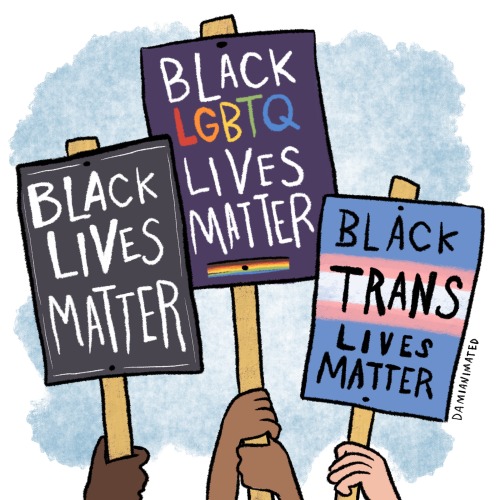
LGBTQIA+ Pride Month

June is LGBTQ Pride Month, so JSTOR Daily gathered some of our favorite stories to celebrate. All with free and accessible scholarly research.

 By: The Editors 

June is LGBTQIA+ Pride Month in the United States, so we’ve collected some of our most popular stories on a range of topics—from pronouns to politics—that highlight the history of the LGBTQIA+ community. As always, links to free JSTOR scholarship are included with each of these.


Please visit the page to find numerous articles regarding LGBTQ+ issues, interests, Art, Books, articles, journals, and even more. This is a fabulous resource for claiming and/or reclaiming LGBTQ+ places in our world and time.

Political cartoons / memes / and news I want to share. 6-7-2026


image


Image from What Are You Really Afraid Of?


Image from What Are You Really Afraid Of?


Image from What Are You Really Afraid Of?


Christopher Weyant CagleCartoons.com

Gary McCoy Shiloh, IL


#white people twitter from White People Twitter


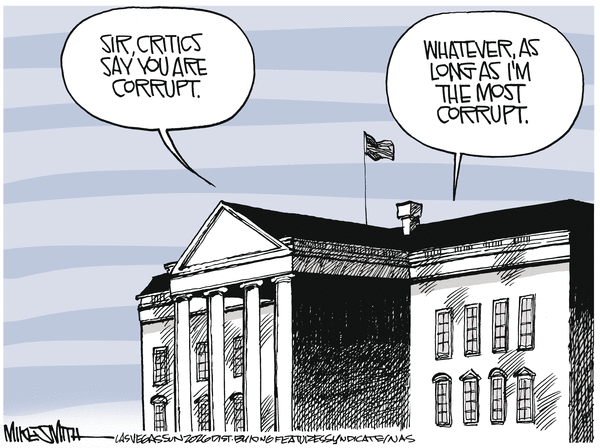
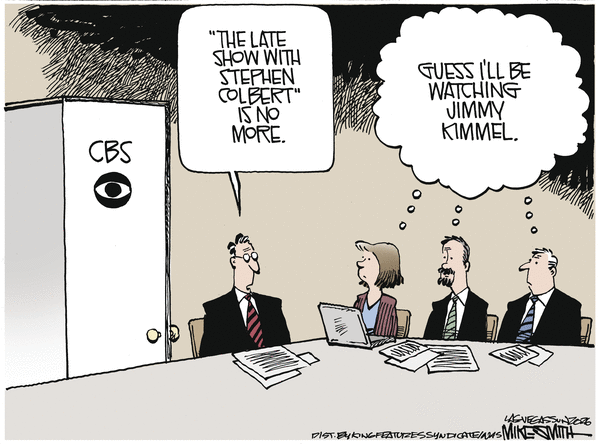
Mike Smith for 5/27/2026


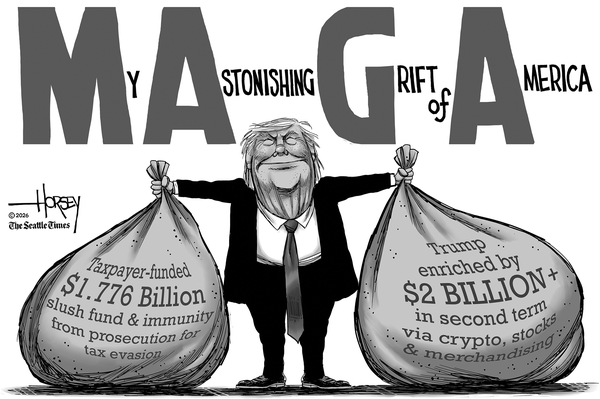
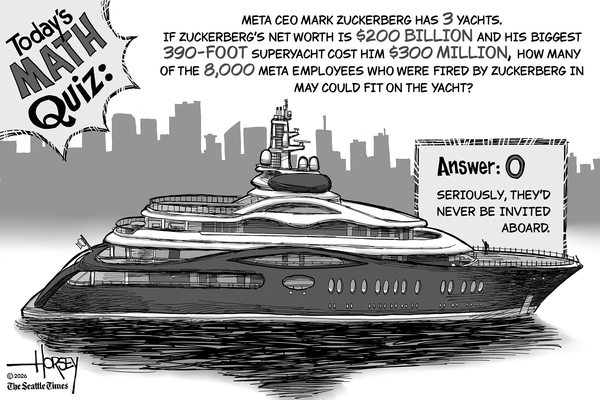
David Horsey for 5/21/2026


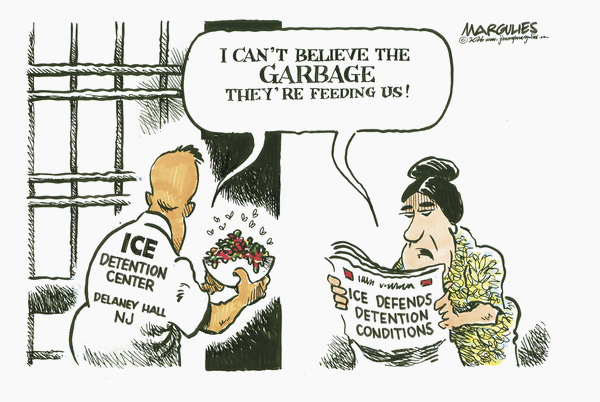
Jimmy Margulies for 6/5/2026


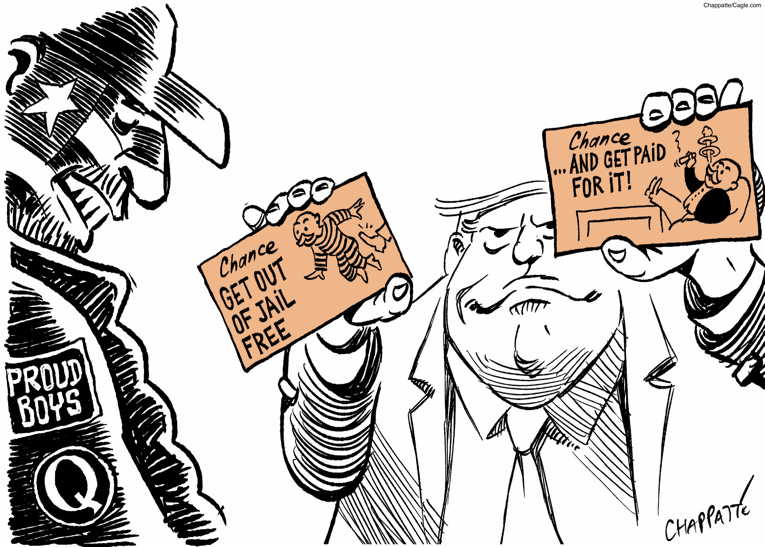
Political/Editorial Cartoon by Patrick Chappatte, International Herald Tribune on Despot Funds Private Army


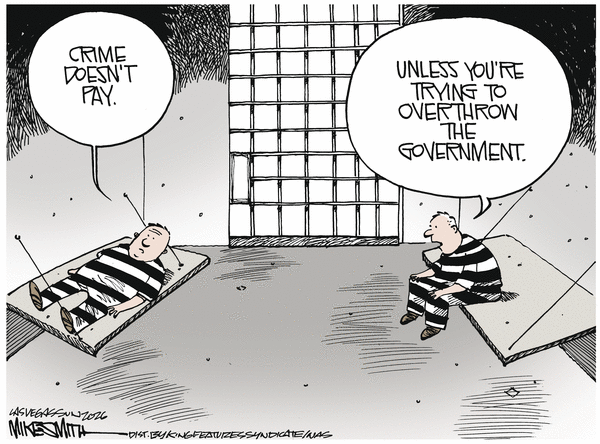
Mike Smith for 5/21/2026


David Horsey for 5/22/2026


Mike Smith for 5/22/2026


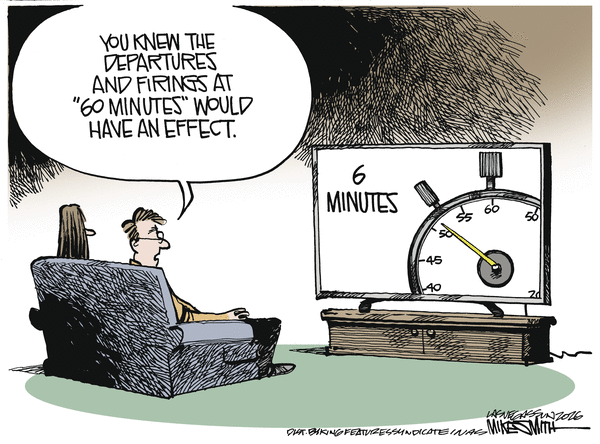
Mike Smith for 6/4/2026

Jon Russo for 6/4/2026


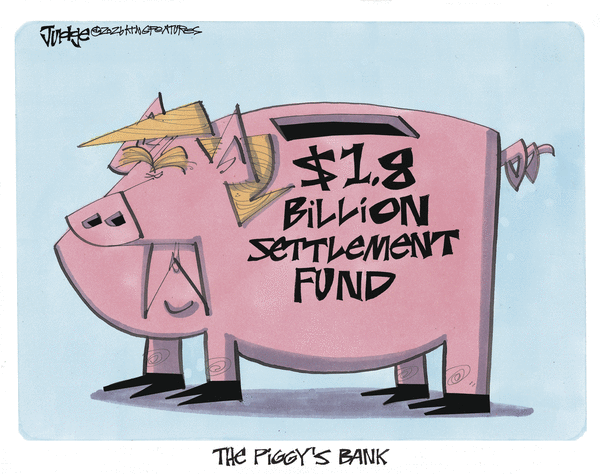
Lee Judge for 6/5/2026


#trump supporters from Saywhat Politics


Image from What Are You Really Afraid Of?


David Horsey for 6/5/2026


#anarchism from Anarchists United


Political/Editorial Cartoon by Matt Wuerker, Politico on Cabinet Shakeup


#anarchism from Anarcho-Communism & Anti-Capitalism


Mike Smith for 6/5/2026


John Branch for 5/18/2026


John Branch for 6/4/2026

John Branch for 5/21/2026


News Anchor: Legislators in Georgia are scrambling to fix their laws after a shocking incident where a man registered to vote on election day. 
"One man has been arrested in connection with the voting."
Cop: We don't know what this psycho wanted. He was pretty much fed up and at the end of his rope and this is what he did. 
Politician: You can just get mad one day, decide to vote, and then raise my taxes. No background check, no waiting period. 
It's CHAOS! And people are going to get hurt!
Crazy Person: Well, I'm not taking this laying down. 
I've purchased all of this since the comic started.


Jon Russo for 6/3/2026


Political/Editorial Cartoon by Steve Sack, Minneapolis Star Tribune on Concentration Camps Expanding


Political/Editorial Cartoon by Monte Wolverton, Cagle Cartoons on Concentration Camps Expanding


Lee Judge for 6/4/2026


Mike Smith for 5/26/2026


Man: We at Boston Dynamics are proud to introduce DigiDog! The FIRST NYPD robot cop on the streets!
Man: It can run, speak, enter hostile environments AND employ facial recognition! 
Cop #1: This technology sounds a little worrying. 
Man: No, no. This science is ONLY for good. We're never going to arm our puppers or use them to profile, shoot or harass people. 
Cop #1: Oh good> I thought they might steal our jobs. 
Cop #2: Now, can you plant a wittle weapon for me, doggo woggo?
PAT PAT


Jonathan Brown PoliticalCartoons.com


Adam Zyglis The Buffalo News

Manny Francisco Manila, The Phillippines


David Horsey for 5/13/2026


David Horsey for 6/3/2026


[Sen.] Gallego Introduces Legislation to Crack Down on Billionaire Tax Loophole

Legislation would close the ‘borrow’ aspect of the ‘buy, borrow, die’ tax loophole used by the ultra-wealthy to avoid paying capital gains or income tax

WASHINGTON – Today, Senator Ruben Gallego (D-AZ) introduced the Redistribution Of Billions by Instituting New High-income Obligations on Overlooked Debt (ROBINHOOD) Act to close the ‘borrow’ aspect of the ‘buy, borrow, die’ tax loophole that is used by the ultra-wealthy to finance extravagant spending without paying income or capital gains taxes.

“Working and middle-class Americans are paying their fair share – they do it with every paycheck. But the billionaires in this country? They’re using legal loopholes and tricky accounting to finance private jets and yachts while most Americans struggle to afford healthcare and groceries,” said Senator Gallego. “My legislation closes a critical loophole and brings us closer to billionaires finally paying their fair share.”

Punchbowl News: Gallego targets ‘buy, borrow, die’ tax maneuver

The ‘buy, borrow, die’ tax loophole has three stages:

  • Buy: A wealthy individual buys, or is given as part of their compensation package, assets, such as stocks. This allows them to store and grow their wealth without paying taxes since the gains from these assets are considered unrealized. 
  • Borrow: The individual then borrows tax-free cash loans, often backed by those assets, to finance their extravagant lifestyles. All the while, their assets continue to gain value.
  • Die: Finally, when they die, their assets are gifted to their heirs on a stepped-up basis, meaning their heirs can sell the assets without paying taxes on the capital gains accumulated during the individual’s life.

The ROBINHOOD Act closes this loophole by treating taking out a loan as a realization event, meaning the individual would have to pay taxes on capital gains equal to the loan amount. The provisions of the bill apply to taxpayers who have an income over $100 million and/or assets worth more than $1 billion. 

You can find a one-page summary of the legislation HERE.

You can find a section-by-section explainer of the legislation HERE.

You can find the full text of the legislation HERE.

Companion legislation was introduced in the House by Rep. Dan Goldman (NY-10).

“While working, wage-earning New Yorkers pay income taxes on every single paycheck, billionaires live tax-free by borrowing against their stock portfolios, real estate holdings, and art collections without paying a dime in taxes on that money,” Congressman Dan Goldman said. “By restoring basic fairness to our tax code and making the ultra-wealthy pay their fair share and contribute what they owe, this bill will generate revenue to invest in universal pre-K, child care, and working families instead of subsidizing billionaires’ yachts and private islands. It’s long past time for the wealthiest people in the country to pay their fair share.”

Political cartoons / memes / and news I want to share. 5-6-2026

It is 4:34 pm here in my office.  Today I was struggling.  But before that I had written an email to Ali that I was doing so much better and wanted to tell everyone.  I had to go out to get my morphines this morning so Ron could take Tupac to the vet.  When I got home I did a few things.  Then I started doing the dishes and laundry.  But by 1:30 pm my pain became so bad I was in tears.  I desperatly did not want to take more medications, I get set back on my getting better every time I have to do that just to function.  The federal government is trying to force my pain doctors to lower my pain medications yet at my last virtual appointment my pain doctor noticed how much pain I was in and did not decrease my medications anymore saying she could justify giving me that which RFK Jr. the road kill harvaster wants to deny all of us in serious medical problems.  Remember this guy was also a cocaine addict who talks about snorting drugs off toilet seats.  

So when Ron Ron got home from mowing his sister’s lawn he found me limping and nearly in tears.  He had me take my blood sugar and I was having an issue with low blood sugar which could explain why I was shivering.  He had me take two glucose tablets and stop doing any more work.  I had been doing dishes and folding clothing by using my very high rolling stool that I moved from kitchen to bedroom and back as needed.  

Ron made supper and I want to let everyone know that even as I was in tears from pain I ate a lot of food for me.  I had five slices of rare roast beef and three small baked potatoes with gravy and a small bowl of green beans.  I took my evening insulin which I have not had to do a lot of as I was not eating.  But Ron was concerned after I ate that I was still distressed.    So I agreed to give up trying to make this post for the morning and just post what it is.  I do have more to add to it but my pain is so bad that sitting in my desk chair is horrible for me.  I will add them to the next day’s post.  

I thank everyone who is worried about me and I love that everyone enjoys these cartoons / memes / news posts.  But I did promise Ron I wouldn’t take more medication which will make me sick and eat into my meager supply and would go to bed.  I will try to make a larger cartoons / memes / news post tomorrow.   Best wishes, love, and hugs to all.   Scottie


#anarchism from Anarchist Art


A Small Bunch Of Stuff

June 5, [since 1972]
World Environment Day was established by the U.N. General Assembly to commemorate the opening of the Stockholm Conference on the Human Environment in Sweden.
The United Nations Environment Program (UNEP) was established as a result of the conference.
The 1972 Stockholm conference 
UNEP’s mission: To provide leadership and encourage partnership in caring for the environment by inspiring, informing, and enabling nations and peoples to improve their quality of life without compromising that of future generations.
Each year World Environment Day adopts a different theme.


Gregory Natal.


Farming While Beige

Farming While Beige 14 hours ago

My book’s nearing the top 1,000 in all books on Amazon… this is nuts. https://www.amazon.com/dp/B0GBR2ZBCF#…

http://youtube.com/post/Ugkx4ERU1GoB4DsmLI_-MLNRSBtQ5f8EvrQn?si=VdQCJjNjD1X_YoIw

Family Togetherness, Slush, J6 Creepers: Clay Jones + Open Windows

Slushy Intel

The insurrectionist slush fund has been canceled, but maybe there’s another way Trump can compensate his homegrown terrorists.

Clay Jones

During congressional testimony, acting Attorney General Todd Blanche said that Donald Trump’s $1.8 billion slush fund, which his J6 insurrectionists/terrorists could have applied for, is dead. In the Oval Office today, Donald Trump said that he doesn’t know if it’s dead. He is lying.

The one thing that we do know for sure is that the immunity for Trump and his family from IRS audits is still alive and well. But more on that tomorrow.

The slush fund was not popular, even with Republicans, with one calling it “stupid on stilts.” Another unpopular thing, even with Republicans, is the appointment of Bill Pulte as acting Director of National Intelligence. Pulte is currently the director of the Federal Housing Finance Agency.

When asked if he has concerns that Pulte would “weaponize” the position, given the role he has played during Trump’s second term in digging into mortgage records to see whether Trump’s political adversaries have committed fraud, Senate Majority Leader John Thune said: “We don’t need a weaponized DNI; we need professionals there.” (snip-MORE)


The family who grifts together…

hopefully is convicted together

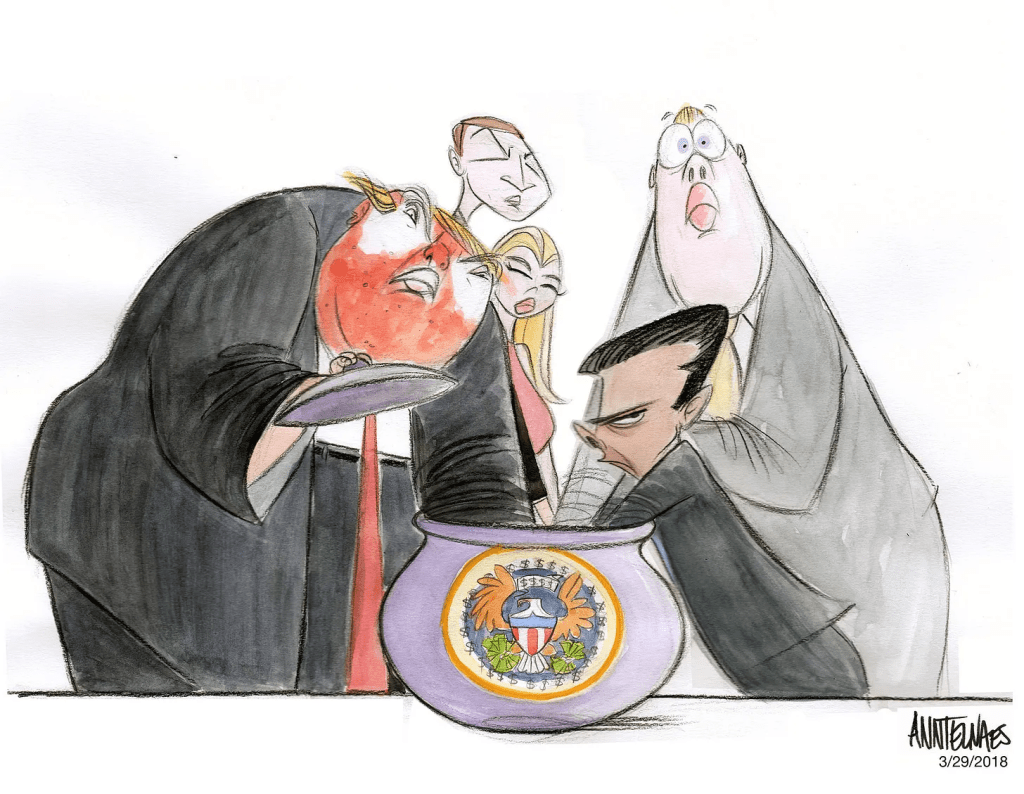
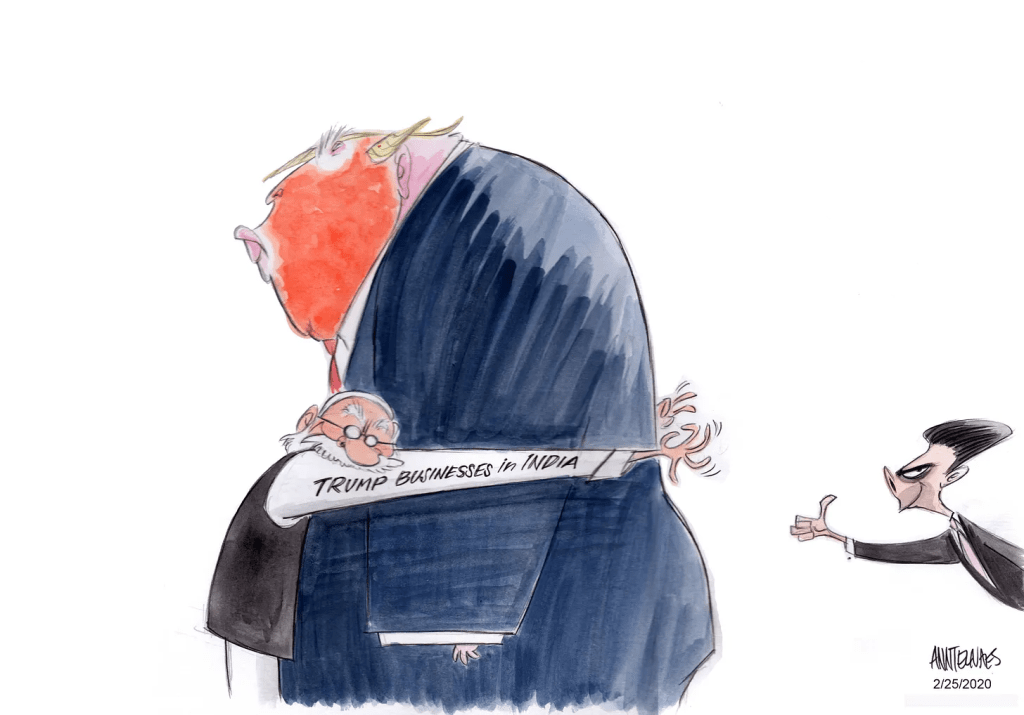
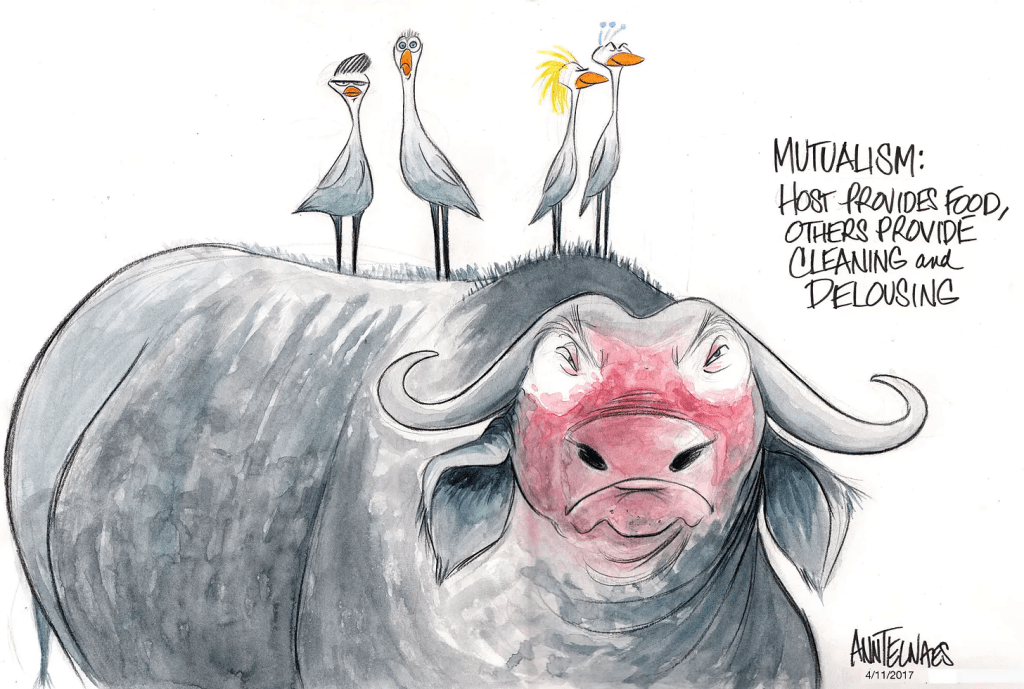
Ann Telnaes

Recently I posted a cartoon after reading this Propublica story about the connections between a Don Jr. linked company and a $620 million Pentagon loan. We haven’t heard as much in the news during the second presidential term about the Trump family and their various grifts (probably due to Trump taking the oxygen out of the room with his various vanity projects), so I’m posting some cartoons from the first as a reminder the entire Trump family is in it all for themselves.

(snip-there are 7 MORE, and they are fantastic-go see!)


J6 Creepers

Trump’s $1.8 billion slush fund for white nationalist insurrectionists is dead (maybe), but MAGA pedos can still find a silver lining.

Clay Jones

Andrew Paul Johnson was one of the insurrectionists who attacked the Capitol on January 6, 2021. He pleaded guilty to multiple nonviolent charges for breaching the Capitol, and was just a few months into his year-long sentence when Donald Trump gave him a pardon. Last March, he was sentenced to life in prison after a Florida jury found him guilty of five criminal charges, including molestation, lewd and lascivious exhibition, and transmission of material harmful to a minor.

Police reported that Johnson, 45, tried to keep the children quiet by telling them he would share millions of dollars in restitution money he expected to receive from the Trump regime in connection with his Jan. 6 case. Don’t worry, kids, he told them. Uncle Donald will take care of you. (snip-it’s disgusting that there is MORE just like this)


Happy PRIDE On Friday

in Hawai’i!

Hawai’i Governor Signs Powerful Trans Shield Law Bill Just In Time For Pride

“Parents and caregivers who affirm, support, and seek medically appropriate care for their keiki [child] are exercising their fundamental right.”

s. baum

After a three-year push, Hawai’i officially has implemented a shield law to explicitly protect providers and patients of gender-affirming care for the trans community.

House Bill 1875, also known as Act 059, was signed by Governor Josh Green—himself a physician—late last week. The bill explicitly adds gender-affirming care to its existing shield law, which broadly covered reproductive health, and established safeguards from “abusive litigation” coming from outside states.

Shield laws create “legal protections for patients, health care providers, and people assisting in the provision of certain health care in states where that care is legal from the reach of states with civil, criminal, and professional consequences related to that care,” according to the Center for Reproductive Health, Law and Policy at UCLA. For example, it means Hawai’i state actors may not aid out-of-state attacks—such as, say, through the extradition of health care providers—over lawful care rendered in Hawai’i.

“The legislature finds that the people of Hawai’i have a long tradition of protecting an individual’s right to privacy and bodily autonomy independently of, and more broadly than, the United States Constitution,” the bill reads. It emphasized that the right to privacy and bodily autonomy extends to minors.

“It is the policy of this State that the rights of equality, liberty, and privacy guaranteed under […] the Hawaii State Constitution are fundamental rights and that those rights include an individual’s right to make health care decisions about one’s own body, including the right to seek and receive health care services that affirm their expressed gender.”

The signing was a resounding victory for LGBTQ activists on the islands. Hawai’i was among the last of the blue states to enact a shield law for the transgender community and their providers.

“We’ve heard from legislators that this is considered a controversial topic and that they’d rather not engage in bills that could draw attention to Hawai’i from the Trump Administration,” Abby Simmons, Chair of the Stonewall Caucus of the Democratic Party of Hawai‘i, told Erin in the Morning last year.

Now, she’s singing a more triumphant tune. “This bill truly was a team effort,” she said in an interview this week. “Lawmakers wanted to understand the legal implications, hear from stakeholders, and make sure they were crafting legislation that would withstand challenges. While that process can sometimes feel slow, it also means that when legislation succeeds, it often has a stronger foundation.”

Simmons also said the playbook for getting the bill over the finish line was rooted in building a big tent. “I think what finally made HB1875 successful was that supporters increasingly focused on a message that resonated far beyond the LGBTQ+ community,” she continued.

“The conversation wasn’t simply about gender-affirming care. It was about protecting patients, families, and healthcare providers who are following Hawaiʻi law. It was about preventing out-of-state actors from interfering with healthcare decisions made here in Hawaiʻi. It was about provider stability at a time when Hawaiʻi already faces healthcare workforce shortages. And it was about preserving Hawaiʻi’s ability to govern itself.”

The bill arrived on the Governor’s desk amid rising federal threats from the Department of Justice against hospitals, including the use of judge and forum shopping to prosecute gender-affirming care providers in conservative jurisdictions based outside of their state. Last month, the Northern District of Texas—an infamously conservative federal court—ordered Rhode Island Hospital, which is almost 2,000 miles away, to hand over patient records from its transgender youth care program. That legal battle is ongoing.

“Gender-affirming care is lawful in Hawaiʻi, grounded in established medical standards, and essential to the well-being of transgender, nonbinary, māhū, and gender-diverse people,” Hawai’i’s LGBTQ political action committee, HOKU, wrote in submitted testimony from when the bill was being considered by the legislature.

“Failure to protect access to gender-affirming care is not only an attack on patients and providers; it is a violation of parental rights,” reads another submission from Pride at Work Hawai’i. “Parents and caregivers who affirm, support, and seek medically appropriate care for their keiki [child] are exercising their fundamental right.”

Donavan Kamakani Albano, Policy Fellow at the ACLU of Hawaiʻi, further spoke to the importance of gender diversity in Hawaiian tradition. Some right-wing officials may push the myth that transness is somehow novel or a “trend.” But Hawai’i has especially rich ties to its pre-colonial culture—including non-binary concepts of gender.

“In Kanaka Maoli culture, māhū describes someone who embodies kāne and wahine [the masculine and feminine] energies,” Albano’s testimony said. “While the visibility of māhū individuals has recently increased, ongoing barriers to gender-affirming care remain.”

This united LGBTQ advocacy with other causes. “Those principles brought together a broad coalition of supporters and helped lawmakers see the bill as a matter of healthcare access, privacy, and state sovereignty,” Simmons said.

Political cartoons / memes / and news I want to share. 6-5-2026

Image from Assigned Male


@arvitammi helped me with the colors!


image

image


#myart from Damian Alexander


image


Image from nebulously-burnished


image

Image from What Are You Really Afraid Of?


Image from Saywhat Politics


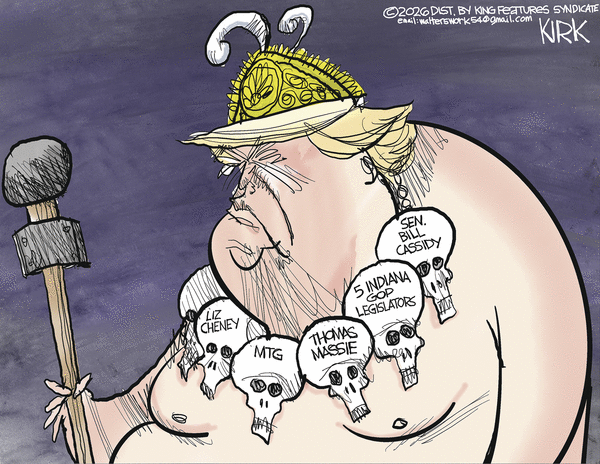
Kirk Walters for 6/3/2026


Jimmy Margulies for 6/2/2026


Lee Judge for 6/3/2026

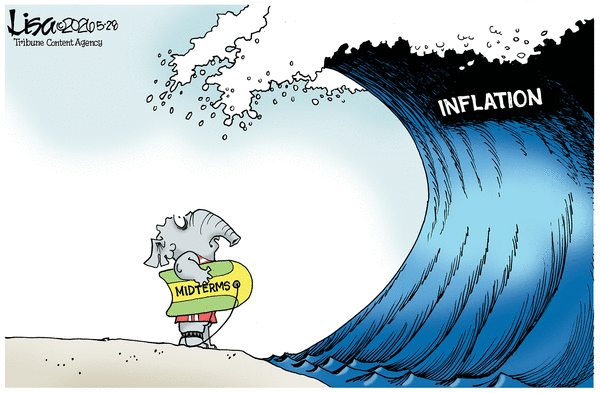
Lisa Benson 6/2/2026


Kirk Walters for 5/21/2026


Image from What Are You Really Afraid Of?


Image from Mea Gloria Fides


Lisa Benson 5/29/2026


Image from What Are You Really Afraid Of?


Jimmy Margulies for 6/3/2026


These are crimes and it is contrary to international and U.S. law to send asylum seekers to any country where their life or freedom is threatened.

We have to take names of all who ordered and participated in these illegal, immoral acts.


image


Political cartoons / memes / and news I want to share. 6-4-2026

Hello all, hope you’ll enjoy the upcoming Pride month content! This year, I’m planning to post comics every single day until the end of June. If you caught a glimpse at comment sections under recent strips, it has already pissed off thousands! It’s just the beginning.

It’s been a while since I gave you any life updates. My husband and I are still on the IVF train – it’s slow but steady. We are being crushed under the weight of debts because of it, but at least we got to keep our car after this spring’s threats, for those who wondered. Such is the price for growing our little queer family! At least we’ve got health.

I’m still trying to make a living from my art. I believe covering the internet with queer and trans comics and making bigots foam at the mouth is an important job, and you can help make it happen by getting me a coffee or by subscribing on Patreon. Every bit makes a huge difference!

So I hope Pride month will be good to you all. Except the bigots.

Be gay, trans, hydrated, or not,

Sophie


image


A woman is talking to a man who has gritted teeth in front of a television.

“Wincing all the time isn’t helping anything.”


A man and a woman watch television news and two oxygen masks drop to their sides.


GOP: Defending white supremacists and neo-Nazis? That's not who we are. Comforting despots and attacking our allies? That's not who we are. Ripping immigrant children from their families? That's not who we are. Voice: So... you'll grow a backbone and stand up to Trump? GOP: That's not who we are.


The progressive comic about the Peabody awards.


Ed Wexler CagleCartoons.com


Political cartoon of the day


Margolis & Cox PoliticalCartoons.com


Meanwhile, far from the border...children are being separated from their families.


Political/Editorial Cartoon by Pat Bagley, Salt Lake Tribune on Trump Lies About War’s End

Political/Editorial Cartoon by Nick Anderson, Houston Chronicle on Trump Lies About War’s End


Sean Delonas Cagle.com/Delonas


Bob Englehart PoliticalCartoons.com


John Darkow Columbia Missourian


Jeff Koterba patreon.com/jeffreykoterba


Bill Day FloridaPolitics.com


Winning Elections Against Autocrats

Opinion M. Gessen

This Is the Formula That Defeated Orban. It Would Defeat Trump, Too.

By M. Gessen

Visuals by Máté Bartha

M. Gessen, an Opinion columnist, and Mr. Bartha reported from Budapest.

  • May 29, 2026

Leer en español

Starting early in the morning on the second Saturday of May, first hundreds and then thousands of people gathered in the square in front of Hungary’s majestic Parliament building to celebrate the start of a new political era. This was the square where tens of thousands gathered in 1956 and 1989 to demand an end to the Soviet occupation and in 2006 to protest a discredited government. It was the square on which Prime Minister Viktor Orban’s regime imposed a major redesign more than a decade ago — with traffic rerouted away, a large reflecting pool and raised beds installed, narrow pathways laid down — apparently to ensure that no such mass gathering could take place again. Today it was the square where Peter Magyar, a former Orban loyalist, would be sworn in, promising a rebirth of democracy and liberty after 16 years of autocratic control.

Squeezing into the available spaces and gradually filling up nearby cafes and streets, the crowd absorbed people of all ages: young people who didn’t remember a time before Orban and who had voted in unprecedented numbers; aging intellectuals who didn’t think they’d ever celebrate their country again; multigenerational families who had arrived by bus after seeing Magyar in their hometowns and villages. During his campaign, Magyar had traveled to an estimated 700 locations, turning many of them into “Tisza islands” — outposts of support for his party. By the end, Magyar was holding five or more rallies a day.

It had looked like an impossible quest. Orban and his cronies dominated the media, persecuted and smeared opposition politicians and changed election laws to benefit his party, Fidesz. Orban had seemed to achieve what the Hungarian sociologist and political theorist Balint Magyar (no relation) calls “autocratic breakthrough” — the point after which it’s impossible to unseat an autocrat using elections. Illiberal politicians from other countries made pilgrimages to Hungary to learn from Orban; CPAC, the gathering for American national conservatives, started staging an annual convention there; and Vice President JD Vance visited Budapest in advance of the election, in a show of support for Orban. And yet Hungarians handed Tisza not just a victory but a constitutional majority, enough power to reverse Orban’s changes to Hungarian laws and institutions. The triumph was stunning — unique in our era of democratic backsliding — and it holds clear lessons for the United States.

One obvious lesson of Peter Magyar’s success lies in the scale, reach and relentlessness of his organizing network. “They had 2,000 Tisza islands with between 30,000 and 50,000 volunteers,” Balint Magyar told me, in evident awe. “Just in their call centers, they had 3,000 to 4,000 people in the last week of the campaign.” We talked two days before the swearing-in ceremony, at his office in the spectacular but largely empty building of Central European University. In 2018, Orban’s government forced most of the university’s operations into exile amid an antisemitic scare campaign focused on the Hungarian American philanthropist George Soros, the C.E.U.’s founder and principal funder. Some of Orban’s many other scare campaigns targeted migrants, “the Brussels elites” and L.G.B.T.Q. people. During the latest election campaign, billboards and A.I.-generated social media posts warned Hungarians they were in danger of being overtaken by Ukraine and only Orban could protect them. It should have seemed absurd — it was absurd — but outlandish xenophobic and antisemitic propaganda had served Orban well for years. It didn’t work against Peter Magyar — probably because so many Hungarians got to see him in person, many of them repeatedly. This is another lesson of his success: Old-fashioned in-person politics can be a powerful antidote to media fearmongering.

In his inaugural speech to Parliament, broadcast on giant screens set up around the square, Peter Magyar said that voters had handed him a mandate “not just to change the government, but to change the system. To start over.”

Magyar enumerated the ways in which Orban had damaged Hungary: a stalled economy in which a third of the population lives in poverty, inadequate health care, low-quality schools, child welfare institutions plagued by abuse, an atmosphere of hatred and fear. Orban’s regime had “stolen from the common good of the Hungarian nation — from the pockets of the Hungarian people, and from the tables of Hungarian children and the elderly,” Magyar said, “an estimated 20 trillion Hungarian forints,” or some $65 billion, over the last decade and a half.

Previous opposition politicians had described Orban’s regime as “corrupt,” a relatively mild term suggesting some aberration from the government’s intended function. Peter Magyar made no such accommodation. Borrowing a term coined by Balint Magyar, he has called it a mafia state — a fundamentally criminal enterprise. Third lesson: Don’t mince words.

Instead of shrinking away from direct confrontation, he fortified himself against it. By getting elected to the European Parliament, in 2024, he secured immunity from prosecution in Hungary. When rumors circulated of an intimate video that would be used to blackmail him, he went on the offensive, accusing Orban of using “Russian-style kompromat” (no video was released). Knowing that he would probably be blocked from registering a new political party, he took over one that had become dormant. Even more important, instead of trying to build coalitions among other parties, he focused on conscripting as many actual people as possible, from across the political spectrum, ultimately building a giant organization capable of taking down Orban’s political monopoly.

One could say — and some have — that Magyar won at least in part because he was a former insider of Orban’s Fidesz party. But my interlocutors in Hungary emphasized that Magyar’s credibility lay in the fact that he was not a member of the old opposition, whose policies had led to the discontent that made Orban’s rise possible and whose timidity had helped perpetuate Orban’s power. That’s a lesson, too: The person best positioned to break the power of Donald Trump would not be an anti-Trump Republican but an outsider to the Democratic establishment, someone who can credibly claim that Trump didn’t happen on his watch — a Graham Platner rather than a Thomas Massie.

For all his tireless work over the last two years, Magyar did not create his political machine from scratch. Like Zohran Mamdani, Magyar excelled at converting potential supporters into campaign volunteers. An existing news distribution service provided an initial skeleton of the organizing network. A panoply of grass-roots protest movements joined, too. On the day of Magyar’s inauguration, a parallel, smaller commemoration organized by the city of Budapest celebrated those organizations. One by one, people took the microphone to give a short speech about their cause and their part in the electoral victory: teachers who had organized against a unified state-dictated curriculum; a young man who spoke up against abuses in the child care system; a high school student persecuted for reciting an anti-Orban poem; organizers of Budapest’s L.G.B.T.Q. Pride celebration. The speakers stayed onstage, gradually forming a crowd of the kind — the many kinds — of ordinary Hungarians who had ended the Orban era.

That’s a fifth lesson: Grass-roots organizations that have little or no connection to electoral politics — in the United States, that might be the networks formed by the No Kings rallies, ICE-resistance groups and so on — can matter as much as or more than those already focused on winning votes.

Another lesson lies in the issues that motivated Magyar’s voters. Hungary’s economy is a mess, but post-election polling by Median, an organization that had predicted election results with uncanny accuracy, shows that voters saw corruption as the most important issue by far. Asked why they thought Orban had lost, 49 percent cited corruption, and only 18 percent thought it was the “worsening economic situation, rising cost of living.” The next three reasons cited were “lies” (15 percent); “fearmongering, war rhetoric” (11 percent); and “people got fed up” (10 percent). In other words, Hungarians seemed to see the damage that Orbanism had done to the nation as more important than any harm they felt they had suffered as individuals. They were united by a sense of moral outrage — “value choices,” as one person close to the incoming government described it to me.

Polls have consistently shown that even Fidesz voters generally want Hungary to stay in the European Union. Some surely just want the ease of travel and residency, but others probably have in mind the loftier ideals of the E.U., such as the rule of law, human rights and the essential purpose of the E.U., which is peace.

Hungary is one of the poorer countries in the union, and in the early years of his regime, Orban was able to use E.U. membership to secure funding, and thereby power, even as he railed against the Brussels bureaucracy. But in 2022, the European Union started withholding funding, citing corruption. And in 2024, after Hungary ignored a European Court of Justice ruling that compelled it to process asylum applications, the court ordered Hungary to pay 200 million euros and imposed a daily fine of 1 million euros. (When Orban refused to pay, Brussels deducted the money from E.U. funds earmarked for Hungary.) These actions didn’t just hurt the Hungarian economy — they also allowed Magyar to draw a causal connection between Orban’s policies and the well-being of ordinary voters. One of his major campaign promises was to unlock E.U. funding.

Hungary joined the European Union in 2004. The E.U. flag — 12 gold stars on a blue background — adorned the facade of the Hungarian Parliament building alongside the nation’s red, white and green standard. But Orban’s politics, like the politics of most autocrats, was the politics of grievance. Under his regime, the E.U. flag was removed and replaced with the flag of the Szekelys, a Hungarian minority that found itself living in Romania when World War I’s victors redrew the region’s borders. Orban’s symbolic gesture helped fan resentment against the E.U. and what he claimed were a new generation of attacks on Hungarian sovereignty.

Peter Magyar scheduled his inauguration for Europe Day — the 76th anniversary of the declaration that created the road map for a united continent. Before he was sworn in, the European flag was raised again. But the Szekely flag remained, signaling that Magyar seeks to represent all Hungarian citizens, including those who supported Orban. In some U.S. coverage, Magyar has been labeled centrist or right-of-center. What his politics actually are — and this is another lesson of his victory — is pluralist. (snip-MORE)