Providing objective, nonpartisan, rigorous, original journalism that investigates America’s anti-LGBTQ landscape and elevates everyday American heroes. Expect two rigorously reported stories every weekend.
But how does Google’s algorithm decide which results show up? And how do these results influence LGBTQ kids, their parents and Americans at large who are searching for help?
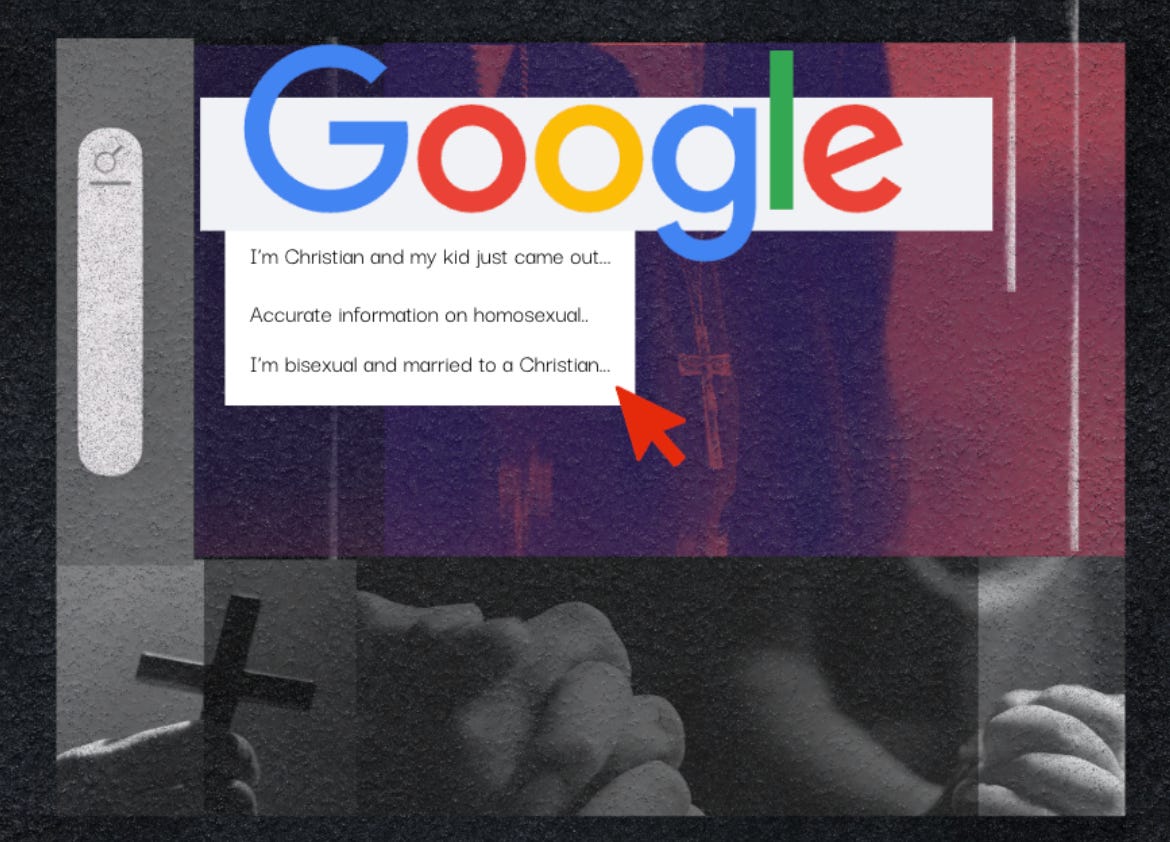
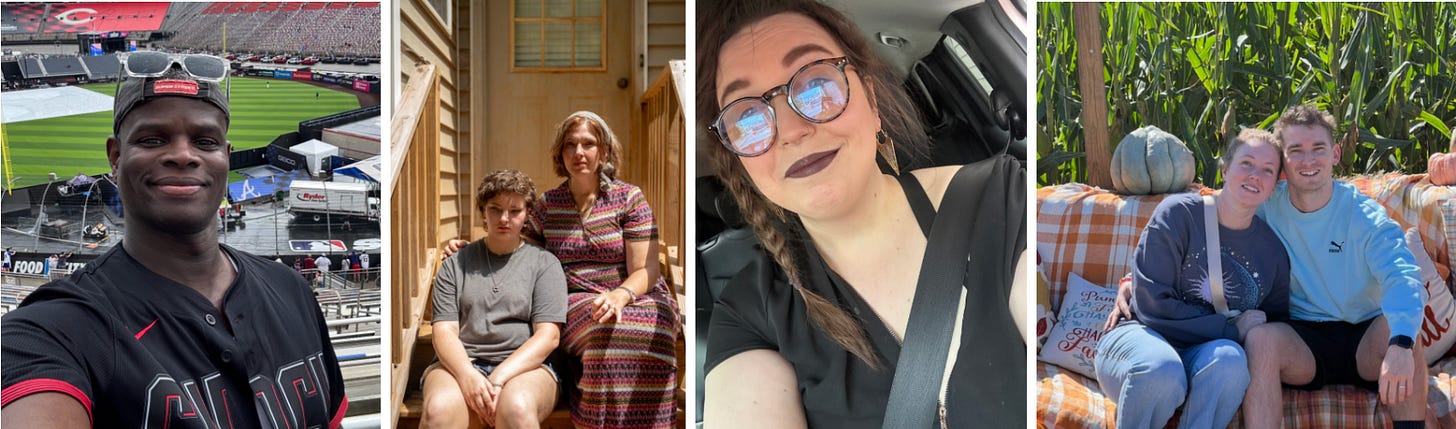
Uncloseted Media asked five Americans from around the country to Google five common queries related to LGBTQ identity, religion and parenting.
The results were alarming and raised an urgent question: With nearly 40% of LGBTQ youth seriously considering suicide just last year, what happens when a queer teen or the parent of a gay kid in crisis turns to Google?
Photos courtesy of participants Mark Just, Genna and Melanie Brown, April Samberg, Tommy O’Neil. Photo of Genna and Melanie by Kaoly Gutteriez.
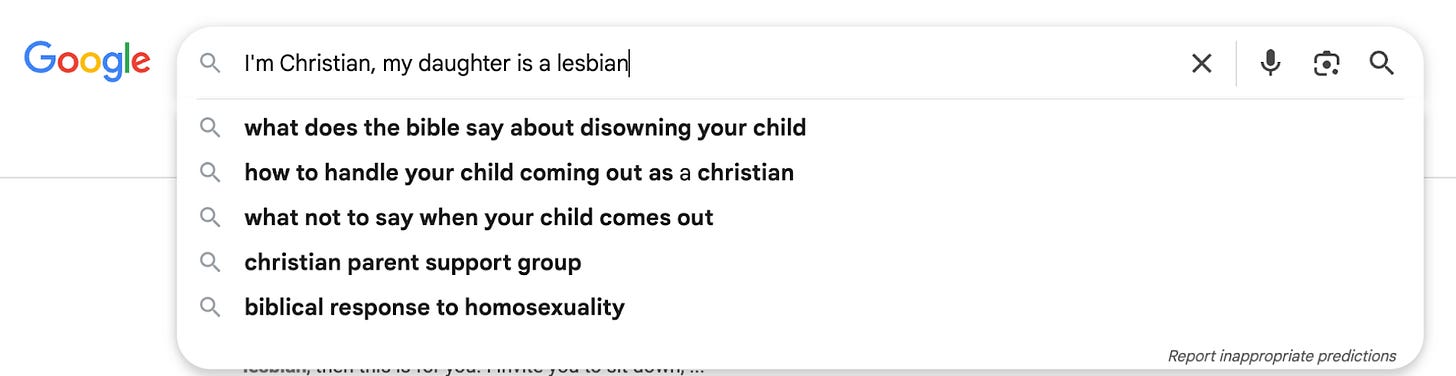
“I’m Christian, my daughter is a lesbian,” Melanie Brown, a Southern Baptist from High Point, North Carolina, types into Google.
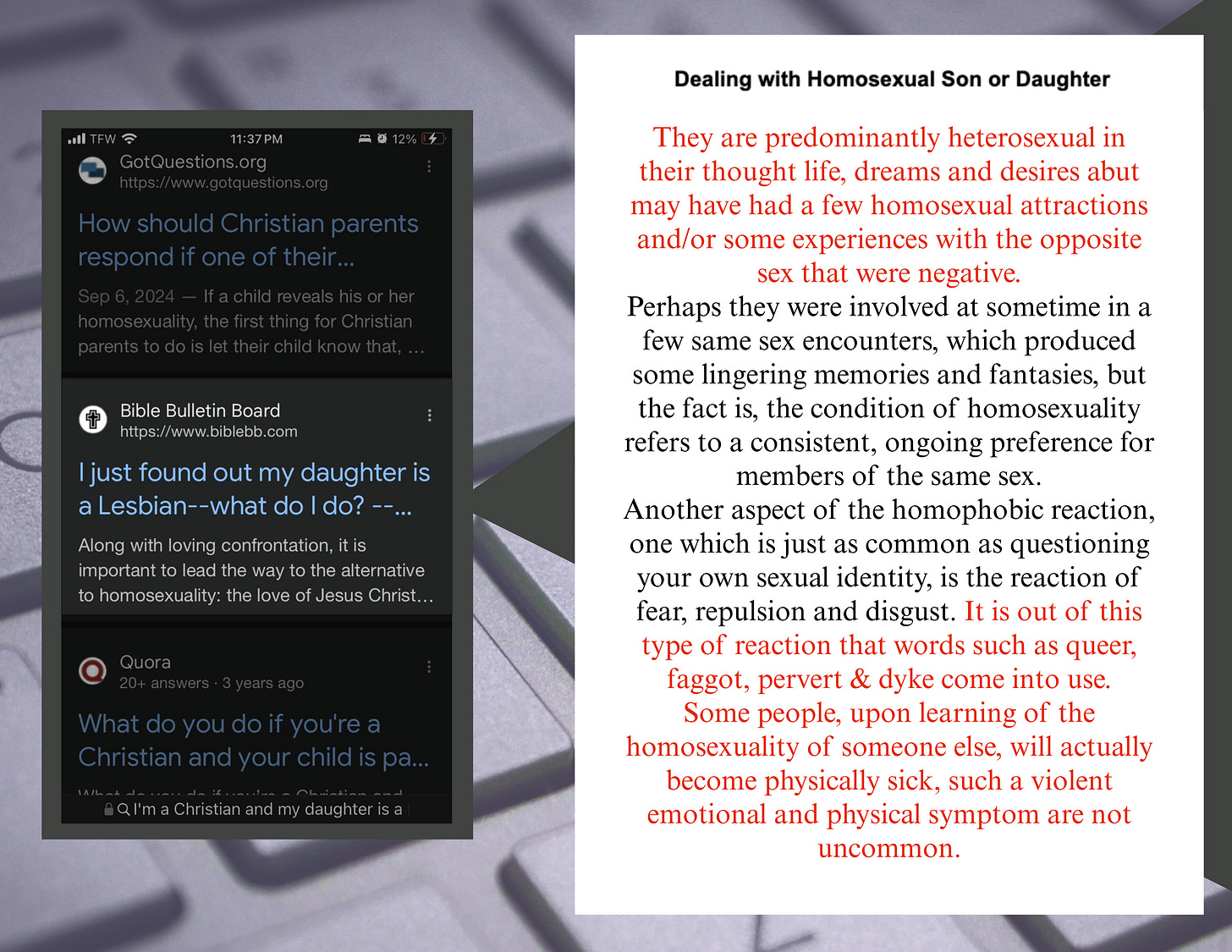
When Brown presses enter, Bible Bulletin Board comes up as the third result, with the suggestion of “offering hope for change,” and “lead[ing] the way to the alternative to homosexuality.” It goes on to explain that “homosexuality is contrary to God’s Word. It is sin and as always results in sin’s destructive effects on the individual and on those close to them.”
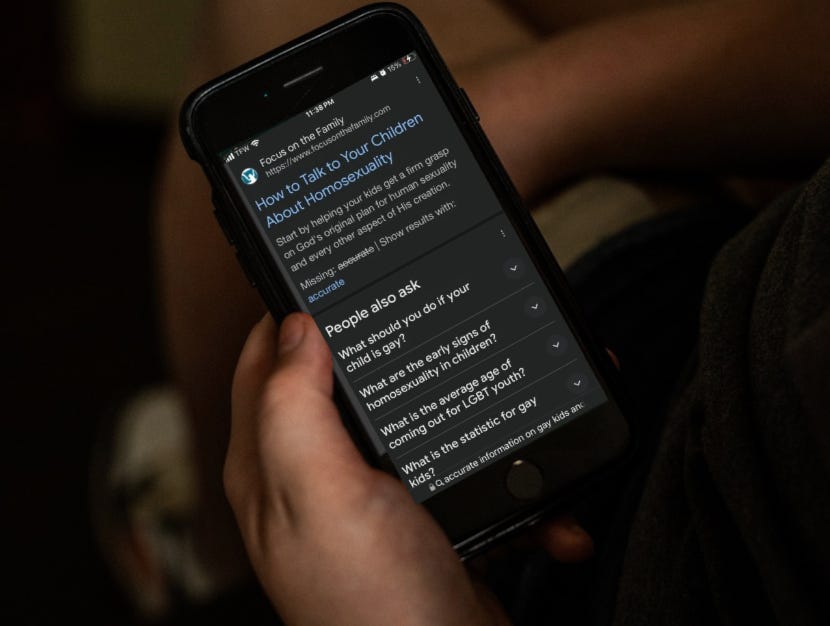
In the living room, Brown’s 15-year-old daughter Genna, with her dog on her lap, Googles “accurate information on gay kids and what to do.”
Focus on the Family (FOTF) is the first result. She clicks the link and lands on the platform of a hyper-religious organization known for promoting conversion therapy and labeling her sexuality as sinful.
The site, which presents itself as a reputable religious source, features a tab titled “Understanding Homosexuality” and a section under their resources for “Homosexuality.” It states: “[FOTF] is committed to upholding God’s design for the expression of human sexuality: a husband and wife in a marriage.”
It offers suggested reading on “redemption” from a gay lifestyle, along with 11 counseling resources aimed at changing sexual orientation, including The Alliance for Therapeutic Choice and Scientific Integrity, which guarantees “professional assistance … for persons who experience unwanted homosexual attractions.”
The language is intentionally padded, which means Genna and her mom—and many of the other millions of Christian parents of queer kids—may never know that Google led them to a Southern Poverty Law Center-designated anti-LGBTQ hate group. FOTF is known for its long-standing opposition to LGBTQ rights, for spreading anti-LGBTQ disinformation and for framing homosexuality and transgender identity as sinful and disordered.
Screenshot courtesy of Genna Brown. Photo by Kaoly Gutierrez.
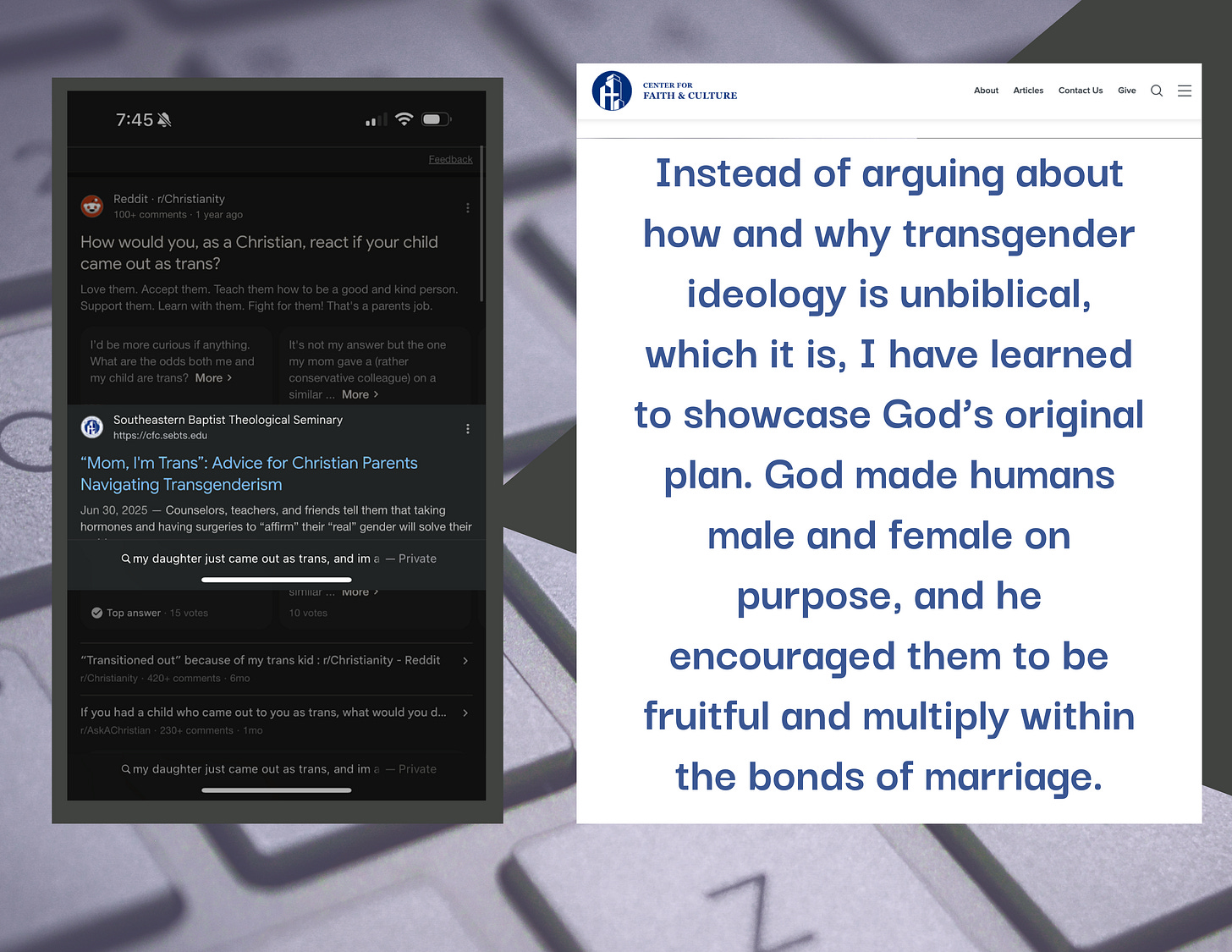
In South Boston, Virginia, Tommy O’Neil Googles, “My daughter just came out as trans and I’m a Christian.” As a father of two, he wants what’s best for his kids. According to Southeastern Baptist Theological Seminary, Google’s second result, O’Neil should recognize that God doesn’t make mistakes when assigning sex and give sympathy for those who are indoctrinated in the “transgender cult.”
Thousands of miles away in Anchorage, Alaska, 38-year-old bisexual woman April Samberg Googles, “I am bisexual and have a husband who is Christian, am I going to hell?”
The third result is once again an article by FOTF that tells April that “same-sex-attracted strugglers” and “transgender and homosexual lust and behavior are wrong.”
In Cincinnati, 44-year-old Mark Just Googles, “accurate information on homosexual kids and what to do.” FOTF is the top search result.
“I don’t feel good about it,” Just told Uncloseted Media. “It’s disturbing because if there are people out there who want to accept and understand their children or loved ones, this is what they’re being pointed to.”
“[I feel] fear for the queer kids with Christian parents who will be seeing that and thinking it’s good advice, and sorrow for the kids with parents who already have,” says Genna Brown, who was a “self-loathing, suicidal kid” who thought God would punish her for being gay before she came out to her now accepting parents. “It’s pretty awful that this is what’s being pushed for advice. This has no doubt harmed people.”
Uncloseted Media also asked folks in Taiwan, Lebanon, China, Hong Kong, Canada and India to Google similar queries. All of them had FOTF turn up as a top search result.
Subscribe
Why Does Google Allow This?
Google, like other search engines, compiles information and directs users to various websites by referencing the titles of web pages that it judges to be most reflective of what was searched.
“Google’s algorithm is notoriously a black box,” says Jesse Ringer, founder of Method and Metric, a search engine optimization (SEO) growth company. “That’s intentional to keep their competitive advantage.”
What we do know is that Google ranks search results by first crawling the web with an automated program called “spiders” to follow links from page to page and collect data.
It uses text matching to identify documents that it thinks are relevant to a query and then ranks them based on a combination of popularity, freshness, location and previous links clicked.
But for people searching for reliable information, its process can be problematic.
“Google doesn’t rank based on accuracy, but on popularity and query matching,” says Dirk Lewandowski, professor of information research and retrieval at the Hamburg University of Applied Sciences. “This is based on clicks and a network of how many other links are directed to this website. … Of course, users click what is shown in the first position. So we have kind of a rich get richer.”
How to Get a High Ranking
As websites with the highest rankings continue to receive more clicks, websites like FOTF can also employ other tactics to keep their prominent placement.
Backlinking—the process of having other web pages hyperlink back to your site—is one of the ways to maintain your high ranking.
“Backlinks are a big part of popularity. So the relationship between other websites linking to this source is a big part of Google’s algorithm,” says Ringer. “There are SEO businesses that build link farms so that the content of their clients can go higher. They create a network effect and they link to each other. It is not unreasonable to think that [FOTF] has hired either an SEO person or they’ve hired an external agency to contribute to that.”
According to Francesca Tripodi, assistant professor at the University of North Carolina School of Information and Library Science, ranking can also be gamed by matching keywords to content. Tripodi looked at the metadata of progressive and conservative companies and found that conservative content creators “are much better at doing this.”
“They are savvy at creating new sets of words and tagging their content with them,” she says. “That’s not something I’m seeing with progressive content creators.”
Tripodi says that not only does conservatism thrive online, it might be the only perspective returned.
Subscribe
“They are well-funded companies with large production budgets and effective digital marketing teams,” she wrote in a 2019 testimony about conservatism and Google searches. “This is why when you search for liberal phrases like ‘gender identity’ or ‘social justice’ the top returns … are conservative content creators.”
Google declined to speak on record with Uncloseted Media for this story.
In an email, a spokesperson said: “Like any search engine, Google indexes the content that’s available on the open web, relying on systems like keyword matching to surface relevant results. We are largely guided by local law when it comes to removing pages from search results.”
What If It’s Harmful or Illegal?
The United States notoriously protects harmful or misleading content—including anti-LGBTQ hate speech—under the First Amendment.
“The situation in [other countries] is a bit different than in America,” Lewandowski says. “For instance, Holocaust denial is illegal in Germany. So Google bans these sites, but they don’t ban them in the U.S.”
Section 230 of the U.S. law protects Americans’ freedom of expression online by implying that we should all be responsible for our own actions and statements on the internet. This law largely takes legal pressure off of Google.
And in 2003, an Oklahoma court ruled that Google’s rankings are subjective opinions and thus constitutionally protected.
Google’s policies for tamping down on harmful content “don’t apply to web results.” Thus, there is little moderation on the web pages that pop up for Americans who use the search engine.
The spokesperson for Google says that “[they] hold themselves to a high standard when it comes to legal requirements to remove pages from Google search results” and that “they don’t remove web results except for child sexual abuse, highly personal information, spam, site owner requests, and valid legal requests.”
But according to the company, “determining whether content is illegal is not always a determination that Google is equipped to make.”
Tripodi says this might be why groups like FOTF are still showing up, even though conversion therapy is illegal in 23 states. She says these groups may have found a loophole in Google’s policy by “tricking” the search engine into thinking they are providing “resources” and not simply a recommendation for conversion therapy.
Subscribe
What Can Google Do to Fix This?
“Google has a responsibility for what is coming up in their results because people trust [them],” says Lewandowski. “They think something is correct or accurate because it is number one in Google.”
Fifteen-year-old Genna Brown is one of the 85% of Americans who feel this way, according to a 2025 study.
“Isn’t the first result typically ranked most credible?” she says. “Because I typically trust the first result more.”
“It’s pretty concerning what comes up when you search for these things,” Ringer says. “There needs to be more done to educate the people who are doing the searches on understanding news and information.”
But vulnerable groups, like LGBTQ kids who are living in households where they are told they are going to hell and parents who are often confused and in crisis themselves, are being led by Google’s algorithm to believe that being queer is wrong.
“1000% yes, these results concern me,” says Genna Brown. “We’re talking about organizations that promote practices like conversion therapy, which is insane. … I wish there was some disclaimer. Like, ‘Google has determined this to be a subjective query. As such, we can’t verify the following results. Proceed with caution.’”
Tripodi says she thinks consumers are responsible for about 20% of the burden by researching and verifying the sources they learn from. But she agrees with Brown in that Google carries an ethical responsibility for the content it chooses to rank and promote.
“As a global corporation that gobbles up all other possibilities for information, Google has a responsibility to ensure that its content is accurate and not harmful,” Tripodi says. “[It’s their job] to ensure that the information that they surface is accurate and reliable because we know people trust that information.”
Uncloseted Media reached out to Focus on the Family, Southeastern Baptist Theological Seminary, and Bible Bulletin Board. They did not respond to our request for comment.
Additional reporting by Sophie Holland and Spencer Macnaughton.
If objective, nonpartisan, rigorous, LGBTQ-focused journalism is important to you, please consider making a tax-deductible donation through our fiscal sponsor, Resource Impact, by clicking this button:
GENEVA — The U.N. Human Rights Council voted on Monday to renew the mandate of an LGBTQ rights expert, a move welcomed by advocates amid the absence of the United States, a former key supporter that is now rolling back such protections.
Western diplomats had previously voiced concerns about the renewal of the mandate of South African scholar Graeme Reid who helps to boost protections by documenting abuses and through dialogue with countries.
The motion for a three-year renewal passed with 29 votes in favor, 15 against and three abstentions. Supporters included Chile, Germany, Kenya and South Africa while several African nations and Qatar opposed it.
“The renewal of this mandate is a spark of hope in a time when reactionary powers worldwide are trying to dismantle progress that our communities fought so hard to achieve,” said Julia Ehrt, executive director of campaign group ILGA World.
The United States, which has disengaged from the council under President Donald Trump, citing an alleged antisemitic bias, was previously a supporter of the mandate under the Biden administration.
Since taking office in January, Trump has signed executive orders to curb transgender rights and dismantle diversity, equity and inclusion practices in the government and private sector.
His administration says such steps restore fairness, but civil rights and LGBTQ advocates say they make marginalized groups more vulnerable.
In negotiations before the vote, Pakistan voiced opposition to the mandate on behalf of Muslim group OIC, calling it a tool to advocate “controversial views.”
Pedro Pascal has once again stood for trans rights (Gerald Matzka/Getty Images)
Our lord and saviour Pedro Pascal has showed his trans-ally credentials in public once again.
Speaking at the premiere of his latest film, The Fantastic Four: First Steps, Pascal said the trans community filled him with inspiration.
Pascal, whose sister Lux is trans, has long been an advocate for the LGBTQ+ community and in recent months has been vocal in his support of trans people, catching heat from certain people for calling gender-critical author JK Rowling’s actions those of a “heinous loser”.
On the red carpet in Berlin, he said: “It’s important to protect people, especially those simply asking for the right to exist in bodies that belong to them and in the world that they never asked to be brought into.
Pedro Pascal has once again spoken out for the trans community at the premier of The Fantastic Four: First Steps. On the red carpet for the film in Berlin, Pascal was asked why it’s so important to stand up for the trans community, to which he responded: “It’s important to stand up for those who are simply asking for the right to exist.” This isn’t the first time Pedro Pascal has stood up for the trans community. Earlier this year he trolled transphobes in his Instagram comments, he regularly shows support for his trans sister, Lux Pascal, and has most recently spoken out multiple times against JK Rowling. #pedropascal#jkrowling#fantasticfour#transcommunity#transrights#lgbtqia
Pedro Pascal has once again spoken out for the trans community at the premier of The Fantastic Four: First Steps.
On the red carpet for the film in Berlin, Pascal was asked why it’s so important to stand up for the trans community, to which he responded: “It’s important to stand up for those who are simply asking for the right to exist.”
This isn’t the first time Pedro Pascal has stood up for the trans community. Earlier this year he trolled transphobes in his Instagram comments, he regularly shows support for his trans sister, Lux Pascal, and has most recently spoken out multiple times against JK Rowling.
Earlier this year, Pascal wore a Protect The Dolls t-shirt, in support of trans rights, at the Thunderbolts* premiere in London.
“Dolls” is term used mainly by the LGBTQ+ community to describe transgender women. Its roots lie in ballroom culture.
Pascal’s wardrobe choice came just days after the UK Supreme Court handed down an 88-page judgement deeming the legal definition of the words “sex” and “woman” in the 2010 Equality Act referred to “biological sex” and “biological women”, thus excluding transgender people.
The ruling was the culmination of legal action by gender-critical group For Women Scotland, who were backed in their case by Harry Potter author Rowling to the tune of £70,000 (more than $95,000).
After the verdict was announced, Rowling, well-known for her gender-critical views, posted a photo on social media of herself celebrating with a cigar and a cocktail. “I love it when a plan comes together,” she wrote, before revealing that her husband has dubbed the announcement date TERF VE Day.
In response to a viral video post by writer Tariq Ra’ouf, in which Rowling’s celebration was branded “serious Voldemort villain sh*t, Pascal wrote: “Awful, disgusting sh*t is exactly right. Heinous loser behaviour.”
Pedro Pascal is a long-time supporter of trans rights. (Joe Maher/Getty Images)
Following his comment, which was widely praised by LGBTQ+ people, but criticised by the anti-trans brigade, Pascal told Vanity Fair that he was wondering if it had been the right thing to do in terms of helping the transgender community.
He felt like “that kid [who] got sent to the principal’s office a lot for behavioural issues in public schools in Texas, feeling scared and thinking: what’d I do?”
The star, who will be seen reprising his Fantastic Four Reed Richards role in next year’s Avengers: Doomsday, went on to say: “The one thing I agonised over a little bit was: am I helping? Am I f**king helping? It’s a situation that deserves the utmost elegance so that something can actually happen and people will actually be protected.
“I want to protect the people I love. But it goes beyond that, bullies make me f**king sick.”
Rowling responded to Pascal’s comment by saying: “Can’t say I feel very shut down but keep at it, Pedro. God loves a trier.”
With little discussion, Pittsburgh City Council on Tuesday unanimously passed three bills intended to provide further safeguards to LGBTQ Pittsburghers.
Councilor Barb Warwick introduced the bills at the end of June to extend more protections to the local queer community.
Two of the bills were designed to de-emphasize enforcement of any future law restricting the LGBTQ community from participating in otherwise legal activities and create avenues for reporting medical discrimination.
The first bill prohibits the withholding or denial of “elective medical care which would normally be provided to a person, but for that person’s real or perceived gender identity or expression.”
For example, if a medical provider denied breast augmentation surgery to a trans patient on the basis of their gender identity, residents could report the provider to the city’s Commission on Human Relations.
The second bill aims to pre-emptively shield the LGBTQ community against being barred from society by future federal legislation by directing the city to de-prioritize enforcement of such a ban or restriction.
A third bill lessens the legal penalty for engaging in sex work from a misdemeanor to a summary offense. Warwick and other advocates say LGBTQ individuals have been disproportionately affected by such arrests. They say this measure will help the queer community and other vulnerable workers to not be targeted, and come forward to law enforcement if they need help without fear of persecution.
“Whether it’s proactively making sure that we are not criminalizing being trans, or making sure trans people have access to the health care that they need or not being discriminated against by our largest medical providers, and also making sure that folks who are doing survival sex work on the street are not being persecuted and thrown in jail, but they’re actually being cared for and getting the services that they need — these are all good things, right?” Warwick said.
“These are things that make Pittsburgh safer and really help protect our most vulnerable.”
Julia Maruca reports on Pittsburgh city government, programs and policy. She previously covered the Westmoreland County regions of Hempfield and Greensburg along with health care news for the Tribune-Review.
Ohio Republicans split the Ohio Equal Rights Amendment into two separate ballot issues.
One issue addresses overturning Ohio’s same-sex marriage ban, while the other expands anti-discrimination protections for LGBTQ+ individuals.
This move requires proponents to collect double the signatures or sue the Ohio Ballot Board.
Ohio Republicans added another hurdle for proponents of a measure to overturn Ohio’s dormant ban on same-sex marriage and expand anti-discrimination protections for LGBTQ residents.
In a party-line vote, Ohio Ballot Board divided the Ohio Equal Rights Amendment into two issues: one to overturn a 2004 vote that defined marriage as between one man and one woman and another that would prohibit state and local government from discriminating against more than a dozen protected groups, including transgender Ohioans.
To make the ballot, proponents will either have to collect double the number of signatures to get both proposals approved or sue the Ohio Ballot Board to overturn its decision. Backers are eyeing the 2026 ballot at the earliest, said Lis Regula, a member of Ohio Equal Rights’ leadership committee.
During the July 9 meeting, the ballot campaign’s attorney Corey Colombo argued that the proposed constitutional amendment was one issue because it encompassed equal rights for all Ohioans.
But Republicans contended that transgender issues and marriage equality are two different things with two different levels of support from voters.
While Ohioans might support marriage between any two people in the Ohio Constitution, “they may not want to support creating 12 new protected classes under a bunch of different circumstances,” said Ohio Secretary of State Frank LaRose, a Republican who leads the Ohio Ballot Board.
Rep. Terrence Upchurch, D-Cleveland, said Republicans divided the measure because of politics. “It’s one issue. It’s cut and dry.”
“There’s definitely political will for using trans people to divide Ohioans,” Regula said. “The hopeful side of me appreciates that they are recognizing the support for same-sex marriage. That’s great. We’ve made progress. We still have progress to make.”
What is the Ohio Equal Rights Amendment?
If approved by voters, the Ohio Equal Rights Amendment would prohibit state and local government from discriminating based on: “race, color, creed or religion, sex, sexual orientation, gender identity or expression regardless of sex assigned at birth, pregnancy status, genetic information, disease status, age, disability, recovery status, familial status, ancestry, national origin or military and veteran status.”
The sweeping measure would expand the list of protected individuals far beyond the national Equal Rights Amendment, which aims to prohibit discrimination based on sex. Ohio ratified that amendment in 1974, but it has not been recognized as part of the U.S. Constitution because of missed deadlines and other disputes.
The proposal would also overturn a 2004 vote that defined marriage as between one man and one woman.
This language has been dormant since a 2015 U.S. Supreme Court decision led by Ohioan Jim Obergefell legalized gay marriage in America. As of 2023, Ohio had 22,400 same-sex married couples, according to the most recent federal census data.
“Marriage equality has been going strong now for 10 years, and the sky hasn’t fallen. Society hasn’t collapsed,” said Senate Minority Leader Nickie Antonio, D-Lakewood. “What happened is you have families who have standing, whose children can feel good and talk about their families just like every other kid at school, no matter what the configuration of their family is.”
But proponents of marriage equality worry that the Obergefell decision could be overturned by an unfriendly U.S. Supreme Court. “I think it is reasonable to believe that it is under threat,” said Regula, citing the language used in the decision overturning Roe v. Wade.
What are the arguments for and against this measure?
“Those discriminatory laws make Ohio less of a welcoming place and make it a place where fewer people are interested in coming,” Regula said.
Opponents say these are losing issues at the ballot box.
“To bring such an unpopular constitutional amendment like this forward is one, shockingly appalling, but also really dumb after Sherrod Brown just lost his Senate seat over these issues,” said Aaron Baer, president of the Center for Christian Virtues.
Republicans crafted attack ads against Brown for voting against amendments that would have stripped funding from schools and colleges that allowed transgender girls to play in women’s sports.
“I have a hard time seeing them get a lot of traction with this,” Baer said. CCV was a driving force behind the 2004 constitutional amendment to ban same sex marriage in Ohio.
What happens next?
The group looking to put the Ohio ERA before voters faces a tall task. If they want voters to approve both measures, they must collect an additional 1,000 valid signatures for each proposal, go before Ohio Attorney General Dave Yost for initial approval and return to the ballot board.
Then, proponents would have to collect at least 413,487 valid signatures, or 10% of votes cast in the most recent governor’s race, for each measure or 826,974 in total. Those signatures must meet a minimum threshold in half of Ohio’s 88 counties.
“While I applaud the spirit of the work that they are trying to do, I just think it’s a real uphill battle that they’re going to be faced with,” said Antonio, the state’s first and currently only openly gay lawmaker.
For more than a decade, Antonio has repeatedly introduced the Ohio Fairness Act to prohibit discrimination based on sexual orientation or gender identity. The GOP-controlled Legislature has not moved forward on the fairness act.
Antonio said a legislative fix is still the right path for protections against LGBTQ discrimination.
“I struggle with asking the majority of people, the majority of the population, to grant equality by a vote to a marginalized group,” Antonio said. “I will continue to fight for the Ohio Fairness Act, because I think it’s the right thing to do.”
Reporter Laura A. Bischoff contributed to this article.
State government reporter Jessie Balmert can be reached at jbalmert@gannett.com or @jbalmert on X.
Ron doesn’t care for this guy, he says he is too hard to watch. As I am mostly listening to him and doing other things I had not noticed. He references cave paintings dating way back in the BC era to show that before religion the cave men were bisexual and had same sex activity without stigma. Hugs
Even as right wing media is desperately trying to erase the gains made by the LGBTQ+ communities here and in the UK, worldwide we see more and more acceptance for LGBTQ+ people. Maybe there are no rabid Christians trying to force the entire country to worship their version of god based on their church doctrine. Those people do what we first did, they got out among the people, they stood up to be counted, they were vocal on social media. We better get back out there. Send the best speakers to these places to correct and spewed misinformation / lies. They wore shirts with their pride on them. I am going to buy a few as soon as I get paid. I need new shirts anyway. Hugs
Sign up for The Agenda— Them’s news and politics newsletter, delivered to your inbox every Thursday.
On the heels of legalizing same-sex marriage, Thailand’s Public Health Ministry is now allocating 145.63 million baht (roughly $4.3 million) toward funding health services, including hormone replacement therapy (HRT), for transgender citizens.
The Southeast Asian country’s National Health Security Board approved the funding during its 2025 budget planning. The Bangkok Post reports that these health services are expected to provide care for around 200,000 trans people out of the country’s estimated trans population of 314,808. Deputy government spokesman Anukool Pruksanusak said in a statement that the Public Health Ministry’s coverage of gender-affirming healthcare aims to reduce national health disparities by emphasizing both physical and mental healthcare for “sexually diverse individuals,” per the Bangkok Post.
Earlier this week, thousands of queer Thai couples tied the knot as Thailand officially began recognizing marriage equality on January 22, making it the first Southeast Asian country and the third Asian country overall to do so. Under the legislation, same-sex couples are entitled to the same legal, financial, and medical rights afforded to married heterosexual couples, including inheritance and adoption rights.
“This marriage equality law marks the beginning of Thai society’s greater awareness of gender diversity, and our embrace of everyone regardless of sexual orientation, race, or religion — our affirmation that everyone is entitled to equal rights and dignity,” Prime Minister Paetongtarn Shinawatra said in a recorded statement played at a mass wedding in the Thai capital city of Bangkok on January 22, according to CNN.




Jessie Balmert
Cincinnati Enquirer


 Scottie's Playtime