Another Bathroom Story

I have strong feelings about women’s restrooms, too, as we all know; so many thoughts about so many women’s bathroom issues. I’m in agreement with this essay. Stick with it, you’ll see. You might want a tissue.

A Trans Girl Approached Me in the Ladies’ Bathroom and It Bothered Me. Here’s Why. by Natalie S. Ohio

Why the girls’ bathroom is a sacred space for women and how we must seek to keep it that way. Read on Substack

Ugh, no hand soap. Again.

If there’s one thing living in Spain will teach you, it’s that hand washing isn’t priority número uno in public spaces.

Luckily, as someone who grew up here, this is no surprise to me. As Gang Starr once said, “I’m not new to this, I’m true to this.”

In other words, I carry soap sheets wherever I go.

As I was washing my hands in the shopping mall bathroom last week, the door cracked open and a head peeked around.

Big brown eyes appeared from under a blunt-cut fringe. A smattering of adolescent acne decorated soft, rounded cheeks and a set of metallic braces twinkled between glossy pink lips.

Either retro makeup is back in style or rubbing my hands together had sent me ricocheting back to the mid-80s…

We regarded each other for a moment.

“¿Puedo pasar?” May I come in?

Her delicate, childlike voice softly penetrated the silence of the empty bathroom.

“Sí, claro.” Of course.

I smiled and gestured to the vacant stalls and the rows of mirrored sinks behind me.

I wondered if she mistakenly believed from the outside that this was a single-person bathroom. Or maybe she thought I was a cleaner. It wouldn’t be the first time a Spaniard had seen my complexion and automatically assumed I was the help.

I was otherwise a little perplexed as to why she would ask.

She hesitated slightly as she stepped around the door.

“Bueno, es que… soy trans.”

Well, it’s just that… I’m trans.


What I’m about to say may sound strange to some, but here goes:

The ladies’ bathroom plays a surprisingly significant role in girlhood.

I’m not talking about the one at Grandma’s house with its peach-coloured wall tiles, nor the ones in fancy restaurants where you go to check your appearance on a date.

I’m talking about the public toilets that double as makeshift community hubs for women — grubby little social sinkholes you find in nightclubs, bars, and airports that offer a brief moment of tranquillity as the commotion fades behind the closing door.

Restrooms with precarious toilet seats, broken flushes, and “love urself babe ur perfect” scribbled in eyeliner on the inside of the stall.
1*AzUe1miYlQzfUY5iSAVd7g.jpeg
Photo by Annika Gordon on Unsplash

I’m willing to bet that anybody who has used a public ladies’ room has had at least one memorably positive encounter with someone they’ve met inside.

What’s so special about it? I hear you cry. Men have bathrooms too and nobody bats an eyelid. If anything, the less said about those, the better.

On a functional level, nothing at all.

In fact, the ladies’ very often sucks in comparison to the men’s. A victim of long queues, scarce toilet paper, and the most unflattering lighting known to man.

However, we’re not talking about serviceability. If we were, we wouldn’t have a leg to stand on.

What I’m referencing is much deeper than that. Much more visceral.

I once undid a drunken stranger’s bodysuit in a nightclub bathroom so she could relieve herself before going back out to tear up the dancefloor. If you’ve any idea what a bodysuit is and where its fastening is located, you’ll understand why that’s a tall order.

I’ve witnessed countless girls take their drinks inside and leave them unattended by the sink without any concerns over getting roofied.

There’s nearly always someone giving an empowering pep talk to a broken-hearted friend who needs a boost of confidence.

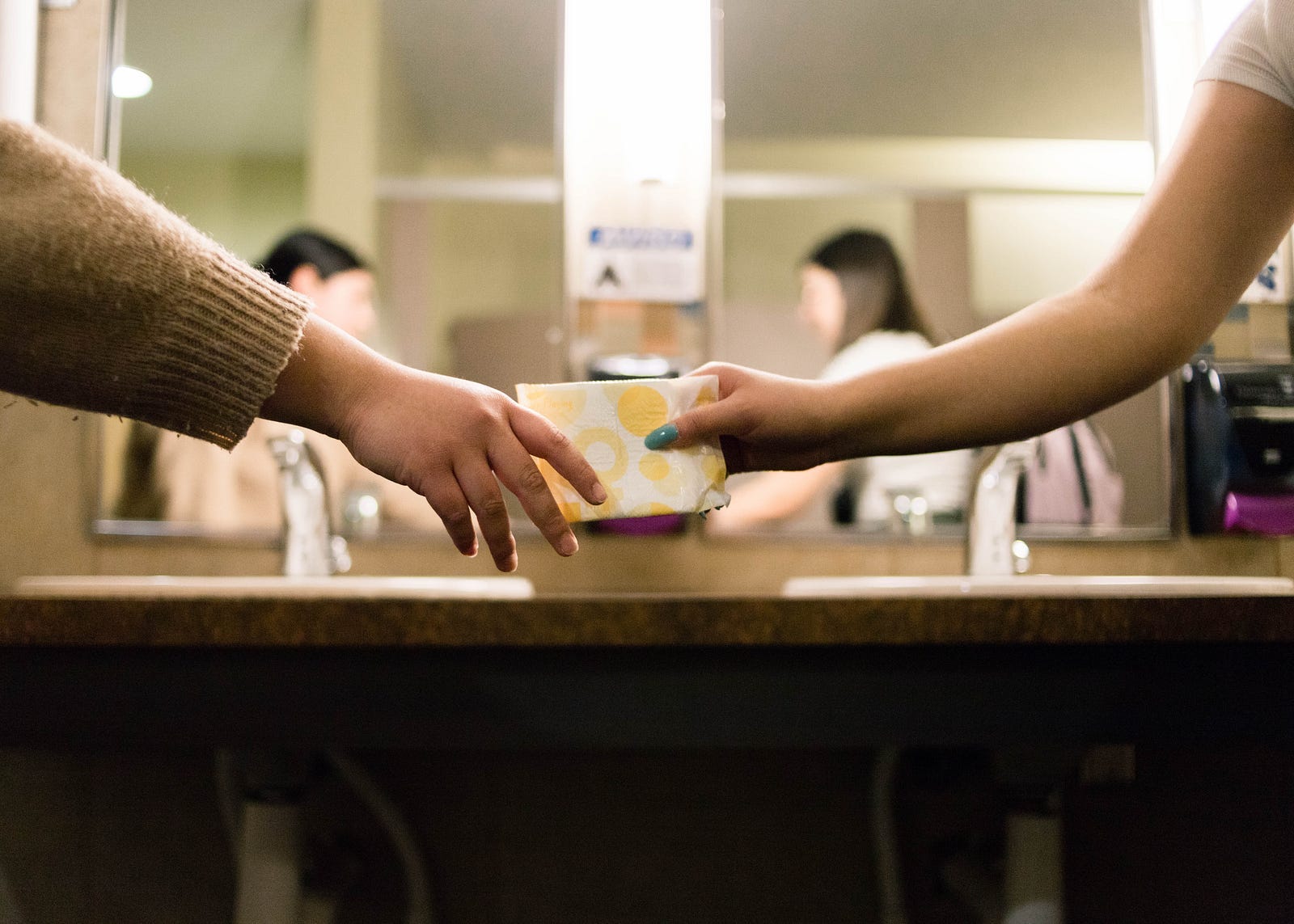
Blister plasters, boob tape, and tampons are handed out like Werther’s Originals at a Women’s Institute meeting. Pleasant conversation dapples the air. Strangers become new best friends.

Outfits are readjusted, hair is coiffed, perfume is shared, and doors with faulty locks are guarded to prevent accidental walk-ins. Those who are desperate are permitted to jump the line.

It’s where the power of sorority is comfortably displayed.

The girls’ bathroom is one of the few places where female vulnerability isn’t preyed upon.

Conversely, it’s often bolstered and allowed to exist without any need for justification.

Sure, it’s where you go when nature calls. But it also acts as a cocoon-like environment — somewhere you can retreat to when you want to feel… safe.

Nat, why are you waxing lyrical about the loo?

Well, because this recent encounter brought about a bracing realisation for me — a conventional woman with an uncomplicated identity who fits comfortably within the margins of the archetype.

I realised that the person peeking her head around the door wasn’t merely asking for permission to enter the room.

She was asking for permission to belong.

She was giving me the power to accept or reject her appeal to exist freely in a space that—for people like me—is a place of comfort, and for people like her, is commonly associated with hostility and consternation.

The alignment of my biological sex and gender identity affords me the confidence to take up space in social settings where others, with less streamlined identities, may feel reluctant.

Of course, uncertainty is a perfectly natural phenomenon in adolescence — kids are constantly trying to make sense of themselves and explore how and where they best fit in a world governed by grown-ups. And this kid, who looked to be some 14 or 15 years old, is no different.

However, this situation was unique because it didn’t focus on the implicit social hierarchy that comes with a significant age gap.

Instead, our respective positions on the spectrum of womanhood forced us to weigh up the other’s existence.

It was as though she believed that within a shared space her identity would encroach on mine; so announcing that she was trans and verbally acknowledging our differences would help me to legitimise her humanity some.

She asked me if she could come in because there may have been a chance that I wouldn’t have wanted her to.

And that is devastating to me.


“Bueno, hija, ¿qué más da? Pasa, pasa.” So what, kiddo? Come on in.

I headed over to the hand dryer.

“Ay, muchas gracias!”

She smiled sweetly and walked past me in her fishnet tights and patent Dr. Martens.


Transphobia is not an alien concept in countries that operate under organised religion or have a traditional set of social values, such as Spain.

Vox—a prominent far-right political party—has been consistently vocal about its disdain towards transgender people and its desire to prevent their access to base-level human rights. Transgender people are persecuted by conservative political parties and their followers all across the nation.

Adults berating other adults is one thing, but what happens when this toxic, nefarious behaviour falls upon the shoulders of children?

Children are sacred

Los niños son sagrados” (children are sacred) is a phrase you see and hear typically in response to the mistreatment of children in any form.

Children are revered in Hispanic culture, so why was this particular child so acutely aware of the controversy surrounding her identity? Shouldn’t the innocence we try so hard to preserve in children include transgender children too?

Shouldn’t she be able to exist as comfortably as her peers do?

Had I voiced an issue with her coming into the bathroom, there is no doubt in my mind that she would’ve turned away and left. And that’s what bothered the hell out of me. It upset me that she felt the need to even mention it.

Because who am I? I’m not important. I have no authority over public spaces or gender identity whatsoever.

I don’t care what people do in the privacy of a bathroom stall. I don’t stop to intimidate them or pass judgement.

I’m just a stranger washing her hands at the sink. But luckily for this girl, I’m a kind stranger. Someone whose cup of compassion and understanding runneth over.

The fact that she felt the need to ask stirred up feelings of pity and rage in equal measure.

It disgusts me that this harmless individual possibly has and probably will suffer at the hands of narrow-minded losers who mind other people’s business more than their own.

As if growing up isn’t already fraught with insecurity and a heightened awareness of your differences from others. Being a teenager in today’s world is like wandering into the seventh circle of hell with gasoline shorts on.

Sure, the world is a big, scary place. But the girls’ bathroom is something else entirely, and it should stay that way.

I felt a wave of protectiveness wash over me as I thought about how she must feel on a regular basis. Physically, she was long-limbed and lofty, yet she seemed so small and defenceless.

A kid.

Just figuring herself out, one day at a time.

When she came into the sink area, she told me she liked my outfit — I told her that I have my own clothing line and was wearing one of my newest designs. I offered her a soap sheet and asked her about her makeup — her parents had bought her an eyeshadow palette for her birthday recently. I’ve never been any good with eyeshadow. She doesn’t go a day without it.

So there we were.

Just two gals chopping it up in the girls’ bathroom, enjoying pleasant conversation with someone we’ll probably recall warmly once or twice before returning to the monotony of our everyday affairs.


I suppose that these are the situations we need more of. Just witnessing humans being humans and doing human things.

So often bigots behave as though those they’re prejudiced towards are a subhuman entity that needs to be exterminated to restore a sense of harmony and order to the world.

In reality, we’re all just people. Trying to get by and get on with things before we shuffle off this mortal coil once our number is up.

Coexisting peacefully really isn’t as complicated as it’s made out to be. Being kind to others is far from difficult.

We’re all different, and that’s fine — it doesn’t need to be fire and brimstone and bloodbaths and battalions.

So when you meet someone different from you, just share the soap.

Don’t work yourself into a lather over it. (snip)

Another Piece I Lifted Off Ten Bears:

Another Coming Out

‘Black Lightning’ creator Jenny Blake Isabella comes out as transgender at 73

Snippet:

Jenny Blake Isabella is proof that it is never too late to embrace being your true authentic self.

A former writer for both Marvel and DC comics Isabella is most well-known for creating the characters Black Lightning, Misty Knight and Tigra.

Over the weekend Isabella came out as transgender with a post on her social media with the meme “Keep Calm and Yes I’m Transgender”. She elaborated further in the caption writing, “This is real. I’ll have more to say soon. In the meantime, I ask you respect my privacy and especially that of my wife and our children. Thank you.”

Isabella is married to Barbara Isabella and the two share two children. While Isabella is now personally using the name Jenny Blacke, she shares that she will continue to write under both that name and her professional name Tony Isabella, and will be presenting as Tony Isabella at upcoming conventions this year. (snipn-MORE)

Is The Left Assaulting The Religion Of The Right?

Groups helping LGBTQ+ victims of violence could face a catastrophic loss of federal funding

Feb 26, 2025 Mel Leonor Barclay, Jasmine Mithani

This story was originally reported by Mel Leonor Barclay and Jasmine Mithani of The 19th. Meet Mel and Jasmine and read more of their reporting on gender, politics and policy.

Organizations that provide services to LGBTQ+ victims of domestic and intimate partner violence expect much of the federal funding they rely on to dry up as the Trump administration’s executive orders target the work they have been carrying out for years.

Some received direct notices from the federal government to stop work that promotes what the administration is calling “gender ideology extremism” and to include disclaimers on their websites that the federal government doesn’t support their mission. 

Federal grants make up significant shares of operating budgets for many domestic violence nonprofits, and losing that funding puts their continued existence at risk. 

Groups that focus specifically on LGBTQ+ victims are part of a broader network of federally funded nonprofits that provide life-saving counseling, housing and legal aid to people experiencing violence from spouses, partners or family members. Some nonprofits also train social workers, therapists and lawyers in how to work sensitively with LGBTQ+ victims of violence. 

The White House has promised to slash funding for programs that don’t align with the administration’s ideology on gender, race and immigration.

Domestic violence groups and the broader network of gender-based violence nonprofits have been on high alert since a temporary federal freeze in late January, as The 19th reported this month. The vague language of President Donald Trump’s executive orders — “illegal” diversity, equity, inclusion and accessibility activities; “gender ideology extremism” — has left organizations scrambling to figure out if they stand to lose federal funding.

Some are trying to protect their funding by removing language or resources that they fear may be at odds with the executive orders. The people leading groups founded specifically to support LGBTQ+ people say that for them, there is no hiding: The executive orders specifically target the people they are focused on serving.

“Some groups are making an effort to kind of change the way they talk about their services and the populations they serve. Our organization literally has the words gay and lesbian in our IRS name — we’re not fooling anybody. And obscuring what we do and who we serve doesn’t help those services stay accessible,” said Audacia Ray, the interim executive director of the New York City Anti-Violence Project, officially the New York City Gay And Lesbian Anti-Violence Project Inc., which supports LGBTQ+ and HIV-affected victims of violence.

LGBTQ+ Americans, with the exception of gay men, are more likely to have experienced domestic violence, partner abuse or dating violence than cisgender and heterosexual people.  Queer women are significantly more likely to have experienced intimate-partner violence in their lifetime than straight women, according to an analysis of federal survey data by the Human Rights Campaign. 

Transgender people are four times more likely to be victims of violent crime than cisgender people, according to research from the Williams Institute at UCLA. Fifty-four percent of respondents to the 2015 U.S. Trans Survey — the most recent data available — said they have experienced intimate partner violence, and 47 percent reported being sexually assaulted. Transgender people are also more likely to experience severe physical intimate partner violence than the average American. 

Nonprofits serving victims of violence have long relied on federal funding, especially since the Violence Against Women Act created specialized grant programs 30 years ago. They receive little support from private philanthropy: Most recent data from the Equitable Giving Lab shows about 0.1 percent of charitable giving in the United States goes toward LGBTQ+ causes, and less than 2 percent goes toward women and girls

“The danger of this moment is that it becomes very nebulous to people how federal funding contributes to the basic social safety net. There aren’t donors. There isn’t all this money,” said the executive director of a regional nonprofit serving LGBTQ+ victims of violence that receives about 40 percent of its funding from the federal government. The organization helps offer shelter and direct cash assistance, among other services, to LGBTQ+ people fleeing violence. 

The executive director spoke on condition of anonymity out of fear that their organization would be targeted further by the Trump administration.

“When people are facing imminent threat of being murdered, and there are no resources to give people funding to flee that situation … it is going to result in more death. Truly, I believe that.” 

The need for targeted LGBTQ+ services

Nonprofits focused specifically on LGBTQ+ communities sprung up to meet the specific needs of this population, which experiences higher incidences of violence and also discrimination based on gender-identity and sexual orientation. 

Specialized resources for LGBTQ+ survivors are dearly needed: A 2017 survey of LGBTQ+ survivors who received services from the National Coalition of Anti-Violence Programs showed that 43 percent of LGBTQ+ intimate partner violence survivors were denied entry to a shelter; of those denied, a third were refused entry due to their gender identity. 

LGBTQ+ people are vulnerable to abuse related to their identity, including threats of outing that could cost them housing, jobs or other relationships. Queer survivors are often isolated from typical support systems like family who could help them in an abusive situation. Transgender people are more likely to be killed by intimate partner violence, and the risk is increased for people of color, especially Black trans women. 

Groups focused on LGBTQ+ survivors serve as a critical safety net for LGBTQ+ victims, often accepting referrals from national and local groups without tailored resources. The Hotline, a national nonprofit that supports victims of domestic violence, describes the “fear of not receiving services” as an obstacle “to reaching safety that LGBTQ+ people might confront.” It offers referrals to service providers focused on LGBTQ+ people – the same providers that are now staring down the loss of federal funding. 

Given the executive orders, “there’s no universe in which some of the work doesn’t take a hit. I feel very clear about that,” said Ray of the New York City Anti-Violence Project. And at the same time, “we have to be able to answer the phone and support our community, who’s directly impacted by all this violence.”

NYCAVP runs a 24/7 hotline for victims of violence, as well as free long-term counseling, legal services and connections to support groups. About two-thirds of the organization’s budget comes from a mix of federal, state and local government grants. Most of its funding comes from programs targeting “underserved communities.” 

Ray said that the New York City Anti-Violence Project, in addition to offering direct services to victims, including through its hotline, also spends resources advocating and advising lawmakers on legislation affecting LGBTQ+ people. For example, NYCAVP helped shape the 2013 reauthorization of the Violence Against Women Act, the first federal funding statute that banned discrimination based on actual or perceived gender identity and sexual orientation. 

“My immediate thought was we will do what we do as long as we can, and we’re not preemptively laying people off or shutting anything down,” Ray said. 

“We have a couple different contingency plans around, ‘What are the services that we need to prioritize and center, and how do we continue to do that as long as possible?’”

The executive director who spoke on condition of anonymity said their organization connected with more than 600 LGBTQ+ people facing abuse and violence in the past year. Some came as referrals from domestic and intimate partner violence organizations that weren’t equipped to serve them, or who were working with a victim needing relocation to a state less hostile to LGBTQ+ people. “It’s kind of like an informal witness protection program,” they said.  

Without federal funding, they said, their ability to help these victims will significantly shrink. 

How nonprofits are fighting back

In a lawsuit filed Thursday by Lambda Legal on behalf of nine nonprofits that receive federal funding, the plaintiffs argue that the Trump administration’s executive orders, including the order calling for the end of federal funding for activities that promote “gender ideology extremism,” amount to “an existential threat to transgender people.” They argue the orders are unconstitutional because they violate the groups’ free speech, due process and equal protection rights. 

“The executive orders force plaintiffs to silence their speech and viewpoints… that are not only of great societal importance but also central to plaintiffs’ missions… or forgo federal funding,” the complaint reads. “That choice is an impossible one.”

Among the plaintiffs suing Trump is FORGE, one of the only organizations in the country focused on supporting transgender people experiencing intimate partner violence. FORGE trains providers who assist transgender and nonbinary survivors of sexual assault, intimate partner violence and hate crimes. The 30-year-old organization also connects victims with wellness services.

According to the case filing, 90 percent of FORGE’s funding is derived from federal grants, the highest out of any listed plaintiff. It has received grants from a wide range of agencies including the Department of Justice, the Department of Health and Human Services (HHS) and the National Institutes of Health. 

Several other plaintiffs that received funds from HHS programs, according to the complaint,  were sent notices in late January to “immediately terminate, to the maximum extent, all programs, personnel, activities, or contracts promoting ‘diversity, equity, and inclusion’” or, separately, “gender ideology.”

“Trans and nonbinary people are scared and hurting – not only from the high levels of violence so many of us experience every day, but also because of the dehumanizing, erasing, and damaging impact of the Executive Orders. For the past 30 years, FORGE has been committed to serving trans survivors of sexual assault, stalking, and hate-fueled harm. We are not going anywhere,” michael munson, executive director of FORGE, said in a statement. “Conditioning federal funding on rejecting transgender identity and DEI not only harms trans people, but it also creates a world that is less safe and less free for us all.”

Deleting language and resources

The National LGBTQ Institute on Intimate Partner Violence urged fellow providers to “hold the line together” and stand in solidarity with LGBTQ+, immigrant and BIPOC survivors in an email obtained by The 19th. The missive explicitly called upon organizations to continue serving LGBTQ+ survivors, to not take down materials tailored to the queer community and to keep pronouns on public-facing materials. It also cited previous reporting from The 19th detailing how some groups removed mentions of LGBTQ+ people from their websites.

“For organizations that have removed LGBTQ+ materials, we encourage that these materials be restored,” the statement read. “We urge organizations to not cede our collective power as a movement and back down in our work to protect LGBTQ+ survivors.”

The group reminded organizations in its network that federal law — the same law that the New York City Anti-Violence Center helped pass — makes it illegal to discriminate based on actual or perceived gender identity or sexual orientation. “These federal non-discrimination policies remain in place and give us power to protect transgender survivors in the work that we do,” the organization said. 

The Los Angeles LGBT Center, where the institute is housed, declined to speak on the record, citing the current lawsuit.

Several days later, Respect Together, the umbrella organization of the National Sexual Violence Resource Center and the Pennsylvania Coalition to Advance Respect, publicly apologized for removing resources for LGBTQ+ people from their websites. 

“Federal and state funding accounts for the vast majority of our operational budget, and as a result, we acted too swiftly to the news from the current administration,” the apology reads. “We heard you, and recognize that this was the wrong choice,” CEO Yolanda Edrington said in the statement. “We are committed to rebuilding trust, learning from this experience, and ensuring that our actions align with our mission to support survivors of all communities, their allies, and advocates.”

The Hotline, which had deactivated a page on LGBTQ+ resources earlier this month, has now restored it. The organization did not respond to a request for comment on the restoration, but told The 19th earlier this month that it was reviewing its website to protect its federal funding.

Even if groups commit to still serve all people in need, regardless of identity, removing resources adds friction. Visibility and ease of navigating resources when you are in need of services is important, said Tandra LaGrone, the CEO of In Our Own Voices, a nonprofit supporting LGBTQ+ people of color in upstate New York, which has received a grant from the Office on Violence Against Women.

The erasure of information can lead victims to feel like they are at fault, LaGrone said.

Ray said that it’s a big risk to not change their organization’s public-facing content in anticipation of a potential loss of funding, but they think holding steady is the right thing to do. Backing down won’t reduce violence, they said. 

“I really believe that complying in advance of direct demands and being forced to change those programs is contributing to the overall violence against LGBT people,” Ray said. “That sort of advance compliance is extremely worrisome to me, because it shows that those orgs are concerned about the org as an institution more than they’re concerned about the community as a directly impacted population.”

Some clips from TizzyEnt

Sorry this may be the last post I make today.  I am not doing well.  I have had 3 hours sleep in two days.  Monday I got a steroid shot in each shoulder so I could move them again.  My bones ache so bad I wondered if I had gotten a cold or flu again.  Steroids do depress my already depressed immune system.  But I can hardly stand the pain in my hands, arms, legs, and I am not a jolly fellow today.  Tomorrow I have my allergy shots.  That should be great, right, what could go wrong with how I feel.  Ron is going with me and we are going to buy the flooring for the Florida room Ron built and that will be my new office.  As I have said before it is to give me more light and not feeling so isolated and will give us a spare bedroom for visitors.   Hugs

How do these people live with themselves

This is his third attempt. At this writing the bill has 33 cosponsors.

The party that claims to worship and act according to the constitution keep demanding they get to change it of things they don’t like!.  Hugs

NEW: Elon Musk's friends have infiltrated the GSA and they're looking for ways to use White House credentials to access agency tech, potentially allowing them to remote into laptops, read emails, and more, sources say.w/ @zoeschiffer.bsky.social http://www.wired.com/story/elon-m…

makena kelly (@makenakelly.bsky.social) 2025-01-31T23:34:55.573Z

It’s also the latest example of Trump trying to blame the Biden administration and Democrats on issues that arise during his term. Trump’s memo alleges that Biden’s administration “egregiously rejected merit-based hiring, requiring all agencies to implement dangerous ‘diversity equity and inclusion’ tactics, and specifically recruiting individuals with ‘severe intellectual’ disabilities in the FAA.”

Nearly One in 10 Americans Now Identify as LGBTQ+, Thanks to Bisexuals and Gen Z

https://www.them.us/story/gallup-lgbtq-population-nine-percent-increase-united-states

The percentage of U.S. adults who identify as LGBTQ+ has nearly doubled since 2020 alone.
Image may contain Adult Person Body Part Hand Holding Hands and Parade
Getty Images

Nearly one in 10 Americans now identify as LGBTQ+, according to Gallup — almost double the percentage recorded just four years ago.


In 2020, 5.6% percent of U.S. adults identified as LGBTQ+ on the Gallup survey, and today, 9.3% of adults in the U.S. identify as part of the community. That number represents a one-point bump from just a year ago, and a staggering increase from the 3.5% first registered in Gallup’s inaugural 2012 poll measuring the size of the LGBTQ+ community. The rise in Americans openly identifying as LGBTQ+ is largely due to an uptick in people who identify as bisexual, especially among Generation Z, according to Gallup’s breakdowns of the data.

More than one in five Gen Z adults (23.1%) now identify as LGBTQ+, per Gallup, followed by about 14% of millennials. Older generations, including Gen X, Baby Boomers and the Silent Generation, all identify as LGBTQ+ at rates of 5% or below, tapering off to only 1.8% for those born in or before 1945.

Of the 900 people surveyed who identified as LGBTQ+, more than half — 56% — indicated that they were bisexual. In fact, more than half of both Gen Z (59%) and millennial (52%) queer people identified as bisexual. These numbers are consistent with past polling that has shown that bisexual people are an “invisible majority” within the queer community.


The percentage of trans U.S. adults has also increased when compared with the survey’s 2024 results. In last year’s poll, fewer than one percent (0.9%) of American adults identified as trans, while this year, 1.3% of respondents self-identified as such. Likewise, last year, 11.8% of the LGBTQ+ population identified as trans, while this year that percentage was recorded at approximately 14%.

The poll notes that LGBTQ+ identification has a strong correlation with being a woman, being politically liberal, and living in an urban area. For example, 21% of liberals, compared to 3% of conservatives, identified as queer or trans, while, overall, 10% of women identify as part of the community compared to 6% of men.

Gallup based its results on interviews with more than 14,000 U.S. adults. Respondents were asked to identify as straight, lesbian, gay, bisexual, trans or something else, and are allowed to indicate multiple identities when responding.

As the percentage of Americans who identify as LGBTQ+ rises, the statistic inches closer to a famous and controversial claim based on the work of human sexuality researcher Alfred Kinsey in the 1940s. Kinsey estimated that about one in 10 Americans were predominantly homosexual — a figure that was colloquially flattened over the years to become the oft-repeated claim that 10% of the population is gay. Kinsey, however, did not believe identity was easily fixed or categorized and often, instead, spoke about behaviors. For example, through surveys and interviews conducted with thousands ordinary Americans, Kinsey estimated that more than a third of men had a same-sex sexual experience in their lives, while at least one in five women had had the same.

The results of Gallup’s poll suggests a population increasingly likely to be at odds with the Trump administration’s anti-LGBTQ+ policies, which include a January executive order making it the official position of the U.S. government that there are only two genders defined at birth. That memo is part of a recent conservative efforts to deny and regulate the existence of trans people nationwide. In 2024, a record number of bills aimed at limiting trans freedoms, including access to gender-affirming health care, were introduced in state legislatures.

Get the best of what’s queer. Sign up for Them’s weekly newsletter here.


It Is Here.

(Also you are beautiful, and you should never stop existing. -A)

Hunter Schafer on why she spoke out about being issued a male passport

By  KRYSTA FAURIA Updated 7:34 PM CST, February 23, 2025

SANTA MONICA, Calif. (AP) — Hunter Schafer says “it’s important to just keep track of where things are in our country,” a day after the “Euphoria” star posted a video in which she revealed her new passport had been issued with a male gender marker.

Speaking to The Associated Press on the red carpet at the Independent Spirit Awards on Saturday, the 26-year-old actor, who is trans, said she felt “it was a good, necessary point” to share. Schafer, also a presenter at the award show, was nominated for best lead performance for “Cuckoo. ”

President Donald Trump signed an executive order on his first day in office instituting a new and narrow federal government definition of the sexes. As part of the order, the federal government defines sex as only male or female and says that must be reflected on official documents, like passports. The State Department, responsible for passports, is no longer issuing passports with the “X” marker that’s been available since 2021 and is not honoring requests to change gender markers between “M” and “F.”

In an 8 ½-minute video posted to TikTok on Friday, Schafer, who transitioned as a young teen, said the passport that was meant to carry her well into her 30s was stolen while she was filming in Spain. After receiving an emergency passport, she later had to apply for a new, permanent one in Los Angeles. Having had female gender markers on her license and passport since she was a teenager, Schafer marked “female” on her application — but received a passport that identified her as male, she said. In the video, she said she had not had her birth certificate amended.

Schafer acknowledged the executive order in her TikTok video: “Because our president, you know, is a lot of talk, I was like, ‘I’ll believe it when I see it.’ And, today, I saw it,” Schafer said, holding up her new passport page with the “M” marker. She said she was making the video not to “fearmonger or like create drama or receive consolation,” but to note the reality of the situation.

“I wasn’t even really looking for support, but I have an amazing community around me and it’s one of the greatest blessings of my life and so I felt very supported throughout, before and then now,” she told the AP on Saturday.

The State Department said in response to a request for comment that it was implementing Trump’s executive order but declined to comment on specific cases, citing privacy laws and restrictions.

“It doesn’t really change anything about me or my transness. However, it does make my life a little harder,” Schafer said in the video, saying she has to travel for the first time with the new passport next week.

“Trans people are beautiful. We are never going to stop existing. I’m never going to stop being trans. A letter and a passport can’t change that,” she concluded.

Associated Press journalist Andrew Dalton contributed reporting.

Heh, heh!