Dr Mehmet Oz, administrator for the Centers for Medicare and Medicaid Services. (Anna Moneymaker/Getty Images)
Mehmet Oz, better-known as Dr Oz, has raged about “$150k penis surgery” for trans youth, but he failed to cite any facts.
Dr Oz, who leads Medicaid and Medicare, announced on Thursday (18 December), alongside health secretary Robert F Kennedy Jr, measures that will ban gender-affirming care for trans youth.
The ban, part of Dr Oz’s bid to end “taxpayer funding of sex rejecting procedures for children in Medicaid and CHIP [children’s health insurance program], full stop”, takes the form of two new proposed rules from Medicaid and Medicare.
The first prevents doctors and hospitals from receiving federal Medicaid reimbursement for gender-affirming care provided to trans youth under the age of 18, while the second blocks all Medicaid and Medicare funding for any services at hospitals that provide pediatric gender-affirming care.
Medicaid, which is the health care program that covers low-income Americans, alongside older and disabled citizens, is taken at most hospitals, meaning the proposals could have a wide-ranging effect, as per New Hampshire Public Radio.
During announcing the proposals, Kennedy referred to gender-affirming care as “malpractice”, while Dr Oz went completely off topic.
The 65-year-old began ranting about the prices of bottom surgery, which is very rarely performed on individuals under 18.
“A vaginoplasty – a procedure a child does not need – costs $60,000,” he claimed, adding: “Shockingly, a phalloplasty, the creation of a penis, costs, on average, in America, $150,000 per child.
“I do believe, with doing some work, that these prices have continued to increase due to increased manufactured demand,” he continued. “A scrotalplasty, where you add testicles? That’s extra.”
Dr Oz didn’t clarify where he pulled his quoted figures from, but according to the Gender Confirmation Center, the price of a vaginoplasty is between $23,000 and $24,500, while phalloplasty ranges between $35,000 and $50,000.
According to 2025 data from the Williams Institute, about one per cent of people aged 13 and older identify as trans in the US, and despite the proposals attacking gender-affirming care for trans youth, multiple studies show that surgeries are rarely performed on minors.
A 2024 study by researchers at Harvard TH Chan School of Public Health found that no gender-affirming surgeries were performed on trans or gender diverse youth (TGD) aged 12 and younger in 2019, the most recent year for which data is available.
For teens ages 15 to 17 and adults ages 18 and older, the rate of undergoing gender-affirming surgery was 2.1 per 100,000 and 5.3 per 100,000, respectively. The majority of surgeries were chest surgeries.
Co-author Elizabeth Boskey, instructor in the Department of Social and Behavioral Sciences, said: “We found that gender-affirming surgeries are rarely performed for transgender minors, suggesting that US surgeons are appropriately following international guidelines around assessment and care.”
Lead author Dannie Dai, research data analyst in the Department of Health Policy and Management, added: “Our findings suggest that legislation blocking gender-affirming care among TGD youth is not about protecting children, but is rooted in bias and stigma against TGD identities and seeks to address a perceived problem that does not actually exist.”
Share your thoughts! Let us know in the comments below, and remember to keep the conversation respectful.
May 14, 2024; New York, NY, USA; Speaker of the House Mike Johnson (center), and Vivek Ramaswamy (right) look on while former President Donald Trump speaks to the media alongside his lawyer Todd Blanche before his criminal trial at Manhattan criminal court at the New York State Supreme Court on May 14, 2024. Mandatory Credit: Justin Lane/Pool via USA TODAY NETWORK | Justin Lane/Pool via USA TODAY N
Yesterday’s announcement from Donald Trump’s Department of Health and Human Services (HHS) shows just why the 2026 midterms will matter so much, and why the 11 months of waiting to get there could be so disastrous. We need a Congress that will stand up and snatch back the purse strings as the Founding Fathers originally intended.
In the United States Constitution, Congress is granted the power of the purse: the right to decide how much to spend and on what. Also, importantly, it gets to decide when to remove funding. In the 70s, that was used to pull funding from the Vietnam War. That power does not belong with the Executive Branch, which the Constitution says must “take Care that the Laws be faithfully executed.”
Unfortunately, the Founders likely never imagined people like House Speaker Mike Johnson (R-LA) or Senate Majority Leader John Thune (R-SD), who have been willing to roll over and allow Trump to usurp their power, in violation of the basic concepts behind the checks and balances built into the Constitution.
Congress is already working to block gender-affirming care. This week, the House of Representatives passed two gender-affirming care bans for minors, one from Rep. Marjorie Taylor Greene (R-GA) and one from Rep. Dan Crenshaw (R-TX). Those bans are horrific, and we can only pray that the Senate will stop them, but they are at least going through some sort of democratic process.
The Trump administration has a way to move towards a gender-affirming care ban if that is in line with the will of the people and democracy. The HHS proposal doesn’t represent a ban; instead, it’s an end-run on democracy, hoping to conduct a scorched-earth funding pull that they should have no authority to do.
The HHS funding blocking proposal would pull all federal funding from any institution that conducts any gender-affirming care for trans people, even if patients pay for it without using federal funds. Hospitals will have to either comply with the HHS plans by ceasing gender-affirming care or risk losing all federal funding for all other treatments. Major hospital systems have already cut their programs because of these sorts of threats.
Trans youth and their families would be left seeking institutions that only provide gender-affirming care and forgo all government funding, if such a place even exists. Additionally, the removal of Medicaid coverage could see prices rise.
There will certainly be pushback against this plan, especially from cities and states that have marked themselves as trans sanctuaries. But those challenges will take time, and a small interruption in care or even just the threat of it does huge damage to trans youth. Denial of care has been linked to increased rates of depression and anxiety, and for those who have begun puberty, the physical changes that can happen in a short time can be extremely upsetting.
Trump keeps using threats of pulling federal funding to power his authoritarianism. That tactic is only working because Congress isn’t stopping him and saying, “No, that’s our job.” When Nixon pulled federal funds as a way to end programs with the Environmental Protection Agency (a process called impoundment), Congress passed the Congressional Budget and Impoundment Control Act, which closed loopholes and ensured that the president couldn’t rule this way. The Supreme Court went on to rule in 1975 that the president did not have the power to overrule Congress by impounding funds.
Michael Dorf, a constitutional law professor at Cornell University Law School, spoke with ABC News early in the Trump presidency, when he first started using this trick. “If Congress says you’re spending that much money on the federal programs, that’s how much is being spent. The president cannot stop it even temporarily,” he said. “Congress passed this statue this very particular rules of what exactly the president has to do if he wants to not spend money on money Congress has spent. He can ask Congress to for a recission, but there is a 45-day clock and a bunch of procedures, none of which have been followed by Trump.”
Congress’ move here wasn’t just granting itself new powers, but providing a safeguard to ensure that the power of the purse remained where the Constitution had put it. Republicans are quick to wheel out the Constitution and the will of the Founding Fathers, but all of that seems forgotten under Trump. Instead, Congress is leaving decisions to be drawn out in protracted judicial battles, which ultimately run the risk of landing in the Trump-packed Supreme Court.
All of those federal funding threats work well for Trump, as he and his administration can wave their hands and claim that they’re standing by their promise to cut bloated government spending (all while spending millions in taxpayer money on golfing and Kid Rock). But it all relies on a tactic that shouldn’t even be part of the presidential toolkit.
There might be a lot of justifiable hope in 2026 that things will work out. Elections this year have already shown a big swing away from Trump’s party. Republicans are resigning, opening more seats that the party could lose between now and 2027. And while Congress might be voting on gender-affirming care bans themselves, it took a capitulation to a hardline anti-trans Republican as she was heading out the door to get that to happen.
But we’re only halfway to those midterms, and there’s going to be a lot of pain if the current Congress can’t remember why they’re there for another year.
Subscribe to the LGBTQ Nation newsletter and be the first to know about the latest headlines shaping LGBTQ+ communities worldwide.
Right now the tRump people are arguing in court that the right of judges to invoke country wide injunctions should be stopped. But they never held that view when republicans ran to this judge’s jurisdiction to stop and hinder every Biden executive order and law. Instead they crowed about it. However like the debt now that it is them in charge they don’t like what they used to stop Democratic Party initiatives. Hugs
Anti-LGBTQ+ Judge Matthew Kacsmaryk | YouTube screenshot
Anti-LGBTQ+ federal Judge Matthew Kacsmaryk ruled that Title VII of the 1964 Civil Rights Act doesn’t protect LGBTQ+ people from workplace discrimination — it only protects them from discriminatory termination. Kacsmaryk’s ruling contradicts the 2020 U.S. Supreme Court decision in Bostock v. Clayton County, a case that classified anti-LGBTQ+ workplace discrimination as a form of sex-based harassment prohibited by Title VII.
In the case, the state of Texas sued the federal Equal Employment Opportunity Commission (EEOC), claiming that the federal agency’s June 2021 guidance interpreting Title VII as prohibiting anti-LGBTQ+ workplace discrimination violated Texas’s “sovereign right” to establish governmental workplace policies dictating employee names, pronouns, dress codes, and facility usage as being based on a person’s sex assigned at birth (and not their gender identity).
The EEOC’s June 2021 guidance said that, to avoid illegally discriminating against LGBTQ+ people in the workplace, adherence to dress codes, use of personal pronouns, and access to gender-segregated facilities must be differentiated based on one’s gender identity and not their sex assigned at birth.
Texas said that the EEOC violated Texas’s free speech rights and Title VII’s sex-based protections by forcing the state’s Department of Agriculture (TDA) to base its workplace policies on gender identity instead of one’s sex assigned at birth. These particular TDA workplace policies were created by Sid Miller, a supporter of the current U.S. president who has said he’s “thrilled” by the ban on trans military members and has called trans identity a form of “leftist social experimentation.”
Texas sued the EEOC with the assistance of the Heritage Foundation, the right-wing think tank that constructed Project 2025, the very anti-LGBTQ+ blueprint for the current U.S. president’s second term in office.
Kacsmaryk agreed with the state of Texas, ruling that the TDA’s policies can legally ban transgender employees from using restrooms, pronouns, and dress codes that align with their gender identity. The TDA’s policies don’t constitute unequal treatment of trans employees, Kacsmaryk wrote, because they “equally” apply to everyone based on their sex assigned at birth, Truthout reported.
Kacsmaryk’s ruling altogether ignores trans identities in a manner consistent with the current president’s interpretation of federal anti-discrimination law. The president has signed executive orders directing all federal agencies, including the EEOC, to end all legal recognition of trans people’s gender identities and to, instead, only recognize a person’s “biological sex” as assigned at birth.
Kacsmaryk ordered the EEOC to remove all references to sexual orientation and gender identity as protected classes under Title VII from its June 2021 guidance.
In 2022, Kacsmaryk ruled against LGBTQ+ protections in Section 1557 of the Affordable Care Act – a law that bans healthcare discrimination on the basis of sex. The two doctors who sued in that case were represented by former Trump advisor Stephen Miller’s America First Legal Foundation, a far-right public interest group that opposes pro-LGBTQ+ civil rights.
Republicans and Christian groups often file their lawsuits in his district because of his tendency to rule in their favor.
Before his 2019 Senate confirmation hearing, Kacsmaryk removed his byline from an article condemning transgender health care in the Texas Review of Law and Politics, a far-right publication that he led as a law student at the University of Texas.
Hiding his contribution to the article likely prevented public scrutiny and questions about the article and his ties to The First Liberty Institute, a Christian conservative legal group that has represented clients who refused to serve LGBTQ+ people based on religious beliefs.
Subscribe to the LGBTQ Nation newsletter and be the first to know about the latest headlines shaping LGBTQ+ communities worldwide.
The state’s ban on gender-affirming pediatric care “cannot be justified” by science, a two-year review concluded.
Madison PaulyMay 27, 2025, 3:00 pm EDT
Spencer Cox of Utah answers a question during a discussion about how our society can learn to disagree in a way that allows us to find solutions on Wednesday, Nov. 15, 2023. | Logan Newell/The Coloradoan / USA TODAY NETWORK
In 2022, Utah Gov. Spencer Cox was the rare Republican governor who seemed to truly care about the well-being of transgender kids. “I don’t understand what they are going through or why they feel the way they do. But I want them to live,” he wrote in a letter that year, explaining why he was vetoing a bill that would have banned four trans middle- and high schoolers in Utah from playing on sports teams with classmates who shared their gender identity. “All the research shows that even a little acceptance and connection can reduce suicidality significantly.”
Meanwhile, nationally, Republican politicians were making opposition to trans rights a core tenet of their platforms, filing hundreds of bills attacking trans kids at the doctor’s office, at school, and on the field. Early in the 2023 legislative session, Cox capitulated, signing a bill that placed an indefinite “moratorium” on doctors providing puberty blockers and hormone therapy to trans kids with gender dysphoria. The bill ordered the Utah health department to commission a systematic review of medical evidence around the treatments, with the goal of producing recommendations for the legislature on whether to lift the moratorium. “We sincerely hope that we can treat our transgender families with more love and respect as we work to better understand the science and consequences behind these procedures,” Cox said at the time.
Now, more than two years later, that review is here, and its conclusions unambiguously support gender-affirming medical care for trans youth. “The conventional wisdom among non-experts has long been that there are limited data” on gender-affirming pediatric care, the authors wrote. “However, results from our exhaustive literature searches have lead us to the opposite conclusion.”
The medical evidence review, published on Wednesday, was compiled over a two-year period by the Drug Regimen Review Center at the University of Utah. Unlike the federal government’s recent report on the same subject, which was produced in three months and criticized gender-affirming pediatric treatments, the names of the Utah report’s contributors are actually disclosed on the more than thousand-page document.
The authors write:
The consensus of the evidence supports that the treatments are effective in terms of mental health, psychosocial outcomes, and the induction of body changes consistent with the affirmed gender in pediatric [gender dysphoria] patients. The evidence also supports that the treatments are safe in terms of changes to bone density, cardiovascular risk factors, metabolic changes, and cancer…
It is our expert opinion that policies to prevent access to and use of [gender-affirming hormone therapy] for treatment of [gender dysphoria] in pediatric patients cannot be justified based on the quantity or quality of medical science findings or concerns about potential regret in the future, and that high-quality guidelines are available to guide qualified providers in treating pediatric patients who meet diagnostic criteria.
In a second part of their review, the authors looked specifically at long-term outcomes of patients who started treatment for gender dysphoria as minors:
Overall, there were positive mental health and psychosocial functioning outcomes. While gender affirming treatment showed a possibly protective effect in prostate cancer in transgender men and breast cancer in transgender women, there was an increase in some specific types of benign brain tumors. There were increased mortality risks in both transgender men and women treated with hormonal therapy, but more so in transgender women. Increase risk of mortality was consistently due to increase in suicide, non-natural causes, and HIV/AIDS. Patients that were seen at the gender clinic before the age of 18 had a lower risk of suicide compared to those referred as an adult.
Submitted with the review was a set of recommendations—compiled by advisers from the state’s medical and professional licensing boards, the University of Utah, and a Utah non-profit hospital system—on steps the state legislature could take to ensure proper training among gender-affirming care providers, in the event it decides to lift the moratorium.
But according to the Salt Lake Tribune, legislators behind the ban are already dismissing the findings they asked for. In response to questions from the Tribune, Rep. Katy Hall, who co-sponsored the 2023 ban, issued a joint statement with fellow Republican state Rep. Bridger Bolinder, the chair of the legislature’s Health and Human Services Interim Committee, that dismissed the study’s findings. “We intend to keep the moratorium in place,” they told the Tribune. “Young kids and teenagers should not be making life-altering medical decisions based on weak evidence.”
Why ignore their own review? Polling, the legislators’ statement suggests. “Utah was right to lead on this issue, and the public agrees—polls show clear majority support both statewide and nationally,” Hall and Bolinder added in their statement. “Simply put, the science isn’t there, the risks are real, and the public is with us.”
Subscribe to the LGBTQ Nation newsletter and be the first to know about the latest headlines shaping LGBTQ+ communities worldwide.
“In almost every single case, the reason was anti-trans discrimination in the form of pressure to ‘detransition’ from one’s family, friends, or community.”
Erin In The Morning is a reader-supported publication. To receive new posts and support my work, consider becoming a subscriber.
Upgrade to paid
A report on the largest survey ever of trans Americans’ health was released on Wednesday, June 11, and its findings reaffirmed what many academics, health care providers and trans people already know: gender-affirming care saves and improves lives, but transphobia often dissuades people from pursuing or continuing it when they need it most.
Over 84,000 trans, nonbinary and gender nonconforming people aged 18 and up responded to the 2022 U.S. Transgender Survey, spearheaded by Advocates for Trans Equality (A4TE). Of respondents who had transitioned, 9% had gone back to living as their sex assigned at birth at some point in their lives, at least for a short while—but in almost every single case, the reason was anti-trans discrimination from one’s family, friends, or community.
“Social and structural explanations dominated the reasons why respondents reported going back to living in their sex assigned at birth at some point,” the report found. “Only 4% of people who went back to living in their sex assigned at birth for a while cited that their reason was because they realized that gender transition was not for them. When considering all respondents who had transitioned, this number equates to only 0.36%.”
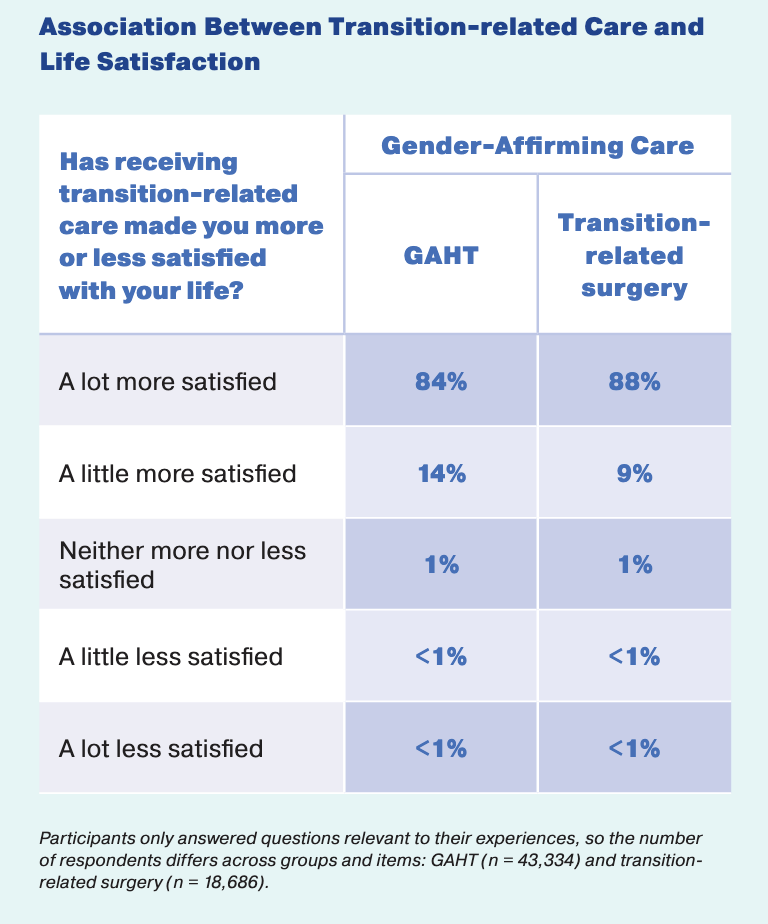
Meanwhile, respondents who received gender-affirming hormone therapy (GAHT) or gender-affirming surgery overwhelmingly reported feeling “more satisfied” with their lives—98% and 97% respectively.
Graphic courtesy of the 2022 U.S. Transgender Survey – Health and Wellbeing Report
This watershed report contradicts the popular narrative being circulated by mainstream media, far-right politicians and anti-trans groups that transgender people are “detransitioning” en masse due to life-shattering “transition regret.” In reality, it shows gender diverse people are living rich and vibrant lives—so long as they are provided the space, support and care they need from their health care providers and communities.
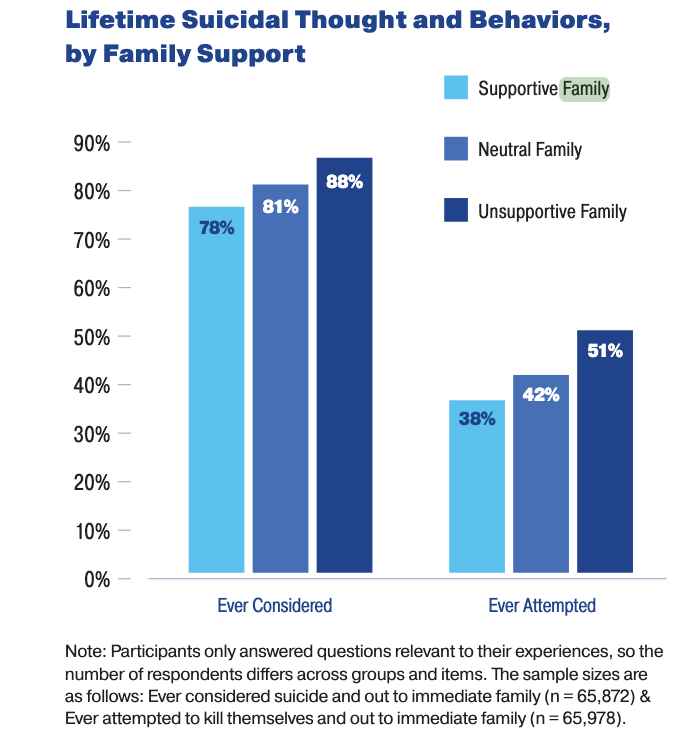
The survey found a trans person’s overall health and wellbeing also heavily depends upon rates of familial support, a factor that has a profound influence over a trans person’s lifetime experience of suicidality.
Graphic courtesy of the 2022 U.S. Transgender Survey – Health and Wellbeing Report
The survey has been released in increments as researchers at A4TE wade through the unprecedented amounts of data from trans people who lent their voice to the project. It is a much-needed, comprehensive overview on the challenges—and victories—seen in trans health care since the prior iteration of the study. The report is especially vital considering the Trump Administration moved to remove transgender people from the U.S. Census and other government websites, rendering trans communities potentially invisible, and robbing researchers of crucial data informing public policy decisions.
“Having real concrete and rigorous data about the realities of trans people’s day-to-day lives is also a vital part of dispelling all of those assumptions and stereotypes that plague the public discourse about our community,” said Olivia Hunt, A4TE’s Director of Federal Policy, during a press briefing this week.
The report also touched upon trans people’s access to health care, which increased between 2015 and 2022; the quality of care, as trust between doctors and trans patients has improved; disparities between trans people across racial groups, which showed trans people of color are generally more prone to experience discrimination compared to white trans people; and the mental health challenges facing the trans community, as 44% of respondents met the criteria for serious psychological distress, compared to less than 4% of the general U.S. population.
Many of these issues have likely been exacerbated since the data was collected. The lead-up to President Donald Trump’s return to the Oval Office incited a new wave of anti-trans animus, impeding access to care and stirring up transphobic vitriol and harassment.
“From 2015 to 2022, state-level policy environments became more protective in some ways for trans people; however, in 2022 alone, when the USTS was administered, 315 anti-LGBTQ bills were introduced across the country, many of which harm trans and nonbinary people’s access to healthcare, participation in sports, access to public facilities, or other facets of public life,” the report says.
“This political landscape has only worsened since the administration of the 2022 USTS, with the introduction of 571 anti-LGBTQ nationwide in 2023 and 489 in 2024,” it continues. “At the time of writing, data on trans and nonbinary people has been erased from federal health surveys. As funding for LGBTQ research is stripped away, the USTS has become an ever more critical resource on the lived experiences of trans and nonbinary people.”
Nonetheless, trans life and trans joy has persisted, as testimonies featured in the U.S. Trans Survey demonstrate.
“I have thrived in the past 12 months in transition, I have a genuine smile on my face most days & laugh with genuine joy,” wrote Charlotte, a trans woman, in her survey response. “I have grown into the woman I was meant to be.”
And as Roo, a nonbinary person, wrote: “Once I learned what it meant to be trans, I never looked back. I traded in my Regina George-esque life for a future with a balding head and a predisposition for a beer gut. I’ve never been more happy to be alive—every single day. ”
Erin In The Morning is a reader-supported publication. To receive new posts and support my work, consider becoming a subscriber.
May 23, 2025, 3:13 PM EDT; Updated: May 23, 2025, 3:35 PM EDT
Allie Reed
Correspondent
A large transgender flag with signatures and messages during a protest.
Photographer: Manaure Quintero/Bloomberg
The Trump administration must republish two Harvard Medical School professors’ papers it censored because they contained words related to gender ideology, a federal judge ruled Friday.
“The plaintiffs are likely to succeed in proving that the removal of their articles was a textbook example of viewpoint discrimination by the defendants in violation of the First Amendment,” Judge Leo Sorokin wrote for the US District Court for the District of Massachusetts.
The US Department of Health and Human Services took down peer-reviewed articles by doctors Gordon Schiff and Celeste Royce from the now-inactive Patient Safety Network website, run by the HHS’s Agency for Healthcare Research and Quality.
PSNet said the articles were taken down in accordance with President Donald Trump’s executive order directing agencies to remove content that promotes “gender ideology.” Schiff’s article, on suicide risk assessment, and Royce’s, on endometriosis, both referenced transgender people.
“This is a flagrant violation of the plaintiffs’ First Amendment rights as private speakers on a limited public forum,” Sorokin wrote.
The government can only restrict speech on a limited public forum like PSNet in a way that is reasonable and viewpoint neutral, the order said, and the administration’s restrictions were not.
Sorokin said it is not within his discretion “to evaluate the wisdom of restricting access to peer-reviewed scientific information that enhances patient safety by fostering more informed and timely diagnostic care—or of eliminating entirely a free, online repository of patient-safety resources accessed each year by thousands of medical professionals seeking to provide better, safer care to their patients in the United States. Those are matters for the political branches of government to decide.”
The preliminary injunction applies to Schiff and Royce’s articles, as well as other content removed from PSNet in a similar manner.
The Trump administration is asking a federal judge to reject a challenge from two Harvard University Medical School physicians seeking to block the government’s removal of research papers because they included terms related to the LGBTQ communities. https://t.co/Bj8Wuuu8c7
By: Susan J. Kressly, MD, FAAP, president, American Academy of Pediatrics
“The American Academy of Pediatrics (AAP) is deeply alarmed by the report released by the U.S. Department of Health and Human Services (HHS) today on medical care for transgender and gender-diverse individuals and the process that informed its development. For such an analysis to carry credibility, it must consider the totality of available data and the full spectrum of clinical outcomes rather than relying on select perspectives and a narrow set of data.
This report misrepresents the current medical consensus and fails to reflect the realities of pediatric care.
As we have seen with immunizations, bypassing medical expertise and scientific evidence has real consequences for the health of America’s children. AAP was not consulted in the development of this report, yet our policy and intentions behind our recommendations were cited throughout in inaccurate and misleading ways. The report prioritizes opinions over dispassionate reviews of evidence.
Patients, their families, and their physicians—not politicians or government officials —should be the ones to make decisions together about what care is best for them based on evidence-based, age-appropriate care.
We urge government officials and policymakers to approach these conversations with care, humility, and a commitment to considering the full breadth of peer-reviewed research. The AAP remains focused on supporting pediatricians in delivering the best possible care to every child, informed by science and the lived experiences of patients and families. We will continue to support the well-being of all children and access to high-quality care that meets their needs.”