I love Erin’s posts and reporting. The attack on trans rights and health was planned and coordinated by religious conservatives who felt they lost the culture war on gay acceptance and same sex marriage so they decided to jump quickly on the trans issue with lots of money. Their first attempt failed because they went after the idea of trans people itself. So then they changed to the old “protect the children” play book with the entire focus on protecting little cis girls but they never mention the trans boys that cis boys need to be protected from. See how patristical it is? It is all about males needing to protect the little womans. They don’t care about trans kids, they don’t care about female sports. It is about not letting trans kids transition with puberty blockers and the correct hormones as then the kids will grow up as they are fitting the societal view of what men and women look like. That scares the straight cis male religious guys because they are terrified they will be attracted to a trans woman. Imagine the horror if trans people moved freely in society not raising any question of their gender because they conformed to how society sees each gender. That sounds like a grand thing to me, but it terrifies these fanatical religious grifters that want to control how everyone lives to please their god. They make up untrue and scary what ifs, what if a man uses the letting trans people use the bathroom of their gender ID to go into a girls … notice they phrase it girls not womans because that make people more protective from the start, and they harm a little girl, your little girl? Well nothing stops a man from doing that now! Predators don’t need permission and won’t wait for it. And that has happened where a straight cis male dragged a little girl into the male bathroom and raped her while his friend watched. There was a famous court case on it. Look it up if you want. Want to know what has not happened, a trans woman going into the female’s bathroom and assaulting a female. Sorry. The right has tried hard to make one happen, but each claim of a trans person in a locker room or bathroom acting inappropriate has been debunked and disproven. This is all a made up scandal and crisis by people who can not accept the society progressing beyond the old traditional binary they grew up with and they think their holy books claim must be as their god insists on it. Weird how it is always how their god insists on what they already believe or promote. Handy that. So many people can not move past the idea that if it dangles you MUST be a boy regardless of how you feel and if it is an inny you must be a girl regardless of anything else idea. They can not seem to grasp personal feelings, needs, or medial science. Hugs
The bill would establish the Affirming Health Care Trust Fund, administered by the State Treasurer, to support clinics and providers outside the reach of federal funding threats.
Vermont Bill Would Create State Trust Fund For Private Trans Youth Care Clinics As Trump Threatens Hospital Funding
The bill would establish the Affirming Health Care Trust Fund, administered by the State Treasurer, to support clinics and providers outside the reach of federal funding threats.
Erin In The Morning is a reader-supported publication. To receive new posts and support my work, consider becoming a subscriber.
Across the United States, gender-affirming care has come under sustained attack in Republican-led states and from the Trump administration. For transgender youth, those attacks have been especially severe, with roughly half of U.S. states now banning such care outright. At the federal level, the administration has waged an intense pressure campaign against hospitals, threatening funding and prompting many systems to drop their care programs altogether. That campaign has now escalated further, with the federal government moving to threaten hospitals’ entire Medicaid and Medicare funding if they continue providing transgender youth care. In response, some states and cities are beginning to fight back by establishing their own funding mechanisms for trans healthcare. The latest example comes from Vermont, where lawmakers have introduced a bill to create a trust fund for gender-affirming care designed to be entirely insulated from federal funding threats.
H.576, introduced by Representatives Daisy Berbeco, Tiffany Bluemle, and Troy Headrick, would establish the Affirming Health Care Trust Fund. Administered by the State Treasurer, the fund would provide direct monetary support to healthcare providers and nonprofits offering gender-affirming care in Vermont. It would cover costs for patients who would otherwise go without treatment, fund the establishment of Vermont-based clinics, and pay for malpractice and liability insurance for clinicians who continue offering care. The bill is part of an increasing movement towards private clinics as a mechanism to survive federal threats.
The bill also includes provisions designed to protect patient information from both federal pressure and out-of-state threats, going further than the recent “refuge” or “shield” laws passed in several blue states to protect transgender youth care. It explicitly bars the board and other state actors from disclosing patient-identifiable data, the identities of providers, or the identities of award recipients to the federal government. This is a significant protection given the wave of abusive legislation and attempts to subpoena transgender healthcare records nationwide. While federal preemption may ultimately be litigated, these provisions give clinics a stronger legal footing to resist such demands—particularly as similar subpoenas have been repeatedly quashed in recent court cases.
The bill comes as families scramble to locate alternatives to hospital systems that are abandoning them. With more than 20 hospitals closing their doors to transgender youth care out of fear and preemptive compliance with the Trump administration, many families have been forced to seek alternatives. Just this week, major hospital systems across Colorado, for example, have stopped providing care. Groups like the Trans Youth Emergency Project say they have the capacity to refer displaced patients to private clinics, and in many places those clinics do exist and are absorbing demand. But as hospital-based programs continue to shut down and demand rises, those private providers will need sustained support—and more clinics will need to be created. Bills like this are a targeted way to do exactly that.
If this bill passes, Vermont would be the latest state to protect care in this way—but it would not be the only one. Massachusetts passed a similar measure last year, allocating $1 million toward transgender youth care clinics, though that funding has already come under criticism as insufficient to meet statewide need in the wake of major clinic closures. In New York City, newly elected mayor Zohran Mamdani has pledged $65 million for transgender healthcare. If that funding is realized, it would position New York City as a major hub for private clinics capable of absorbing demand created by hospital closures across the country. This strategy could prove to be a critical backstop for private providers that are already emerging—and that are likely to come under increasing strain in the years ahead.
The bill allows funding from state appropriations, private donations, grants, and—importantly—federal funds under a future administration that is protective of transgender healthcare. It would take effect immediately upon passage, with the board required to convene by August 1, 2026. There are still hurdles ahead: the bill must advance through committee, pass both chambers, and ultimately receive meaningful funding to function as intended. But its introduction alone signals something important. At a moment when hospitals are retreating and families are being forced into crisis planning, Vermont lawmakers are putting forward a concrete framework to protect access to care rather than surrender it. For Vermonters who want to see their state take a clear stand, residents can find and contact their legislators through the Vermont General Assembly website to make clear where they stand on protecting transgender healthcare.
Erin In The Morning is a reader-supported publication. To receive new posts and support my work, consider becoming a subscriber.
As the flu and covid are on the rise again vaccines are on the decline due to the tRump admin claiming that the best science we have is wrong based on feelings and in the case of the people like JFK Jr it is greed. People don’t realize he makes his money suing drug manufacturers that produce vaccines. Every time he thinks he has some wacked out idea he sues and nothing they can show him will matter to him, all he wants is money and to stop vaccines for other people, as his families kids are protected. Think on it, he is vaccinated, their family has the money to get the vaccines without medical insurance, all he is doing is making it harder and more costly for your kids to get them because you need the medical insurance to help pay for it. Hugs
Under Robert F. Kennedy Jr.’s guidance, the CDC no longer recommends routine vaccination to protect against meningococcal disease.
Jan. 11, 2026, 7:00 AM EST
By Kaitlin Sullivan
Deaths from a rare and dangerous bacterial infection could rise if fewer teens are vaccinated, doctors warn.
After the Centers for Disease Control and Prevention recommended that all adolescents get vaccinated against meningococcal disease in 2005, cases of the potentially deadly illness plummeted in the United States by 90%.
However, cases have sharply risen since 2021, likely due to a combination of mutating bacteria and declining rates of vaccination overall, especially among teens getting a booster dose for bacterial meningitis, doctors suggest.
Dr. Luis Ostrosky, an infectious disease doctor at UT Health in Houston, is concerned that as cases of bacterial meningitis climb in the United States, the CDC’s recent overhaul of the childhood vaccine schedule could lead to more deaths.
Under Health Secretary Robert F. Kennedy Jr.’s guidance, the CDC is no longer recommending a meningitis vaccine for all adolescents. The vaccine and booster protect against the most common types of the infection in the U.S., serogroups A, C, Y, W.
“We see quite a few cases of meningitis per year,” Ostrosky said.
Under the new guidance, the vaccines will be recommended for “high-risk groups,” although parents can still ask doctors to vaccinate their children through a process called “shared clinical decision making.”
Teenagers and college-age adults, who often spend a lot of time in groups or communal living spaces such as dorms, and people with HIV are considered at highest risk for the infection, caused by a group of bacteria called Neisseria meningitidis.
Vaccination is important not because the disease is common — around 3,000 people are diagnosed with bacterial meningitis in the U.S. each year — but because the infection is both extremely serious and fast-moving.
Bacterial meningitis can progress quickly, causing the brain to swell and limbs to develop gangrene and sepsis, and can kill within 24 hours.
Symptoms such as headache, stiff neck, vomiting and fever come on suddenly, and may be mistaken for other minor illnesses. It can be treated with antibiotics, but even with rapid diagnosis, about 15% of patients die.
Fast-acting and life-threatening
Why some people are susceptible isn’t well understood. The infection develops when usually harmless bacteria travel through the respiratory tract and infiltrate the membranes surrounding the brain and spinal cord, causing severe inflammation. These bacteria, which commonly live in the back of the throat, can spread from person to person through close contact.
It can lead to a life-threatening infection in someone whose immune system is compromised — sometimes by a simple cold or flu virus — or who doesn’t have immunity to those bacteria. Viruses and fungi can also cause meningitis, but bacterial meningitis is the most serious.
Among patients who survive, as many as 20% have lifelong disability or complications, including amputated limbs, hearing impairment and neurological problems.
“You can die from a brain hernia, or from sepsis,” Messacar said. “And if you survive a brain hernia, you will most likely have severe complications.”
In 2024, the CDC issued an alert about a rise in cases of a type of invasive meningococcal disease. More than 500 cases were reported, the highest since 2013. Most of the infections were due to a specific strain of the Y serogroup of bacteria, which is included in the previously recommended vaccine. The cases were more common in adults ages 30 to 60, in Black people and in people with HIV.
“It’s even more important now that we get meningococcal vaccines out to people given that we are seeing a spike in this Y strain,” Messacar said.
The Food and Drug Administration has approved three types of meningitis vaccines. In 2005, the CDC began recommending that 11- and 12-year-olds get vaccinated against the most common meningococcal serotypes, A, C, Y and W. Because of waning immunity, the CDC in 2011 added a booster recommendation for 16-year-olds to protect them through young adulthood. A vaccine for meningitis B and a combined shot are available for children or babies who are considered at high risk.
In a statement Monday, Kennedy said that the CDC’s new childhood vaccine schedule was “aligning the U.S. childhood vaccine schedule with international consensus.”
Dr. Peter Chin-Hong, an infectious disease doctor at the UCSF School of Medicine in San Francisco, said the new approach to meningitis vaccination in the U.S., which is based on Denmark’s, is flawed.
“You can’t just look at another country’s vaccine approach and photocopy it. You really have to look at what is happening in your own country,” Chin-Hong said. Given the safety of meningitis vaccines, “it makes sense to vaccinate.”
Alicia Stillman, who serves on a World Health Organization task force for eliminating meningitis, worries that by moving the vaccine into shared decision making, the CDC is creating hurdles for parents who want to protect their children.
Stillman’s daughter, Emily, died from meningitis B in 2013. Emily had been vaccinated against meningitis A, C, W and Y, but the FDA didn’t approve a vaccine for meningitis B until 2014.
Emily Stillman, pictured with her mother, Alicia, was 19 when she died from meningitis B. Courtesy Alicia Stillman
Because many types of bacteria can cause bacterial meningitis, different vaccines are needed. The meningitis B vaccine hasn’t been recommended for all children but is available for people at high risk through the shared decision making process.
“I have watched medical professionals not bring [meningitis B vaccination] up,” said Stillman, who is the co-executive director of the American Society for Meningitis Prevention. “I have watched parents who are maybe a little less educated and not know how to ask about it, or they go to a public clinic instead of a private clinic where they have less time with a provider.”
She believes that could happen more broadly with the changed guidance.
What the research says
A CDC statement said the changes to the recommendation reflect the need for more data on certain vaccines, “including placebo-controlled randomized trials and long-term observational studies to better characterize vaccine benefits, risks, and outcomes.”
While there haven’t been placebo-controlled trials for meningitis vaccines — which would test how well a vaccine works either by deliberately infecting people with bacteria or by seeing how well they fare if they are infected in the real world — there have been many randomized clinical trials and other studies that use decades of data collected from both vaccinated and unvaccinated individuals in the real world.
Chin-Hong said placebo-controlled trials aren’t realistic or ethical for every drug, especially for life-threatening and rare diseases.
“A well-designed observational study, especially using decades of experience, can be just as informative as a randomized controlled trial,” Chin-Hong said.
A 2020 CDC report analyzed 20 clinical trials on meningococcal disease vaccines, including data from the Vaccine Adverse Event Reporting System (VAERS) and the Vaccine Safety Datalink (VS). The most common reported side effects were “mild to moderate,” and included swelling, fever and headache.
In 2005, Katie Thompson, now 39, was infected with an antibiotic-resistant strain of bacterial meningitis when she was a college freshman, the same month the FDA approved the first MenACWY vaccine.
“I don’t know how to describe it besides it’s pure hell,” she said.
After five weeks in the hospital and nearly dying, she went home, but not without lifelong complications. Thompson, who lives outside of Charleston, South Carolina, still struggles with migraines and vestibular disorders that cause vertigo and nausea. The infection was hard on her organs and she uses a bladder stimulator that helps regulate both her bladder and nerves in the base of her spine.
“It’s just not a disease that you want to take a risk on,” she said. “It’s not one that you want to gamble with your child’s life.”
Two vaccines that remain universally recommended by the CDC — the Haemophilus influenzae type b, or Hib, vaccine and the pneumococcal vaccine — protect against some causes of bacterial meningitis. However, these vaccines don’t protect against meningitis A, C, W, Y or B.
Kaitlin Sullivan
Kaitlin Sullivan is a contributor for NBCNews.com who has worked with NBC News Investigations. She reports on health, science and the environment and is a graduate of the Craig Newmark Graduate School of Journalism at City University of New York.
Dr Mehmet Oz, administrator for the Centers for Medicare and Medicaid Services. (Anna Moneymaker/Getty Images)
Mehmet Oz, better-known as Dr Oz, has raged about “$150k penis surgery” for trans youth, but he failed to cite any facts.
Dr Oz, who leads Medicaid and Medicare, announced on Thursday (18 December), alongside health secretary Robert F Kennedy Jr, measures that will ban gender-affirming care for trans youth.
The ban, part of Dr Oz’s bid to end “taxpayer funding of sex rejecting procedures for children in Medicaid and CHIP [children’s health insurance program], full stop”, takes the form of two new proposed rules from Medicaid and Medicare.
The first prevents doctors and hospitals from receiving federal Medicaid reimbursement for gender-affirming care provided to trans youth under the age of 18, while the second blocks all Medicaid and Medicare funding for any services at hospitals that provide pediatric gender-affirming care.
Medicaid, which is the health care program that covers low-income Americans, alongside older and disabled citizens, is taken at most hospitals, meaning the proposals could have a wide-ranging effect, as per New Hampshire Public Radio.
During announcing the proposals, Kennedy referred to gender-affirming care as “malpractice”, while Dr Oz went completely off topic.
The 65-year-old began ranting about the prices of bottom surgery, which is very rarely performed on individuals under 18.
“A vaginoplasty – a procedure a child does not need – costs $60,000,” he claimed, adding: “Shockingly, a phalloplasty, the creation of a penis, costs, on average, in America, $150,000 per child.
“I do believe, with doing some work, that these prices have continued to increase due to increased manufactured demand,” he continued. “A scrotalplasty, where you add testicles? That’s extra.”
Dr Oz didn’t clarify where he pulled his quoted figures from, but according to the Gender Confirmation Center, the price of a vaginoplasty is between $23,000 and $24,500, while phalloplasty ranges between $35,000 and $50,000.
According to 2025 data from the Williams Institute, about one per cent of people aged 13 and older identify as trans in the US, and despite the proposals attacking gender-affirming care for trans youth, multiple studies show that surgeries are rarely performed on minors.
A 2024 study by researchers at Harvard TH Chan School of Public Health found that no gender-affirming surgeries were performed on trans or gender diverse youth (TGD) aged 12 and younger in 2019, the most recent year for which data is available.
For teens ages 15 to 17 and adults ages 18 and older, the rate of undergoing gender-affirming surgery was 2.1 per 100,000 and 5.3 per 100,000, respectively. The majority of surgeries were chest surgeries.
Co-author Elizabeth Boskey, instructor in the Department of Social and Behavioral Sciences, said: “We found that gender-affirming surgeries are rarely performed for transgender minors, suggesting that US surgeons are appropriately following international guidelines around assessment and care.”
Lead author Dannie Dai, research data analyst in the Department of Health Policy and Management, added: “Our findings suggest that legislation blocking gender-affirming care among TGD youth is not about protecting children, but is rooted in bias and stigma against TGD identities and seeks to address a perceived problem that does not actually exist.”
Share your thoughts! Let us know in the comments below, and remember to keep the conversation respectful.
Right now the tRump people are arguing in court that the right of judges to invoke country wide injunctions should be stopped. But they never held that view when republicans ran to this judge’s jurisdiction to stop and hinder every Biden executive order and law. Instead they crowed about it. However like the debt now that it is them in charge they don’t like what they used to stop Democratic Party initiatives. Hugs
Anti-LGBTQ+ Judge Matthew Kacsmaryk | YouTube screenshot
Anti-LGBTQ+ federal Judge Matthew Kacsmaryk ruled that Title VII of the 1964 Civil Rights Act doesn’t protect LGBTQ+ people from workplace discrimination — it only protects them from discriminatory termination. Kacsmaryk’s ruling contradicts the 2020 U.S. Supreme Court decision in Bostock v. Clayton County, a case that classified anti-LGBTQ+ workplace discrimination as a form of sex-based harassment prohibited by Title VII.
In the case, the state of Texas sued the federal Equal Employment Opportunity Commission (EEOC), claiming that the federal agency’s June 2021 guidance interpreting Title VII as prohibiting anti-LGBTQ+ workplace discrimination violated Texas’s “sovereign right” to establish governmental workplace policies dictating employee names, pronouns, dress codes, and facility usage as being based on a person’s sex assigned at birth (and not their gender identity).
The EEOC’s June 2021 guidance said that, to avoid illegally discriminating against LGBTQ+ people in the workplace, adherence to dress codes, use of personal pronouns, and access to gender-segregated facilities must be differentiated based on one’s gender identity and not their sex assigned at birth.
Texas said that the EEOC violated Texas’s free speech rights and Title VII’s sex-based protections by forcing the state’s Department of Agriculture (TDA) to base its workplace policies on gender identity instead of one’s sex assigned at birth. These particular TDA workplace policies were created by Sid Miller, a supporter of the current U.S. president who has said he’s “thrilled” by the ban on trans military members and has called trans identity a form of “leftist social experimentation.”
Texas sued the EEOC with the assistance of the Heritage Foundation, the right-wing think tank that constructed Project 2025, the very anti-LGBTQ+ blueprint for the current U.S. president’s second term in office.
Kacsmaryk agreed with the state of Texas, ruling that the TDA’s policies can legally ban transgender employees from using restrooms, pronouns, and dress codes that align with their gender identity. The TDA’s policies don’t constitute unequal treatment of trans employees, Kacsmaryk wrote, because they “equally” apply to everyone based on their sex assigned at birth, Truthout reported.
Kacsmaryk’s ruling altogether ignores trans identities in a manner consistent with the current president’s interpretation of federal anti-discrimination law. The president has signed executive orders directing all federal agencies, including the EEOC, to end all legal recognition of trans people’s gender identities and to, instead, only recognize a person’s “biological sex” as assigned at birth.
Kacsmaryk ordered the EEOC to remove all references to sexual orientation and gender identity as protected classes under Title VII from its June 2021 guidance.
In 2022, Kacsmaryk ruled against LGBTQ+ protections in Section 1557 of the Affordable Care Act – a law that bans healthcare discrimination on the basis of sex. The two doctors who sued in that case were represented by former Trump advisor Stephen Miller’s America First Legal Foundation, a far-right public interest group that opposes pro-LGBTQ+ civil rights.
Republicans and Christian groups often file their lawsuits in his district because of his tendency to rule in their favor.
Before his 2019 Senate confirmation hearing, Kacsmaryk removed his byline from an article condemning transgender health care in the Texas Review of Law and Politics, a far-right publication that he led as a law student at the University of Texas.
Hiding his contribution to the article likely prevented public scrutiny and questions about the article and his ties to The First Liberty Institute, a Christian conservative legal group that has represented clients who refused to serve LGBTQ+ people based on religious beliefs.
Subscribe to the LGBTQ Nation newsletter and be the first to know about the latest headlines shaping LGBTQ+ communities worldwide.
The state’s ban on gender-affirming pediatric care “cannot be justified” by science, a two-year review concluded.
Madison PaulyMay 27, 2025, 3:00 pm EDT
Spencer Cox of Utah answers a question during a discussion about how our society can learn to disagree in a way that allows us to find solutions on Wednesday, Nov. 15, 2023. | Logan Newell/The Coloradoan / USA TODAY NETWORK
In 2022, Utah Gov. Spencer Cox was the rare Republican governor who seemed to truly care about the well-being of transgender kids. “I don’t understand what they are going through or why they feel the way they do. But I want them to live,” he wrote in a letter that year, explaining why he was vetoing a bill that would have banned four trans middle- and high schoolers in Utah from playing on sports teams with classmates who shared their gender identity. “All the research shows that even a little acceptance and connection can reduce suicidality significantly.”
Meanwhile, nationally, Republican politicians were making opposition to trans rights a core tenet of their platforms, filing hundreds of bills attacking trans kids at the doctor’s office, at school, and on the field. Early in the 2023 legislative session, Cox capitulated, signing a bill that placed an indefinite “moratorium” on doctors providing puberty blockers and hormone therapy to trans kids with gender dysphoria. The bill ordered the Utah health department to commission a systematic review of medical evidence around the treatments, with the goal of producing recommendations for the legislature on whether to lift the moratorium. “We sincerely hope that we can treat our transgender families with more love and respect as we work to better understand the science and consequences behind these procedures,” Cox said at the time.
Now, more than two years later, that review is here, and its conclusions unambiguously support gender-affirming medical care for trans youth. “The conventional wisdom among non-experts has long been that there are limited data” on gender-affirming pediatric care, the authors wrote. “However, results from our exhaustive literature searches have lead us to the opposite conclusion.”
The medical evidence review, published on Wednesday, was compiled over a two-year period by the Drug Regimen Review Center at the University of Utah. Unlike the federal government’s recent report on the same subject, which was produced in three months and criticized gender-affirming pediatric treatments, the names of the Utah report’s contributors are actually disclosed on the more than thousand-page document.
The authors write:
The consensus of the evidence supports that the treatments are effective in terms of mental health, psychosocial outcomes, and the induction of body changes consistent with the affirmed gender in pediatric [gender dysphoria] patients. The evidence also supports that the treatments are safe in terms of changes to bone density, cardiovascular risk factors, metabolic changes, and cancer…
It is our expert opinion that policies to prevent access to and use of [gender-affirming hormone therapy] for treatment of [gender dysphoria] in pediatric patients cannot be justified based on the quantity or quality of medical science findings or concerns about potential regret in the future, and that high-quality guidelines are available to guide qualified providers in treating pediatric patients who meet diagnostic criteria.
In a second part of their review, the authors looked specifically at long-term outcomes of patients who started treatment for gender dysphoria as minors:
Overall, there were positive mental health and psychosocial functioning outcomes. While gender affirming treatment showed a possibly protective effect in prostate cancer in transgender men and breast cancer in transgender women, there was an increase in some specific types of benign brain tumors. There were increased mortality risks in both transgender men and women treated with hormonal therapy, but more so in transgender women. Increase risk of mortality was consistently due to increase in suicide, non-natural causes, and HIV/AIDS. Patients that were seen at the gender clinic before the age of 18 had a lower risk of suicide compared to those referred as an adult.
Submitted with the review was a set of recommendations—compiled by advisers from the state’s medical and professional licensing boards, the University of Utah, and a Utah non-profit hospital system—on steps the state legislature could take to ensure proper training among gender-affirming care providers, in the event it decides to lift the moratorium.
But according to the Salt Lake Tribune, legislators behind the ban are already dismissing the findings they asked for. In response to questions from the Tribune, Rep. Katy Hall, who co-sponsored the 2023 ban, issued a joint statement with fellow Republican state Rep. Bridger Bolinder, the chair of the legislature’s Health and Human Services Interim Committee, that dismissed the study’s findings. “We intend to keep the moratorium in place,” they told the Tribune. “Young kids and teenagers should not be making life-altering medical decisions based on weak evidence.”
Why ignore their own review? Polling, the legislators’ statement suggests. “Utah was right to lead on this issue, and the public agrees—polls show clear majority support both statewide and nationally,” Hall and Bolinder added in their statement. “Simply put, the science isn’t there, the risks are real, and the public is with us.”
Subscribe to the LGBTQ Nation newsletter and be the first to know about the latest headlines shaping LGBTQ+ communities worldwide.
“In almost every single case, the reason was anti-trans discrimination in the form of pressure to ‘detransition’ from one’s family, friends, or community.”
Erin In The Morning is a reader-supported publication. To receive new posts and support my work, consider becoming a subscriber.
Upgrade to paid
A report on the largest survey ever of trans Americans’ health was released on Wednesday, June 11, and its findings reaffirmed what many academics, health care providers and trans people already know: gender-affirming care saves and improves lives, but transphobia often dissuades people from pursuing or continuing it when they need it most.
Over 84,000 trans, nonbinary and gender nonconforming people aged 18 and up responded to the 2022 U.S. Transgender Survey, spearheaded by Advocates for Trans Equality (A4TE). Of respondents who had transitioned, 9% had gone back to living as their sex assigned at birth at some point in their lives, at least for a short while—but in almost every single case, the reason was anti-trans discrimination from one’s family, friends, or community.
“Social and structural explanations dominated the reasons why respondents reported going back to living in their sex assigned at birth at some point,” the report found. “Only 4% of people who went back to living in their sex assigned at birth for a while cited that their reason was because they realized that gender transition was not for them. When considering all respondents who had transitioned, this number equates to only 0.36%.”
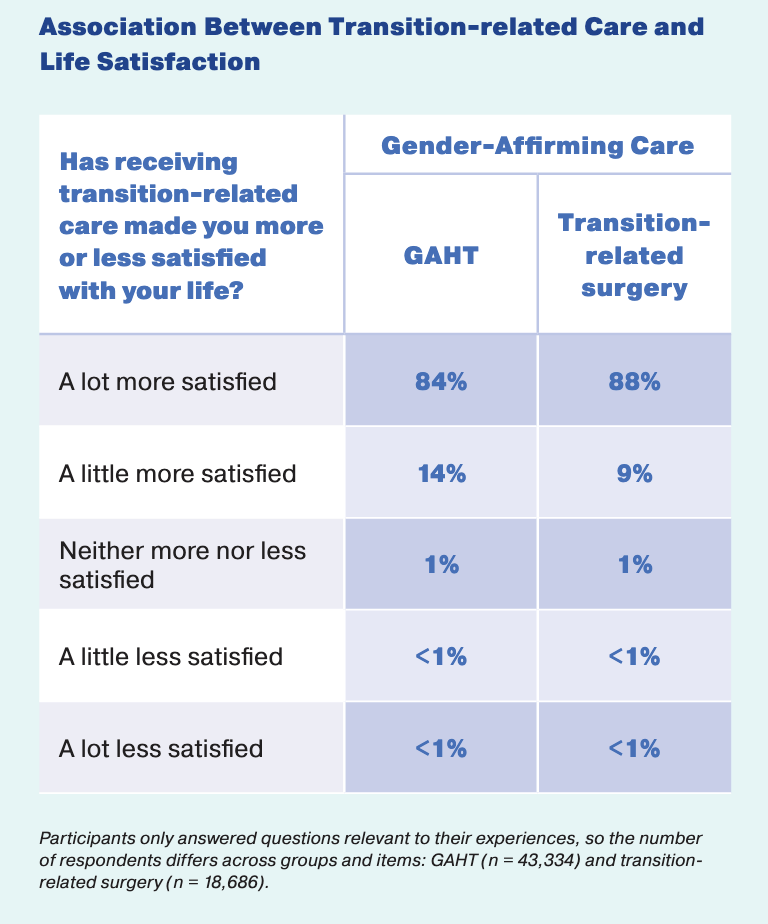
Meanwhile, respondents who received gender-affirming hormone therapy (GAHT) or gender-affirming surgery overwhelmingly reported feeling “more satisfied” with their lives—98% and 97% respectively.
Graphic courtesy of the 2022 U.S. Transgender Survey – Health and Wellbeing Report
This watershed report contradicts the popular narrative being circulated by mainstream media, far-right politicians and anti-trans groups that transgender people are “detransitioning” en masse due to life-shattering “transition regret.” In reality, it shows gender diverse people are living rich and vibrant lives—so long as they are provided the space, support and care they need from their health care providers and communities.
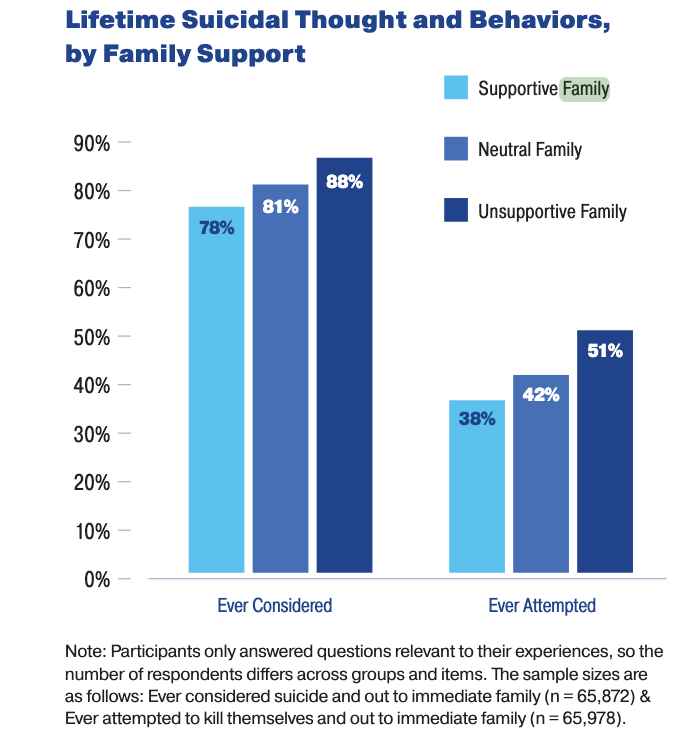
The survey found a trans person’s overall health and wellbeing also heavily depends upon rates of familial support, a factor that has a profound influence over a trans person’s lifetime experience of suicidality.
Graphic courtesy of the 2022 U.S. Transgender Survey – Health and Wellbeing Report
The survey has been released in increments as researchers at A4TE wade through the unprecedented amounts of data from trans people who lent their voice to the project. It is a much-needed, comprehensive overview on the challenges—and victories—seen in trans health care since the prior iteration of the study. The report is especially vital considering the Trump Administration moved to remove transgender people from the U.S. Census and other government websites, rendering trans communities potentially invisible, and robbing researchers of crucial data informing public policy decisions.
“Having real concrete and rigorous data about the realities of trans people’s day-to-day lives is also a vital part of dispelling all of those assumptions and stereotypes that plague the public discourse about our community,” said Olivia Hunt, A4TE’s Director of Federal Policy, during a press briefing this week.
The report also touched upon trans people’s access to health care, which increased between 2015 and 2022; the quality of care, as trust between doctors and trans patients has improved; disparities between trans people across racial groups, which showed trans people of color are generally more prone to experience discrimination compared to white trans people; and the mental health challenges facing the trans community, as 44% of respondents met the criteria for serious psychological distress, compared to less than 4% of the general U.S. population.
Many of these issues have likely been exacerbated since the data was collected. The lead-up to President Donald Trump’s return to the Oval Office incited a new wave of anti-trans animus, impeding access to care and stirring up transphobic vitriol and harassment.
“From 2015 to 2022, state-level policy environments became more protective in some ways for trans people; however, in 2022 alone, when the USTS was administered, 315 anti-LGBTQ bills were introduced across the country, many of which harm trans and nonbinary people’s access to healthcare, participation in sports, access to public facilities, or other facets of public life,” the report says.
“This political landscape has only worsened since the administration of the 2022 USTS, with the introduction of 571 anti-LGBTQ nationwide in 2023 and 489 in 2024,” it continues. “At the time of writing, data on trans and nonbinary people has been erased from federal health surveys. As funding for LGBTQ research is stripped away, the USTS has become an ever more critical resource on the lived experiences of trans and nonbinary people.”
Nonetheless, trans life and trans joy has persisted, as testimonies featured in the U.S. Trans Survey demonstrate.
“I have thrived in the past 12 months in transition, I have a genuine smile on my face most days & laugh with genuine joy,” wrote Charlotte, a trans woman, in her survey response. “I have grown into the woman I was meant to be.”
And as Roo, a nonbinary person, wrote: “Once I learned what it meant to be trans, I never looked back. I traded in my Regina George-esque life for a future with a balding head and a predisposition for a beer gut. I’ve never been more happy to be alive—every single day. ”
Erin In The Morning is a reader-supported publication. To receive new posts and support my work, consider becoming a subscriber.
I admit my life was different but from the time I was five I knew I was attracted to males. Specifically both sexually and emotionally. One of the hell spawn female siblings even held me down to pound the point that I was “queer” into me. I did not understand why it was wrong, after all they were the ones telling me what to do and farming me out to their teen boyfriends. I craved being held by the boys and not so much the girls. But all the other gay and lesbian people I have talked to knew early also. Preteen time frame. 7 or 8 and up they knew they were gay and either knew they had to hide it or knew they couldn’t so had to live with being attacked for it. These people who think it is a choice, a fad, or a phase need to ask themselves the famous question. When did they know they were cis and straight and was it a choice they made. No they just felt it all their lives, they simply knew it. Same for the LGBTQ+. The only difference is straight cis kids see themselves everywhere from birth. Mommies and daddies, they see themselves in the older kids around them, in the news, movies, TV shows, and the books they read. It feels so natural to them they just don’t question it. They are lucky. Until recently like in the last decade LGBTQ+ kids did not see themselves reflected in society. No movies had kids like them, no books in the library had kids like them. Some kids did not even know the words for how they felt. It was changing in the last ten years. Schools made a push for inclusion and tolerance, movies showed LGBTQ+ kids, books had them as plots or characters. Kids could see themselves and be proud. That is what the haters, the anti-trans / anti-gay bigots want to remove. The ability of kids who are different from the majority to see themselves represented positively in society. It is why they write and pass don’t say gay bills, and why they ban books. It is why they try to ban drag shows and pride events. These people who demand a straight cis world with only them showing in public are terrified of a world where people can be different. To them those who are the other must be destroyed, ideas of acceptance and tolerance must be erradicated and removed. All because they don’t feel different from the majority so the difference must not be real. But it is and we need to realize the scars left on kids who grew up in the times when they never seen themselves represented in society. We must not go backward in time, regressing to a time of hate. Hugs
LGBTQ+ youth advocates gathered outside the Monmouth County Courthouse in Freehold on Tuesday, Aug. 15, 2023, where a school policy that would impact lesbian, gay, bisexual, transgender and queer youth was being reviewed in Superior Court. | Amanda Oglesby / Asbury Park Press / USA TODAY NETWORK
A new poll from Pew Research Center sheds some light on just how early LGBTQ+ people are aware of their identities. The study of LGBTQ+ adults in the U.S. found that most respondents understood their identity before the age of 14, with a substantial portion knowing about their identities before the age of 10.
Among gay and lesbian adults, 36% said that they felt they were gay or lesbian before the age of 10 and 35 first felt they were gay or lesbian from ages 10 to 13. Only a minority – 29% – had their first feelings about their sexuality after the age of 14.
The numbers were similar for transgender people. Approximately 33% felt they might be transgender before age 10, and 25% felt the same way between ages 10 to 13. Only 19% had their first feelings about being transgender after the age of 18.
Bisexual people tended to know the latest, but even a majority of bisexual people said that they had their first thoughts about being queer before age 18. Half – 50% – had their first feelings of being bisexual before age 14.
The question often comes up in discussions of LGBTQ+ youth, with many on the right insisting that people can’t know their identities before adulthood. Often, these people claim that only LGBTQ+ people can’t know their identities before adulthood, but then support heterosexuality and cisgender identities in young people.
But these statements fly in the face of LGBTQ+ people’s lived experiences, which often include years of hiding their identities before they create a safer space for themselves to live authentically as adults.
While LGBTQ+ respondents generally first thought about their queer identities when they were very young, most waited until they were older to tell others. While 71% of gay and lesbian people said that they first knew about their sexuality before age 14, only 13% said that they told someone before that age. Approximately 58% of trans people first thought they might be trans before age 14, but only 15% told someone before that age.
This also contradicts the rightwing narrative that young people are saying that they are trans or gay to gain social acceptance and not because they actually identify as such. In reality, young people are saying that they’re straight or cisgender when they actually aren’t, likely to try and get social acceptance.
Pew broke down the results even more and showed that gay men generally felt that they were gay at a younger age than lesbian women, with 40% saying they were younger than 10 years old when they first thought they were gay, as opposed to 29% of lesbian women.
| Pew Research Center
Bisexual women, on the other hand, likely knew earlier than bisexual men. 53% of bi women said they felt they might be bi before they were 14 years old, while just 40% of bi men said the same.
| Pew Research Center
The poll was conducted in January of this year and involved a sample of 3,959 adult LGBTQ+ Americans. The survey asked about a wide variety of topics, including support from family and friends, ties to the larger LGBTQ+ community, and social acceptance.
Subscribe to the LGBTQ Nation newsletter and be the first to know about the latest headlines shaping LGBTQ+ communities worldwide.
By: Susan J. Kressly, MD, FAAP, president, American Academy of Pediatrics
“The American Academy of Pediatrics (AAP) is deeply alarmed by the report released by the U.S. Department of Health and Human Services (HHS) today on medical care for transgender and gender-diverse individuals and the process that informed its development. For such an analysis to carry credibility, it must consider the totality of available data and the full spectrum of clinical outcomes rather than relying on select perspectives and a narrow set of data.
This report misrepresents the current medical consensus and fails to reflect the realities of pediatric care.
As we have seen with immunizations, bypassing medical expertise and scientific evidence has real consequences for the health of America’s children. AAP was not consulted in the development of this report, yet our policy and intentions behind our recommendations were cited throughout in inaccurate and misleading ways. The report prioritizes opinions over dispassionate reviews of evidence.
Patients, their families, and their physicians—not politicians or government officials —should be the ones to make decisions together about what care is best for them based on evidence-based, age-appropriate care.
We urge government officials and policymakers to approach these conversations with care, humility, and a commitment to considering the full breadth of peer-reviewed research. The AAP remains focused on supporting pediatricians in delivering the best possible care to every child, informed by science and the lived experiences of patients and families. We will continue to support the well-being of all children and access to high-quality care that meets their needs.”