Enjoy, and be aware of your keyboard’s presence.
Josh Day Next Day
Enjoy, and be aware of your keyboard’s presence.

Enjoy, and be aware of your keyboard’s presence.
Considered sacred by several Mesoamerican civilizations, the Resplendent Quetzal remains culturally significant to this day. The Resplendent Quetzal likely inspired Quetzalcoatl, the “plumed serpent” god of Mesoamerica. Legend has it that Quetzalcoatl helped create Earth. Rulers and nobility wore headdresses made from this quetzal’s shining green feathers, which symbolically connected them to the god.
In some Mesoamerican cultures, it was considered a crime to kill a quetzal, so the plumes were procured by capturing the bird, plucking its long tail feathers, and setting it free. In several Mesoamerican languages, the term for quetzal can also mean “precious” or “sacred.”
These iridescent green tail feathers also symbolized spring plant growth to the Aztecs and Maya, who viewed the quetzal as the “god of the air” and as a symbol of goodness and light. The Maya also viewed the quetzal as a symbol of freedom (due to the difficulty of keeping them in captivity) and wealth and status, as its feathers were used as money. Even today, the currency of Guatemala is called the quetzal.
The Resplendent Quetzal is also the national bird of Guatemala, pictured on the country’s flag and coat of arms. It was thought to be the spirit guide of a Maya ruler and hero, Tecún Umán, who fought against the Spanish conquest. According to legend, Tecún Umán was killed as he fought the conquistador Pedro de Alvarado. As Tecún Umán lay dying, a quetzal flew down and landed on his chest, dipping its feathers in the hero’s blood. This is supposedly how the bird acquired its red breast and belly feathers.
This spectacular species belongs to the trogon family, a group of colorful, fruit-eating birds found in the Americas, Asia, and Africa. Other family members found in the Americas include the Golden-headed Quetzal, the Elegant Trogon, and Haiti’s national bird, the Hispaniolan Trogon.
Birds around the world are declining, and many of them, like the Resplendent Quetzal, are facing ever-increasing threats. Partners in Flight includes the Resplendent Quetzal on its Red Watch List as a species of high conservation concern, and also classifies it as a “Tipping Point” species — one that has lost more than 50 percent of its population within the past 50 years. (snip-so much more!)

While the name Christmas features here, this is interesting food history. Enjoy!
Earlier (yesterday by now,) I told Scottie I’m taking some time off posting because it’s become busy at my place, but I can’t not post Josh Day! Enjoy, and all keyboard protection protocols should be in place. 🤣

The Observable Universe
Illustration Credit & Licence: Wikipedia, Pablo Carlos Budassi
Explanation: How far can you see? Everything you can see, and everything you could possibly see, right now, assuming your eyes could detect all types of radiations around you — is the observable universe. In light, the farthest we can see comes from the cosmic microwave background, a time 13.8 billion years ago when the universe was opaque like thick fog. Some neutrinos and gravitational waves that surround us come from even farther out, but humanity does not yet have the technology to detect them. The featured image illustrates the observable universe on an increasingly compact scale, with the Earth and Sun at the center surrounded by our Solar System, nearby stars, nearby galaxies, distant galaxies, filaments of early matter, and the cosmic microwave background. Cosmologists typically assume that our observable universe is just the nearby part of a greater entity known as “the universe” where the same physics applies. However, there are several lines of popular but speculative reasoning that assert that even our universe is part of a greater multiverse where either different physical constants occur, different physical laws apply, higher dimensions operate, or slightly different-by-chance versions of our standard universe exist.
Explore the Observable Universe: Random APOD Generator
Tomorrow’s picture: stellar shell game
We get Mississippi Kites in late Spring; they’re about gone now. They give amazing air shows! Watching them makes a day better.-Ali

With pearlescent gray feathers and a sleek silhouette, the Mississippi Kite glides gracefully through the skies on wingbeats that manage to look effortless. While this medium-sized raptor with long, pointed wings and a squared-off tail may resemble a Peregrine Falcon in flight, the Mississippi Kite’s bouyant and easy flight can quickly distinguish it from the rapid, businesslike flight of the falcon. Its aerial acrobatics have earned the kite nicknames like “Hovering Kite.”
A long-distance migratory species, the Mississippi Kite breeds throughout the southern and central United States, making use of wooded areas in a range of settings — in large, low-lying forest tracts, windbreaks (stands of wind-resistant trees and shrubs) in prairies, and even in urban settings. Their habitat use and even their social behaviors vary throughout their range, with kites in the west being more likely to nest in colonies than their counterparts in the east.
The global Mississippi Kite population is increasing, and its range has expanded into parts of the Southwest since the mid-20th century. Even so, the cumulative impacts from threats like habitat degradation and loss, pesticide use, and collisions may make the Mississippi Kite more vulnerable across parts of its range.

from the end of the shutdown,-and I have huge hope that we the people will continue to stand together to help each other through the days!-we do get the Astronomy Photo of the Day again!

Orion and the Running Man
Image Credit & Copyright:R. Jay Gabany
Explanation: Few cosmic vistas can excite the imagination like The Great Nebula in Orion. Visible as a faint, bland celestial smudge to the naked-eye, the nearest large star-forming region sprawls across this sharp colorful telescopic image. Designated M42 in the Messier Catalog, the Orion Nebula’s glowing gas and dust surrounds hot, young stars. About 40 light-years across, M42 is at the edge of an immense interstellar molecular cloud only 1,500 light-years away that lies within the same spiral arm of our Milky Way galaxy as the Sun. Including dusty bluish reflection nebula NGC 1977, also known as the Running Man nebula at left in the frame, the natal nebulae represent only a small fraction of our galactic neighborhood’s wealth of star-forming material. Within the well-studied stellar nursery, astronomers have also identified what appear to be numerous infant solar systems.
Tomorrow’s picture: pixels in space
What Scottie’s has always stood for, too:
I thought you needed this. by Jenny Lawson (thebloggess)
It might be my compulsive thoughts talking, but here goes. Read on Substack
Dear friend,
This is the last week of October and so I drew you a Halloweeny sketch but then Sunday I had this really weird thought that someone out there needed to hear something specific and so I drew it up and thought I’d share it next week but my very compulsive mind is telling me that I need to post it now. This might just be my OCD winning but I also believe in following your gut, so next week you’ll get my Halloween drawing WAY AFTER HALLOWEEN and I’m so sorry I’m like this.
But…maybe you’re the person who needs to hear this today…
it’s going to be okay. I love you. You are doing amazing.
The world is hard at times and we’re all fighting so many battles, but you’re doing so much better than you think. You are making differences in the lives of people in ways you’ll probably never see. It’s easy to let the darkness around us overshadow the light, but your shine is integral. It may be impossible for your own eyes to recognize the glow you bring, but it is so gorgeously obvious to so many others.
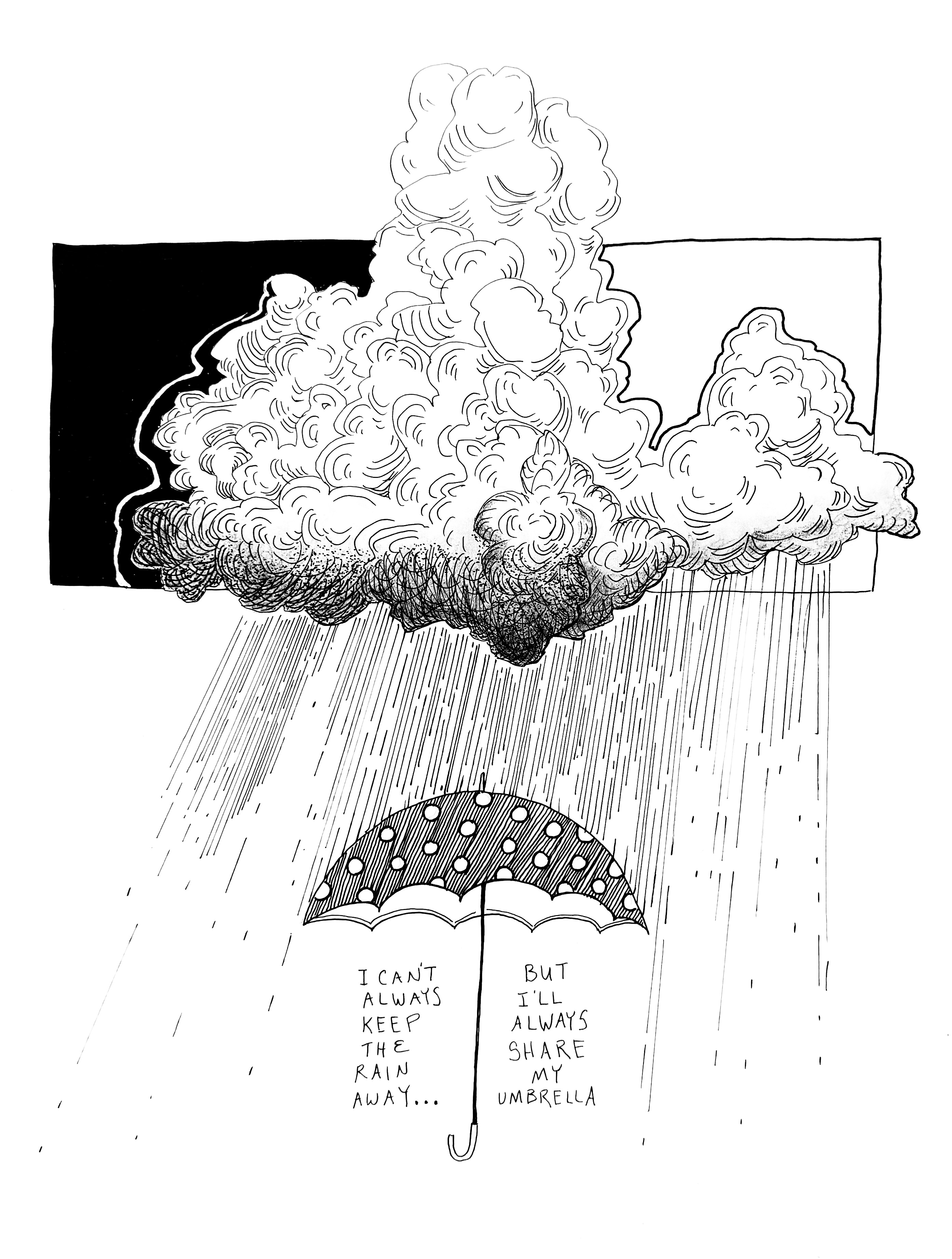
“I can’t always keep the rain away. But I’ll always share my umbrella.”
There is always space under my umbrella for you.
I super crazy love you.
Your friend,
~ Jenny

 Scottie's Playtime
