Beverage alert! 🤣
Day-old Josh Day Set
Beverage alert! 🤣

Beverage alert! 🤣
I will never see a Robin Williams movie, an interview, or a stand-up without a tear in my eye. He made me laugh, he made me cry, he made me feel anger and he made me feel hope, all behind a mask paper-thin. He reveled in the joy of others, while in his heart he felt so alone. How few knew his hidden hurts? I feel the absence of this great man and am saddened that his joie de vivre was only a mask he used to protect us all.


My morning trek to the daily grind found me hearing about Charlie Kirk. I thought about the demands he made upon his audience; that they think his way, act his way, love his way, pray his way. Somehow those who think differently are more than a target for his former speeches, we have become enemies of our own government.
Again, I don’t want to see anyone hurt. But, what about those he made to feel alone?
What about those he made to feel hated? What about those he told ‘You don’t matter’? What about those he accused of horrible motives, intentions to commit crimes, just because they were different?
Why is crass, abusive, hateful, prejudiced, and violent words and actions acceptable to anyone? Why is it cheered in certain circles?


I have every right to be angry at those who sling abuse for political expediency. I have every right to be angry at those who whip the easily led mob into denying others their rights to be genuine, their hopes to feel love, their need for happiness. I’m so tired, so very tired of the justification, the hypocrisy, the gleeful ruination.
I so miss the promise of the 70’s. Change was supposed to come. I bought into the hype, only to see that the very fight continue. Maybe it’s not the era, maybe it’s just something in us that makes people keep doing this to each-other. I want to believe differently.

I dedicate this to my beautiful brother.
Randy
Drawing is learning: the birds of the subantarctic
September 12, 2025 Bonnie Koopmans

(Some) Penguins of the Subantarctic. Watercolour and gouache on toned paper, 30 x 23cm. Credit: Bonnie Koopmans.
Between Tasmania and Antarctica, there are a series of tiny, isolated islands on the cusp of the Southern Ocean. Many people don’t even realise they exist, but these frigid and windswept islands host a surprising diversity of seabirds.
Last summer, I was awarded a Heritage Expeditions True Young Explorer Scholarship to visit this remarkable region. My time in the subantarctic included visiting 4 of the island groups in the region: The Snares, the Auckland Islands, and Campbell Island (belonging to New Zealand) and Macquarie Island (belonging to Australia).
As a keen naturalist and natural history illustrator, I jumped at the chance to experience an area so remote, expensive and difficult to access. Additionally, as a keen birder, the subantarctic represented an opportunity to see some stunning birds in the most beautiful, harsh and unique environment.

As an illustrator and visual learner, drawing is one of my methods of learning about something, whether it’s internalising technical species differences or figuring out the general shape and character of an animal.
Field studies and drawing from life, especially, allow an artist to deeply observe and capture behaviour and colours in a way that is otherwise very difficult to achieve. The illustrations featured in this article are a mixture of studies done in the field, and finished paintings I completed once I was back home.
Flipping through a bird field guide, the seabird section often seems remarkably… grey. For me, it was finally seeing these birds in the flesh that made me realise how special they are.
While seabird identification can be complicated (groups such as prions are notoriously difficult to identify), observing them in person can provide other avenues to assist the process, as even aspects such as manner of flight can help with distinguishing species.
Albatross with their immense unflapping wingspan, and their endearing rambling stride on land. Petrels following the ship almost the entire journey, arcing left and right past the stern. Penguins effortlessly rocketing through the water, only to reach land and be slowed to a shuffle by their own tiny legs.
Certainly, the highlight of the trip were the penguins, with 6 species seen on the trip, each absolutely bursting with personality and charm. To see a breeding colony of penguins is an unforgettable sight (and sound!) and, if anything, it’s a wonder to see immense congregations of penguins at all considering the history of whaling and sealing in the subantarctic.

During the 1800s and into the early 1900s, whaling and the subsequent products of oil and baleen were critically important to the newly industrial world. Whale oil – and later seal and penguin oil – provided crucial lubricants for machinery, and fuel for lighting. The subantarctic was heavily targeted.
Besides the obvious and huge impact these activities had on whale, seal and penguin numbers, another long-term conservation issue was the introduction of livestock and establishment of stowaway predators. These affected the local populations of seabirds, especially.
Once the whale and seal populations were low enough that it was no longer financially viable for whalers to remain on the islands, they turned their livestock loose, and pigs, cows, cats, and stowaways such as rats were left to run rampant.
As many of the seabirds breeding on these islands had never had to contend with land-based predators, the introduction of cats and rats devastated their populations. Surprisingly voracious predators which were, similarly, introduced as a food source were weka – flightless rails endemic to New Zealand.
As ground dwellers, the rails could easily eat chicks of ground burrowing seabirds such as common diving petrels and blue petrels. Additionally, livestock such as pigs and cows caused environmental damage and drastically changed the composition of habitat through grazing and trampling.

Beyond the obvious seabird residents, these islands are home to a wide variety of other bird species, from red-crowned parakeet and New Zealand falcon, to several species of passerines (‘perching birds’) such as tomtit, New Zealand bellbird and tūī.
Being so isolated, the islands tend to have a high level of endemism, meaning they are unique to the location. Several species of shags, ducks and snipe have diverged evolutionarily between the islands over time.
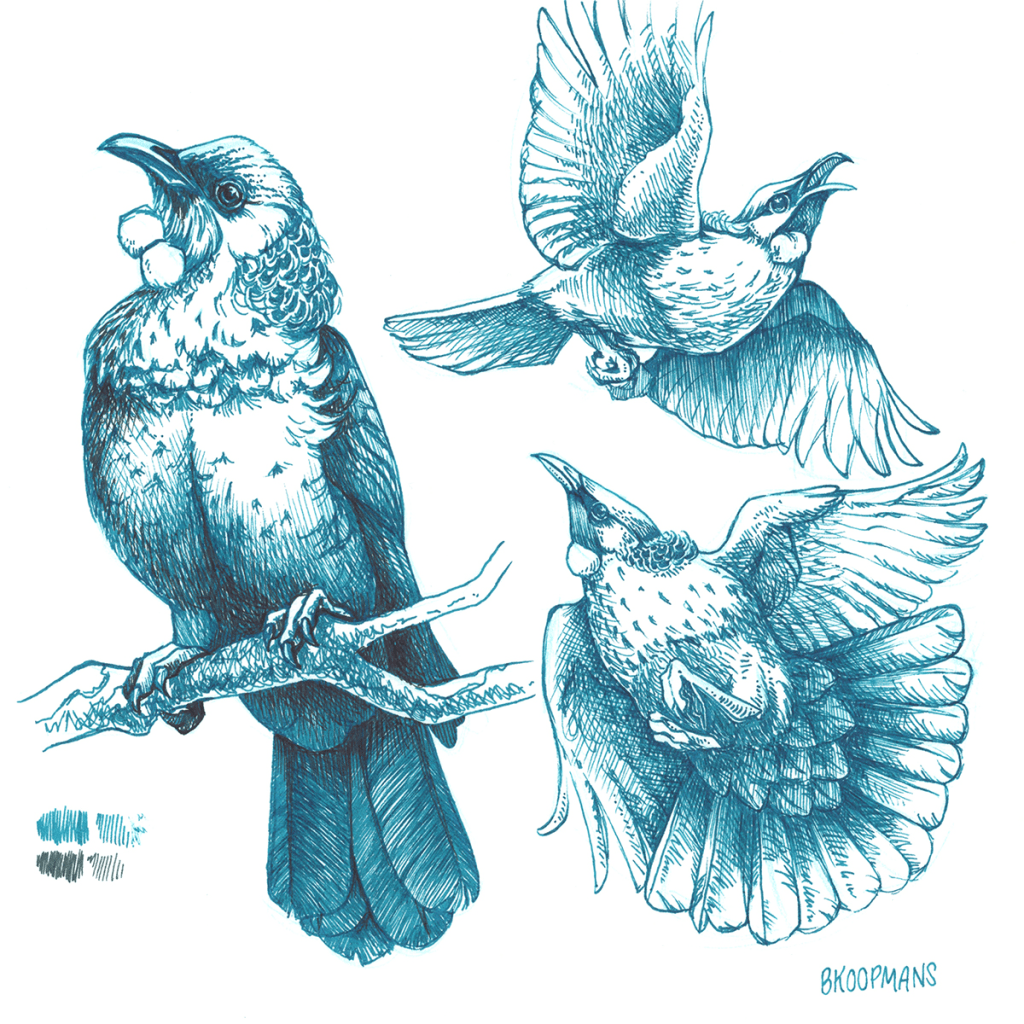
Campbell teal (Anas nesiotis) represent the impact introduced predators can have, but are also an incredible success story. This charismatic flightless duck was presumed extinct following the introduction of brown rats to Campbell Island during the period of whaling. A precariously small population was discovered on Dent Island, which rats hadn’t managed to reach, and in 1987 some of the teal were removed from the wild to establish a captive breeding program and ensure the preservation of the species.

Due to the significance of the New Zealand and Australian subantarctic islands in terms of unique habitat, flora and importance for the fauna that eke out an existence in the region, there have been some incredibly successful efforts to remove predator species and rehabilitate these islands.
Macquarie, Enderby, and Campbell Islands are now free of introduced pests, with New Zealand’s Department of Conservation aiming to embark on their most ambitious pest eradication yet, targeting Auckland Island at 46,000ha.
Campbell teal have been reintroduced to Campbell Island as of 2004, and bird populations generally have been improving with lessened pressure from predation.
The precariousness of life on these tiny specks of land in the middle of a vast ocean makes them so unique and important to the creatures that thrive there.
All 4 of these island groups are now protected as UNESCO World Heritage Sites for outstanding universal value.
True Young Explorer scholarship applications open each year in spring for summer voyages. You must be aged 18–30 and share your experience of the subantarctic.

Originally published by Cosmos as Drawing is learning: the birds of the subantarctic
Yes, it will be 2 more clicks. Trust me, you’ll be better for the clicking!
On Wednesday morning, Poland shot down several Russian drones that entered its airspace—a first since Moscow’s invasion of Ukraine. The incident disrupted air travel and set the region on edge.
Early Wednesday morning, Poland shot down several Russian drones that had violated its airspace during a massive strike against western Ukraine. The Polish military operation, confirmed by Prime Minister Donald Tusk through a social media message in the early morning hours, marks a turning point in Warsaw’s involvement in the conflict that has affected the region for more than two and a half years. The Polish defense agency reported the presence of more than 10 objects coming from Ukrainian airspace and called the violation an “act of aggression.”
In response to the raid, Poland activated Article 4 of NATO, the North Atlantic Treaty, requesting immediate consultations with allies. Tusk urgently convened a meeting of the Council of Ministers at 8 am local time, maintaining constant contact with the alliance’s secretary general, Mark Rutte, to coordinate the political and diplomatic response.
Article 4 allows a NATO member to solicit consultations whenever it believes its security, territorial integrity, or political independence is threatened. Unlike Article 5, which provides for collective military action in the event of an armed attack, Article 4 does not compel immediate military action, but its activation nevertheless constitutes a significant political escalation, as it emphasizes the unity of the alliance in responding to perceived threats against NATO members.
Poland had already been on high alert for possible aircraft overruns since at least November 2022, when a stray Ukrainian missile accidentally hit a village in the south of the country, killing two people. Until now, however, there had been no recorded cases of Polish or allied defense systems shooting down drones on national territory. Ukrainian president Volodymyr Zelensky claimed on Wednesday that “at least eight” Iranian-made Shahed drones were “aimed in the direction of Poland” during the nighttime attack, suggesting the incursion into Polish airspace was intentional.
Residents of the affected Polish areas reported hearing explosions in the sky during the night, followed by the activation of warning sirens. The alert was triggered precisely during a large-scale Russian attack on Ukraine’s western regions, particularly those in Volyn and Lviv that directly border Poland.
According to information released by the Polish military command, national and NATO air defense systems were activated immediately after radar detected the entry of unmanned aircraft into Polish airspace. The interception operation continued for several hours, with the armed forces neutralizing objects deemed dangerous using air defense systems. The search for the wreckage of the downed drones is still ongoing in the eastern parts of the country as of midday Wednesday.
The intervention led to the temporary closure of four airports, including Warsaw-Chopin and Lublin, as well as the Rzeszów airport, which has become a crucial hub for sending Western military aid to Ukraine in the past two years. The United States Federal Aviation Administration confirmed the temporary closure of the Polish airports for “unplanned military activity related to national security.”
The Russian drone strike also hit eastern Ukraine hard: According to reports by the BBC citing local Ukrainian officials, 24 people were killed and 19 wounded in an air raid on a village in the Donetsk region, where the victims were standing in line to collect their pensions. The incident comes amid a particularly intense phase of the conflict, where Moscow’s troops are carrying out a slow but steady offensive in much of Donetsk, in western Ukraine. Meanwhile, diplomatic attempts to reach a peace agreement have essentially stalled, and contacts between Washington and Moscow in recent months have produced no concrete results.
The incident comes at a time of particular tension in the region. Only 24 hours before Poland shot down Russia’s drones, the Polish president warned during a press conference in Helsinki that Russian president Vladimir Putin would be ready to invade other countries after the aggression against Ukraine. The timing of the incursion takes on even greater significance when one considers that on Friday, September 13, Russia and Belarus will kick off joint military exercises dubbed “Zapad,” which have already raised regional security concerns.
Poland had announced Tuesday that it was closing its border with Belarus precisely in response to what Warsaw calls “very aggressive” maneuvers, in addition to the growing number of provocations by Moscow and Minsk. Neighboring Lithuania has also decided to tighten border controls, a sign of widespread alertness among NATO member countries that border Russia and Belarus.
Wednesday’s incident also comes at a delicate time for international diplomacy: US president Donald Trump declared over the weekend that he was ready to move to a second phase of sanctions against Russia after months of unsuccessful negotiations for a peace agreement between Moscow and Kyiv. The downing of drones on Polish territory now risks further complicating any mediation efforts.
This story originally appeared on WIRED Italia and has been translated from Italian.
| September 10, 1897 Nineteen unarmed striking coal miners were killed and 36 more wounded in Lattimer (near Hazleton), Pennsylvania, for refusing to disperse, by a posse organized by the Luzerne County sheriff. The strikers, most of whom were shot in the back, were originally brought in as strike-breakers, but later created their own union. The background and details |
| September 10, 1963 Twenty black students entered public schools in Birmingham, Tuskegee and Mobile, Alabama. The Governor George C. Wallace had ordered Alabama state troopers to stop the federal court-ordered integration of Alabama’s elementary and high schools. President John Kennedy responded by calling out the Alabama National Guard to protect the students and to see the order enforced. President Kennedy spoke that day at American University’s commencement, saying, “Peace need not be impractical, war not inevitable . . . There is not peace in many of our cities because there is not freedom.” |
September 10, 1996 Sheryl Crow’s second album was banned from Wal-Mart stores because the song she co-wrote with Tad Wadhams, “Love Is A Good Thing” opens with “Watch out sister, watch out brother, Watch our children while they kill each other With a gun they bought at Wal-Mart discount stores….” Read more about this event and an update |
https://www.peacebuttons.info/E-News/peacehistoryseptember.htm#september10
This is a succinct summary and discussion of the decision and its import.
Affirmed: E. Jean Carroll Case by Joyce Vance
Read on Substack
I asked Robbie Kaplan, the lawyer who tried the case, how she felt after learning that the Court of Appeals for the Second Circuit affirmed the $83.3 million verdict a jury awarded E. Jean Carroll in her defamation case against Donald Trump. This is what Kaplan told me: “Both the amazing and brave E. Jean Carroll and I could hardly be happier about today’s decision from the Second Circuit. It has been a long road to get here, and we are not at the end of the road yet, but as the opinion makes clear: ‘The starting point is the now-indisputable fact that a jury found in Carroll II that Trump sexually abused Carroll in 1996, and … that, based on the jury’s findings, Carroll did not lie and that Trump uttered falsehoods in his statements accusing her of lying and acting with improper motivations.’”
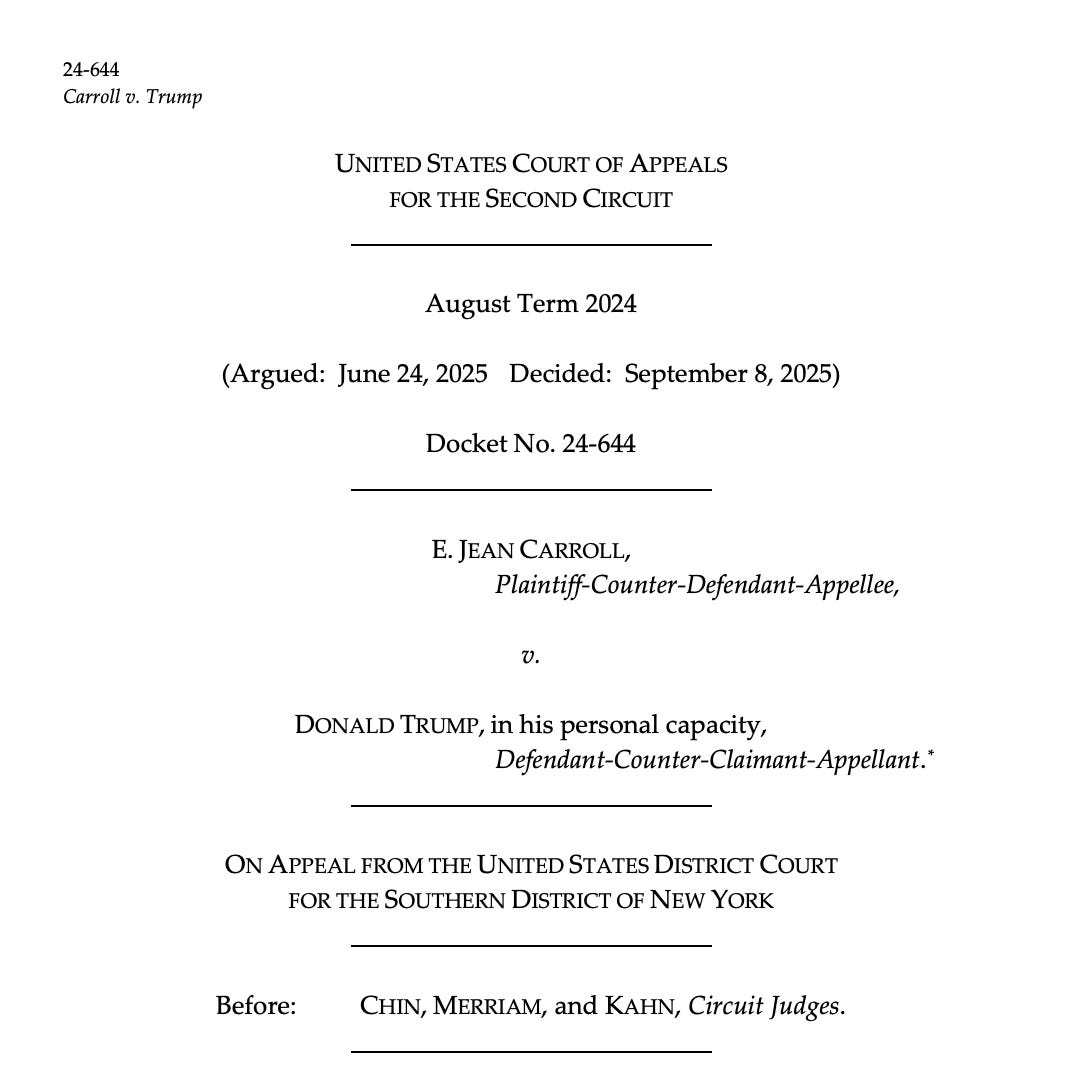
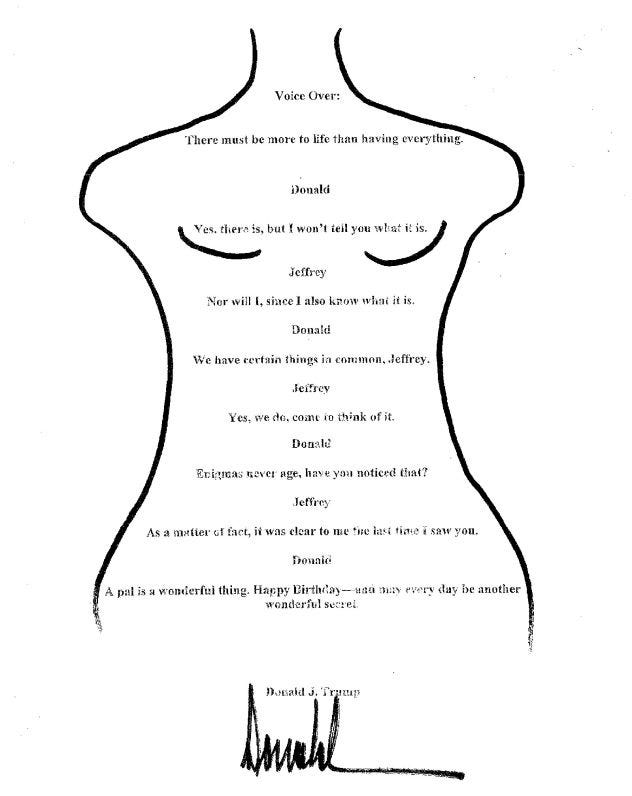
The Second Circuit affirmed the verdict against Trump on the same day that Trump’s birthday missive to Jeffrey Epstein became public. Trump says he didn’t send it, but the signature is extremely similar to verified Trump signatures on notes he wrote to both George Conway and Hillary Clinton. The birthday message is in the distinctive Sharpie marker scrawl Trump is known for. But Trump is insisting it isn’t his, a strange hill to die on since his friendship with Epstein is well documented. A jury believed E. Jean when she said Trump sexually assaulted her. The jury of public opinion may well believe Trump sent this incriminating note to Epstein.
Trump will undoubtedly try to appeal the case to the Supreme Court. It will be up to the Court to decide whether to hear the case or let the Second Circuit’s opinion stand.
The 70-page opinion starts like this: “A jury found that then-President Trump acted with common law malice when he made defamatory statements about Carroll in June 2019 and awarded compensatory and punitive damages. Trump appeals, arguing that he is entitled to presidential immunity or, in the alternative, a new trial. Trump also contends that the jury’s damages award is excessive and must be remitted.” The court then writes one word, “AFFIRMED,” which means that the jury’s verdict stands. You can read the full opinion here.
Last December, the Second Circuit affirmed the verdict in the case referred to as “Carroll II”—the second defamation case Carroll filed against Trump, which confusingly went to trial first (because Trump bogged down “Carroll I” in appeals). The jury in Carroll II returned a $5 million verdict against Trump.
In this case, Carroll I, Carroll’s lawyer, Robbie Kaplan, argued to the jury that if a $5 million verdict was insufficient to stop Trump’s defamation of Carroll, then they needed to return a larger verdict that they believed would stop his misconduct. That’s what they did. The verdict was for $83.3 million.
Trump asked the Court of Appeals to reverse for two reasons:
Trump has frequently been able to twist courts and delays to his advantage. He did that here for a time. But that clock seems to have run out on him. The Supreme Court would have to up end its existing jurisprudence on basic procedural issues to rule for Trump here.
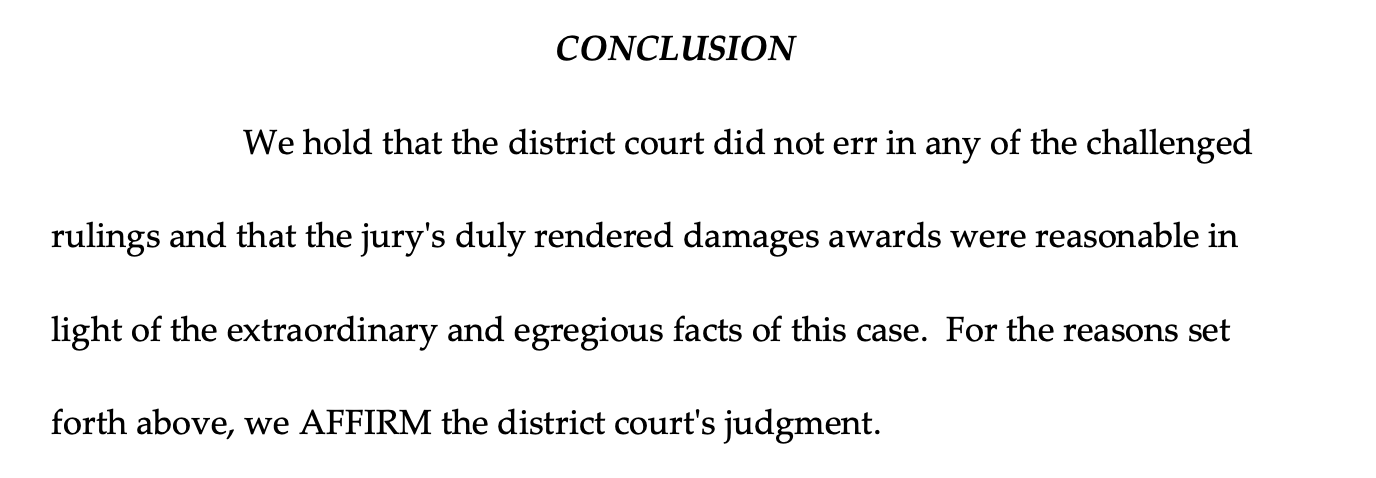
A jury believed E. Jean Carroll. That’s the bottom line. In our system, we leave decisions about disputed facts and what happened to juries. The jury here deliberated and found against Donald Trump. That decision should remain in place. In an era where so much damage is being done to women’s legal standing, it’s essential that we be believed when we have the courage to speak out about sexual assault. Carroll did that. She told friends about the attack at the time in occurred but had been too intimidated by threats she would lose her job and her livelihood if she spoke up to move forward then.
If we can do nothing else for women in an era where abortion rights, more properly understood as the right to receive lifesaving medical care, and other rights have been taken away, we can do this: we can believe them when they summon the courage to come forward and reveal a rape or a sexual assault. Maybe if our nation had done that sooner, we wouldn’t have had a Trump presidency at all.
We’re in this together,
Joyce
 Scottie's Playtime