Mary Robinson (center), former president of Ireland, shares her views on human rights at a Carter Center event in March. From the Center, CEO Paige Alexander (right) participated in the discussion, and Nicole Kruse, VP, Development, moderated.
Human rights pioneer Mary Robinson shares life lessons at Carter Center event
When Mary Robinson began her term in 1990 as the first female president of Ireland, she didn’t let her gender take a back seat to the office. She wanted to convince people that “I would actually do a better job because I was a woman,” she told an audience at The Carter Center in March.
Robinson went on to blaze trails not only in politics but human rights, women’s rights, and climate advocacy. She offered insight on her remarkable life during a public conversation and Q&A with the Carter Center’s Paige Alexander, CEO, and Nicole Kruse, vice president of development, following a screening at the Center of “Mrs. Robinson,” a new biographical documentary.
Robinson has several ties with the Center, including a long friendship with co-founders President Jimmy Carter and Rosalynn Carter. She also helped lead the Carter Center’s election observation mission to Myanmar in 2015.
But perhaps her strongest connection to the Center is a shared commitment to bolstering human rights around the world. “The universal values of human rights are indispensable,” Robinson said. “They are as valid today as they ever were, and they are more relevant today than they ever were.”
During her tenure as U.N. High Commissioner for Human Rights from 1997 to 2002, she traveled to many dangerous places — Chechnya, Kosovo, and Goma in the Democratic Republic of the Congo. “I always came back energized because I was meeting people on the ground,” Robinson said.
The world celebrated the 75th anniversary of the Universal Declaration of Human Rights last year and its 50th anniversary while Robinson was high commissioner. The document is as “relevant today as it was in 1948,” she said. “We have learned so much about how, hopefully, to do better in creating more understanding but also embedding it in the cultures of people.”
Despite her belief that “countries go up and countries slide” in their commitment to human rights, she remains optimistic about the future and the young people who will be inheriting the world older generations created.
As a member of the Elders, a group of former world leaders to which President Carter also belonged, Robinson said she has been involved in conversations about climate and energy that span several age groups. “Younger people are insisting at being at the table,” she said. “I’ve had incredible conversations with 13-, 14-, and 15-year-old climate activists.”
The motivation of younger generations will lead to sea change soon, Robinson believes, because they want the world to move faster. “We’re on the cusp of this much healthier clean energy, renewable energy, no-waste circular economy,” she said. Robinson marveled at the difference such innovations will make for people in Africa who have never had electricity.
Although Robinson has spent her career addressing societal ills across the globe, she believes joy and hope can be found anywhere and are essential components for a well-lived life. She once heard her mentor, Archbishop Desmond Tutu, describe himself as a “prisoner of hope.” It made an impression on Robinson. She thought, “what he’s saying is the glass may not be half full. There may be only a tiny bit in the glass. But hope is action. You work with that.”
Forum Participants Provide Perspectives on Human Rights
As a former U.N. High Commissioner for Human Rights and member of the Elders, Mary Robinson has fought for human rights around the world. Similarly, the Carter Center’s Human Rights Program works to advance the rights of protected groups. Last year, the Center hosted the Human Rights Defenders Forum, where activists and scholars came together to learn from and support one another. Below are perspectives from four participants, working on different aspects of a broad human rights agenda.
Colette Pichon Battle Vision and Initiatives Partner, Taproot Earth “One way for us to understand the climate crisis is to understand everybody’s going to be impacted.… The worst part of climate change is not the big hurricanes. It’s not the big storms that you can predict. It’s global temperatures that are going to take out more people than any storm ever could.”
Vincent Warren Executive Director, Center for Constitutional Rights “States talk a lot about their rights, but states don’t have rights. What states have are power. And who has the rights? People have the rights.… What we have to do as human rights defenders is shift power to the people from the state.”
Hossam Bahgat Founder, Egyptian Initiative for Personal Rights “Our work can only succeed if we think of ourselves and execute our activities as a movement, not as a group of individual organizations working in individual countries, and not as a group of visionary individuals exercising leadership. To really make change, you need to build.”
Hina Jilani Pakistani Lawyer and Women’s Activist, Member of the Elders “I cannot afford the luxury of either pessimism or cynicism or frustration, so I always have hope. I respect my struggle more than I expect achievement. I believe in my struggle. And because I have that belief, I have hope.”
Today I want to introduce you to a friend of mine from years ago, a community leader in Beirut Lebanon, a man named Kamal Mouzawak.
Kamal and me at Souk el Tayeb a couple of years ago (photo Thomas Schauer)
I’m proud to know Kamal and his team, and to have spent time with them after the horrific 2020 explosion that rocked Beirut and destroyed so many lives. The World Central Kitchen team, who arrived in Beirut to help with the recovered, joined up with Kamal’s team at Tawlet, a kitchen in the city serving foods from around Lebanon (more about that later), along with our mutual friend Aline Kamakian—a brilliant chef, food writer, and culinary advocate. Together, we worked to feed the people of Beirut who were the ones cleaning up the streets. It was a difficult time, but also an amazing one, to see the incredible efforts of Beirutis helping their neighbors get back on their feet, to clean up their neighborhoods, and to make sure they were all fed. (snip-a little video I can’t get a link or embed.)
Kamal has for many years been a leader in the community. In 2004 he started a farmers market in Beirut called Souk el Tayeb, working with farmers from around the rural areas of the country to reach the people of the city. From there his mission has expanded…well, why am I telling you, when I could let Kamal do it? My team had a moment to talk to him recently, since Kamal and Souk el Tayeb were the recipients of a grant from my Longer Tables Fund—specifically to support a new vision for the market, transforming it into a community space. I am so thrilled to be able to support my dear friend Kamal in his work to bring fresh produce to more of his community.
So friends, now I want to give the floor to the super thoughtful Kamal:
Longer Tables: First of all…what is Souk el Tayeb, and what is Tawlet?
Kamal: The whole story has been an evolution since the beginning, in 2004.
Souk el Tayeb is what we call a farmers’ market and Tawlet we call a farmers’ kitchen (“Souk el Tayeb” means “good market” and “tawlet” means “table” in Arabic). That naming is intentional, to stress the fact that this is not another store, and it’s not another restaurant. It’s not about selling vegetables. It’s not about cooking food and serving food in a restaurant or in whatever we want to call it. It’s about changing the world, making the world a better place.
And it was for people to understand is that food is not just a commodity that you buy on a supermarket shelf but something that someone planted, produced, cooked, transformed—and it’s an exchange between you and him or her through money, but the idea is Why not meet the producers of our food? It was a move for farmers to come from rural to urban in order to be where there’s a demand and purchasing power. It was about farmers coming to meet people who would buy their produce. (snip-MORE, and it’s really nice)
No, really, it is. The history of the Tenth Amendment explains [almost] everything happening in politics and government today.
But before I get to the [scintillating] topic of the Tenth Amendment, I have an announcement: Today is the birthday of Rebels, Robbers, and Radicals: The Story of the Bill of Rights.
(I have created birth announcements on publication day for every one of my books beginning with my firstborn novel in 2001.)
And now . . . all about the Tenth Amendment.
* * *
The Tenth Amendment consists of a single sentence:
The powers not delegated to the United States by the Constitution, nor prohibited by it to the States, are reserved to the States respectively, or to the people.
The Supreme Court has described the Tenth Amendment as stating a simple “truism”—“all power is retained which has not been surrendered.”
The problem with calling the Tenth Amendment a “truism” is that, since the start of the nation, there has been bitter disagreement over how much power has been retained by the states, and how much has been surrendered to the federal government. In fact, we fought a Civil War over that question. The Confederacy’s slogan “states’ rights!” was grounded in the Tenth Amendment.
* * *
The drafters of the Constitution debated whether to insert the word “explicitly” into the Tenth Amendment, so that it would read like this:
The powers not explicitly delegated to the United States by the Constitution, nor prohibited by it to the States, are reserved to the States respectively, or to the people.
The anti-Federalists (the party of Thomas Jefferson), wanted to insert the word “explicitly,” which they understood would sharply limit the power of the federal government. At one point during the early debates on the Constitution, Thomas Jefferson suggested that the federal government should consist of a committee. The Federalists (the party of George Washington and Alexander Hamilton), on the other hand, didn’t want to place such a limitation on federal power because they worried that a situation requiring a national response might arise that they could not foresee.
The Federalist won. The word “explicitly” was not included. Had the word “explicitly” been inserted, the United States most likely would have become a loose coalition of independently governed states sharing a Post Office, armed forces, and not much more.
* * *
Shortly after George Washington was elected president, he appointed Alexander Hamilton as secretary of the Treasury. This was a key post because the Revolutionary War left the nation almost bankrupt, and Hamilton understood commerce and finance. As a teenager in the Caribbean, he worked as a clerk in a trading company. After the Revolutionary War, he and a handful of other New Yorkers helped establish the Bank of New York, which allowed New York to grow into a hub of commerce and trade.
One of Hamilton’s first acts as secretary of the Treasury was to propose a plan that would allow the federal government to assume state debt. There was much resistance to the idea, even by the states that were heavily in debt from the Revolutionary War. Many saw this as a federal power grab because it gave the federal government powers not “delegated” and thus violated the Tenth Amendment.
Hamilton got his way. The federal government assumed state debt. He next proposed a national bank to help the United States prosper the way the Bank of New York helped New York prosper.
The resistance to Hamilton’s proposed national bank was fierce. At stake was the kind of nation the United States would become. Thomas Jefferson and the other anti-Federalists believed a national bank would turn the United States into another Great Britain, which at the time was a vast and powerful financial empire governed by a strong central government. Jefferson believed the way to liberty was for power to reside locally. For Jefferson, the point of the Revolutionary War was for Americans to free themselves from a faraway, out-of-touch, commerce-oriented government.
Slavery, of course, was the underlying issue. The economy of the South and the wealth of people like Thomas Jefferson was built on slave labor. They were afraid that if the federal government grew too powerful, it would end slavery.
It’s Really All About John Locke
To understand how Jefferson reconciled his demand for freedom as an unalienable right with his belief that local governments should decide whether to legalize slavery, we need some John Locke, who — like Thomas Jefferson — was full of contradictions. At the time of his death in 1704, Locke was the most famous philosopher in Europe. Thomas Jefferson took his ideas and much of his famous language from John Locke. The idea that it is a self-evident truth that we all possess unalienable rights is pure John Locke, as is the idea that, to prevent a tyrant, power should be divided between independent branches of government. To quote Steven B. Smith, a political science professor at Yale, “Locke’s writings seem to have been so completely adopted by Thomas Jefferson in the Declaration of Independence that Locke is often thought of as almost an honorary member of the American founding generation.”
Recall Thomas Hobbes’s theory about how government evolved: According to Hobbes, in the state of nature before government, there was violence and chaos. Government arose as a way to create order. For Hobbes, absolute monarchy is the best form of government because only a ruler with absolute power can maintain order. Government arises as a kind of social contract: People give up their freedom and submit to the rule of a king in exchange for protection and order.
John Locke offered a competing theory. In his view, in the state of nature before government, people lived in perfect freedom with unalienable rights. Moral law (or natural law) reigned supreme.
Among our inalienable rights, according to Locke, is the right to own property and a chief function of government is to protect private property rights, which, according to John Locke, derive from natural law. This immediately raises questions. In a state of nature without government, how do we know which property belongs to which person? Can I just claim the river for my own? Locke’s answer is that, “Our claim to property derives from our own work; the fact that we have expanded our labor on something gives us title to it. Labor is the source of all value.”
Okay, so I suppose this means that if a person in the state of nature gathers natural materials and uses their labor to make the material into a house, the person owns the house and has title to that property. But what if one person finds minerals in the earth and uses their labor to extract the minerals. Does the person then own the minerals? What about a forest? If I expend labor to cut down all the wood, does that mean I own it all? What about the servant who expends labor cleaning the master’s house. Does that servant now have claim to the master’s property? As Karl Marx later pointed out, the factory worker does not own the product of his own labor.
Liberty for John Locke was another unalienable right. Here is how Jefferson (and others) reconciled slavery with the belief that all people are born with an unalienable right to liberty: They believed it was part of natural law that Black people were inferior and best suited to laboring for others, which brings us to another problem with the entire idea. Different people will have different ideas of what is ‘moral.’ Locke’s answer is that rational people will all see things the same way, and irrational people are the ones we need government to protect us from.
See the problem? See how this leads to “Some people have unalienable rights and others do not.” It also leads to, “People who agree with me are rational. The purpose of government is to protect our freedom and property rights from those who are irrational.” This, combined with an ‘if I grab it first, I have title to it’ mentality, leads to the idea that one purpose of government is to protect the property rights of the wealthy.
Make no mistake — the idea of unalienable rights and checks on governmental power was a liberal idea and a step toward self-determination and dignity. My point is that the specifics of how this might be applied in the real world wasn’t very well thought out.
Another Lockean innovation is the movement away from feudalism — with its emphasis on a static social hierarchy — toward a market economy with opportunities for all. Locke said, “The world was created in order to be cultivated and improved” and “the world was given to the industrious.” He also believed that government should not stand in the way of industriousness, which you could say makes him the original free market capitalist. The problems here are the same: The idea that in the state of nature people lived happily in an unregulated market economy is fantasy.
Locke also says that people have the right to rebel against a tyrannical government, which raises even more questions. How do the people decide when rebellion is appropriate? What if people have different ideas about what is tyrannical? Wouldn’t this put us in an almost constant state of rebellion and civil war?
Locke’s ideas are naive, but, he did not have the benefit of modern neuroscience and modern psychology. He didn’t know what we know today about brain differences, and how these brain differences lead to personality differences. What is more important: Locke had never seen what actually happens in a world without positive law. Hindsight is always clearer.
And now . . . Back to the Story of the Tenth Amendment
Because George Washington and most members of Congress agreed with Hamilton about the need for a national bank, Hamilton got his way again. Hamilton’s bank did indeed allow the country to recover from years of war, but it remained controversial. Andrew Jackson, the country’s seventh president, dismantled the national bank because he believed it was unconstitutional under the Tenth Amendment. The national bank was reinstated in 1863 to help the North with the Civil War effort. In 1913, the Federal Reserve—the national bank we have today—was established. (In the end, Hamilton won.)
* * *
On December 20, 1860—less than two months after Lincoln was elected—South Carolina declared itself no longer part of the United States. The leaders of South Carolina ordered the U.S. Army to abandon its forts and military bases within South Carolina’s borders. The U.S. Army refused to budge. Within four months, the Civil War broke out. Mississippi, Florida, Alabama, Louisiana, Texas, and Georgia also seceded.
The leaders of the Confederate States of America argued that the Constitution says nothing about whether states have the power to secede or whether the federal government has the power to stop them. Under the Tenth Amendment, any powers not delegated to the federal government are retained by the states. Therefore, they argued that whether to remain part of the United States is up to the states.
Locke’s ideas thus underpinned some of the rationale of the Confederate States of America.
The Civil War ended after the South surrendered, but defeat on the battlefield did not persuade many of the Confederates that they were wrong as a matter of constitutional interpretation. Legal historian Cynthia Nicoletti suggested that the idea of “trial by battle” was inherently problematic. To this day, people believe self-governance means that states should be able to secede if their values cease to align with the nation.
* * *
In 1900, approximately two million children were working in mines, fields, and factories across the United States, often doing hard labor and performing dangerous jobs. As people became aware of the conditions children worked under, activist groups formed to address the problem. In 1908, a group called the National Child Labor Committee hired a photographer to visit fields, factories, and mines to report on child labor. More people became aware of the problem and pressured Congress to do something about it.
The Constitution gives Congress the power to regulate commerce between the states, so in 1916 — under the power of the commerce clause — Congress passed a law known as the Keating-Owen Child Labor Act, which sought to prevent child labor by banning the sale of any products that were produced by children under the age of fourteen, or by children between fourteen and sixteen who were forced to work more than eight hours per day.
The Supreme Court struck down the Keating-Owen Act as unconstitutional on the grounds that regulating how products were created was reserved by the Tenth Amendment to the states. Specifically, the Court said, “It was not intended as an authority to Congress to control the States in the exercise of their police power over local trade and manufacture, always existing and expressly reserved to them by the Tenth Amendment.”
The idea was that if states wanted to allow child labor, that was up to the states, and the federal government did not have the power to interfere. If people didn’t like it, they could refuse to buy products produced by child labor. Obviously, this was a poor solution. What would prevent the factories from exporting their goods to markets where people didn’t know the goods had been produced by child labor?
Some see the late 19th and early 20th century as a glorious time when industry and the economy boomed. There were almost no federal regulations. Business tycoons could do as they pleased. Tycoons — also called robber barons — grew wealthy. Income inequality widened. There was no minimum wage, no 40 hour workweek, no social security.
You might say that the business tycoons of the late 19th century lived in a state of nature without government. Did they follow natural law and behave rationally? Of course they didn’t. They cheated. Their wealth then gave them power. They monopolized huge industries through the formation of trusts, exploited workers, and engaged in unethical business practices. For example, a group of well-respected investors would agree to buy a lot of a particular company’s stock on a given day. Others would see what they did, assume the stock was valuable, and also buy it, pushing the price higher. When the price was artificially high, the speculators would sell their stock at a large profit. Soon the prices would fall again. The people who had been duped into buying when the price was artificially inflated would lose their money, and the people who duped them would grow wealthy.
Then in 1929 the market crashed, ushering in the Great Depression. Franklin D. Roosevelt believed that the solution to the nation’s financial woes, and the way to prevent future financial crises, was to regulate businesses and commerce to create fairness and protect investors. He ran for president in 1932 promising what he called a New Deal—a series of federal laws designed to get the United States out of the Depression, offer protections for workers, and regulate commerce to stop unfair business practices such as manipulating markets and fixing prices.
After Roosevelt was elected, he and Congress set to work to enact his New Deal.
During Roosevelt’s first several years in office, the Supreme Court repeatedly invalidated the New Deal legislation as unconstitutional under the Tenth Amendment. Then, in 1938, the Court did an about face and stopped invalidating New Deal legislation. Congress tried again to outlaw child labor and, in 1938, passed the Fair Labor Standards Act, which established among other things a minimum working age of sixteen, except in certain industries outside of mining and manufacturing. In a case called United States v. Darby, the Supreme Court held that the new labor laws were constitutional under Congress’s power to regulate commerce between the states. The Supreme Court thus overturned its previous 1918 case that had declared federal child labor laws unconstitutional.
Historians and scholars have offered various reasons for the Supreme Court’s sudden change of mind. It appears that the Court saw that Roosevelt and the New Deal were exceedingly popular and that Roosevelt was looking for ways to get around the Court, so the Court finally gave in.
The New Deal legislation created numerous federal regulatory agencies including the Securities and Exchange Commission, an independent federal agency designed to protect investors by regulating the sale of financial products such as stocks. Roosevelt signed into law the Public Utility Holding Company Act of 1935, which allowed the government to regulate utilities such as electricity and water to make sure those companies didn’t unfairly raise prices for people who depended on their services. Roosevelt’s 1935 Social Security Act offered a way for workers to pay into a pension so that they would have something to live on in their old age. The nation got a forty-hour workweek and worker protection laws.
Among the most far-reaching of Roosevelt’s programs was the G.I. Bill, formally known as the Servicemen’s Readjustment Act of 1944. It gave soldiers returning from duty the right to a government-paid college education, allowing ten million soldiers over a twelve-year period to attend college, thus helping lower-income families break out of poverty.
The New Deal had its critics. Right-wing activist Elizabeth Dilling denounced the New Deal as a piece of communism. One of the most famous journalists of the era, H.L. Mencken likened Roosevelt actions to a dictatorship. The New Deal critics not only despised the expansion of the federal government, they saw the New Deal as redistributing wealth, which — as they saw the situation — meant taking wealth from the people who expended their labor and were “industrious” and gave it to people who were not. This is the “makers and the takers” argument. The makers, of course, are business owners. Takers are those who accept government assistance.
Indeed, if your view is that, in the natural state, people lived free and happy, and government regulations infringe on liberty (which they do) you will despise the New Deal. You will hate agencies such as the CDC or the FDA. You will resent vaccine mandates because they infringe on your “liberty.” (You won’t consider the liberty of others not to be infected in public places and schools, because Locke’s idea that “each person is free” and the purpose of government is to protect our personal liberty was appealing, but not well thought out. One person’s “freedom” will often infringe on another’s.)
Roosevelt’s New Deal dramatically increased the size and complexity of the federal government and marked the beginning of what has been called the federal administrative state—a vast network of federal departments and regulatory agencies that has grown steadily since Roosevelt’s time.
* * *
While Roosevelt’s legislation helped create America’s first true middle class, the new suburbs were mostly white because of racial segregation. Among other things, legalized segregation meant that Black Americans found it difficult to get loans from banks, making it impossible for them to buy houses. Some sellers simply refused to sell them homes. Some neighborhoods made it clear that Black people were unwelcome.
Then, in 1954, the Supreme Court sent shock waves through the American South when it declared racial segregation unconstitutional. There was massive resistance on the grounds that the federal government, in telling people how they must live, was overreaching its authority.
A decade later, President Lyndon B. Johnson signed into law three key pieces of legislation: the Civil Rights Act of 1964, the Civil Rights Act of 1965, and the Voting Rights Act of 1965. This legislation further enlarged the size and power of the federal government because they gave the federal government the task of ensuring that all Americans were offered the opportunity to participate in civil and public life. Racial discrimination continued, but it was now illegal, so people who were wronged could bring their cases to federal court.
Those opposed to these new laws argued that the federal government overstepped its authority under the Tenth Amendment. In fact, when the Supreme Court invalidated part of the Voting Rights Act decades later, it did so by finding that the required procedures violated the Tenth Amendment.
The Republican Party’s opposition to the New Deal solidified in the 1930s. During the decades since, the opposition to the New Deal has been steadily gaining power. And here we are. A president — backed by Congress — working to roll back the authority of regulatory agencies.
Most of this material is from Chapter 10 of my new book, Rebels, Robbers, and Radicals.
And now a moment of reflection on my latest book’s birthday: After so many books (and several decades of writing) I understand that writing books is my way to leave my footprint on the earth. My contribution: Books that go to schools and libraries.
(Not that I am going anywhere. I intend to live forever. But occasionally I suppose we all think about mortality.)
May 21, 1930 Sarojini Naidu, a renowned Indian poet, was arrested as a leader of the nonviolent “raid” on the Dharasana Salt Works, a salt production facility. She had assumed leadership of the effort to break the salt monopoly after the arrest of Mahatma Gandhi. She and as many as 2500 filled the local jails for their civil disobedience. Column after column of Indians advanced toward the gates and had been severely beaten by the native police under British direction. Not one satyagrahi (one who works for justice with courage and sacrifice but without violent force) raised a hand to defend himself; many lost consciousness, and some died. The British Raj, the ruling colonial authority, controlled all production of salt, a dietary necessity in the tropics; the government taxed it as well. Gandhi decided to focus attention on salt as an example of unfair British oppression in his effort toward national independence for India. British public opinion was deeply affected by the Dharasana nonviolent movement, which revealed the violence inherent in the British colonial system. Sarojini Naidu More on the Dharasana Salt Works The Pinch Heard “Round the World”
May 21, 1956 The United States conducted the first airborne test of an improved hydrogen bomb, dropping it from a B-52 bomber over the tiny island of Namu, part of the Bikini Atoll in the Pacific Ocean. The United States first detonated a hydrogen bomb in 1952 in the Marshall Islands, also in the Pacific. This bomb was far more powerful than those previously tested and was estimated at 15 megatons or larger (one megaton is roughly equivalent to one million tons of TNT). Observers said that the fireball caused by the explosion measured at least four miles in diameter and was “brighter than the light from 500 suns.”
May 21, 1981 The U.S. Senate approved a $20 billion program to return the U.S. to full-scale production of chemical and nerve-gas weapons (CW). President Reagan’s Special Envoy to the Mideast Donald Rumsfeld meeting Saddam Hussein in 1983. Rumsfeld had become a member of the President’s General Advisory Committee on Arms Control the previous year. Though the U.S. maintained a public policy opposing chemical weapons, it extended financial and military assistance to Iraq in its war against Iran (1980-88), despite the Iraqi military’s frequent use of such weapons. Iraq had developed its “CW production capability, primarily from Western firms, including possibly a U.S. foreign subsidiary” (from a memorandum to Secretary of State Alexander Haig). Watch a video on the U.S./Saddam Hussein partnership
May 19, 1934 10,000 participated in a “No More War” march in New York City.
May 19, 1952 Playwright and activist Lillian Hellman advised the U.S. House Committee on Un-American Activities (HUAC) that she refused to testify against friends and associates, saying, “I cannot and will not cut my conscience to fit this year’s fashions.” Lillian Hellman Learn more about Lillian Hellman Text of her letter to HUAC
May 19, 1997 Two international human rights workers, Mario Calderón and Elsa Alvarado, as well as her father, were shot dead in Bogotá, Colombia, by a paramilitary gang. Their one-year-old was hidden and thus spared, her mother wounded. The couple worked for the Center for Investigation and Popular Education (Centro de Investigación y Educación Popular, or CINEP), a non-governmental organization founded by the Jesuits (the Roman Catholic Society of Jesus) to foster education, understanding, justice and sustainable development in Colombia. Mario Calderón and Elsa Alvarado CINEP’s peace program
(I worked in restaurants from mid-70s through mid-80s. 86 means cancel or never mind, not kill. Else the call “86 99” would have been very awkward, especially because usually the kitchen only called the boss when something the boss needed to know about was occurring. You could hear a call, “99” when the boss was wanted for something, then if whatever it was resolved, or the caller made a change, it was “86 99” so the boss could continue what they were up to. So to me, this controversy is just weird, stupid, and definitely a waste of we the people’s resources, since the highest offices are sounding off about investigating. On to Clay Jones. -A)
The number 86 doesn’t mean what Donald Trump thinks it means.
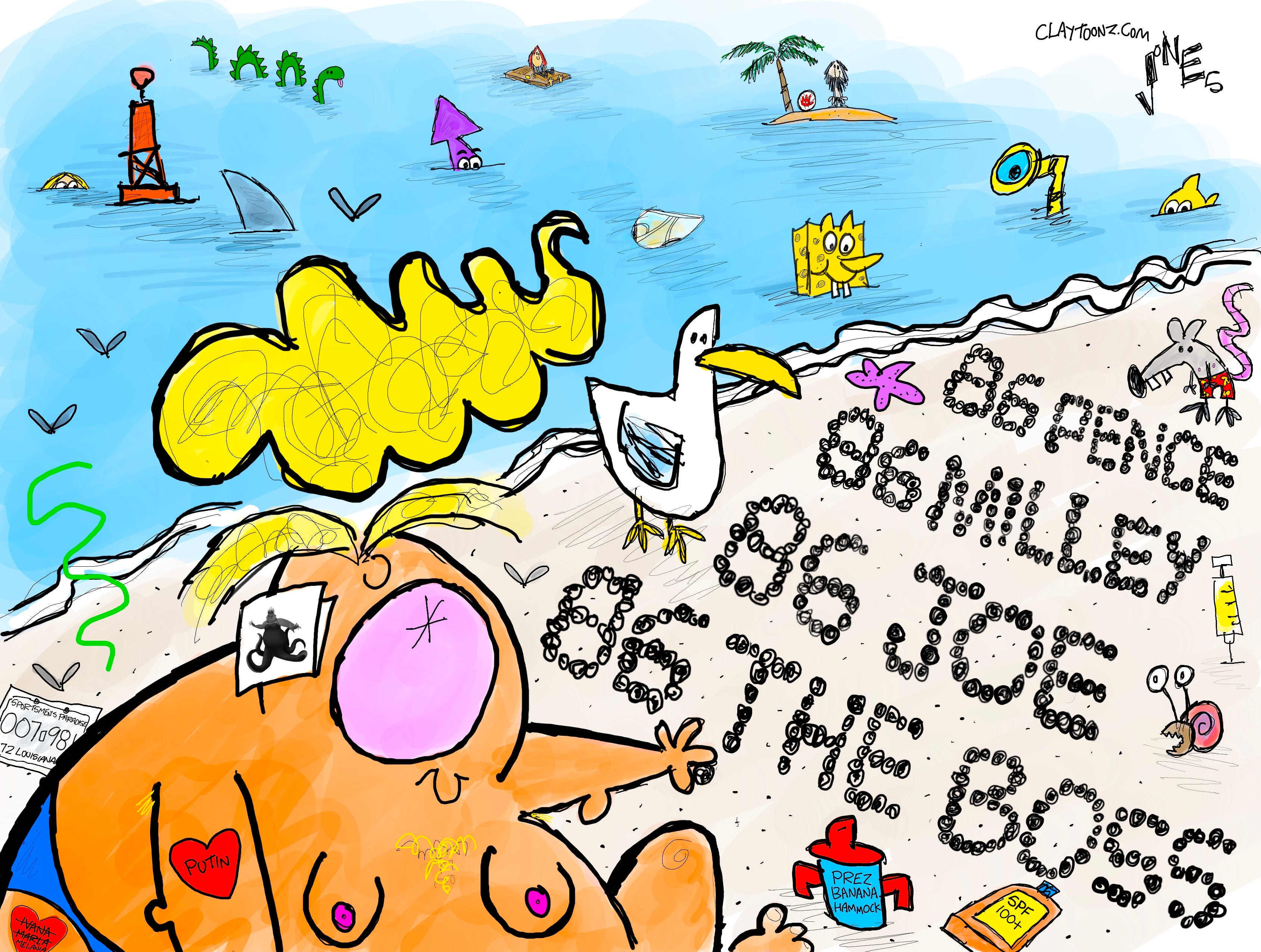
Former FBI Director James Comey tweeted an image of seashells forming the numbers 8647. What that means is replace Trump. But Trump and his cult freaked out and claimed that Comey was calling for the assassination of Trump.
But 86 doesn’t mean killing someone. It simply means to replace them, or get rid of someone or something. The term started in the restaurant industry way back in the 1920s or 1930s. The term meant an item on the menu was no longer available, so they would have to 86 it. Then it spread to customers they wanted out of their restaurant, so they would 86 a customer, NOT murder the customer.
There are different theories as to why they used the number 86. Some believe it came from the word “nix.” Others believe it came from the address of 86 Bedford Street in the West Village of lower Manhattan during prohibition. An informant inside the police department would call the restaurant to warn of a police raid, and tell the restaurant that their customers needed to leave through the door on 86th Street. That became “86 the customers.”
I don’t know if those stories or theories are true, but 86 does NOT mean someone should be assassinated. It’s not a death threat or a call to kill somebody, like all the times Trump has tweeted insinuations for his goons to attack people.
A good example of 86 is when Trump fired James Comey. He 86’ed Comey. In 2020, the voters 86’ed Trump by kicking him out of office. Hopefully, in the midterms, we 86 Republicans from the House.
As we all know, Donald Trump is a hypocrite.
When MAGAts were chanting, “Hang Mike Pence” during the attack on the Capitol on January 6, 2021, they weren’t trying to “86” Pence. They were trying to murder him.
When Donald Trump called for the death penalty for General Mark Milley, was he trying to 86 him? No, just kill him. Milley had retired, so he couldn’t be replaced.
When Trump posted a video of President Joe Biden hog tied in the back of a pickup truck, was he calling for Biden to be 86’ed or murdered?
When Trump Jr. tweeted a picture of a hammer after Paul Pelosi was attacked by a hammer-wielding lunatic, was he calling for him to be 86’ed or bashed in the head with a hammer?
What Trump is trying to do is 86 all criticism of him. The Secret Service is investigating Comey for his 86 post, which is bullshit.
In addition to howling about Comey, Trump is crying about Bruce Springsteen criticizing him, which he did from Scotland. Trump got all bent out of shape from the Boss’s criticism and went on the attack. Remember when presidents would ignore criticism from celebrities?
Trump threatened Springsteen, posting, “This dried out ‘prune’ of a rocker (his skin is all atrophied!) ought to KEEP HIS MOUTH SHUT until he gets back into the Country, that’s just ‘standard fare.’ Then we’ll all see how it goes for him!”
Trump is threatening Springsteen for saying, “My home America, the America I’ve written about that has been a beacon of hope and liberty for 250 years, is currently in the hands of a corrupt, incompetent, and treasonous administration.” That sounds about right.
Trump said, “Never liked him, never liked his music, or his Radical Left Politics and, importantly, he’s not a talented guy − Just a pushy, obnoxious JERK, who fervently supported Crooked Joe Biden, a mentally incompetent FOOL, and our WORST EVER President, who came close to destroying our Country.”
If Trump never liked Springsteen or his music, then why did he steal it for his hate rallies? The Boss had to send a legal notice for Trump to stop playing Born in the USA.
Trump didn’t stop there, and on the same day he was filling his diapers over the Boss’ criticism, he attacked Taylor Swift, and posted on ShitSocial, “Has anyone noticed that, since I said ‘I HATE TAYLOR SWIFT,’ she’s no longer ‘HOT?’“
Are we still talking about Biden having dementia? Trump’s definition of “hot” is his daughter.
In case the Secret Service is reading, I wholeheartedly endorse 8647.
By the way, Springsteen, the “dried-up prune,” is younger than Trump, and his face definitely looks better than Donald’s dried-up face covered with orange pancake batter.
Creative note: A couple of readers told me they were looking forward to my cartoon about Bruce Springsteen. But I didn’t know if I was going to do one. There are four or five other things I wanted to hit, and that I thought were more important. The Comey/86 thing was one of them. But what do you know? I found a way to get two of those subjects off my list with one cartoon.
I had a long conversation with Proofer Laura about the license plate. She didn’t know the significance. I didn’t tell her.
May 18, 1872 Bertrand Russell Birthday of Sir Bertrand Russell, British philosopher, logician, essayist, and social critic, a leading figure in his country’s anti-nuclear movement. In 1954 he delivered his “Man’s Peril [from the Hydrogen Bomb]” broadcast on the BBC, condemning the Bikini H-bomb tests, and warning of the threat to humanity from the development of nuclear weapons: “. . . as a human being to other human beings: remember your humanity, and forget the rest.” A year later, together with Albert Einstein nine other scientists, he released the Russell-Einstein Manifesto calling for the curtailment of nuclear weapons. Text of the Russell-Einstein Manifesto He became the founding president of the Campaign for Nuclear Disarmament in 1958. He resigned in 1960, however, and formed the more militant Committee of 100 with the overt aim of inciting mass civil disobedience, and he himself with Lady Russell led mass sit-ins in 1961 that brought them a two-month prison sentence, at the age of 89. Bertrand Russell in front of the British Ministry of Defence, Whitehall, London
May 18, 1896 Supreme Court endorsed “separate but equal” facilities for those of different races with its Plessy v. Ferguson decision, a ruling that was overturned 58 years later.
May 18, 1972 Margaret (Maggie) Kuhn founded the Gray Panthers (originally called the Consultation of Older and Younger Adults for Social Change) to consider the common problems faced by retirees — loss of income, loss of contact with associates, and loss of one of society’s most distinguishing social roles, one’s job. The members discovered a new kind of freedom in their retirement — the freedom to speak personally and passionately about what they believed in, such as their collective opposition to the Vietnam War.
May 18, 1974 In the Rajasthan Desert in the state of Pokhran, India successfully detonated its first nuclear weapon, a fission bomb similar in explosive power to the U.S. atomic bomb dropped on Hiroshima, Japan. The test fell on the traditional anniversary of the Buddha’s enlightenment, and Indian Prime Minister Indira Gandhi received the message “Buddha has smiled” from the exuberant test-site scientists after the detonation. The test, which made India the world’s sixth nuclear power, broke the nuclear monopoly of the five members of the U.N. Security Council—the United States, the Soviet Union, Great Britain, China, and France. Detailed background on India’s nuclear weapons program and its first test
May 18, 1979 A jury in a federal court in Silkwood v. Kerr-McGee established a company’s responsibility for damage to the health of a worker in the nuclear industry. Karen Silkwood worked for the Kerr-McGee Nuclear Corporation at their Cimmaron, Texas, plant where plutonium was manufactured. Silkwood had become the first female member of the Oil, Chemical and Atomic Workers bargaining committee, focusing on worker safety issues, but had suffered radiation exposure in a series of unexplained incidents. The jury in Judge Frank G. Theis’s court awarded her estate $505,000 in actual damages, and $10 million punitive damages. Karen Silkwood’s sisters and parents She had died in a car accident on her way to a meeting with a The New York Times reporter five years earlier. Karen Silkwood remembered The Supreme Court upheld the decision and the award
Ann Arbor (Informed Comment) – Abu Dhabi-based Erem News reports that the Prime Minister of Libya’s internationally recognized Government of National Unity (GNU) in Tripoli, Abdul Hamid al-Dbeibeh, has vehemently denied the report in the “American Thinker” by what Libya called the “notorious conspiracy theorist” Jerome Corsi that the Trump administration is negotiating with the Libyan government to take one million Palestinians. It is an absurd allegation on the face of it. Libyans have long been extremely pro-Palestinian and any leader that cooperated with the extremist government of Israeli Prime Minister Benjamin Netanyahu in ethnically cleansing so many Palestinians from …
May 17, 1919 The Women’s International League for Peace and Freedom (WILPF) was formally established in Zurich, Switzerland.
May 17, 1954 In a major civil rights victory, the U.S. Supreme Court handed down a unanimous decision in Brown v. Board of Education, ruling “separate but equal” public education to be unconstitutional under the 14th Amendment, which guarantees equal treatment under the law. The historic decision, bringing an end to federal tolerance of racial segregation, specifically dealt with Linda Brown, a young African American girl denied admission to her local elementary school in Topeka, Kansas, because of the color of her skin. Read more and more Above: Nettie Hunt and her daughter Nickie on the steps of the U.S. Supreme Court, 1954. George E. C. Hayes, Thurgood Marshall and James M. Nabrit (left to right), the successful legal team, celebrate the Brown decision. . . three years later . . .
May 17, 1957 Martin Luther King, Jr. led 30,00 on a Prayer Pilgrimage to Washington, D.C. to mark the third anniversary of Brown vs. Board of Education decision in which the Supreme Court declared racial segregation in education unconstitutional.
May 17, 1968 A group of anti-war activists who came to be known as the “Catonsville Nine,” including Philip and Daniel Berrigan, broke into the Catonsville, Maryland, draft board center and burned over 600 draft files. The Catonsville Nine in a picture taken in the police station minutes after the action. From left to right (standing) George Mische, Philip Berrigan, Daniel Berrigan, Tom Lewis. From left to right (seated) David Darst, Mary Moylan, John Hogan, Marjorie Melville, Tom Melville. photo Jean Walsh Read more about the Catonsville Nine
May 17, 1970 100 protesters staged a silent “die-in” at Fifth Avenue and Pine Street in downtown Seattle to protest shipment through their city of Army nerve gas being transported from Okinawa, Japan, to the Umatilla Army Depot in eastern Oregon. Outrage and Rebellion
May 17, 1973 In Washington, D.C., the Senate Select Committee on Presidential Campaign Activities, headed by Senator Sam Ervin of North Carolina, began televised hearings on the escalating Watergate affair. One week later, Harvard Law Professor Archibald Cox was sworn in as Watergate special prosecutor. Flashback: On June 17, 1972, five men were arrested for breaking into the Democratic National Committee headquarters in the Watergate complex in Washington, D.C. with the intent to set up wiretaps. One of the suspects, James W. McCord, Jr., was revealed to be the salaried security coordinator for President Richard Nixon’s reelection committee.
May 17, 2004 Marcia Kadish, 56, and Tanya McCloskey, 52, of Malden, Massachusetts, were married at Cambridge City Hall in Massachusetts, becoming the first legally married same-sex partners in the United States. Over the course of the day, 77 other such couples tied the knot across the state, and hundreds more applied for marriage licenses. The day was characterized by much celebration and only a few of the expected protests materialized. Read more
May 16, 1918 The U.S. Congress passed the Sedition Act, legislation designed to protect America’s participation in World War I. Along with the Espionage Act of the previous year, the Sedition Act was orchestrated largely by A. Mitchell Palmer, the United States attorney general under President Woodrow Wilson. The Espionage Act, passed shortly after the U.S. entrance into the war in early April 1917, made it a crime for any person to convey information intended to interfere with the U.S. armed forces’ prosecution of the war effort or to promote the success of the country’s enemies. Aimed at socialists, pacifists and other anti-war activists, the Sedition Act imposed harsh penalties on anyone found guilty of making false statements; insulting or abusing the U.S. government, conscription, the flag, the Constitution or the military; agitating against the production of necessary war materials; or advocating, teaching or defending any of these acts. The Sedition Act of 1918
May 16, 1943 The Nazis crushed the Jewish uprising in the Warsaw ghetto after a month of bloody fighting. 56,000 died in the struggle. Read more
May 16, 1967 Nhat Chi Mai immolated herself in Saigon, the capital of South Vietnam, to protest the war. “I offer my body as a torch / to dissipate the dark / to waken love among men / to give peace to Vietnam.” The flower known as Nhat Chi Mai. Read more
May 16, 1998 Tens of thousands of Britons supporting Jubilee 2000 formed a human chain around the meeting place of the G7 Summit (an annual meeting of the leaders of the largest industrial countries) in Birmingham, England. Jubilee 2000 urged the major international lending countries to relieve terms of and forgive the massive indebtedness of poor countries around the world. Jubilee 2000 by Noam Chomsky

 Mary Robinson (center), former president of Ireland, shares her views on human rights at a Carter Center event in March. From the Center, CEO Paige Alexander (right) participated in the discussion, and Nicole Kruse, VP, Development, moderated.









 Scottie's Playtime