Yes, this passed in the Senate, thanks to the VP’s tiebreaking vote. However, it’s still got rows to hoe in the US House; Spkr. Johnson wants to vote tomorrow. The thing to remember about our US Reps is, they’re up for election each 2 years. So, while firmly directing them in dealing with this dreadful bill, also firmly yet lovingly remind them that the OBBB will be hanging around their necks every step of the way of their campaigns like a bubblegum machine golden giant dollar sign necklace, if they vote in favor.
(Actually, if you didn’t when you contacted your Senators last week, you can still remind them of the same thing, unless they voted against, in which case, Thank Them. It took bravery to vote against, and they need to know we have their backs. And thank you very much. Now call.)
Crackdown on Pride is part of effort to curb democratic freedoms ahead of a hotly-contested election next year
Tens of thousands march against Hungary’s government for LGBT rights – video
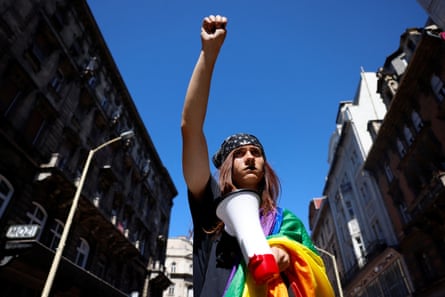
Tens of thousands of people have taken to the streets of Budapest in defiance of the Hungarian government’s ban on Pride, heeding a call by the city’s mayor to “come calmly and boldly to stand together for freedom, dignity and equal rights”.
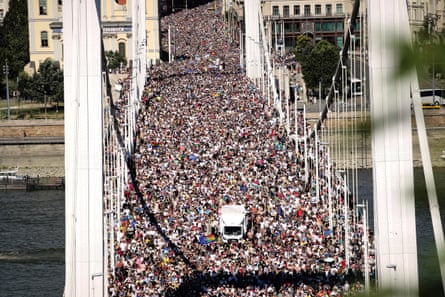
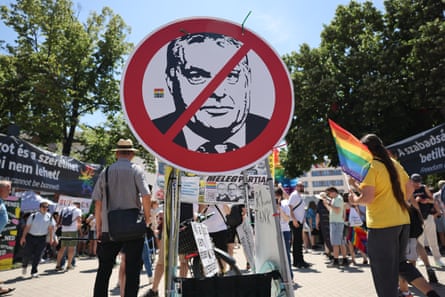
Jubilant crowds packed into the city’s streets on Saturday, waving Pride flags and signs that mocked the country’s prime minister, Viktor Orbán, as their peaceful procession inched forward at a snail’s pace.
Organisers estimated that a record number of people turned up, far outstripping the expected turnout of 35,000-40,000 people.
“We believe there are 180,000 to 200,000 people attending,” the president of Pride, Viktória Radványi told AFP. “It is hard to estimate because there have never been so many people at Budapest Pride.”
The mass demonstration against the government was a bittersweet marking of Budapest Pride’s 30th anniversary; while the turnout on Saturday was expected to reach record levels, it had come after the government had doubled down on its targeting of the country’s LGBTQ+ community.
Hungary Pride participants in the march cross the Elisabeth Bridge in Budapest, Hungary. Photograph: Rudolf Karancsi/AP
“We came because they tried to ban it,” said Timi, 49. The Hungarian national was marching with her daughter, Zsófi, 23, who had travelled from her home in Barcelona to join the rally.
After the ruling Fidesz party, led by the rightwing populist Orbán, fast-tracked a law that made it an offence to hold or attend events that involve the “depiction or promotion” of homosexuality to minors, many Hungarians vowed to show their disapproval by attending Pride for the first time.
Viki Márton was among those who had made good on the promise, turning up with her nine-year-old daughter.
The pair had come equipped with hats, water spray, and a swimsuit, more worried about heat than rightwing protesters. “I want her to see the reality,” said Márton. “And I’m so excited to be here!”
Tens of thousands of Hungarians took to the streets on Saturday, despite Orbán’s warning on Friday that those who attend or organise the march will face ‘legal consequences’. Photograph: János Kummer/Getty Images
Earlier this month, police announced they would follow the government’s orders and ban the march. The progressive mayor of Budapest, Gergely Karácsony, was swift to respond, saying that the march would instead go ahead as a separate municipal event, with Karácsony describing it as a way to circumvent the need for official authorisation.
On Saturday, the mayor reiterated why the city had decided to host the event, hinting at how the march had become a symbol of discontent against a government that has long faced criticism for weakening democratic institutions and gradually undermining the rule of law.
“The government is always fighting against an enemy against which they have to protect Hungarian people,” said Karácsony.
“This time, it is sexual minorities that are the target … we believe there should be no first and second class citizens, so we decided to stand by this event.”
Akos Horvath, 18, who had travelled two hours from his city in southern Hungary to take part in the march, described it as an event of “symbolic importance”.
Speaking to news agency AFP, he added: “It’s not just about representing gay people, but about standing up for the rights of the Hungarian people.”
The sentiment was echoed by fellow marcher Eszter Rein-Bódi. “This is about much more, not just about homosexuality,” Rein-Bódi told Reuters “This is the last moment to stand up for our rights.”
‘This is about much more, not just about homosexuality,’ one participant told Reuters. Photograph: Lisa Leutner/Reuters
Tens of thousands of Hungarians, including senior citizens and parents with their children, plus politicians and campaigners from 30 countries, took to the streets on Saturday, despite Orbán’s warning on Friday that those who attend or organise the march will face “legal consequences”.
The Hungarian prime minister sought to minimise concerns over violence, however, saying that Hungary was a “civilised country” and police would not “break it up … It cannot reach the level of physical abuse”.
Still, in a video posted to social media this week, the country’s justice minister, Bence Tuzson, warned the Budapest mayor that organising a banned event or encouraging people to attend is punishable by up to a year in prison.
Speaking to reporters on Friday, the mayor brushed off the threat and downplayed concerns that police would later impose heavy fines on attende s. “Police have only one task tomorrow: to guarantee the safety and security of those gathered at the event,” said Karácsony.
The potential for violence had been amplified after three groups with ties to the extreme right said they were planning counter-marches. As the Pride march got under way, local news site Telex reported that the route of the march had to be changed after one of these groups blocked off a bridge.
Analysts had described the government’s bid to crackdown on Pride as part of a wider effort to curb democratic freedoms ahead of a hotly contested national election next year.
Orbán is facing an unprecedented challenge from a former member of the Fidesz party’s elite, Péter Magyar, leading Pride organisers to suggest they are being scapegoated as Orbán scrambles to shore up support among conservative voters.
Orbán’s government had also prompted concerns across Hungary and beyond after it said it would use facial recognition software to identify people attending any banned events, potentially fining them up to €500 (£425).
Ahead of the march, as campaigners scrambled for clarity on whether or how this technology would be used, AFP reported that newly installed cameras had appeared on the lamp-posts that dotted the planned route.
The threat had been enough to rattle some. Elton, 30, a Brazilian living in Hungary wore a hat and sunglasses as he took part on Saturday, explaining that he had been worried about jeopardising his job and immigration status, but that his Hungarian boyfriend had persuaded him to attend.
“This is my second time at Pride, but the first time I feel insecure about it,” he said.
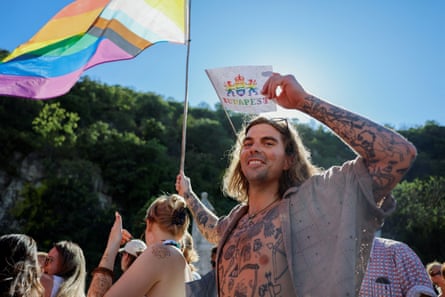
Orbán’s government had also prompted concerns across Hungary and beyond after it said it would use facial recognition software to identify people attending any banned events. Photograph: Lisa Leutner/Reuters
Mici, a 21-year-old Budapest resident, said she had attended Pride marches in the past but this time had weighed whether to join in after she was spooked by reports of the facial recognition system.
“At first, I was scared to come out because of the news, but I feel safe with so many people.”
She hoped that the massive turnout for the march would be enough to push the Orbán government to change its stance.
“I think the crowd that has come from across Europe, the record numbers, will make Hungarian people see that this cause is well-supported.”
June 29, 1925 The South African parliament passed a bill excluding black, coloured (mixed race) and Indian people from all skilled or semi-skilled jobs.
June 29, 1963 A mass “walk-on” (trespass) was organized at a chemical and biological warfare facility in Porton Down, England. These weaponized agents had been researched and produced there since 1916; it’s now known as the Defence Science and Technology Laboratory. Protesters demand an end to germ warfare in 1963 at Porton Down (Getty) Unconscionable activities at Porton Down (From 2004)
Jermaine Thomas, who says he was deported to Jamaica without a passport though he’s never been to the country (Provided by Jermaine Thomas)
Ten years ago, Jermaine Thomas was at the center of a case brought before the U.S. Supreme Court: Should a baby born to a U.S. citizen father deployed to a U.S. Army base in Germany have U.S. citizenship?
Last week, Thomas was escorted onto a plane with his wrists and ankles shackled, he says. He arrived in Jamaica, a country he’d never been to, a stateless man.
“I’m looking out the window on the plane,” Thomas told the Chronicle, “and I’m hoping the plane crashes and I die.”
Thomas has no citizenship, according to court documents. He is not a citizen of Germany (where he was born in 1986) or of the United States (where his father served in the military for nearly two decades) or of his father’s birth country of Jamaica (a place he’d never been).
Thomas doesn’t remember Germany. He says he thinks his first memory is in Washington state, but he moved around so much in his military family that it was hard to keep track.
He spent most of his life in Texas, much of it homeless and in and out of jail, he says. His parents divorced when he was too little to remember. His mother, a nurse, remarried to another man in the Army. They moved a lot, and as she and the stepfather had their own kids, Thomas says he struggled in the new family setup.
So at about about 11 years old, he went to stay with his biological father in Florida. By then, his dad was retired from an 18-year career in the U.S. military, he says. His dad died from kidney failure not long after, in 2010.
“If you’re in the U.S. Army, and the Army deploys you somewhere, and you’ve gotta have your child over there, and your child makes a mistake after you pass away, and you put your life on the line for this country, are you going to be okay with them just kicking your child out of the country?” Jermaine says, phoning the Chronicle from a hotel in Kingston, Jamaica. “It was just Memorial Day. Y’all are disrespecting his service and his legacy.”
From Killeen to Kingston
Thomas says it all began with an eviction in Killeen, Texas, which is about an hour north of Austin. Thomas didn’t know where he’d go next, so to get things out of the apartment quickly, he says he moved all of the stuff into the front yard.
While he was gathering things up in the yard, he was joined by his rottweiler, Miss Sassy Pants, whose leash he had tied to a pole.
Then Killeen police showed up. Thomas says they asked for his ID without telling him what he was in trouble for. He says he responded: I haven’t committed a crime and I don’t want to talk to you. They told him that they’d gotten a call about a dog being tied up. Next, they asked if he had the dog’s immunization records or chip number. He said they checked her chip and didn’t see Sassy’s name, so they told Thomas they’d be taking her to the pound.
The dog was loaded into a truck, and Thomas says at this point, he was arrested. Killeen police confirmed that he was arrested for suspected trespassing with no other charges. That’s a misdemeanor in Texas. He went to the Bell County Jail, where he says a court-appointed lawyer told him he could be sitting in a cell for eight months if he wanted to take the case to trial.
After about 30 days in jail, which resulted in losing his job as a janitor, Thomas says he signed paperwork to be released with conditions. But instead of being released, he was transferred to an Immigration and Customs Enforcement detention center in Waco. He was there only a few hours before being transferred again to an ICE detention camp in Conroe, Texas, just north of Houston.
He says he spent two and half months incarcerated in Conroe, and it seemed like no one knew the status of his case. According to Thomas, a deportation officer told him repeatedly that he had a very unique case, and that it was out of their hands in Texas, and now in the hands of “Washington, D.C.”
“You keep explaining to me that I’m being detained in suspended custody, in detention, but if I don’t have a release day and I don’t get to see a judge, that’s pretty much a life sentence,” Thomas says.
Feeling frustrated with his indefinite imprisonment, Thomas says he called the Department of Homeland Security and the Office of the Inspector General to file a report about what he thought was unlawful detention.
His case only got more confusing after that, he says. After a guard told him he would soon be released, Thomas was allowed a mesh bag to put his property in. He says all he had was some paperwork from his citizenship case and a phone. The phone didn’t have service – naturally, as he hadn’t been able to pay his phone bill since being incarcerated.
Officers brought Thomas to a room full of Spanish speakers. Thomas says he found one man who spoke “broken English” who said they were all being deported to Nicaragua. “So I get to banging on the door, and I’m like: Hey, why am I in here with them?”
Jermaine Thomas in Kingston (Provided by Jermaine Thomas)
Thomas says he decided then that if officers asked him to put his hands behind his back, he just wouldn’t. “I thought, I’m not gonna do it,” he says. “I’m gonna refuse to do it: Respectfully, I don’t mean to be a problem or anything like that, but you’re not gonna just kidnap me and traffic me across the lands and international lines and deport me like I’ve been seeing y’all do on the news.”
The Back of the Airbus
At least they sent him to Jamaica, says Thomas’ new friend and fellow deportee Tanya Campbell. It may be a country he’s never stepped foot in, and it may be he’s only there because of his “appearance,” as she puts it, but at least the language is English. Campbell, who actually grew up in Jamaica, was imprisoned for manslaughter more than a decade ago in New York. Upon her release from prison a few weeks ago, ICE picked her up. On May 29, she says she was one of roughly 100 people brought to a plane on a tarmac in Miami, bound for Kingston.
At the airport, as she exited a van and was being shackled, she noticed a man surrounded by between eight and 10 officers. That’s how she describes first seeing Jermaine. He was the last to board the plane, “And it was like a walk of shame,” she says. He was seated at the back with officers on either side. She assumed he was a fugitive.
Thomas says he sat in the 31st row. Landing was “bizarre, too real,” he says. “It was like a stampede. Everybody just got up and got off the plane.”
Thomas waited in the last row.He says an ICE officer got on the plane and said: “I don’t have records for more than half of these people. There’s something wrong.”
ICE and DHS did not respond to our questions.
Thomas says he doesn’t know what to do in Jamaica. He finds people difficult to understand, plus many speak Patois, and he doesn’t. He doesn’t know how to get a job. He doesn’t know if it’s the Jamaican or U.S. government paying for his hotel room, and for how long that will last. He’s not sure if it’s even legal for him to be there.
Editor’s Note Friday, June 6, 4:44pm: This story has been updated to correct the year of Thomas’ father’s death. The Chronicle regrets the error.
The final version of Ohio’s two-year state operating budget retains anti-LGBTQ provisions, requires Governor’s Merit Scholarship recipients pledge to remain in Ohio after graduation, and ties state funding to compliance with a new higher education law.
The budget now heads to Ohio Gov. Mike DeWine’s desk for his signature, which he must sign by June 30. He can line-item veto provisions in the budget.
Anti-LGBTQ provisions
A handful of anti-LGBTQ+ provisions are sprinkled throughout the budget, including a provision that would only recognize two sexes — male and female.
“Do we really have to make a law that says that men are men and women are women?” state Rep. Gary Click, R-Vickery, asked. “Do we really have to define that? We shouldn’t have to, but apparently we do.”
The budget would require public libraries to put books related to sexual orientation or gender identity in an area of the library that is out of sight for minors.
“If moms and dads want their kids to be indoctrinated within that, that’s up to the moms and dads, but we’re not going to put it in children’s faces in the children’s sections of the libraries,” Click said.
Ohio House Minority Leader Dani Isaacsohn, D-Cincinnati, called out the library provision.
“If you are one of the 20% of young people who identify as LGBTQ, you’re not going to be a hero in that story,” he said. “We have to have more books that show you as a leader, as a champion, as a hero.”
The budget would also ban Pride flags from being flown at public buildings and prohibit giving funds to youth homeless shelters that house transgender youth, even if they also serve youth who are not transgender.
“We are not hanging out the welcome mat for people from the LGBTQ community,” said Ohio Senate Minority Leader Nickie Antonio, D-Lakewood. “We should be a place where folks can just be who they are authentically and live and let live.”
Higher education provisions
The Governor’s Merit Scholarship awards the top 5% of each high school graduating class a $5,000 scholarship each year to attend an Ohio college or university.
Under the final version of the budget, scholarship recipients must sign a statement of commitment to live in Ohio for three years immediately after graduation starting in fiscal year 2027.
“If we want our young people to stay in Ohio, to start their careers in Ohio, to start a family in Ohio, we need to put our money where our mouth is, and we are doing that in this budget,” said Ohio House Finance Chair Brian Stewart, R-Ashville.
The Senate’s version of the budget would have required scholarship recipients sign a promissory note, but the final version of the budget instead requires students to sign a statement of commitment to live in Ohio for the first three years after graduating college.
“It was deemed (the promissory note) was a little bit heavy-handed and so we tried to roll that back,” Ohio Senate President Rob McColley, R-Napoleon said.
The budget allocates $47 million for fiscal year 2026 and $70 million in fiscal year 2027 for the Governor’s Merit Scholarship.
The Governor’s Merit Scholarship was enacted through the last state budget two years ago and 76% of the state’s 6,250 eligible students from the class of 2024 accepted the scholarship. Eighty-seven percent of Ohio students accepted the scholarship in its second year and 11 rural counties had a 100% acceptance rate.
The budget ties a portion of the State Share of Instruction to compliance with Senate Bill 1, a new higher education law banning diversity efforts, creates post-tenure reviews and an American civic literacy course, among other things.
The law affects Ohio’s public universities and community colleges and each university must submit a report showing compliance to the House and Senate higher education committees by March 1, according to the budget.
Housing provisions
The budget kept housing provisions the Senate added to the budget — $90 for the Residential Development Revolving Loan Program and $10 million for the Residential Economic Development District.
The Residential Development Revolving Loan Program supports new, single-family residential homes in rural areas of the state.
“If we want to grow our population, we have to have places for folks to live,” Stewart said. “This is going to be directed to small counties. We can’t be growing housing just in the three C’s, we need to be growing housing all across Ohio.”
June 27, 1905 The IWW (Industral Workers of the World) was founded in Chicago.
June 27, 1954 The first atomic power plant opened at Obninsk, Russia, near Moscow, and could generate up to 5 megawatts. The plant was ordered by Josef Stalin and—being graphite-moderated and water-cooled—could be switched to plutonium production in case it was needed. The facility was shut down in 2002.
June 27, 1954 Military action directed and funded by the CIA (Operation PBSUCCESS) forced the resignation of the Guatemalan President, Jacobo Arbenz Guzman. Winner of the country’s first election under universal suffrage, and having taken office in the country’s first peaceful transition of governments, he was accused by the U.S. of Communist influence. Following the coup d’etat, hundreds of Guatemalans were rounded up and killed. Jacobo Arbenz Guzman Between 1954 and 1990, human rights groups estimate, the security forces of successive military regimes murdered more than 100,000 civilians, including genocide against Guatemalan native peoples. More about Arbenz The CIA’s own documents on the action
June 27, 1973 President Nixon’s former White House counsel, John W. Dean, III, told the Senate Watergate Committee about Nixon’s “enemies list.”He released a 1971 memo, written by presidential advisor (now Rev.) Charles Colson, proposing the use of “available federal machinery to screw our political enemies.” John Dean Twenty persons were to be subjected to IRS audits, litigation, prosecution, or denial of federal grants, and an additional list contained 200 names of other individuals and organizations considered enemies of the administration. The complete Enemies List and memos from Colson The president’s misuse of government agencies and powers, in pursuing those he saw as his political enemies, was the basis for one of the articles of impeachment that forced Nixon from office.
June 27, 1978 Seven citizens of the Soviet Union sought refuge in the American Embassy in Moscow as escape from government oppression of religious minorities. The Pentecostal Christians, known as the Siberian Seven, from two families, the Vashchenkos and Chmykhalovs, spent months in the basement of the embassy awaiting permission for all family members to emigrate to the U.S. One of their sons was already in prison for defying the military draft, and another was about to reach conscription age. Recently released from prison, Baptist Pyotr Vins was twice assaulted by police after trying to arrange his family’s emigration. His father Georgi, national leader of dissident Baptists, though due for release from a labor camp, faced five additional years of Siberian “exile.” The leader of a breakaway Seventh-day Adventist group was sentenced to five years of hard labor at age 83.
June 27, 1980 President Jimmy Carter signed a measure that required approximately 4 million U.S. men age 18 to 25 to register for the military draft, and all 18-year-old males thereafter. If there were to be a crisis, registered men would be inducted as determined by age and a random lottery.
June 27, 1986 The International Court of Justice (“World Court”) decided that the United States violated international law as well as its bilateral Treaty of Friendship, Commerce and Amity with Nicaragua through its use of force against the Central American country. This included a trade embargo, the mining of harbors and bombing of airfields, as well as furnishing financial, military and logistical support to the so-called Contra insurgents. The Contras’ goal was to overthrow Nicaragua’s popular left-wing government. The Court also ruled that the U.S. should compensate the country financially.The Reagan administration had originally contested the standing of the Court to rule on such an issue, and it had walked out of Court after losing the ruling on jurisdiction, despite its treaty obligation to appear. The Court’s judgment to act had been decided 11-3 on almost all counts, those voting for the U.S. position being an American, a British and a Japanese judge. THE WORLD COURT IN ACTION by Howard N. Meyer More about the Court’s decision
It happened just a few weeks ago: Jim Obergefell was moving things in his office when he came across the ashes of his late husband, John Arthur, now 12 years gone. Arthur had last wishes for his ashes. Obergefell had yet to fulfill them.
“And it struck me that, oh, I am actually now mentally, emotionally ready to take care of John’s ashes,” Obergefell told The 19th. “It was the first time that I had that feeling so clearly and so strongly.”
Obergefell, 58, is ready to move on. Not exactly from the love of his life or the history-making Supreme Court decision that came after Arthur died. But certainly from the insecurities straight America was grappling with a decade ago about same-sex unions.
Obergefell is that Obergefell: the named plaintiff in the landmark lawsuit that extended marriage equality to every state in the nation in 2015. Ten years later, he celebrates that win and the many ways it rewrote his life. And in a time when LGBTQ+ rights are again under assault, he is looking to the future — of the queer rights movement and also his own.
A journey to the Supreme Court
Obergefell’s journey to the Supreme Court was hardly destined. It began 12 years ago, on June 26, 2013, when the Supreme Court struck down the Defense of Marriage Act, a federal law that prohibited the government from recognizing same-sex marriages.
Obergefell and Arthur had been together for 21 years at the time. The two had discussed getting married before. But they wanted it to be legal, and their home state of Ohio didn’t offer same-sex marriages.
Arthur was gravely ill with ALS, a progressive neurodegenerative disease, and he barely left his home hospice bed.
After the ruling, Obergefell leaned over to Arthur, hugged, then kissed him.
“Let’s get married,” he said.
Arthur agreed.
The logistics were not easy. Arthur was in no shape to travel, and the couple could not wed in Ohio. Obergefell researched and found that Maryland would let him get a marriage license even with only one of them present. But both would need to arrive in the state for the ceremony.
When friends and family learned about their predicament, they pooled together money to charter a medical jet for Arthur. The two flew to Baltimore. Over the course of 45 minutes, they exchanged vows on the tarmac before flying home.
“In the days that followed, we said the word ‘husband’ hundreds of times a day,” Obergefell said on the Decidedly Podcast in 2023.
But just five days later, their joy was muted when civil rights attorney Al Gerhardstein informed them that because of Ohio’s ban on same-sex marriage, Arthur would be listed as single in death.
Arthur and Obergefell were angry. The couple sued the state of Ohio in federal district court and won. Three months later, Arthur died.
The following year, Obergefell, still in mourning, lost on appeal. But he refused to believe he might lose altogether.
“I just kept going,” Obergefell said. “It was the right thing to do.”
On June 26, 2015, he won. For the country, the win was immensely practical. Many told Obergefell it gave them so much hope it saved their lives. For Obergefell, it meant a legacy for the man he loved.
“I made promises to John to love, honor and protect him, and I was going to keep doing that,” he said.
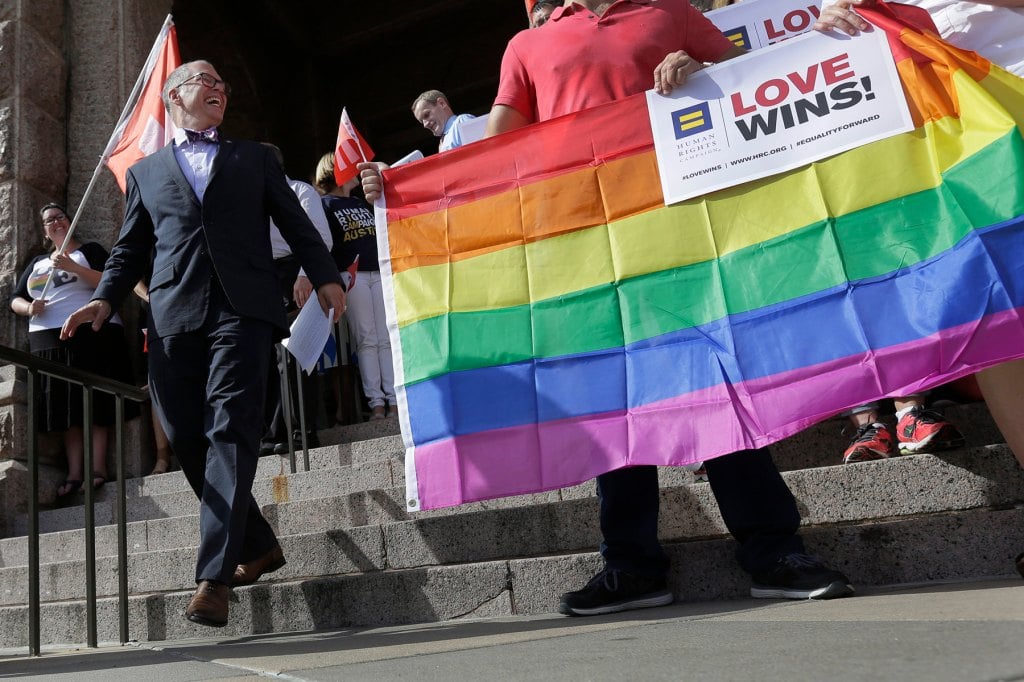
In the decade since Jim Obergefell won his Supreme Court case that made same-sex marriage federally legal, hundreds of thousands of same-sex couples have married in the U.S. (Eric Gay/AP Photo)
Changing history
It’s difficult to overstate the impact of Obergefell’s case on the nation or the world. Since the 2015 ruling, the Williams Institute at the UCLA School of Law estimates, 591,000 queer couples have wed, generating an estimated $5.9 billion in wedding spending for state and local economies.
It has also radically transformed Obergefell’s life. Introverted and unassuming, he has spent the last decade campaigning for LGBTQ+ rights. He helms Equality Vines, a wine company that donates its proceeds to advancing civil rights causes.
It’s a position that makes him deeply proud if not a little fatigued.
“I’m not tired of talking about it,” he said of the 10-year anniversary of the ruling. “I’m just physically tired from all of the interviews and the photographers and the speaking gigs and the events. Yes, I’m exhausted.”
For 12 years, Obergefell has kept Arthur alive through retelling their story countless times in courtrooms and for the media. That exercise, of telling and retelling, helped Obergefell process his profound loss.
But he has never recoupled. It wasn’t that Arthur didn’t want him to. In fact, Arthur told him regularly that he wanted him to find love again. He asked his friends and family to tell Obergefell that he wanted him to find love after he was gone.
“I know it was sincere, because he told me that he had other people tell me that,” Obergefell said.
It isn’t about the pressure he feels as the face of marriage equality, he said, though part of him wonders what it would be like to date after making history.
“I don’t know how to date,” he confessed. “I’m clueless when people flirt with me, and as much as I hate it, and I don’t go into any conversation or anything like this, but you know, there’s that part of me that sometimes wonders, you know, are they interested in me as a person, or are they interested in me as Jim Obergefell, named plaintiff?”
Obergefell’s name has become synonymous with marriage equality in the United States, an issue that has not always united the LGBTQ+ community. Some queer activists have argued that same-sex marriage was a misguided goal for the movement as queer youth continue to face high rates of homelessness and transgender people grapple with police violence and incarceration, among other issues.
More work to do
Obergefell, too, is worried that the needs of the community’s most vulnerable have gone unmet. He has watched horror-struck over the last five years as state legislatures have moved to restrict transgender rights.
“We need to fight for every marginalized community, because the queer community includes every marginalized community, and equality for one is pointless without equality for all,” he said. “I didn’t go to the Supreme Court just so White, cisgender, gay men like me could get married.”
Despite all of the setbacks in LGBTQ+ rights, and even threats to Obergefell’s game-changing victory, he is hopeful — and feels stronger than ever. People assume his case was difficult for him. It was, but the path was also obvious, to him and to Arthur. They loved each other.
“If we weren’t willing to fight for each other and for what was right, then what’s the point?”
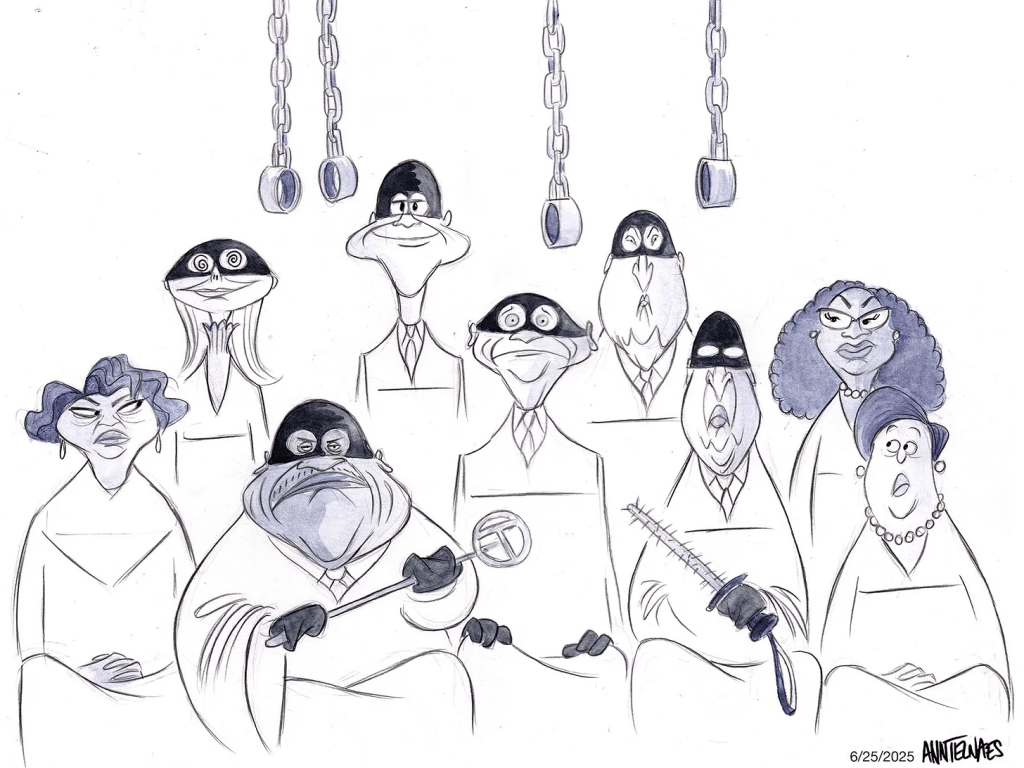
SCOTUS allows deportations to “third party countries” by Ann Telnaes
The Supreme Court justices pauses a federal judge’s ruling Read on Substack
Justice Sonia Sotomayor dissented and was joined by Justices Elena Kagan and Ketanji Brown Jackson. Sotomayor wrote, “the Court finds the idea that thousands will suffer violence in far-flung locales more palatable than the remote possibility that a District Court exceeded its remedial powers when it ordered the Government to provide notice and process to which the plaintiffs are constitutionally and statutorily entitled.”
I gotta be honest with you. I didn’t think Trump’s F-bomb was anything unique or scandalous in the New Normal. Sure, it’s not presidential for a president to say, “They don’t know what the fuck they’re doing” to reporters while standing in the White House driveway, but none of this has been presidential.
So, I didn’t think it was cartoon worthy, but then I saw one yesterday, and another one today, and then another one, and then another one, which means there are going to be at least 12 more by the end of the day. I decided to use it myself in doing a cartoon on the New York City Democratic mayoral primary, but put a little twist on it.
Political Cartooning 101 lesson: Use the F-bomb in your cartoon as a tool, but don’t make the cartoon about the F-bomb…unless it’s too funny to resist.
Former New York Governor Andrew Cuomo was and maybe still is trying to resurrect his political career after resigning in disgrace after being accused of sexual harassment by at least 11 women, which is less than half the number of women who have accused Donald Trump, yet his political career is still going. And former senator Al Franken is now playing a fictional senator in a limited Netflix series.
Cuomo was the favorite to win the Democratic primary, but unfortunately for him, it was rank-choice voting, where voters rank candidates for office in order of their preference. This system gave the nomination to young upstart Zohran Mamdani, an Islamic democratic- socialist state assemblyman with very few legislative accomplishments. And this is what I meant when I said Cuomo was/is trying to resurrect his political career.
Of course, Cuomo’s bid to become the Democratic nominee for NYC’s mayor is over, but not his bid to become mayor…unless he changes his mind and removes himself from the ballot, as Cuomo is now running as an Independent.
Previously, victory in the Democratic primary all but guaranteed a move to Gracie Mansion, as Democrats outnumber Republicans 6-1 in the Big Apple. But now, it may be a five-way race.
Rank-choice will not be implemented in the general election, where Mamdani will have to compete once again against Cuomo, but also against current mayor and bribe-taker Eric Adams (who will have Donald Trump’s support), Guardian Angels founder and Republican nominee Curtis Sliwa (who had no opposition for the nomination), and former federal prosecutor Jim Walden, who is also running as an Independent. And I’m sure there are a few dozen other never-heard-of-before dingbats on the ballot.
While some pollsters may predict that Mamdani will win the general election, you can’t be too sure with his socialist platform, that Cuomo’s still in the race, and NYC has the largest Jewish population in the world outside Israel. If Cuomo does drop out, I’d predict Mamdani to win.
One thing you can expect during the race is chaos, and more of this… (snip-MORE, and though well-written, the story is not pretty)
June 26, 1894 Mohandas Gandhi (center) as a young lawyer in Durban, South Africa in 1894 Mohandas Gandhi, a young Indian lawyer from Porbandar in Gujarat province, urged the Natal (a province in South Africa) India Congress to run a campaign of education and peaceful noncooperation to assert and protect their rights as ethnic Indians in South Africa. Within days of Gandhi’s arrival in South Africa the previous year, though he was a British subject and South Africa was under British rule, he had been thrown off a train, assaulted by a white coachman, denied hotel rooms, and pushed off a sidewalk because his skin color defined his status and limited his rights. “Truly speaking, it was after I went to South Africa that I became what I am now. My love for South Africa and my concern for her problems are no less than for India….” – Mohandas Gandhi, 1949
“Gandhiji was a South African and his memory deserves to be cherished now and in post-apartheid South Africa. The Gandhian philosophy of peace, tolerance and non-violence began in South Africa as a powerful instrument of social change . . . This weapon was effectively used by India to liberate her people.” – The Rev. Martin Luther King, Jr. [King used the same techniques to combat racism in the U.S.]
“We must never lose sight of the fact that the Gandhian philosophy may be a key to human survival in the twenty-first century.” – Nelson Mandela, in his speech opening the Gandhi Hall in Lenasia, South Africa, September 1992 [source: anc.org.za] Mohandas Gandhi, 1949]
Also known as Mohandas Karamchand Gandhi was born on October 2, 1869, in Porbandar, India. He was known to the Indian people as Mahatma, meaning great-souled, a person revered for high-mindedness, wisdom and selflessness. Ghandiji adds a suffix to the last name to show respect. He was also known as Bapu which means great father.
June 26, 1918 Pacifist and socialist organizer Eugene V. Debs was arrested for having given an anti-war speech in Canton, Ohio, ten days earlier. He was charged with “uttering words intended to cause insubordination and disloyalty within the American forces of the United States, to incite resistance to the war, and to promote the cause of Germany,” This last was despite his repeated and vehement criticism in the speech of Germany and its landed aristocracy, known as the Junkers. “And that is war in a nutshell. The master class has always declared the wars; the subject class has always fought the battles.The master class has had all to gain and nothing to lose, while the subject class has had nothing to gain and all to lose — especially their lives.”
June 26, 1945 On the stage of San Francisco’s Veterans Auditorium (now known as the Herbst Theatre in the center of the War Memorial Veterans Building), delegates from 50 nations signed the United Nations Charter, establishing the world body as a means of saving “succeeding generations from the scourge of war.” The U.S. Post Office issues a commemorative envelope. The Germans had just surrendered to the Allied forces in April; the war in the Pacific continued. Read the Preamble (included is full text of the Charter) Collection of photos from Founding of the UN – San Francisco Conference (I love looking at these photos! -A.)
June 26, 1955 Flyer used to promote the Freedom Charter The South African Freedom Charter was adopted at the Congress of the People at Kliptown near Johannesburg. “We, the People of South Africa, declare for all our country and the world to know that South Africa belongs to all who live in it, black and white, and that no government can justly claim authority unless it is based on the will of all the people . . . .” The Congress of the People in Kliptown Text of the Charter:
June 26, 1963 President John F. Kennedy addressed 120,000 West Berliners and concluded his speech, “All free men, wherever they may live, are citizens of Berlin, and, therefore, as a free man, I take pride in the words: “Ich bin ein Berliner!” The East German government had stopped all travel and commerce between the Soviet-controlled and the American/British/French-controlled parts of the city in 1961. west. John F. Kennedy, West Berlin, June 26, 1963 They then built a 166 km-long (103 miles) wall to separate the two Berlins and to stop emigration from east to west. Watch the speech
June 26, 2003 The U.S. Supreme Court found a Texas “anti-sodomy” law unconstitutional, overruling, and apologizing for, the 1986 Bowers v. Hardwick decision. The 6-3 decision in Lawrence v. Texas said that citizens have the “right to liberty under the Due Process Clause gives them the full right to engage in private conduct without government intervention.” Text of the decision







 Scottie's Playtime