This article is going to explain what we’re actually facing, lay out its four preconditions, and show you that America meets every single one. It will then explain why knowing this is important, and what we can do once equipped with that knowledge.
There’s a name for what’s happening: electoral autocracy. Elections happen. Multiple parties compete. But the system is rigged to favor one faction through gerrymandered maps, voter suppression, captured courts, and media control. When the wrong side wins anyway, those captured courts block them from governing. Hungary operates this way. So do we.
Start with gerrymandered maps. The Brennan Center’s September 2024 analysis found Republicans hold approximately 16 extra House seats due to favorable district lines.¹ Republicans drew 191 congressional districts while Democrats drew 75.¹ Only 69 of 435 House seats are rated competitive.² The Senate is worse. California’s 39 million residents have the same representation as Wyoming’s 579,000, a ratio of 68 to 1.³ The 50 Republican senators who confirmed Trump’s Supreme Court justices represented 43.5 percent of the American population. Their 50 Democratic colleagues represented 56.5 percent.⁴ The last time Republican senators represented a majority of voters was 1996.⁵
Rigged maps only work if the right people show up to vote. That’s where voter suppression comes in. The evidence includes confessions. During floor debate on Montana’s HB 176 in 2021, a Republican state representative explained he wanted to end Election Day registration because young voters are “not on our side of the aisle.”⁶ The bill passed. In oral arguments before the Supreme Court that same year, Arizona Republican Party attorney Michael Carvin was asked what interest his party had in maintaining voting restrictions. His answer: eliminating them “puts us at a competitive disadvantage relative to Democrats.”⁷ When the Fourth Circuit struck down North Carolina’s HB 589, the court found the legislature had requested data on voting practices broken down by race, then restricted exactly those practices disproportionately used by Black voters. The law, the court wrote, “targeted African Americans with almost surgical precision.”⁸ North Carolina enacted that law less than two months after the Supreme Court gutted the Voting Rights Act in Shelby County v. Holder. Between 2021 and 2024, states passed 79 restrictive voting laws, nearly three times the number passed between 2017 and 2020.⁹
Gerrymandering and voter suppression tilt the playing field. Media control ensures tens of millions of Americans never realize the game is rigged. Sinclair Broadcast Group owns or operates 178 television stations reaching approximately 40 percent of American households.¹⁰ The company requires stations to air “must run” segments including commentary from Boris Epshteyn, a former Trump White House official, nine times per week.¹⁰ In March 2018, Deadspin compiled footage of nearly 200 Sinclair anchors reading identical scripts warning about “fake news” at other outlets.¹¹ You can watch the video. Sinclair executive chairman David Smith reportedly told Trump in 2016: “We are here to deliver your message.”¹² When your local news is owned by a conservative media conglomerate pushing partisan content through trusted local faces, voters cannot punish leaders for policy failures they never learn about.
None of this would hold without the final piece: captured courts that enforce the rigged system and block any attempt to change it.
The Biden administration asked the Supreme Court to decide whether federal district judges have the power to issue nationwide injunctions blocking presidential policies. The Court declined to hear the case.¹³ The Trump administration asked the same question. The Court took it, ruled in Trump’s favor, 6-3.¹⁴
Same legal question. Same Court. Different answer depending on who asked.
The judiciary abandoned neutrality decades ago. Bush v. Gore stopped votes from being counted. Shelby County gutted voting rights. Citizens United flooded elections with dark money. What we’re watching now is the endgame.
The Niskanen Center analyzed the Court’s treatment of lower court injunctions and found that within the first six months of Trump’s second term, the Supreme Court lifted approximately 77 percent of injunctions blocking administration actions. For the Biden administration over four years, the Court lifted 10 percent.¹⁵ Georgetown law professor Steve Vladeck documented that in the first 20 weeks of Trump’s second term, the administration sought emergency action from the Supreme Court 19 times. That equals the total number of requests the Biden administration made over four years.¹⁶ The Court sided with Trump nearly every time.
In July 2024, the Court ruled 6-3 that presidents enjoy absolute immunity from criminal prosecution for official acts within their core constitutional authority, and presumptive immunity for all other official acts.¹⁷ The Court held that Trump’s discussions with the Acting Attorney General about overturning the 2020 election fell within his exclusive constitutional authority and were therefore absolutely immune.¹⁷ Courts cannot inquire into a president’s motives. An action does not become unofficial merely because it violates the law.¹⁷ Justice Sotomayor wrote in dissent that the decision makes the president “a king above the law.”¹⁷
A president can now direct the Justice Department to prosecute political enemies. He can order federal law enforcement to investigate, harass, and charge anyone he designates as a threat. He can pardon co-conspirators before, during, or after any scheme. He can fire any official who refuses to comply. If these actions fall within his official duties, he faces no criminal liability. The Court manufactured this immunity from whole cloth. No statute authorized it. No constitutional text required it. No precedent compelled it. Six justices simply declared that presidents need this protection to act “boldly.”
The Court is simultaneously dismantling the independence of federal agencies. In Trump v. Slaughter, currently before the Court, the administration argues that the president can fire Federal Trade Commission commissioners at will, eliminating the for-cause removal protections that have governed independent agencies since 1935.¹⁸ The D.C. Circuit has already ruled that Trump’s firings of Merit Systems Protection Board and National Labor Relations Board members were lawful.¹⁸ If Humphrey’s Executor falls, the Federal Reserve, the FTC, the SEC, the NLRB, and every other independent agency comes under direct presidential control. A president could fire the Fed chair for refusing to cut interest rates before an election. He could purge every agency of anyone who might resist.
Criminal immunity for official acts. Direct control of every federal agency. And now, with the nationwide injunction ruling, illegal orders take effect everywhere except in the specific jurisdictions where individual plaintiffs have standing to sue. The Court has built a legal architecture in which a Republican president operates with essentially no constraint.
Now consider what the same Court does when a Democrat holds office. In June 2023, the Court struck down President Biden’s student loan forgiveness program, a $430 billion initiative affecting over 40 million borrowers.¹⁹ Chief Justice Roberts invoked the “major questions doctrine,” holding that agencies cannot make decisions of vast economic significance without explicit congressional authorization.¹⁹ The previous year, the Court used the same doctrine to strike down the Clean Power Plan.²⁰ In June 2024, the Court overturned Chevron deference entirely, eliminating the 40-year principle that courts should defer to agency interpretations of ambiguous statutes.²¹ The six-justice majority handed every conservative federal judge in the country a veto over Democratic governance.
The student loan program and the Clean Power Plan were not radical initiatives. They were exercises of delegated authority that prior courts would have upheld without controversy. This Court invented new doctrines to stop them. As Justice Kagan wrote in dissent, the Court’s approach “overrules Congress’s decisions about when and how to delegate” and makes the Supreme Court itself “the arbiter, indeed, the maker, of national policy.”²²
SCOTUSblog’s analysis calls this the “who-what duality” of the Roberts Court: expanding presidential power over personnel while restricting presidential power over policy.²³ But that framing is too neutral. The personnel expansions let a Republican president fire anyone who might resist. The policy restrictions prevent a Democratic president from using the administrative state to do anything at all. One president gets to destroy. The other gets blocked from building. This is not judicial philosophy. It is collaboration.
None of these tools will transfer. A Democratic president attempting to invoke the immunity ruling, the removal power, or the elimination of nationwide injunctions would discover new limits, new doctrines, new procedural barriers. We know this because we already have the data. Seventy-seven percent versus ten percent. Nineteen emergency requests in twenty weeks versus nineteen in four years. Same questions, different answers, depending entirely on who is asking.
Here is what all of this means in plain terms. One faction wins elections while losing the popular vote, governs without constraint, and installs lifetime judges who validate the structures that enabled minority rule. The other faction needs supermajorities to win, cannot govern when it does, and watches every policy achievement get struck down by courts it cannot reform. The gears turn freely toward authoritarian consolidation. Try to turn them back and the teeth catch.
This is why nothing ever gets better. Two-thirds of Americans support raising the minimum wage to $15 an hour.²⁴ Seventy-three percent believe the healthcare system needs major change or a complete rebuild, including 67 percent of Republicans.²⁵ Exposed to policies without party labels, supermajorities support them. Yet the federal minimum wage has not moved since 2009. Healthcare remains broken. Housing stays unaffordable. Climate action stalls. Not because these policies are unpopular. Because the system is designed to prevent the popular will from becoming law. Gerrymandered legislatures will not pass them. If they pass, captured courts strike them down. If courts uphold them, the next minority-elected president dismantles them.
Every precondition is met. This is not a warning about where we are headed. We are already here.
The federal government will not save us. It has been captured. Any strategy for preserving democratic governance must begin by acknowledging what we are actually facing. What remains is the ground we still hold at the city and state level, and the willingness to use it.
The Introduction to Soft Secession booklet explains exactly what that looks like: public banking, interstate compacts, criminal prosecutions of federal officials under state law, and revenue strategies that reduce dependency on a captured federal government. It’s free at BuyMeACoffee.com/TheER, along with the Educate Activate Recruit Repeat Method for actually getting these policies passed, Being Dangerous: How to Go from Activist to Operative, a printable trifold you can hand out, and Conservatism: America’s Personality Disorder, the full book explaining how we got here. Physical copies and merch at TheExistentialistRepublic.com.
References
- Brennan Center for Justice. (2024, September). How gerrymandering tilts the 2024 race for the House. https://www.brennancenter.org/our-work/research-reports/how-gerrymandering-tilts-2024-race-house
- Unite America. (2024). Research brief: Why are most congressional elections uncompetitive? https://www.uniteamerica.org/articles/research-brief-why-are-most-congressional-elections-uncompetitive
- Harvard Gazette. (2022, November). Change the Senate: Vicki C. Jackson. https://news.harvard.edu/gazette/story/2022/11/change-the-senate-vicki-c-jackson/
- Brookings Institution. (2022, July 13). The challenge to democracy: Overcoming the small state bias. https://www.brookings.edu/articles/the-challenge-to-democracy-overcoming-the-small-state-bias/
- FiveThirtyEight. (2020, July 29). The Senate has always favored smaller states. It just didn’t help Republicans until now. https://fivethirtyeight.com/features/the-senate-has-always-favored-smaller-states-it-just-didnt-help-republicans-until-now/
- Montana Free Press. (2021, March 24). GOP lawmaker says prior voter registration bill that died had “ichthyological” qualities. https://montanafreepress.org/2021/03/24/montana-prior-voter-registration-debate/
- Brennan Center for Justice. (2021, March 2). Supreme Court appears skeptical of key Voting Rights Act provision. https://www.brennancenter.org/our-work/analysis-opinion/supreme-court-appears-skeptical-key-voting-rights-act-provision
- North Carolina State Conference of the NAACP v. McCrory, 831 F.3d 204 (4th Cir. 2016).
- Brennan Center for Justice. (2024, December). State voting laws roundup: 2024 in review. https://www.brennancenter.org/our-work/research-reports/voting-laws-roundup-2024-review
- Britannica. (2024). Sinclair Broadcast Group. https://www.britannica.com/money/Sinclair-Broadcast-Group
- Deadspin. (2018, March 31). How America’s largest local TV owner turned its news anchors into soldiers in Trump’s war on the media. https://deadspin.com/how-americas-largest-local-tv-owner-turned-its-news-anc-1824233490
- New York Magazine. (2018, April 3). The conservative mediaeli giant that could rival Fox News. https://nymag.com/intelligencer/2018/04/sinclair-broadcast-group-david-smith-trump-fox-news.html
- NPR. (2025, July 10). How SCOTUS ruled to increase executive power and challenge constitutional order. https://www.npr.org/2025/07/10/nx-s1-5463516/how-scotus-ruled-to-increase-executive-power-and-challenge-constitutional-order
- PBS NewsHour. (2025, June 28). How the Supreme Court ruling on nationwide injunctions affects presidential powers. https://www.pbs.org/newshour/show/how-the-supreme-court-ruling-on-nationwide-injunctions-affects-presidential-powers
- Niskanen Center. (2025, October 15). The Supreme Court is enabling Trump’s executive power. https://www.niskanencenter.org/the-supreme-court-is-enabling-trumps-executive-power/
- Brennan Center for Justice. (2025). Supreme Court must explain why it keeps ruling in Trump’s favor. https://www.brennancenter.org/our-work/analysis-opinion/supreme-court-must-explain-why-it-keeps-ruling-trumps-favor
- Trump v. United States, 603 U.S. 593 (2024).
- NPR. (2025, December 8). Supreme Court appears poised to vastly expand presidential powers. https://www.npr.org/2025/12/08/nx-s1-5626876/supreme-court-trump-ftc-unitary-executive
- Biden v. Nebraska, 600 U.S. ___ (2023).
- West Virginia v. EPA, 597 U.S. 697 (2022).
- Loper Bright Enterprises v. Raimondo, 603 U.S. ___ (2024).
- SCOTUSblog. (2023, June 30). Supreme Court strikes down Biden student-loan forgiveness program. https://www.scotusblog.com/2023/06/supreme-court-strikes-down-biden-student-loan-forgiveness-program/
- SCOTUSblog. (2025, December). The who’s and what’s of presidential power. https://www.scotusblog.com/2025/12/the-whos-and-whats-of-presidential-power/
- Pew Research Center. (2021, April 22). Most Americans support a $15 federal minimum wage. https://www.pewresearch.org/short-reads/2021/04/22/most-americans-support-a-15-federal-minimum-wage/
- Community Catalyst. (2024). New polling: Health care affordability is a significant and growing concern for most voters. https://communitycatalyst.org/news/new-polling-health-care-affordability-is-a-significant-and-growing-concern-for-most-voters/

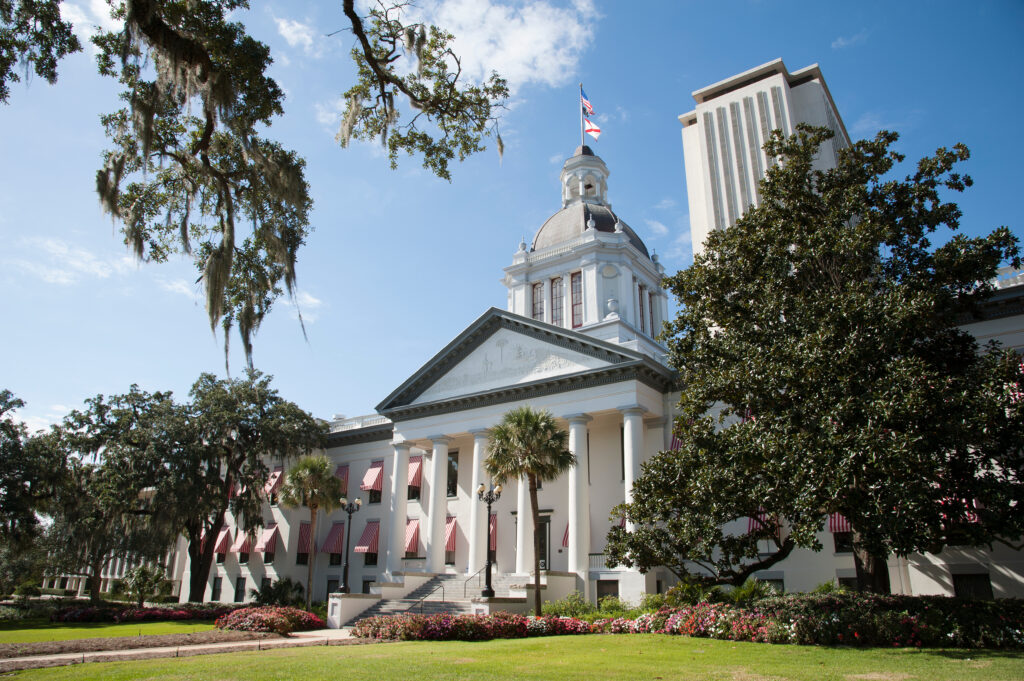 Florida State Capitol building
 (Kenneth Fowler/CNN)
 Scottie's Playtime