Nearly one in 10 Americans now identify as LGBTQ+, according to Gallup — almost double the percentage recorded just four years ago.
In 2020, 5.6% percent of U.S. adults identified as LGBTQ+ on the Gallup survey, and today, 9.3% of adults in the U.S. identify as part of the community. That number represents a one-point bump from just a year ago, and a staggering increase from the 3.5% first registered in Gallup’s inaugural 2012 poll measuring the size of the LGBTQ+ community. The rise in Americans openly identifying as LGBTQ+ is largely due to an uptick in people who identify as bisexual, especially among Generation Z, according to Gallup’s breakdowns of the data.
More than one in five Gen Z adults (23.1%) now identify as LGBTQ+, per Gallup, followed by about 14% of millennials. Older generations, including Gen X, Baby Boomers and the Silent Generation, all identify as LGBTQ+ at rates of 5% or below, tapering off to only 1.8% for those born in or before 1945.
Of the 900 people surveyed who identified as LGBTQ+, more than half — 56% — indicated that they were bisexual. In fact, more than half of both Gen Z (59%) and millennial (52%) queer people identified as bisexual. These numbers are consistent with past polling that has shown that bisexual people are an “invisible majority” within the queer community.
The percentage of trans U.S. adults has also increased when compared with the survey’s 2024 results. In last year’s poll, fewer than one percent (0.9%) of American adults identified as trans, while this year, 1.3% of respondents self-identified as such. Likewise, last year, 11.8% of the LGBTQ+ population identified as trans, while this year that percentage was recorded at approximately 14%.
The poll notes that LGBTQ+ identification has a strong correlation with being a woman, being politically liberal, and living in an urban area. For example, 21% of liberals, compared to 3% of conservatives, identified as queer or trans, while, overall, 10% of women identify as part of the community compared to 6% of men.
Gallup based its results on interviews with more than 14,000 U.S. adults. Respondents were asked to identify as straight, lesbian, gay, bisexual, trans or something else, and are allowed to indicate multiple identities when responding.
As the percentage of Americans who identify as LGBTQ+ rises, the statistic inches closer to a famous and controversial claim based on the work of human sexuality researcher Alfred Kinsey in the 1940s. Kinsey estimated that about one in 10 Americans were predominantly homosexual — a figure that was colloquially flattened over the years to become the oft-repeated claim that 10% of the population is gay. Kinsey, however, did not believe identity was easily fixed or categorized and often, instead, spoke about behaviors. For example, through surveys and interviews conducted with thousands ordinary Americans, Kinsey estimated that more than a third of men had a same-sex sexual experience in their lives, while at least one in five women had had the same.
The results of Gallup’s poll suggests a population increasingly likely to be at odds with the Trump administration’s anti-LGBTQ+ policies, which include a January executive order making it the official position of the U.S. government that there are only two genders defined at birth. That memo is part of a recent conservative efforts to deny and regulate the existence of trans people nationwide. In 2024, a record number of bills aimed at limiting trans freedoms, including access to gender-affirming health care, were introduced in state legislatures.
The wealthy and powerful want us to kick down, the liberals want us to kick up, and the sheep go where they are told without thought or reason. Chaos, divisiveness. “Don’t trust the main stream media”. “Don’t trust the courts”. “Don’t trust your very eyes, they only lie to you”. But who are we to trust? It’s a fevered dream screaming out What’s Going On?
Lady finger, dipped in moonlight /Writing “What for?” across the morning sky/ Sunlight splatters, dawn with answer/ Darkness shrugs and bids the day goodbye by Worriedman
By KRYSTA FAURIA Updated 7:34 PM CST, February 23, 2025
SANTA MONICA, Calif. (AP) — Hunter Schafer says “it’s important to just keep track of where things are in our country,” a day after the “Euphoria” star posted a video in which she revealed her new passport had been issued with a male gender marker.
Speaking to The Associated Press on the red carpet at the Independent Spirit Awards on Saturday, the 26-year-old actor, who is trans, said she felt “it was a good, necessary point” to share. Schafer, also a presenter at the award show, was nominated for best lead performance for “Cuckoo. ”
President Donald Trump signed an executive order on his first day in office instituting a new and narrow federal government definition of the sexes. As part of the order, the federal government defines sex as only male or female and says that must be reflected on official documents, like passports. The State Department, responsible for passports, is no longer issuing passports with the “X” marker that’s been available since 2021 and is not honoring requests to change gender markers between “M” and “F.”
In an 8 ½-minute video posted to TikTok on Friday, Schafer, who transitioned as a young teen, said the passport that was meant to carry her well into her 30s was stolen while she was filming in Spain. After receiving an emergency passport, she later had to apply for a new, permanent one in Los Angeles. Having had female gender markers on her license and passport since she was a teenager, Schafer marked “female” on her application — but received a passport that identified her as male, she said. In the video, she said she had not had her birth certificate amended.
Schafer acknowledged the executive order in her TikTok video: “Because our president, you know, is a lot of talk, I was like, ‘I’ll believe it when I see it.’ And, today, I saw it,” Schafer said, holding up her new passport page with the “M” marker. She said she was making the video not to “fearmonger or like create drama or receive consolation,” but to note the reality of the situation.
“I wasn’t even really looking for support, but I have an amazing community around me and it’s one of the greatest blessings of my life and so I felt very supported throughout, before and then now,” she told the AP on Saturday.
The State Department said in response to a request for comment that it was implementing Trump’s executive order but declined to comment on specific cases, citing privacy laws and restrictions.
“It doesn’t really change anything about me or my transness. However, it does make my life a little harder,” Schafer said in the video, saying she has to travel for the first time with the new passport next week.
“Trans people are beautiful. We are never going to stop existing. I’m never going to stop being trans. A letter and a passport can’t change that,” she concluded.
Associated Press journalist Andrew Dalton contributed reporting.
February 24, 1895 José Martí, a Cuban revolutionary, poet, journalist and teacher, began the liberation struggle against Spanish control. He had been forced out of Cuba repeatedly (to Spain) for his opposition to colonial rule, and spent 15 years in the U.S. organizing the revolution just before returning home. José Martí
Cultivate a White Rose By José Martí I cultivate a white rose In July as in January For the sincere friend Who gives me his hand frankly. And for the cruel person who tears out the heart with which I live, I cultivate neither nettles nor thorns: I cultivate a white rose. read about José Martí
February 24, 1965 District 1199 of the health care workers’ union (now Service Employees International Union) in New York City became the first U.S. labor union to officially oppose the war in Vietnam.
February 24, 1966 Father and son, Tom and Barry Bondhus, united in their opposition to the draft. Photo: Pete Hohn, Minneapolis Tribune Barry Bondhus, classified 1-A (fully eligible) for the draft during the Vietnam War, dumped two buckets of manure in file drawers at the Elk River, Minnesota, draft board. A farmer’s son (one of ten brothers) from Big Lake who acted with the full support of his parents, he was charged with destruction of government property. His father, Tom, wrote a declaration of war on the government over their insistence on forcing his boys into the army. He said he was prepared to die to protect his sons but eager to negotiate.“My opinion is that since our constitution guarantees: Life, Liberty, and The Pursuit of Happiness; and because the army denies all three; the draft is not lawful.” Barry, sometimes referred to as “the Big Lake One,” who listed his race as “human” on the draft forms, served 14 months in jail and prison for his action. Perspective on the case and the Bondhus family more than 50 years later
February 24, 1972 Daniel Berrigan (one of the “Catonsville 9”) was released after 18 months of a three-year term. He went to Harrisburg, Pennsylvania, where his brother Phil Berrigan was on trial, also for anti-Vietnam War activities [see February 21, 1972]. Investigation of a Flame, a film about the Berrigan brothers and the Catonsville 9
February 24, 1983 A congressional commission released a report condemning the internment of Japanese-Americans during World War II, calling it a “grave injustice.” Read more
February 24, 2012 Syndicated talk-radio host Rush Limbaugh began a three-broadcast-day-long campaign attacking Georgetown Law School student Sandra Fluke (rhymes with book) for her testimony before the House Democratic Steering and Policy Committee.
The previous week she had been invited to testify on the subject of federal requirements for contraceptive coverage in health insurance policies before the Republican-controlled House Oversight and Government Reform Committee. Instead, Committee Chair Darrell Issa (R-CA) declared her testimony inappropriate (she is past president of Georgetown Law Students for Reproductive Justice), instead hearing from five men. Committee member Congresswoman Carolyn Maloney asked, “Where are the women?” Fluke talked about the high cost of contraception and the non-pregnancy-related importance of such medications for some women. Limbaugh spent six hours on air demeaning her personally and derided her as a “slut” and a “prostitute.” Watch Sandra Fluke’s testimony:
From George Orwell to Hannah Arendt and John le Carré, thousands of blacklisted books flooded into Poland during the cold war, as publishers and printers risked their lives for literature
The volume’s glossy dust jacket shows a 1970s computer room, where high priests of the information age, dressed in kipper ties and flares, tap instructions into the terminals of some ancient mainframe. The only words on the front read “Master Operating Station”, “Subsidiary Operating Station” and “Free Standing Display”. Is any publication less appetising than an out-of-date technical manual?
Turn inside, however, and the book reveals a secret. It isn’t a computer manual at all, but a Polish language edition of Nineteen Eighty-Four, George Orwell’s famous anti-totalitarian novel, which was banned for decades by communist censors in the eastern bloc.
This copy lives now in the library of Warsaw University, but for much of the cold war it belonged to the Polish writer and dissident Teresa Bogucka. It was Teresa’s father, the art critic Janusz Bogucki, who first brought it to Poland. In 1957, during a window of liberalisation that opened after Stalin’s death, Janusz picked up the Orwell translation from a Polish bookshop in Paris, smuggled it back through the border and gave it to his daughter. Teresa was only 10 or 11 years old then, but she was a precocious reader, and recognised the ways in which communist Poland mirrored Orwell’s fictional dystopian state: “It absolutely traumatised me,” she remembered.
Years later, in 1976, when Bogucka joined the emerging Polish opposition movement, she decided to create a library of books that had bypassed the state censor, and donated her own small collection, including this Nineteen Eighty-Four. The SB security service, Poland’s KGB, kept continual watch on her, eavesdropping on her conversations, arresting her and searching her apartment, so she asked neighbours to store the forbidden books. Much of the time, though, they would be circulating among readers, since this would be a “Flying Library”, which rarely touched the ground.
Bogucka’s system of covert lending ran through a network of coordinators, each of whom was responsible for their own tight group of readers. She sorted the books into categories – politics, economics, history, literature – and divided them into packages of 10, before allocating each coordinator a particular day to pick up their parcel, which they carried away in a rucksack. The coordinator would drop the books back the following month at a different address, before picking up a new set.
The demand for Bogucka’s books was such that soon she needed more, and these could only come from the west. Activist friends passed word to London, where émigré publishers arranged shipments of 30 or 40 volumes at a time, smuggling them through the iron curtain aboard the sleeper trains that shuttled back and forth between Paris and Moscow, stopping in Poland along the way. By 1978, Teresa Bogucka’s Flying Library had a stock of 500 prohibited titles.
How many people read her copy of Orwell’s book in those crucial cold war years? Hundreds, probably thousands. And this was just one of millions of titles that arrived illegally in Poland at that time. As well as via trains, books arrived by every possible conveyance: aboard yachts; in secret compartments built into vans and trucks; by balloon; in the post. Mini-editions were slipped into the sheet music of touring musicians, or packed into food tins or Tampax boxes. In one instance, a copy of Aleksandr Solzhenitsyn’s The Gulag Archipelago was carried on a flight to Warsaw hidden in a baby’s nappy.
What some in the east suspected, but very few knew for sure, was that the uncensored literature flooding the country wasn’t reaching Poles by chance. It was sent as part of a decades-long US intelligence operation, known in Washington as the “CIA book program”, designed, in the words of the programme’s leader, George Minden, to assault the eastern bloc with an “offensive of free, honest thinking”. Minden believed that “truth is contagious”, and if they could only deliver it to the oppressed peoples of the Soviet zone, it was certain to have an effect.
From today’s vantage point, when disinformation threatens western liberal democracy as never before, and censorship and book bans are once again turning schools and libraries into ideological battlegrounds, the CIA literary programmes appear almost quaint. Although they had political goals, they must rank among the most highbrow of psychological warfare operations. Along with copies of the Manchester Guardian Weekly and the New York Review of Books, the CIA sent works by blacklisted authors such as Boris Pasternak, Czesław Miłosz and Joseph Brodsky, anti-totalitarian writings by Hannah Arendt and Albert Camus, literary fiction from Philip Roth and Kurt Vonnegut, writing advice from Virginia Woolf, the plays of Václav Havel and Bertolt Brecht, and the spy thrillers of John le Carré.
Later, as well as smuggling books, the CIA would fund and ship presses and printing equipment into Poland, so that the banned titles could be reproduced in huge quantities by underground printers in situ. Few individuals were more central to these latter operations than the dissident publisher Mirosław Chojecki, known to the CIA by the cryptonym QRGUIDE.
On a Tuesday evening in March 1980, the police came to arrest Chojecki for the 43rd time. Chojecki was 30 years old that night – a tall man, with a mane of red-brown hair. He lived with his family in a third-floor apartment in Żoliborz, a suburb of northern Warsaw, and was cooking dinner for his young son and talking to his father-in-law when they heard the door. There were three men outside, a local cop in the jackboots and grey tunic of the citizen’s militia, and two plainclothes SB agents. They flashed their badges and told him to get his coat. There was no explanation. He had just enough time to calm his crying son, grab a toothbrush and a pack of cigarettes, then they clapped handcuffs on his wrists and took him down to the police Fiat waiting on the road below.
They brought him to Mokotów jail, a house of terror to rival the KGB’s Lubyanka headquarters in Moscow, and put him in block III, a wing reserved for political prisoners. He had been here before, once for “vilifying the Polish People’s Republic” and again for “organising a criminal group with the aim of distributing illegal publications” – at least then he had known the reason for his detention. As the days dripped by, he and his cellmates talked politics and played chess with a set made from heavy black prison bread. He wasn’t allowed a lawyer.
At Easter, when he had been locked up for 10 days without being summoned to court or allowed to contact his family, he decided to take the path chosen by political prisoners everywhere: he would go on a hunger strike. Eight days later, when he had lost 8kg (17lb), the prison doctor announced that they would force-feed him. They inserted a hose into his mouth, pushing it in deep so that it scratched his oesophagus and made him gag, and poured in a sweet, fatty mush. Tears ran down his face, of helplessness, rage, revulsion. When the food was gone, the doctor whipped out the tube and left without a word.
Chojecki had not yet recovered when the guards returned and forced him to climb three landings to an interrogation room, where an intelligence officer was waiting. It was Lieutenant Chernyshevsky, an old sparring partner.
How was he feeling, Chernyshevsky asked?
“Bad.”
“Do you know that there is a printing house on Reymonta Street?”
Chojecki didn’t answer.
“Do you have Jan Nowak’s book Courier from Warsaw? If so, where, when and how did you come into possession of it and what is your relationship with the author?”
There were more questions in this vein, all about the underground press. Chojecki gave the same response to each: as long as he didn’t know what the evidence was against him, they had nothing to discuss.
Realising the interrogation was pointless, Chernyshevsky brought it to an end. He offered the prisoner a cigarette, then the guards took Chojecki back to his cell.
Of course he knew all about Nowak’s outlawed text. His publishing house had just printed it. It was, he said later, one of the best books they had ever produced.
Unlike the Nazis, who burned books as a public ritual, in the Soviet system the destruction of literature was designed to be invisible. The lists of banned titles sent round to libraries and bookstores every year were secret. Works were pulped covertly. Allusions to censorship were not allowed. A list of prohibited publications from 1951 details 2,482 items, including 238 works of “outdated” sociopolitical literature and 562 books for children. Mostly these were proscribed for ideological reasons, but some rulings made little sense even within the bizarre logic of the party: a book about growing carrots was destroyed for implying that vegetables could sprout in individuals’ gardens, as well as in those run by collectives.
Chojecki was introduced to the idea of uncensored literature by Krystyna Starczewska, a teacher at his high school. “She got me interested,” he remembered. “She got me reading.” It wasn’t hard for Chojecki to find banned books, as his parents – war heroes who fought against the Nazis – were already plugged into dissident intellectual circles. He was never allowed much time with these publications as they had to be passed on to other readers. But the fragments he read, often overnight, were enough to sow the seeds of dissent.
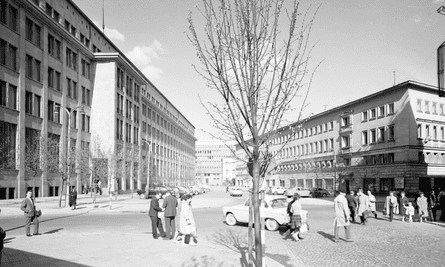
The Main Office for the Control of the Press, Publications and Public Performances in Warsaw. Photograph: Zbyszko Siemaszko/National Digital Archive
In 1976, when the government announced drastic increases in the state-controlled prices of food, workers went on strike, and the party responded as it always did, with violence. One victim recalled waking up from a beating with a broken nose and no teeth; another remembered seeing men beat a pregnant woman. The 1976 events turned a group of bookish young graduates into hardened opposition activists, and it didn’t take them long to realise they needed a public voice.
In spring 1977, Chojecki decided to focus on underground publishing. He wasn’t the only pioneer of illicit printing techniques, but the operation he led, the Independent Publishing House NOWa, grew to be the biggest and most successful in the underground. By Christmas they had published short runs of half a dozen books by blacklisted writers in Poland. Crucially, they also began to reprint editions of titles that were arriving from the west. The same books that were actively pushed by the CIA.
By the third week of his hunger strike, Chojecki’s body was shutting down. On 27 April 1980, the warden came to see him. This was a first: he had never heard of the head of the prison visiting an inmate in their cell before.
“How’s the starvation?” the warden asked.
“Very well.”
“Do you intend to starve for a long time?”
“Until I leave prison.”
“That’s five years.”
“Less.”
“Four and a half years?”
“A few days, Citizen Warden.”
The warden was wrong, as it turned out. Two weeks later, on Saturday 10 May, the order came through that Chojecki was to be released. He had been arrested in the snow; now the season had turned. As he squinted out from the shadow cast by the prison wall at the sunshine blazing down, he could pick out green shoots on the branches of the trees.
He had no appetite, but he knew he needed to eat. He struggled round the corner to a cafe, where he bought a small coffee and two doughnuts, and sat at a window table. He ate very slowly, savouring the sweet pastry with absolute delight. People passed by on the other side of the glass.
“They think they are free,” he thought.
The regime might have released him, but it was still determined to prosecute Chojecki. As he prepared for his moment in the dock, it was more important than ever for the dissidents to show that underground publishing operations would not be stopped. Five days before the court date, two young NOWa printers set out on a job that would turn into a cat-and-mouse game with the secret police.
The night before leaving for work, Jan Walc went through his pockets. In this line of business, you had to assume you would be caught, searched and interrogated, and he couldn’t be found with anything that would incriminate him or his friends. Next he packed a few essentials and took a long bath, knowing it would be his last for some time.
He knew where to meet his partner, Zenek Pałka. The only extra piece of information he needed was the time, and Pałka had given him that over the phone. Without saying his name, he had announced that they should get together at 11am on Monday 9 June. Walc recognised the voice. He also knew what the wiretap sergeant listening in didn’t: namely, that he had to subtract two from everything, so the rendezvous was set for 9am on Saturday 7 June. That morning, he said goodbye to his wife and young son and walked out into a humid Warsaw day.
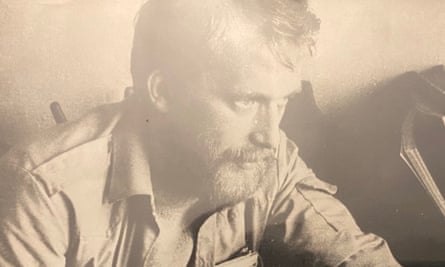
Dissident publisher Mirosław Chojecki. Photograph: Chojecki family
Leaving the building, Walc discreetly scanned the street. As a rule the secret police liked to watch your apartment or place of work and follow you from there, so if you didn’t pick up a tail right away, the prospects of avoiding one were good. All the same, he kept checking until he reached the cafe. Soon Pałka, a giant of a man with frizzy red hair, was settling into the seat next to him.
“Is the place far away?” Walc asked. Pałka took a paper serviette and wrote down an address before burning through the words with his cigarette. Then he passed on a few more details. Water came from a well, but they would need a week’s worth of food, since they couldn’t risk leaving the job to go shopping. The printing machine was a mimeograph made by AB Dick of Chicago. It had already been delivered to the house, along with a tonne and a half of paper, six full carloads. The job was to print several thousand copies of the civil society newsletter Information Bulletin, plus some pages for NOWa’s literary journal Pulse. They would need to buy 10 bottles of turpentine to run and clean the press.
By the time they’d packed all the food, they had no room for the solvent, so they stopped by at a friend’s place to borrow an extra bag. They didn’t realise he was under surveillance, and when they left his building they spotted a boxy grey Fiat saloon with three men inside which shadowed them as they walked along the road.
Reaching a tram stop, they saw the Fiat pull into a side road and park illegally, a sure sign it was the secret police, and when the tram arrived and the printers boarded, two plainclothes agents jumped out of the car and ran across the street, climbing up behind them. All four men now sat in the same streetcar as it rattled towards Zawisza Square. The Fiat kept pace alongside.
How to get rid of them? As they reached a stop, the printers saw the Fiat was boxed in at the traffic lights, and they took their chance, leaving the tram at the last minute. When the lights changed and the unmarked car had to pull away, Walc and Pałka were hurrying in a different direction, towards the railway station. A part of their tail was lost, but the other two agents had been alert and were keeping pace behind them as they ran down the station platform.
The agents were close as they boarded a train for Warsaw Central. Walc made a show of placing his bags on the luggage rack, but as the doors closed Pałka jammed his leg between them and slipped out. Walc now had the two remaining agents to himself. His job was to drag them around long enough for Pałka to prepare the next move. The men were behind him as he left the train at Warsaw Central and ducked into the warren of passages beneath the station. He knew police radios wouldn’t work down here. He ordered a Coke at a bar, bought some cigarettes, browsed the shops. When 20 minutes had passed, he emerged and headed for the taxi rank. He could see one of the men talking into his lapel as he climbed into a cab.
Warsaw’s Poniatowski Bbridge is as much a viaduct as a river crossing, the roadway linked to the streets below by a series of stone staircases. Speeding east, Walc gave the driver his instructions. Midway along the viaduct, the taxi came to a sudden halt, and the printer dived out and ran down the steps to the street below.
The chasing agents pulled up behind and raced down in pursuit, but as they reached the lower level Walc was already climbing into another cab, where Pałka was waiting. The policemen watched as their quarry pulled away. Knowing they would now be radioing in the cab’s licence plate, a few hundred yards up the road the printers swapped into another taxi. They transferred their bags, left a generous tip and gave the new driver an address on the far side of the city.
Around 3pm, they caught the train to Rembertów The place looked ideal. It was set back from the street, at the far end of a large, overgrown garden. The printing machine and the paper were hidden in an outhouse, 500 reams stacked almost to the roof. The paper was damp, which was far from ideal, but they would make it work somehow.
By evening their small room was filled with the fumes of cigarettes and turpentine, and the sound of the duplicating machine beating out its regular, soporific rhythm, bad-dum bad-dum bad-dum bad-dum. Underground printing was filthy, exhausting work. The duplicators were old and the paper was poor. Bibula, the Polish word for uncensored publications, means “blotting paper”, which reflected the stock they had to work with, which had to be hand-fed into the machine, three pages a second, hour upon hour. This meant they worked round the clock, in shifts, for days, until the job was done.
Pałka had brought along a transistor. They tuned it to Radio Free Europe, which maintained a regular commentary on Chojecki’s upcoming trial. American printers and British lawyers were protesting at what they called a show trial. Amnesty International was sending a legal representative. “A great day is coming,” Walc thought, “and we are stuck in a printing shop!” If they hurried the job, they might still be able to get to court.
Early on Thursday morning they had 20 reams left to print. By 8pm, Pałka was finishing the last stencil and Walc was burning misprints in the garden. Before leaving they had to strip down the machine, wash all the parts and lubricate them.
At last, carrying 50 copies of the Bulletin, they found a taxi and gave the driver the address of the apartment where they had been told to collect their pay. They arrived around 11pm. It was crowded with people, including half the Bulletin’s editors. Walc asked about the trial. He was astonished to hear it was already over. The sentence had been read an hour ago. One of the editors had just come back from the court, where they saw Chojecki deliver an excoriating indictment of the communist system. He told the court that his flat had been searched 17 times in the past four years, on a litany of pretexts: they were looking for a murderer, they had said, or a poisoner or a thief, but all they ever took away for evidence were books, typewriters and manuscripts.
“Why are such accusations levelled against people who fight against the pillaging of our culture? Officially, half of our recent history is erased from textbooks, studies, encyclopedias,” said Chojecki. It was the same in literature, where the state gave itself a “monopoly of thought” and a “monopoly of the word”. The lists of banned authors contained some of world’s best writers, he said. That was why he and his colleagues had set up NOWa, to fill the silences and correct the falsification.
Reaching a rousing finale, Chojecki announced that the trial was not about the accused at all, but about “free speech and thought, about Polish culture, about the dignity of society”.
Of course, none of this would change the verdict. The court duly convicted Chojecki and his co-defendants of theft of state property. He was sentenced to 18 months in prison, suspended for three years. But to everyone gathered in the editors’ apartment, this was a tremendous victory and Chojecki was a hero.
“Everybody around us rejoices,” Walc wrote in his account of that week’s events, which would be published in the following month’s Bulletin.
Someone pressed a cold beer into his hand. It was midnight.
Chojecki’s parents had fought for Polish independence with guns and bullets. He continued the struggle through literature and publishing. At times, his father, Jerzy was sceptical of his son’s tactics. “Do you think, Mirek, that you’ll be able to bring down the communist system with your little books?” he would ask. “Do you think your little words will make a difference?”
In fact, the impact of the CIA-sponsored literary tide was huge. By the mid-1980s the so-called “second circulation” of illicit literature in Poland grew so large that the system of communist censorship began to break down. Poland was the most crucial of eastern bloc nations: when communism collapsed in 1989, this was the first domino to fall. As the leading Polish dissident Adam Michnik put it: “It was books that were victorious in the fight. A book is like a reservoir of freedom, of independent thought, a reservoir of human dignity. A book was like fresh air. We should build a monument to books … they allowed us to survive and not go mad.”
Teresa Bogucka didn’t know for sure who was paying for the literature she received from the west, but she was aware that the Polish regime claimed that American intelligence supported émigré publishers, and the idea didn’t concern her at all.
“I thought, wow, a secret service supporting books,” she said. “That’s fantastic.”
This is an edited extract from The CIA Book Club: The Best Kept Secret of the Cold War by Charlie English, published by William Collins on 13 March.







 Scottie's Playtime