Israeli strikes on Gaza schools used as civilian shelters part of deliberate strategy, say sources
Exclusive: More schools identified as targets after controls on IDF action against Hamas operatives at civilian sites loosened
Ann Arbor (Informed Comment) – Harald Ringbauer et al. writing in Nature report on a genetic study of the ancient Phoenicians that is really going to anger Lebanese Christian nationalists. In fact, it contains a profound lesson for nationalists and nationalism in general, which is that the whole thing is a scam thought up in the last 250 years.
The 19th century racist thinker Ernest Renan saw a racial distinction between “Aryans” and “Semites.” From that point of view, the Punic wars between Rome and Carthage had a racial element, since Phoenicians were classed as “Semites.” But it turns out it was all a tiff among people we would now class as Italians.
The Phoenicians had been thought to be a unified civilization that began in what is today Lebanon. Well, they did start off in what is today Lebanon. But the “unified civilization” bit turns out to be a misconception.
The Phoenicians developed an alphabet. Like most alphabets, the letters had originally been pictograms. The Hebrew, Aramaic and Arabic, as well as the Greek and Roman alphabets (we still use the latter) derived from the Phoenician. For instance a picture of waves stood for water (ma’), and that became our M, which still looks like waves. Or a circle stood for eye (`ayn), which became our ‘o.’
Since the Phoenicians founded city-states all around the Mediterranean and left inscriptions in that alphabet, scholars had assumed that they were a related people. Phoenician settlements in the western Mediterranean were called “Punic,” but the language and customs were the same.
Regarding the Lebanese origins of this civlizational complex, Ringbauer et al. write, “We find that individuals from the Levantine Phoenician site of Akhziv in present-day Israel cluster together with previously published Bronze and Iron Age Levantine individuals, including from Megiddo in present-day Israel and the Phoenician cities of Sidon and Beirut in present-day Lebanon.” That is, they looked at ancient individuals from around the Levant and found that they all had shared haplotypes, i.e. they were Canaanites. Phoenicians, Hebrews, Nabataeans, etc. were all Canaanites culturally and genetically.
Now imagine the scientists’ astonishment when they looked at DNA from individuals who had lived in Phoenician cities such as Ibiza off Spain or Carthage in Tunisia to find that it did not display the ancient haplotypes or genetic sequences associated with Levantine peoples.
They write, “However, a mitochondrial genome from Carthage and whole-genome data from 12 individuals from the nearby rural Punic site of Kerkouane show substantial south European ancestry as well as indigenous North African ancestry. Partial North African ancestry was also found in genome-wide data from eight individuals from two Punic sites in Sardinia, combined with a broad eastern Mediterranean ancestry. Together with analysis of the whole-genome sequence of an individual from Ibiza, which was also interpreted to harbour eastern Mediterranean ancestry, this suggested that Punic people had complex ancestry.”
They observe of these “Phoenicians of the middle and western Mediterranean, “They are broadly distributed with a primary mode overlapping Bronze and Iron Age individuals from Sicily and the Aegean, regardless of sampled location.” There were only three exceptions: two persons from Sicily and one from Sardinia showed Canaanite genetic heritage.
In all the other 119 samples from “Punic” sites, the genetic heritage was mixed, showing patterns similar to those in ancient Greece and Sicily. After around 550 BC, when Carthage was founded by the “Phoenicians” in what is now Tunisia, some North African [Amazigh] genetic heritage starts to circulate among some of them. But this was a minority population. The authors observe, “Even in North Africa, 10 out of the 27 individuals from Kerkouane and 5 out of the 17 individuals from Carthage can be modelled with no indigenous North African ancestry, and 84% of individuals from these sites have more than 50% Sicilian–Aegean ancestry, making it the dominant ancestry component also in North African Punic sites.”
Also, the Iberians were mostly not Iberians. “Only two Iberian individuals, from Ibiza and Cádiz, had confidently high proportions of Bronze Age Iberian ancestry… Instead, Punic sites in the western Mediterranean share similar ancestry distributions of predominantly Sicilian–Aegean or North African origin.”
So how did all this happen? The authors hypothesize that Lebanese Phoenicians colonized Sicily, which had earlier had Greek colonies, and the Sicilians adopted Phoenician language, religion and culture. They they were the ones who struck out west, establishing Phoenician colonies in the central and western Mediterranean.
Ringbauer and his colleagues explain, “A critical question raised by our results is how and when Canaanite–Phoenician culture and language were adopted by people without any detectable Levantine ancestry. One hypothesis is that, after Levantine Phoenicians founded settlements in the central and western Mediterranean in the early first millennium bce, these communities continuously incorporated people with Sicilian–Aegean ancestry.”
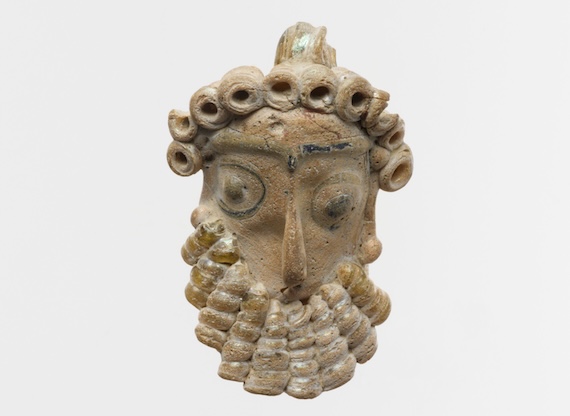
Glass head pendant, Phoenician or Carthaginian, ca. 450–300 BCE. Metropolitan Museum. Public Domain.
Reporting on the study for a Nature briefing, Ewen Callaway quotes Ringbauer as asking how it was that many Mediterranean peoples abandoned their own local cultures for that of the Phoenicians. “Does this mean Phoenician culture was like a franchise that others could adopt? That’s one for the archaeologists.”
Of course they were a franchise. So were the ancient Greeks, whose culture was adopted by so many Egyptians in places like Alexandria. As late as the 200s and 300s, there are no Arabic or Aramaic inscriptions in and around Damascus, only Greek ones. Ashkenazi Jews in Europe were also a franchise, which was joined by many gentiles — especially but not only women.
Nineteenth century European theorists of nationalism confused language groups with kinship groups, assuming that people who spoke a language were a “race,” perhaps even a “pure” one.
Today many Lebanese Christians claim to be “Phoenicians,” as though it was a pure “race” unconnected to the “Arabs.” And they take pride in Carthage, a Phoenician city, and in the Phoenician outposts of Spain, imagining they were all “Lebanese.” Ringbauer has knocked that down.
There are no nations or races of that sort. There are no “Aryans” and “Semites.” This was a linguistic distinction that was stupidly racialized. Racial “nation” was all a fevered racist fantasy. Even modern genetics only traces two lines of ancestry, the Y chromosome and the mitochondrial DNA of the X chromosome, whereas we have millions of ancestors. We’re all mongrels, all mixed up, and people in the Mediterranean basin all have a common ancestor from not so long ago. All humans have one likely only 200,000 years ago.
June 3, 1900 The International Ladies’ Garment Workers Union (ILGWU), a consolidation of seven smaller east coast needle trades unions, was founded. Read more Herman Grossman, ILGWU president
June 3, 1946 In Irene Morgan v. Virginia, the U.S. Supreme Court ruled that racial segregation in interstate travel was unconstitutional as “an undue burden on commerce.” The southern states refused to enforce it, however, and Jim Crow (the term for laws, local and state, that enforced segregation) continued as the way of life in the South. Eleven years before Rosa Parks refused to give up her seat on a city bus in Montgomery, Alabama, a young woman named Irene Morgan rejected that same demand on an interstate bus headed to Maryland from Gloucester, Virginia. Read more about Irene Morgan Recovering from surgery and already sitting far in the back, she defied the driver’s order to surrender her seat to a white couple. Like Parks, Morgan was arrested and jailed. But her action caught the attention of lawyers from the NAACP, led by (future Supreme Court justice) Thurgood Marshall, and two years later her case reached the Court. Headlines when Irene Morgan won out over Jim Crow (JC) segregation law
June 3, 1957 Thousands of scientists, led by Barry Commoner and Nobel laureate Linus Pauling, issued a call for banning nuclear weapons testing: “As scientists we have knowledge of the dangers involved and therefore a special responsibility to make those dangers known.” “…Then on May 15, 1957, with the help of some of the scientists in Washington University, St. Louis, I wrote the Scientists’ Bomb Test Appeal, which within two weeks was signed by over two thousand American scientists and within a few months by 11,021 scientists, of forty-nine countries….” –Linus Pauling Linus Pauling at a disarmament demonstration photo: Robert Carl Cohen
June 3, 1964 Conscientious objection, the refusal to bear arms in time of war on the grounds of moral or religious principles, became legally recognized in Belgium. A history of European conscientious objection
“This is your month to celebrate the strength and courage it takes to be your authentic self. But this month is not just about celebrating, it’s also about commemorating and remembering AND creating safer spaces for people to feel Pride about being their authentic selves!
“These quotes from activists, artists, politicians, entertainers, and more emphasize what it means to be an LGBTQ+ person. I hope they inspire and encourage you along your journey of being LGBTQ+ or celebrating those who are.
1. “Love is too beautiful to be hidden in the closet.” – Anonymous
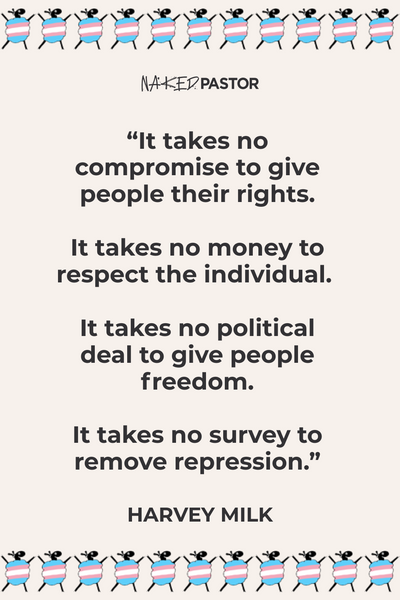
2. “It takes no compromise to give people their rights … it takes no money to respect the individual. It takes no political deal to give people freedom. It takes no survey to remove repression.” – Harvey Milk
3. “So let me be clear: I’m proud to be gay, and I consider being gay among the greatest gifts God has given me.” – Tim Cook
Israeli strikes on Gaza schools used as civilian shelters part of deliberate strategy, say sources
Exclusive: More schools identified as targets after controls on IDF action against Hamas operatives at civilian sites loosened
Before the word ‘transgender’ existed, icon Bambi already danced for the stars
The moment which changed queer history occurred on a sweltering summer day in early 1950s Algeria. An effeminate teenage boy named Jean-Pierre Pruvot stood mesmerized as traffic halted and crowds swarmed around a scandalous spectacle unfolding in the conservative Algiers streets. (AP Video: Oleg Cetinic)Published 11:32 PM CDT, May 22, 2025.)
I admit my life was different but from the time I was five I knew I was attracted to males. Specifically both sexually and emotionally. One of the hell spawn female siblings even held me down to pound the point that I was “queer” into me. I did not understand why it was wrong, after all they were the ones telling me what to do and farming me out to their teen boyfriends. I craved being held by the boys and not so much the girls. But all the other gay and lesbian people I have talked to knew early also. Preteen time frame. 7 or 8 and up they knew they were gay and either knew they had to hide it or knew they couldn’t so had to live with being attacked for it. These people who think it is a choice, a fad, or a phase need to ask themselves the famous question. When did they know they were cis and straight and was it a choice they made. No they just felt it all their lives, they simply knew it. Same for the LGBTQ+. The only difference is straight cis kids see themselves everywhere from birth. Mommies and daddies, they see themselves in the older kids around them, in the news, movies, TV shows, and the books they read. It feels so natural to them they just don’t question it. They are lucky. Until recently like in the last decade LGBTQ+ kids did not see themselves reflected in society. No movies had kids like them, no books in the library had kids like them. Some kids did not even know the words for how they felt. It was changing in the last ten years. Schools made a push for inclusion and tolerance, movies showed LGBTQ+ kids, books had them as plots or characters. Kids could see themselves and be proud. That is what the haters, the anti-trans / anti-gay bigots want to remove. The ability of kids who are different from the majority to see themselves represented positively in society. It is why they write and pass don’t say gay bills, and why they ban books. It is why they try to ban drag shows and pride events. These people who demand a straight cis world with only them showing in public are terrified of a world where people can be different. To them those who are the other must be destroyed, ideas of acceptance and tolerance must be erradicated and removed. All because they don’t feel different from the majority so the difference must not be real. But it is and we need to realize the scars left on kids who grew up in the times when they never seen themselves represented in society. We must not go backward in time, regressing to a time of hate. Hugs
LGBTQ+ youth advocates gathered outside the Monmouth County Courthouse in Freehold on Tuesday, Aug. 15, 2023, where a school policy that would impact lesbian, gay, bisexual, transgender and queer youth was being reviewed in Superior Court. | Amanda Oglesby / Asbury Park Press / USA TODAY NETWORK
A new poll from Pew Research Center sheds some light on just how early LGBTQ+ people are aware of their identities. The study of LGBTQ+ adults in the U.S. found that most respondents understood their identity before the age of 14, with a substantial portion knowing about their identities before the age of 10.
Among gay and lesbian adults, 36% said that they felt they were gay or lesbian before the age of 10 and 35 first felt they were gay or lesbian from ages 10 to 13. Only a minority – 29% – had their first feelings about their sexuality after the age of 14.
The numbers were similar for transgender people. Approximately 33% felt they might be transgender before age 10, and 25% felt the same way between ages 10 to 13. Only 19% had their first feelings about being transgender after the age of 18.
Bisexual people tended to know the latest, but even a majority of bisexual people said that they had their first thoughts about being queer before age 18. Half – 50% – had their first feelings of being bisexual before age 14.
The question often comes up in discussions of LGBTQ+ youth, with many on the right insisting that people can’t know their identities before adulthood. Often, these people claim that only LGBTQ+ people can’t know their identities before adulthood, but then support heterosexuality and cisgender identities in young people.
But these statements fly in the face of LGBTQ+ people’s lived experiences, which often include years of hiding their identities before they create a safer space for themselves to live authentically as adults.
While LGBTQ+ respondents generally first thought about their queer identities when they were very young, most waited until they were older to tell others. While 71% of gay and lesbian people said that they first knew about their sexuality before age 14, only 13% said that they told someone before that age. Approximately 58% of trans people first thought they might be trans before age 14, but only 15% told someone before that age.
This also contradicts the rightwing narrative that young people are saying that they are trans or gay to gain social acceptance and not because they actually identify as such. In reality, young people are saying that they’re straight or cisgender when they actually aren’t, likely to try and get social acceptance.
Pew broke down the results even more and showed that gay men generally felt that they were gay at a younger age than lesbian women, with 40% saying they were younger than 10 years old when they first thought they were gay, as opposed to 29% of lesbian women.
| Pew Research Center
Bisexual women, on the other hand, likely knew earlier than bisexual men. 53% of bi women said they felt they might be bi before they were 14 years old, while just 40% of bi men said the same.
| Pew Research Center
The poll was conducted in January of this year and involved a sample of 3,959 adult LGBTQ+ Americans. The survey asked about a wide variety of topics, including support from family and friends, ties to the larger LGBTQ+ community, and social acceptance.
Subscribe to the LGBTQ Nation newsletter and be the first to know about the latest headlines shaping LGBTQ+ communities worldwide.
At the end of the video the Reverend says our only job is to love god by loving others. The only question is … how much will you love. Good thoughts in this video. Had the church been like this when I was a teen, had the church been inclusive like this when I was a little boy being molested by the Pastor I would have stayed in the faith, in the church. I might not have believed in the magic parts of the bible and I might have quibbled over the facts, but I would have stayed for the community. The environment of people who enjoyed each other’s company and loved the comradery of fellowship. Sadly the churches I saw as a child, as a teen, and as an adult lost people because rather than love, they clung to hate. The joy of feeling better than some other group, of being able to look down on them, to revel in negative emotions meant more to them than hugging those different that maybe they did not understand. They set themselves up as god judging others. Not as a loving flock, but as deciders over who was worthy to be in the flock. They were not the sheep, they wanted to be the Sheppard. Hugs







 LGBTQ+ youth advocates gathered outside the Monmouth County Courthouse in Freehold on Tuesday, Aug. 15, 2023, where a school policy that would impact lesbian, gay, bisexual, transgender and queer youth was being reviewed in Superior Court. | Amanda Oglesby / Asbury Park Press / USA TODAY NETWORK


 Scottie's Playtime