July 18, 1872 Great Britain, under the leadership of William Gladstone, passed a law requiring voting by secret ballot. Previously, people had to mount a platform in public and announce their choice of candidate to the officer who then recorded it in the poll book. Secrecy served to prevent the possibility of coercion and retaliation for one’s vote. A ballot box used in the 1872 election. ————————————————————————– July 18, 1918 Nelson Mandela was born. He was one of the leaders in the successful fight against apartheid in South Africa and became its first black president. In 1993 he was awarded the Nobel Peace Prize. Mandela at 19 Mandela photo gallery A short bio of Nelson Mandela by the Nobel Committee
There will not be a cartoon / meme / news post tomorrow. I am so sorry people. I tried repeatedly all day to do it. I got called away for one emergency after the other and / or my body simply gave out and I couldn’t sit at the computers because of the pain. Best wishes to all and hugs to those that wish them. A very tired worn out almost done Scottie.
Why Is Trump Constantly S**tting On Cities? Political Scientists Have A Theory
City dwellers are just as American as those who reside in more rural areas. Here’s why conservative politicians trash-talk them, according to political scientists.
In my recent post about participating in a French journalism festival, I mentioned that the publisher of the satirical magazine Charlie Hebdo appeared on one of the cartoonists’ panel discussions. Due to the high security around him, his participation wasn’t advertised and had, at least to my count, five armed bodyguards who followed him around constantly. Those murders at the offices of Charlie Hebdo were 10 years ago and this man still has to have around the clock protection.
I drew and wrote quite a bit about the issue of free speech during that time and it still infuriates me that some people feel they have the right to threaten (and even kill) cartoonists just because they feel offended. While most of the world were in solidarity after the massacre, the discussion in the U.S. turned to questions about limiting speech…coming even from the so-called liberals in the media.
And now we have another editorial cartoonist receiving death threats because of a cartoon he drew about the Texas floods. Right wing commentators and even several news outlets are describing the cartoon by Adam Zyglis as “mocking” the flood survivors, which of course it is not. It is a legitimate comment about the Republican hypocrisy of attacking government programs except when natural disasters affect them.
Margaret Sullivan has a good piece about how social media, the “right-wing outrage machine” (although I’d argue the left also engages in this), and ignorance of an editorial cartoon’s purpose all figure into these potentially dangerous situations.
(my graphic essay after the 2015 Charlie Hebdo massacre)
(snip-go see it on Substack; just click through. The comic turns quite small with a copy/paste, and enlarging it makes it blurry. -A.)
———————————
Fed TACO by Clay Jones
If Fed Chair Jerome Powell gets a hankering for Tacos today, we know why Read on Substack
Donald Trump hates Jerome Powell, which puts Powell in a non-exclusive club. Donald Trump hates a lot of people. Am I on that list?
Jerome Powell, of course, is the Chair of the Federal Reserve. Last night, TACO met with about a dozen House Republicans and asked their opinions on whether or not he should fire Powell. Trump even showed them a letter he wrote firing Powell. He just hasn’t sent it yet.
Asked today by the press in the Oval Office about this letter and the imminent firing of Powell, Trump said it’s very unlikely.
Did Trump just TACO Jerome Powell? Trump earned the nickname TACO from his tariff threats, where he threatens to place tariffs on nations, then backs off, and threatens again, then backs off. Wall Street has started to ignore Trump’s tariff threats, which created “Trump Always Chickens Out.” It’s the acronym for TACO.
Calling Trump TACO upsets him greatly, but he’s still chickening out with the tariffs.
Speaking of tariffs, in June, our nation had its first surplus in nine years. Wow! The surplus is $27 billion, though the national debt is still over $36 trillion (year to date is over $1 trillion). MAGAts are celebrating this, praising Trump, and calling him a genius for this surplus they think was paid by other nations, forgetting that tariffs are taxes. Trump raised taxes on Americans, and it’s the American taxpayer from where this $27 billion surplus came from.
Republicans, do not ever play a shell game because you will lose. On the other hand, I just created a new game, Republican. Come play with me. (snip-MORE)
Margolis & Cox by Clay Jones
(Note from A.-this one’s long, but I left it whole so we can check our comics sources. The names are interesting, though I’ve seen some of the work, and wondered about it. -A.)
I’m gonna get in trouble again, but it’s good trouble Read on Substack
There’s a duo who create cartoons together, which is my first issue with these guys.
Though there’s no set rule for it, political cartooning is supposed to be a solo craft. I don’t even take ideas from readers. Here, we have a writer feeding ideas to an artist, and they’re terrible ideas. The cartoons are worse than the vitriolic bigotry shit out by Gary Varvel, Steve Kelley, and Mike Lester (if you think I just pissed some cartoonists off, I’m just getting warmed up, baby). At least those dudes can suck on their own. But the MargoCox goons work for Townhall, a very racist right-wing propaganda outlet. Based on that alone, no legitimate news publication should be publishing their cartoons/propaganda, and no syndicate should be distributing them. Unfortunately, Politico publishes them as they’re syndicated by Cagle Cartoons, owned by Daryl Cagle.
In the past, Cagle was also the syndicate for the “anonymous” cartoonist, who was Canadian Cameron Cardow, a racist conspiracy theorist pretending to be an American in fear for his life from liberals, wokeness, and trans people. Politico published his work, too, no matter that it violated every journalism ethics policy in existence. Instead of the racist Cameron, why couldn’t Canada just send us more black squirrels?
I’m pretty sure the first syndicate that will distribute AI-created “cartoons” will be Cagle, and Politico will be waiting to publish them. I’m shocked Cagle isn’t selling lying racist antisemitic conspiracy theorist MAGAt Ben Garrison’s cartoons. He draws Trump with muscles. Take note, MargoCox.
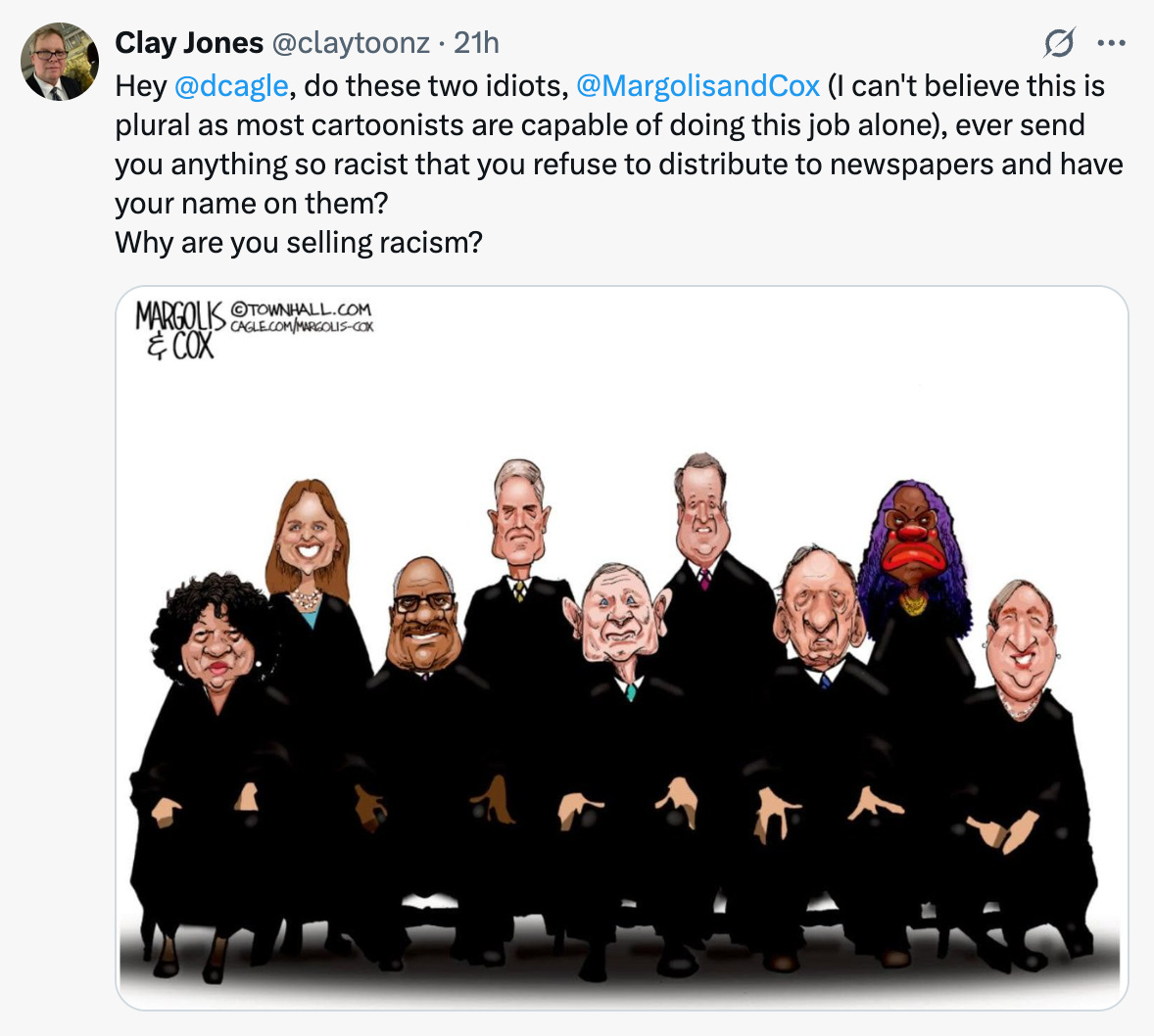
But MargoCox has been producing horrible cartoons, many typical of other conservative cartoons with bigotry and lies, but also boring and bad writing for the most part. They’re a two-man trope machine. Last week, they produced something extremely racist.
If Margo wrote it, then Cox should have refused to draw it. I don’t know these guys, but I’m going to have to assume they’re both equally racist bags of dicks (and after a brand new encounter with them today, I’m not assuming anymore). As for Cagle Cartoons, the syndicate should have said no. Daryl Cagle should have refused to have his name on it.
I took issue with this, so I tweeted and posted this to Facebook (which at this time has 156 comments) on Sunday.
I hate posting the cartoon here, but you have to see it to understand the extent of the racism. It’s like old-timey minstrel shit. I got a reply from Margocox, but it was just a nonsensical GIF.
To me, it comes off as “neener neener, I owned you by being racist. Tee-hee.” If I’m wrong, feel free to inform me what this shit is. I think the guys are proud to be racist. Later, they posted another gif, but this time to my Facebook page.
I did not hear from Daryl Cagle…or did I?
I got a message from a friend late Sunday night who works for Cagle. He said he had to call “bullshit” on my post about Cagle and MargoCox. He said that the cartoon duo worked for Townhall and not Cagle, which I thought I had been clear about. I know how a syndicate works. I own a syndicate.
He said that this specific cartoon hadn’t been sent to Cagle for syndication yet and was not in their database, and that he couldn’t even find it. He demanded to know where I found the cartoon. I told him…
How could I find the cartoon, and he couldn’t?
He explained that it was on Cagle’s website, but NOT on the syndicate website. Yeah, I’m confused. It’s sitting right there, on Cagle’s site with Cagle’s name on it. What up with that? But then he did a whatabout (which should be only a MAGAt technique, but it’s what he did) and said I never go after another syndicate for this kind of stuff, but I do, and I have called out other racist, gaslighting, conspiracy theorist cartoonists in the past. He’s known me for decades, so this can’t be the first time he’s seen me call out cartoonists. In fact, he’s secretly messaged me in the past to feed me dirt on other cartoonists, hoping I would publish it (other cartoonists do this too).
But as for the cartoon NOT being on the syndication site, it is, and presented here with the pricing list.
Cagle is definitely selling this racist cartoon.
I asked my friend, who may not be my friend anymore, if Cagle had sent him to talk to me. It took him a while to reply. Are you familiar with messenger services where you can see that the other person is replying, or trying to…and you see the dots while they’re typing, then they stop, start again, stop, start again, all because the person is trying to formulate how he wants to say something. There was a lot of that.
But he finally got his denial through, saying he hadn’t talked to Cagle about it. I replied, “He’s talking to you right now, isn’t he?” I never got another reply to the conversation he initiated. That was two days ago.
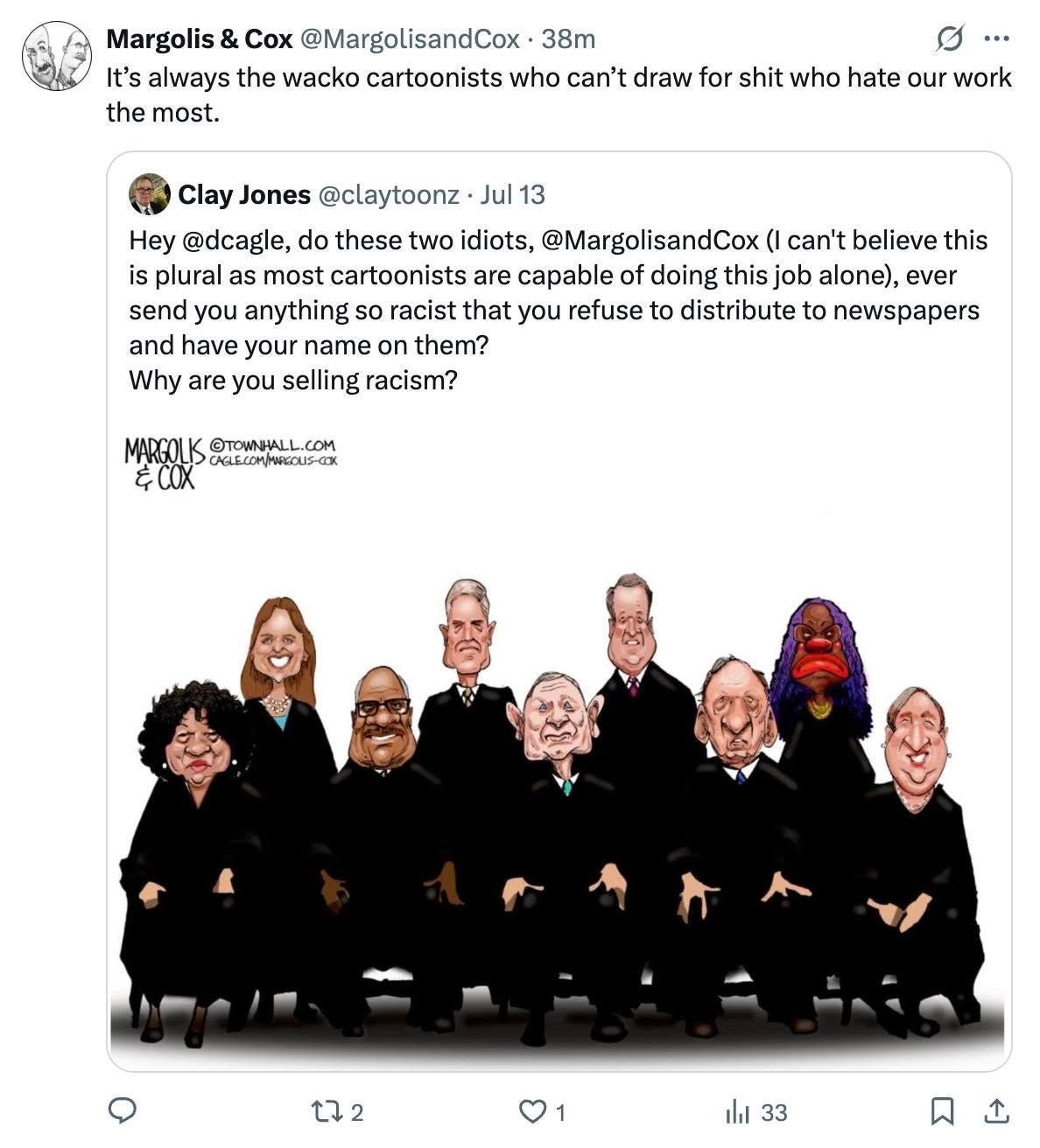
Today, Margolis & Cox came after me, not by defending themselves from accusations of racism, but by attacking my art skills, as if that has anything to do with their racism.
Only right-wing MAGAt trolls attack my drawing ability because it changes the subject and tries to put the onus on me. It’s also stupid criticism when it takes two of them to produce the rancid, bigoted tropes they crap out. I replied, saying that it doesn’t matter how well you draw if the ideas are shit. And their racist ideas are shit.
Of course, I was accused of trying to cancel them, and they’re right. I’m trying to cancel racism. They, with Daryl Cagle’s help, are advancing racism. In addition to racism, you should see all the homophobic crap they’re selling. Homophobic cartoons like this, and this, and this. Also, fellas…don’t talk about my art until you figure out how doors work.
I don’t know which one was coming at me, Margo or Cox, but it demanded that I defend myself from their attacks on my art (roll your eyes) and said there was nothing racist about drawing a black woman as a clown, except these art critics didn’t draw her as a clown. All they did was give her giant lips.
They said I was a “mediocre” cartoonist, jealous of them, and that being “printed” means they don’t “suck.” It’s like talking to very racist and stupid children. I really don’t like to boast about my success, and I don’t think I am that successful, but guys…I’m published more than the two of you put together, and I have more awards at this time than you will ever see, unless the Daily Stormer gives out cartoon awards.
And you can’t brag about being syndicated when your cartoons are sold by the same guy who sells Gary McCoy and the “Anonymous” cartoonist.
This went on for a while with them, and I quickly learned it was pointless to talk to the moron twins because they’re like insecure and immature little boys… little stupid racist boys. If someone were able to make them listen to why their cartoon is racist, they wouldn’t have the intellectual bandwidth combined to comprehend. They’re too stupid to be drawing political cartoons, and much too stupid to be syndicated. But I’ve also learned over the years that Cagle will syndicate anyone if it’ll get him a nickel. He exercises zero civic responsibility.
Syndicates need to be responsible for the stuff they put out. If they can’t, then they shouldn’t sell it. When I asked Cagle a couple of years ago on Twitter to justify syndicating the anonymous cartoonist, his answer was, “I don’t see a problem with it,” which is not an answer.
Now, he’s not replying to this. Why not? Because he can’t justify it. His only reason for carrying this shit is that it might sell. But he needs to explain why he sells racist cartoons. This is beyond a different viewpoint or a counterpoint. He can’t argue it’s not racist, because it is, and the comments from his employee indicate that they know it’s racist. Why was he so upset in the first place? Because I “accused” Cagle of selling a racist cartoon, which I have proven they are doing.
One of Cagle’s cartoonists, Gary McCoy, has had multiple newspapers apologize to their readers for his racist cartoons, with one paper even pulling cartoons altogether over it. This happens with Gary’s work TIME after TIME after TIMEafterTIME, and Cagle continues to sell his racist cartoons. I don’t understand why Cagle continues to carry McCoy despite his racism, because McCoy’s cartoons suck. They can’t be bringing in that much revenue, can they?
What I propose, since Daryl Cagle refuses responsibility for selling racism, is that all of his cartoonists, the ones whose work he syndicates, need to tell him he needs to stop.
A few cartoonists commented on my initial post about MargoCox, outraged over their racism. A few of those are Lalo Alcaraz, Chris Britt, Marc Murphy, John Kovalic, Kevin Necessary, Bob Krieger, Phil Hands, Gary Huck, and Steve Brodner. Other cartoonists need to step up, even those syndicated by Cagle, and denounce racism in political cartooning.
Guys, you are in the business of publishing your opinions…publish your opinion on this. Speak up, or at least speak to Daryl. Tell him to cut out the bullshit. This should go double for the good cartoonists who are in Cagle’s stable. I’m looking at you, some of whom are my friends who I respect greatly, Pat Bagley, Adam Zyglis, Ed Wexler, Michael de Adder, Rick McKee, Bill Day, Jeff Koterba, John Cole, and Alexandra Bowman. For the love of god, for the love of this industry, say something.
I’m asking my colleagues to stand up against racism in our industry, because we know Daryl never will.
A friend of mine, who is a Black woman, said about this, “It’s sad but the good thing as Black women is that we are used to this type of hate to the point where we expect it, and since we have so much experience with it, we are able to rise above it because that’s the only other choice that we have.”
One last note: MargoCox told me that calling them out “will not end well for me.”
The comments will be open for everyone on this blog, because the accused and the ones I’ve called out deserve the opportunity to reply.
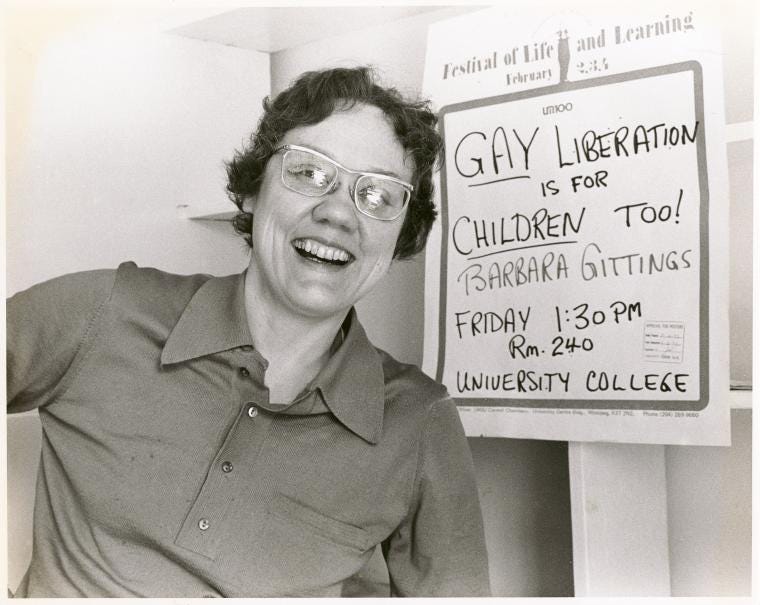
Queer History 491: Barbara Gittings – The Librarian Who Told the Shrinks to Go Fuck Themselves by Wendy🏳️⚧️🏳️🌈🌈 Read on Substack
In the dark fucking ages of American psychiatry, when homosexuality was classified as a mental illness and queer people were subjected to electroshock therapy, chemical castration, and lobotomies in the name of “treatment,” Barbara Gittings stood up and said what needed to be said: “We’re not sick, you assholes.” Born in 1932 in Vienna, Austria, to American parents, Gittings didn’t just challenge the psychiatric establishment’s classification of homosexuality as pathology—she dismantled it piece by piece with the methodical precision of the librarian she was and the righteous fury of a woman who had spent her entire adult life watching her community be tortured by medical professionals who should have been helping them.
Gittings wasn’t content to politely ask for acceptance or quietly hope that attitudes would change. She organized, she protested, she confronted the American Psychiatric Association directly, and she refused to let them continue pathologizing her existence without a fight. When the APA finally removed homosexuality from their Diagnostic and Statistical Manual in 1973, it wasn’t because they suddenly developed enlightened attitudes—it was because activists like Gittings had made their position scientifically and politically untenable. She didn’t just change a classification; she helped save thousands of lives by ending the medical justification for torturing gay people into compliance.
The Making of a Revolutionary: From Confusion to Clarity
Barbara Gittings’s journey to activism began in the most American way possible—in a college library, researching her own fucking existence because nobody else would give her straight answers about what it meant to be attracted to women. Born into a middle-class family that moved frequently due to her father’s work, she grew up feeling different but having no language or framework to understand why.
When she enrolled at Northwestern University in 1950, she was a typical college student in every way except one: she was desperately trying to figure out why she was attracted to women instead of men. In an era when homosexuality was literally unspeakable in polite society, when the very word “lesbian” was considered so shocking that newspapers wouldn’t print it, Gittings did what any good researcher would do—she went to the library.
What she found there was a psychological horror show disguised as medical literature. Book after book described homosexuality as a mental illness, a developmental disorder, a psychological pathology that could and should be cured. The “experts” had a whole arsenal of explanations for why people like her existed—overbearing mothers, absent fathers, childhood trauma, arrested development—and an even more horrifying arsenal of “treatments” designed to fix them.
The psychological impact of reading this shit cannot be overstated. Imagine being a young woman trying to understand herself and discovering that every medical authority in your society considers your very existence to be evidence of mental illness. The internalized shame, self-doubt, and fear that this “research” created in LGBTQIA+ people was devastating and intentional—designed to make them compliant with attempts to “cure” them.
But Gittings had something that many of her peers lacked: a librarian’s skepticism about sources and a growing suspicion that the experts might be full of shit. The more she read, the more she began to question whether the problem was with homosexuality or with the people studying it.
The Mattachine Society: Where Polite Activism Met Reality
In 1958, Gittings discovered the Mattachine Society, one of the earliest gay rights organizations in America, and it changed her life forever. But it also pissed her off. The organization, founded in the early 1950s, was committed to what they called “accommodation”—basically, trying to prove to straight society that gay people were just like everyone else, except for that one little detail about whom they fucked.
The Mattachine approach was understandable given the political climate of the 1950s—this was the era of McCarthyism, when being gay could cost you your job, your security clearance, and your freedom. The organization’s founders believed that the best strategy was to keep their heads down, be respectable, and hope that straight society would eventually accept them as harmless.
Gittings thought this approach was bullshit, and she wasn’t afraid to say so. She joined the New York chapter of Mattachine in 1958 and immediately began pushing for more visible, more confrontational activism. She understood something that the old guard didn’t: that respectability politics wouldn’t work because the problem wasn’t that gay people were too visible—it was that they weren’t visible enough.
Her psychological insight was profound: as long as gay people remained hidden, straight society could continue to believe whatever stereotypes and prejudices they wanted about homosexuality. The only way to change attitudes was to force people to confront the reality of gay existence—to see actual gay people living actual lives rather than the pathological caricatures promoted by the medical establishment.
The Daughters of Bilitis: Creating Community Through Visibility
In 1958, Gittings also became involved with the Daughters of Bilitis, the first lesbian organization in the United States. Founded in San Francisco in 1955, DOB was even more conservative than Mattachine, focused primarily on providing social opportunities for lesbian women in a safe, private environment.
But Gittings wasn’t interested in hiding. She became the editor of The Ladder, DOB’s newsletter, and immediately began transforming it from a timid publication that avoided anything controversial into a bold voice for lesbian rights and visibility. Under her editorship, The Ladder began featuring photographs of lesbians (with their permission), publishing articles that challenged the medical pathologizing of homosexuality, and providing positive representations of lesbian relationships.
This shift toward visibility was revolutionary in ways that are hard to understand today. In the 1960s, most gay publications featured either no photographs of gay people or images that were so heavily shadowed or cropped that the subjects were unrecognizable. The idea that lesbians would allow their faces to be published in a gay magazine was considered so dangerous that many DOB members were horrified by Gittings’s approach.
But Gittings understood the psychological importance of representation. She knew that isolated lesbians across the country were reading The Ladder as their only connection to lesbian community, and she wanted them to see that lesbians were real people with real lives, not the pathological specimens described in medical literature.
The psychological impact of this visibility cannot be overstated. For many readers, The Ladder was the first place they had ever seen positive representations of lesbian existence. It provided both validation and hope—proof that they weren’t alone and that other women like them were not only surviving but thriving.
The Confrontation Strategy: Making Homosexuality Impossible to Ignore
By the early 1960s, Gittings was convinced that the gay rights movement’s strategy of respectability and accommodation was not only ineffective but counterproductive. She began advocating for what she called “confrontation”—direct, visible challenges to discrimination and prejudice that would force society to deal with gay people as real human beings rather than abstract concepts.
In 1965, she organized the first gay rights picket in front of the White House, protesting the federal government’s ban on employing gay people. The images of well-dressed gay men and lesbians carrying signs demanding equal rights were shocking to a society that had never been forced to confront organized homosexual political action.
The psychological courage required for these early demonstrations cannot be overstated. The participants were risking their jobs, their families, their safety, and their freedom by identifying themselves publicly as homosexuals. Many wore sunglasses or otherwise tried to disguise their faces, but they showed up anyway because they understood that visibility was the price of liberation.
Gittings’s strategic insight was brilliant: by presenting gay people as ordinary Americans demanding basic civil rights rather than patients seeking treatment for mental illness, she was reframing the entire discourse around homosexuality. She was moving the conversation from the medical model—where gay people were sick individuals who needed to be cured—to the civil rights model—where gay people were a minority group facing discrimination.
The War Against Psychiatric Oppression
But Gittings’s most important battle was against the psychiatric establishment itself. She understood that as long as homosexuality was classified as a mental illness, gay people would continue to be subjected to “treatments” that were actually torture, and society would continue to view them as fundamentally defective.
The psychiatric profession’s approach to homosexuality in the 1960s was a fucking nightmare. Therapists were using electroshock therapy, aversion therapy (including showing gay men pictures of naked men while administering electric shocks or nausea-inducing drugs), hormone treatments, and even lobotomies to try to “cure” homosexuality. These treatments didn’t work—they couldn’t work, because there was nothing to cure—but they destroyed thousands of lives and caused immeasurable psychological trauma.
Gittings began a systematic campaign to challenge the psychiatric establishment’s classification of homosexuality as mental illness. She studied the research, attended psychiatric conferences, and began confronting psychiatrists directly about their unscientific and harmful approaches to treating gay people.
Her psychological insight was devastating to the psychiatric establishment: she pointed out that their research was fundamentally flawed because it was based entirely on gay people who were seeking treatment or who had been forced into treatment. It’s like studying cancer by only looking at people who are dying from it and then concluding that cancer is always fatal.
The vast majority of gay people, Gittings argued, were living perfectly healthy, productive lives without any need for psychiatric intervention. The only reason they might seek therapy was to deal with the psychological damage caused by living in a society that told them they were sick.
The APA Infiltration: Activism from Within
Gittings’s most brilliant tactical move was her decision to infiltrate the American Psychiatric Association’s own conferences and meetings. Starting in the late 1960s, she began attending APA meetings not as a patient or a researcher, but as an activist demanding that gay voices be heard in discussions about homosexuality.
This was psychological warfare at its finest. Psychiatrists were used to talking about gay people, not to gay people. They were comfortable theorizing about homosexuality in the abstract but deeply uncomfortable being confronted by actual homosexuals who refused to accept their pathological classifications.
In 1972, Gittings organized a panel at the APA’s annual meeting titled “Psychiatry: Friend or Foe to Homosexuals?” The panel included both hostile and sympathetic psychiatrists, but the real bombshell was the appearance of “Dr. H. Anonymous”—a gay psychiatrist who spoke from behind a mask and with a voice modulator to protect his identity while describing the discrimination and fear that gay medical professionals faced within their own profession.
The psychological impact of this presentation on the psychiatric establishment was enormous. For the first time, many psychiatrists were forced to confront the possibility that their colleagues—people they respected and worked with—might be gay themselves. It shattered the comfortable distance between the treaters and the treated.
The Victory: When Science Finally Caught Up with Reality
The combination of Gittings’s activism, changing social attitudes, and pressure from within the psychiatric profession itself finally led to the APA’s decision in 1973 to remove homosexuality from the Diagnostic and Statistical Manual of Mental Disorders. This wasn’t just a bureaucratic change—it was a fundamental shift in how American society understood homosexuality.
The psychological impact of this victory on the LGBTQIA+ community cannot be overstated. Overnight, millions of gay people were no longer officially mentally ill. Parents could no longer force their gay children into psychiatric treatment. Insurance companies could no longer pay for “conversion therapy.” The medical justification for discrimination and violence against gay people had been removed.
But Gittings understood that the victory was fragile. She continued her activism, working to ensure that the APA’s decision stuck and that other medical and psychological organizations followed suit. She also worked to educate mental health professionals about how to provide genuinely helpful therapy to LGBTQIA+ people—therapy that affirmed their identities rather than trying to change them.
The philosophical implications of this victory were profound. For the first time in modern American history, a minority group had successfully challenged the medical establishment’s classification of their identity as pathological. It established an important precedent for other groups facing medical discrimination and provided a model for how activism could challenge supposedly scientific authority.
The Personal Cost of Public Activism
Gittings’s decades of activism came with significant personal costs. She faced job discrimination, social ostracism, and constant stress from being a public target for anti-gay hostility. Her relationship with her partner, Kay Tobin (later Kay Tobin Lahusen), was subjected to scrutiny and criticism from both hostile straight society and conservative elements within the gay community who thought she was too visible, too confrontational, too unwilling to compromise.
The psychological toll of being a full-time activist for an unpopular cause was enormous. Gittings dealt with depression, anxiety, and the constant stress of knowing that her public visibility made her a target for violence and harassment. She also faced criticism from within the gay community—from people who thought her tactics were too aggressive and from younger activists who thought she wasn’t radical enough.
But she persisted because she understood that the stakes were too high for compromise. Every day that homosexuality remained classified as mental illness, gay people were being subjected to harmful “treatments.” Every day that gay people remained invisible, young LGBTQIA+ people were growing up believing they were fundamentally broken.
Her commitment to the cause required sacrificing many of the normal pleasures and securities of life. She couldn’t have a completely private relationship, couldn’t avoid political controversy, couldn’t retreat into the kind of respectability that might have made her life easier but would have betrayed the people counting on her activism.
The Intersection of Library Science and Liberation
Gittings’s background as a librarian profoundly shaped her approach to activism. She understood the power of information, the importance of documentation, and the need to preserve the historical record of LGBTQIA+ resistance. Her work wasn’t just about changing laws or policies—it was about changing the fundamental narratives that society told about gay people.
She applied librarian principles to activism: careful research, systematic organization, preservation of documents, and broad dissemination of information. She understood that lasting social change required changing not just attitudes but the underlying information systems that shaped those attitudes.
Her work with The Ladder exemplified this approach. She transformed it from a social newsletter into a comprehensive archive of lesbian thought, experience, and resistance. She published articles by and about lesbians from all walks of life, creating a literary and intellectual tradition that had previously been almost completely suppressed.
The psychological importance of this work cannot be overstated. For isolated LGBTQIA+ people across the country, publications like The Ladder were lifelines—proof that they weren’t alone, that other people shared their experiences, and that their lives had value and meaning beyond what mainstream society acknowledged.
The Legacy of Confrontational Activism
Gittings’s approach to activism—direct, confrontational, unwilling to compromise on fundamental questions of dignity and rights—provided a model for later LGBTQIA+ activists and for other social justice movements. She demonstrated that marginalized groups didn’t have to wait for permission to demand equality, didn’t have to prove their worthiness for basic human rights, and didn’t have to accept expert opinion that contradicted their lived experience.
Her victory over the psychiatric establishment proved that supposedly scientific authority could be challenged and changed when it was based on prejudice rather than evidence. This lesson has been crucial for other communities facing medical discrimination, from transgender people challenging pathological classifications of gender identity to fat activists challenging medical assumptions about weight and health.
The psychological liberation that her work provided to LGBTQIA+ people continues to reverberate today. Every time someone refuses to accept a mental health professional’s attempt to pathologize their sexual orientation or gender identity, every time an LGBTQIA+ person demands affirmative therapy rather than conversion therapy, every time someone challenges medical authority that contradicts their lived experience, they’re building on the foundation that Gittings laid.
The Continuing Relevance of Information Warfare
In an era when LGBTQIA+ rights are again under attack, when conversion therapy is being repackaged and promoted by religious and political conservatives, when young LGBTQIA+ people are being told that their identities are phases or mental illnesses, Gittings’s example remains urgently relevant.
Her understanding that information is power, that representation matters, and that marginalized communities must control their own narratives provides a roadmap for contemporary activism. She showed that it’s possible to challenge expert authority when that authority is being used to harm rather than help, and that sustained, organized resistance can change even the most entrenched institutional prejudices.
The psychological principles she identified—that visibility reduces stigma, that community reduces isolation, that accurate information reduces fear—remain as relevant today as they were in the 1960s. Her work reminds us that the fight for LGBTQIA+ rights isn’t just about laws and policies—it’s about the fundamental right to exist without being pathologized, criminalized, or erased.
The Sacred Act of Refusing to Be Sick
Perhaps Gittings’s greatest contribution to LGBTQIA+ liberation was her simple, revolutionary insistence that being gay was not a sickness. This wasn’t just a political position—it was a spiritual and psychological stance that transformed how millions of people understood themselves.
By refusing to accept the psychiatric establishment’s pathological classification of homosexuality, she was asserting something profoundly important: that LGBTQIA+ people were the ultimate authorities on their own experience, that scientific-sounding prejudice was still prejudice, and that no one had the right to define another person’s identity as inherently disordered.
This principle—that marginalized people are experts on their own lives—has become central to contemporary social justice movements. From disability rights activists challenging medical models that pathologize difference to racial justice activists challenging psychological theories that blame victims for systemic oppression, Gittings’s example continues to inspire people who refuse to let experts define their experiences for them.
The Revolutionary Power of Saying “Fuck That”
Barbara Gittings’s legacy can be summed up in her fundamental refusal to accept bullshit, even when that bullshit came with medical degrees and official stamps of approval. She looked at a psychiatric establishment that was torturing gay people in the name of treatment and said, essentially, “Fuck that. We’re not sick, you’re the ones with the problem.”
This kind of clarity—the ability to see through official rhetoric to underlying prejudice—is what made her such an effective activist. She wasn’t intimidated by credentials or authority when those credentials were being used to justify harm. She trusted her own experience and the experiences of her community over the theories of people who had never lived what they were trying to explain.
Her victory over the APA wasn’t just a policy change—it was proof that marginalized communities have the power to challenge and change even the most entrenched systems of oppression when they organize, persist, and refuse to accept definitions of themselves created by their oppressors.
The revolution she started continues today, carried forward by every LGBTQIA+ person who refuses to be pathologized, every activist who challenges expert authority that contradicts lived experience, and every individual who understands that the most radical act is sometimes simply insisting on your right to define yourself.
Holy shit, what a legacy: she helped save an entire community from medical torture by having the courage to tell the experts they were wrong. That’s the kind of revolutionary clarity the world needs more of—the willingness to trust your own experience, challenge authority that causes harm, and never stop fighting until justice is achieved.
July 17, 1927 In a significant early use of close air support, a U.S. Marine squadron of seven airplanes dive-bombed rebels and peasants surrounding Marines and Nicaraguan military (then under direct U.S. control) in Ocotal, Nicaragua, killing more than 100. The rebels were opposed the presence of U.S. forces, essentially continuously in their country since 1909. Why was the U.S. in Nicaragua?
July 17, 1970 The Young Lords Party entered the Lincoln Hospital in the South Bronx, NYC. The hospital, located in a condemned and dilapidated building, was filled with pain, degradation, neglect, flies, and humiliation. The YLP set up care units in the Hospital, and drew attention to the abysmal conditions. The direct-action takeover prompted a response by the government, and the building of a new Lincoln Hospital. The Lincoln Hospital Offensive
=July 17, 1976 The opening ceremony of the 21st Olympic Games in Montreal was marked by the withdrawal of more than twenty African countries, Iraq and Guyana, and their 300 athletes. They had demanded that New Zealand be banned from participation because its national rugby team had toured South Africa, itself banned from the Olympics since 1964 for its refusal to end the racially separatist policy of apartheid. The Soweto Massacre, in which 150 children were killed by South African troops, had occurred just one month earlier. The apartheid government had been using international sport as a means to build respectability. The following year, however, in reaction to the Olympic boycott, the nations of the British Commonwealth (which includes New Zealand) adopted the Gleneagles Agreement, discouraging all sporting contacts with South Africa. African countries boycott Olympics Gleneagles Agreement (It’s a .pdf)
July 17, 1979 Fighters of the Sandinista National Liberation Front overthrew the U.S.-supported dictatorial regime of Anastasio Somoza in the Central American republic of Nicaragua and forced him to flee the country. The notorious and feared U.S.-trained National Guard crumbled and its surviving commanders negotiated a surrender, despite their superiority in armaments. The Sandanista Revolution Anastasio Somoza Girls born after the historic Sandinista victory. Legal voting age in Nicaragua is 16 years. The overthrow: Sandinista rebels take Nicaraguan capital
The Young GOPer Behind “Alligator Alcatraz” Is the Dark Future of MAGA
James Uthmeier is the real brains behind this notorious migrant detention camp in the Everglades. The more barbarities that emerge, the brighter his star will no doubt shine.
The other day, Stephen Miller went on Fox News and offered a plea that got surprisingly little attention given its highly toxic and unnerving implications. Miller urged politicians in GOP-run states to build their own versions of “Alligator Alcatraz,” the state-run immigration detention facility that officials just opened in the Florida Everglades.
“We want every governor of a red state, and if you are watching tonight: pick up the phone, call DHS, work with us to build facilities in your state,” Miller said, in a reference to the Department of Homeland Security. Critically, Miller added, such states could then work with the federal government by supplying much-needed detention beds, helping President Trump “get the illegals out.”
Keep all that in mind as we introduce you to one James Uthmeier.
Uthmeier, the attorney general of Florida and a longtime ally of Governor Ron DeSantis, is widely described in the state as the brains behind “Alligator Alcatraz.” Peter Schorsch, the publisher of Florida Politics, sums him up this way: “In Uthmeier, DeSantis found his own Stephen Miller.”
Uthmeier is indeed a homegrown Florida version of Miller: Only 37 years old, he brings great precociousness to the jailing of migrants. Like Miller, he is obscure and little-known relative to the influence he’s amassing. Also like Miller, he is fluent in MAGA’s reliance on the spectacle of inhumanity and barbarism.
“You don’t need to invest that much in the perimeter,” Uthmeier said of “Alligator Alcatraz” in a slick video he recently narrated about the complex, which featured heavy-metal guitar riffs right out of a combat-cosplay video game. “People get out, there’s not much waiting for them other than alligators and pythons. Nowhere to go, nowhere to hide.”
Any migrant who dares escape just might get devoured alive by an animal—one animal eating another. Dehumanization is so thrilling!
The real-world “Alligator Alcatraz” is already gaining notoriety for its very real cruelties. After Democratic lawmakers visited over the weekend, they sharply denounced the scenes they’d witnessed of migrants packed into cages under inhumane conditions. Meanwhile, detainees and family members have sounded alarms about worm-infested food and blistering heat. And the Miami Heraldreports that an unnervingly large percentage of the detainees lack criminal convictions.
But Uthmeier is getting feted on Fox News and other right wing media for this new experiment in spite of such notorieties—or perhaps because of them. There’s good reason to think more red state politicians will seek to create their own versions of “Alligator Alcatraz” or get in on this action in other ways—and that more young Republican politicians will see it as a path to MAGA renown and glory.
For one thing, the money is now there. Buried in the big budget bill that Trump recently signed is a little-noticed provision that immigration advocates increasingly fear could fund more complexes like this one. It makes $3.5 billion available to “eligible states” and their agencies for numerous immigration-related purposes, including the “temporary detention of aliens.”
When Miller told GOP politicians to follow Uthmeier by collaborating with federal officials to develop new versions of “Alligator Alcatraz,” he was probably talking about this slush fund. State officials can try to tap into it for building out such facilities. “For Republican states across the country that want to copy the ‘Alligator Alcatraz’ model, this bill will give them that money,” immigration analyst Austin Kocher tells me.
What’s more, red state politicians are paying attention. Fox News contacted numerous gubernatorial offices to ask if they intend to take up Miller’s invitation. The responses were positive, with many eagerly touting plans for detention complexes. While it’s unclear if these will resemble “Alligator Alcatraz,” the underlying impulse is clear: Many red states want to expand state-run detention efforts. And again: The money is there.
This is a bad development. “Alligator Alcatraz” should not be the model for the future of migrant detention in much of the United States.
Here’s why. The facility is funded and operated by the state of Florida, but the state can use it to detain undocumented people under a federal program that allows ICE to authorize local law enforcement to carry out immigration crackdowns. That puts “Alligator Alcatraz” in a grey area: Local law enforcement agencies are using it to carry out Trump’s immigration detention agenda even as ICE does not run the facility.
Lauren-Brooke Eisen of the Brennan Center, who specializes in criminal justice, points to a toxic combination built into the idea of more versions of this arrangement. ICE detention is subject to federal oversight. But huge influxes of federal money for migrant detention—as in Trump’s new bill—could create new incentives for states to ramp up their own detention efforts. Yet because “Alligator Alcatraz” is a new experiment, she says, it’s unclear what sort of federal oversight future imitation efforts would receive, even if they get some federal money.
“What will access to counsel look like for detainees?” Eisen asks. “What will access to family members look like? It’s difficult to imagine state-run facilities where conditions and due process are prioritized.”
Illustrating the point, when a reporter recently asked ICE for comment on what’s going on inside “Alligator Alcatraz,” ICE said, well, it isn’t their facility. In other words, the federal government is not responsible for what happens inside those walls—even as Miller and Trump call on other states to build more of them.
Which brings us back to Uthmeier and the future of MAGA.
It’s easy to see Uthmeier and his “Alligator Alcatraz” becoming a model for other young Republicans seeking a route into MAGA celebrity. Consider his career trajectory: It’s fairly conventional establishment-Republican stuff. A native of Destin, a small beach city in the deep red Florida panhandle, he earned a law degree from Georgetown and then worked for the Commerce Department in the first Trump administration—and then for the ultra-establishment D.C. law firm Jones Day.
Uthmeier has also made appearances at the conservative Federalist Ssociety, which is as establishment-conservative as it gets. He joined DeSantis’s first administration as a senior legal adviser, and then got appointed as attorney general when the slot was vacated by the appointment of former AG Ashley Moody to now-Secretary of State Marco Rubio’s Senate seat.
All in all, it’s in some ways a conventional path to GOP success. In fact, Uthmeier actually has a track record of criticizing Trump in the past on things like Covid-19 and abortion. But J.D. Vance survived such heresies, and now, in the party that Trump remade, Uthmeier apparently recognizes that “Alligator Alcatraz” is his big ticket. It’s a reminder that in today’s GOP, the MAGA and older-line Republican establishments are bleeding into one another—and that getting attached to such an idea is a path to national MAGA stardom.
Put another way, in the cut-throat world of the MAGA attention economy, association with things like “Alligator Alcatraz” can carry enormous weight. It’s hard for people who don’t swim in MAGA’s rancid information currents to grasp, but when Trump recently toured the facility with DeSantis, it was a huge MAGA propaganda coup for the Florida governor (yes, he apparently still harbors national ambitions).
Indeed, one person who very much noticed this was apparently Uthmeier himself. According to one Florida operative in touch with Uthmeier’s staff, there’s considerable sensitivity in his inner circle over who is getting credit for “Alligator Alcatraz,” with some worrying that Uthmeier isn’t reaping enough of it.
Uthmeier needn’t worry, however. When Trump toured the facility, he said of Uthmeier: “That guy’s got a future.” In this, the MAGA God King himself gave a big boost to Uthmeier’s 2026 electoral bid to keep his appointed AG role, which will be a platform for even higher ambitions. And if more barbarities emerge from “Alligator Alcatraz,” as they surely will, his MAGA future will only get that much brighter.














 Scottie's Playtime