August 12, 1953 The first Soviet hydrogen (thermonuclear or fusion) bomb, far more potentially damaging than those dropped on Japan, was exploded in the Kazakh desert, then part of the Soviet Union. Igor Vasziljevics Kurcsatov, head of the Soviet Uranium Committee, said to Josef Stalin at the time: “The atomic sword is in our hand. It is time to think about the peaceful use of nuclear energy.” The Soviet Nuclear Weapons Program
August 12, 1982 Open missile tubes on Trident sub Twelve were arrested in an attempted blockade of the first Trident submarine, the USS Ohio, entering the Hood Canal in the state of Washington. In motorboats, sailboats and small handmade wooden vessels, the demonstrators were objecting to the presence of nuclear weapons in Seattle. The Coast Guard overturned some of the vessels with water cannon.
August 12, 1995 Thousands demonstrated in Philadelphia and other cities in support of journalist and former Black Panther Mumia Abu-Jamal (on death row for murder since 1982) in the largest anti-death-penalty demonstrations in the U.S. to date. All Out For Mumia Abu-Jamal
(Seriously, go read this. You’ll get great laughs, and the oxygen will be so good for the brain! -A)
Snippet:
Amanda: Does she have to pee?
Claudia: Yes! Also, his left pant leg is missing?
Sarah: Why is the perspective weird? Their legs look so short and their heads are so large?
Okay taking another look, I think the angle of her hip looks too low.
So it looks like her legs are short and her midsection is bizarro long, and her head is sized correctly, just looks out of whack with the leg. (snip-I cannot overstate the gold: go read it! And no drinks over your keyboard… )
Cosmos: Cosmos is a quarterly science magazine. We aim to inspire curiosity in ‘The Science of Everything’ and make the world of science accessible to everyone.
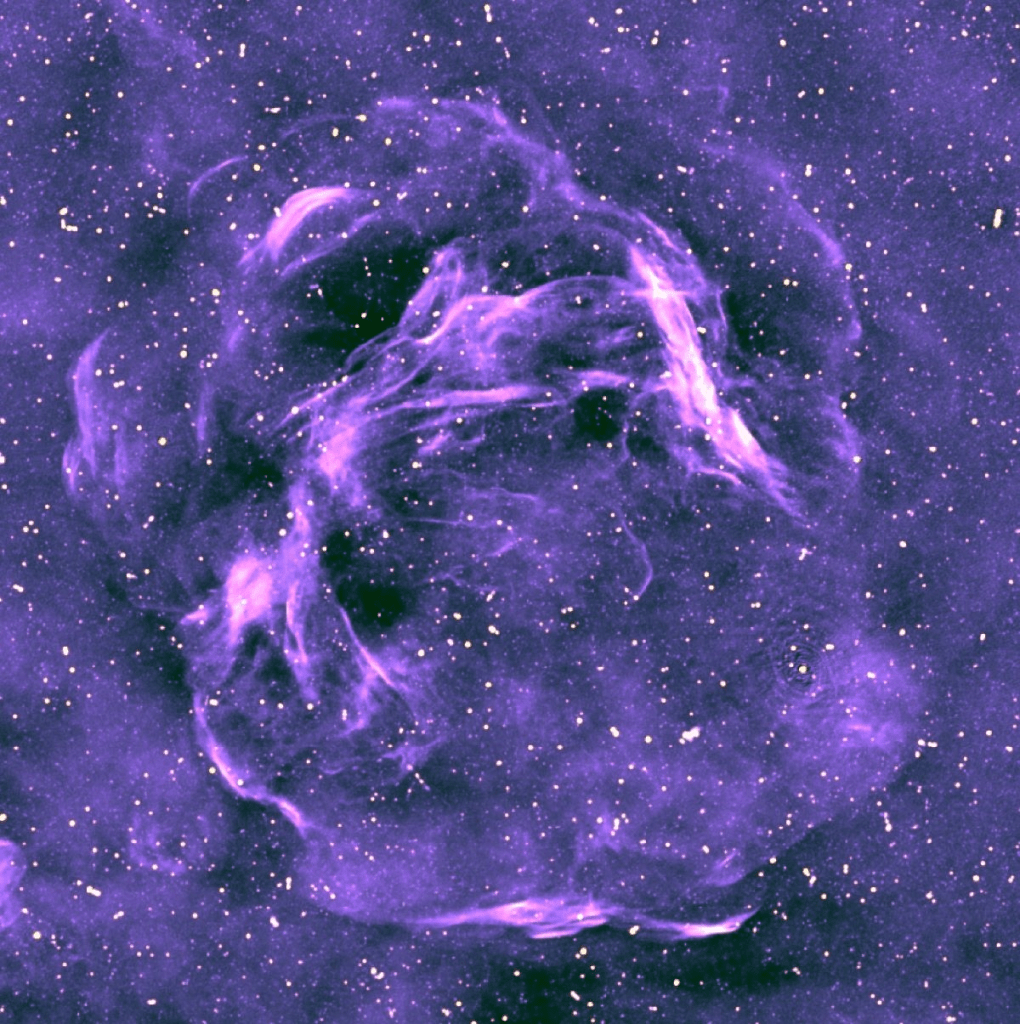
Supernova remnant G278.94+1.35, dubbed ‘Diprotodon’, captured by CSIRO’s ASKAP radio telescope. Credit: Sanja Lazarević
Supernova remnants are some of the most visually impressive objects in space. Astronomer Kovi Rose offers us a unique window into these violent and powerful celestial events.
Something explosive always seems to be happening in space. We often see headlines in the news about dramatic events like a flaring star, a gravitational wave from colliding neutron stars, or the latest supernova erupting in a galaxy far, far away.
The stories normally tend to focus on the peak periods of these energetic events, which generate in a week roughly a trillion-trillion times as much energy as we generated on Earth last year. But what remains after a star’s collapse – a supernova remnant, as astronomers call it – is both spectacular and scientifically interesting.
Supernova remnant G295.5+09.7 captured by the ASKAP radio telescope at Inyarrimanha Ilgari Bundara, CSIRO’s Murchison Radio-astronomy Observatory. Cloud-like ripples and filaments of interstellar gases are illuminated along the boundaries of the supernova remnant. Credit: ASKAP Evolutionary Map of the Universe (EMU) Team & Kovi Rose
The end of a star
Stars are endlessly collapsing under gravity. This immense pressure drives a fusion reaction, where hydrogen particles join together into heavier elements. The energy produced by this fusion reaction pushes outwards, stopping the star from collapsing in on itself. However, when a star starts to run out of fuel for its fusion engine, the balance breaks down and things get interesting.
For stars roughly the size of our Sun, there is no big explosion as they reach their final years. Instead, when they run out of fuel, they gently shrink into a glowing lump of carbon and oxygen called a white dwarf. White dwarfs don’t collapse entirely under the force of gravity, because the electrons in the remaining atoms are strong enough to push back. This is thanks to a quirky quantum effect called electron pressure.
A white dwarf can produce a supernova, but only under very specific circumstances, when the white dwarf is orbiting another star. When a white dwarf gets too close to the other star – which could even be another white dwarf – its gravitational influence will start to pull in material from the other star. This breaks the balance between gravity and those simmering electrons, ultimately causing the white dwarf to explode!
Bigger stars do end their lives in a supernova, and usually without any outside help. These stars – with more than 8 times the mass of our Sun – live fast and die young. They burn through their nuclear fuel faster than their smaller cousins, with lifetimes of millions (not billions) of years. These stars start by fusing hydrogen into helium in the core. As that runs out, they start fusing helium atoms together instead. And so it continues up the periodic table. The heavier the element, the faster the star runs out of fuel – with carbon and oxygen burning for mere years and months, respectively. But this can’t go on forever.
Once the core is made of iron, the fusion process grinds to a halt. With no new energy keeping the star inflated, its layers suddenly collapse. The rush of material inwards hits the remaining iron core and produces a shockwave that moves outwards at speeds nearing a quarter of the speed of light. These aptly named core-collapse supernovae usually leave their densely packed remains behind in the form of a neutron star – or, depending on how massive they were, a black hole.
Tuning the radio
For both classes of supernova, the stellar matter from the explosion is launched out across space at thousands, or even tens of thousands, of kilometres per second. Moving at these speeds, the leading front of the supernova can take tens of thousands of years to slow down, usually after spreading out across several light-years of space (one light-year is about 9.5 trillion kilometres) and sweeping up any additional material they encounter along the way. This is a supernova remnant: an interstellar bubble created by the wake of one of nature’s most energetic explosions.
This powerful blast wave contains fast-moving electrons that interact with nearby material in a fascinating way. The space around a supernova is filled with magnetised matter, and because of the special relationship between electricity and magnetism, the electrons curve rather than flying straight. As their paths change, the electrons are forced to slow down. Some of their energy is converted into light – but not always as light our eyes can see.
Supernova remnant SN1006 captured by CSIRO’s ASKAP radio telescope. SN1006 is the remnant of a supernova that was observed in the year 1006 by astronomers all over the world, from Egypt to China. It was first recognised as a supernova remnant in 1965, following radio observations at Murriyang (the Parkes radio telescope). Credit: Dr Emil Lenc & Kovi Rose.
Visible light is just one window into the full spectrum of electromagnetic waves. It has a short wavelength of a few hundred nanometres; for context, the average width of a single human hair is nearly 100,000 nanometres. Most of the light in supernova ‘bubbles’ has much less energy, with a wavelength of tens of centimetres or even metres. This particular type of light is called radio.
Radio astronomers have built just the right instruments to detect this kind of light emitted by supernovae. From the initial blast to the giant bubble-like structures they create as the explosion moves out through space, radio telescopes can detect these explosive supernova ‘bubbles’ expanding and eventually slowing down as they become a remnant.
We also see the brightness and energy of the light changing depending on how much material the shockwave sweeps up as it expands, or how strongly magnetised the surrounding material is. By studying the radio light generated by supernova remnants, we can learn when and how they formed, as well as what kind of dense objects the explosion left behind.
Australia’s view
Radio astronomy has a long, continuous history in Australia. We were one of the first countries in the world to use radio instruments to study celestial objects. The American radio engineer Karl Jansky, widely considered the founder of radio astronomy, first detected radio emission in 1933 from a dense region somewhere in the Milky Way. However, in 1954, CSIRO astronomers in Sydney figured out that the source of Jansky’s detection was located right at the centre of our galaxy.
As the field of radio astronomy developed, astronomers and engineers began exploring different types of telescopes that could be used to study a range of objects in the sky. Depending on the design of the instrument, we can use them to detect point-like radio sources – like the centres of distant galaxies – or diffuse clouds and filaments, like the boundaries of a supernova remnant. And using advanced image-processing techniques and modern telescopes like CSIRO’s ASKAP radio telescope, we can create images that show the beauty of the radio sky at both small and large scales.
This 24-metre-wide ‘hole-in-the-ground’, originally dug out by a few radio astronomers during their lunch breaks, was used to locate Sagittarius A. At the time it was the second-largest radio telescope in the world. Credit: CSIROCSIRO’s ASKAP is a telescope made of 36 smaller (12-metre) dish-like antennas spread over a large area on Wajarri Yamaji Country in Western Australia. Credit: Laura Driessen
Exploring our galaxy
Supernova remnants are stunning markers of the explosive history of our galaxy. And luckily for astronomers, we’ve already discovered hundreds of them. Observations of that white road of stars that runs across the sky, the Milky Way, have revealed a foamy sea of interstellar bubbles created by ancient supernovae.
The shapes of supernova remnants reflect the circumstances of their formation and their encounters with neighbouring objects, including cosmic clouds of gas and dust. Some appear symmetrical, while others take on distorted forms, moulded by interactions with nearby material or overlapping with other expanding bubbles. In fact, our whole solar system sits near the centre of a ‘superbubble’ – a vast cavity containing most of the stars visible to the naked eye. Scientists reckon the superbubble was carved out by the cumulative explosions of multiple supernovae over millions of years.
Radio astronomers estimate that as many as 1,500 supernova remnants may be still hiding in our galaxy undiscovered. New observations with highly sensitive radio instruments like ASKAP and the upcoming SKA telescopes will help us uncover these elusive interstellar bubbles, and reveal more details about the energetic processes that shaped the Milky Way.
The central band of the Milky Way seen at radio wavelengths. This image combines observations from the Parkes and ASKAP radio telescopes to reveal the network of supernova remnants and gas clouds in the central region of our galaxy. Credit: R Kothes (NRC) and the PEGASUS team.
Kovi Rose is an astrophysics PhD candidate at the University of Sydney who studies the radio light from nearby dwarf stars and distant supernovae.
August 11, 1894 Federal troops forced some 1,200 jobless workers across the Potomac River and out of Washington, D.C. Jack London Led by an unemployed activist, “General” Charles “Hobo” Kelly, the jobless group’s “soldiers” included young journalist Jack London, known for writing about social issues, and miner/cowboy William ”Big Bill” Haywood who later organized western miners and the Industrial Workers of the World (IWW). “Big Bill” Haywood Read about “Big Bill”
August 11, 1958 A drugstore chain in Wichita, Kansas, agreed to serve all its customers after weeks of sit-ins at Dockum’s lunch counter by local African-Americans who wanted an end to segregation. On this day, as several black Wichitans were sitting at the counter even though the store refused to serve them, a white man around 40 walked in and looked at them for several minutes. Then he looked at the store manager and said, simply, “Serve them. I’m losing too much money.” He was the owner, Robert Dockum. That day the lawyer for the local NAACP branch called the company and was told by the a vice president ”he had instructed all of his managers, clerks, etc., to serve all people without regard to race, creed or color,” statewide. This was the first success of the sit-in movement which soon spread to Oklahoma City and other towns in Kansas, but is often thought to have started in Greensboro, North Carolina, in 1960.
August 11, 1984 Prior to his weekly radio address, unaware that the microphone was open and he was broadcasting, President Ronald Reagan joked, “My fellow Americans, I’m pleased to tell you today that I’ve signed legislation that will outlaw Russia forever. We begin bombing in five minutes.” Many Americans and others throughout the world were concerned about the President’s apparently flippant attitude towards nuclear war at a time of increasing tension between the two major nuclear powers. Among other things, the U.S. had begun a major strategic arms buildup, adding many thousands of additional nuclear warheads along with a broad range of new delivery systems: long-range bombers including 100 B-1B stealth bombers and MX (10-warhead) ICBMs, considered first-strike weapons; intermediate-range missiles to be deployed in Europe; 3000 cruise missiles; and Trident nuclear submarines with sea-launched cruise missiles. Additionally, Reagan had proposed building the space-based Strategic Defense Initiative of anti-ballistic missiles, a destabilizing influence on the nuclear balance. The Nuclear Arms Control Legacy of Ronald Reagan
This week, as I noted last night when I wrote to you, a lot was going on. Really, too much, which seems to be a definite feature and not a bug of this second Trump administration. They don’t want us to be able to take in everything that’s going on. So I’m starting a Sunday morning wrap-up feature to help you keep up with anything you may have missed during the week.
I’m going to cheat by a day and start with the column from Saturday, August 2nd, It’s 1984, which is the perfect lead in for starting the conversation about our Book Club book, George Orwell’s 1984, now that we’ve had some time to start reading. If you haven’t started, we’ll have a Substack Live discussion about it later this week, so now is a great time to get started. In the column, following Trump’s firing of Bureau of Labor Statistics commissioner Ericka McEntarfer because he didn’t like the jobs numbers, I wrote, “In the novel 1984, facts are not a barrier. Rewriting history is a central tenet of the totalitarian regime, carried out by the Ministry of Truth.” We need to take note as this becomes a feature of the Trump administration. We live in a post-truth society now.
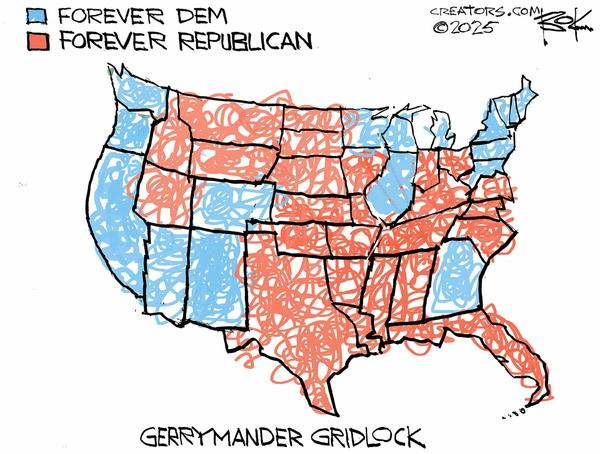
In The Week Ahead last Sunday, we kicked off a conversation about the Voting Rights Act, which had its 60th anniversary last week. The irony of the Supreme Court’s announcement late on the Friday night ahead of that anniversary, that it would hear a case with an issue designed to gut much of what remains of it, was far too measured to be coincidence. Here’s your essential refresher on the Act, and the way the Supreme Court has eroded it. Most importantly, this is not hopeless! Electing majorities in the Senate and the House at the midterms would almost certainly make restoring the Act, which the Supreme Court invited Congress to do, a top priority. We took that issue up in conversations later in the week, which you’ll want to see if you missed them during the week.
On Monday, Marc Elias and I discussed the Voting Rights Act. There is no sugar coating here, but realism about where we are, and also what the path forward could look like if we don’t give up.
There’s no nice way to put it. I’m heartsick about what’s happening at DOJ and the FBI. Discussed in this post, Desecrating DOJ. Pam Bondi is proving to be exactly the Attorney General we expected—someone with loyalty to Donald Trump instead of to the Constitution. But even here, there are guardrails—even if DOJ tries to indict its revenge cases, grand juries may refuse to go along. If they indict, trial judges and juries must be persuaded of guilt beyond a reasonable doubt. Make sure you read this piece to the end, because part of Trump’s shtick is persuading people to give up because he’s already won, already taken the system apart, and he has not. There is still some play in the joints, and every reason for us to persist.
We had no chicken pictures this week, but the Turkeys that were roaming around in the woods while I finished proofreading my book were pretty engaging. I appreciated all the people who wrote to tell me this was a pack of males roaming around in the pre-mating season. The things you can learn here at Civil Discourse!
If you missed my conversation with Alabama Congressman Shomari Figures, do yourself a favor and go listen now. Shomari was elected out of Alabama 2, the new district created last term after the Supreme Court ruled Alabama’s legislature engaged in racial discrimination when it drew new maps after the decennial census and ordered them redrawn. I’m a little biased here, Shomari was my Obama-era colleague working on criminal justice reform and other issues, and his parents are civil rights icons in Alabama, but he makes you feel proud to be a Democrat. This is a conversation filled with hope but tempered with realism. Shomari is part of the new generation of leaders we need.
This week’s Five Questions column featured Maine’s Secretary of State (and gubernatorial candidate) Shenna Bellows, who recently told the administration to “Go Jump in the Gulf of Maine,” when it asked her to give them information on Maine’s voters. This is someone who knows what it takes to run an election, but in addition to being smart, she also reminds us that elections are about us and about grassroots American patriotism. We’ll follow up with a Substack Live with her soon.
Finally, last night’s, A Tough Week for the Rule of Law, catches us up on more of the difficult legal news from last week. “In order to resist what Trump is doing in our country, you need to be informed; you need to know what’s at stake.” It can be awfully tempting to look away right now, but don’t. This is our generation’s fight for democracy, and this week confirmed my sense that I landed on the right title for my book, when I called it “Giving Up is Unforgivable.” Get mad. Get angry. Feel the sadness of the moment. But don’t give up.
I hope you’ll use the week’s posts to stay up to speed and that you’ll share them widely—it’s going to take every last one of us to reset guardrails in Congress in the 2026 election. There will be nothing more important, and the time to start educating people around you is now. Thanks for being here with me at Civil Discourse, as we take on the challenges ahead!
“Rep. Rob Bresnahan, a multimillionaire who recently sold control of his family’s company and now represents one of Pennsylvania’s poorest congressional districts, appears to have taken steps to hide one whirling aspect of his wealth: his new personal helicopter.” #PA08pic.twitter.com/k6IqcD0LmN
MAGA Republican Rep. Rob Breshnahan represents the second poorest congressional district in the nation (#PA08) and is a prolific stock trader.
Breshnahan also secretly owns a 2024 Robinson R66 helicopter worth between $1 million and $1.5 million. pic.twitter.com/4JyA7EV8FP
— Republican Accountability (@AccountableGOP) August 8, 2025
While his constituents scrape by, Rep. Rob Bresnahan is literally flying over their struggles in a secret, million-dollar helicopter, then landing just in time to vote to gut their health care and food assistance. #PA08pic.twitter.com/YDy342t747
— American Bridge 21st Century (@American_Bridge) August 8, 2025































 Scottie's Playtime