Extra! Extra! 4/13 by Jessica Craven
What’s right with this picture? Read on Substack

Hi, all, and happy Sunday!
Also, a belated Chag Sameach to everyone who celebrated Passover yesterday.
I know it’s been a super tough week—it’s all the more reason that a pause for good news is important. So here’s everything I could find that went right in the last seven days. As always, there was a lot more of it than you might have thought.
Enjoy reading this list. And please share. Lots of folks need a morale boost—I’m sure you know a few of them.
And if you notice that I forgot something please drop it in the comments! Like everything in this newsletter, they’re open to everyone.
OK, my friends. Have a great rest of your day. Tomorrow we get back to the fight.
Read This 📖
Rebecca’ Solnit’s post about the Hands Off protests, which includes the speech she made at the one she attended, is an absolute must-read.
Celebrate This! 🎉
In an unexpected win for antitrust, one of the Republican commissioners remaining on the Federal Trade Commission will save the agency’s investigation into pharmacy benefit managers by unrecusing himself from the case.
A plan to study “social housing” passed the Portland City Council with unanimous support.
Four countries—Brazil, Thailand, Zambia and Poland—have successfully reversed democratic decline in recent years.
AOC is leading Chuck Schumer among Democratic primary voters by double digits.
A judge blocked the White House’s AP ban.
Sen. Richard Blumenthal announced that he plans to place a hold on ALL Trump nominees going forward.
Sen. Brian Schatz is placing holds on over 50 Trump nominees. He has also placed holds on all nominations at the State Department, bringing his total to over 300 positions. Bravo!
The American Library Association, the largest library association in the world, and the American Federation of State, County and Municipal Employees, the largest union representing museum and library workers, are suing the Trump administration over its gutting of the Institute of Museum and Library Services.
In response to public backlash, the National Park Service restored original content to its webpage about Harriet Tubman and the Underground Railroad.
A federal judge in Texas (appointed by Trump) has issued a ruling blocking the removal of individuals under the Alien Enemies Act, citing concerns raised in the Supreme Court’s recent decision and the controversial Abrego Garcia case.
A Delaware judge ruled that Newsmax’s coverage of Dominion Voting Systems was false and defamatory.
Senator Adam Schiff called on Congress to investigate whether President Donald Trump engaged in insider trading or market manipulation when he abruptly paused a sweeping set of tariffs, a move that sent stock prices skyrocketing.
Indiana lawmakers in the state’s Republican-led senate are looking to take on pharma’s price-gouging middlemen known as pharmacy benefit managers by creating a public system.
The Government Accountability Office (GAO) is auditing DOGE.
A federal court ordered multiple government agencies to provide additional details about their use of Signal for official government business.
A coalition of more than 240 pastors, Christian faith leaders, and faith-based nonprofit organizations across Tennessee have come together to oppose a bill that could allow public schools there to deny enrollment for migrant children without legal status.
American Oversight secured a significant legal victory after a Georgia court denied State Election Board member Janice Johnston’s motion to dismiss in its ongoing transparency lawsuit against the Georgia State Election Board.
Maine officials sued the Trump administration to try to stop the government from freezing federal money in the wake of a dispute over transgender athletes in sports.
The Supreme Court told the Trump administration to seek the return of a migrant mistakenly sent to a Salvadoran prison, rebuffing government claims that it need do nothing to remedy its error.
In Wisconsin, former state Supreme Court Justice Michael Gableman agreed to surrender his law license following a disciplinary complaint related to his conduct during his investigation of the 2020 presidential election.
Two groups representing Harvard professors sued the Trump administration, saying that its threat to cut billions in federal funding for the university violates free speech and other First Amendment rights
The Trump administration restored USAID emergency food programs in Lebanon, Syria, Somalia, Jordan, Iraq, and Ecuador.
After local residents organized a 1000-person march past Tom Homan’s house in rural upstate NY, the Sackets Harbor Superintendent announced that an ICE-abducted family—including 3 small children—would be returning home. Amazing!
Since Trump’s “Liberation Day” announcements his approval ratings have absolutely plummeted.
Solar energy in New York got a big boost with the announcement of a $950 million contract to construct the state’s largest solar farm, and the program has now broken ground.
A first-of-its-kind pilot to electrify homes on Cape Cod and Martha’s Vineyard is set to finish construction in the coming weeks — and it could offer a blueprint for decarbonizing low- and moderate-income households in Massachusetts and beyond.
Initial analysis of the Wisconsin elections on April 5 shows that relative to 2024’s presidential race, every single county in Wisconsin moved left. Wow!
A federal judge rejected Johnson & Johnson’s third attempt to use a controversial legal maneuver to settle tens of thousands of lawsuits claiming its baby powder and other products were tainted with toxic asbestos and caused cancer.
A Mississippi judge on April 4 dismissed former governor Phil Bryant’s (R) defamation suit against a nonprofit newsroom for exposing potential corruption in his administration.
Companies are starting to tack tariff surcharges onto invoices as a separate line item.
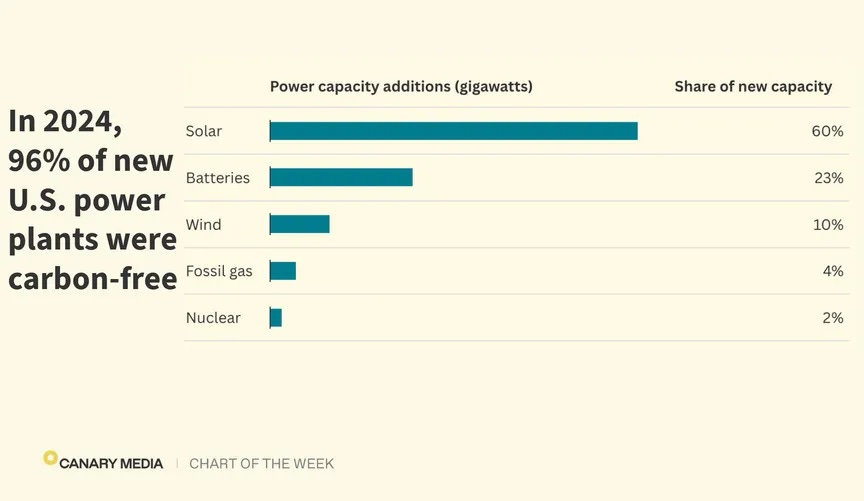
Fossil fuels made up less than half of the U.S. electricity mix in March for the first month on record.
Senator Chris Murphy raised 8M in the first quarter of this year—even though he just won re-election last year! (Presidential run coming?)
Chevron was ordered to pay more than $740 million to restore coastal wetlands in Louisiana.
The U.S. solar industry has stockpiled 50 GW of imported equipment, which will help it stave off the impact of President Trump’s tariffs.
Some House Freedom Caucus members are apparently warming to the idea of a new 40% tax bracket for those earning $1 million or more to offset some new tax cuts. YEs, you read that right.
Alabama legislators unanimously passed a bill that would expedite access to Medicaid for pregnant women.
Former New Hampshire Gov. Chris Sununu (R) told the Pulse of New Hampshire that he will not run for the U.S. Senate, a setback for Republicans’ hopes to flip the open seat.
The Senate parliamentarian ruled that Republicans in Congress cannot use an obscure legislative maneuver to stop California’s ban on the sale of new gasoline-powered cars by 2035.
The Wisconsin Supreme Court dismissed a challenge last week that sought to limit municipalities’ authority to set early voting locations and prevent the future use of a mobile voting van.
Maryland lawmakers passed a package of energy bills that includes provisions for fast-tracking some community solar project approvals and prohibiting counties from banning solar development in hopes of curbing power rates.
Republican senators, led by Sens. Bill Cassidy of Louisiana and Lindsey Graham of South Carolina, unveiled a bill Tuesday that would slap penalties on countries that generate high levels of manufacturing pollution. Yes, really.
The world used clean power sources to meet more than 40% of its electricity demand last year for the first time since the 1940s, figures show.
Jeff Bezos is funding a secretive EV startup based in Michigan called Slate Auto that could start production as soon as next year. Slate Auto is tackling a big goal: an affordable two-seat electric pickup truck for around $25,000.
36K people attended Bernie Sanders’ and AOC’s “Fighting Oligarchy” event in Los Angeles.
For the first time, a fully electric airplane flew from New York to California and back again.
The California Coastal Commission voted to fine Sable Offshore, an oil drilling company, nearly $18 million after Sable repeatedly ignored cease-and-desist orders, failed to obtain Coastal Development Permits, and proceeded to restart its work on oil infrastructure with a documented history of environmental disaster.
DOGE backed away from cuts to Social Security phone services following intense backlash.
Federal agents attempted to enter two Los Angeles Unified elementary schools this week. The principals of each school denied the agents entry and contacted legal support; the agents left. Let’s give a round of applause to the LAUSD community members and activists—some of whom I know—who “went deep on proper warrants for entry,” as soon as Trump was elected. Because of them, these schools were prepared and disaster was averted!
Russia freed a Russian-American ballerina in a prisoner exchange with the Trump administration.
Almost 300,000 new EVs were sold in the U.S. in the first three months of the year, a nearly 11% increase.
A federal judge ordered the Trump administration to unfreeze federal funding that was allocated to Maine from the U.S. Department of Agriculture — funds that had been withheld following President Trump’s clash with Maine Gov. Janet Mills over the issue of transgender athletes.
In Coeur d’Alene, Idaho, police have recommended criminal charges—including battery and false imprisonment—against the security team who brutally dragged Dr. Teresa Borrenpohl out of a town hall in February.
For the first time, fossil fuels accounted for less than half of U.S. electricity production across an entire month as clean power generation surged in March.
A federal judge in New York also blocked the Trump administration from continuing to deport people under the Alien Enemies Act.
A federal judge has rejected President Trump ‘s effort to dismiss a defamation lawsuit against him filed by the men formerly known as the Central Park Five
It’s official: The Tesla Cybertruck is a flop. (snip-a bit more)