
Category: Animals / Insects / Water Life / Plants / Nature
The Birds Must Be Heard & Seen
Just click through on the birds’s names to see more and hear their songs.
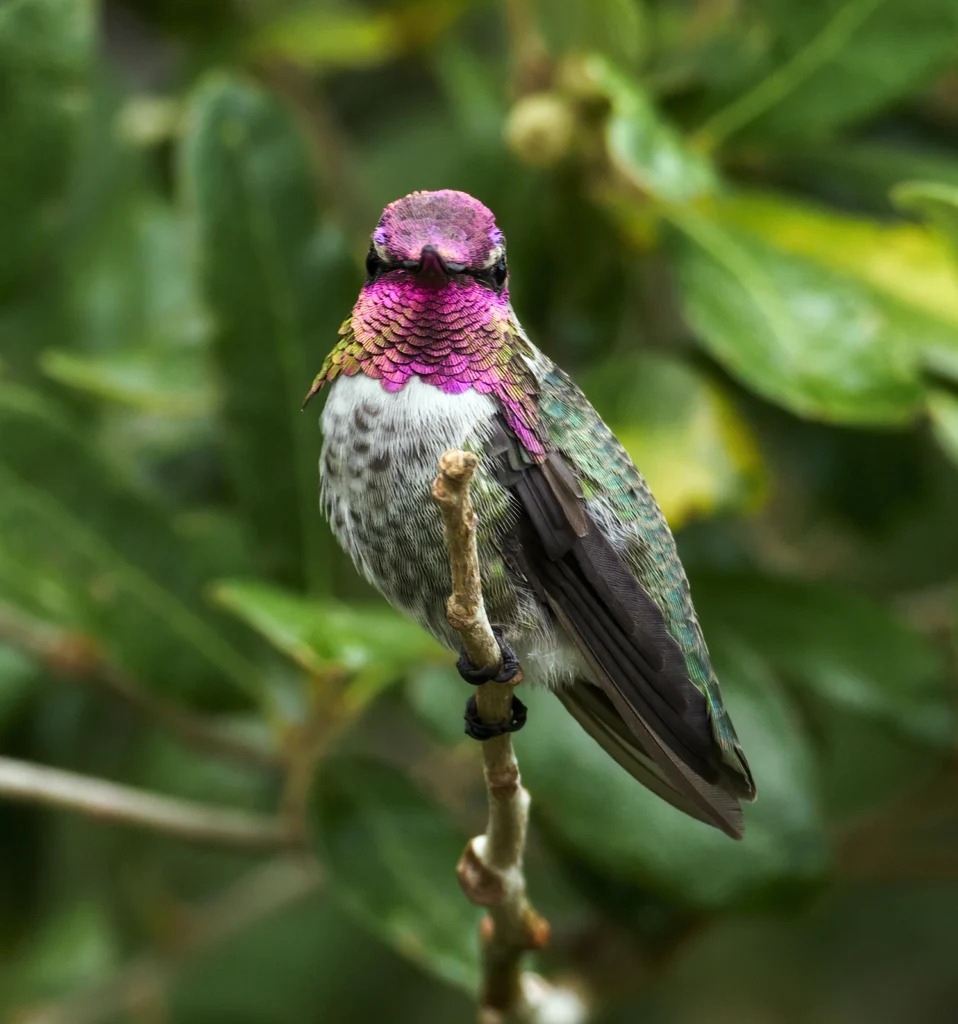
Anna’s Hummingbird
Calypte anna
Colibrí Cabeza Roja (Spanish)
About
The Anna’s Hummingbird is a characteristic and charismatic species of coastal Central, Southern, and Baja California, although this species has expanded its range northward along the Pacific Coast and eastward into the Desert Southwest. Like the Rufous Hummingbird, Anna’s is well known for its aggressive territorial behavior. Males fiercely defend feeding areas, where they chase away other male hummingbirds and even large insects such as bumblebees and hawk moths that try to feed there.
Although the Anna’s Hummingbird readily feeds from non-native plants, wild plants are still crucial to these birds — and the birds are just as critical to these native plants. Anna’s Hummingbirds are important pollinators of the chaparral flora of coastal California. Many of these plants flower in the winter months, coinciding with California’s wet season. To take advantage of this boon of nectar, Anna’s Hummingbirds in coastal California breed in what is the nonbreeding season for most North American species, nesting as early as mid-December. After the rains end, many hummingbirds will move up into the mountains to take advantage of blooms at higher elevations.
The Anna’s Hummingbird is a highly vocal species, especially for a hummingbird. Males sing a complex, scratchy-sounding song while perched and during their high-flying courtship spectacles. The male performs this diving display by first ascending to 100 feet or higher, then swooping toward the ground. At the bottom of his dive, he will be moving at about 60 miles per hour, just overhead of a female (or intruding male). At the last minute, he banks upward and flares his tail, causing his modified tail feathers to produce an explosive, high-pitched chirp. The gravitational force (“G-force”) caused by this maneuver would cause a human pilot to lose consciousness, but these little hummingbirds do it again and again, up to about 40 times back to back, when trying to impress a female. He also orients his dives to maximize the reflectance of his beautiful gorget — the gem-like patch of tiny iridescent purple-pink feathers on his throat. According to researchers Christopher Clark and Stephen Russell, from the perspective of a female, he looks like a “tiny, glowing magenta comet” plummeting towards her. (Snip-More on the page. Actually hear a hummingbird!)
=====
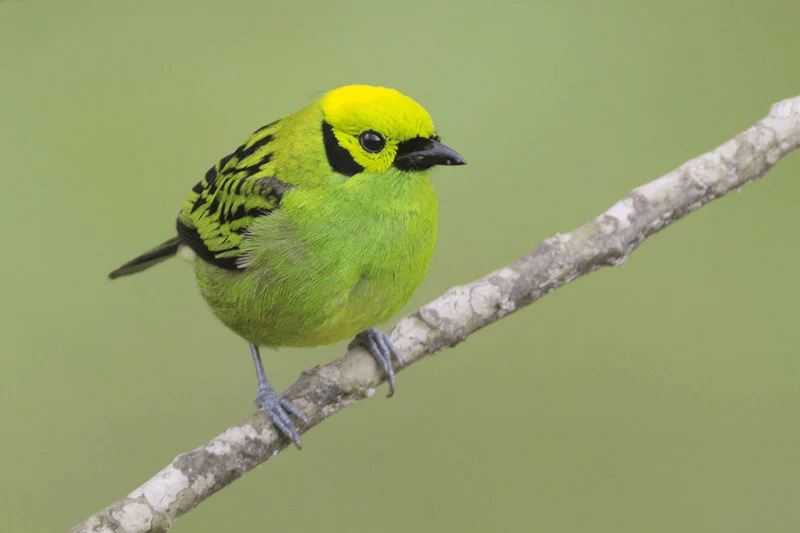
Emerald Tanager
Tangara florida
About
The Emerald Tanager is truly a gem of the forest, roaming through the canopy in search of fruiting trees in the humid montane forests of Central and northern South America. Although primarily a fruit-eater, this species is also adept at hunting insects and other invertebrates on tree branches, deftly manipulating mosses with its bill in search of prey. This behavior sets it apart from other tanager species it often flocks with, but outside of the Emerald Tanager’s range, other specialized tanager species may fill this niche.
The Emerald Tanager’s relationship with moss extends beyond its foraging habits. Though their breeding biology is largely undescribed in peer-reviewed literature, the nests that have been observed have either been made of moss entirely or thoroughly covered in it. This, of course, provides good camouflage on the mossy branches where these tanagers build their nests. (Snip; MORE, and hear the Emerald Tanager)
A Couple of Fun Bits
I understand about the pastry boxes; they are pretty stupid. Lewis Black expresses someone’s feelings as Lewis Black does.
Have a fun dog video!
Oh, yeah! Another email buried but that I wanted to post here last week. My accomplished niece is a writer, and this is her webpage for her fiction books, Swaimwrites.com . She’s got one about to be released called “Reven,” which is, as her site says, “A steampunk retelling of Peter Pan about the lengths we’ll go to escape the past.” I’m excited to read it, not only because I’m her auntie, but because it looks like it’ll be perfect for these times!📖📚
Observing Women’s History Month
I haven’t made a Women’s History Month post in a while; it’s difficult to feel celebratory in the face of what both very bad men and women are doing in our names in the US these days. However, to make up for being remiss in re-recording history, please accept this post about Rose O’Neill. I first learned of her when my grandparents moved to Springfield, MO in 1970, and took us to her small museum at the small, then-non-commercial Shepherd Of The Hills area. (It was great back then!) I knew of Kewpies (I don’t care for the cutesiness, but they are art nonetheless,) but had no idea a woman created them, nor that she did so much art right in the area where we were then living. I began to be a fan, but sort of let it go as I got older. Below will be a PBS documentary that is excellent, and inspired me to make this post for March 21st. There is also some other info. Enjoy, and remember, we all have history, and it doesn’t go away just because someone makes it more difficult to find (yes, that is encouraging myself as well as readers who’ve made it this far!)
Here is a link with a snippet, about the museum now in Walnut Shade, MO. I bet all the things I remember will be there. Maybe I’ll make it over there and try again. It looks far less commercialized than Shepherd of the Hills last time I was there.
Rose O’Neill’s Bonniebrook
“I love this place better than anywhere on earth”
-Rose O’Neill about Bonniebrook
Bonniebrook is a historic home and museum located in Walnut Shade, Missouri, just a short drive from Branson. Our museum is dedicated to preserving the life and legacy of artist, writer, and activist Rose O’Neill, best known for her creation of the Kewpie dolls.
Bonniebrook Museum features Rose’s original drawings, paintings, and sculptures, artifacts from the O’Neill home, a large collection of Kewpies and other characters, the O’Neill family cemetery, and much more!
As one of the only art museums and historical homes in the Branson area, Bonniebrook is a must-see destination for those looking for things to do in Branson, Missouri and the surrounding areas. Come visit this well-preserved piece of history!
Mission Statement:
Bonniebrook Historical Society (BHS) was founded in 1975. Its purpose is to collect, preserve, and make available for educational and historical purposes artifacts, documents, personal items, and any work or items directly relating to the history and life of Rose O’Neill. In addition, BHS accumulates research, materials that document, authenticate, explain, and provide detailed information about the character, personality, and accomplishments of the talented and generous Rose O’Neill.
And here is the documentary I watched yesterday and mentioned above. It’s very worthy of views!
For The Weekend On A Friday Night
Ballad of the Wandering Charms: Weekend Edition
A Softening of the Day
Richard Hogan, MD, PhD(2), DBA

O come now, friend, and rest your bones,
the week’s been fierce and long;
but Ease comes stepping down the lane
to hum you its soft song.

A Lantern glows along the path,
a stubborn, golden spark;
the kind our grandfolks swore was left
to guide us through the dark.

Stillness drapes its woolen shawl
around your weary frame;
it whispers like an old seanchaí
who’s long forgotten blame.

The Hearth is warm for wanderers,
its welcome deep and wide;
it keeps a chair for every soul
the world has weathered tired.

Then Solace pours a quiet cup
the colour of the dawn;
it doesn’t ask what burdens ache—
it simply sits till they’re gone.

Your Breath returns like gentle rain
across an Irish hill;
it fills the fields inside your chest
and bids your heart be still.

And Grace—ah sure, it comes uncalled,
the way good blessings do;
it settles on your shoulders light
as morning’s silver dew.

An Ember glows beneath it all,
a spark that won’t give in;
the same that warmed our ancestors
through storm and winter’s din.

So walk with Gentle in your step,
let kindness be your guide;
for those who move with softened hands
find strength they need not hide.

And Here you stand, upon the earth,
your troubles set to rest;
the world leans in a little close
and wishes you its best.
Should you wish, please feel free to subscribe (no Paywalls): (Link up top as the title)
Thank you.
FWIW, All My Very Best
for a fine Spring this year. As I type, the Equinox will occur in 54 minutes. This is a striking photo!
Astronomy Picture of the Day
Discover the cosmos! Each day a different image or photograph of our fascinating universe is featured, along with a brief explanation written by a professional astronomer.
2026 March 20

Spring Equinox at Teide Observatory
Image Credit & Copyright: Juan Carlos Casado (Starry Earth, TWAN)
Explanation: The defining astronomical moment of the equinox today is at 14:46 UTC (March 20). That’s when the Sun crosses the celestial equator moving north in its yearly journey through planet Earth’s sky, marking the beginning of spring for our fair planet in the northern hemisphere and fall in the southern hemisphere. Then, day and night are nearly equal around the globe. In fact, both day and nighttime exposures from a spring equinox at the Observatorio del Teide in Tenerife, Canary Islands, Spain, are used in this composited skyscape. Over 1,000 images were taken with a fisheye lens and merged in the ambitious equinox project. The apparent motion of the Sun setting along the celestial equator on the equinox date follows the bright linear, diagonal track from the sequence of daytime exposures taken over 6 hours. After sunset, nighttime exposures recorded startrails, with the celestial equator as a linear track and concentric arcs circling the north celestial pole near Polaris at upper right and the south celestial pole beyond the lower left edge (and below the Teide horizon). The foreground includes the distant Teide volcano peak and the observatory’s pyramid-shaped solar laboratory building.
Tomorrow’s picture: NGC 1300 and Friends
It is not just the oil


Trump and Hegseth do not understand supply chains. Or China, or Russia, or Yemen. They only follow Israel.
They were blackmailed into war.
Reblogging da-AL:
Oopsie!
I didn’t get “Lay Lines” posted yesterday. Although, I didn’t have/take time to read comics yesterday… anyway, here it is, a day late.

Tuesday For Science!
This is the answer to yesterday’s Free The Ocean Trivia. I got it correct, but it was a guess because the other ones didn’t really seem correct. Anyway, it’s good eco news for Tuesday, taken from nature!
Clownfish Collapse in Size as Ocean Temperatures Break Records·
Written by Matthew Russell
In the shallows of Papua New Guinea’s Kimbe Bay, scientists have documented a surprising adaptation among one of the ocean’s most recognizable fish. During a 2023 marine heatwave, orange clownfish—familiar to many as the inspiration behind *Finding Nemo*—began shrinking. Not just slimming down, but actually shortening their bodies to weather the rising temperatures of their coral reef home, as reported by AP News.
This previously undocumented response was observed across dozens of breeding pairs tracked over several months. The findings, now published in *Science Advances*, offer rare insight into how marine species are physically changing to survive extreme climate conditions.

Clownfish are shrinking their bodies during marine heatwaves.
The Heatwave That Triggered a Transformation
Between February and August 2023, researchers repeatedly measured 134 clownfish as ocean temperatures soared to levels resembling a “hot bath,” according to Newcastle University doctoral researcher Melissa Versteeg, whose team led the study alongside local organizations Mahonia Na Dari and Walindi Resort. The scientists discovered that nearly three-quarters of the adult fish shrank at least once during the period, decreasing in total length by several millimeters. These changes happened in mere weeks—not over a lifetime, as previously assumed in similar cases, according to Vox.
Unlike earlier studies that linked climate to stunted growth in birds and mammals over generations, this was physical shrinkage in mature individuals. The observation challenges assumptions about static adult body sizes and opens new possibilities for understanding animal adaptability.

This size reduction is a physical adaptation, not just weight loss.
A Strategy Rooted in Survival and Social Balance
The shrinking wasn’t random. It was synchronized, particularly within breeding pairs. Versteeg’s team found that pairs where both fish shrank together had better odds of surviving the heatwave. The behavior, documented in the wild for the first time in reef fish, helps sustain clownfish social structure, Sustainability Times reports.
Clownfish live in tight-knit social hierarchies, often with one dominant breeding pair and several subordinate members. Size plays a critical role in that hierarchy. When heat stress reduced food availability or oxygen levels, shrinking may have reduced the energy and oxygen needs of the fish. Coordinated downsizing likely helped avoid social conflict and maintain reproductive bonds.
Speaking to the The Washington Post, Newcastle marine ecologist Dr. Theresa Rueger emphasized how this size shift offered advantages: smaller fish may manage heat stress better and require fewer resources—both of which are scarce in warming seas.
 The phenomenon was discovered during a 2023 heatwave in Papua New Guinea.
Beyond Clownfish: A Broader Pattern in a Warming Ocean
Clownfish aren’t alone. Scientists have linked higher global temperatures to shrinking trends in a range of species, from birds to mammals. A 2019 study showed that North American birds shrank by an average of 2.6% over several decades. But the clownfish response is distinct because it occurs rapidly, during the adult life stage, and in direct response to a single environmental event.
Thermal stress may trigger these changes by limiting the availability of oxygen and nutrients. Smaller bodies have less demand and are more efficient under strained conditions. There’s even speculation that clownfish, like marine iguanas, may be reabsorbing bone or fat tissue to reduce size, though more study is needed to confirm this hypothesis, BBC News reports.

Scientists measured 134 clownfish monthly and saw widespread shrinkage.
The Limits of Adaptation
Despite this remarkable display of flexibility, adaptation has its limits. The heatwave that prompted this discovery was the first of three consecutive ones in the region. Many of the clownfish studied didn’t survive them all. Coral bleaching—another side effect of heat stress—is stripping clownfish of their sea anemone homes. These vibrant, venomous hosts are essential for clownfish survival, offering shelter and protection. Without them, even the most adaptive clownfish may struggle to persist.
Moreover, this shrinking behavior is not a cure-all. As pointed out by University of Massachusetts fish biologist Joshua Lonthair in The Washington Post, if shrinking turns out to be a widespread response to environmental pressures, it may fundamentally alter how scientists understand growth and maturity in marine life.
Looking Ahead
The clownfish shrinking phenomenon marks a breakthrough in how marine biologists interpret resilience. It’s a glimpse into the extraordinary ways wildlife tries to keep pace with a planet in flux. While researchers continue to explore the exact mechanisms behind this body-size shift, one thing is clear: even iconic species like the clownfish are being reshaped by climate change—literally.
Understanding these changes is crucial, not just for preserving individual species, but for forecasting the health of entire marine ecosystems. In a world growing hotter by the year, adaptation may be the difference between survival and extinction.

