The video below is hilarious. Right wing trump loving maga Dave Rubin gets destroyed with facts and figures from podcaster Parkergetajob. While Rubin tries to spout maga talking points and fox news misinformation. Hugs

The video below is hilarious. Right wing trump loving maga Dave Rubin gets destroyed with facts and figures from podcaster Parkergetajob. While Rubin tries to spout maga talking points and fox news misinformation. Hugs
In normal times, in a normal Federal Communications Commission, Anna M. Gomez’s job might be described as wonky. But now is not that time.
“A large part of my role is to call out this administration’s abuses of the First Amendment, particularly when it chooses to weaponize the FCC in trying to shut down any voices that it doesn’t like,” said Gomez. “And we see this constantly, there is a constant infringement on the free press and on the First Amendment and on the rights of viewers and listeners to see and hear what they want to see.”
Gomez is the sole Democrat on the commission. Her term is set to end on June 30. Normally, there would be five commissioners at the FCC, but right now, there are only three. Two resigned last year, and the Trump administration has not nominated their replacements. Gomez is on a First Amendment tour of sorts—telling Americans that the actions of the FCC chair, Brendan Carr, are egregious. Disney seems to agree. Unlike other media companies, it’s lawyered up to fight against the FCC’s latest demands.
On a recent episode of What Next: TBD, host Lizzie O’Leary spoke to Gomez about the FCC and why ABC isn’t folding like CBS did. This transcript has been edited and condensed for clarity.
Lizzie O’Leary: How do broadcast affiliates work?
Anna M. Gomez: Although Disney owns and operates only eight stations nationwide, there are hundreds of ABC affiliates because there are hundreds of markets all over this country. They are owned independently by other broadcasters. Some of those broadcasters are quite large, and some of them are very small.
The FCC manufactured a complaint against a Disney station in Texas that carried The View. And although multiple ABC stations carried that particular program, it had the Texas Democratic Senate nominee James Talarico on it.
There were tons of other ABC affiliates that also could have had this complaint lodged against them. But the FCC went to the nonowned affiliates in the market and said to them: “We want you to file with us, and we’re not going to hold it against you because of this alleged violation.” They didn’t go to Disney.
The FCC then used the fact that other affiliates filed as a reason to initiate this investigation against the one Disney-owned station. That to me is a setup. Some would call that entrapment. It’s where the FCC manufactures an issue and coordinates with the other stations so that only the Disney-owned station is the outlier. And this is why it is so egregious what this FCC is doing, because it is clearly targeting Disney in retaliation for its viewpoints.
How is that legal?
It’s not. It’s absolutely unlawful. Not only is it unlawful, it is also unconstitutional. The FCC is challenging the First Amendment rights of the broadcasters, the talent, the press, through all of these actions. We are explicitly prohibited from censoring broadcasters, but this is censorship.
This feels like a shakedown. This feels like the emperor doesn’t like these comedians, whether it’s Jimmy Kimmel or Joy Behar, and if you don’t do something, we’re going to take away your affiliate licenses. Is that a fair reading?
Absolutely. This administration cannot tolerate anything that is critical of it, that doesn’t mention its worldview. And it is weaponizing any tool in its toolbox, whether it’s the FCC, the Federal Trade Commission, the Department of Defense, in order to go after the press and to go after the media.
It is clear that this is absolute harassment in order to get Disney to capitulate. The good news is that Disney is not capitulating. It has actually shown courage. It has decided to stand up for its First Amendment rights and to push back. And if this gets carried out to its conclusion, and by that I mean it goes to court, the FCC will lose.
Is Disney finding a spine, or can Disney read a poll?
Disney has, in fact, found its spine. Part of that, of course, is that we saw Disney capitulate very early on when it settled the case against ABC because of the George Stephanopoulos interview. And legal scholars said there is no basis for this case, but it went ahead and settled it. And that opened the door to all of these future actions against the media. I think what Disney learned is that capitulation doesn’t buy you protection; it might buy you some time, but they will keep coming back and coming back for more because what they demand is absolute allegiance to this administration and nothing else.
I’m curious about where this impacts TV. How much of this campaign is about pressuring tech platforms?
There’s an absolute campaign by this administration to censor and control any media outlet using whatever levers it has at its power. Look at social media. The Federal Trade Commission used the fact that there were two ad agencies merging to force them to carry ads on Twitter, which they had stopped doing because of some of the content that they found to be harmful to their clients’ interests. And that is forced speech. That is a First Amendment violation.
I do believe that this administration is sending a signal. We have seen media companies win time and time again against this administration when they go to court. But litigation and regulatory investigations are costly, and a lot of companies, corporate parents, make the decision that it is actually less painful to settle and to capitulate than it is to fight. So the process is the point, the pain is the point, the threat is the point. They don’t want this to be carried out to its fruition. They want it to just force the companies enough pain so that they will capitulate. Now, I think this is a signal to every part of the media that they would do this to them, whether it’s to the New York Times, Wall Street Journal, universities, law firms, or broadcasters. They will go after anyone who speaks out against them.
Date: May 31, 2026
Source:University of Rochester
Summary: Scientists have developed a solar desalination system that turns seawater into drinking water without creating environmentally damaging brine. Special laser-textured metal panels use sunlight to evaporate water while automatically moving salt deposits away from the working surface, preventing clogging. The process was successfully tested with water from three oceans and can recover nearly all salts as solids. Those leftover materials could even become a source of valuable lithium for batteries.
‘This is a tragedy’: swimming snakes open new front in battle with Balearic lizards
Sam Jones in Madrid
Irrefutable proof of what Spanish researchers and wildlife experts had long suspected, and long feared, finally presented itself in the form of a grainy video that was shot on a minuscule island in the Balearics in April 2024.
Ribboning its way through the turquoise waters that separate the east coast of Ibiza from the islet of Santa Eulària 450 metres away, came a pale and solitary horseshoe whip snake in search of new territory and fresh sustenance.
The arrival of the snake on Santa Eulària, recorded by a local wildlife ranger, confirmed that the insatiable invader from the Spanish mainland – which has almost wiped out Ibiza’s endemic population of dazzlingly coloured wall lizards – had opened up a new front.
“There’d been increasing anecdotal evidence from fishermen and tourists who’d seen the snakes swimming, so we’d thought it was happening very often,” said Oriol Lapiedra, a biologist at the Centre for Ecological Research and Forestry Applications (Creaf) in Catalonia. “But this was the first proper [evidence] we’d had of a snake swimming from Ibiza to the islet.”
The horseshoe whip snake, a non-venomous reptile found across southern and eastern Spain, has become an existential threat to the lizards since it began appearing on the island two decades ago.
Its rapid colonisation has been attributed to the fashion among wealthy property owners in Ibiza for importing ancient olive trees from mainland Spain to adorn the grounds of their homes. Unbeknown to them, however, the trees – replete with their nooks and hollows – have provided ideal travel berths for hibernating snakes and snake eggs. (snip-MORE)
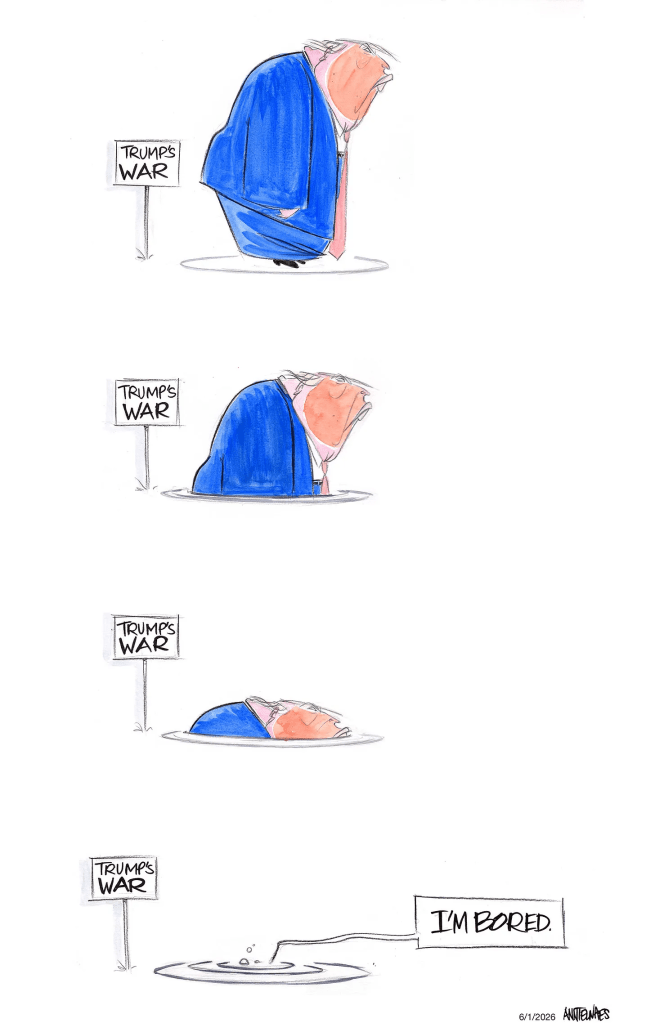
Trump also says he “couldn’t care less” if negotiations break down with Iran.
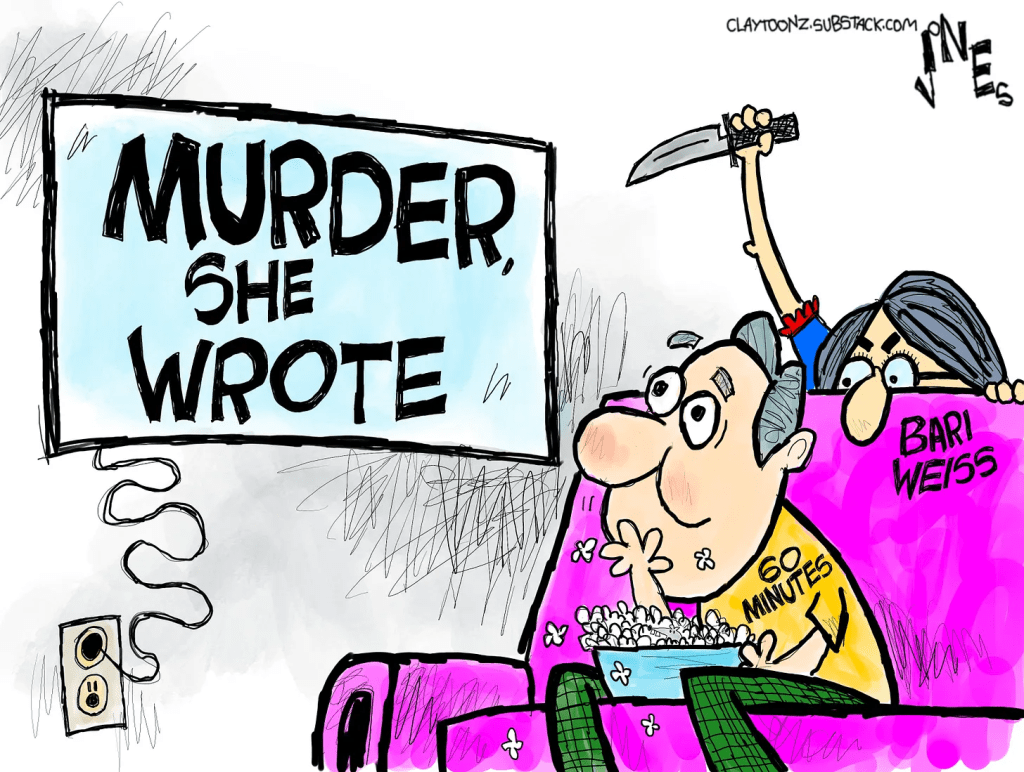
Getting rid of The Late Show with Stephen Colbert to appease Donald Trump isn’t the only poke in the eye of CBS by Paramount Skydance.
Bari Weiss, the network’s editor in chief, appointed by Paramount Skydance CEO and Trump ally David Ellison, has been accused by Scott Pelley of murdering 60 Minutes.
Ellison really wants to be on good terms with regulators in the Trump administration. He was at the inauguration, has attended UFC fights with Trump, and even hosted an invite-only Washington DC party for him.
Tech journalist and filmmaker Nick Bilton is the new executive producer of 60 Minutes, who was appointed last week after the firing of former producer Tanya Simon and her deputy, along with correspondents Sharyn Alfonsi and Cecilia Vega. Bilton held a morning meeting in Midtown Manhattan, which was a formal introduction to the staff of 60 Minutes, where he was told by Pelley that he had “slender” qualifications for the job and that Beri Weiss was “murdering” 60 Minutes.
A recording of the meeting was obtained by The New York Times. (snip-MORE)

This is Bodie. His presence indicates the beginning of Pride Month. May his whimsy and steadfastness bring joy and confidence to all. 14/10 the parade starts right behind him 🌈🐾
June 01, 2026 Cueball

By James Jordan, Sumner Newscow — The month of May is barely over, and the wheat harvest has already started in Sumner County. That is not a good thing. Last year, the harvest didn’t get going well until mid-June, which is still on the early side.
Drought conditions over the winter and early spring caused the wheat to mature earlier than it should have, resulting in poorer yields.
Recent rains are likely too little too late; wet conditions may even hamper the harvest.
Last year, there was good wheat in the fields, but wet conditions prevented a bumper harvest.
State and local wheat officials say the wheat that is out there is not in very good shape.
According to the Kansas Wheat Association, the crop generally looked good as it went into its dormant stage in the late fall. There was not much rain in March and April, which is the primary growing stage, turning a promising crop into a dismal one.
The drought conditions in that growing stage force the wheat to develop faster. It limits the yield and accelerates growth, which is why we have wheat ready to harvest so early.
There are still some areas in Sumner and Cowley County that may get good yields. Conditions are much worse in western and central Kansas.
According to USDA statistics, as of the beginning of May, 41 percent of the wheat was very poor or poor, with 35 percent being fair. Only 24 percent was rated good or excellent.
As of last week, the wheat commission reported 55 percent as poor to very poor, and 30 percent as fair. Only 15 percent was rated good.
Last year at this time, 48 percent was rated as good to excellent.
The USDA estimates that this year’s crop could be the smallest nationwide since 1965 and 25 percent smaller than last year.
By Peter Karleby
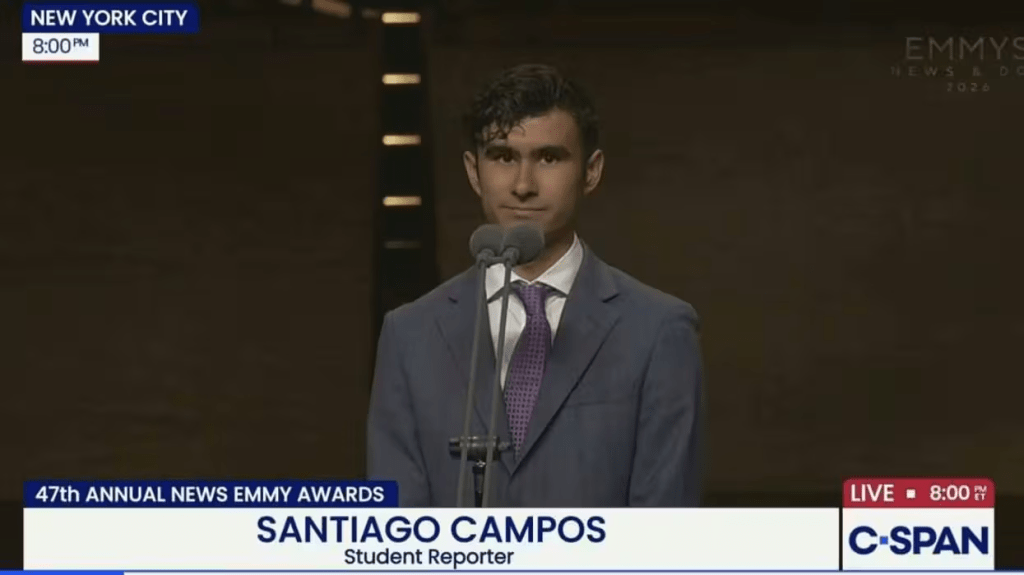
A student journalist is getting thunderous applause after bravely lambasting CBS’s capitulation to the Trump regime during his acceptance speech at the News Emmys.
Santiago Campos, a senior at District of Columbia International School in DC, was awarded the Mike Wallace Memorial Scholarship, created in honor of the legendary CBS journalist of the same name.
Campos, after being presented his award by CBS’s Scott Pelley, thanked the network for its gift but then quickly pivoted to calling out the appalling direction the network has taken since Trump re-took office last year.
Nearly every American media network has bent the knee to Trump to some degree, but none more than CBS, which has turned into something akin to state media since being taken over by right-wing propagandist and Trump acolyte Bari Weiss.
Campos, standing before a room full of the most powerful people in news, plainly called this what it is: a “stain” on Wallace’s legacy and journalism itself.
Campos called out in particular the network’s slant in favor of Israeli Prime Minister Benjamin Netanyahu, saying:
“While I want to thank CBS news for funding this generous gift towards my education, I want to also acknowledge how the recent direction of the outlet stains the legacy of Mike Wallace, the namesake of this scholarship…”
“…So, if at any time you hesitate to utter the word genocide or remain silent in the face of blatant lies. Remember to ask yourself, Who is this for?”
There’s little doubt of Weiss’s answer to that question—it’s “for” Donald Trump. But most of those who remain at the network since Weiss’s takeover once had reputations as some of the most august journalists in the country.
There are blaring signs that that is changing: CBS’s ratings have plummeted since Weiss’s takeover, which has seen both the network’s morning news show CBS Mornings and CBS Nightly News take decidedly more Trump-friendly stances. (snip-a bit MORE)
TOPEKA — Private school founder, farmer and businessman Zach Lahn is running an insurgent Republican campaign for governor in Iowa.
The former Kansan has labeled this outsider bid as an “Iowa First” campaign. He’s opposed abortion and high taxes, but defended gun rights, school vouchers and religious freedom. He told Iowa voters he admired President Donald Trump’s tenacious fight against the political establishment.
“I told my wife many times, if I ever ran for anything, the only thing I’d ever want to run for was governor,” Lahn said.
Lahn grew up near Sioux City, Iowa, graduated from University of Colorado in Boulder, worked for Montana and Colorado congressmen, served as Montana director of Americans for Prosperity and as an AFP fundraiser, and bought a Belle Plaine, Iowa, farm previously owned by relatives. He launched an unorthodox school in Wichita and voted in Kansas elections in the 2018, 2020 and 2022 cycles.
Lahn’s campaign didn’t respond to a request for comment about why he chose to run for governor in Iowa rather than Kansas or questions raised by the Iowa Democratic Party about his close ties to Kansas and decision in 2024 to transfer his voter registration to Iowa.
Lahn has stood out among Iowa’s GOP gubernatorial candidates by denouncing lobbyists, corporations and organizations with outsized influence on politics. He’s not been shy about criticizing Democrats and Republicans responsible for blocking public policy reform.
“I’m fighting the ‘Uni-party.’ Both sides have been bought off in many ways,” he said.
Lahn is on the Tuesday primary ballot with U.S. Rep. Randy Feenstra, state Rep. Eddie Andrews, former state Rep. Brad Sherman and former Iowa Department of Administrative Services director Adam Steen. The Democratic nominee will be Iowa state Auditor Rob Sand, who is running unopposed.
For the first time since 2006, an incumbent Iowa governor won’t be on the ballot. Republican Gov. Kim Reynolds, with one of the lowest approval ratings in the country, didn’t seek reelection.
Michael Smith, a political science professor at Emporia State University, said old-school political theory dictated gubernatorial candidates had to be rooted in a state’s political infrastructure and local community life to be relevant. That changed as Trump assumed control of GOP politics and showed how firebrand conservatives, including those without prior experience in public office, might find a lane to run, he said.
“It’s all different now,” said Smith, who indicated Lahn could be a beneficiary of that shift. “He’s trying to be his own kind of populist.”
Lahn created momentum for his candidacy by loaning the campaign $2 million and using that cash to fill the airwaves with television advertising.
After working for Americans for Prosperity, an advocacy group associated with founders of Koch Industries, Lahn moved to Wichita to launch the unconventional private school named Wonder. The pre-kindergarten through 12th-grade school opened in 2018 on the campus of Wichita State University. It was financed by Chase Koch, the son of billionaire Charles Koch, and Chase Koch’s wife at the time, Annie Koch.
Annie Koch and Lahn subsequently divorced their spouses and were married. They have seven children in a blended family and the kids have been featured in campaign materials.
Kansas voter registration records show Zach Lahn voted in Kansas with a provisional ballot in November 2018, in-person at a Sedgwick County polling place in November 2020 and with an advance ballot in the August 2022 primary. Zach Lahn registered to vote in Iowa on Oct. 17, 2024. Transferring his registration at that time allowed him to meet the state’s two-year residency requirement for a run for governor in 2026.
Jennifer Konfrst, a professor of journalism and strategic political communication at Drake University in Des Moines, said there was potential for Lahn’s “Iowa First” campaign slogan to come across as disingenuous among voters aware of his lengthy presence in Kansas. Iowa voters appreciate the life history of candidates, she said, but some dig deeper into whether a candidate’s staff came from Iowa or Washington, D.C.
“Being from here matters,” said Konfrst, a Democratic member of the Iowa House not seeking reelection. “It’s not unimportant that somebody who wants to be governor of Iowa isn’t from here.”
In July 2024, according to Sedgwick County’s register of deeds, Annie Lahn purchased a home in Kechi near Wichita and declared on mortgage documents it was her primary residence. One year after acquiring the property, Zach and Annie Lahn sold the home to an LLC for $1.
Business records filed with the Kansas Secretary of State’s Office identified the LLC’s “authorized person” as Wichita resident Mikaela Ledbetter, who made a modest donation in December 2025 to Zach Lahn’s campaign for governor.
Less than two weeks after the transaction in July 2025, Annie Lahn registered to vote in Belle Plaine, Iowa. Zach Lahn and his previous wife, Lauren, had purchased that Belle Plaine homestead in 2014.
The Des Moines Register reported in April that Zach Lahn flew from Iowa to Wichita in his personal airplane 37 times since Oct. 1, 2025. Zach Lahn told the Register the flights allowed him to be with children that he and his wife had from previous marriages.
“I’m trying my best to be present for things,” Zach Lahn told the Register. “I have no worries that we’ll be able to fulfill every duty we need to do on the campaign or as governor.”
Zach Lahn told the newspaper he moved from Kansas to Iowa in 2023 and was an official Iowa voter in the 2024 general election and a 2025 local election.
Iowa Democratic Party spokesperson Terra Hernandez seized upon the Register’s reporting to declare Zach Lahn a “Kansas carpetbagger.”
“Lahn has been trying to fool Iowa voters since the start of his campaign, thinks he can pay his way to the governor’s mansion with his millions in out-of-state money and spends more time in Wichita than Belle Plaine,” Hernandez said.
During the gubernatorial campaign, Zach Lahn has emphasized he was a sixth-generation Iowan with family roots as far back as the Civil War.
His campaign has concentrated on restoration of academic achievement in the state’s education system and removal of classroom educators who insisted on advancing personal ideology.
“We don’t have a spending problem. We have a quality problem,” Zack Lahn said during a GOP forum broadcast by KCCI in Des Moines.
He said he would work to preserve Iowa family farms after 10,000 vanished during the past 20 years. He said one-fourth of Iowa land was now owned by out-of-state investors. He proposed raising property taxes on Iowa land held by nonresidents so property taxes for Iowa residents could be lowered.
He’s questioned economic development strategies in Iowa that did little to stem the brain drain of youth to other states.
Zack Lahn, endorsed by MAHA Action associated with U.S. Health and Human Services Secretary Robert Kennedy Jr., made a campaign issue of rising cancer rates in Iowa. He promised to veto any bill granting agricultural chemical companies immunity from lawsuits tied to alleged failure to accurately warn consumers of health risks.
“I believe big ag and big pharma have treated our farmers and families as numbers, not neighbors,” Zack Lahn said.
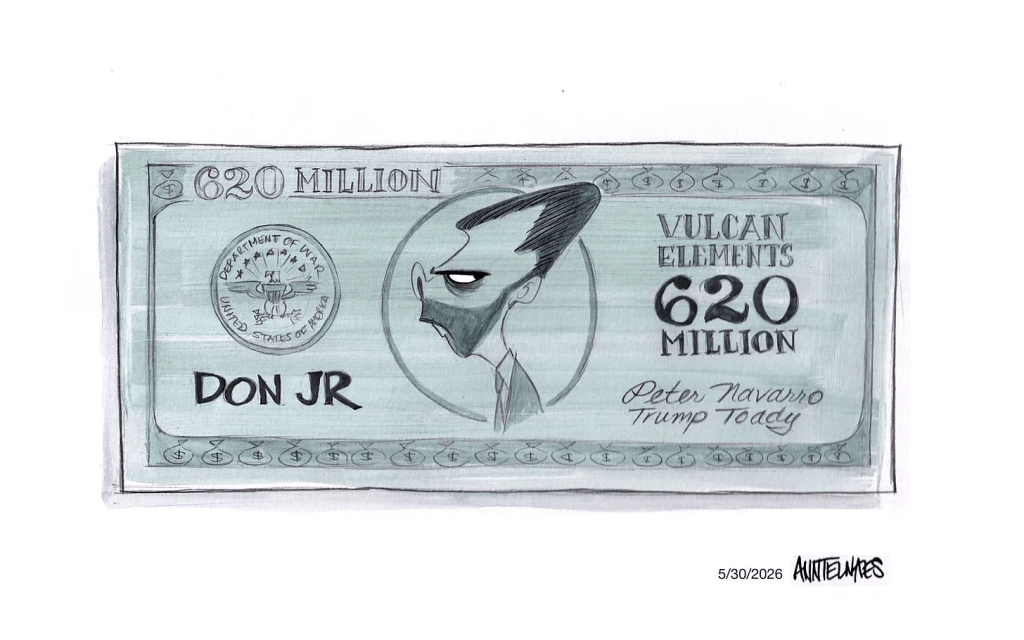
Propublica has a story about another Trump family grift
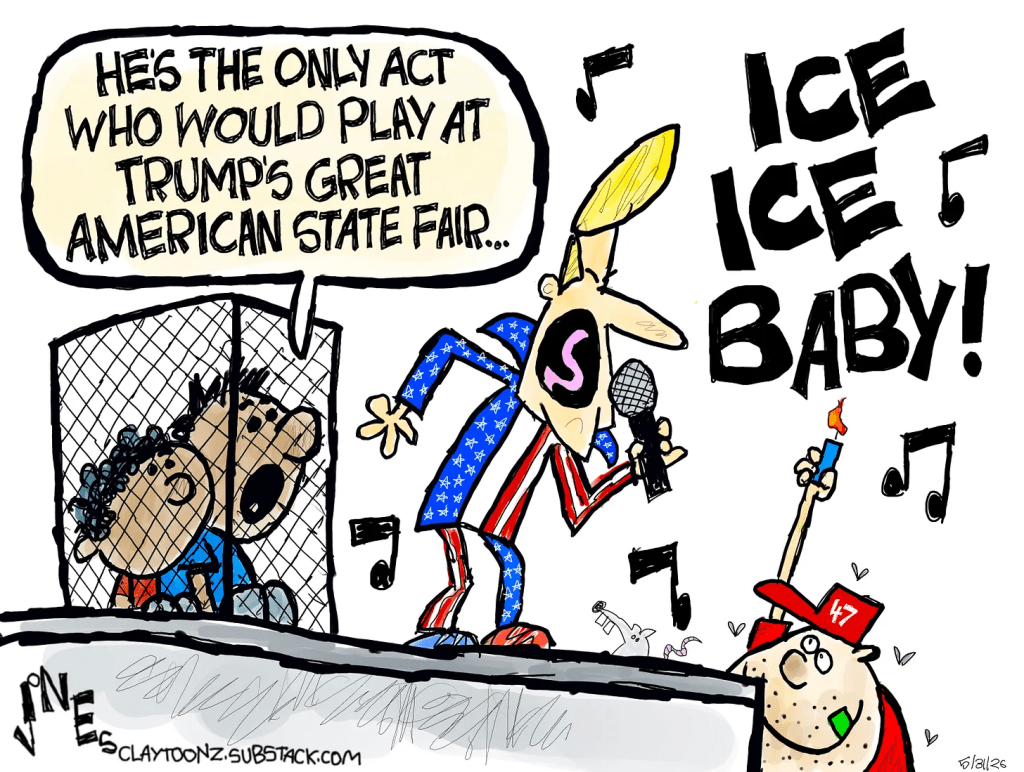
When artists were invited to participate in what’s being called the Great American State Fair, they were promised that it was not political or partisan. And proving that point, Donald Trump will be kicking it off.
The Great American State Fair is described as a birthday bash to celebrate America’s 250th anniversary, and it will include a series of concerts on the National Mall from June 24 to July 10.
After several artists dropped out, including Morris Day and the Time, Young MC, the Commodores, Martina McBride and Bret Michaels, Trump took to Truth Social and said, “I understand Artists are getting ‘the yips’ having to do with their performance … so I am thinking about bringing the Number One Attraction anywhere in the World, the man who gets much larger audiences than Elvis in his prime, and he does so without a guitar, the man who loves our Country more than anyone else, and the man who some say is the Greatest President in History (THE GOAT!), DONALD J. TRUMP, to take the place of these highly paid, Third Rate ‘Artists,’ and give a major speech, rallying the Country forward like I have done ever since being President!”
The “yips” is what Trump has when he TACOs out or something. (snip-MORE)
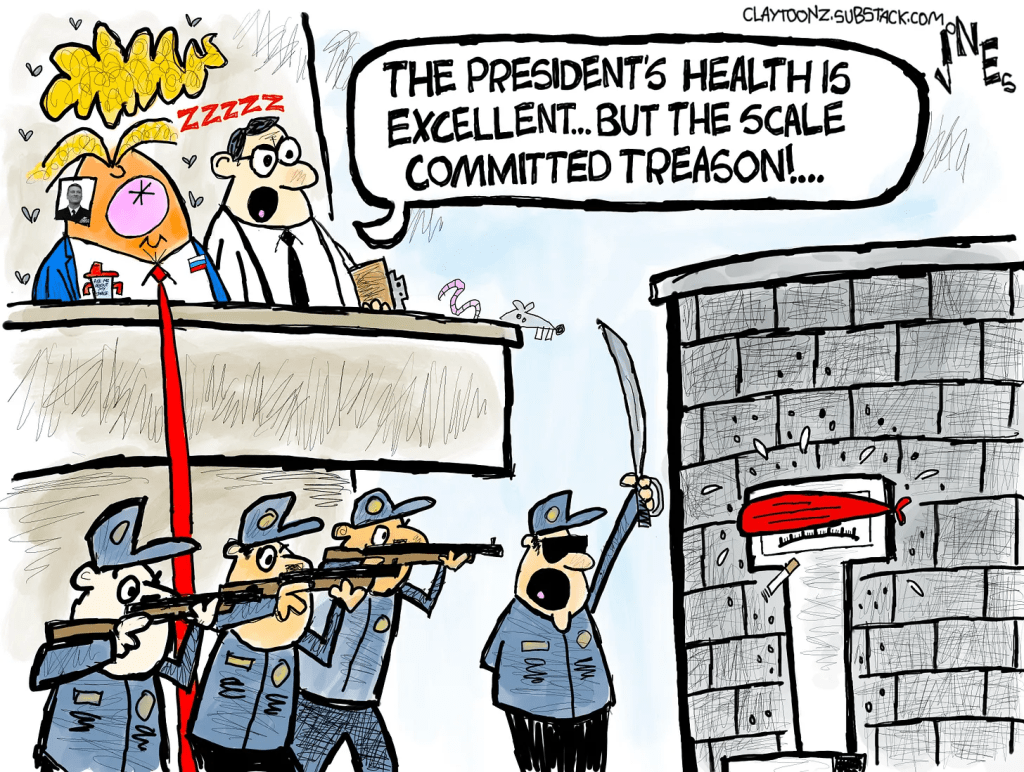
Donald Trump had another mystery visit to a doctor’s office this week.
Three years ago, only 28% of Americans surveyed by a Washington Post-ABC News-Ipsos poll said Trump was NOT healthy enough to serve as president. Today, that same poll found that 55% of Americans don’t believe Donald Trump is healthy enough to serve as president. There needs to be a poll asking if he’s mentally healthy enough to be president.
Trump has always rambled incoherently, but it seems to be distressing people more now in combination with his cankles, hand bruises, swollen eyes, and excessive blinking. Shhhh…he’s sleepy.
Trump had a physical in April of last year, and then he had a semi-annual physical in October, and now he has gone back for his third physical in 13 months. Additionally, he’s been to a Dentist twice over the past five months, which surprises everyone. He still has his teeth? (snip-MORE)

All my life, I have heard people say they respect the office of the president, even if they do not like the current occupant. Even though I did not like or respect George W. Bush, I still respected the presidency. But it’s getting harder and harder to respect the office when the current occupant is holding cage fights on the south lawn.
Are we in gladiator times? Are we conducting fights on the self lawn to distract us from our troubles, like inflation, illegal tariffs, ICE goons shooting Americans in the streets, and Donald Trump’s chosen war? In addition to a gaudy oversize ballroom, should we also build a replica of the Roman Colosseum on the White House grounds? Is today’s Caesar, Donald Trump, going to give a thumbs up or a thumbs down to determine the fate of the loser of each bout? Will wenches be feeding Trump grapes during the fights? (snip-MORE)
May 29, 2026
The Washington Post reports:
The Pentagon is moving to recruit hundreds of troops to appear as spectators next month at President Donald Trump’s UFC cage-fighting event on the White House lawn, and requiring those who attend to pay their own way and meet height and weight requirements, according to people familiar with the matter and internal memos reviewed by The Washington Post.
The Defense Department in recent days has solicited troops across the services to attend the June 14 event. Officials are seeking junior enlisted personnel and junior officers specifically, according to internal messages that make clear travel will be “member-procured.”
Junior troops make up the military’s lowest pay grades. One memo, circulated within the Air Force, stipulates that to be eligible, personnel “MUST MEET CURRENT WAIST-HEIGHT RATIO and current physical fitness standard.” Troops will be required to wear their short-sleeve dress uniforms, the memo adds.
Read the full article.


