WASHINGTON — Bradley Bondi, the brother of Attorney General Pam Bondi, lost his bid for president of the D.C. Bar, receiving 3,490 votes compared with opponent Diane Seltzer’s 34,982.
Seltzer, an employment lawyer who ran a campaign focused on supporting members of the organization at a time of “governmental chaos,” said after the results were announced Monday that she credited the D.C. Bar’s members with showing up and saying what kind of leader they wanted.
“We’ve got to make sure that we hang on to the rule of law and that we can practice law safely,” Seltzer told NBC News. “That we can represent who we want without worrying about retaliation, and that judges can issue fair and impartial rulings without worrying about being intimidated or retaliated against.”
The result came amid the Trump administration’s attacks on judges who have ruled against its policies, as well as on law firms that have represented causes or clients President Donald Trump doesn’t like. Last month, federal judges struck down Trump’s executive orders against Jenner & Block and Perkins Coie, finding the orders unconstitutional. (snip-MORE)
June 10, 1917 The Women’s Peace Crusade in Scotland launched a three-week campaign of street meetings and demonstrations in dozens of towns to build support for peace in the midst of what was then called The Great War (now known as World War I). More about the Womens’s Peace Crusade
June 10, 1937 The mayor of Monroe, Michigan, organized a citizens’ posse of some 1400 vigilantes, armed with baseball bats and tear gas, to combat the union organizing drive at local Newton Steel. The mob threw a dozen of the picketers’ cars into the River Raisin. Steelworkers’ cars were rolled into Monroe, Michigan’s River Raisin by strike breakers recruited by the mayor. The 120 striking steelworkers and their supporters were working to form unions in the “Little Steel” companies which, unlike U.S. Steel, continued to resist unionization. Newton had just been purchased by Republic Steel [see Chicago’s Memorial Day Massacre [May 30, 1937]. The whole story (Note from Ali: the link in the newsletter was no longer functional. Doing a search of cars going into the River Raisin is really interesting, even simply in modern times! I had to search the specific date to get this report. Seems like an “active” place, there in Monroe!)
June 10, 1963 The “Equal Pay Act of 1963” was passed and signed into law; it guaranteed women equal pay for equal work. The legislation was a result of the recommendations of President John F. Kennedy’s Commission on the Status of Women. The law itself
June 10, 1980 Nelson Mandela’s first writings, and those of other imprisoned anti-apartheid leaders, were smuggled out and made public while they were imprisoned on South Africa’s Robben Island. “ As I read these fascinating essays, I was struck so forcibly by the importance of memory, of history, for both the individual and the community. . . . I pray that our people and especially our children will, by reading this collection of essays, remember the very high price that has been paid to achieve our freedom.” – Desmond Tutu, from the foreword Nelson Mandela’s cell on Robben Island, where he spent 17 years Review of Reflections in Prison Portions of the book
Since I blogged about this issue yesterday, and I just finished my second cartoon of the day (for the FXBG Advance, which you’ll see tomorrow), we’re going to talk about some of the fallout of the Elon/Trump War.
Trump is thinking of selling the cherry red Tesla S he bought from Elon to throw some public support and propaganda his way after Tesla’s stock took a huge hit. Since Elon started gutting the government, a lot of Tesla owners have buyer’s remorse and have been selling their cars. Now, Trump has buyer’s remorse.
Presidents can’t drive on public roads, and Trump can’t drive at all. Trump buying a car would be like me buying a helicopter. I can’t fly a helicopter. If anything, Trump should buy Jeffrey Epstein’s plane. That would be more accurate symbolism, especially if what Elon said about the Epstein Files is true.
I’m sure there’s a MAGAt out there with too much money who would overpay for Trump’s Tesla, other wise, the value has dropped about 28 percent, even if it’s slightly used and fart-free (though Trump did sit in it for a minute which is probably long enough for him to blast a few dozen and christen the car. (snip-MORE)
I thought I’d be up super late last night, and planned to watch news coverage of the L.A. protests until the wee hours of the morning. But I felt out of sorts all day yesterday, which infected my cartooning, and sleepiness hit me heavy at 11 p.m. after a dinner of runny egg salad sandwiches (I had to do something with a dozen recently-expired eggs before leaving town Saturday, and I used too much mayo), so I went to bed.
I woke up at 5 a.m. this morning, and I was ready to go. But I dreaded turning on my TV. I was afraid I’d find nothing but coverage of deaths and a city burning. But no, I didn’t find any of that. The most disturbing thing I learned was that Lauren Tomasi, a reporter from Australia’s Channel 9 News, was struck by a rubber bullet while she was doing her job. (snip-MORE)
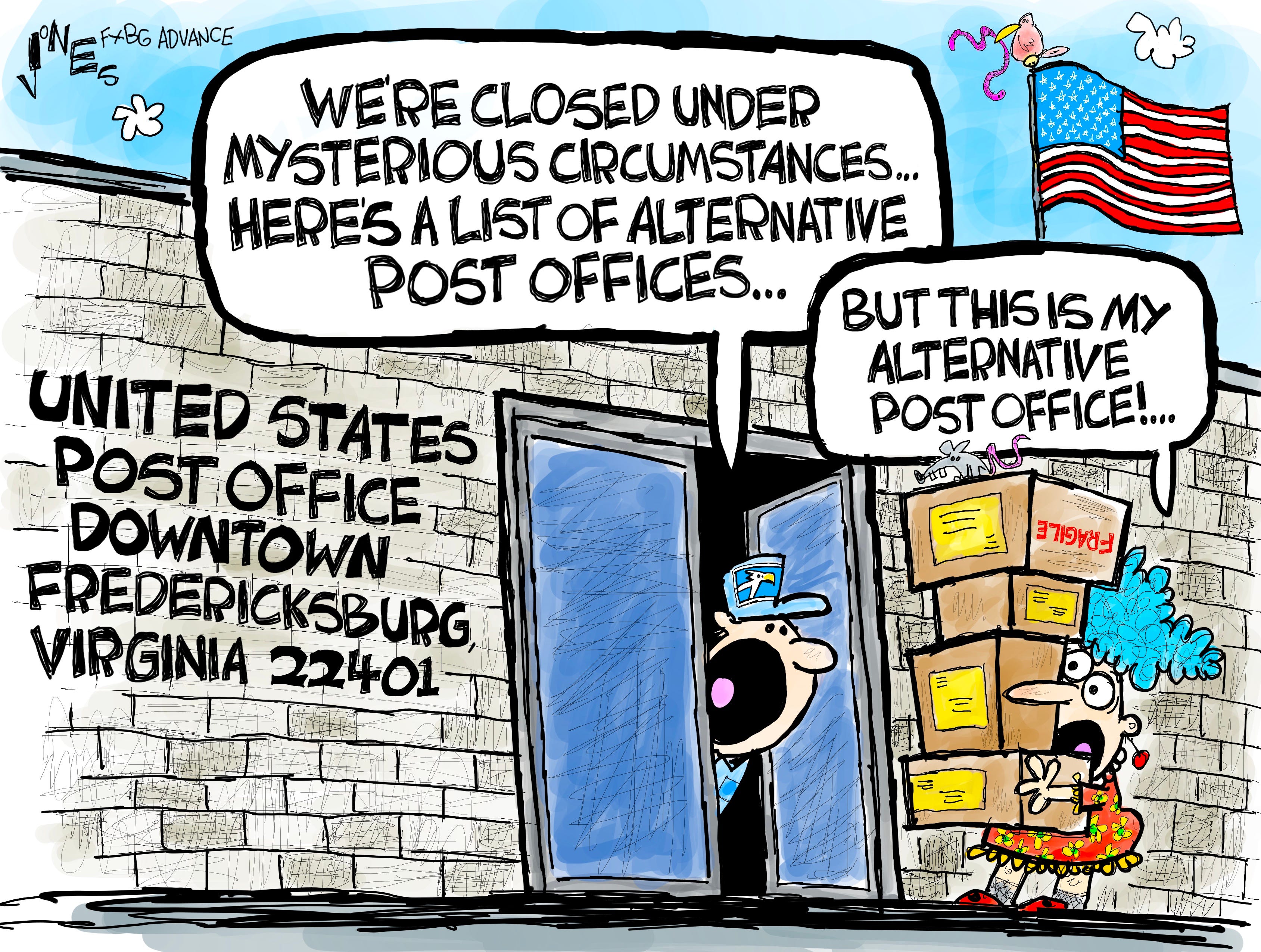
The Advance included a note with my cartoons this morning as it often does, and today’s said:
Mail delivery in our area — indeed, in the Commonwealth — is a problem. Don’t take our word for it. Take former Congresswoman Abigail Spanberger’s word for it. Her work uncovered delays galore, and the state consistently rates as one of the worst in the country for mail delivery. So when the downtown post office recently shutdown for, well, whatever reason it was closed for, there was mumbling, but not much of an uproar. Clay certainly noticed, however.
This cartoon was inspired by my own grievances, and it’s the second time the local post office has pissed me off enough to draw a cartoon. Louis DeJoy has inspired others.
The first time was back in December, when they raised the rates to my mailbox and then shut down the branch containing that mailbox. (snip-MORE)
Donald Trump is deploying the National Guard, not to stop riots or for safety, but to start a fight. And he’s doing it illegally.
ICE is conducting raids in the Los Angeles area. They’re not going after criminals, but average citizens who may just so happen to be undocumented. I don’t use the word “illegal” to describe humans unless it’s in the context of someone else using it. Humans are not illegal.
When the National Guard is deployed, it’s usually at the request of a governor or other officials. Yet, neither the mayor of Los Angeles, Karen Bass, nor Governor Gavin Newsom has requested military aid, like what happened during the Rodney King riots in 1992.
There has been some violence, such as cars being set on fire and other property damage, but to a small extent. The L.A.P.D. can handle these protests, which are legal.
Governor Newsom said Trump’s decision to call in the National Guard is “purposefully inflammatory.” He’s right.
Trump wants everyone to sit back and allow him to do whatever he wants. Not getting that, he wants a fight. He wants protesters to get violent. He wants L.A. to burn. He wants blood. He wants to point at the city and blame a Democratic mayor and a Democratic governor. He wants to blame liberals and Democrats. He wants to portray himself as the law-and-order president (sic), while he’s the president (sic) who pardoned the white nationalist J6 terrorists who attacked law enforcement. (snip-MORE)
With DEI initiatives firmly in the crosshairs of the Trump administration, many large corporations that were once so quick to celebrate June as Pride month have quietly ditched their public support for LGBTQI+ rights even faster.
It used to be common for companies to emblazon their social media accounts with rainbow-themed versions of their logo, but in 2025, the same big businesses that were so vocal about supporting Pride initiatives have fallen silent.
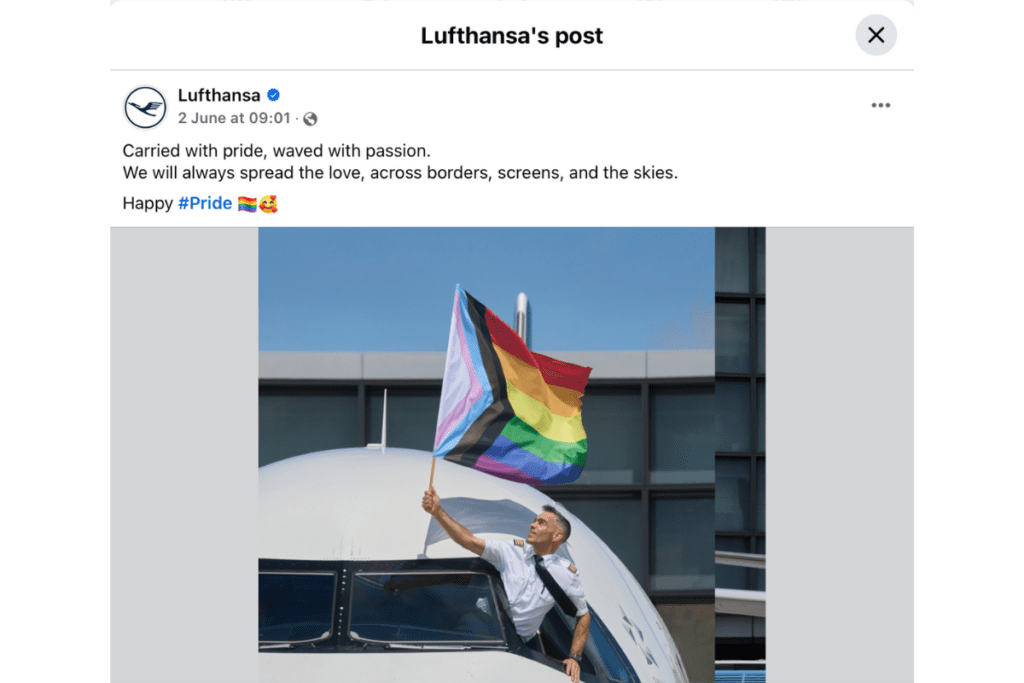
The controversial post that sparked a social media backlash.
That’s certainly true for big international airlines in the United States, which were falling over themselves to show their support for Pride until very recently (critics might argue they were just chasing the so-called ‘Pink Dollar’).
In 2025, the social media accounts of American Airlines, Delta, and United make no mention or reference to Pride, even if these airlines do still support LGBTQ+ initiatives (Alaska and United are still sponsors of San Francisco’s Pride parade even as other big name corporations drop their support).
German flag carrier Lufthansa doesn’t seem too concerned that supporting LGBTQ+ rights is no longer fashionable… at least not in Trump’s America.
On June 2, the airline posted a photo of a pilot waving a Pride rainbow flag out the window of a cockpit, captioned with the words: “Carried with pride, waved with passion. We will always spread the love, across borders, screens, and the skies.”
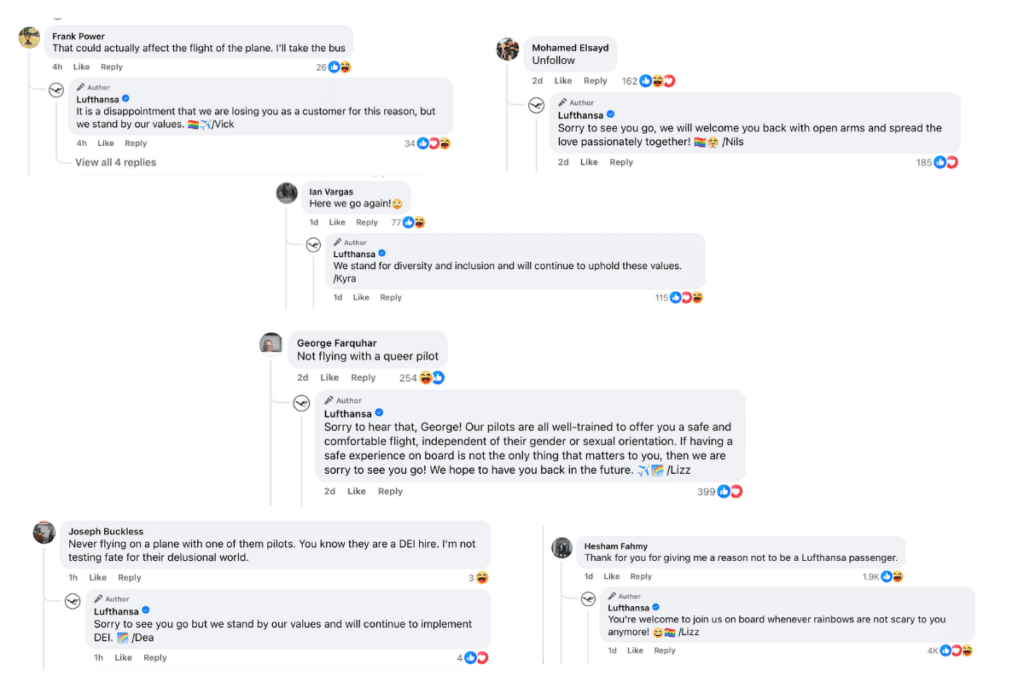
Lufthansa has been quick to respond to critics.
It seemed like a pretty inoffensive and inspiring message that didn’t directly reference LGBTQ+ rights, but it didn’t take long for Lufthansa’s Facebook page to be deluged with homophobic comments.
But it looks like Lufthansa knew exactly what it was getting itself into, and its social media team quickly fired back at critics with sassy replies that shut down the hateful comments without censoring them or turning off the comment feature altogether.
“Thank you for you for giving me a reason not to be a Lufthansa passenger,” one person wrote underneath the post. Lufthansa clapped back with: “You’re welcome to join us on board whenever rainbows are not scary to you anymore!”
While one person inferred that inclusivity was a safety issue, saying: “That could actually affect the flight of the plane. I’ll take the bus.”
Lufthansa was not having any of it, though, relying: “It is a disappointment that we are losing you as a customer for this reason, but we stand by our values.”
Another referenced DEI, saying: “Never flying on a plane with one of them pilots. You know they are a DEI hire. I’m not testing fate for their delusional world.”
Again, Lufthansa stood firm: “Sorry to see you go but we stand by our values and will continue to implement DEI.”
Many responses to the post have, however, been positive, and some fans have pointed out that the response has proved exactly why, even in 2025, Pride is still needed.
June has traditionally been recognized as Pride Month to mark the Stonewall riots that occurred in late June 1969. Since then, several US presidents have issued proclamations, declaring June as the month of Pride, but White House press secretary Karoline Leavitt said earlier this week that President Trump has no plans to issue a similar proclamation this year.
Trump was, however, the first Republican President to acknowledge LGBT Pride Month back in 2019 when he Tweeted a message in support of the commemoration.
Isn’t this a rouge thug agency that hides their faces and refuses to show ID? How does anyone tell them apart from kidnappers, maybe a Proud Boy member pretending so they can abuse people they dislike. Plus the creative ideas she has suggested are dubiously legal, possibly a crime. Also as you see in the second one they already pretended to be utility workers causing issues for that company and lying to kids. There is so much more than I can express here about what our country has become. How can people hate that much. I did not paste the hateful attacks on Pride Events by religious people making up stuff they think the right is doing like using the Trevor Project’s suicide hotline to claim that they are transing kids? Or the woman who claimed walking into a store with pride merchandise is being assaulted with rainbows, the cloying fume of pride, and Legos of all colors. When did just seeing that other people exist become an assault and a threat to yourself personally. I don’t agree with fundamentalist Christians, but I don’t want to ban them or force their books from stores and libraries. Why can not these people live and let live. Just knowing people eat asparagus don’t make the evil even if I personally refuse to touch the stuff. Anyway, the news has me very down and sad. So much hate or bigotry and these people revile in both. They love it. They want it at the same time saying it is in the name of their god who as I remember preached the opposite of what they are doing, feed the poor, clothe the poor, help the immigrant as you were once an immigrant, judge not least you be judged, and so much more. Hugs
Senior US immigration officials over the weekend instructed rank-and-file officers to “turn the creative knob up to 11” when it comes to enforcement, including by interviewing and potentially arresting people they called “collaterals”, according to internal agency emails viewed by the Guardian. Officers were also urged to increase apprehensions and think up tactics to “push the envelope” one email said, with staff encouraged to come up with new ways of increasing arrests and suggesting them to superiors.
“If it involves handcuffs on wrists, it’s probably worth pursuing,” another message said. The instructions not only mark a further harshening of attitude and language by the Trump administration in its efforts to fulfill election promises of “mass deportation” but also indicate another escalation in efforts, by being on the lookout for undocumented people whom officials may happen to encounter – here termed “collaterals” – while serving arrest warrants for others.
Read the full article. Impersonating utility workers apparently falls under getting “creative.”
“Creative” = “Get illegal” and “terrorize”. San Diego is still reeling from a raid on a restaurant at happy hour where employees were handcuffed until 4 of their colleagues were dragged off by masked men. When concerned community members began filming the encounter they were greeted by flash-bang grenades. This is fascism.
Southside neighbors jumped into action Wednesday morning when they believed immigration officers were attempting an arrest near Sixth Ave. and Ajo Way. A spokesperson for the Department of Homeland Security told KGUN 9 that there is an ongoing investigation, but did not provide further details.
Christine Cariño called KGUN 9 because she believed there were ICE or HSI agents in her neighborhood. Cariño described their unmarked vehicles, claimed they asked her unusual questions, and claimed that they worked with Tucson Electric Power.
She began to suspect the individuals were immigration enforcement officers during the initial interaction. She explained how they initially asked her to help them find her neighbor. That’s when she questioned if they were ICE or HSI agents, despite having been told they were with Tucson Electric Power.
An Arizona power company is warning that it objects to anyone who may misrepresent themselves as one of its employees amid allegations that immigration officials posed as utility workers while attempting to detain a man at his home in south Tucson.
Tucson Electric Power’s statement come after local residents raised concerns that two men who introduced themselves to neighbors as utility workers and asked for directions to a specific house were actually federal agents with U.S. Immigration and Customs Enforcement.
Members of the Arizona Latino Legislative Caucus were quick to condemn the incident, saying it was “part of a broader pattern of concerning actions” by immigration authorities. State Rep. Mariana Sandoval, D-Goodyear, said in a statement that federal officials should investigate the incident and publish guidelines to prevent future occurrences.
Do ya notice how quickly and gladly ICE and other law enforcement agents go full on gestapo? If they could just shoot people dead for no reason, a lot of them would do it and high-five each other afterwards.
there was a clip of the ICE director (either very mad, or very nervous –(watching his fingers tapping anxiously on the podium)) the other day answering the question on the facial coverings (hence my calling them ICEis ) ..
because nasty people were taking pictures of agents and Doxxing them! (and apparently their wives, children, etc etc ) …
well, oddly enough, in most places you can find the names of the local police officers, and who of those are on things like the SWAT team .. and they at least wear badge numbers, if not names ..
Ahhh. That explains the push to make it a crime to identify ICE officers. There was one the other day that was confronted over his white supremacist tattoos that were clearly visible on his right arm. I think it has more to do with them hiring from racist groups rather than protecting their “families”.
No question. My trump loving cousin works for a homeland security contractor. he is always talking about the “gangs” from the city who take over all the street festivals, all the parks (especially the suburban ones), all the malls and gallerias, and all other public spaces. He really thinks that there are roving gangs on marauding everywhere! And they are all black and brown people, naturally, and he insists they are all criminals, raping and murdering everyone. It’s why he will never go downtown.
He is totally anti-immigrant and would dearly love to deport every one of them for any reason or no reason. And if they die in the process, so much the better.
I thought it was illegal to claim you were utility person? I recall back in olden times that sometimes men would pose as a utility person or cable guy to get access to people’s homes to steal things or even rape women. That’s why they started carrying ID cards that they were required to have them visible. I wonder if they violated some law?
I was an enumerator for the Census in 2020, and we were told how to look, dress conservatively, be respectful of the property, etc. We were required to wear our badges and to show it to any person who answers the door. We also had bags with US CENSUS 2020 emblazoned in large letters. Sometimes when I’d be walking down the street, bikers or car drivers would shout out a thankyou.
Even with all that, some people refused to open the door and speak with us, fearing whatever. We were instructed on how to handle that politely, and leave a note.
I can only imagine that ICE keeps doing these things for the next four years, the Census will not get a good count on huge swaths of people.
First you know this man was threatened all the way back to the US that his family would be rounded up and tortured if he told of what happened to him in that prison. I wonder if they had to wait until injuries healed before they could let the public see him? Ron says they maybe starved him and had to feed him again to build up his weight and looks. Poor man I hope he is able to safely get his story out. It is clear the charges against him are fraudulent and made up. Just like the government kept saying he was an MS 13 gang member which two courts found he was not. Also he was living in Maryland and his court case is being heard in DC so why is the Justice department trying his new charges in Tennessee? Why not add the charges to the case being heard now in DC. Clearly they hope to get a much more conservative and racist court there than they would in the northern states. I am surprised they did not charge him in Texas. Hugs.
Mistakenly deported Salvadoran native Kilmar Abrego Garcia appeared in a Tennessee courtroom Friday, hours after he was brought back to the United States to face criminal charges for allegedly transporting undocumented migrants within the U.S.
More than two months after the Trump administration admitted it mistakenly deported Abrego Garcia from Maryland to his native El Salvador, a two-count indictment unsealed Friday alleges that he participated in a years long conspiracy to haul undocumented migrants from Texas to the interior of the country.
The return of Abrego Garcia from his native El Salvador follows a series of court battles in which the Trump administration repeatedly said it was unable to bring him back, drawing the country toward the brink of a constitutional crisis when the administration failed to heed the Supreme Court’s order to facilitate his return.
MORE: Justice Department investigating 2022 Abrego Garcia traffic stop: Sources
He made his initial court appearance Friday evening in the Middle District of Tennessee, answering “Yes, I understand” in Spanish when U.S. Magistrate Judge Barbara Holmes asked him if he understood the charges against him.
Judge Homes set a hearing for June 13, where Abrego Garcia will be arraigned on charges and the judge will take up the government’s motion to hold him in pre-trial detention on the grounds that he “poses a danger to the community and a serious risk of flight” He will remain in federal custody in Tennessee pending next week’s hearing.
“If convicted at trial, the defendant faces a maximum punishment of 10 years’ imprisonment for ‘each alien’ he transported,” said the government’s motion for detention, which also contained an allegation — not included in the indictment — that one of Abrego Garcia’s co-conspirators told authorities that Abrego Garcia participated in the murder of a rival gang member’s mother in El Salvador.
Abrego Garcia’s attorney, in an online press briefing, called the charges against his client “an abuse of power.”
Kilmar Abrego Garcia is placed in the back seat of a truck by ICE agents after arriving in Nashville, Tenn., June 6, 2025.
ABC News
“They’ll stop at nothing at all — even some of the most preposterous charges imaginable — just to avoid admitting that they made a mistake, which is what everyone knows happened in this case,” said attorney Simon Sandoval-Moshenberg.
“Mr. Garcia is going to be vigorously defending the charges against him,” the attorney said.
The decision to pursue the indictment against Abrego Garcia led to the abrupt departure of Ben Schrader, a high-ranking federal prosecutor in Tennessee, sources briefed on Schrader’s decision told ABC News. Schrader’s resignation was prompted by concerns that the case was being pursued for political reasons, the sources said.
Schrader, who spent 15 years in the U.S. Attorney’s Office in Nashville and was most recently the chief of the criminal division, declined to comment when contacted by ABC News.
The alleged conspiracy spanned nearly a decade and involved the domestic transport of thousands of noncitizens from Mexico and Central America, including some children, in exchange for thousands of dollars, according to the indictment.
Abrego Garcia is alleged to have participated in more than 100 such trips, according to the indictment. Among those allegedly transported were members of the Salvadoran gang MS-13, sources familiar with the investigation said.
MORE: Timeline: Wrongful deportation of Kilmar Abrego Garcia to El Salvador
Abrego Garcia is the only member of the alleged conspiracy charged in the indictment.
Attorney General Pam Bondi, at a Friday afternoon press conference, thanked Salvadoran President Nayib Bukele for “agreeing to return Abrego Garcia to the United States.”
“Our government presented El Salvador with an arrest warrant and they agreed to return him to our country,” Bondi said.
Bondi said that if Abrego Garcia is convicted of the charges, upon the completion of his sentence he will be deported back to his home country of El Salvador.
“The grand jury found that over the past nine years, Abrego Garcia has played a significant role in an alien smuggling ring,” Bondi said. “They found this was his full time job, not a contractor. He was a smuggler of humans and children and women. He made over 100 trips, the grand jury found, smuggling people throughout our country.”
Attorney General Pam Bondi speaks as Deputy Attorney General Todd Blanche listens during a news conference about Kilmar Abrego Garcia at the Justice Department, June 6, 2025, in Washington.
Julia Demaree Nikhinson/AP
In a statement to ABC News, Abrego Garcia’s attorney said that he’s going to keep fighting to ensure Abrego Garcia receives a fair trial.
“From the beginning, this case has made one thing painfully clear: The government had the power to bring him back at any time. Instead, they chose to play games with the court and with a man’s life,” Sandoval-Moshenberg said. “We’re not just fighting for Kilmar — we’re fighting to ensure due process rights are protected for everyone. Because tomorrow, this could be any one of us — if we let power go unchecked, if we ignore our Constitution.”
Abrego Garcia, a Salvadoran native who had been living with his wife and children in Maryland, was deported in March to El Salvador’s CECOT mega-prison — despite a 2019 court order barring his deportation to that country due to fear of persecution — after the Trump administration claimed he was a member of the criminal gang MS-13. His wife and attorneys deny that he is an MS-13 member.
The Trump administration has acknowledged in court filings that Abrego Garcia’s removal to El Salvador in March was in error, because it violated a U.S. immigration court order in 2019 that shielded Abrego Garcia from deportation to his native country, according to immigration court records. An immigration judge had determined that Abrego Garcia would likely face persecution there by local gangs that had allegedly terrorized him and his family.
The administration argued, however, that Abrego Garcia should not be returned to the U.S. because he is a member of the transnational Salvadoran gang MS-13, a claim his family and attorneys have denied. In recent weeks, Trump administration officials have been publicizing Abrego Garcia’s interactions with police over the years, despite a lack of corresponding criminal charges.
After Abrego Garcia’s family filed a lawsuit over his deportation, U.S. District Judge Paula Xinis in Maryland ordered the Trump administration to facilitate his return to the United States. The U.S. Supreme Court affirmed that ruling on April 10.
Abrego Garcia was initially sent to El Salvador’s notorious CECOT prison but was believed to have later been transferred to a different facility in the country.
The criminal investigation that led to the charges was launched in April as federal authorities began scrutinizing the circumstances of a 2022 traffic stop of Abrego Garcia by the Tennessee Highway Patrol, according to the sources. Abrego Garcia was pulled over for speeding in a vehicle with eight passengers and told police they had been working construction in Missouri.
According to body camera footage of the 2022 traffic stop, the Tennessee troopers — after questioning Abrego Garcia — discussed among themselves their suspicions that Abrego Garcia might be transporting people for money because nine people were traveling without luggage, but Abrego Garcia was not ticketed or charged.
The officers ultimately allowed Abrego Garcia to drive on with just a warning about an expired driver’s license, according to a report about the stop released last month by the U.S. Department of Homeland Security.
Asked what circumstances have changed since Abrego Garcia was not taken in custody during that traffic stop in Tennessee, Bondi replied, “What has changed is Donald Trump is now president of the United States, and our borders are again secure, and thanks to the bright light that has been shined on Abrego Garcia — this investigation continued with actually amazing police work, and we were able to track this case and stop this international smuggling ring from continuing.”
Asked by ABC News’ Pierre Thomas asked whether this should be seen as resolving the separate civil case in Maryland in which a federal judge ordered the government to facilitate Abrego Garcia’s return, Deputy Attorney General Todd Blanche said, “There’s a big difference between what the state of play was before the indictment and after the indictment. And so the reason why he is back and was returned was because an arrest warrant which was presented to the government and in El Salvador. So there’s, there’s a big difference there as far as whether it makes the ongoing litigation in Maryland moot. I would think so, but we don’t know about this. He just landed today.”
As ABC News first reported last month, the Justice Department had been quietly investigating the Tenessee traffic stop. As part of the probe, federal agents in late April visited a federal prison in Talladega, Alabama to question Jose Ramon Hernandez-Reyes, a convicted felon who was the registered owner of the vehicle Abrego Garcia was driving when stopped on Interstate 40 east of Nashville, sources previously told ABC News. Hernandez-Reyes was not present at the traffic stop.
MORE: Newly released video shows Abrego Garcia’s 2022 Tennessee traffic stop
Hernandez-Reyes, 38, is currently serving a 30-month sentence for illegally re-entering the U.S. after a prior felony conviction for illegal transportation of aliens.
After being granted limited immunity, Hernandez-Reyes allegedly told investigators that he previously operated a “taxi service” based in Baltimore. He claimed to have met Abrego Garcia around 2015 and claimed to have hired him on multiple occasions to transport undocumented migrants from Texas to various locations in the United States, sources told ABC News.
When details of the Tennessee traffic stop were first publicized, Abrego Garcia’s wife said her husband sometimes transported groups of fellow construction workers between job sites.
“Unfortunately, Kilmar is currently imprisoned without contact with the outside world, which means he cannot respond to the claims,” Jennifer Vasquez Sura said in mid-April.
Sen. Chris Van Hollen of Maryland, who flew to El Salvador and met with Abrego Garcia shortly after his deportation, said Friday that the Trump administration had “relented” regarding his return.
“After months of ignoring our Constitution, it seems the Trump Admin has relented to our demands for compliance with court orders and due process for Kilmar Abrego Garcia,” Van Hollen posted on X. “This has never been about the man — it’s about his constitutional rights & the rights of all.”
Abrego Garcia entered the U.S. illegally as a teenager in 2012, according to court records. He had been living in Maryland for the past 13 years, and married Vasquez Sura, a U.S. citizen, in 2019. The couple has one child together.
ABC News’ Laura Romero contributed to this report.
from Heather Cox Richardson. Though our current president has little respect for U.S. veterans, that is not true of anybody I know. Even anti-war I believe our current service people and our veterans are deserving of all benefits of their citizenship and especially added benefits of their service to the U.S. Many readers here are military veterans. My mother’s brother-in-law, my (favorite!) Uncle Jack, served as a U.S. Marine in WWII. My father served in the U.S. Army during the Korean conflict. All of us know and love someone who’s served us in this honorable and unique fashion. While our president doesn’t think to respect that, or even think about it at all, the rest of us do. I know we are thankful. And now, from Heather Cox Richardson, history expert,
Today the U.S. political world was consumed today by a public fight between President Donald J. Trump and his former sidekick, billionaire Elon Musk. Musk invested about $290 million into the 2024 election, vowing to elect Trump in order to get rid of government investigations into his businesses he worried would “take [him] down.”
When Trump took office, Musk became a fixture in the White House, attending Cabinet meetings and heading the “Department of Government Efficiency.” That group set out to kill government programs by withholding congressionally approved funds at the same time that its staff sucked up information on Americans that could feed the training of artificial intelligence and killed the investigations into his businesses Musk had worried about.
In February, Musk posted on social media: “I love [Donald Trump] as much as a straight man can love another man.”
But Musk overstepped boundaries and overstayed his welcome even as his antics hurt sales of his signature car, the Tesla, inspiring Trump to do a car commercial for him on the White House grounds. Just a week ago, Musk officially left the White House on the same day that an article in the New York Times documented his heavy drug use on the campaign.
Then, on Tuesday, June 3, he took a public stand against the omnibus bill Trump desperately wants Congress to pass, posting on X: “I’m sorry, but I just can’t stand it anymore. This massive, outrageous, pork-filled Congressional spending bill is a disgusting abomination. Shame on those who voted for it: you know you did wrong. You know it.”
And with that, the falling out began.
This morning, Trump told reporters he was “disappointed” in Musk. Ron Filipkowski of Meidas followed the saga from there.
“Without me, Trump would have lost the election, Dems would control the House, and the Republicans would be 51–49 in the Senate,” Musk wrote. “Such ingratitude.”
Trump then suggested that “The easiest way to save money in our Budget, Billions and Billions of Dollars, is to terminate Elon’s Governmental Subsidies and Contracts. I was always surprised that Biden didn’t do it!”
Musk promptly said he would begin decommissioning SpaceX’s spacecraft, which supply the International Space Station.
The two men continued to go back and forth, with Musk saying that “Donald Trump is in the Epstein files,” a reference to the records compiled by convicted sex offender Jeffrey Epstein, with whom Trump was friendly. Musk also said Trump’s tariffs will cause a recession, and agreed with another poster who suggested that Trump should be impeached and replaced with Vice President J.D. Vance.
Trump responded to that attack far more weakly than one would have expected, simply turning back to the omnibus bill and insisting it “is one of the Greatest Bills ever presented to Congress.”
Musk’s behavior is erratic in its own right, but if there is anything but pique behind it, it appears he is threatening Trump by making a play to control the Republican Party. In response to a post by conspiracy theorist Laura Loomer suggesting that Republican lawmakers are unsure if they should side with Trump or Musk, Musk wrote: “Oh and some food for thought as they ponder that question: Trump has 3.5 years left as President, but I will be around for 40+ years.”
It’s quite a gamble, since Trump controls the government contracts on which Musk’s fortune was built and on which he still relies. Some MAGA loyalists appear to see the fight as a victory for Trump and are thrilled to see Musk’s star fall. MAGA influencer Steve Bannon told Tyler Pager of the New York Times that he has advised Trump to cancel all of Musk’s federal contracts and launch a formal investigation of his drug use and his immigration status.
Kylie Robison and Aarian Marshall of Wired noted that TrumpCoin lost more than $100 million in value during the fight. Tesla stock lost $152 billion of value from its market capitalization, prompting Filipkowski to note that the total came to about $9 billion per tweet.
Economist Robert Reich had perhaps the best summary of the fight today when he noted, “That any of us have to care about the messy breakup of these two massive narcissists—and that they both individually wield such massive power—is an indictment of our political system and further proves the poisonous influence of Big Money on our democracy.”
Indeed, today’s White House and today’s America are very different from what they were eighty-one years ago.
President Franklin Delano Roosevelt gave his twenty-ninth Fireside Chat on June 5, 1944, and had good news for the American people. The day before, on June 4, Rome had fallen to Allied troops. “The first of the Axis capitals is now in our hands,” Roosevelt said.
The president pointed out that it was “significant that Rome has been liberated by the armed forces of many nations. The American and British armies—who bore the chief burdens of battle—found at their sides our own North American neighbors, the gallant Canadians. The fighting New Zealanders from the far South Pacific, the courageous French and the French Moroccans, the South Africans, the Poles and the East Indians—all of them fought with us on the bloody approaches to the city of Rome. The Italians, too, forswearing a partnership in the Axis which they never desired, have sent their troops to join us in our battles against the German trespassers on their soil.”
This group of ordinary men from many different countries had worked together to defeat the forces of fascism.
But FDR warned Americans that the fall of Rome was only the beginning. “We shall have to push through a long period of greater effort and fiercer fighting before we get into Germany itself,” he said. [T]he victory still lies some distance ahead. That distance will be covered in due time—have no fear of that. But it will be tough and it will be costly.”
FDR knew something his audience did not. On the other side of the Atlantic, paratroopers, their faces darkened with cocoa, were already dropping into France, and the soldiers, sailors, and airmen of the Allies were on their way across the English channel.
The order of the day from their commander Dwight D. Eisenhower that day had read: “You are about to embark upon the Great Crusade, toward which we have striven these many months. The eyes of the world are upon you. The hopes and prayers of liberty-loving people everywhere march with you. In company with our brave Allies and brothers-in-arms on other Fronts, you will bring about the destruction of the German war machine, the elimination of Nazi tyranny over the oppressed people of Europe, and security for ourselves in a free world.
“Your task will not be an easy one,” it read, but it assured the troops that the Germans had suffered great defeats and Allied bombing had reduced German strength, while “[o]ur Home Fronts have given us an overwhelming superiority in weapons and munitions of war, and placed at our disposal great reserves of trained fighting men. The tide has turned! The free men of the world are marching together to Victory!”
Eisenhower’s public confidence did not reflect his understanding that the largest amphibious invasion in military history was a gamble. On June 5, in pencil on a sheet of paper, he had written a message to be communicated in case the invasion failed.
“Our landings in the Cherbourg-Havre area have failed to gain a satisfactory foothold and I have withdrawn the troops,” it read. “My decision to attack at this time and place was based upon the best information available. The troops, the air and the Navy did all that bravery and dedication to duty could do. If any blame or fault attaches to the attempt it is mine alone.”
On the morning of June 6, 1944, five naval assault divisions stormed the beaches of Normandy. Seven thousand ships and landing craft operated by more than 195,000 naval personnel from eight countries brought almost 133,000 troops to beaches given the code names UTAH, OMAHA, GOLD, JUNO, and SWORD. By the end of the day, more than 10,000 Allied troops were wounded or killed, but the Allies had established a foothold in France that would permit them to flood troops, vehicles, and supplies into Europe. When FDR held a press conference later that day, officials and press alike were jubilant.




 “
“







 Scottie's Playtime