We ask for peace. We, at the bound O life, are weary of the round In search of Truth. We know the quest Is not for us, the vision blest Is meant for other eyes. Uncrowned, We go, with heads bowed to the ground, And old hands, gnarled and hard and browned. Let us forget the past unrest,— We ask for peace.
Our strainéd ears are deaf,—no sound May reach them more; no sight may wound Our worn-out eyes. We gave our best, And, while we totter down the West, Unto that last, that open mound,— We ask for peace.
This poem is in the public domain. Published in Poem-a-Day on February 8, 2025, by the Academy of American Poets.
I do not care for sleep, I’ll wait awhile For Love to come out of the darkness, wait For laughter, gifted with the frequent fate Of dusk-lit hope, to touch me with the smile Of moon and star and joy of that last mile Before I reach the sea. The ships are late And mayhap laden with the precious freight Dawn brings from Life’s eternal summer isle.
And should I find the sweeter fruits of dream— The oranges of love and mating song— I’ll laugh so true the morn will gayly seem Endless and ships full laden with a throng Of beauty, dreams and loves will come to me Out of the surge of yonder silver sea.
This poem is in the public domain. Published in Poem-a-Day on February 9, 2025, by the Academy of American Poets.
February 6, 1899 Spain agreed to abandon all claims of sovereignty over Cuba, the cession of Puerto Rico and Guam, the cession of the Philippine Islands; and in exchange the U.S. agreed to pay $20,000,000 in a treaty ratified by the U.S. Senate on this day. The previous July the U.S. took control of Gantanamo Bay, blockaded Cuba’s other ports and destroyed the Spanish fleet at Santiago Bay. The U.S. Army, landed at Guanica, near Ponce, Puerto Rico, and shortly took possession of the island with the exception of San Juan. The Spanish Pacific fleet was destroyed and the U.S. took control of Manila, the capital, and Luzon, the main island of the Philippines a few weeks later.
February 6, 1943 The U.S. government required the 110,000 disposessed Japanese Americans forcibly held in concentration (internment) camps to answer loyalty surveys. Some of the interned were U.S. citizens, and some volunteered to serve in the armed forces during the war with Japan. The Nisei, as they were known, were kept in the camps until the end of World War II. The Manzanar Relocation Center, a one of the concentration camps where Japanese-Americans were forced to live throughout World War II.
February 6, 1956 Autherine Lucy was excluded from classes just three days after becoming the first black person allowed to attend the University of Alabama. Her suspension “for her own safety” followed three days of riots over her Supreme Court-ordered enrollment. Autherine J. Lucy and her attorney Thurgood Marshall Crowds of students, townspeople and members of the Ku Klux Klan shouted, “Kill her!” among other things. It is unclear why the University did not suspend the students who were among the rioters. Lucy had originally applied for graduate study in library science in 1952, and had been accepted until the University realized her race, and claimed state law prevented her admission. A graduate of traditionally black Miles College, she was only admitted with the help of the National Association for Colored People Legal Defense and Education Fund (NAACP-LDEF) and lawyers Thurgood Marshall (later a Supreme Court justice), Constance Baker Motley (future federal judge) and Arthur Shores (elected to Birmingham City Council). Read more
February 6, 1959 The United States successfully test-fired its first intercontinental ballistic missile (ICBM), known as Titan, from Cape Canaveral. It was a two-stage rocket designed to carry nuclear warheads.Titans were also capable of boosting satellites and spacecraft into orbit. Before the last was produced in 2002, they launched several two-man Gemini missions in the 1960s and launched the first spacecraft to land on Mars. First test launch of Titan booster rocket from Cape Canaveral, Florida.
February 6, 1961 The civil rights jail-in movement began when ten negro students in Rock Hill, South Carolina, were arrested for requesting service at a segregated lunch counter. They refused to post bail and demanded jail time rather than paying fines, refusing to acknowledge any legitimacy of the laws under which they were arrested. More about Charles Sherrod Reverend Martin Luther King, Jr. wrote to Charles Sherrod, Diane Nash and the others in jail: ‘‘You have inspired all of us by such demonstrative courage and faith. It is good to know that there still remains a creative minority who would rather lose in a cause that will ultimately win than to win in a cause that will ultimately lose.’’
February 6, 1985 The Molesworth Common Peace Camp, just outside the Royal Air Force Base there, was evicted by the British Army. The 300 inhabitants and their many supporters had been nonviolently protesting the siting of nuclear-tipped U.S. cruise missiles at the base. Peace camps were established at several locations in Europe in the early 1980s to protest the destabilizing nuclear weapons buildup. Molesworth Common peace camp
I quickly visited the Male Survivor site this morning. One of the other members posted this. I liked it, thought it was funny and true at the same time. Hugs.
This interview appeared in a small zine, and it’s appearing here as well. Check out Charles Brubaker’s LAUREN IPSUM on this site! He does everything on paper!Read on Substack
INTERVIEW WITH NANCY BEIMAN SEPTEMBER 1, 2023
By Charles Brubaker
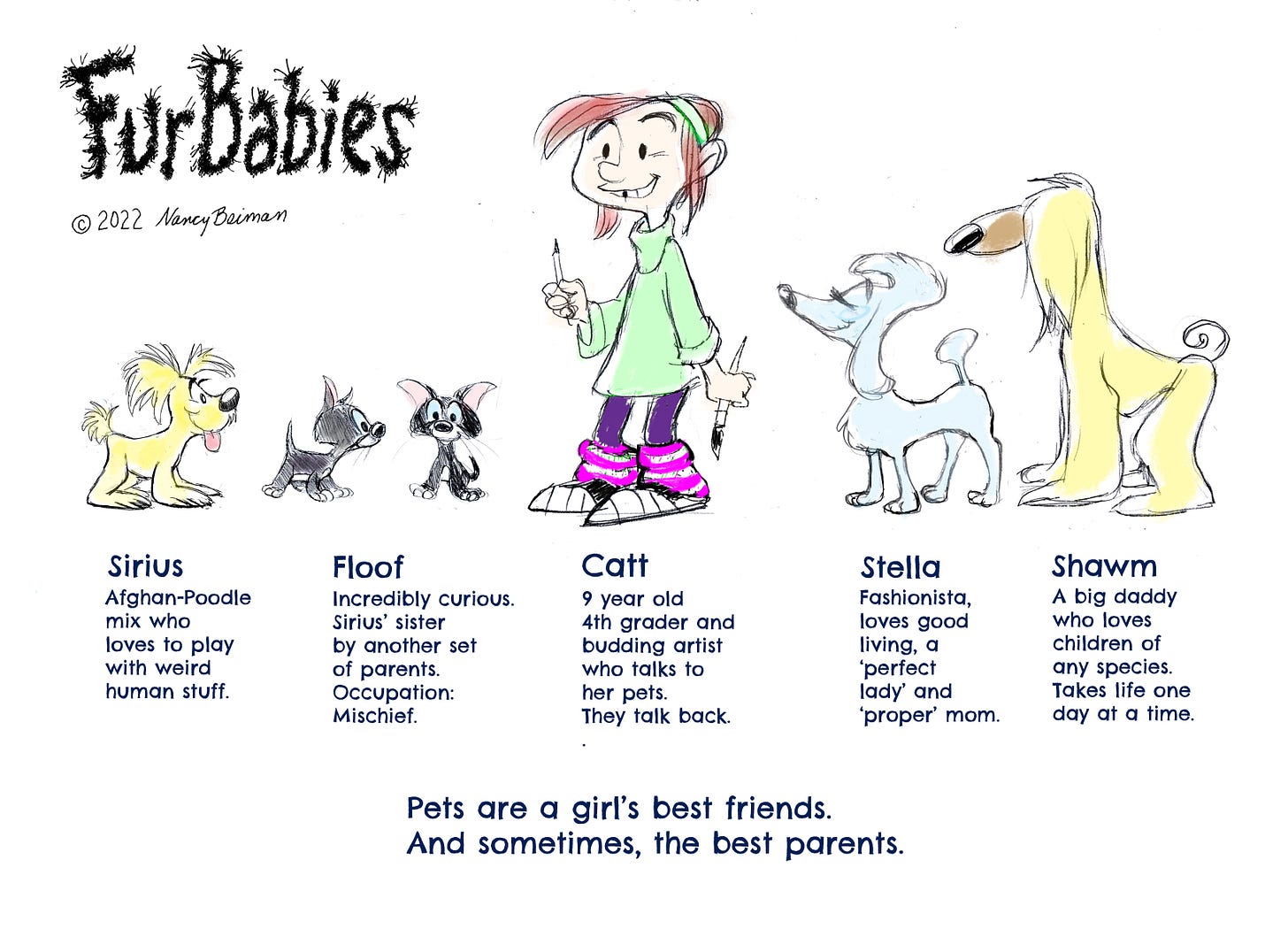
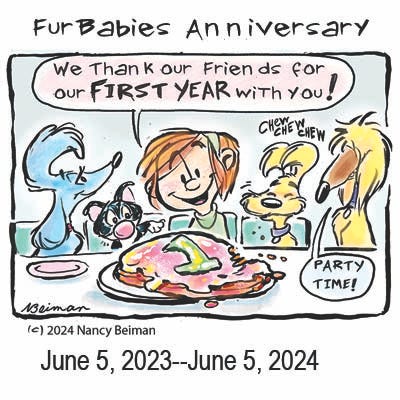
Nancy Beiman is best known for her decades-long work in animation, having animated for Warner Bros., Disney, Bill Melendez Productions, among others. However, on December 2022, at the age of 65, she ventured into a world of cartooning she hasn’t tried yet: a comic strip. The result was FurBabies, which made its debut on GoComics.com on June 5, 2023. The strip features Kate Buffet (pronounced boo-fay), an imaginative 9-year-old girl who can talk to her pets, dogs Stella and Shawm and their puppy Sirius, and Floof the kitten.
I interviewed Nancy about the comic via email. The following interview took place between August 12 to 16, 2023, and has been lightly edited for clarity.
What were your earliest cartooning influences?
My influences in animation were Chuck Jones, Charles M. Schulz, Robert Osborn, and Walt Kelly. I loved Zoltan Grgic’s work for the Zagreb animation studio. I was very fond of the UPA style but at the time did not know any of the artists’ names.
I met two of my influences and worked for one of them.
Speaking of Schulz, I remember you discussing your work on It’s the Girl in the Red Truck, Charlie Brown (1988) and how you animated Spike for it. What was your most memorable experience on that special?
Just working on a pantomime character was a liberating experience. I asked Bill Melendez who was the lead animator on Spike, and he said “You are. He’s never been animated before!” I loved using my knowledge of silent film comedy to block action on Spike. He walked like Chaplin (with those big feet) and did deadpan comedy like Keaton. He was a lot of fun to animate. That film is the most obscure of the Peanuts specials and should not be. It combined live action and animation (with the animated characters considered a ‘normal’ part of the live action world) two years before Who Framed Roger Rabbit. But CBS didn’t see any opportunity to sell toys, and it was not associated with any holiday, so they did not broadcast it until after Roger Rabbit was a hit. The Girl in the Red Truck was there first.
While you were getting started in animation did you think of doing comics? Were you published anywhere during your early days in the field?
I never considered doing comics at any time before December, 2022.
So FurBabies really is your first in the world of comics? What was the development process like? Which characters were created first?
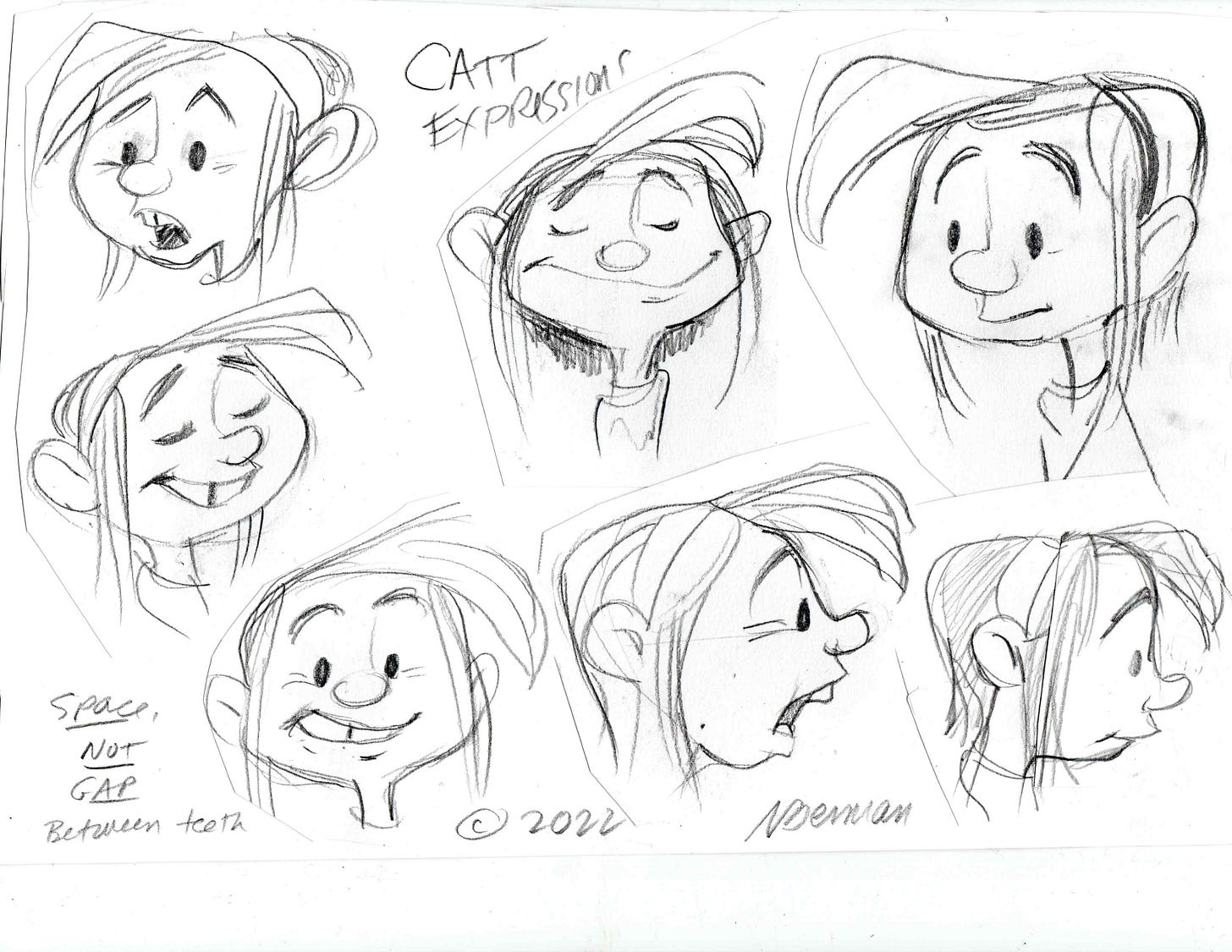
I first got the idea for a comic strip about a kid who can talk to her pets as family members (rather than pets) in mid-December 2022. I drew up some sketches on December 24 and got Stella, Sirius, and Shawm immediately. They have changed very little since then. Kate has changed a lot. Here are the first sketches of her.
“Catt” drawn on December 24, 2022.
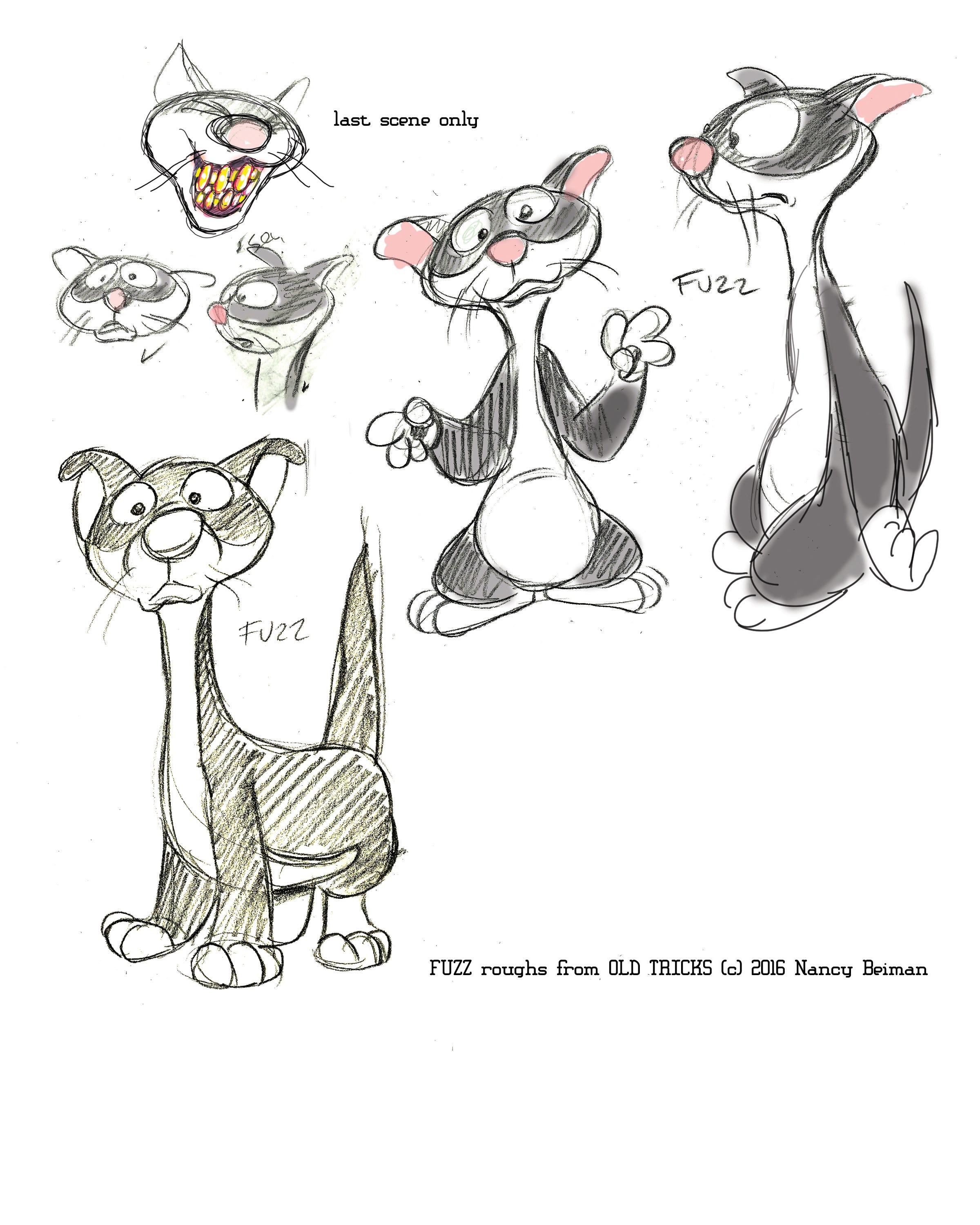
Floof is adapted from a cat design that I made for an unfinished film, Old Tricks. I used only the head and redesigned a kitten body. Floof has changed a bit since then. The head was that of an adult cat; she became more kittenish and cute after I drew about 10 strips. I had to go back and redraw some early Floofs when the strip was picked up by Andrews McMeel/GoComics. Kate was the hardest to create, and she was originally named Catt. She is inspired by Pippi Longstocking and a few students I have known (and they don’t know.) I had the character lineup, with Kate as Catt, on December 23, and changed her name to Katt, then Kate, on December 29. That’s when the characters were copyrighted.
Lynn Johnston saw the lineup on the 29th and instructed me to write 24 short story outlines, one sentence or so each, with dialogue. I got them done on New Year’s Eve. “You’ve got something. Can you keep this up?” Lynn asked me. I answered “Yes”. “Then draw 24 comics and let me know when they are done.” The first FurBabies comic strip, which is actually the first one on the GoComics site, was drawn on January 4, 2023. I used a 1926 Esterbrook “Radio” 914 pen nib once owned by Charles M. Schulz, on hot pressed Bristol board. It’s a gorgeous nib, but it is difficult to use a dip pen when you have inquisitive cats in a small apartment/studio. All subsequent strips were inked with a Pentel brush pen. All character art and backgrounds are drawn on paper, then scanned.
While we’re on art tools used in the comic, how big do you draw the strips? How do you color the comics?
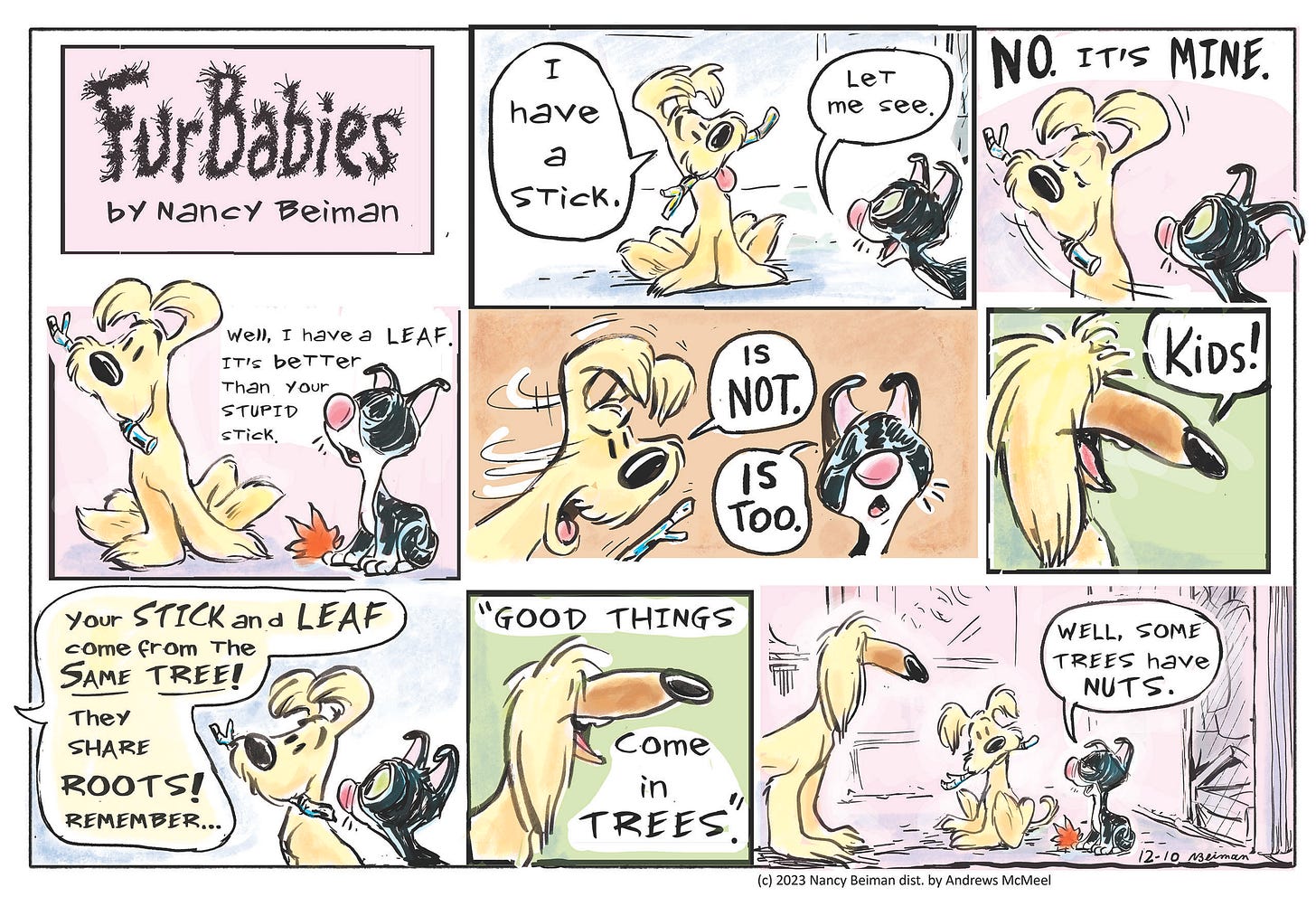
I don’t draw ‘the strips’. I do rough scribbly thumbnail layouts for them, the most detailed are done for the Sundays. Each Sunday strip has a different layout. The characters and backgrounds are inked on paper, all of them separately. I use old animation paper or Italian hot press paper and draw a light rough, then ink with a Pentel brush pen. Characters can fill the entire page or be smaller, depending on the complexity of the drawing. I’ll do a drawing over if I don’t like the first one, and sometimes modify the scan in Photoshop. The backgrounds are often reused. I save each image as a 300dpi .bmp file and composite them on digital templates for 2, 3, or 4 panel strips. The digital dailies are 17 inches wide. Sundays are 24 inches wide. The finals are saved as TIFF files at GoComics’ recommended size…which means they are half to 2/3 of the size of the PDF files I work on. Only the first strip (June 5) was drawn with characters and backgrounds all on paper, like a traditional comic…I work much faster using animation methods. I use whatever works, the technology is not important.
Coloring is done in Photoshop using brushes that mimic pastel and watercolor wash. I work on top of the black line to continue the illusion that it was ‘painted’ on paper. Even the borders of the strip are ‘fuzzy’ and characters sometimes break through the panels. Sunday strips are designed to be graphically pleasing and planned on paper but still done piecemeal, animation style.
Sunday strip, December 10, 2023.
The writing method Lynn Johnson suggested, with 24 one-sentence outlines, is an interesting technique for plotting out comic strips. What’s your overall writing method like once you got your strip off the ground?
I continue to follow Lynn’s method. It’s not a one sentence log line: dialogue and location, sometimes action, is always included. I often change things when I actually draw the characters since I still think in visual story, like an animator. Lynn’s method is the best way to keep a comic on track. It shows you where you are going and what characters can do. You can change the script order before you draw the strips.
Like animation dialogue, scripts and action for the comic are often changed when I get down to the drawing. Short scripts are the best way to get a series going, to plan when new characters are introduced, and develop characters. Lynn also suggested that I use a monthly planner (a book with the entire month on one page) to plan and time the storylines. That was a lifesaver. Several storylines have been moved since I started drawing the strip in January and wintry themes were out of place in June.
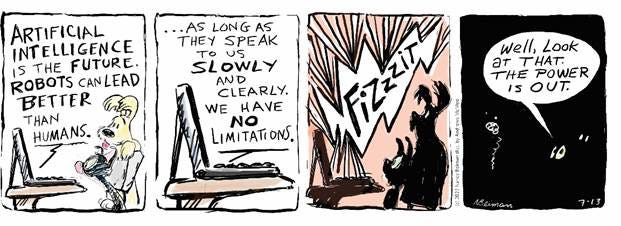
You recently introduced Pratt-L, an AI chatbot Kate uses to cheat on her homework. Do you have concerns about the use of AI in creative fields? What was on your mind when you wrote the arc?
I tried out AI’s writing and art programs when they were available for free trial and found them completely incompetent. Pratt-L combines the worst features of both. It is the perfect villain for this strip since the main conflict is between organic lifeforms and technology. This conflict developed as I got to know Kate better. She was the hardest one to write for.
Some modern comics have child characters that never stream videos, play video games, or use cell phones. Tauhid Bondia deliberately set Crabgrass in 1985 before these things became common and life changed for children. Kate Buffet is nine years old, lives in the 21st century, grew up in the age of smartphones, influencers, and streaming videos. Kate is not lazy or stupid but has a quirky way of thinking that does not match what is expected of her, especially in school. She has a lot of curiosity and it’s only natural that she would try the new AI technology. She has the latest digital technology. I made the rest of the apartment furnishings very dated, to show the contrast between Kate and her parents. There are some subliminal messages (family friendly ones) in the backgrounds. For example, the refrigerator is a Calder, named after the artist. Pratt-L wants to be a friend, is completely incompetent, sometimes snarky, in need of constant approval and self-pitying (depending on what it is scraping), but not a dangerous threat the way it is in real life.
There will also be an ‘influencer’ in FurBabies. It will not be human.
AI is not a matter of concern; it is literally going to be a matter of life and death. There is a bill in Parliament recommending that it be allowed to write medical prescriptions in Canada. What could possibly go wrong? People are not taking it seriously as a threat because artists and writers are the first ones affected by it, and most people do not consider art to be a ‘real job’ (My Labor Day strip addresses that issue.) I am most surprised by artists who keep insisting that it is ‘a tool’ like Photoshop. There is a difference. Photoshop allows you to personally modify artwork and photos. I use my own photos for backgrounds, and I sometimes use pictures from the Web for dogs and cats, but always redraw and redesign what I see. Photoshop does not use a bot to ‘scrape’ material from a million other artists and then ‘create’ art which you claim as your own.
My biggest surprise is that some artists think that it is fun to play with it. I think that they are like rabbits admiring the scales on the snake that is about to kill them.
Pratt-L’s quotes are from an actual ‘robot press conference’ held in Zurich a few days before this strip was published.
There’s a strong “family” theme in your comic, with how Kate views her pets to Sirius and Floof referring to Stella and Shawn as their mom and dad. Will this dynamic be explored more further as the strip continues?
The animals are definitely a family. The Dog Family has accepted Floof as one of their members. Kate is a link between the Dog Family and the Human family; she can speak to both, but only one of them understands her. She knows that she really is not a Dog or a Cat. It’s an interesting dynamic, and since the characters generally ‘tell’ me what they will and will not do, I am not sure if Kate’s situation will change. I also don’t think the human parents will appear, except as offscreen character voices. It’s not that they don’t interact with Kate…I just don’t find them interesting enough to include in the strip. It’s told very much from the animals’ point of view unless Kate is in school without them.
June 5, 2024. The Dog Family.
Early in the run most of the strip focuses on Kate and her pets, although newer strips start to include more characters, like in the recent Scavenger Hunt story arc. In addition to Kate’s classmates you also had her interact with Little Fingers the raccoon. Will we see more of Kate interacting with other kids in her class, and more of Little Fingers and other animals Kate can talk to?
Optima “Poppy” Populare and Iris, the two girls on the scavenger hunt, are not interesting enough to do much more than snark. “Poppy” returns in school and in some Halloween strips. There will probably be a few more kids appearing later on, with their own pets, probably in the dog park or maybe in the apartment building. Little Fingers the raccoon returns in November, but he’s a wild raccoon. He won’t ever interact with the other animals.
You indicated in your newsletter that you have a backlog for your comic. How far ahead are you currently?
I am currently working on strips that will air in October. I am proud to say that not one of them involves a pumpkin! (Charles M. Schulz covered that territory very well.) I like to stay about two weeks ahead of deadlines, and originally was two months ahead due to the late start in 2023! That gave me the option of shifting the cartoons, or changing them, as I got to know the characters better. I can also take a week off without worrying about comics not appearing.
Since FurBabies is still a very new comic and I am still redefining myself as a comic strip creator, I moved story lines or reworked some existing strips after I had enough comics that showed the characters’ developing personalities. Some people who have seen months of the strips in continuity tell me that they read better ‘as a whole’ but that is not the way comics work; it’s taken one day at a time. FurBabies is not a ‘gag’ strip, it’s character driven, so there were a lot of changes. Some of the cartoons that ran in June were originally drawn for September.
Things are settling down now. Some readers are adjusting to the fact that Kate is not a ‘perfect’ little girl, she sometimes tries to cheat on homework with AI (and gives up), or that she can be a distraction in class. I finally figured out who she was when she took her burned cookies and sold them as dog biscuits. Kate makes plenty of mistakes, but she has a creative way of dealing with them.
February 2, 1779 Anthony Benezet and John Woolman, both prominent Quakers (Society of Friends), urged refusal to pay taxes used for arming against Indians in Pennsylvania. Since William Penn established the state two generations earlier, the Friends had dealt with the Indian tribes nonviolently, and had been treated likewise by the native Americans. Benezet and the Quakers were also early and consistent opponents of slavery. More about Anthony Benezet
February 2, 1848 The Treaty of Guadalupe Hidalgo was signed in the Mexican city of the same name, ending the Mexican War. In 1845 Congress had voted to annex Texas, and President James K. Polk sent General Zachary Taylor and troops to patrol the border, newly defined by Congress as the Rio Grande, though it previously had been the Nueces River. Following an encounter between Mexican and U.S. troops, Polk called for Congress to declare war on Mexico. General Winfield Scott and troops eventually seized Mexico City.The treaty’s provisions called for Mexico to cede 55% of its territory (present-day California, Nevada and Utah, New Mexico, most of Arizona, and portions of New Mexico, Wyoming and Colorado), and to recognize the Rio Grande as the southern border of Texas, in exchange for fifteen million dollars in compensation for war-related damage to Mexican property. According to the treaty, U.S. citizenship was offered to any Mexicans living in the 500,000 sq miles (1.3 million sq km) of new U.S. territory. Land ceded to the U.S. after the Mexican War. The Treaty of Guadalupe Hidalgo
February 2, 1931 The first of well over 400,000 Mexican-Americans from across the country, some of them citizens and many of them U.S. residents for as long as 40 years, were “repatriated” as Los Angeles Chicanos were forcibly deported to Mexico. More on those deported, Los Repatriados
February 2, 1932 The Conference on the Reduction and Limitation of Arms, the world’s first disarmament meeting, opened in Geneva, Switzerland. Sponsored by the League of Nations, and attended by delegates from 60 nations, no agreement was reached. The U.S. delegation called for the abolition of all offensive weapons as the basis for negotiations but found little support.
February 2, 1966 The first burning of Australian military conscription papers as a protest against the Vietnam War occurred in Sydney, Australia.
February 2, 1970 Bertrand Russell later in life Bertrand Russell, mathematician, Nobel laureate in literature and philosopher of peace, died in Penryndeudreaeth, Merioneth, in Wales at age 97. Bertrand Russell at age 10 “Patriots always talk of dying for their country but never of killing for their country.” — Bertrand Russell More of Russell’s wisdom
February 2, 1980 Reports surfaced that the FBI had conducted a sting operation targeting members of Congress. In what became known as ”Abscam,” members suspected of taking bribes were invited to meetings with FBI agents posing as Arab businessmen, offering $50,000 and $100,000 payments for special legislation. Audio and video recordings of the meetings were made surreptitiously. Six members of the house were convicted of accepting bribes. Another member of the House and one senator were targeted but took no money. FBI agents in Abscam sting operation Actual FBI videotape of one attempted scam
February 2, 1989 Soviet participation in the war in Afghanistan ended as Red Army troops withdrew from the capital city of Kabul. They left behind many of their arms for use by Afghan government forces. They were driven out principally by the insurgent mujahadin, armed through covert U.S. funding. Read more “Charlie Wilson’s War” movie trailer
February 2, 1990 South African President F.W. De Klerk unbanned (lifted the legal prohibition on) opposition parties: the African National Congress (ANC), the Pan-Africanist Congress and the South African Communist party were officially considered legal. He also announced the lifting of restrictions on the UDF, COSATU and thirty-three other anti-apartheid organizations, as well as the release of all political prisoners and the suspension of the death penalty. This was the result of his negotiations with the imprisoned Nelson Mandela, a leader of the ANC. The ecstatic reaction to De Klerk’s beginning the end of apartheid on BBC video