Portico’s Part in Telling the Story of Emmett Till

The Emmett Till Memory Project teaches new generations about the tragedy that kickstarted the Civil Rights Movement. Preserving its digital assets is vital.
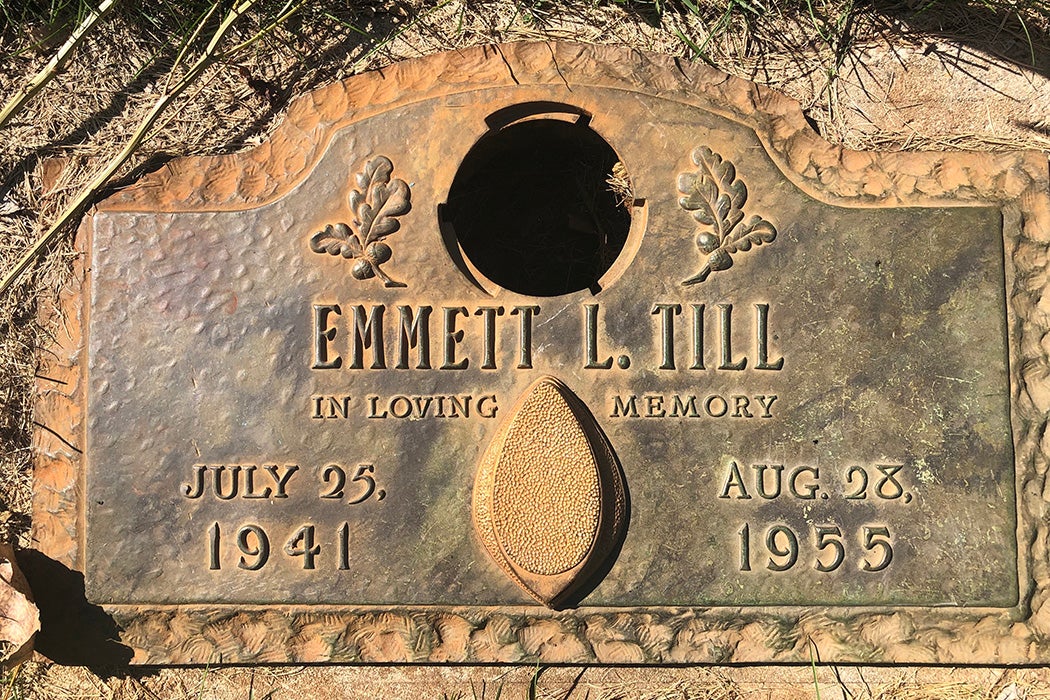
Emmett Till Headstone

Photo by Dave Tell via ETMP

By: Sara Ivry

On a late August day in 1955, Emmett Till was murdered in Mississippi. A fourteen-year-old African American from Chicago, Till stopped with his cousins at Bryant’s Grocery & Meat Market to buy chewing gum. There, Till whistled at the clerk, a brazen act that violated the norms of the Jim Crow South and so angered the clerk’s husband and brother-in-law that they killed the boy.

The events and locations that tell the story of Till’s life and death have been memorialized in different ways and forms over the ensuing decades. The Emmett Till Memory Project (ETMP), an app,  is one of them. It uses digitized archival documents, photos of those involved and of sites central to that fateful August day, and more so that users may educate themselves about who Emmett Till was and why his death still resonates. The ETMP’s digital assets are vital to ensuring the ongoing preservation of Till’s memory as well as his legacy.

That’s where Portico comes in. Dedicated to digital preservation, Portico has partnered with the ETMP to ensure the safekeeping in perpetuity of these digital artifacts.

Historian Dave Tell, a professor of communication studies at the University of Kansas, as well as the co-founder and director of the Emmett Till Memory Project, spoke with JSTOR Daily’s Sara Ivry about the Project and why its partnership with Portico is so critical.

Sara Ivry: How did you first learn of Portico?

Dave Tell: Kate Wittenberg reached out to me as part of the DEI efforts of her organization, specifically, a pilot project to support the preservation of archival content about under-represented topics that might be at risk. Kate contacted me about the time that we were massively reorganizing the Emmett Till Memory Project. She asked if she could just come along and preserve the site as it existed. I said, “Well, yes, you can, but we’re also trying to make it way better.” She sat in on development meetings over the last few years with us and has been an integral partner, not only in helping us think about preserving the site but helping us make design decisions that would render the site preservable.

Can you describe a little what the site was before you revamped it and what you were trying to do in the renovation?

The short story is we went live in October of 2019, and then in the pandemic, we used our last $10,000 of grant money to pay a DEI consultancy to tell us what we did well and what we did poorly. They did this entire audit, focus groups, they talked to the family, they talked to scholars. They looked at analytics, and they came back to us. Essentially, they told us great content, very bad design, which in retrospect is not surprising. Everyone on the project had been a content expert; we had never had design people on board. We had never had UX people.

The design only works for people who already know the story, they told us, which of course was a devastating blow to us. They also said this reads as if it was written by a middle-aged white guy and I’m like, “Well, I wrote it and I’m a middle-aged white guy—so fair enough.”

Included by Favor 

So, we hired a woman named Renee Payne out of the Rhode Island School of Design who runs a graphic design firm called included. She specializes in computer design for veterans of the Civil Rights movement; her clients include the families of Andy Young, Harry Belafonte, and family of Malcolm X. She assembled a team of young designers of color, and I said to them, “Nothing is sacred here. Let’s make this as good of a project as it can be,” and they reimagined it from the ground up.

When exactly then did Portico come on board?

Kate came in in the middle of this revamped process, and one of the specific things she encouraged us to do was to avoid third-party dependencies. The example that I understood was if you embed a YouTube video, your content is only as secure as YouTube, which you have no control over.

We really thought long and hard about what technologies we could preserve, and Kate and her colleague Karen Hanson pushed us to think about what exactly we’re preserving. The technologies we are currently depending on do not last forever, right? We changed our mindset. We don’t want to preserve this project so that like it will look the same for everyone into the future, but we want to preserve the assets.

Make images preservable, the text—the component parts.

Eventually we’re going to have a lot of immersive stuff on there. It’s only halfway there now. Portico helped us understand better to preserve the components that make up immersive pieces. In the future, people can use whatever technology is then current, use our same data, and create their own project.

I hadn’t thought about the built-in obsolescence of technology, and that we have to account and plan for that in the design of an app or site as well as in the design of an archive. Had you considered that before Portico got involved?

No, I’m a humanist by training, so when I first started thinking about digital preservation, probably a decade ago now, my gut instinct was we make the website just like a book. It’ll sit there unchanged forever. And Portico has been instrumental in changing the way I think about preservation—that first of all, forever might not be the goal.

Emmett and Mamie Till-Mobley on the exterior of the house they lived in from 1950–1955. Photo by Dave Tell via ETMP

Second, what gets preserved is not necessarily the sort of same experience that our users have today. What really matters and what needs to be preserved is what we have. The Emmett Till Memory Project has amazing artifacts. We have hours of audio with the family that they’ve given us permission to use that no one else has. We can tell the story in incredibly intimate ways and that’s super important. When you open this app, you’ll hear the voice of Reverend Wheeler Parker, Till’s cousin, narrating the story as all this stuff flashes on the screen behind you—I don’t care if the flashy, immersive technologies are preserved forever. But I care deeply that the audio files—and the voice of Rev. Parker—gets preserved. Someone else can build their own tools with that stuff. My ability to make that distinction is a testament to Kate and Portico.

Why is digital preservation of these assets critical in any case?

It’s almost hard to answer this question without going into cliche other than to say: Ignoring the past is a critical component of white supremacy. Full stop. What we want to do and what the family wants to do is tell the story—not that telling the story is sufficient for the change that they and I want to see, but it’s a critical part of the change that they and I want to see.

The Interpretive Center—what’s the first line of their mission statement, “We believe that racial reconciliation begins with telling the truth,” right?—that’s a sentence that accurately describes the vision of the Till family and it certainly describes my vision.

What was the origin of this app?

If you start from the murder of Emmett Till in August 1955 you have to count 49 years and 11 months before the state of Mississippi dropped a single dollar on the Till story. Eighteen citizens of Tallahatchie County thought that was ridiculous; they put up a commemorative sign that got shot, defaced with acid, spray painted.

Tallahatchie Civil Rights Driving Tour sign, ca. 2015. Photo by Pablo Correa via ETMP

In 2014, I got invited to go down, I’d been writing about Till for a decade and a half by then, and the question was: How do we tell Till’s story in the context of vandalism?

It’s easy to shoot a sign in the middle of the country. It’s harder to shoot an app.

What are some of the assets on the app that stand out to you?

My favorite by far are the hours of audio, oral history we have of Reverend Parker that was taken in his church in Chicago. We also drove him from site to site; we put a microphone on his lapel and on the sun visor of the car. And we just asked him what these sites meant to him as we went from place to place. All that audio’s not up yet, but we have it. (snip-a bit More)
Some Resources

They’re accepting support, and offering support. Snippets here; there is more info about each on the page here:

https://www.them.us/story/trans-mutual-aid-funds-donate-support

This year’s Transgender Awareness Week (the leadup to Trans Day of Remembrance on November 19) has felt particularly macabre, arriving on the heels of a presidential election that will be disastrous for trans rights. Still, there’s never been a better time to help trans communities across the U.S. find shelter, obtain medical care, and protect themselves from state violence — and if you’re reading this, you can help by getting involved in mutual aid.

Although there are plenty of well-known LGBTQ+ nonprofit organizations and advocacy groups throughout the country, mutual aid funds prioritize giving directly to marginalized people in need, in order to survive crises and improve their material conditions. Numerous trans-led mutual aid funds exist on local, state, regional, and national scales, and while many may not be tax-deductible, we think that’s a small price to pay in order to help trans folks find safe shelter, obtain gender-affirming care, change legal identity documents, and more.

The phrase “we keep us safe” may have originated in prison abolition organizing, but it definitely applies to LGBTQ+ folks as well. Below, we’ve highlighted just a few trans mutual aid funds that are open to donations — or applications for assistance, if the trans person in need is you — as of November 2024. For more, check out our state-by-state list of mutual aid funds and advocacy groups. You can also search for #TransCrowdFund on your preferred social media platform to find individual trans people fundraising for their own needs.

Black Trans Fund

Organized by the Louisville, Kentucky-based nonprofit Change Today, Change Tomorrow, the Black Trans Fund offers “unrestricted assistance” for Black trans, nonbinary, and gender-nonconforming people. According to organizers, the fund has distributed over $35,000 for “bills, travel, food, medical needs, and recreational needs” over its four years in existence. Donations are tax-deductible. (snip)

Genderbands

Based in Utah, Genderbands offers individual grants for trans people seeking help with medical costs (including surgeries for those over 18), travel, name and identity document changes, and special grants for trans youth with parental consent. Any trans person in the U.S., Canada, or Mexico may apply, although surgical grants are limited to U.S. residents; the application period for 2025 grants, including one dedicated grant for a masculinizing top surgery procedure in Salt Lake City, ends November 30. Donations of gently used binders are also accepted. (snip)

Iowa Trans Mutual Aid Fund

A project of the Iowa Mutual Aid Network, this fund is dedicated to providing aid for gender-affirming medical care throughout the state, and has distributed over $100,000 since 2021, according to its website. Grant seekers may apply every month, and may receive funding for hormone therapy, surgeries, therapy, and some other medical fees, as well as name change costs, travel expenses for medical care, and gender-affirming clothing. (snip)

Point of Pride

One of the largest trans-led mutual aid networks in the U.S., Point of Pride has raised millions for trans mutual aid through its annual TikTok fundraisers. The organization funds gender-affirming surgeries, hormone therapy, hair removal, clothing, and more through its various dedicated funds, and offers free binders and shapewear for those who cannot afford to buy their own. In 2024, Point of Pride reported giving $163,000 to 117 trans people through their HRT Access Fund alone, including 49 Black recipients thanks to funding from the National Black Trans Advocacy Coalition. (snip)

Socialist Trans Initiative (STRIVE)

Based in Pensacola, Florida, STRIVE’s anticapitalist organizers say their mission is to “provide moral and material support to trans people who need it,” in the form of emergency housing, hormone therapy, food support, transportation, and “any other items needed for our survival.” In addition to its aid funds, STRIVE also holds trans community events and weekly political organizing meetings. (snip)

Transitional Justice

Although most of its organizers are based in Missouri, Transitional Justice seeks to facilitate travel and “temporary, transitional housing” for trans people fleeing harmful legislation throughout the U.S., as well as “people who have been evicted from their homes, fired from their jobs, or denied access to healthcare.” Applicants can request assistance by filling out the organization’s web form. (snip)

Trans Love Fund

Founded in 2013 through the South Carolina nonprofit We Are Family, the Trans Love Fund offers microgrants up to $200 for assorted “medical, legal, and emergency living expenses.” Grants are available to trans South Carolinians ages 16 and older, with applications opening one week out of every month (usually the first week, per the fund’s FAQ). We Are Family also operates the “Closet Case Thrift Store,” which offers free gender-affirming clothing to trans and gender-nonconforming youth. (snip)

Got our vaccines and tRump’s admin plan to put migrants in for profit prisons

We got our vaccines and tRump’s plan for mass for profit prison detention camps for migrants.

There are some distortions because I moved a lot due to pain in my hips and back. But it looks OK but if you want just listen to the audio.  I put a lot of effort into the video.  Hugs


Poem-a-Day: Miscarriage

Christine Stewart-Nuñez

Gauzy film between
evergreens is a web

of loss. Get closer. Reach
to touch the shimmering

gossamer and your finger
pushes through. Remember

filling that space with desire?
Someone else might grieve

the spider who abandoned
this home; others grow anxious

waiting for a deer’s walk
to wreck it. But you—

you grieve the net of thought
spun inside your own womb:

intricate and glossy and strong.

Copyright © 2024 by Christine Stewart-Nuñez. Originally published in Poem-a-Day on November 14, 2024, by the Academy of American Poets.

More about this poet and this poem here.

Bernie Sanders says Americans ‘have a right to be angry’: Full interview

Sen. Bernie Sanders (I-Vt.) joins Meet the Press to discuss his criticism of the Democratic Party and what’s next for Democrats after Kamala Harris’ projected loss.

Trump pledged to roll back protections for transgender students. They’re flooding crisis hotlines

Image

1 of 3 |  

Republican presidential nominee former President Donald Trump walks from the podium after speaking at a campaign rally at Lee’s Family Forum, Thursday, Oct. 31, 2024, in Henderson, Nev. (AP Photo/Julia Demaree Nikhinson)

Image

2 of 3 |  

FILE – Protesters advocating for transgender rights and healthcare stand outside of the Ohio Statehouse, Jan. 24, 2024, in Columbus, Ohio. (AP Photo/Patrick Orsagost, File)

Image

3 of 3 |  

FILE – Jude Armstrong and fellow Benjamin Franklin High playwriting class students perform their play, “The Capitol Project,” on the steps of the Louisiana Capitol in Baton Rouge, La., March 27, 2024. (AP Photo/Gerald Herbert, File)

We knew he was going to go to this, but remember the only one talking about trans people was the republicans.  Harris never mentioned them.  This is totally a manufactured outrage.  No one cared before a few religious republicans got talking constantly about it.  I think you all need to ask yourself how trans people affect your lives?  There are what 1,400 trans people in the country?  There are 5 trans kids in sports?  There has never been a trans woman sweep the awards at any event yet that was the constant talking point.  Trans women who they mistakenly call men / boys are going to steal your daughter’s trophy.   But it never happened and they couldn’t show it.  How was this something people voted to switch the election on? Think on it right wing voters on how you were played.  So silly and stupid.  Plus the religious people now in charge of the military intend to remove trans people and gay people.   That will not only harm readiness because the military keeps saying it doesn’t affect the readiness at all.  I know from experience that if you remove the LGBTQ+ from the military, it will gut the military entirely and that will harm readiness.   Hugs

A special request from me.

I have posted and told people in email or comments about my friend kamyk who is a fellow abuse survivor.  He was kidnapped at age 7, trained and abused to be a sex toy for wealthy men.  Then for some reason no one will admit to he was returned to his family after months of being used and abused, filmed and made to do sex acts with adults, other kids, and dogs.  He then was abused all his childhood until he became an adult and then sadly was pimped out and sexually abused until at 40 he escaped and started a life trying to understand himself / what happened to him.   

Some background for those that don’t know and I have his permission to share this much.  He was born premature and with an intestine system not fully formed and so he had intestinal troubles and pain all his life.  It effected his bowl movements badly which was bad when he was being abused.  He had diverticulitis which went bad and became full blown diverticulosis.  That means the pockets formed on the outside of the intestine and attached to it forming a pocket got super infected and then burst.   One burst into his bladder. During the time his infected pockets ruptured, his pain in his lower intestines got really bad and he developed a high fever of 104.  He was taken to a walk into care which sent him to the hospital.   They admitted him and shortly he had what they called a dirty surgery.  That was when they couldn’t clean his system out and they couldn’t get a scope inside him because his intestines were so inflamed.  They had to remove his sigmoid colon. 

After the surgery he had a bad incident where a person ordered him up out of bed and ignored his pleas to get help from the nurse.  That caused his abdominal wound to open up among other things.   He was put in the ICU.  He was taken from the ICU and placed in a specialty care facility to further heal.  I tell you all of this because I have a request for my followers who care.  

When he talks to me he is very unhappy, he feels trapped, he feels unworthy to live, he feels depressed, he is lonely.  This afternoon his sister reached out to me and asked me to ask those that knew him and my friends to send him get well cards.  She felt he needed to be flooded with love.  I contacted those on the Male Survivor site I have email addresses for who have asked me to keep them informed and asked them to forward the message to the site.  But they have a strict rule against posting addresses of survivors so that might be hard.  

I am asking you who would care to do so, to please send him a card or well wishes to the address I will put below.  You don’t need to be specific or even mention all I wrote.  Just tell him you heard about his situation and that he was in recovery from Scottie and wanted to send him a get well message.  Or anything like that.  You people all care about others so may know far better how to write a get well message, I admit I am sort of a klutz or clueless at that stuff, Ron does it for us.  On those kinds of things I don’t understand or function well.   

Thank you to everyone.  I used to spend hours at night listening to him cry out his anguish as new memories of his abuse surfaced.  I was doing for him what Randy did for me in 2014 when I had my emotional breakdown for the same reasons.  But now he needs more than someone to listen, he needs to know people care about him.  Thank you.  Hugs


Select specialty hospital
Attn: Kamyk Robinson
8049 South Ave room 103
Youngstown Ohio 44512

Today in Good, almost Karmic, News

I am so tired of the lies about immigrants to please the maga bastards.

OK this is me just ranting before bed.  Sorry.  See I was an abused kid.  Most of you who come here already know and don’t need any extra help in that to show you how badly I was abused.  So I don’t need to show you more than my occasionally over the top ranting about my childhood abuse or the republicans claiming the republicans are stealing kids at the border … which is really what the republicans did.  They separated parents from children and then gave the children to Christian adoption agencies to sell for profit.  I wonder how their god feels about that.  But please let’s keep talking about how Biden lost all these kids … who were never lost.  Does any one else mind they are doing this?????   Because as a human trafficked sexually abused and traded person … I fucking sure DO!   Hugs.

https://apnews.com/article/fact-check-misinformation-migrant-children-missing-7ab0cea2fd2238346197429e952baa8b

https://www.usnews.com/news/us/articles/2024-10-02/fact-focus-claims-that-more-than-300-000-migrant-children-are-missing-lack-context

I am so very very tired and sorry if I hurt anyone tonight.  It just hurts what the republicans are doing and keep doing.   They hurt adults … They hurt kids.  They care for no one.

I wrote this post days ago and fell asleep before I could publish it.  Hugs

Peace & Justice History 11/13:

November 13, 1933
The first recorded “sit-down” strike in the U.S. was staged by workers at the Hormel Packing Company in Austin, Minnesota. When the Independent Union of All Workers (IUAW) went on strike, the company tried to bring in scab (strike-breaking) workers.

“ Four hundred men, many of them armed with clubs, sticks and rocks, crashed through the plant entrance, shattering the glass doors and sweeping the guards before them. The strikers quickly ran throughout the plant to chase out non-union workers. One . . . group crashed through the doors of a conference room where Jay Hormel and five company executives were meeting and declared “We’re taking possession. So move out!” (Larry Engelmann, “We Were the Poor — The Hormel Strike of 1933,” Labor History, Fall, 1974.)

The tactic worked: within four days Hormel agreed to submit wage demands to binding arbitration. The success of this strike reinvigorated the labor movement, which had been in decline throughout the 1920s.
November 13, 1956
The U.S. Supreme Court ruled segregation unconstitutional in public transportation. The case, Browder v. Gayle, was brought by four women, Aurelia Browder, Susie McDonald, Claudette Colvin and Mary Louise Smith, who had refused to surrender their bus seats to whites in Montgomery (months before Rosa Parks had done so), and had been arrested for violating Alabama law which required segregation on public buses.They challenged the law and the Court agreed, finding the law under which they were arrested in violation of the due process and equal protection clauses of the Fourteenth Amendment to the U.S. Constitution.
Aurelia Browder

A roadside monument was dedicated in 2004 to the four plantiffs in the Browder v. Gayle case.
Colvin, a 15-year-old student at Booker T. Washington High School, boarded a bus in 1955 and refused to give up her seat to a white man. She was handcuffed, arrested and forcibly removed from the bus, as she screamed that her constitutional rights were being violated. 
More on Browder v. Gayle 
November 13, 1960

Over 1000 Quakers (members of the Society of Friends) surrounded the Pentagon for a silent vigil to commemorate the 300th anniversary of the first Quaker Peace Testimony issued to King Charles II in 1660.
From the original Peace Testimony: “We utterly deny all outward wars and strife and fightings with outward weapons, for any end or under any pretence whatsoever.
And this is our testimony to the whole world….”

The complete text of the 1660 Declaration
November 13, 1974

Karen Silkwood, a technician and union activist (Oil, Chemical, and Atomic Workers’ Union) at the Kerr-McGee Cimarron plutonium fuels production plant near Crescent, Oklahoma, was killed in a one-car crash.
Read more about her story  
November 13, 1982
Maya Ying Lin
The Vietnam Veterans Memorial was dedicated in Washington, D.C. Carved into black granite are the 58,260 names of those Americans who died in Vietnam. The designer, Maya Ying Lin of Athens, Ohio, a 21-year-old architecture student at Yale University, was the winner of the competition that drew 1,421 design entries: “. . . this memorial is for those who have died, and for us to remember them.” Eventually, the Memorial included three elements, the Wall of names, the Three Servicemen Statue and Flagpole, and the Vietnam Women’s Memorial.

The Wall of Names, the Three Servicemen Statue and Flagpole, and the Vietnam Women’s Memorial

Read more about the memorial

Stunning photo gallery of the Memorial including interactive panoramic images

Interview with Maya Lin and filmmaker Freida Lee Mock, who made the Academy-Award-winning documentary, “Maya Lin: A Strong Clear Vision” (My apologies about Charlie Rose; it’s PeaceButton’s link, and it’s good info, Rose notwithstanding. -A)

https://www.peacebuttons.info/E-News/peacehistorynovember.htm#november13