June 9, 1872 Julia Ward Howe, an abolitionist and the composer of “Battle Hymn of the Republic,” tried to establish the Mothers’ Peace Day Observance on the second Sunday in June. In 1872 the first such celebration was held and the meetings continued for several years. Her idea was widely accepted, but she was never able to get the day recognized as an official holiday. Mothers’ Peace Day was the predecessor of the Mothers’ Day holiday in the United States now celebrated on the third Sunday of May. Julia Ward Howe ca.1898 Her proclamation read in part: “As men have often forsaken the plough and the anvil at the summons of war, Let women now leave all that may be left of home For a great and earnest day of counsel. Let them meet first, as women, to bewail and commemorate the dead. Let them solemnly take counsel with each other as to the means Whereby the great human family can live in peace….”
June 9, 1954 Special Counsel for the U.S. Army Joseph N. Welch confronted Senator Joseph P. McCarthy (R-Wisconsin) during hearings into alleged communist infiltration of the Army Signal Corps.McCarthy had attacked a member of Welch’s law firm, Frederick G. Fischer, among many others, as a communist. This was alleged due to Fischer’s prior membership in the National Lawyers Guild. The Guild was the nation’s first racially integrated bar association. Army counsel Joseph N. Welch (l) confronts Senator Joseph McCarthy (r) Welch was outraged by the attempt to destroy the reputation and career of someone of whose integrity he had no doubt: “Until this moment, senator, I think I never gauged your cruelty or recklessness . . . . Have you no sense of decency, sir? At long last, have you left no sense of decency?” The entire hearings and this encounter were seen live on television, the first congressional committee hearings ever to be broadcast. McCarthy’s ability to make such accusations was soon greatly diminished. Watch the confrontation National Lawyers Guild, since 1937 and today
June 9, 1984 150,000 marched in London, England, for nuclear disarmament, protesting the presence of U.S. cruise missiles on British soil.
June 9, 1993 Police banned a vigil by Women in Black (Zene u Crnom) in Belgrade, Serbia. Who are the Women in Black? Women in Black demonstrations combine art & politics
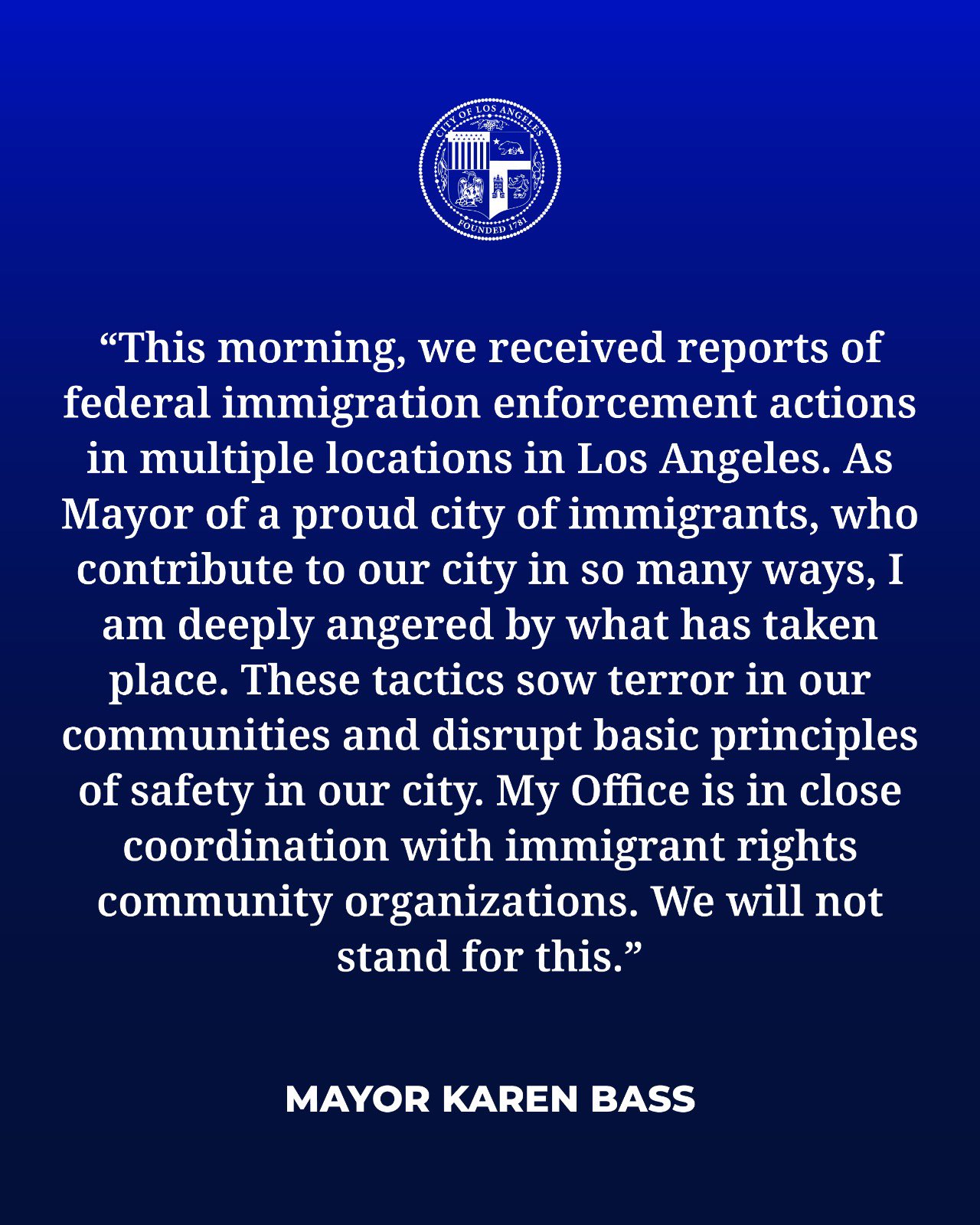
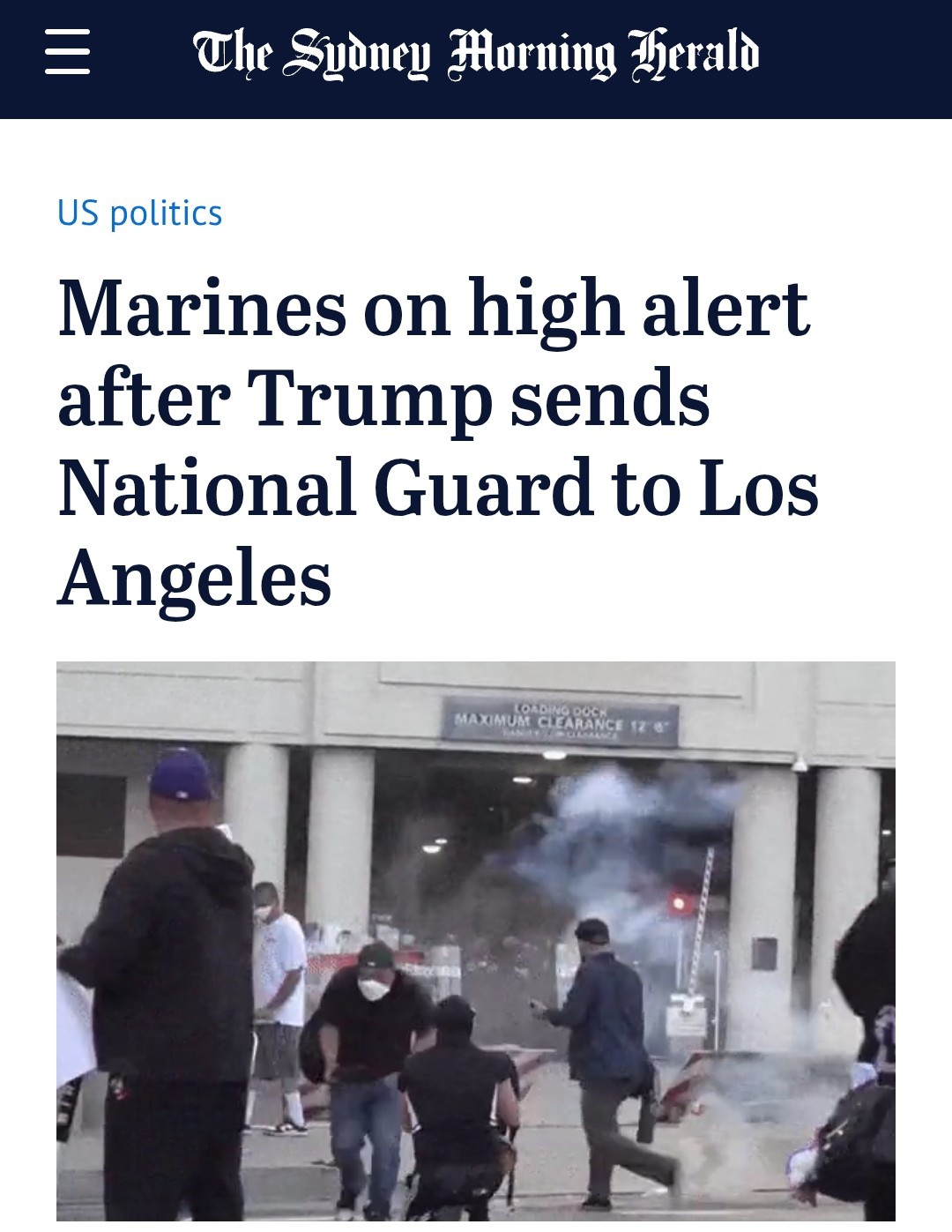
A third day of protests against immigration raids was expected to take place in the Los Angeles area on Sunday, hours after President Trump took the extraordinary action of ordering at least 2,000 National Guard members to assist immigration agents clashing with demonstrators.
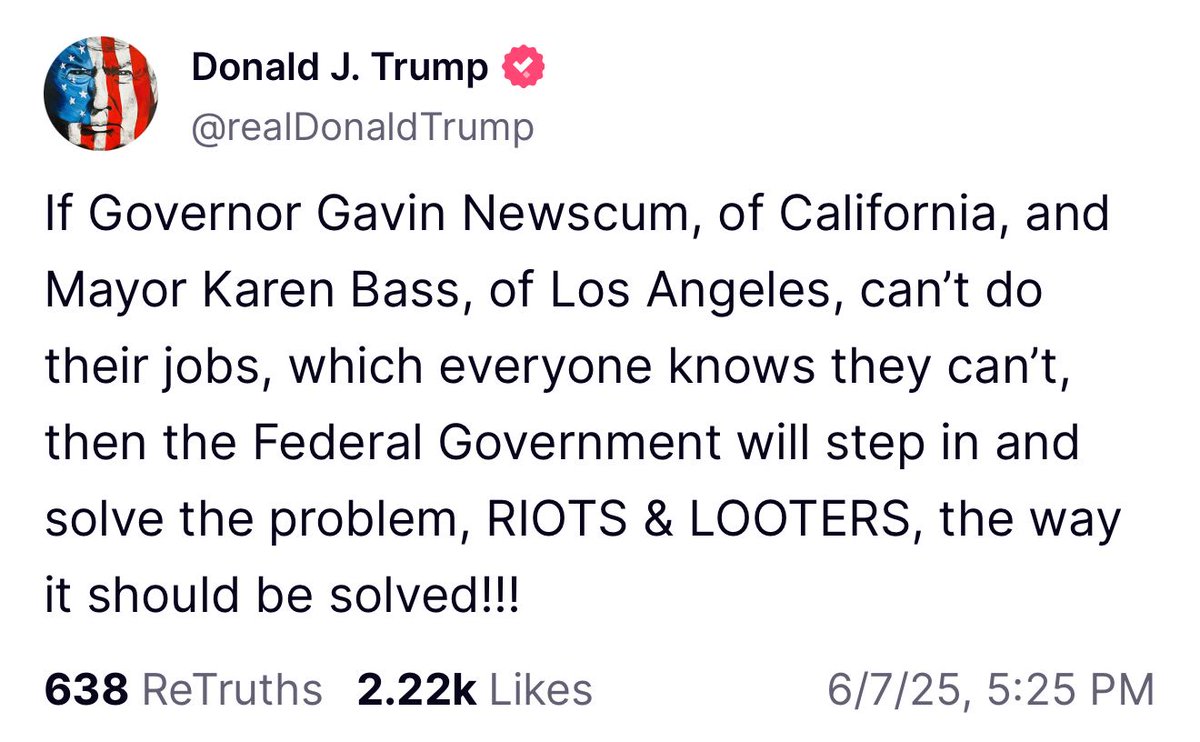
The announcement by Mr. Trump — who said that any protest or act of violence that impeded officials would be considered a “form of rebellion” — was an escalation that put Los Angeles squarely at the center of tensions over his administration’s immigration crackdown and made rare use of federal powers to bypass the authority of California’s governor, Gavin Newsom.
Mr. Trump issued the order on Saturday as law enforcement officers faced off with hundreds of protesters for a second consecutive day in the Los Angeles area, in some cases using rubber bullets and flash-bang grenades. Mr. Newsom described Mr. Trump’s order as “purposefully inflammatory,” saying that the federal government was mobilizing the National Guard “not because there is a shortage of law enforcement, but because they want a spectacle.”
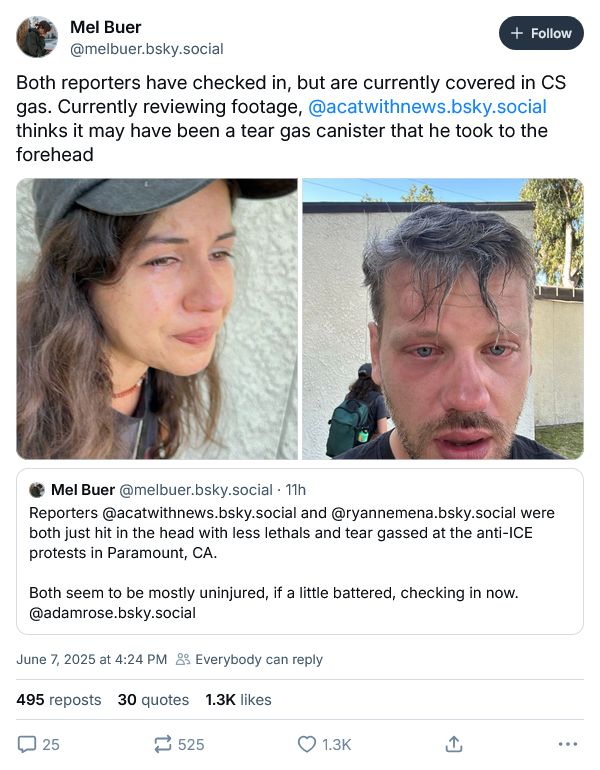
Confrontations broke out on Saturday near a Home Depot in the heavily Latino city of Paramount, south of Los Angeles, where federal agents were staging at a Department of Homeland Security office nearby.
Agents unleashed tear gas, flash-bang explosives and pepper balls, and protesters hurled rocks and cement at Border Patrol vehicles. Smoke wafted from small piles of burning refuse in the streets.
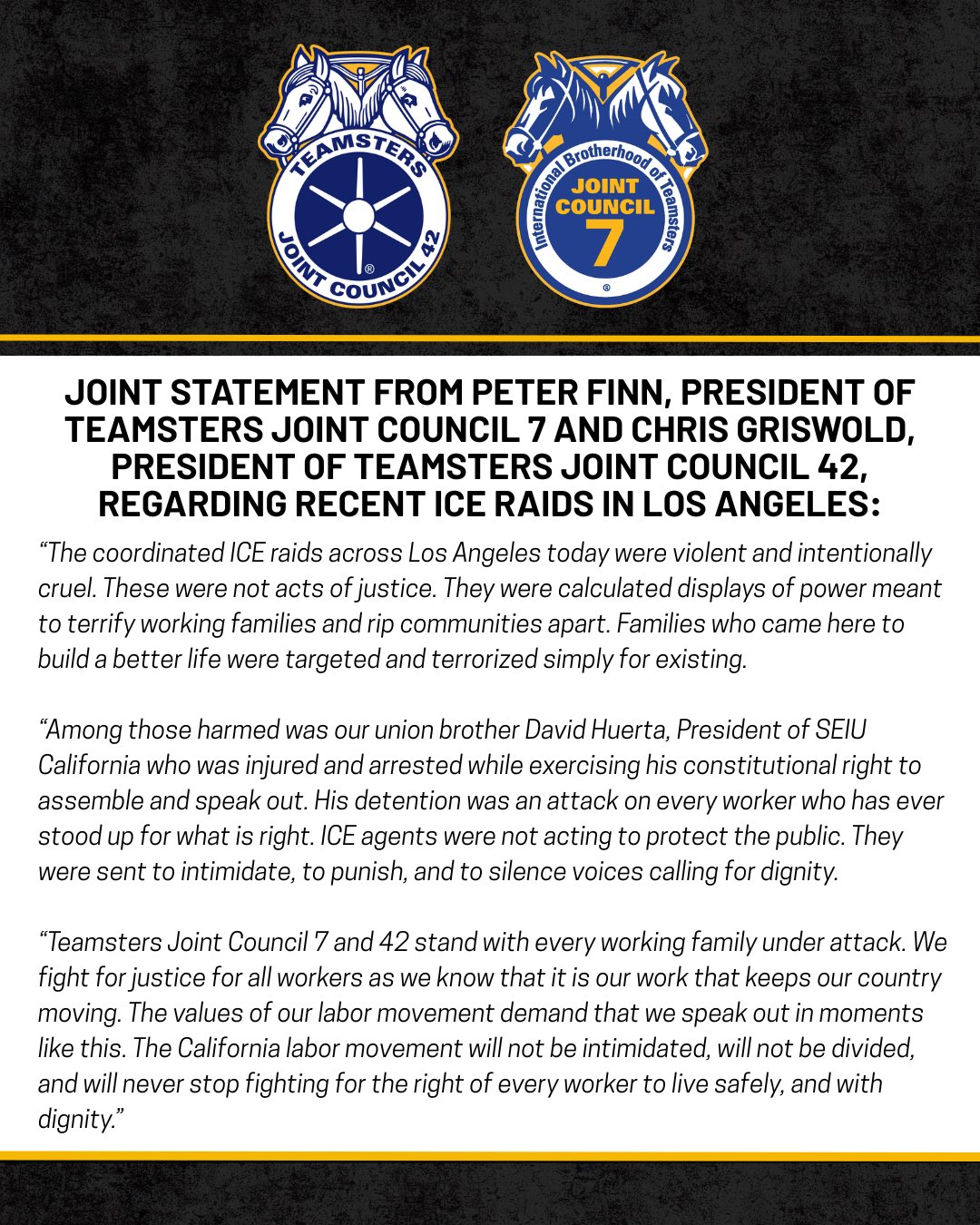
Tensions were high after a series of sweeps by immigration authorities the previous day, including in LA’s fashion district and at a Home Depot, as the weeklong tally of immigrant arrests in the city climbed past 100. A prominent union leader was arrested while protesting and accused of impeding law enforcement.
The National Guard has not yet been deployed to the sites of any protests in Los Angeles County, according to its sheriff’s department. “We were told that the National Guard had been deployed, however they are not on the scene or the ground yet,” Deputy Sheriff Tracy Koerner said around 1:45 a.m. local time. Earlier Sunday, Mayor Karen Bass said the National Guard had not been deployed in the city limits.
The Los Angeles Police Department said at midnight that it detained “multiple” people who breached an area near the city’s Metropolitan Detention Center where the agency had declared an “unlawful assembly.” “Those detained will be arrested and booked for failing to disperse,” the force said on social media. Earlier, police said a section of Alameda Street was closed to all vehicle and pedestrian traffic.
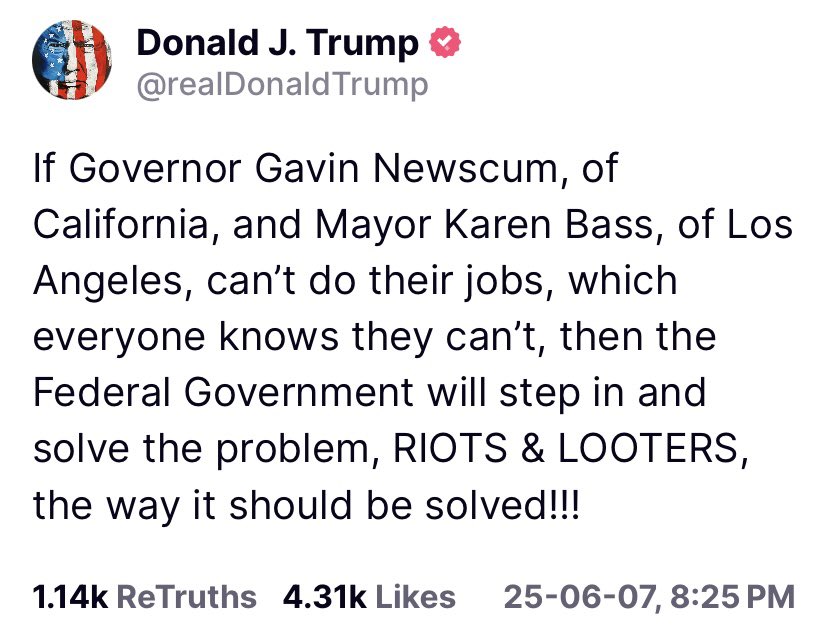
The cult is celebrating on X, with some calling for the use of “live rounds” on protesters. Trump’s post below came at 2:41am, presumably upon his return from a UFC match where he was seated with Mike Tyson.
Post
See new posts
Conversation
emptywheel (check)
@emptywheel
SEIU CA President David Huerta was assaulted and arrested for peaceful protest. The injuries the assault caused required hospital care.
Quote
JD Vance
@JDVance
·
Replying to @JDVance
For the far left rioters, some helpful advice; peaceful protest is good. Rioting and obstructing justice is not.
Deploying troops to communities already under pressure is not leadership—it’s provocation. The Trump Administration is weaponizing fear to divide and destabilize. We will not be silent. We stand with those targeted and terrorized. We fight for justice. Always.
Quote
Gavin Newsom
@GavinNewsom
·
The federal government is taking over the California National Guard and deploying 2,000 soldiers in Los Angeles — not because there is a shortage of law enforcement, but because they want a spectacle. Don’t give them one.
Brian Allen
@allenanalysis
Subscribe
In case you were wondering what sparked the LA standoff between protesters and federal agents, this is it. Immigrants showed up for routine ICE check-ins and were detained on the spot. Hauled into the basement. Held overnight like fugitives. No warning. No due process. Just snatched. “Land of the free,” right?
Republicans against Trump
@RpsAgainstTrump
Subscribe
During his first term, Trump asked Defense Secretary Mark Esper to shoot protesters. Esper refused. Now he has Pete Hegseth. God help us all
JD Vance now wants to use the chaos ICE is causing in Los Angeles as pretext to pressure politicians to pass the Republican budget bill that will saddle Americans with trillions of dollars of debt, skyrocket the deficit, take away people’s healthcare, and give massive tax breaks to the wealthy.
Jo
@JoJoFromJerz
Subscribe
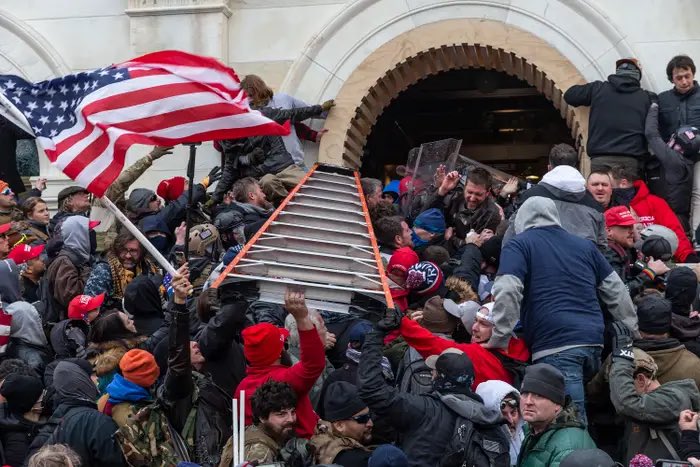
Weird how he didn’t call up the National Guard on January 6th.
Post
See new posts
Conversation
Crooks and Liars
@crooksandliars
Trump sends in his brown shirts to cause disruption so he can use the insurrection act or whatever fucked rational he comes up with to send in the the National G. Mussolini gives a thumbs up in his grave.
Quote
MeidasTouch
@MeidasTouch
·
Trump lit the match, poured the gasoline, and now wants to use the blaze he is creating as pretext to burn it all down.
A powder keg is about to explode: With masks to hide their identity, this is what a Nazi takeover of the streets of Los Angeles looks like. Trump’s cosplaying ICE Gestapo is carrying out a lawless assault against one of the most diverse cities in America.
I was told ICE was going to arrest gangsters and mobsters. But all I see is fat white guys in cosplay doin jobsite raids, school raids, and arresting mothers with kids who are applying for citizenship.
Ask yourself why ICE is conducting raids in cities like LA and Chicago, where they face strong opposition, while massive agribusinesses in places like Kristi Noem’s South Dakota remain untouched.
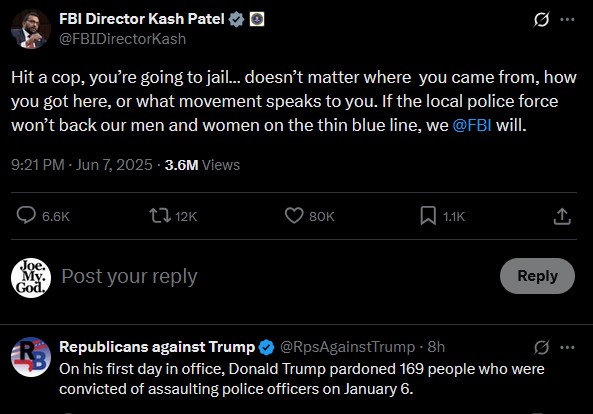
Your boss pardoned cop beaters at the January 6th riot
CBP
@CBP
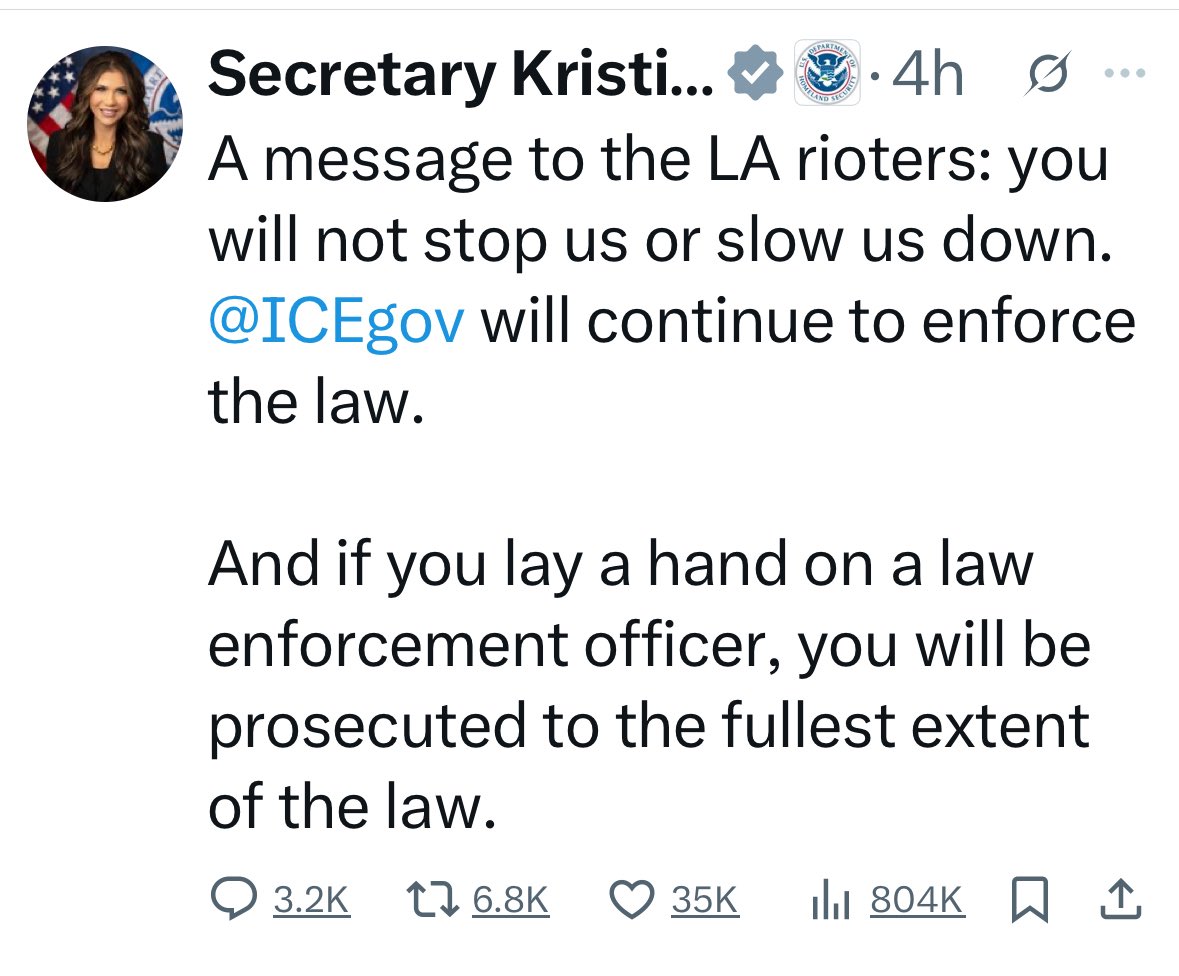
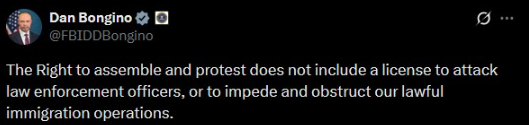
Let this be clear: Anyone who assaults or impedes a federal law enforcement officer or agent in the performance of their duties will be arrested and swiftly prosecuted to the fullest extent of the law. Attack a cop, and life long consequences will follow!
This guy is living out his camo fantasy right now like it’s a game. Disgusting.
Acyn
@Acyn
Tom Homan: We are making Los Angeles safer. Mayor Bass should be thanking us. She says they are going to mobilize—guess what? We are already mobilizing. We are going to bring the National Guard in tonight
President Obama deported 3 million people and managed to do so without using stormtroopers and the National Guard. Like everything else, Obama was better at that too.
Trump is sending in highly visible and armored ICE agents to LA and other big cities. He’s deliberately creating conflict so he can federalize the National Guard to go in and start hurting American citizens. That’s the end game.
The person most responsible for the chaos and violence in southern California right now is @StephenM – who screamed at and fired ICE officials for not making 3,000 arrests per day Now he’s put ICE agents, police officers, protesters, immigrants, and innocent bystanders at riskShow more
It’s even worse than just “capturing them at court dates”…they are dropping charges against the people for the sole purpose of arresting and deporting them as they are leaving the courthouse, It’s underhanded bullshit.
TACO will declare a national emergency and then suspend Habeas Corpus and initiate mass arrests. The captured true American Patriots protesting the Dear TACO will be sent to concentration camps. Who will stop him? More court orders.
Legal or not, it’s going to take an escalation by the Mayor or Governor, telling their officers to arrest and detain ICE members for trespassing and kidnapping, to attempt to end this. Governor could just tell the National Guard to disobey. It’s going to take open defiance by those with the power to smack down these fascists who think they have all the power.
Isn’t this a rouge thug agency that hides their faces and refuses to show ID? How does anyone tell them apart from kidnappers, maybe a Proud Boy member pretending so they can abuse people they dislike. Plus the creative ideas she has suggested are dubiously legal, possibly a crime. Also as you see in the second one they already pretended to be utility workers causing issues for that company and lying to kids. There is so much more than I can express here about what our country has become. How can people hate that much. I did not paste the hateful attacks on Pride Events by religious people making up stuff they think the right is doing like using the Trevor Project’s suicide hotline to claim that they are transing kids? Or the woman who claimed walking into a store with pride merchandise is being assaulted with rainbows, the cloying fume of pride, and Legos of all colors. When did just seeing that other people exist become an assault and a threat to yourself personally. I don’t agree with fundamentalist Christians, but I don’t want to ban them or force their books from stores and libraries. Why can not these people live and let live. Just knowing people eat asparagus don’t make the evil even if I personally refuse to touch the stuff. Anyway, the news has me very down and sad. So much hate or bigotry and these people revile in both. They love it. They want it at the same time saying it is in the name of their god who as I remember preached the opposite of what they are doing, feed the poor, clothe the poor, help the immigrant as you were once an immigrant, judge not least you be judged, and so much more. Hugs
Senior US immigration officials over the weekend instructed rank-and-file officers to “turn the creative knob up to 11” when it comes to enforcement, including by interviewing and potentially arresting people they called “collaterals”, according to internal agency emails viewed by the Guardian. Officers were also urged to increase apprehensions and think up tactics to “push the envelope” one email said, with staff encouraged to come up with new ways of increasing arrests and suggesting them to superiors.
“If it involves handcuffs on wrists, it’s probably worth pursuing,” another message said. The instructions not only mark a further harshening of attitude and language by the Trump administration in its efforts to fulfill election promises of “mass deportation” but also indicate another escalation in efforts, by being on the lookout for undocumented people whom officials may happen to encounter – here termed “collaterals” – while serving arrest warrants for others.
Read the full article. Impersonating utility workers apparently falls under getting “creative.”
“Creative” = “Get illegal” and “terrorize”. San Diego is still reeling from a raid on a restaurant at happy hour where employees were handcuffed until 4 of their colleagues were dragged off by masked men. When concerned community members began filming the encounter they were greeted by flash-bang grenades. This is fascism.
Southside neighbors jumped into action Wednesday morning when they believed immigration officers were attempting an arrest near Sixth Ave. and Ajo Way. A spokesperson for the Department of Homeland Security told KGUN 9 that there is an ongoing investigation, but did not provide further details.
Christine Cariño called KGUN 9 because she believed there were ICE or HSI agents in her neighborhood. Cariño described their unmarked vehicles, claimed they asked her unusual questions, and claimed that they worked with Tucson Electric Power.
She began to suspect the individuals were immigration enforcement officers during the initial interaction. She explained how they initially asked her to help them find her neighbor. That’s when she questioned if they were ICE or HSI agents, despite having been told they were with Tucson Electric Power.
An Arizona power company is warning that it objects to anyone who may misrepresent themselves as one of its employees amid allegations that immigration officials posed as utility workers while attempting to detain a man at his home in south Tucson.
Tucson Electric Power’s statement come after local residents raised concerns that two men who introduced themselves to neighbors as utility workers and asked for directions to a specific house were actually federal agents with U.S. Immigration and Customs Enforcement.
Members of the Arizona Latino Legislative Caucus were quick to condemn the incident, saying it was “part of a broader pattern of concerning actions” by immigration authorities. State Rep. Mariana Sandoval, D-Goodyear, said in a statement that federal officials should investigate the incident and publish guidelines to prevent future occurrences.
Do ya notice how quickly and gladly ICE and other law enforcement agents go full on gestapo? If they could just shoot people dead for no reason, a lot of them would do it and high-five each other afterwards.
there was a clip of the ICE director (either very mad, or very nervous –(watching his fingers tapping anxiously on the podium)) the other day answering the question on the facial coverings (hence my calling them ICEis ) ..
because nasty people were taking pictures of agents and Doxxing them! (and apparently their wives, children, etc etc ) …
well, oddly enough, in most places you can find the names of the local police officers, and who of those are on things like the SWAT team .. and they at least wear badge numbers, if not names ..
Ahhh. That explains the push to make it a crime to identify ICE officers. There was one the other day that was confronted over his white supremacist tattoos that were clearly visible on his right arm. I think it has more to do with them hiring from racist groups rather than protecting their “families”.
No question. My trump loving cousin works for a homeland security contractor. he is always talking about the “gangs” from the city who take over all the street festivals, all the parks (especially the suburban ones), all the malls and gallerias, and all other public spaces. He really thinks that there are roving gangs on marauding everywhere! And they are all black and brown people, naturally, and he insists they are all criminals, raping and murdering everyone. It’s why he will never go downtown.
He is totally anti-immigrant and would dearly love to deport every one of them for any reason or no reason. And if they die in the process, so much the better.
I thought it was illegal to claim you were utility person? I recall back in olden times that sometimes men would pose as a utility person or cable guy to get access to people’s homes to steal things or even rape women. That’s why they started carrying ID cards that they were required to have them visible. I wonder if they violated some law?
I was an enumerator for the Census in 2020, and we were told how to look, dress conservatively, be respectful of the property, etc. We were required to wear our badges and to show it to any person who answers the door. We also had bags with US CENSUS 2020 emblazoned in large letters. Sometimes when I’d be walking down the street, bikers or car drivers would shout out a thankyou.
Even with all that, some people refused to open the door and speak with us, fearing whatever. We were instructed on how to handle that politely, and leave a note.
I can only imagine that ICE keeps doing these things for the next four years, the Census will not get a good count on huge swaths of people.
Trump officials transferred the migrants to the East African nation in response to a judge’s order. They now face threats that include rocket attacks from Yemen.
June 6, 2025 at 5:51 p.m. EDTyesterday at 5:51 p.m. EDT
A U.S. Air Force plane used for deportation flights is stationed at Biggs Army Airfield in Fort Bliss, El Paso, on Feb. 13. (Justin Hamel/AFP/Getty Images)
Nearly a dozen immigration officers and eight deporteesare sick and stranded in a metal shipping container in the searing-hot East African nation of Djibouti, where they face the constant threat of malaria and rocket attacks from nearby Yemen, according to a federal court filing issued Thursday.
A federal judge in Boston interrupted an Immigration and Customs Enforcement deportation flight taking immigrants from Cuba, Vietnam, Myanmar, Laos and Mexico to South Sudan more than two weeks ago. U.S. District Judge Brian E. Murphy said the flight violated his order prohibiting officials from sending immigrants to countries where they aren’t citizens without a chance to ask for humanitarian protection. He instructed officials to arrange screenings.
Trump officials could have flown the immigrants back to the United States. Instead, they were taken to Djibouti, where in late May officers turned a Conex container into a makeshift detention facility on U.S. Naval Base Camp Lemonnier, according to Mellissa Harper, a top ICE official, who detailed the conditions Thursday in a required status update to the judge.
Three officers and eight detainees arrived at the only U.S. military base in Africa unprepared for what awaited them. Defense officials warned them of “imminent danger of rocket attacks from terrorist groups in Yemen,” but the ICE officers did not pack body armor or other gear to protect themselves. Temperatures soar past 100 degrees during the day. At night, she wrote, a “smog cloud” forms in the windless sky, filled with rancid smoke from nearby burning pits where residents incinerate trash and human waste.
The Trump administration has urged the Supreme Court to stay Murphy’s April order requiring screenings under the Convention Against Torture, which Congress ratified in 1994 to bar the U.S. government from sending people to countries where they might face torture. In a filing in that case Thursday, officials told the Supreme Court that Murphy’s order violates their authority to deport immigrants to third countries if their homelands refuse to take them back, particularly if they are serious offenders who might otherwise be released in the United States.
Matt Adams, a lawyer for the detainees and legal director of the Northwest Immigrant Rights Project, said the government is delaying interviewing the men to determine whether they have a reasonable fear of harm. The judge ordered the government to provide the detainees with access to their lawyers, but Adams said they haven’t spoken to them.
Lawyers fear the Trump administration is delaying the screenings in hopes that the Supreme Court stays Murphy’s order and clears the way for officers to deport the men to South Sudan. He said detainees are likely to prevail in proving they have a credible fear of being tortured because South Sudan is on the brink of civil war and they are not citizens of that country.
“What person wouldn’t have a reasonable fear of being dropped into a war torn country that they know nothing about?” he said.
While Djibouti is one of the hottest inhabited places on earth, a Navy guide to Camp Lemonnier says it has air conditioning, WiFi, a Pizza Hut, a Planet Smoothie, and a medical clinic. It also has a movie theater, a restaurant called “Combat Cafe,” a gym and a swimming pool.
But Harper wrote that the officers and detainees staying in the shipping container have not had access to basic necessities. Officers and detainees began to suffer symptoms of a bacterial upper respiratory infection soon after deplaning, including “coughing, difficulty breathing, fever, and achy joints.”
Medication wasn’t immediately available. She wrote that the flight nurse has since obtained treatments such as inhalers, Tylenol, eye drops and nasal spray, but they cannot get tested for the illness to properly treat it.
“It is unknown how long the medical supply will last,” Harper wrote, though the camp guide has a clinic on-site.
The officers spend their days guarding eight immigrants convicted of crimes that include murder, attempted murder, sex offenses and armed robbery, court records show. Harpersaid Defense Department employees “have expressed frustration” about staying in close proximity to violent offenders.
Harper said ICE has had to deploy more officers available to work in “deleterious” conditions to give the initial crew a break. Currently 11 officers are assigned to guard the immigrants and two others “support the medical staff,” she said. They work 12-hour shifts guarding immigrants, taking them to get medication, and to use the restroom and the shower in a nearby trailer, one at a time. Officers pat down the detainees, searching them for contraband.
At night and on breaks, officers sleep on bunk beds in a trailer, with one storage locker apiece. Some wear N95 masks even while they sleep, because the air is so polluted it irritates their throats and makes it difficult to breathe. The area is dimly lit, which Harper wrote poses a security risk to the officers.
Department of Homeland Security officials seized on the court filings to criticize the judge.
“This Massachusetts District judge is putting the lives of our ICE law enforcement in danger by stranding them in [Djibouti] without proper resources, lack of medical care, and terrorists who hate Americans running rampant,” said DHS spokeswoman Tricia McLaughlin on X. “Our @ICEgov officers were only supposed to transport for removal 8 *convicted criminals* with *final deportation orders* who were so monstrous and barbaric that no other country would take them. This is reprehensible and, quite frankly, pathological.”
A lawyer for the detainees said they are also worried about their clients’ health, and said the government is responsible for the current situation. Trina Realmuto, a lawyer for the detainees and executive director of the National Immigration Litigation Alliance, noted Murphy gave the government the option of returning the men to the United States.
“The government opted to comply overseas,” she said. “This is a situation that the government created by violating the order and easily can remedy with a single return flight.”
Family members who finally reached the detainees by phone said the trailer where they are being kept has air conditioning, but that they remain in leg irons and without sufficient access to medicine.
Murphy had said DHS abruptly launched the deportation flight even though it plainly violated his April 18 preliminary injunction barring them from removing people without due process. Federal law prohibits sending anyone — even criminals — to countries where they might be persecuted or tortured.
Although McLaughlin said officials couldn’t deport them to their home countries, Mexico President Claudia Sheinbaum said at a news conference last month that the U.S. government did not inform her of the Mexican national sent to Djibouti, Jesus Munoz Gutierrez, who was convicted of second-degree murder in Florida 20 years ago, court records show.
She said the U.S. would have to follow protocols to bring him to Mexico, if he wishes to be repatriated, and she said he could be detained upon arrival. She said Mexico is reviewing the case.
Murphy has also ordered the government to return a gay Guatemalan man who was deported to Mexico, where he said he had been kidnapped. The man returned Wednesday.
First you know this man was threatened all the way back to the US that his family would be rounded up and tortured if he told of what happened to him in that prison. I wonder if they had to wait until injuries healed before they could let the public see him? Ron says they maybe starved him and had to feed him again to build up his weight and looks. Poor man I hope he is able to safely get his story out. It is clear the charges against him are fraudulent and made up. Just like the government kept saying he was an MS 13 gang member which two courts found he was not. Also he was living in Maryland and his court case is being heard in DC so why is the Justice department trying his new charges in Tennessee? Why not add the charges to the case being heard now in DC. Clearly they hope to get a much more conservative and racist court there than they would in the northern states. I am surprised they did not charge him in Texas. Hugs.
Mistakenly deported Salvadoran native Kilmar Abrego Garcia appeared in a Tennessee courtroom Friday, hours after he was brought back to the United States to face criminal charges for allegedly transporting undocumented migrants within the U.S.
More than two months after the Trump administration admitted it mistakenly deported Abrego Garcia from Maryland to his native El Salvador, a two-count indictment unsealed Friday alleges that he participated in a years long conspiracy to haul undocumented migrants from Texas to the interior of the country.
The return of Abrego Garcia from his native El Salvador follows a series of court battles in which the Trump administration repeatedly said it was unable to bring him back, drawing the country toward the brink of a constitutional crisis when the administration failed to heed the Supreme Court’s order to facilitate his return.
MORE: Justice Department investigating 2022 Abrego Garcia traffic stop: Sources
He made his initial court appearance Friday evening in the Middle District of Tennessee, answering “Yes, I understand” in Spanish when U.S. Magistrate Judge Barbara Holmes asked him if he understood the charges against him.
Judge Homes set a hearing for June 13, where Abrego Garcia will be arraigned on charges and the judge will take up the government’s motion to hold him in pre-trial detention on the grounds that he “poses a danger to the community and a serious risk of flight” He will remain in federal custody in Tennessee pending next week’s hearing.
“If convicted at trial, the defendant faces a maximum punishment of 10 years’ imprisonment for ‘each alien’ he transported,” said the government’s motion for detention, which also contained an allegation — not included in the indictment — that one of Abrego Garcia’s co-conspirators told authorities that Abrego Garcia participated in the murder of a rival gang member’s mother in El Salvador.
Abrego Garcia’s attorney, in an online press briefing, called the charges against his client “an abuse of power.”
Kilmar Abrego Garcia is placed in the back seat of a truck by ICE agents after arriving in Nashville, Tenn., June 6, 2025.
ABC News
“They’ll stop at nothing at all — even some of the most preposterous charges imaginable — just to avoid admitting that they made a mistake, which is what everyone knows happened in this case,” said attorney Simon Sandoval-Moshenberg.
“Mr. Garcia is going to be vigorously defending the charges against him,” the attorney said.
The decision to pursue the indictment against Abrego Garcia led to the abrupt departure of Ben Schrader, a high-ranking federal prosecutor in Tennessee, sources briefed on Schrader’s decision told ABC News. Schrader’s resignation was prompted by concerns that the case was being pursued for political reasons, the sources said.
Schrader, who spent 15 years in the U.S. Attorney’s Office in Nashville and was most recently the chief of the criminal division, declined to comment when contacted by ABC News.
The alleged conspiracy spanned nearly a decade and involved the domestic transport of thousands of noncitizens from Mexico and Central America, including some children, in exchange for thousands of dollars, according to the indictment.
Abrego Garcia is alleged to have participated in more than 100 such trips, according to the indictment. Among those allegedly transported were members of the Salvadoran gang MS-13, sources familiar with the investigation said.
MORE: Timeline: Wrongful deportation of Kilmar Abrego Garcia to El Salvador
Abrego Garcia is the only member of the alleged conspiracy charged in the indictment.
Attorney General Pam Bondi, at a Friday afternoon press conference, thanked Salvadoran President Nayib Bukele for “agreeing to return Abrego Garcia to the United States.”
“Our government presented El Salvador with an arrest warrant and they agreed to return him to our country,” Bondi said.
Bondi said that if Abrego Garcia is convicted of the charges, upon the completion of his sentence he will be deported back to his home country of El Salvador.
“The grand jury found that over the past nine years, Abrego Garcia has played a significant role in an alien smuggling ring,” Bondi said. “They found this was his full time job, not a contractor. He was a smuggler of humans and children and women. He made over 100 trips, the grand jury found, smuggling people throughout our country.”
Attorney General Pam Bondi speaks as Deputy Attorney General Todd Blanche listens during a news conference about Kilmar Abrego Garcia at the Justice Department, June 6, 2025, in Washington.
Julia Demaree Nikhinson/AP
In a statement to ABC News, Abrego Garcia’s attorney said that he’s going to keep fighting to ensure Abrego Garcia receives a fair trial.
“From the beginning, this case has made one thing painfully clear: The government had the power to bring him back at any time. Instead, they chose to play games with the court and with a man’s life,” Sandoval-Moshenberg said. “We’re not just fighting for Kilmar — we’re fighting to ensure due process rights are protected for everyone. Because tomorrow, this could be any one of us — if we let power go unchecked, if we ignore our Constitution.”
Abrego Garcia, a Salvadoran native who had been living with his wife and children in Maryland, was deported in March to El Salvador’s CECOT mega-prison — despite a 2019 court order barring his deportation to that country due to fear of persecution — after the Trump administration claimed he was a member of the criminal gang MS-13. His wife and attorneys deny that he is an MS-13 member.
The Trump administration has acknowledged in court filings that Abrego Garcia’s removal to El Salvador in March was in error, because it violated a U.S. immigration court order in 2019 that shielded Abrego Garcia from deportation to his native country, according to immigration court records. An immigration judge had determined that Abrego Garcia would likely face persecution there by local gangs that had allegedly terrorized him and his family.
The administration argued, however, that Abrego Garcia should not be returned to the U.S. because he is a member of the transnational Salvadoran gang MS-13, a claim his family and attorneys have denied. In recent weeks, Trump administration officials have been publicizing Abrego Garcia’s interactions with police over the years, despite a lack of corresponding criminal charges.
After Abrego Garcia’s family filed a lawsuit over his deportation, U.S. District Judge Paula Xinis in Maryland ordered the Trump administration to facilitate his return to the United States. The U.S. Supreme Court affirmed that ruling on April 10.
Abrego Garcia was initially sent to El Salvador’s notorious CECOT prison but was believed to have later been transferred to a different facility in the country.
The criminal investigation that led to the charges was launched in April as federal authorities began scrutinizing the circumstances of a 2022 traffic stop of Abrego Garcia by the Tennessee Highway Patrol, according to the sources. Abrego Garcia was pulled over for speeding in a vehicle with eight passengers and told police they had been working construction in Missouri.
According to body camera footage of the 2022 traffic stop, the Tennessee troopers — after questioning Abrego Garcia — discussed among themselves their suspicions that Abrego Garcia might be transporting people for money because nine people were traveling without luggage, but Abrego Garcia was not ticketed or charged.
The officers ultimately allowed Abrego Garcia to drive on with just a warning about an expired driver’s license, according to a report about the stop released last month by the U.S. Department of Homeland Security.
Asked what circumstances have changed since Abrego Garcia was not taken in custody during that traffic stop in Tennessee, Bondi replied, “What has changed is Donald Trump is now president of the United States, and our borders are again secure, and thanks to the bright light that has been shined on Abrego Garcia — this investigation continued with actually amazing police work, and we were able to track this case and stop this international smuggling ring from continuing.”
Asked by ABC News’ Pierre Thomas asked whether this should be seen as resolving the separate civil case in Maryland in which a federal judge ordered the government to facilitate Abrego Garcia’s return, Deputy Attorney General Todd Blanche said, “There’s a big difference between what the state of play was before the indictment and after the indictment. And so the reason why he is back and was returned was because an arrest warrant which was presented to the government and in El Salvador. So there’s, there’s a big difference there as far as whether it makes the ongoing litigation in Maryland moot. I would think so, but we don’t know about this. He just landed today.”
As ABC News first reported last month, the Justice Department had been quietly investigating the Tenessee traffic stop. As part of the probe, federal agents in late April visited a federal prison in Talladega, Alabama to question Jose Ramon Hernandez-Reyes, a convicted felon who was the registered owner of the vehicle Abrego Garcia was driving when stopped on Interstate 40 east of Nashville, sources previously told ABC News. Hernandez-Reyes was not present at the traffic stop.
MORE: Newly released video shows Abrego Garcia’s 2022 Tennessee traffic stop
Hernandez-Reyes, 38, is currently serving a 30-month sentence for illegally re-entering the U.S. after a prior felony conviction for illegal transportation of aliens.
After being granted limited immunity, Hernandez-Reyes allegedly told investigators that he previously operated a “taxi service” based in Baltimore. He claimed to have met Abrego Garcia around 2015 and claimed to have hired him on multiple occasions to transport undocumented migrants from Texas to various locations in the United States, sources told ABC News.
When details of the Tennessee traffic stop were first publicized, Abrego Garcia’s wife said her husband sometimes transported groups of fellow construction workers between job sites.
“Unfortunately, Kilmar is currently imprisoned without contact with the outside world, which means he cannot respond to the claims,” Jennifer Vasquez Sura said in mid-April.
Sen. Chris Van Hollen of Maryland, who flew to El Salvador and met with Abrego Garcia shortly after his deportation, said Friday that the Trump administration had “relented” regarding his return.
“After months of ignoring our Constitution, it seems the Trump Admin has relented to our demands for compliance with court orders and due process for Kilmar Abrego Garcia,” Van Hollen posted on X. “This has never been about the man — it’s about his constitutional rights & the rights of all.”
Abrego Garcia entered the U.S. illegally as a teenager in 2012, according to court records. He had been living in Maryland for the past 13 years, and married Vasquez Sura, a U.S. citizen, in 2019. The couple has one child together.
ABC News’ Laura Romero contributed to this report.


























 Scottie's Playtime