This report is terrifying. This country doesn’t have money to feed or give healthcare to the people, but we can spend billions arming and militarizing a secret masked unrestrained force with the power to detain, restrain, and kill the public with no consequence. The report explains how in other cases these groups take on a power and lawlessness of their own. They are the Taliban of the US. How soon until they show up with military vehicles not just in our cities but at our places to vote? What do ICE and border patrol need with high powered rifles, military armaments, and ar-15 style weapons for anyway, they are arresting the easy low hanging fruit from court rooms and hearings, school teachers, and kids. Plus remember they have ramped up public survaence, facial recognition, and databases on everyone. Hugs
In addition to staffing up at a furious rate, ICE and CPB are acquiring a vast cache of weapons from private contractors, new data reveals. This will not end well—or anytime soon.
The “forever wars” abroad and the global war on terror after the September 11 attacks left behind a long trail of failure, disillusionment, and death—but they also funneled huge sums of taxpayer money to companies that supplied the equipment that made all that destruction possible. That resulted in windfalls for GOP-connected companies, and fueled a massive public-private bureaucracy that grew harder to rein in as it metastasized to monstrous proportions.
Something like this is happening again in a different theater of operations: Donald Trump’s campaign of violent mass deportations. It’s becoming its own forever war: It could drag on for years or decades without success. It’s producing misguided military occupations of restive local populations. It has launched a huge arms buildup. And it also has what might be termed its very own war profiteers.
To wit: A handful of private companies that manufacture weaponry and ammunition have already inked very lucrative contracts with the Department of Homeland Security, which will provide it with enormous stockpiles of military-style equipment, some to the tune of tens of millions of dollars, according to data from Senator Adam Schiff’s office, which is probing DHS contracts.
The pileup of all that equipment hints at a major long-term problem. Just as we saw in the long aftermath of September 11, this new and evolving MAGA terror bureaucracy will expand in grotesque ways. It too will grow less constrained as it amasses more troops—and more firepower.
A harrowing glimpse of this future lies in a new report by Schiff that has gotten surprisingly little notice: It finds that Immigration and Customs Enforcement and Customs and Border Protection have formally approved contracts for at least a whopping $144 million in weapons, ammunition, and other accessories during Trump’s first year. The analysis—based on government contracting data—documents at least a fourfold increase for ICE and a doubling for CBP, relative to 2024, concluding that this will “build a heavily-armed domestic police force.”
It’s eye-opening stuff. One ICE contract is with Geissele Automatics for millions of dollars’ worth of “precision long guns and accessories” to support “armed agents” and other ICE operations, Schiff’s report says. This involves an unknown number of Geissele Border Patrol rifles, the report notes, describing this weapon as an “AR-style rifle with military specifications.” CBP contracted for millions of dollars more in rifles, as well.
ICE and CBP also contracted with Glock for millions of dollars in handguns and accessories, the report says. Taking all these contracts together, the report starkly concludes: “ICE and CBP have together placed orders to purchase thousands of new high-powered lethal weapons at taxpayer expense.”
There’s still more. The report documents ICE and CBP contracts totaling more than $30 million in ammunition and more than $25 million in contracts for the “non-lethal” weapons. That’s not a reassuring description: They include Tasers, pepper spray, and tear gas canisters.
In short, we’re looking at a massive stockpiling of weapons that will be in ICE’s and CBP’s possession for years to come. And someone is supplying all that equipment.
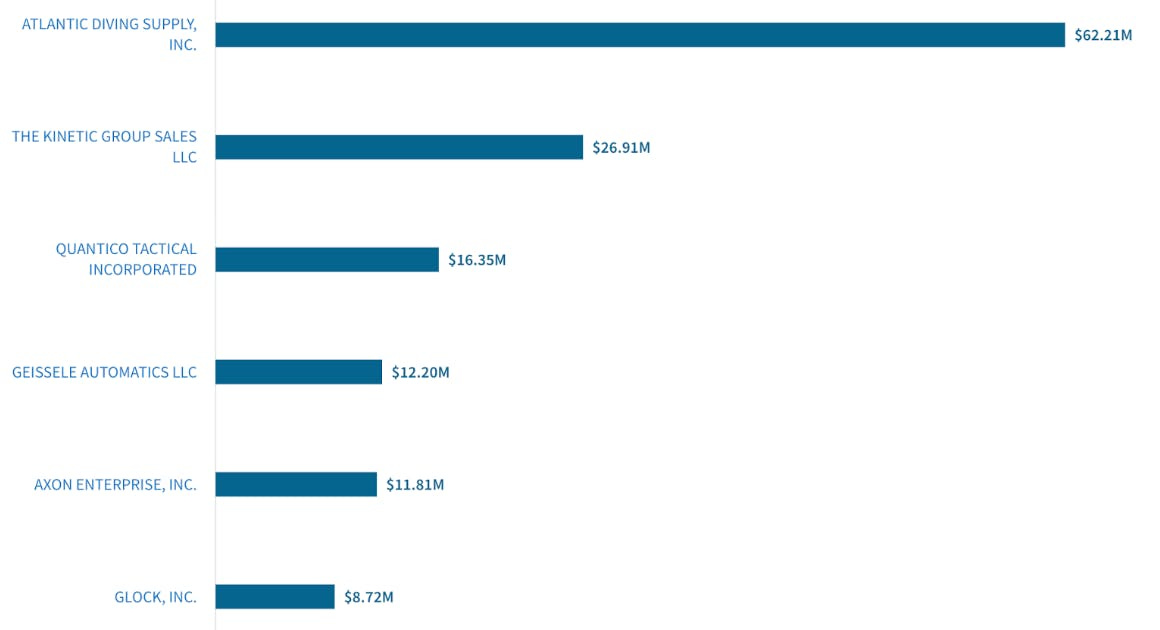
At my request, Schiff’s office analyzed the contracting data it collected to determine which companies are the top ICE and CBP contractors. Here are the results, per a chart provided by Schiff’s staff:
These particular contracts are mostly for small arms (including AR-style rifles), ordnance, ammunition, and related accessories like gun sights and suppressors, Schiff’s office says. A subcategory includes pepper spray, Tasers, tear gas, and other “non-lethal” weaponry.
“These contracts expose how DHS has set in motion a massive surge in spending to put even more dangerous weapons in ICE and CBP’s arsenal,” Schiff told me in an emailed statement. “This misuse of taxpayer dollars to maximally arm federal immigration agents, including those with questionable vetting and insufficient training, must end.”
In a sense, we’re seeing yet more cancerous growth of the post-September 11 national security bureaucracy, but with a more intensified inward focus. DHS, which was created after September 11, has long had a domestic anti-terror component. But now Trump has supercharged its role as a mass immigrant-expulsion operation that is unleashing violence toward U.S. citizens—and even killing them—while operating with near-total impunity among American populations, which Trump officials openly describe as a good thing.
“It’s the transformation of DHS from an entity that protected the homeland from external threats to one increasingly policing American society,” Donald Moynihan, author of an excellent Substack on state capacity, tells me. With this ramped-up stockpiling, Moynihan says, the endgame will be “filling those warehouses with people and using those guns and that technology to control American cities.”
The war on terror also teaches us that expanding bureaucracies like these only grow harder to control over time. “Trump is building up a well-funded, poorly trained paramilitary force that could easily take on a life of its own,” says Georgetown national security law expert Rosa Brooks. “Once you have a massive moneymaking machine ginned up, it’s hard to reverse course and turn off the spigot.”
The folly and waste of the forever wars, we are endlessly told, enabled Trump to successfully campaign against elites who foolishly sank unlimited blood and treasure into misguided imperial adventures abroad. Yet Trump’s mass deportations constitute their own forever war.
This is not meant glibly: Measured in political years, Trump’s mass expulsions actually will seemingly go on forever. Deporting an estimated 14 million people, if it continues at current rates, will take longer than this Trump term followed by two terms of President JD Vance. The scaled-up prison camps, if they materialize, will seemingly have to be packed for years, constituting an ever-expanding immigrant carceral state.
Meanwhile, just like the forever wars, this fiasco is also birthing its own captive constituencies and internal political momentum. This includes everyone from the private contractors supplying it to the large population of MAGA-adjacent young (and not so young) men signing up for ICE, which writer John Ganz describes as “an employment program for the Trumpenproletarian mob.”
Any entity this hypermaterialized—especially one simultaneously aimed at immigrants—will inevitably attract white nationalists and evolve into a political paramilitary force in thrall to ideologically aligned leaders, as Substacker Brian Beutler explains. This is borne out in ICE recruitment messaging, which explicitly seeks to get recruits invested in the mission of achieving national rejuvenation by employing cleansing ethno-nationalist violence.
The stockpiling of weapons underscores the point unnervingly. Now that Trump is feinting toward winding down in Minneapolis, what will be done with all that ideologically fired-up ICE manpower—and all that heavy weaponry? Even a relatively benign answer is alarming. It means more operations like the one in Minneapolis, but packaged with a sheen of new constraints that will simply be shrugged off by the force of this machine’s internal momentum—with more horrors awaiting us.
This is a quagmire for Trump, even if he doesn’t know it. Appropriately enough, it has also been created by unprincipled elite folly—only MAGA elites support it, while the American people verymuchdo not. Trump’s approval on immigration, once a foundational political strength, has deteriorated rapidly at moments when ICE dominates our attention. If his forever war continues in its current form—with its bureaucracy metastasizing in unpredictable directions—it will further cripple his presidency. And it’s darkly fitting that it may take down the presidential ambitions of Vance, also a self-proclaimed critic of forever war follies, along with him.
Again Christian fundamentlist rehtoric and constant attacks on LGBTQ+ people by religious leaders lead to the gullible doing actions like this. He knew demons would be there and he needed to be the hero and slay the evil man living in a way that made his god un happy. Every church leader who preaches hate against other communities should be held responsible for the actions of those who listen to their ridiculous, hateful claims and then act on them. Hugs
McGee told detectives they met on Grindr, and that he went to his apartment because he knew “demons would be there,” according to court documents. He also told detectives he intended to “slay” and “get rid of” the victim.
Investigators discovered that McGee planned the attack ahead of time, and including searching the internet for violently homophobic material, purchasing the weapon and searching for how to get away with murder, as well as how to dispose of a body.
Daniel McGee, 26, was sentenced to just over 12 years in prison, along with five years of supervised release.
“The right to live safely in one’s community is a fundamental civil right. The District of Oregon remains committed to combating hate crimes and protecting that right for all,” said U.S. Attorney for the District of Oregon Scott E. Bradford. “While no conviction can undo the harm caused, we hope this sentence will bring some measure of justice to the victim and our community.”
“Hate crimes impact not just individuals, but entire communities,” added FBI Portland Special Agent in Charge Matt Torres. “The FBI works together with our partners to prevent hate crimes from impacting our communities, and every attack on someone because of who and what they are deserves to be acted on by the full extent of the law.”
McGee made national news in 2021 when he was charged with attacking a man he met on Grindr, a dating app for gay men.
In court documents, prosecutors said he used the screen name “str8 curious” and arranged to meet the man at his apartment. He said he had just turned 18 and wasn’t ready to kiss yet, but wanted to make sure they would be alone.
But when McGee arrived at the apartment, he attacked the man. He struck the victim over the head repeatedly using a small wooden club known as a tire thumper. Multiple callers told emergency dispatchers they could hear someone screaming for help.
When police arrived, they found both men inside the victim’s apartment. The victim had life-threatening injuries, including multiple lacerations to the sides and back of his head, and a large portion of his scalp was missing.
McGee told detectives they met on Grindr, and that he went to his apartment because he knew “demons would be there,” according to court documents. He also told detectives he intended to “slay” and “get rid of” the victim.
Investigators discovered that McGee planned the attack ahead of time, and including searching the internet for violently homophobic material, purchasing the weapon and searching for how to get away with murder, as well as how to dispose of a body.
In November 2021, McGee was charged with a federal hate crime involving an attempt to kill. He pleaded guilty in federal court in Nov. 2025.
Montana elected Republican Jeannette Rankin as the first woman to sit in the U.S. House of Representatives three years before American women nationwide could legally vote.
A persistent advocate for women’s rights, particularly suffrage, Rankin voted in Congress against American entry into both world wars, and late in life led marches against the Vietnam war.
Rep. Jeannette Rankin with her colleagues in the 61st Congress.
Jeannette Rankin was the first woman ever elected to the U.S. Congress, and a native of Missoula, Montana. She was elected in 1916, before women nationwide had the right to vote. In 1917 she joined a handful of representatives who voted against entry into World War I asserting, despite harsh criticism and certain damage to her career, that, “the first time the first woman had a chance to say no against war she should say it.” In 1941 she bravely stood alone in Congress in voting against entry into World War II, but she did not stand alone in society in her opposition to institutional violence and war. Her stand against war as a viable resolution to international conflicts provoked questions on the basic assumptions about peace, war, and conflict, which we continue to grapple with today. Rankin’s staunch opposition to war made her a spokesperson for veteran’s rights, as well, since she recognized them as pawns in the games of politicians. It was she who first introduced the GI Bill to Congress, which guaranteed post-discharge education and other benefits to those who served in the military. Her long career was also distinguished by her deep commitment to the country’s women, poor, and its children. She put forth an alternate vision for this country as one which championed peace and justice. She worked tirelessly in opposition to war and oppression by attending rallies, and by giving speeches in person and on television into her 90s.
The Jeannette Rankin Peace Center is proud to carry the name of this pioneer Montanan whose life’s work exemplified a steadfast devotion to peace, justice, and democratic equality. Jeannette Rankin was, in many ways, the first lady of U.S. politics. Her legacy lives on today through those who carry on her work and honor her memory. University of Montana’s Archives and Special Collections houses a collection of oral history interviews that were conducted by Dawn Walsh for the Jeannette Rankin Peace Center. The interviewees were former and current members of the Missoula Women for Peace and detail their interest and activities related to peace activism. These interviews are available in both audio and text format through University of Montana Scholar Works. (snip-MORE)
There is a video at the site linked. How ever as you read through this remember that this is the group that wrote project 2025 and the main author of that Christian nationalist screed is Russell Vought who has a powerful position in the tRump administration. This is entirely about pushing a fundamentalist Christian lifestyle and worldview on the US public with heavy emphasis on quiverful which ishave as many children as possible for Christian families most of whom in that movement lived impoverished on one income. The idea is more kids butts in church pews now leads to more adult butts in those pews increasing tithes and money in the collection plates. Church attendance has decreased steadily and this is designed to increase it again. Plus it removes rights for women and LGBTQ+ families. The parents get the money only if women / the mothers marry young, forgo an advanced education, stay out of the work place, and have child after child after child like a breeding stock farm animal. It is only for the “right or correct types of families” and harms those who are not the “right” kinds of families. Plus it is totally racist with the poor people being cut out of the funds. The fact is minorities make on average far less than white families due to inherent racism and CRT, which is a real thing. Hugs
Last week, I wrote about the Heritage Foundation’s Saving America by Saving the American Family: A Plan for the Next 250 Years. The plan is, essentially, to make women drop out of school, marry young, have tons of babies, rely financially on their husbands, be unable to divorce, and wind up in the poor house if they don’t follow these rules. But I wanted to zero in specifically on the policy section of the piece, which comes at the very end and which I haven’t seen get the coverage it deserves. Because what the Heritage Foundation is proposing is a massive cash transfer from poor single mothers to better-off married couples. This really is the plan: Take from the poor to give to the “right” kind of families. Make poor mothers work, and pay better-off ones to stay home. Further impoverish single mothers to force them to marry.
The Heritage Foundation wants to eventually end cash welfare as we know it (“Credits designed specifically to benefit poor single mothers may be well intended, but they have proven to incentivize single motherhood in poor communities,” Heritage laments). They don’t propose totally doing away with welfare benefits here, I suspect because they realize that would be a nonstarter. But they do propose taking resources that currently mostly benefit poorer families and redirecting them to wealthier ones, so long as those wealthier families have married parents. The Heritage proposal would only give its proposed benefits to married couples (policies should “privilege marriage as directly and explicitly as possible,” Heritage writes, emphasis theirs). It would only give benefits to married couples in which one partner works and makes above a certain income. And it would incentivize women dropping out of the workforce… unless they’re poor or single.
Here are the specifics.
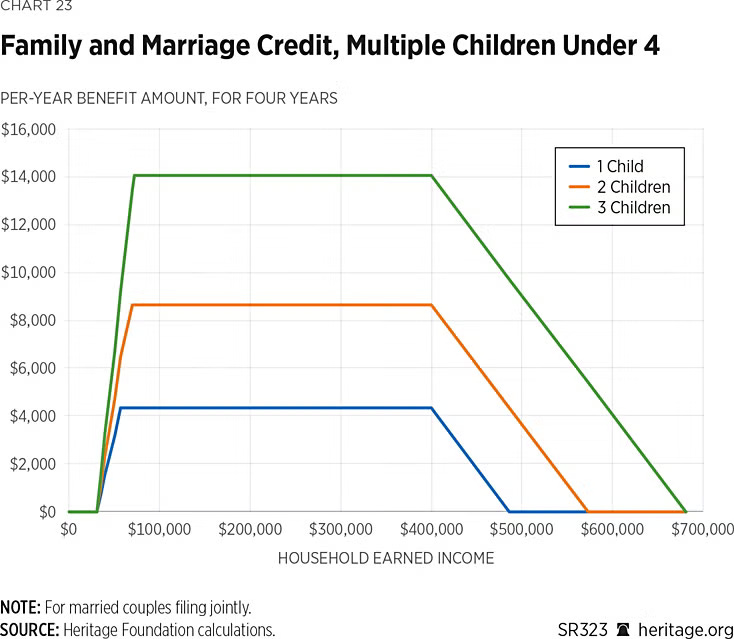
Child tax credits only for married couples who are the child’s biological parents, who are working, and who make at least $30,500. The Heritage proposal would get rid of the Earned Income Tax Credit, because that credit gives more money to struggling single parents than better-off married ones, as well as the Child Tax Credit, and replace them with what they call a Family and Marriage (FAM) tax credit of $4,418 per child per year for four years. But this credit would phase in for families once they’re earning $30,500 per year — in other words, poor families wouldn’t qualify. It would only go to married parents — single parents wouldn’t qualify. It would only go to biological parents — step parents wouldn’t qualify. A person could be working full-time, but even if they’re earning above minimum wage, they may not qualify for this tax credit.
Bonuses for larger families — but only for married couples, only for biological parents, and not for the poor. Additionally, Heritage proposes a 25% per-child bonus to their FAM tax credit for third children and beyond. But, again, poor families are out of luck, as only couples with at least one working spouse qualify, and that spouse has to make at least $30,500.
More money for higher earners, none for the lowest. The FAM credit phases in at $30,500, and goes up from there relative to income. That’s right: This is government family support that gives more money to families that already have more money. And it gives the most money to families that are the most stable: Those with two married parents who make more than six figures. The credit doesn’t begin to scale down until a family makes $110,000, and even then, the wind-down is small (beginning at just 5%). Why set up a program that gives people more money as they make more money? Because “the FAM credit’s phase-in would incentivize work.” All of this means that a married couple with three children making $400,000 a year would get $14,000 additional dollars from the US taxpayer — while a single mom making $20,000 a year would get nada.
No help after a child’s fourth birthday. As it stands, parents can claim the Child Tax Credit until a child’s 17th birthday. The Heritage plan cuts parents off when their kid turns four. They claim that these early years are when parents need the most help. But children don’t stop needing food and a roof over their heads once they’re kindergarten age. The Heritage Foundation is clear that the purpose of this plan isn’t to support children, but to incentivize parents to have more of them: “The FAM credit is designed specifically for families with newborns or young children. Lawmakers interested in family policy may be inclined simply to expand the CTC. However, this approach would be inefficient as a family formation incentive. Only a small fraction of the benefit would go toward new parents, while most of it would go to families that are already formed.” They continue: “many other family benefits, such as the CTC, are backloaded to later in life when many parents are on more solid financial footing and may be past their prime child-bearing years.” Emphasis mine, because this is truly stunning: The Heritage Foundation only wants to give parents tax credits for their (expensive) children if those parents (mothers) are in their “prime child-bearing years” and might make more babies. Eggs too old? No child tax credits for you.
Pay women to stay home. The Heritage Foundation could have proposed a generous paid leave program, which would allow parents of newborns to stay home and care for them in that crucial first year. But their aim is not to make sure that young children receive the best possible care. Their aim seems to be to get women out of the workforce. And so they’ve instead offered a $2,000 per-child credit for one parent (almost always the mother) to stay home and care full-time for her child — but again, this only applies to married couples where one spouse (almost always the husband) is working and makes more than $30,500 per year. You’re a single mom who wants to stay home with your child? Tough luck, get to work. You’re a low-income married parent who wants to stay home with your child? Tough luck, get to work. If the concern really were for children — if the view really was that young children are best off being cared for at home by a parent — then this policy would apply to all parents of young children. But that’s not the concern. The concern is that women aren’t living their lives in the way Heritage deems acceptable.
Fund this whole scheme by getting rid of Head Start. Head Start is an incredible program that has had vast positive impacts, increasing high school and college graduation rates, adult incomes, health outcomes, and overall wellbeing. Studies have found it even decreases child abuse and neglect. This proposal would effectively end it, and use the money saved to give tax breaks to wealthy married couples with children.
Pay people to marry young. The final Heritage policy is a $2,500 deposit into a savings account for every new baby born in the US — but the only way to get the full benefit of that money as an adult is to marry well before the age of 30. That is, when an American is born, the government will deposit $2,500 into a savings account for them, which they cannot touch until they either marry or turn 30. At either marriage or age 30, they can start to withdraw from the account, but only over three years — so about a third of the original value per year. They get the full withdrawal amount each year (roughly one-third of the total account value) if, in each year, they are married but not yet 30. If they’re over 30, whether they’re married or not, they pay a tax penalty. In other words, to get the full benefit, you have to marry by 27 — below the average age of first marriage for women (28.6) and men (30.2) alike. Again, the point is not to incentivize marriage; it’s to incentivize women especially marrying as young as possible, despite early marriage being tied to higher divorce rates.
xx Jill
Subscribe to Throughline by Jill Filipovic
Hundreds of paid subscribers
Connecting the dots. Politics, culture, women’s rights, foreign affairs, law, and more.
Immigration and Customs Enforcement (ICE) faced a major legal setback as federal judges in New Jersey and Texas criticized the agency over prolonged detentions and repeated violations of court orders.
A federal judge in New Jersey wrote a withering critique of the agency and the Department of Justice (DOJ) over what he described as widespread violations of court orders in immigration matters. Meanwhile, in Texas, another federal judge ordered that an ICE detainee be given a bond hearing or be released, continuing a string of rulings challenging the agency’s mandatory detention policy.
A Department of Homeland Security agent wearing an Immigration and Customs Enforcement patch and badge at Royalston Square on January 22 in Minneapoli… | Jim Watson – Pool/Getty Images
These back-to-back rulings place ICE’s operations under increased court scrutiny amid ongoing tensions between immigration authorities and federal judges. Courts across the country have increasingly pushed back against what they view as procedural lapses or administrative overreach in detention practices under the Trump administration’s expansion of mandatory detention and mass deportations.
DHS has frequently criticized federal judges whose rulings slowed or blocked deportations, often labeling them as “activist judges.” Trump officials have argued that these judicial interventions interfere with enforcement priorities and complicate efforts to remove individuals quickly, framing the courts as obstacles to the administration’s immigration agenda.
New Jersey Judge Slams ICE Over Repeated Court-Order Violations
New Jersey District Judge Michael Farbiarz issued a strongly worded order pointing to dozens of instances in which ICE and the DOJ failed to comply with judicial directives concerning the detention and transfer of immigration detainees, according to a court filing reviewed by Newsweek.
The case involves Baljinder Kumar, who filed a habeas petition challenging his detention without a bail hearing. A January 26 injunction barred ICE from transferring Kumar out of the district, but the agency moved him to Texas on January 31, per the filings.
Farbiarz noted the scale of the problem, writing in a court opinion that “no-transfer injunctions issued by New Jersey district judges have been recently violated 17 times by the Respondents,” about “three every two weeks.”
The court acknowledged an investigation by the U.S. Attorney’s Office, which concluded that the transfers “occurred inadvertently due to logistical delays in communicating the court order to the relevant custodians or to administrative oversight of the court order,” and that ICE had “agreed to return the petitioner to the District of New Jersey to regain compliance.”
Court filings showed violations of more than 50 orders over roughly 10 weeks, including cases in which detainees were moved or deported despite explicit court prohibitions.
“The revelation that the Department of Homeland Security violated dozens of judicial orders in New Jersey is shamefully unsurprising. This isn’t just inadvertent or sloppy; the Trump administration has repeatedly flouted judicial orders and attacked the integrity of judges,” ACLU-NJ Executive Director Amol Sinha said in a statement.
Texas Ruling Orders Bond Hearing or Release for ICE Detainee
A federal judge in the Western District of Texas has ordered ICE to either hold a bond hearing or release a Mexican national who has been detained for more than eight months without a final removal order at the Camp East Montana detention facility, according to court filings.
On March 2, Senior U.S. District Judge David C. Guaderrama ruled that Victor Zamudio Sanchez’s continued detention without a hearing violated the Fifth Amendment’s Due Process Clause.
Guaderrama wrote in court documents, “Respondents, by detaining Petitioner without the opportunity for a custody redetermination hearing, have deprived Petitioner of his procedural due process rights.”
The judge directed that if Sanchez was not released by March 9, ICE must provide a bond hearing before an immigration judge.
At that hearing, the government would be required to prove, “by clear and convincing evidence, the dangerousness or flight risk justifying Petitioner’s continued detention,” according to the filing.
Sanchez, who has lived in the United States for more than two decades, has been held without a meaningful opportunity to challenge his confinement, the court said. Guaderrama emphasized that the prolonged detention, absent any individualized assessment, posed a serious risk of “erroneous deprivation of [Petitioner’s liberty] interest.”
The court found that Sanchez had been caught in a procedural limbo, with ICE failing to issue a timely Notice to Appear and repeatedly denying him a bond hearing. While the agency eventually initiated formal removal proceedings, the judge ruled that Sanchez’s indefinite detention violated the Fifth Amendment’s Due Process Clause, ordering ICE either to release him or provide a bond hearing.
The administration has interpreted federal law to allow ICE to hold many noncitizens without bond hearings, applying mandatory detention to people who entered the United States without inspection, even if they have lived in the country for years. This represents a departure from decades of practice, when many detainees could seek release while their cases proceeded.
Again all this is about is a Christian nationalist desire to mimic Russia and remove all LGBTQ+ representation from the public view in the name of “protecting children from porn” as if just being or media representing LGBTQ+ people is pornographic and sexual. These people feel anything not straight and cis is sexualizing and abusing children simply because they do not want the LGBTQ+ people to exist. Hugs
Side note. Ron got home last night 3-2-2026 about 6 pm. I made him a supper of a salad and two hamburgers with the fixings. He was so happy. I was happy. We went to bed and snuggled which made Tupac who has snuggled me every night a bit unhappy but he pressed in from the other side. All day Ron and I have been together, unloading the car, doing laundry, Ron started on the floors in the kitchen, and we are making a pork tenderloin, potatoes, brown gravy, carrots, and greenbeans for supper. It is so good to have my husband home. I understood why he had been gone for the better part of three months but it sure is grand to have him home. I feel better, anxieties lower, and happy feeling up. Also for those worried I was not eating which I was not, I ate like a pig at a trough tonight, having a first heaping plate of everything and then going back for a second heaping plate. The end of the second one was a bit challenging to finish but I did. I offered to pick up the last bits of left overs but ron said he would do it. I think he noticed I was trying to hide that I was swaying and wobbleing when I walked due to my pain levels. Hugs
Discussion of gender is not sexualization. Making books available to students that represent the diversity of their experiences and showcase the numerous ways to be a person in the world is not sexualizing them. Such an interpretation says far more about the adults and the perspectives they’re applying to books than it does about the books or their intended audiences.
Following this week’s State of the Union Address, House Republicans worked quickly to advance legislation to ban books from public schools nationwide. House Resolution 7661 (H.R. 7661), also known as the “Stop the Sexualization of Children Act” would modify the Elementary and Secondary Education Act of 1965 by prohibiting use of funds under the act “to develop, implement, facilitate, host, or promote any program or activity for, or to provide or promote literature or other materials to, children under the age of 18 that includes sexually oriented material, and for other purposes.”
The bill was introduced by House Representative Mary Miller (Republican, Illinois). 17 additional Representatives cosigned it.
H.R. 7661 is an anti-trans bill, and tucked within its provisions are those that ban books for those under 18 that “include sexually oriented material.” This is the same vague language used in numerous states across the U.S. to ban books from public schools and public libraries. This bill includes “lewd” and “lascivious” dancing as prohibited topics or themes. No such books for young readers exist, but facts don’t matter to a regime seeking total and complete control.
The bill goes on to further define “sexually oriented material” as anything broaching the topics of “gender dysphoria or transgenderism.” The latter is an intentionally harmful word used as a cudgel to harm trans people. Such a broad definition also ensures that this kind of bill could be applicable in any situation where it would benefit the banners. It isn’t a stretch to see a bill like this used to outright ban all books by or about LGBTQ+ people under the guise of it being “sexually oriented.”
Though this legislation would apply to institutions using funds from the Elementary and Secondary Education Act of 1965, there’s little question that it would expand to include all public libraries, not just those in public schools. We’ve already seen this very thing play out across the country.
These local-level policies, alongside state-level policies like Iowa’s Senate File 496 and Idaho’s House Bill 710–both still working their way through numerous lawsuits–provided the roadmap for the proposal of federal-level book ban legislation. It was only a matter of time, and the ongoing onslaught of anti-trans legislation and rhetoric that has grown exponentially under the Trump-Vance regime made this the prime moment.
Discussion of gender is not sexualization. Making books available to students that represent the diversity of their experiences and showcase the numerous ways to be a person in the world is not sexualizing them. Such an interpretation says far more about the adults and the perspectives they’re applying to books than it does about the books or their intended audiences.
You can read the full text of H.R. 7661 here, including its list of cosponsors. Right now, your best way to have your voice heard about this hateful and discriminatory bill is to call your House representatives and urge them to veto this bill at every opportunity. There are years’ worth of resources from which you can pull about where and how all of these bills are calculated and targeted, and you can pull from the numerous ongoing lawsuits challenging similar bills and policies at the local and state level. Let your lawmakers know that you’re watching them and their voting records, especially if they’re among the roster of those proposing the legislation.
These bills aren’t about removing books; books are just one of the tools. These bills are about the complete and total erasure and removal of queer people from American life.
Don't be fooled by this bill's name– this is a book banning bill that will exclude LGBTQ books from all public schools NATIONWIDE.Call your congresspeople and tell them to VOTE NO on this nakedly bigoted book banning bullshit. http://www.congress.gov/bill/119th-c…
The conflation of porn and LGBTQ (but specifically trans) issues is purposeful. It's part of the Project 2025 plan to criminalize LGBTQ+ ppl.It starts with books. It moves to bathrooms. Then it moves to govt IDs. We're in it already.You don't need to be an expert to see where this goes next.
Nazi Republican Mary Miller who has quoted Hitler in the past now wants to ban strippers in public schools…and she's all in with banning any book that dares mention LGBTQ+ issues…www.lgbtqnation.com/2026/02/gop-…
First the judges started questioning the truth of government officials and attorneys. Then the judges accused the DOJ / ICE of ignoring court rulings and orders. Now in this case Bondi’s posts clearly violate a judges orders and the constant posting on social media is designed to color or bias the public and potential jurors. The coruptin of this administration if beyoung anything we have ever seen in the US. I just read that Kash Patel has ordered the elete tatical teams around the country to rotate providing complete security and transportation. Not the regular FBI but the strategic elite teams. Hugs
“The government failed to respect Ms. Flores’s dignity and privacy, exposed her to a risk of doxxing, and generally thumbed its nose at the notion that defendants are innocent until proven guilty. The post also directly violated a court order sealing the case,” the judge wrote. “Notwithstanding, the government now seeks an accommodation from the Court that it blatantly failed to give Ms. Flores and her codefendants.”
The attorney general’s posts included names and photographs of the defendants.
Attorney General Pam Bondi’s posts made the government’s request for court-ordered discretion for its agents “eyebrow-raising, to say the least,” one judge wrote. | Allison Robbert/AP
Two federal judges have raised concerns about Attorney General Pam Bondi’s use of social media to publicize a wave of arrests last month of people charged with interfering with federal officers during an immigration enforcement surge in Minnesota.
In an order earlier this week, Magistrate Judge Dulce Foster said Bondi’s posts on X including the names and, in many instances, photographs of the defendants shortly after their arrests “violated a court order” placing those cases under seal.
Foster leveled the criticism in connection with the prosecution of Nitzana Flores, a South Haven, Minnesota, resident accused of assaulting two Border Patrol officers during a scuffle last month in Minneapolis surrounding the arrest of another person for allegedly ramming a government vehicle.
The judge said Bondi’s posting of the names and arrest photos undercut prosecutors’ request for an order to prohibit defense attorneys from publicly disclosing personal information about immigration agents involved in the case against Flores. The requested order would also prohibit any defense counsel from sharing that information with their client.
Foster said Bondi’s social media posts made the government’s request for court-ordered discretion for its agents “eyebrow-raising, to say the least.”
“The government failed to respect Ms. Flores’s dignity and privacy, exposed her to a risk of doxxing, and generally thumbed its nose at the notion that defendants are innocent until proven guilty. The post also directly violated a court order sealing the case,” the judge wrote. “Notwithstanding, the government now seeks an accommodation from the Court that it blatantly failed to give Ms. Flores and her codefendants.”
Foster modified the government’s proposal by broadening it to cover any party, victim or witness, while narrowing it to details such as phone numbers, residential addresses, email addresses and dates of birth. The judge also declined to restrict what evidence Flores can see and declined to prohibit disclosure of identities, which would include names and photographs.
At a hearing in a separate Minneapolis case last week, another magistrate judge, Shannon Elkins, directed prosecutors to “address whether the public posting of photographs violated the Court’s sealing order.” The government missed a deadline Tuesday to respond. Elkins later agreed to extend the deadline until Monday.
Justice Department spokespeople did not respond to requests for comment, but there are signs that Bondi got the magistrates’ messages.
On Friday, Bondi was careful not to jump the gun when announcing a new, massive wave of arrests in connection with a disruptive immigration-related protest at a St. Paul church last month. The new indictment Bondi announced added 30 defendants to the nine people already charged, who include former CNN anchor Don Lemon.
“YOU CANNOT ATTACK A HOUSE OF WORSHIP,” Bondi wrote in an X post that went up within a minute of the indictment being unsealed in the court’s online docket. “If you do so, you cannot hide from us — we will find you, arrest you, and prosecute you. This Department of Justice STANDS for Christians and all Americans of faith.”
While booking photos or mugshots are public in many states, the federal government has traditionally cited privacy concerns to resist making them public in federal criminal cases. In 2012, the Obama administration instituted a nationwide Justice Department policy to refuse release of such photos, except where necessary to track down a fugitive or for investigative reasons.
That policy appears to have been abandoned after President Donald Trump returned to office last year. The Justice Department has for decades routinely publicized the names, ages and hometowns of people arrested by including that information in press releases.






 Scottie's Playtime