May 31, 1955 The U.S. Supreme Court ordered (in a unanimous decision known as Brown II after the 1954 decision Brown v. Board of Education) that school integration be implemented “with all deliberate speed,” ordering the lower federal courts to require the desegregation of public schools. Between 1955 and 1960, federal judges held more than 200 school desegregation hearings. The decision reiterated “the fundamental principle that racial discrimination in public education is unconstitutional . . . . All provisions of federal, state or local law requiring or permitting such discrimination must yield to this principle.” A timeline of school integration
May 31, 1957 U.S. playwright Arthur Miller was convicted of contempt of Congress for refusing to reveal the names of associates who were alleged to be Communists. The conviction was ultimately set aside on appeal. More about Arthur Miller
May 31, 1966 Nguyen Thi Can, a 17-year-old Buddhist girl, committed suicide by setting herself afire (self-immolation) on a street in the city of Hue, Vietnam. She was protesting against the South Vietnamese regime and the war being waged by the U.S., the separate armies of the north and south, and the insurgent Viet Cong; it was the fifth such death in three days.
May 31, 1973 A bipartisan majority (69-19) of the U.S. Senate voted to cut off funds for the bombing of Cambodia (Vietnam’s neighbor) despite pleas from U.S. President Richard Nixon’s Secretary of State, Henry Kissinger.
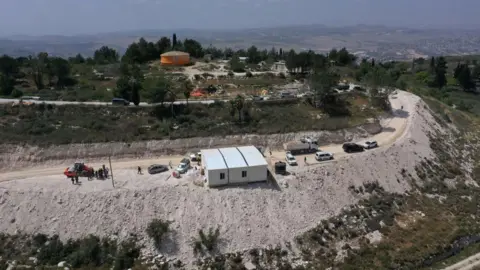
Israeli ministers said the settler outpost at Homesh will be retrospectively legalised (file photo from May 2023)
Israeli ministers say 22 new Jewish settlements have been approved in the occupied West Bank – the biggest expansion in decades.
Several already exist as outposts, built without government authorisation, but will now be made legal under Israeli law. Others are completely new, according to Defence Minister Israel Katz and Finance Minister Bezalel Smotrich.
Settlements – which are widely seen as illegal under international law, though Israel disputes this – are one of the most contentious issues between Israel and the Palestinians.
Katz said the move “prevents the establishment of a Palestinian state that would endanger Israel”, while the Palestinian presidency called it a “dangerous escalation”.
The Israeli anti-settlement watchdog Peace Now called it “the most extensive move of its kind” in more than 30 years and warned that it would “dramatically reshape the West Bank and entrench the occupation even further”.
BBC team’s tense encounter with sanctioned Israeli settler while filming in West Bank
Israeli settlers are seizing Palestinian land under cover of war – they hope permanently
Israel has built about 160 settlements housing some 700,000 Jews since it occupied the West Bank and East Jerusalem – land Palestinians want, along with Gaza, for their hoped-for future state – in the 1967 Middle East war. An estimated 3.3 million Palestinians live alongside them.
Successive Israeli governments have allowed settlements to grow. However, expansion has risen sharply since Prime Minister Benjamin Netanyahu returned to power in late 2022 at the head of a right-wing, pro-settler coalition, as well as the start of the Gaza war, triggered by Hamas’s 7 October 2023 attack on Israel.
On Thursday, Israel Katz and Bezalel Smotrich – an ultranationalist leader and settler who has control over planning in the West Bank – officially confirmed a decision that is believed to have been taken by the government two weeks ago.
A statement said they had approved 22 new settlements, the “renewal of settlement in northern Samaria [northern West Bank], and reinforcement of the eastern axis of the State of Israel”.
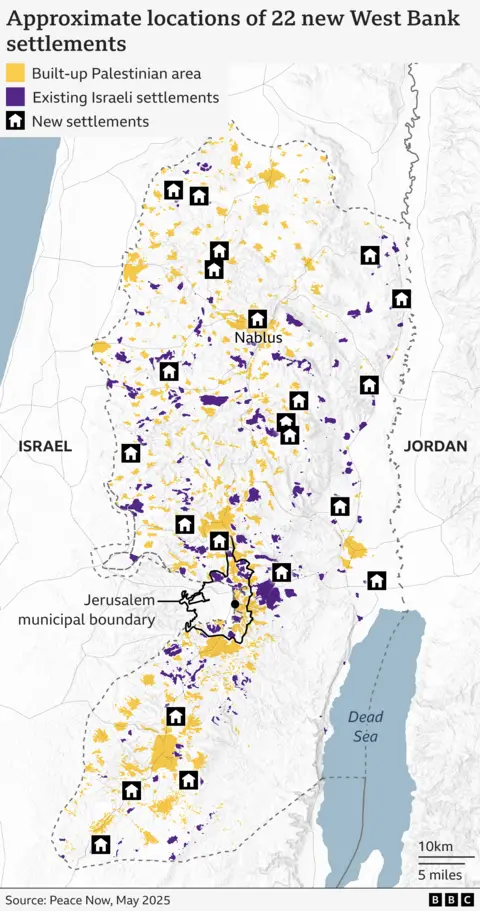
It did not include information about the exact location of the new settlements, but maps being circulated suggest they will be across the length and width of the West Bank.
Katz and Smotrich did highlight what they described as the “historic return” to Homesh and Sa-Nur, two settlements deep in the northern West Bank which were evacuated at the same time as Israel withdrew its troops and settlers from Gaza in 2005.
Nine of the settlements would be completely new, according to the watchdog. They include Mount Ebal, just to the south of Homesh and near the city of Nablus, and Beit Horon North, west of Ramallah, where it said construction had already begun in recent days.
The last of the settlements, Nofei Prat, was currently officially considered a “neighbourhood” of another settlement near East Jerusalem, Kfar Adumim, and would now be recognised as independent, Peace Now added.
Katz said the decision was a “strategic move that prevents the establishment of a Palestinian state that would endanger Israel, and serves as a buffer against our enemies.”
“This is a Zionist, security, and national response – and a clear decision on the future of the country,” he added.
Smotrich called it a “once-in-a-generation decision” and declared: “Next step sovereignty!”
But a spokesperson for Palestinian Authority President Mahmoud Abbas – who governs parts of the West Bank not under full Israeli control – called it a “dangerous escalation” and accused Israel of continuing to drag the region into a “cycle of violence and instability”.
“This extremist Israeli government is trying by all means to prevent the establishment of an independent Palestinian state,” Nabil Abu Rudeineh told Reuters news agency.
Lior Amihai, director of Peace Now, said: “The Israeli government no longer pretends otherwise: the annexation of the occupied territories and expansion of settlements is its central goal.”
Elisha Ben Kimon, an Israeli journalist with the popular Ynet news site who covers the West Bank and settlements, told the BBC’s Newshour programme that 70% to 80% of ministers wanted to declare the formal annexation of the West Bank.
“I think that Israel is a few steps from declaring this area as Israeli territory. They believe that this period will never be coming back, this is one opportunity that they don’t want to slip from their hands – that’s why they’re doing this now,” Mr Ben Kimon told the BBC’s Newshour programme.
Israel effectively annexed East Jerusalem in 1980, in a move not recognised by the vast majority of the international community.
AFP
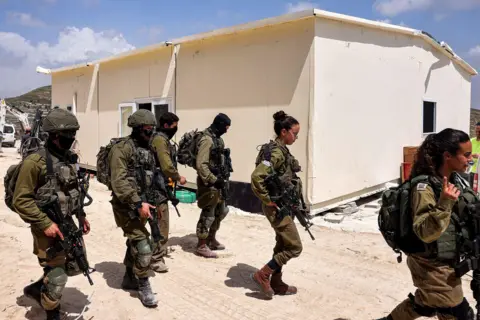
Israeli soldiers accompanied settlers establishing the Homesh outpost in May 2023
This latest step is a blow to renewed efforts to revive momentum on a two-state solution to the decades-old Israel-Palestinian conflict – the internationally approved formula for peace that would see the creation of an independent Palestinian state alongside Israel – with a French-Saudi summit planned at the UN’s headquarters in New York next month.
Jordan’s foreign ministry condemned what it called a “flagrant violation of international law” that “undermines prospects for peace by entrenching the occupation”.
UK Foreign Office Minister Hamish Falconer said the move was “a deliberate obstacle to Palestinian statehood”.
Since taking office, the current Israeli government has decided to establish a total of 49 new settlements and begun the legalisation process for seven unauthorised outposts which will be recognised as “neighbourhoods” of existing settlements, according to Peace Now.
Last year, the UN’s top court issued an advisory opinion that said “Israel’s continued presence in the Occupied Palestinian Territory is unlawful”. The International Court of Justice (ICJ) also said Israeli settlements “have been established and are being maintained in violation of international law”, and that Israel should “evacuate all settlers”.
Netanyahu said at the time that the court had made a “decision of lies” and insisted that “the Jewish people are not occupiers in their own land”.
May 30, 1868 Memorial Day, originally known as Decoration Day, was first observed some say [see May 1, 1865] when two women in Columbus, Mississippi, placed flowers on the graves of Civil War soldiers, both Confederate and Union. War widow Augusta Murdoch Sykes, one of the Columbus planners, pointed out that “after all, they are somebody’s sons.” It is now celebrated to honor all those who have died in America’s wars. “The 30th day of May, 1868, is designated for the purpose of strewing with flowers, or otherwise decorating the graves of comrades who died in defense of their country….” -from an order from the Grand Army of the Republic ========================================================= May 30, 1937 1000 striking steel workers (and members of their families), on their way to picket at the Republic Steel plant in south Chicago where they were organizing a union, were stopped by the Chicago Police. In what became known as the “Memorial Day Massacre,” police shot and killed 10 fleeing workers, wounded 30 more, and beat 55 so badly they required hospitalization. More on the incident Watch a video of oral history with historic footage
May 29, 1932 In the depths of the Great Depression, the “Bonus Expeditionary Force,” a group of 1000 World War I veterans seeking to cash in their veterans’ bonus certificates, arrived in Washington, D.C. Though issued to the veterans in 1924, the certificates were not scheduled to be paid until 1945. By mid-June, the vets had set up a massive “Hooverville,” a contemporary term for an encampment of the homeless. The St. Louis contingent of the Bonus Expeditionary Force is pictured here as it starts for Washington, D.C., in May 1932. One month later, other veteran groups made their way to the nation’s capital, swelling the Bonus Marchers to nearly 20,000 strong, most of them unemployed veterans in difficult financial straits. President Herbert Hoover ordered the Army to clear out the veterans when they resisted being evicted by Washington police. Infantry and cavalry supported by six tanks were dispatched with Chief of Staff General Douglas MacArthur in command. Major Dwight D. Eisenhower served as his liaison with Washington police and Major George Patton led the cavalry. This was a direct violation of the Posse Comitatus Act, which prohibits the armed forces’ being used against U.S. citizens. More on the Bonus Army
May 29, 1965 In one of the first demonstrations promoting equal treatment of homosexuals, Jack Nichols, Barbara Gittings and others picketed in front of the White House. Her sign read, “Sexual preference is irrelevant to federal employment.” More about Barbara Gittings
May 29, 1986 The Christic Institute filed a lawsuit charging U.S. government complicity in an assassination bombing at La Penca, Nicaragua, and that the CIA had a role in smuggling cocaine into the U.S. to fund the Contras, an insurgent military force working to bring down the government of Nicaragua. Find out more about the Christic Institute
May 26, 1647 The first person in America was executed for the crime of witchcraft. Alse Young was arrested, tried in Windsor, Connecticut, and hanged at Meeting House Square in Hartford, the site of what is now the Old State House. There is no further record of Young’s trial or the specifics of the charge — only that she was a woman, as 80% of those executed for witchcraft were. The Salem witch trials would not begin for another 45 years. Some 300 years later the U.S. experienced another “witch hunt” as Senator Joe McCarthy and the House Un-American Activities Committee pursued communists. Arthur Miller makes this comparison in his famous play “The Crucible.” Read more about the play “The Crucible” The Guardian
May 26, 1937 United Auto Workers organizers and Ford Service Department men clashed in a violent confrontation on the Miller Road Overpass outside Gate 4 of the Ford River Rouge Plant in Dearborn, Michigan. It became known as “The Battle of the Overpass.” Henry Ford announced: “We’ll never recognize the United Automobile Workers Union or any other union.” Though General Motors and Chrysler signed collective bargaining agreements with the UAW in 1937, Ford held out until 1942. More background and photos Read more T The Ford Servicemen (goons) approach Walter Reuther and Richard Frankensteen, third and second from right, and the other unionists. UAW official Richard Frankensteen being beaten by Ford goons
May 26, 1946 A patent was filed in the U.S. for the H-Bomb, the hydrogen, or fusion-based, nuclear explosive device.
May 26, 1969 John Lennon and Yoko Ono (along with her 5-year-old daughter Kyoko) held their second Bed-in for Peace at the Queen Elizabeth Hotel in Montreal, Quebec. A late-night rendition of “Give Peace a Chance,” recorded in the hotel room with their visitors singing and accompanying, reached No.14 on the Billboard pop music charts. John and Yoko meet cartoonist Al Capp in their hotel room
May 26, 1972 The Anti-Ballistic Missile (ABM) Treaty was signed by U.S. and U.S.S.R. (Union of Soviet Socialist Republics which included Russia and 15 other republics). The two countries agreed not to build defensive missile systems and thus to limit escalation of the nuclear arms race. It was reasoned that if either side deployed defensive missiles, the other would be forced to respond by increasing the number, explosive yield or effectiveness of their offensive nuclear weapons and delivery systems to maintain the balance of nuclear deterrence. Research and development of defensive systems was allowed under the ABM treaty, the U.S. having spent about $100 billion in the 20 years before the treaty was abrogated by President George W. Bush in the first months of his presidency.
May 26, 1991 20,000 Israeli Jews and Palestinians participated in a peace rally in Israel’s capital, Tel Aviv.
May 25, 1774 A group of African slaves in Massachusetts Bay colony petitioned the British royal governor for freedom as their natural right: “. . . we have in common with all other men a natural right to our freedoms without Being depriv’d of them by our fellow men as we are a freeborn Pepel [people] and have never forfeited this Blessing by aney compact or agreement whatever.”
May 25, 1925 John T. Scopes was indicted for teaching Darwin’s theory of evolution. Scopes, a football coach and substitute high school biology teacher in Dayton, Tennessee, agreed to be arrested and put on trial for teaching evolution. He was challenging the legitimacy of a four-day-old state law barring Darwin’s theory from the public school curriculum. The Scopes “Monkey Trial” ACLU
May 25, 1948 Garry Davis, formerly a member of the U.S. military, renounced his American citizenship to become a Citizen of the World. Davis continued to promote “world citizenship” for over 50 years; 400,000 have, at one time or another, joined the movement. watch trailer “THE WORLD IS MY COUNTRY” Read more about Garry Davis NY Times
May 25, 1963 Leaders of 32 African nations met in Addis Ababa, Ethiopia, to set up the Organization of African Unity (OAU), giving them a united voice for the first time in the continent’s history. The primary aim of the OAU was to end European colonial control in the countries where it still existed at the time: Southern Rhodesia (now Zimbabwe), South Africa, Mozambique and Angola. OAU flag Read more
May 25, 1986 An estimated 7 million Americans participated in Hands Across America, forming a line across the country from Los Angeles to New York to raise public awareness of the issues of hunger and homelessness in the U.S. Participants paid ten dollars [almost $20 in 2009] to reserve their place in line; the proceeds were donated to local charities to feed the hungry and help the homeless.
May 25, 2003 Four activists, members of the Catholic Worker movement and known as “Riverside Ploughshares,” were arrested for pouring blood and hammering on the USS Philippine Sea’s Tomahawk cruise missile hatches. The ship was visiting New York City for the annual “Fleet Week.” “With hammers we have initiated the process of disarming this battle ship, of transforming this carrier of mass destruction into a vessel for peace…” pouring blood and hammering.. Details of the Riverside Ploughshares action
May 24, 1774 The Virginia House of Burgesses declared this a day of “fasting, humiliation and prayer” in reaction to the British closure of the Port of Boston.
May 24, 1906 Dora Montefiore British suffragist Dora Montefiore protested the lack of women’s right to the vote by refusing to pay taxes, and barricading her house against bailiffs sent to collect. Dora Montefiore biography
May 24, 1917 An Anti-Conscription Parade was held in Victoria Square, Montreal, Quebec, in resistance to a Canadian draft to send soldiers to the European war. Riots nearly a year later resulted in the death of four demonstrators in Quebec City. Anti-Conscription Parade, Victoria Square
May 24, 1964 Senator Barry Goldwater (R-Arizona), running for the Republican Party nomination for president, gave an interview in which he said he would consider the use of low-yield atomic bombs in North Vietnam.
May 24, 1968 Four protesters, including Phil Berrigan and Tom Lewis, were sentenced in Baltimore, Maryland, to six years each in prison for pouring blood on draft records.
May 24, 1971 At Fort Bragg, North Carolina, an anti-war newspaper advertisement, signed by 29 U.S. soldiers supporting the Concerned Officers Movement, resulted in controversy. The group had been formed in 1970 in Washington, D.C. by a small group of junior naval officers opposed to the war. The newspaper advertisement at Fort Bragg was in support of the group’s members, who had joined with anti-war activist David Harris and others in San Diego to mobilize opposition to the departure of the carrier USS Constellation for Vietnam. No official action was taken against the military dissidents, though many were forced to resign their commissions. GI resistance to the Vietnam War
May 24, 1981 (since 1981) International Women’s Day for Disarmament was declared, calling for the peaceful resolution of conflict, and an end to the horror and devastation of armed conflict. IFOR’s Women Peacemakers Program
May 24, 1982 More than 200,000 people participated in a massive anti-nuclear demonstration in Tokyo, Japan.
May 24, 2000 Israeli troops completed their withdrawal from southern Lebanon, ending 18 years of occupation. Prime Minister Ehud Barak: “From now on, the government of Lebanon is accountable for what takes place within its territory, and the Lebanese and Syrian governments are responsible for preventing acts of terror or aggression against Israel, which is from today deployed within its borders.”
May 23, 1838 U.S. General Winfield Scott began the forced removal of the Cherokee Indians from North Carolina, Georgia, Alabama, and Tennessee, and their detention in forts built for that purpose. He was implementing the Treaty of New Echota, signed by a few members of the tribe relinquishing their lands for a payment of $5 million, under orders from President Martin VanBuren. 16,000 Cherokee were then driven on foot to “Indian Territory” (what is now Oklahoma). Of those who set out on the forced march known as the “The Trail of Tears,” nearly one-quarter died along the way or as a result of the relocation. Detailed history of the Trail of Tears Cherokee letter protesting the Treaty of New Echota from Chief John Ross
May 23, 1982 10,000 marched in London protesting British Prime Minister Margaret Thatcher’s Falklands War. The Falklands are islands off the coast of Argentina (known there as the Malvinas), and Great Britain was fighting to maintain colonial control over them, which they originally claimed in 1833. an anti-war demonstration in Argentina
May 23, 1982 400,000 demonstrated for peace and disarmament in Tokyo, Japan.
May 23, 1992 Belarus, Kazakhstan and Ukraine, which had inherited strategic nuclear weapons from the Soviet Union, ratified the START I treaty and joined the Nuclear Non-Proliferation Treaty as non-nuclear states. Through the Lisbon Protocol, Belarus, Kazakhstan, Russia and Ukraine became parties to START I as legal successors to the Union of Soviet Socialist Republics. The breakup of the Soviet Union delayed START’s entry into force nearly three-and-a-half years. The Strategic Arms Reduction Treaty (START I)
May 23, 1997 Khatami in 2009 Iranians elected a new president, Mohammad Khatami, with 70% of the vote, over hard-liners in the ruling Muslim clergy. Khatami won largely due to young people and women, who voted for him because he promised to improve the status of women and respond to the demands of the younger generation in Iran. Political situation in Iran before and after Khatami’s election Khatami today
May 23, 2003 Congress passed a third major tax cut proposed by President George W. Bush in his first two years in office: $330 billion. The budget deficit in the following year was the largest ever and a record percentage of the Gross Domestic Product.
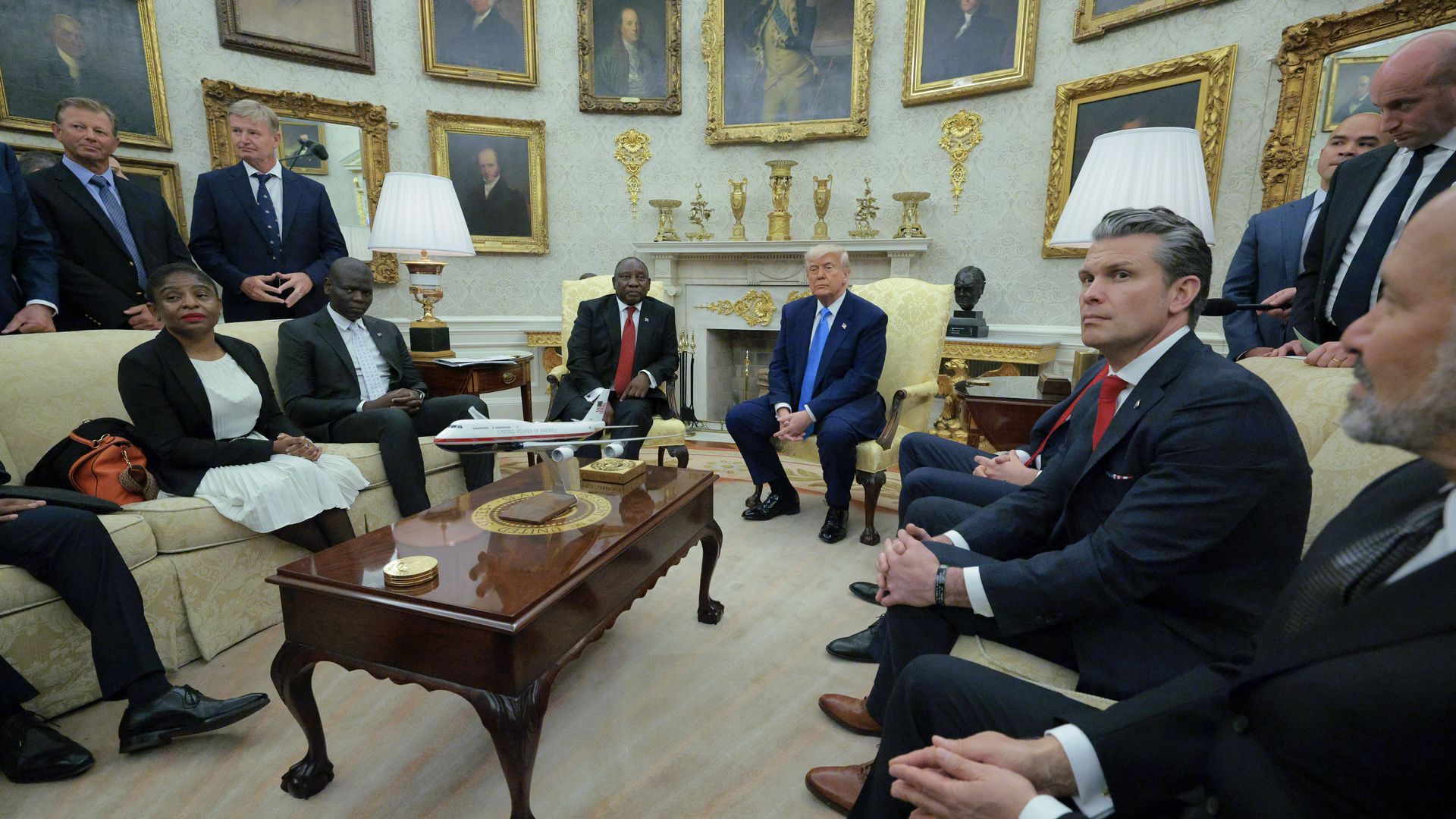
President Cyril Ramaphosa meets with President Trump in the Oval Office on May 21. Photo: Chip Somodevilla/Getty Images
In a shocking moment during President Trump‘s meeting with South African President Cyril Ramaphosa on Wednesday, Trump requested that videos be displayed purporting to show evidence of violence against white people in the country.
The big picture: Trump, who cut all foreign assistance to South Africa, has embraced the false accusations of genocide against white South Africans as justification for granting them refugee status in the U.S.
A South African court in February dismissed claims of a “white genocide” asnot real.
Driving the news: In a stunning scene reminiscent of the Oval Office showdown with Ukrainian President Volodymyr Zelensky, Trump asked for the lights to be dimmed before playing the videos.
While Trump watched the video, Ramaphosa looked away, appearing uncomfortable.
At one point, speaking over the video, Trump said the screen was displaying “burial sites.” Ramaphosa inquired where the scene was located, adding, “This I’ve never seen.”
Later on, Trump paged through articles from the “last few days” while repeating, “death, death, death.”
Catch up quick: In the question that preceded the video display, a reporter asked Trump what it would take for him to be convinced there was no genocide in South Africa — an inquiry Ramaphosa answered.
“It will take President Trump listening to the voices of South Africans,” Ramaphosa said.
Trump jumped in, saying there were “thousands of stories” and “documentaries.”
“It has to be responded to,” he said before the footage began.
Context: The video played in the Oval Office featured the voice of Julius Malema, a firebrand politician and leader of the Economic Freedom Fighters, who was ejected from Parliament.
Ramaphosa clarified that the utterances in the footage were not “government policy,” saying, “We have a multiparty democracy in South Africa that allows people to express themselves.”
South Africa’s Agriculture Minister John Steenhuisen — who is white — reiterated Ramaphosa’s point, emphasizing that the two people in the video are opposition leaders. He said his party, the Democratic Alliance, chose to join forces with Ramaphosa’s “to keep those people out of power.”
Trump interjected, “You do allow them to take land … and then when they take the land, they kill the white farmer, and when they kill the white farmer, nothing happens to them.”
South Africa recently passed the Expropriation Act, which allows the government to take some land and redistribute it as part of a long-running effort to lessen the racial and economic disparities created by apartheid.
Ramaphosa acknowledged there is “criminality” in the country — but said the majority of people killed have been Black people.
Trump claimed the “farmers are not Black” and said, without evidence, that people were being killed “in large numbers” and were decapitated. He repeatedly lashed out at reporters, saying, “The fake news in this country doesn’t talk about that.”
This is a developing story. Please check back for updates.




 T
T


 Scottie's Playtime