As I keep saying this is a small very loud mostly religious driven minority using ever tool and lie they can to change perception of the LGBTQ+ to erase them from society to create the cis straight society they want to force on everyone. We must counter them by being as loud and forceful to not only refute their lies but also promote the joy of living freely as an inclusive society. Hugs
Close-Up of rainbow flag with crowd In background during LGBT Pride Parade. Getty Images.
Ohio lawmakers on both sides of the aisle have introduced several LGBTQ-related bills so far this General Assembly.
Republicans have put forth a drag ban bill, a piece of legislation that would make it harder for a student to use a different name or pronoun at school, and a bill requiring transgender political candidates to list their deadname, among others.
On the other side of the aisle, Democrats have introduced the Ohio Fairness Act and a bill that would ban conversion therapy.
An Ohio court partially overturned a ban on gender-affirming care for LGBTQ youth earlier this year, meaning doctors can still prescribe puberty blockers and hormone therapy.
Anti-LGBTQ bills
Ohio House Bill 249 would ban drag performers from performing anywhere that is not a designated adult entertainment facility. State Reps. Angie King, R-Celina, and Josh Williams, R-Sylvania Twp., introduced the bill, which has had sponsor testimony.
This is a re-introduction of a bill from the previous General Assembly that did not make it out of committee and faced much opposition.
Ohio House Bill 190 would require parental permission for schools to use different pronouns or different names for students that don’t match up with the biological sex or birth name.
Williams and state Rep. Johnathan Newman, R-Troy, introduced the bill, which has had sponsor testimony.
Ohio House Bill 172 would ban children 14 and older from receiving mental health services without parental consent. Newman also introduced this bill, which has had sponsor testimony.
Ohio House Bill 196 would require political candidates to list their former names on candidacy petitions. This, however, would not apply to names that have been changed due to marriage. King and state Reps Rodney Creech, R-West Alexandria, introduced the bill, which has had sponsor testimony.
Ohio House Bill 262 would designate the weeks from Mother’s Day to Father’s Day as Natural Family Month. Williams and state Rep. Beth Lear, R-Galena, introduced the bill, which has had sponsor and opponent testimony.
Pro-LGBTQ bills
Ohio Senate Minority Leader Nickie Antonio, D-Lakewood, has introduced a few bills that support LGBTQ people. Antonio is the only openly gay lawmaker in the Ohio General Assembly.
Ohio Senate Bill 70, also known as the Ohio Fairness Act, would expand anti-discrimination laws to include sexual orientation and gender identity. House Bill 136 is a companion bill.
Antonio has introduced the Ohio Fairness Act in every General Assembly since she was elected to the Ohio House of Representatives in 2011 and this is the first time since 2018 the bill has no Republican support.
Ohio Senate Bill 71 would ban any licensed health professionals from doing conversion therapy when providing mental health treatment to minors. Antonio and state Sen. Beth Liston, D-Dublin, introduced the bill. House Bill 300 is a companion bill.
Ohio Senate Bill 211 would designate the first full week of June as “Love Makes a Family Week.” Antonio introduced this bill as well.
None of these bills have had any hearings so far this General Assembly. Ohio lawmakers are on summer break and will come back to the Statehouse this fall.
I wasn’t an adult in 1972, but it was a relief to me, that there was no more death penalty! Four years later, it was back, and I cannot explain how that happened. My town had a death penalty trial almost immediately. A teacher had access to an execution film; the state was required to keep that on record for a while, whenever anyone sat on Ol’ Sparky; we viewed it before the trial (no one present was on the jury, of course.) It was medieval. And, here we still are in 2025, killing people in the names of everybody who lives here. There are ways to work against it; let me know if there is interest in comments.
July 29, 1970 Signing the contract After a five-year strike, the United Farm Workers (UFW) signed a contract with the table grape growers in California, ending the first grape boycott. Exploring the United Farm Workers’ History
July 29, 1972 The U.S. Supreme Court ruled the death penalty to be cruel and unusual punishment by a 5-4 vote. The Court called the wide discretion in application of capital punishment, including the appearance of racial bias against black defendants, “arbitrary and capricious” and thus in violation of due process guarantees in the 14th Amendment [see July 28, 1868]. Influence of race on imposition of the death penalty
After over 21 months of Israel’s brutal assault on Gaza, the humanitarian crisis in the Strip has reached its worst point yet. 94% of Gaza’s hospitals have been destroyed or damaged. Dozens of children have died from malnutrition. And Israeli troops continue to kill scores of Palestinians as they try to receive food from the so-called “Gaza Humanitarian Foundation.”
In this second part of Zeteo’s live ‘Unshocked,’ Dr. Yasser Khan – a Canadian ophthalmologist and plastic surgeon who has traveled twice to Gaza since October 7, 2023 – describes to Mehdi and Naomi how Israel’s humanitarian assault on Gaza has turned injuries and disabilities in Gaza into, “a death sentence.”
Dr. Yasser Khan: “It was horrific, the most horrific things that I’ve ever seen.”
In the interview, Dr. Khan shares the stories of his many patients, the vast majority of whom he says were women and children.
Dr. Khan also discusses how upon returning from Gaza, many of his colleagues in the medical field refused to believe such stories, with some even going out of their way to tell him that, “‘he’s done nothing to be a hero.’”
Dr. Khan explains how he came to the conclusion that what he was seeing in Gaza was indeed a genocide and why he takes so much inspiration from the people in Gaza. Mehdi, Naomi, and Dr. Khan also take questions from a live audience.
Do consider becoming a paid subscriber so you can get early access to exclusive content like this.
Also, if you are interested in learning more about Israel’s assault on Gaza’s healthcare system, check out Zeteo’s most recently acquired documentary, ‘Gaza: Doctors Under Attack.’
These were the words used by the King Of Belgium recently and every day things are getting worse, as starvation starts to run rampant across the area. And all of this was man made. We cannot be silent about this.
These are difficult and traumatic times and, to help us navigate them, my team and I will be producing a regular stream of books to enable people to better understand the psychology of our leaders and the world around us, as well as ourselves. You can buy these self-help ebooks at http://www.RussellsBooks.com
Also, if you like my videos, please like, subscribe, comment and also JOIN MY NEWSLETTER to stay in touch and up to date with all my content: https://razzaque.short.gy
July 27, 1919 A riot began in Chicago when police refused to arrest a white man who was responsible for the death of a young black man, Eugene Williams. The 29th Street Beach on Lake Michigan was used by both black and white Chicagoans. But the man had been throwing stones at the black boys swimming there before hitting Williams. The Coroner’s report on the riot described the events as follows: “Five days of terrible hate and passion let loose, cost the people of Chicago 38 lives (15 white and 23 colored), wounded and maimed several hundred, destroyed property of untold value, filled thousands with fear, blemished the city and left in its wake fear and apprehension for the future . . . .” The city’s booming economy, especially jobs in the stockyards, had drawn many blacks during the Great Migration from the South, more than doubling their population in just three years. Only one policeman died in the chaos, Patrolman John Simpson, 31, an African American working out of the Wabash Avenue Station. Gangs and the 1919 Chicago Race Riot.
July 27, 1953 After three years of bloody and frustrating war leading to stalemate, the United States, the People’s Republic of China and North Korea agreed to a truce, bringing the Korean War—and America’s first experiment with the Cold War concept of “limited war”—to an end (South Korean President Syngman Rhee opposed the truce and refused to sign). U.S. President Dwight Eisenhower had taken office six months earlier, and Soviet leader Josef Stalin had died that March. Korean War Memorial photo: Heather Stanfield The armistice signed this day ended hostilities and created the 4000-meter-wide (2.5 miles) demilitarized zone (DMZ), a buffer between North and South Korean forces, but was not a permanent peace treaty. It also set up a system for exchanging prisoners of war: 12,000 held by the North, 75,000 by South Korea, the U.S. and the U.N. allied forces. There were four million military and civilian casualties, including 16,000 from countries which were part of the U.N.-allied forces; 415,000 South and 520,000 North Koreans died. There were also an estimated 900,000 Chinese casualties. 36,516 died out of the nearly 1.8 million Americans who served in the conflict.
July 27, 1954 The democratically elected Guatemalan government of Jacobo Arbenz Guzmán, after receiving 65% of the vote, was overthrown by CIA-paid and -trained mercenaries. There followed a series of military dictatorships that waged a genocidal war against the indigenous Mayan Indians and against political opponents into the ’90s. Nearly 200,000 citizens died over the nearly four decades of civil war. “They have used the pretext of anti-communism. The truth is very different. The truth is to be found in the financial interests of the fruit company [United Fruit, which controlled more land than any other individual or group in the country. It also owned the railway, the electric utilities, telegraph, and the country’s only port at Puerto Barrios on the Atlantic coast.] and the other U.S. monopolies which have invested great amounts of money in Latin America and fear that the example of Guatemala would be followed by other Latin countries . . . I took over the presidency with great faith in the democratic system, in liberty and the possibility of achieving economic independence for Guatemala.” Jacobo Arbenz More about Arbenz The real coup story through official U.S. documents
July 27, 1996 Trident sub being loaded Known as the “Weep for Children Plowshares,” four women were arrested for pouring their own blood on weaponry at the Naval Submarine Base at Groton, Connecticut, on the morning of the launch of the last-built Ohio-class submarine, the U.S.S. Louisiana. The 18 such submarines carry about half of the U.S. nuclear deterrent – 24 Trident I & II missiles with a range of 7400 km (4600 miles), each with several warheads known as MIRVs (multiple independently targeted re-entry vehicles). Details of the action
Sayfollah Musallet, a Palestinian-American born in Florida, was visiting family in the West Bank town of Al-Mazra’a ash-Sharqiya when Israeli settlers brutalized him, beating him unconscious and blocking an ambulance from reaching him, according to the victim’s family. The young Palestinian-American was pronounced dead by the time he arrived at a hospital.
And although days have passed since Sayfollah was apparently killed by Israeli settlers, no one from the White House has contacted the family. No one from Congress. No one who represents Florida, where Musallet hails from.
Kamel Musallet, Sayfollah’s father, spoke with Zeteo’s political correspondent Prem Thakker about the lack of accountability from both US and Israeli officials over the ongoing settler violence in the West Bank. “An American has been killed by Israeli violence… Israeli settler terrorism,” Kamel told Prem.
Sayfollah is the seventh American killed by Israeli forces or settlers in the past 21 months. Most US politicians remain conspicuously silent about the widespread violence carried out by Israeli settlers.
This video was released earlier on Zeteo.com, if you want to get earlier access, make sure you subscribe: zeteo.com/subscribe
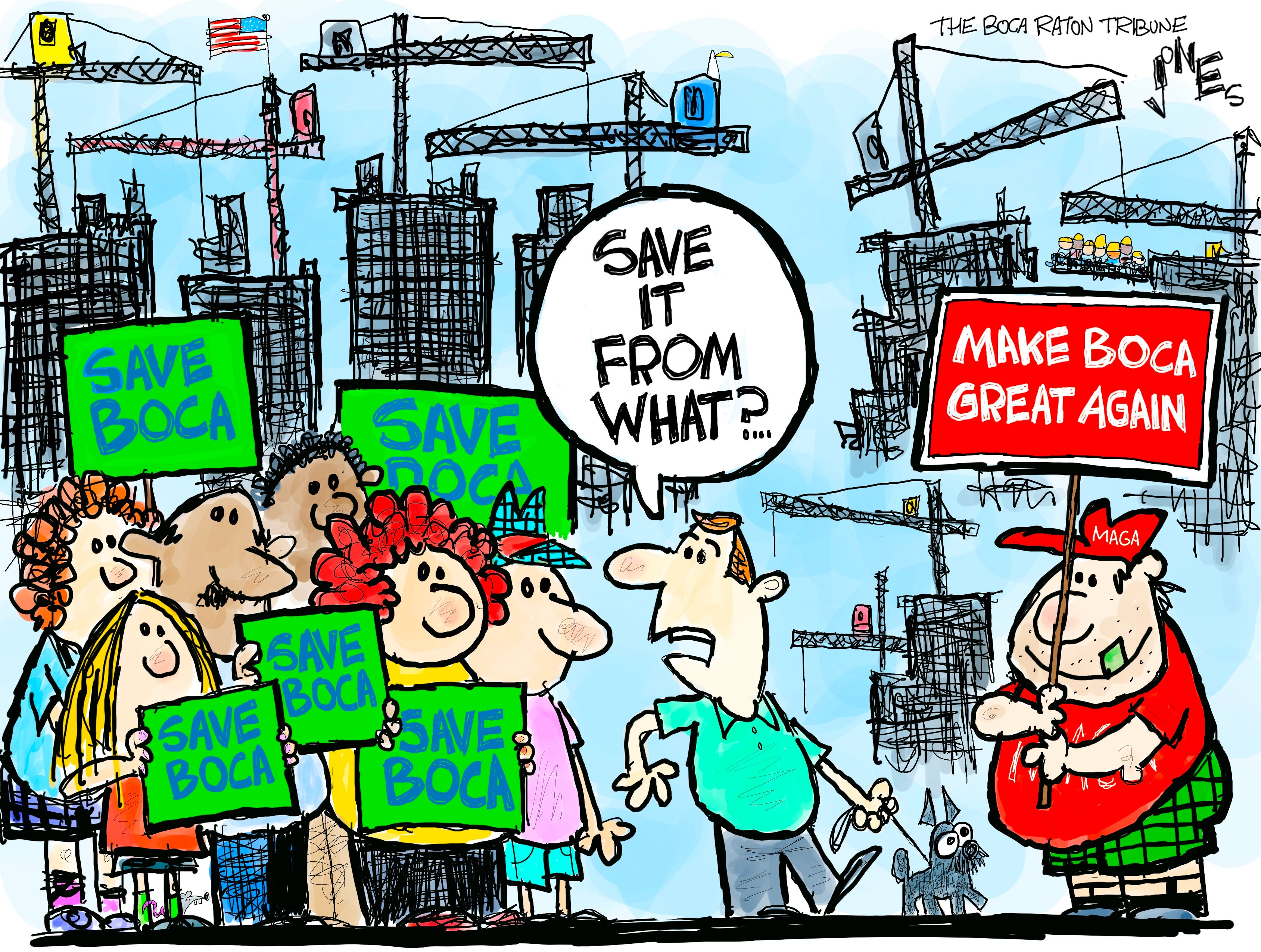
This cartoon was drawn for The Boca Raton Tribune. A group named Save Boca is trying to save the city from overdevelopment…and MAGA “leadership.”
The Boca Raton Tribune is a client of my syndication, and now they want to commission occasional cartoons from me on local issues. They choose the subjects, and I write and draw them. This is our second, with the first being in early July.
The cranes and buildings under construction were the editor’s suggestion. One thing I love about local cartoons is that you can put in local stuff residents will recognize. I do that with a lot of my local cartoons for the FXBG Advance, which is easier for me because I live here. That’s not the case with Boca Rotan, so it’s very helpful when the editor can mention local stuff. (snip)
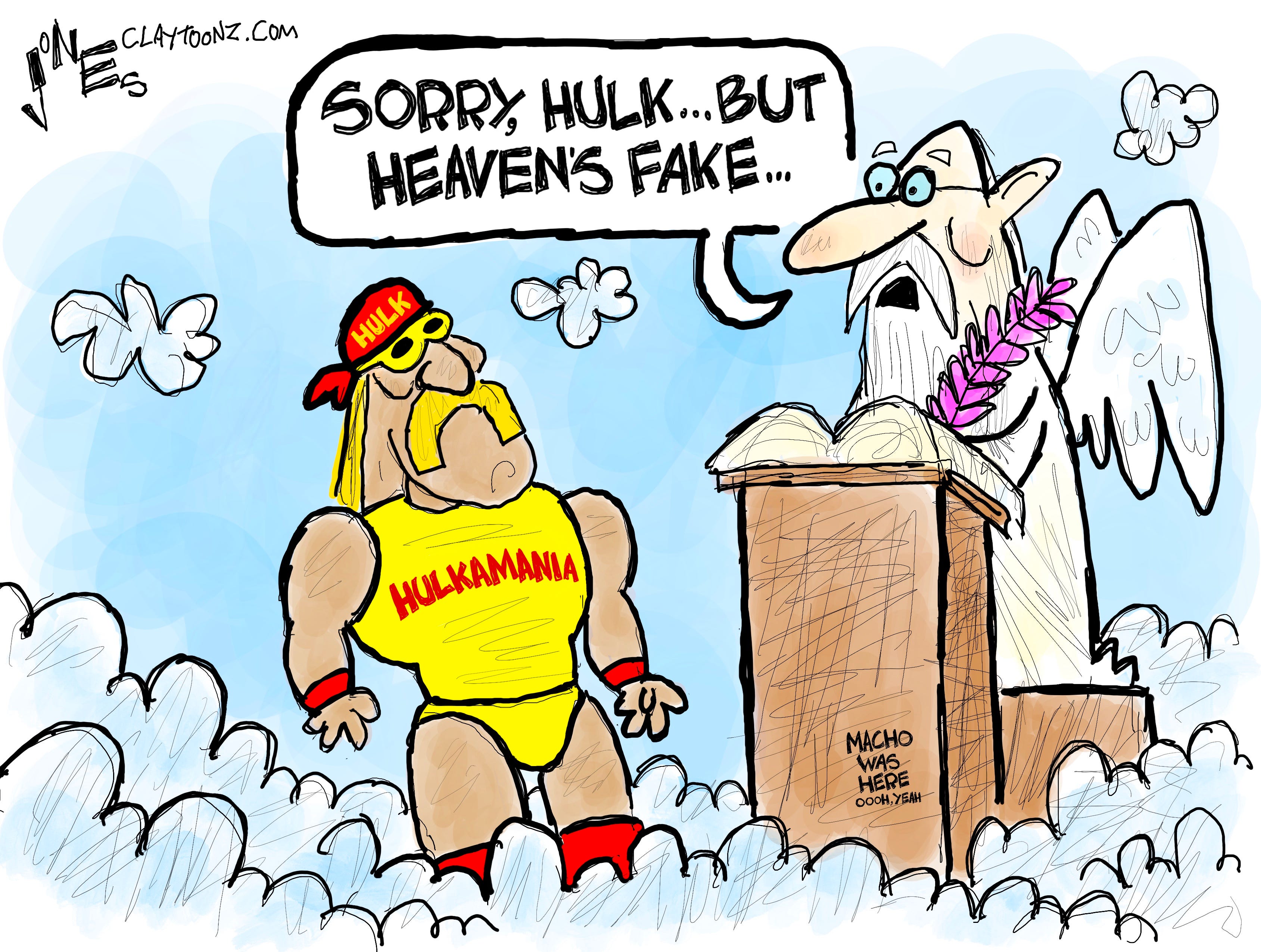
I do not like to draw obit cartoons. I especially don’t like them featuring the Pearly Gates. I bet when editors receive an obit cartoon from me, they get slightly excited because I don’t normally do these things. And I bet that excitement drops real quick after they read the cartoon, because even when I do an obit cartoon, it’s not like other cartoonists’ obit cartoons. It’s not often I give you a Betty White.
Terry Bollea died today at 71. Bollea was Hulk Hogan. Hogan, like Ozzy, wasn’t someone who had a huge impact on me, like Freddy Mercury, Kurt Cobain, Jeff MacNeely, Prince, David Bowie, John Lennon, George Harrison, or Tom Petty. Notice that they’re mostly musicians. Even at the age of 11, Elvis’ death hit me. But sometimes I will draw an obit cartoon for someone just because of how iconic they were.
Ozzy was iconic. Everyone knew who he was, even if they couldn’t name a song of his. His reality show helped a lot with that. Terry Bollea was iconic, too, in that you don’t have to watch professional wrestling to know who Hulk Hogan is. If there is a Mount Rushmore for wrestlers, many fans would put Hogan in George Washington’s spot.
Hogan made wrestling. When the then-WWF (World Wrestling Federation) went national (wrestling used to be territorial), owner Vince McMahon (who is now in deep trouble for sexual assault) needed a babyface (good guy) hero to be the face of the company. And it worked, Hulkamania ran wild across the nation, as Hulk Hogan defended the World Title year after year against bigger and badder bad guys. One problem was that there weren’t that many bad guys physically larger than Hulk Hogan. There was only one Andre the Giant, and most big guys couldn’t wrestle, even enough to match Hogan’s three-move set. They once hired actor Tommy Lister (Deebo from the Friday movies) to have a feud with Hogan, because Lister was huge and had played the hell (bad guy) in a horrible film with Hogan. I didn’t have to see it to know it was horrible. One problem with hiring an actor to wrestle is that actors are not wrestlers. This makes for bad matches.
At Wrestlemania 2, Hulk faced off against King Kong Bundy, who was paid $50,000 for the match, which was half of what Hogan made for the event. Bundy wasn’t mad. He was happy because wrestlers didn’t usually make those kinds of paydays. Hogan was such a star that wrestlers made more money working with/against him. McMahon would sign new guys, not always by promising them titles (he often lied), but with runs with Hogan. This is an estimation, but a wrestler who usually made $1,000 a week could make $10,000 to $50,000 a week if he was working with Hogan. This information comes from wrestlers, but keep in mind that wrestlers are often liars.
Hogan was the hero. He would make his entrance to the song Real American (it’s catchy and annoying) while waving an American flag. He’d tell the kids to “say your prayers and eat your vitamins.” Hogan, despite never losing and being the champ, was always the underdog. Most of the match consisted of Hogan getting his ass kicked, until he hulked up. The villain’s punches would suddenly become ineffective, Hogan would turn around with an angry expression, take a few more punches, then stand straight up and point his finger at the bad guy, like, “YOU!” Then he’d start punching, whip the bad guy off the rope, perform a bodyslam, whip himself off the ropes, do a legdrop on his opponent, and then it was 1, 2, 3 for the pin, and the fans would go crazy. Find the Hogan/Andre match, and you’ll see. I was shocked to look this up to discover it lasted as long as 12 minutes. I’m trying to remember what they did in that match to make it last so long. It’s very slow. It wasn’t technical wrestling, and Hogan did the same routine for every match, but it was storytelling in the ring. Hulk always won….usually.
Hogan was a real-life cartoon. (snip; yes, there is MORE)
I am posting a different article on this kidnapping and disappearing of a long time resident and family man because the right wing media keeps telling us that they are detaining the worst of the worst, only deporting the dangerous criminals. The thug in charge of ICE Tom Homan keeps mumbling that anyone protesting is wanting rapist, arsonists, murders gang drug runners in your neighborhood. This man was a green card holder and a threat to know one. They way that ICE treated his elderly wife was horrific in itself. Hugs
An Immigration and Customs Enforcement (Ice) agent. Photograph: Charly Triballeau/AFP/Getty Images
An 82-year-old man in Pennsylvania was secretly deported to Guatemala after visiting an immigration office last month to replace his lost green card, according to his family, who said they have not heard from him since and were initially told he was dead.
According to Morning Call, which first reported the story, longtime Allentown resident Luis Leon – who was granted political asylum in the US in 1987 after being tortured under the regime of the Chilean dictator Augusto Pinochet – lost his wallet containing the physical card that confirmed his legal residency. So he and his wife booked an appointment to get it replaced.
When he arrived at the office on 20 June, however, he was handcuffed by two Immigration and Customs Enforcement (Ice) officers, who led him away from his wife without explanation, she said. She said she herself was kept in the building for 10 hours until relatives picked her up.
The family said they made efforts to find any information on his whereabouts but learned nothing.
Then, sometime after Leon was detained, a woman purporting to be an immigration lawyer called the family, they said, claiming she could help – but did not disclose how she knew about the case, or where Leon was.
On 9 July, according to Leon’s granddaughter, the same woman called them again, claiming Leon had died.
A week later, however, they discovered from a relative in Chile that Leon was alive after all – but now in a hospital in Guatemala, a country to which he has no connection.
According to Morning Call, the relative said Leon had first been sent to an immigration detention center in Minnesota before being deported to Guatemala – despite not appearing on any Ice detention deportation lists.
Ice on Monday evening denied the Morning Call story, calling it a hoax.
Morning Call claimed it repeatedly requested confirmation and details from Ice throughout its reporting. Morning Call also claimed it was introduced to the family during a Lehigh county courthouse protest over Ice’s operations there.
It noted the family ceased responding to its requests for clarification on Monday.
A recent supreme court decision ruled the Trump administration could deport immigrants to other countries beside their country of origin.
In his nearly 40 years living in the US, Leon spent his career working in a leather manufacturing plant, and raised a family. He had since retired.
He suffers from diabetes, high blood pressure and a heart condition, according to his family, who said they are planning to fly to Guatemala to see him.
An Ice official told the Morning Call it was investigating the matter. The Guatemala Migration Institute denied that Leon was deported from the US to Guatemala.
Morning Call reported on Sunday that Leon was recovering from pneumonia in Guatemala, according to his family, and that he arrived in Guatemala City on 1 July. According to the family, reported Morning Call, his phone was taken away and Ice officers kept referring to him and other detainees as “Mario.”
I really like this scholar. He is not a preacher, he studies the bible for what it is and not what he wants it to be. He doesn’t tell you what to think or believe, he simply explains the texts and passages of the bible explaining what they mean as he does. Hugs