Poetry for An Election

You know what to do to find out more.

Morning After The Election by Regie Cabico

I can’t control
the vanishing
       of bees

       but I can control
the honey I swallow
to soothe
       the vocal cords

I can’t control boys
       bully-tumbling
another boy

in the classroom
       like they’re
in a mosh pit

but I can remember
       rolling on hills
with boys being the bully

I can’t change my major
from drama to global peace

but I can write
similes of serenity

& poetic sermons
in temples
of matrimonial fanfare

I know the bombs, the explosives,
and Molotovs are overhead

and I can’t control 
       the lottery, the multiverses,
and tomorrow’s astrology

but whatever tarot card I pick
       or whatever
   gets thrown
       at my face: 

Hangman
       or Fallen Towers

I can express
my weathering emotions

to sing while hoarse
to control air placement
to find the chakra

the right amount of air
to pass through my throat

oh sing with me
the octave between

blade & nectar
rubble & clouds 
ash & mountain

Copyright © 2024 by Regie Cabico. Originally published in Poem-a-Day on December 30, 2024, by the Academy of American Poets.

‘Shocking’ bodycam video released of New York officers fatally beating prisoner

https://www.nbcnews.com/news/rcna185537

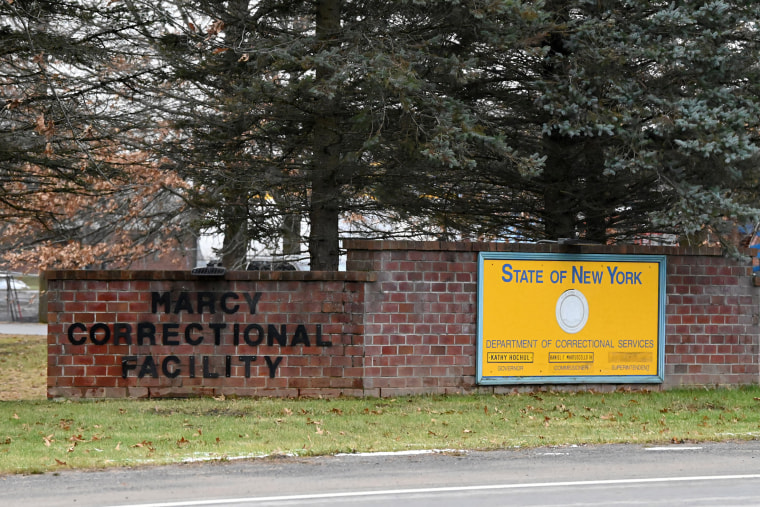
Robert Brooks, 43, died a day after being attacked by several correctional officers at the Marcy Correctional Facility on Dec. 9. His death has prompted a state investigation.
 
***  There is a video at the site linked above that is very informative and shows the man before the police killed him.  ***
 

The office of New York’s attorney general released body camera footage Friday showing the fatal beating of a state prisoner this month by correctional officers who punched and kicked him repeatedly while he was handcuffed on an infirmary bed.

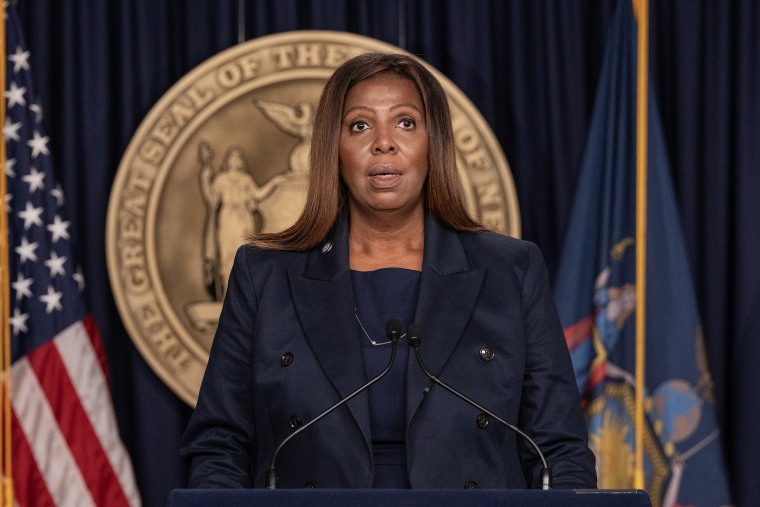
The incident, which has drawn outrage from political leaders and was condemned by the officers’ union as “incomprehensible,” is being investigated by state Attorney General Letitia James. The inmate, Robert Brooks, 43, died in the hospital a day after the Dec. 9 attack.


“I do not take lightly the release of this video, especially in the middle of the holiday season,” James said at a virtual news conference.

“These videos are shocking and disturbing,” she added.

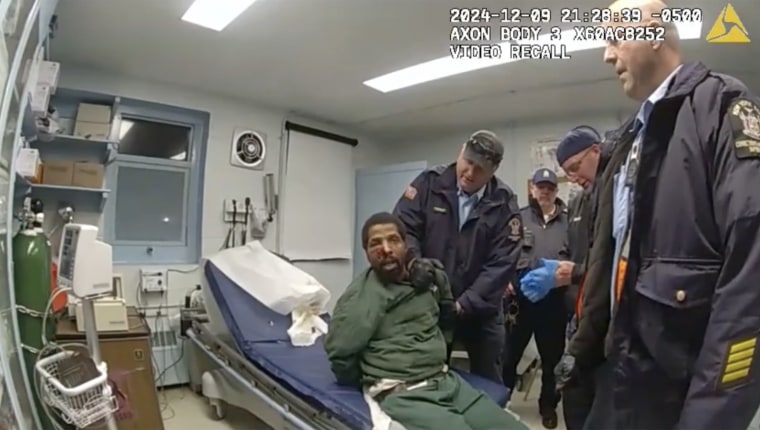
Brooks can be seen in the videos with his hands cuffed behind his back. In one video, he is sitting up as an officer presses his foot down on him. He is then punched by two officers.

At another point, he is forcefully yanked from the bed by his shirt collar and held up above the ground, his face visibly bloodied.

OSI is currently conducting an investigation into the death of Robert Brooks, who died on December 10, 2024 following an encounter with Department of Corrections and Community Supervision officers at Marcy Correctional Facility in Oneida County.
Robert Brooks as seen in body camera footage at the Marcy Correctional Facility in Oneida County, New York, on Dec. 9.Office of the New York State Attorney General

Last week, Gov. Kathy Hochul ordered the state Department of Corrections and Community Supervision to begin the process of firing 14 workers at the Marcy Correctional Facility in Oneida County, where the incident occurred. They include correctional officers, sergeants and a prison nurse. In the interim, all have been suspended without pay, except for one officer, who already resigned. In a statement following the release of the videos, Daniel Martuscello, the commissioner of the state corrections department, said his office has launched its own investigation in an effort to bring “institutional change.”

“Watching the video evidence of Robert Brooks’ life being taken left me feeling deeply repulsed and nauseated,” Martuscello said. “There is no excuse and no rationalization for a vulgar, inhumane act that senselessly took a life. This type of behavior cannot be normalized, and I will not allow it to be within DOCCS.”

Somber News

Former U.S. President Jimmy Carter Passes Away at 100

Dec. 29, 2024

ATLANTA (Dec. 29, 2024) — Jimmy Carter, 39th president of the United States and winner of the 2002 Nobel Peace Prize, died peacefully Sunday, Dec. 29, at his home in Plains, Georgia, surrounded by his family. He was 100, the longest-lived president in U.S. history.

President Carter is survived by his children — Jack, Chip, Jeff, and Amy; 11 grandchildren; and 14 great-grandchildren. He was preceded in death by his beloved wife, Rosalynn, and one grandchild.

“My father was a hero, not only to me but to everyone who believes in peace, human rights, and unselfish love,” said Chip Carter, the former president’s son. “My brothers, sister, and I shared him with the rest of the world through these common beliefs. The world is our family because of the way he brought people together, and we thank you for honoring his memory by continuing to live these shared beliefs.”

There will be public observances in Atlanta and Washington, D.C., followed by a private interment in Plains, Georgia. The final arrangements for President Carter’s state funeral, including all public events and motorcade routes, are still pending. The schedule will be released by the Joint Task Force-National Capital Region at 

www.usstatefuneral.mdw.army.mil.

Members of the public are encouraged to visit the official tribute website to the life of President Carter at www.jimmycartertribute.org. This site includes the official online condolence book as well as print and visual biographical materials commemorating his life.

The Carter family has asked that in lieu of flowers, donations be made to The Carter Center, 453 John Lewis Freedom Parkway N.E., Atlanta, GA 30307.

Letters From An American

December 28, 2024 by Heather Cox Richardson
Read on Substack

On the clear, cold morning of December 29, 1890, on the Pine Ridge Reservation in South Dakota, three U.S. soldiers tried to wrench a valuable Winchester away from a young Lakota man. He refused to give up his hunting weapon. It was the only thing standing between his family and starvation, and he had no faith it would be returned to him as the officer promised: he had watched as soldiers had marked other confiscated valuable weapons for themselves.

As the men struggled, the gun fired into the sky.

Before the echoes died, troops fired a volley that brought down half of the Lakota men and boys the soldiers had captured the night before, as well as a number of soldiers surrounding the Lakotas. The uninjured Lakota men attacked the soldiers with knives, guns they snatched from wounded soldiers, and their fists.

As the men fought hand to hand, the Lakota women who had been hitching their horses to wagons for the day’s travel tried to flee along the nearby road or up a dry ravine behind the camp. Stationed on a slight rise above the camp, soldiers turned rapid-fire mountain guns on them. Then, over the next two hours, troops on horseback hunted down and slaughtered all the Lakotas they could find: about 250 men, women, and children.

Fifteen years ago, I wrote a book about the Wounded Knee Massacre, and what I learned still keeps me up at night. But it is not December 29 that haunts me.

What haunts me is the night of December 28.

On December 28 there was still time to avert the massacre.

In the early afternoon, the Lakota leader Sitanka had urged his people to surrender to the soldiers looking for them. Sitanka was desperately ill with pneumonia, and the people in his band were hungry, underdressed, and exhausted. They were making their way south across South Dakota from their own reservation in the northern part of the state to the Pine Ridge Reservation. There they planned to take shelter with another famous Lakota chief, Red Cloud. His people had done as Sitanka asked, and the soldiers escorted the Lakotas to a camp on South Dakota’s Wounded Knee Creek, inside the boundaries of the Pine Ridge Reservation.

For the soldiers, the surrender of Sitanka’s band marked the end of what they called the Ghost Dance Uprising. It had been a tense month. Troops had pushed into the South Dakota reservations in November, prompting a band of terrified men who had embraced the Ghost Dance religion to gather their wives and children and ride out to the Badlands. But at long last, army officers and negotiators had convinced those Ghost Dancers to go back to Pine Ridge and turn themselves in to authorities before winter hit in earnest.

Sitanka’s people were not part of the Badlands group and, for the most part, were not Ghost Dancers. They had fled from their own northern reservation two weeks before when they learned that officers had murdered the great leader Sitting Bull in his own home. Army officers were anxious to find and corral Sitanka’s missing Lakotas before they carried the news that Sitting Bull had been killed to those who had taken refuge in the Badlands. Army leaders were certain the information would spook the Ghost Dancers and send them flying back to the Badlands. They were determined to make sure the two bands did not meet.

But South Dakota is a big state, and it was not until late in the afternoon of December 28 that the soldiers finally made contact with Sitanka’s band. The encounter didn’t go quite as the officers planned: a group of soldiers were watering their horses in a stream when some of the traveling Lakotas surprised them. The Lakotas let the soldiers go, and the men promptly reported to their officers, who marched on the Lakotas as if they were going to war. Sitanka, who had always gotten along well with army officers, assured the commander that the band was on its way to Pine Ridge and asked his men to surrender unconditionally. They did.

By this time, Sitanka was so ill he couldn’t sit up and his nose was dripping blood. Soldiers lifted him into an army ambulance—an old wagon—for the trip to the Wounded Knee camp. His ragtag band followed behind. Once there, the soldiers gave the Lakotas an evening ration and lent army tents to those who wanted them. Then the soldiers settled into guarding the camp.

And the soldiers celebrated, for they saw themselves as heroes of a great war, and it had been bloodless, and now, with the Lakotas’ surrender, they would be demobilized back to their home bases before the South Dakota winter closed in. As they celebrated, more and more troops poured in. It had been a long hunt across South Dakota for Sitanka and his band, and officers were determined the group would not escape them again.

In came the Seventh Cavalry, whose men had not forgotten that their former leader George Armstrong Custer had been killed by a band of Lakota in 1876. In came three mountain guns, which the soldiers trained on the Indian encampment from a slight rise above the camp.

For their part, the Lakotas were frightened. If their surrender was welcome and they were going to go with the soldiers to Red Cloud at Pine Ridge, as they had planned all along, why were there so many soldiers, with so many guns?

On this day and hour in 1890, in the cold and dark of a South Dakota December night, there were soldiers drinking, singing, and visiting with each other, and anxious Lakotas either talking to each other in low voices or trying to sleep. No one knew what the next day would bring, but no one expected what was going to happen.

One of the curses of history is that we cannot go back and change the course leading to disasters, no matter how much we might wish to. The past has its own terrible inevitability.

But it is never too late to change the future.

—

Note:

Every year on this date, I post the story of the Wounded Knee Massacre.

My book about that event was so hard to write I had to take a long break in the middle of it. When you write a book, you get to know your characters as if they were family. Sometimes you love them and sometimes you don’t, but they become part of you. As the massacre drew inexorably closer, I wrote about the scenery, plant life, and animals of the Plains as a distraction from what I knew was coming.

But it came anyway. Even after all these years, I still have a hard time on the date of the massacre.

In an interview this year, someone asked me why I write as if I am running out of time, and it hit me that I write these letters because no matter how hard I tried, I could not stop the Wounded Knee Massacre.

But maybe I can help to stop the next one.

More Peace & Justice History for 12/29

December 29, 1890
The U.S. Army killed approximately 300 Miniconju Sioux (another of the Teton Sioux tribes). They had fled after the murder of Sitting Bull and sought refuge on the Oglala reservation of Pine Ridge at Wounded Knee, in the new state of South Dakota.
The 7th Cavalry (Custer’s old command) fired their artillery amidst mostly unarmed women, children, and fleeing men. The Wounded Knee Massacre was the final major military battle in the genocide against Native Americans. 18 soldiers received Congressional Medals of Honor for their “bravery.”
Encroaching white settlement after gold was found in 1874 on Sioux lands led to conflicts.


The Great Sioux Agreement of 1889 established reservations for the native inhabitants and encouraged further white settlement on Indian land. 
December 29, 1996
War-weary guerrilla and government leaders in Guatemala signed an accord ending 36 years of civil conflict.
What was the conflict all about? 

True Facts: Rays, The Floppy Sombreros of the Sea

Peace & Justice History for 12/26

December 26, 1862
38 members of the Santee Sioux tribe were hanged in a public mass execution in Minnesota. 300 members of the band had been convicted of participating the the Minnesota Uprising and ordered to hang. However, all sentences except the 38 had been commuted by President Abraham Lincoln.
For decades white settlers had been encroaching on Santee Sioux territory, and they had been victimized by corrupt federal Indian agents on the reservations.In July agents and contractors had withheld food when their demands for kickbacks had been refused. The Indians eventually struck back, killing Anglo settlers and taking some hostages. In two battles with the U.S. Army, they killed or wounded dozens of soldiers, but ultimately lost and were put on trial.


America’s only legal mass execution
===========================================
December 26, 1966

The first Kwanzaa was celebrated in Los Angeles, California. It was conceived and organized in the wake of the Watts riots by Dr. Maulana (Ron) Karenga, a professor and chairman of Black Studies at California State University at Long Beach. Kwanzaa is a non-religious African-American holiday focusing on family, community, and culture.The name Kwanzaa is derived from the phrase “matunda ya kwanza,” which means “first fruits” in Swahili. The celebrations are expressed through song, dance, drumming, storytelling, poetry and the lighting of candles in a Kinara, all followed by a large traditional meal. The holiday is observed for seven days, each representing a different principle:

a Kwanzaa Kinara
• Umoja (oo-MO-jah) Unity
• Kujichagulia (koo-gee-cha-goo-LEE-yah) Self-Determination
• Ujima (oo-GEE-mah) Collective Work and Responsibility
• Ujamaa (oo-JAH-mah) Cooperative economics
• Nia (NEE-yah) Purpose
• Kuumba (koo-OOM-bah) Creativity
• Imani (ee-MAH-nee) Faith

Ron Karenga lighting the Kinara
History, Principles, and Symbols of Kwanzaa 
============================================
December 26, 1971


Two dozen members of Vietnam Veterans Against the War “liberated” the Statue of Liberty with a sit-in to protest resumed U.S. aerial bombings in Vietnam. They flew an inverted U.S. flag from the crown as a signal of distress.
more on this action 
=============================================
December 26, 1992

photo: Simran Sachdev Belgrade, 7.2009
Women In Black began campaign against rape during war, Belgrade, Serbia.
WIB website 
Women in Black is a world-wide network of women committed to peace with justice and actively opposed to injustice, war, militarism and
other forms of violence.

================================================
December 26, 1999

Alfonso Portillo Cabrera scored a resounding victory (nearly 70% of the vote in the second round) in Guatemala’s first peacetime presidential elections following a 36-year civil war.

Alfonso Portillo Cabrera after his election
Some perspective 

https://www.peacebuttons.info/E-News/peacehistorydecember.htm#december26

More cult of tRump maga hate, bigotry, and stupid. They specialize in it.

(whew!) “Biden Denies Trump The Joy Of Killing 37 People”

(I posted about this earlier, there is success, so I’m posting a funny-serious one about it. Sometimes we win when we step up. -A)

He commuted the death sentences of 37 of 40 federal death row prisoners.

Robyn Pennacchia

One thing we know Trump was for sure looking forward to for his second term was getting to kill more federal death row prisoners. During the last months of his first term, he went on a full-on killing spree, with his administration carrying out 13 federal executions after a 17-year hiatus.

To put things into perspective, of the 13 prisoners executed prior to his administration, two of them were Julius and Ethel Rosenberg. Only 37 federal death row prisoners were executed between 1927 and 2019, so 13 in six months was quite the bloodbath.

Alas, his dreams have been dashed, for President Joe Biden has announced that he will commute the death sentences for nearly all of the prisoners on federal death row.

“Today, I am commuting the sentences of 37 of the 40 individuals on federal death row to life sentences without the possibility of parole,” Biden said in a statement released Monday morning.

“Make no mistake: I condemn these murderers, grieve for the victims of their despicable acts, and ache for all the families who have suffered unimaginable and irreparable loss,” he continued. “But guided by my conscience and my experience as a public defender, chairman of the Senate Judiciary Committee, Vice President, and now President, I am more convinced than ever that we must stop the use of the death penalty at the federal level. In good conscience, I cannot stand back and let a new administration resume executions that I halted.”

It’s unlikely that this was simply meant to bust Trump’s balls and make him sad — Biden had pledged to “work to pass legislation to eliminate the death penalty at the federal level, and incentivize states to follow the federal government’s example” in his 2020 campaign.

The three prisoners whose sentences will not be commuted are those who committed crimes related to terrorism and hate-motivated mass murders — Dylann Roof, the white supremacist who killed nine people and injured one in a Charleston, South Carolina, church in 2015; Dzhokhar Tsarnaev, one of the two brothers responsible for the Boston Marathon bombing in 2013 (his brother, Tamerlan Tsarnaev, was killed in a shootout with police after the attack); and Robert Bowers, who killed 11 people at the Tree of Life Synagogue in Pittsburgh, Pennsylvania, in 2018.

The other prisoners were given their federal death sentences for far lesser crimes, like killing prison guards or drug trafficking-related murders.

It’s certainly nice to get this news after Biden’s 1,500 commutations of federal prisoners failed to include political prisoners like Leonard Peltier or Mumia Abu-Jamal and did include the kids-for-cash judge. It’s also nice to see, considering the fact that the DNC removed opposition to the death penalty from its platform after eight years of including it. Hopefully we can get back on that one, given the fervor with which Republican governors have pursued the executions of people who were almost definitely innocent in the last few years.

Anti-death penalty advocates, including Martin Luther King III, Sister Simone Campbell, Rev. Ralph McCloud, and exoneree Herman Lindsey made a video thanking President Biden for taking this step.

“President Biden has shown our country – and the rest of the world – that the brutal and inhumane policies of our past do not belong in our future,” Anthony D. Romero, executive director of the ACLU said in a statement. “By commuting 37 federal death row sentences, he has paved the way for other elected officials to build on his legacy of racial justice, humanity and morality by commuting state death rows and passing legislation to abolish capital punishment.”

“Biden has commuted almost all federal death row. This is indeed a good day to do the Lord’s work,” Sister Helen Prejean wrote on Bluesky. I’m thankful to so many religious leaders and justice advocates who helped make this possible. I pray for victims’ families, knowing that wishing for death is not a healing course.”

Personally, as horrible as their crimes were, and as hard of a decision as it would have been, I still think he should have commuted the sentences of all of the prisoners, simply because — to quote a bumper sticker — I don’t believe we should kill people who kill people to show people that killing people is wrong. Also there is evidence that Dzhokhar Tsarnaev was unduly influenced by his brother and also afraid he might kill him if he didn’t go along with his plan, and that the jury was biased against him. (Which would be entirely understandable given that they were all from the Boston area, but also technically unfair.) Family members of those who were killed in the Charleston church shooting have said for years that they don’t want Roof executed, and as loathsome as he is, that ought to be taken into consideration. Two of the families who lost loved ones in the Tree of Life shooting, and the rabbi who was shot himself also asked for Bowers to get a life sentence, due to their opposition to the death penalty. One of the many injustices of the death penalty is that it puts those who oppose it in the position, occasionally, of having to ask for leniency for those who hurt them or have killed their loved ones.

But, you know, optics.

In any case, this is a great day for those of us who oppose the death penalty, and for all Americans who may not oppose it but still do not deserve to be hardened by its application.

Peace & Justice History for 12/23

December 23, 1943
A 135-day strike by 23 conscientious objectors (COs) ended dining hall segregation at Danbury Federal Penitentiary in Connecticut.
The number of conscientious objectors had increased from 15 in early 1941 to 200 by the time of the strike.
December 23, 1944
General Dwight Eisenhower endorsed the finding of a court-martial in the case of Eddie Slovik, who was tried for desertion, and authorized his execution. It was the first such sentence against a U.S. Army soldier since the Civil War, and Slovik was the only man so punished during World War II.
He made no secret of his unwillingness to enter combat, but his pleas to be reassigned to noncombat status were rejected.
Eisenhower ordered that Slovik’s execution be carried out to avoid further desertions in the late stages of the war.


Eddie Slovik
Read more 
December 23, 1946
University of Tennessee refused to play Duquesne University, because they might have used a black player, Chuck Cooper, in the basketball game [see July 14, 1887].
Cooper went on to be drafted (the first black player ever) by the Boston Celtics, playing his first NBA game on the same day as the debut of head coach Red Auerbach, guard Bob Cousy, and center “Easy” Ed Macauley.


Chuck Cooper, graduate of Duquesne University
December 23, 1961

James Davis
James Davis of Livingston, Tennessee, was killed by the Viet Cong, the insurgents in South Vietnam, and became the first of some 58,000 U.S. soldiers killed during the Vietnam War.
Lyndon Johnson later referred to him as “the first American to fall in defense of our freedom in Vietnam.”
Over two million Vietnamese would die before the end of the war.

https://www.peacebuttons.info/E-News/peacehistorydecember.htm#december23